The Mustad 3576 L is a mid-twentieth-century saltwater bait hook produced in Oslo, Norway, under the Key Brand trademark. Marketed as the Bridgeport Snapper Hook, this model exemplifies Mustad’s strategy of reverse-engineering regional American fishing patterns for global export—in this case, targeting the bluefish and striped bass fisheries of Long Island Sound and Connecticut’s coastal waters.
The defining feature of the 3576 L is its exceptional shank length of 3.5 inches combined with a relatively modest gap of approximately 0.39 inches. In the pre-wire-leader era of the 1950s–1960s, this extreme length-to-gap ratio served a critical functional purpose: the long shank acted as a built-in bite guard, keeping the fish’s razor-sharp teeth away from the angler’s vulnerable linen or early monofilament line. This design reflects a period when hook engineering was highly specialized for precise environmental and tactical conditions rather than homogenized for universal use.
The specimen shown carries a tinned finish (electroplated tin coating) and a straight ball eye, both standard specifications for inshore saltwater applications where corrosion resistance was paramount. The Superior point designation (near-straight inner taper) indicates moderate penetration requirements rather than specialized delicacy or extreme durability.
Dating evidence is strong: the blue-paper label with decorative snowflake border, the Key Brand logo, the printed Oslo address (as opposed to the pre-1925 Christiania designation), and the absence of any barcode place this hook firmly in the 1950–1965 window, representing Mustad’s dominance during the post-war boom in American recreational saltwater fishing.
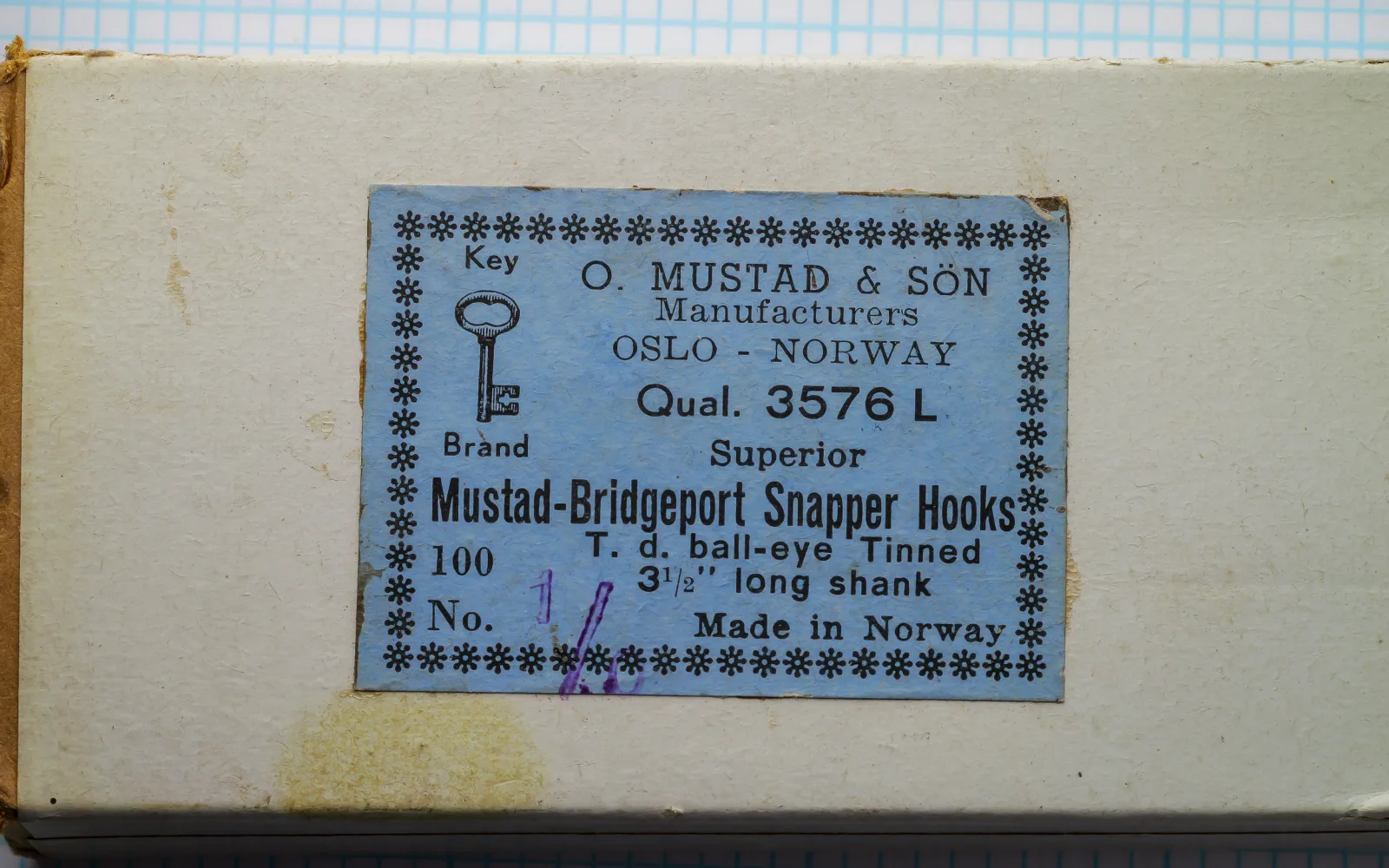
Original packaging label for Mustad 3576 L Superior Bridgeport Snapper Hooks, tinned finish, 3½" long shank, 100-count box.
Photographic record
3 cataloged imagesSelect any record to load it above.
3 images shown
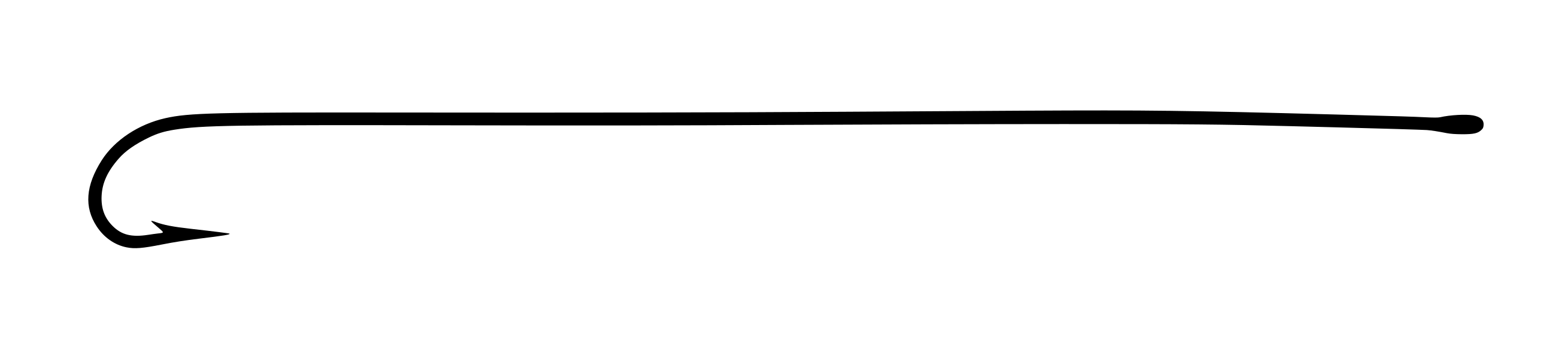
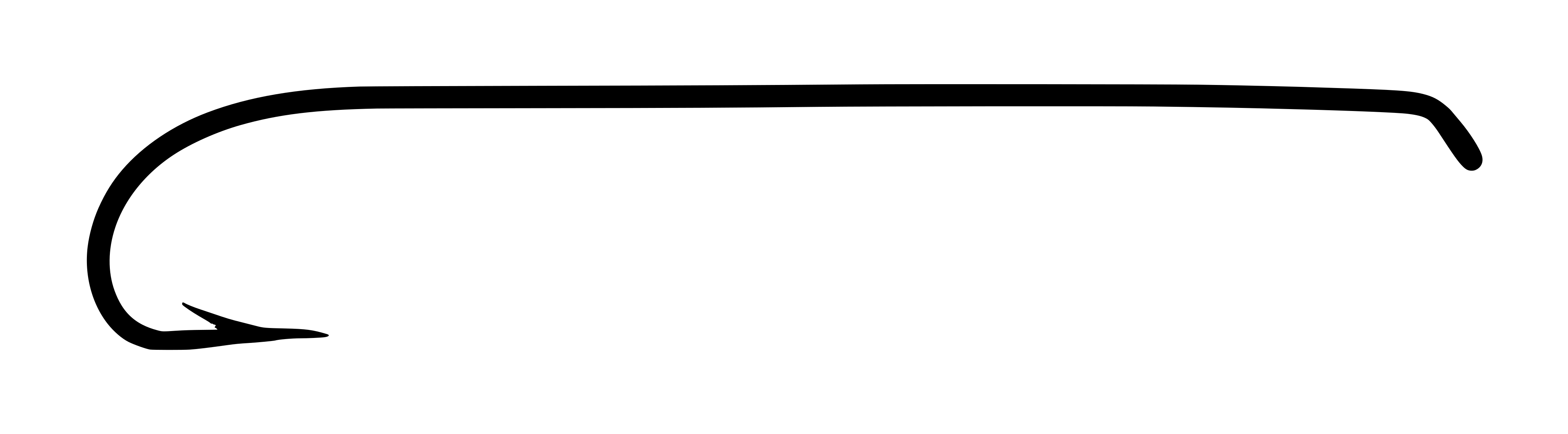
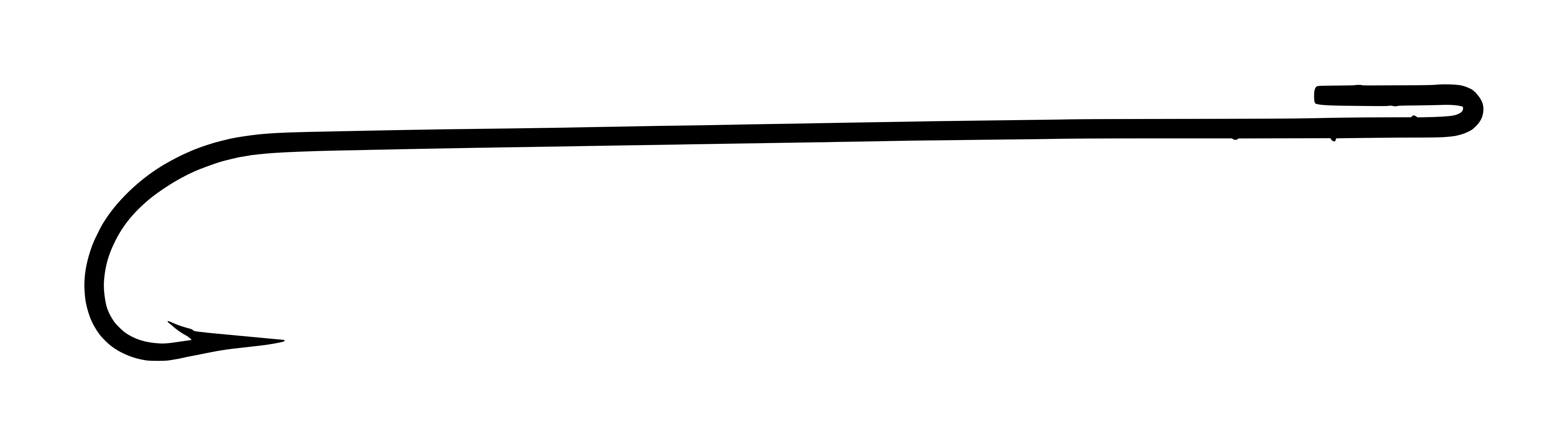
Mustad 3576 L Box LabelOriginal packaging label for Mustad 3576 L Superior Bridgeport Snapper Hooks, tinned finish, 3½" long shank, 100-count box.Open originalMustad 3576 L Hook ProfileProfile view of the 3576 L showing the Carlisle bend family structure and straight point alignment.Open originalMustad 3576 L Pair, Actual SizeTwo examples of the 3576 L demonstrating consistent long-shank proportions and ball-eye construction.Open original
Technical profile
Eye
Ball Eye, Turned DownStraight ball eye with clean wire curvature and minimal taper; the wire forms a uniform loop without the tapered wire reduction seen on premium dry-fly hooks. The ball is well-formed and sits square to the shank axis, typical of mid-tier saltwater production standards. P
Wire
Fine (1X Fine), Round, Est. ~0.040"-0.045" (~1.0-1.1 mm)
Shank
Extra-Extra Long (XXL) — Plain
Bend
carlisle, Narrow gap, Offset / kirbedClassic Aberdeen bend geometry—a smooth, continuous rounded curve with no angular components. The bend is relatively deep (approximately 0.45–0.50 inches) proportional to the gap width, creating a parabolic profile suited to holding firm and resisting straightening under load. No visible offset or kirb. P
Point
Superior (near-straight inner taper)Standard short, close-cut barb positioned at approximately 45 degrees to the shank axis. Barb size is moderate—not a small microbarb nor an exaggerated sweeping barb. Barb cut is clean and precise, consistent with high-speed automated machine forging. P
Finish
Tinned — Confirmed (stated on packaging)Tinned finish with a bright, cold silver tone. The specimen shows uniform tin plating across the visible surfaces with no obvious wear spots, oxidation, or patina development, suggesting careful storage or recent preservation. The tin coating appears slightly darker in recessed areas (barb region, bend apex) due to accumulated dust or light oxidation accumulation. P
Both specimen hooks are bright and show no active corrosion despite age. The original blue paper label shows light to moderate toning and edge wear consistent with 60–75 years of storage. One handwritten annotation in purple/magenta ink (appears to be '1/0' or size verification) is visible on the label. The card stock is intact with no tears or major creasing.
The Superior point geometry on the 3576 L represents a near-straight inner taper that concentrates penetration force efficiently at the tip while maintaining structural strength throughout the point and barb region. Unlike a hollow point (which features a concave, dished-out outer cut for minimal penetration resistance), the Superior point balances delicate initial entry with durability when encountering harder tissues or accidental contact with shells or rocks in shallow estuarine environments.
The tinned finish—achieved through electroplating or hot-dipping the high-carbon steel in molten tin—provides exceptional resistance to the highly corrosive effects of saltwater and dissolved minerals in brackish estuaries. Tin was the industry standard for commercial marine hooks long before the widespread adoption of marine-grade stainless steel in the 1980s–1990s, as it offered a dramatic improvement in corrosion resistance without the cost penalties of stainless metallurgy.
The extreme shank length (3.5 inches) was engineered not merely for aesthetic or fly-tying purposes but as functional defensive architecture: it physically prevents a toothy fish from swallowing the bait deeply or reaching the vulnerable knot and line connection at the eye. This was critical in an era when affordable wire leaders were not standard and when most fishing lines were either linen (highly abrasion-prone) or early monofilament (notch-sensitive and prone to failure when nicked by fish teeth). The long shank absorbed the kinetic energy of violent head-shakes, distributing the stress across a longer lever rather than concentrating all load at the bend and eye junction.
The Mustad 3576 L holds the record in the garrenwood.com catalog for the longest shank-to-gap ratio among documented saltwater bait hooks (approximately 9:1). This extreme proportion is not exceeded by any other single-hook design in the current collection and represents a specialized, transitional design philosophy that anticipated the modern wire-leader bite guard.
Own this hook? Help us measure it.
We have measurement for size 1/0. Know any others? Submit calipered measurements and we'll review and add them. Thank you!
Historical context
mustad
O. Mustad & Søn was founded in 1832 in Gjøvik, Norway, originally under the name Brusveen Spiger- og Staltradfabrikk, specializing in basic metal goods including nails and steel wire. The company was acquired by Ole Hovelsen Mustad and his son Hans Mustad, who rebranded it as O. Mustad & Søn. The pivotal moment came in 1877 when Mathias Topp, a visionary within the company, invented the first fully automated hook-making machine. This mechanization allowed raw steel wire to be continuously fed, cut, bent, barbed, and pointed at unprecedented scale. Rather than filing patents—which would have required public disclosure of the mechanical schematics—the Mustad family relied on intense corporate secrecy and restricted factory access to protect their proprietary technology. This strategy proved devastatingly effective against rivals in Redditch, England, and manufacturing hubs across Japan and the United States. By the 1950s, Mustad had secured approximately 50 percent of global hook production, operating sales offices and manufacturing facilities across multiple continents.
Series History
The Mustad 3576 L belongs to Mustad’s mid-tier product catalog (Quality codes in the 3000–3999 range), representing the company’s deliberate strategy of industrial ‘cloning’—reverse-engineering highly localized, regional hook patterns and producing them with Norwegian manufacturing efficiency for global distribution. The Bridgeport Snapper pattern is a distinctly American regional design, likely originating from blacksmiths or local craftsmen serving the Connecticut and New York coastal bluefish fisheries. The ‘Snapper’ designation traditionally refers to juvenile bluefish (Snapper Blues), which are voracious predators with razor-sharp teeth and hard mouths.
The 3576 L’s extreme shank length (3.5 inches) was specifically engineered to serve as a physical barrier—a built-in ‘bite guard’—protecting vulnerable fishing lines in an era before cost-effective wire leaders or fluorocarbon became standard. The wide gape (relative to the shank) accommodates chunked or live bait presentations typical of bluefish and striped bass fishing.
This pattern appears to have been discontinued by the 1980s as modern tackle materials (stainless steel, fluorocarbon leaders, non-corroding synthetics) rendered the long-shank bite guard unnecessary. The model survives today primarily as a collector’s piece and in niche fly-tying applications where the length, tinned finish, and traditional ball eye hold aesthetic and functional appeal for streamer patterns and long-bait rigs.
Era and Packaging Dating
Multiple packaging indicators support a 1950–1965 production window: (1) The geographic designation reads 'OSLO - NORWAY,' confirming post-1925 manufacture (Christiania was renamed Oslo on January 1, 1925). (2) The blue paper label with decorative snowflake border and the Key Brand downward-pointing skeleton key logo are emblematic of Mustad's mid-century export packaging before the transition to plastic blister packs in the 1970s–80s. (3) No Universal Product Code (UPC) barcode is present, strongly indicating pre-1974 manufacture. (4) The label text is printed via offset lithography rather than letterpress, consistent with post-1940 printing technology. (5) The specification notation style ('T. d. ball-eye,' 'Qual.' code format) matches documented Mustad label conventions from the 1950s–1960s. (6) The handwritten size annotation in ballpoint or fiber-tip pen suggests early post-war inventory marking practices. The cumulative evidence places this specimen in the 1950–1965 window, most likely the early-to-mid 1950s.
The Terror of Long Island Sound
The 'Snapper' designation in 'Bridgeport Snapper Hooks' refers to juvenile bluefish—aggressive, fearless predators that will attack nearly anything in the water, including hooks, tackle, and each other. Bluefish were so abundant in Connecticut and Long Island Sound during the 1950s–1960s that recreational fishing for 'snappers' was a rite of passage for East Coast anglers. A single 'snap' fishing excursion could yield dozens of fish. The Bridgeport Snapper hook was specifically engineered to handle the violent, erratic strikes and razor-sharp teeth of these juveniles, making it one of the most specialized regional patterns Mustad manufactured for the American market.
Design lineage and influence
The Bridgeport Snapper pattern appears to be a regional American design—likely originating from blacksmiths or tackle craftsmen in Connecticut or Long Island—serving the specialized demands of Northeast coastal bluefish and striped bass fisheries. Mustad’s aggressive reverse-engineering strategy capitalized on these localized patterns by incorporating them into their global catalog under brand names that retained geographic or functional identity.
The extraordinarily long shank is a predecessor concept to the modern wire-leader bite guard and the modern circle hook’s snag-resistant geometry. In effect, the Bridgeport Snapper’s long shank anticipated the functional purpose that would later be served by wire leaders and fluorocarbon, making it a transitional design that bridges hand-forged regional tackle traditions and industrially scaled, specialized manufacturing.
Modern descendants include long-shank streamer hooks (such as the Mustad 34011 and various Tiemco extra-long models), which retained the shank length for fly-tying purposes but lost the defensive bite-guard function once wire leaders became affordable and ubiquitous. Some modern saltwater bait hooks retain the wide gape and tinned finish but with more modest shank lengths (e.g., the Mustad O’Shaughnessy series), prioritizing brute strength over length-based tooth protection.
Best matchRelated by Attribute
Computed automatically from catalog data — updated as new hooks are added.
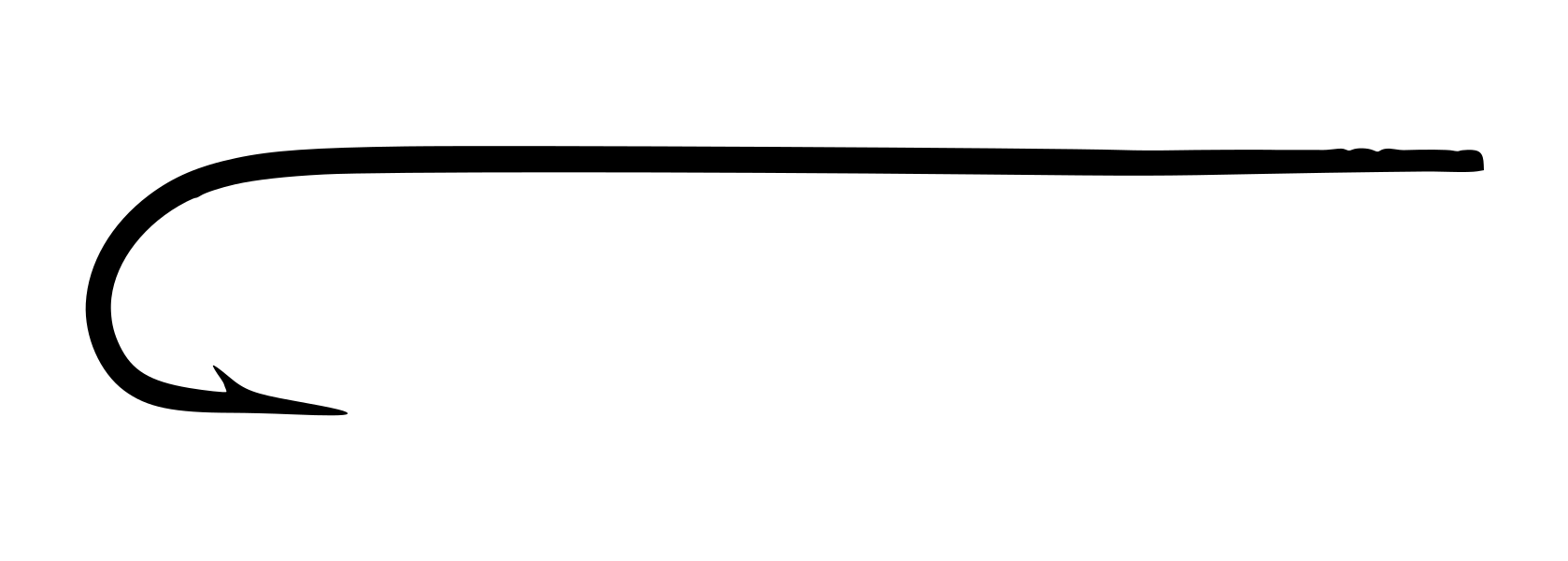
Matches: Bend, Shank, Gap, Eye, Point +6 moreDiffers: Wire: Fine (1X Fine) vs Standard; Eye Orient.: Turned Down vs Straight / Inline; Length: 25 mm vs 79 mm
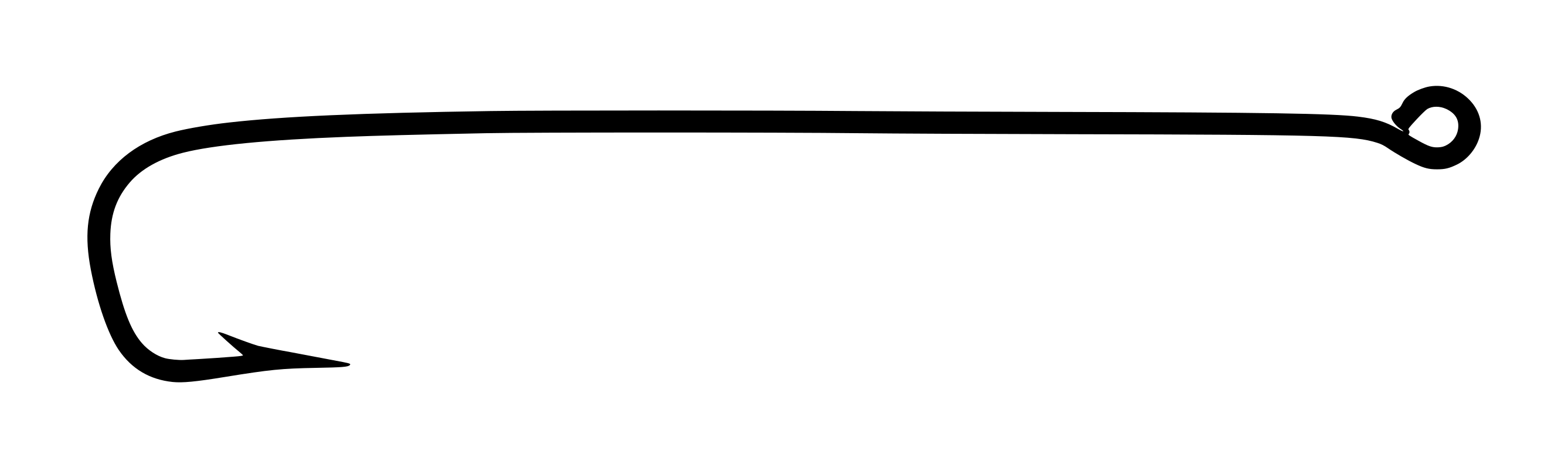
Matches: Bend, Shank, Gap, Eye, Point +5 moreDiffers: Wire: Fine (1X Fine) vs Extra-Fine; Eye Orient.: Turned Down vs Straight / Inline; Finish: Tinned vs Bronzed +1 more
The Mustad 3576 L was engineered for inshore saltwater bait fishing targeting bluefish (particularly juvenile ‘Snapper Blues’) and striped bass in northeastern U.S. coastal waters, especially Long Island Sound and Connecticut estuaries. The extraordinarily long 3.5-inch shank served as both a structural element and a defensive barrier: the sheer length physically prevented toothy fish from swallowing the bait deeply or from reaching and severing the monofilament line during violent head-shakes. The wide gape and tinned finish made it suitable for chunked mackerel, herring, or live minnow presentations in fast-moving tidal currents where a strong, corrosion-resistant hook was essential. The Superior point geometry provided reliable penetration without requiring excessive force, suitable for the relatively soft mouths of bluefish when struck properly.
Secondary Applications
Modern niche fly tying (long-shank streamer patterns mimicking sand eels or baitfish profiles), display/collectible specimens, historical reenactment fishing with period-authentic tackle.
Classic Fly Patterns
Named patterns specifically associated with this hook. Leave blank if none formally documented. Do not speculate — only include patterns with a confirmed association.
Modern Equivalents
Hook
Match Quality
Notes
Mustad 34011
Very Good
Long-shank saltwater hook with similar geometry; modern stainless steel construction but shorter shank than 3576 L
Eagle Claw 214EL
Good
Extra-long Aberdeen pattern with similar gap and shank proportions; available in tinned finish
Varivas 2600
Moderate
High-end long-shank streamer hook; maintains traditional tinned finish but different bend geometry
Tiemco 811S
Moderate
Extra-long steamer hook with tinned finish; modern construction but not specifically engineered for bluefish bait
Blue paper label (approximately 3.5 x 2.5 inches) affixed to a kraft paperboard carton or card. The label features a decorative border of small snowflake or star motifs in black ink. The header displays 'Key Brand' with the iconic downward-pointing skeleton key graphic on the left side. The main text block reads: 'O. MUSTAD & SON / Manufacturers / OSLO - NORWAY / Qual. 3576 L / Superior / Mustad-Bridgeport Snapper Hooks / T. d. ball-eye Tinned 3½'' long shank / 100 / No. [handwritten size] / Made in Norway.' The label is printed via offset lithography on smooth, calendered paper stock with a subtle blue tint. Handwritten annotation in purple or magenta ballpoint pen (likely the size designation '1/0') is visible on the label. The overall condition shows light toning consistent with 60+ years of storage, with minor edge wear and slight foxing on the cream-colored card backing. The label edges show fine creasing from the original box folding. No barcode or modern markings are present.
Collector's Identification Tips
Identification of the Mustad 3576 L is straightforward: the model code ‘Qual. 3576 L’ is clearly printed on the blue paper label, with the ‘L’ designation explicitly indicating the extra-long shank variant. The geographic origin ‘OSLO – NORWAY’ confirms post-1925 manufacture. The label text ‘Mustad-Bridgeport Snapper Hooks’ and the specific shank measurement ‘3½” long’ are unmistakable. The Key Brand logo (downward-pointing skeleton key with ‘Key Brand’ text) is Mustad’s trademark. The tinned finish and straight ball eye are visible in hand. Cross-reference the handwritten size (‘1/0’) with the visual scale of the hook to confirm the documented size. No modern reproduction or counterfeit versions of this specific model are known to exist; the design has been discontinued and is not manufactured anywhere today.
Preservation
Storage and Preservation
The Mustad 3576 L should be stored in a cool, dry environment with stable humidity levels (ideally 40–50% RH). The tinned finish is generally corrosion-resistant but can develop light patina with prolonged exposure to high humidity or moisture. Keep hooks in the original packaging or in an acid-free envelope to minimize oxidation. Avoid storing in damp basements, attics, or salt-spray environments—the relatively delicate tinned finish will deteriorate significantly under such conditions.
If the hooks are to be used for fishing (rather than collected as reference specimens), briefly inspect the point and barb under magnification before deployment; a century-old point will likely be dull and may require careful honing on a fine whetstone or ceramic hook stone. Do not attempt to use these as modern fishing hooks without proper maintenance, as the tinned coating may have micro-fractures or the point may have dulled naturally over decades of storage.
Original packaging should be preserved intact whenever possible, as it adds substantial collectibility value and serves as the authoritative source for model identification, era dating, and original specifications. Store the box flat in a stable temperature environment (65–75°F is ideal) and protect from direct sunlight, which will fade the blue label over time. A photography record of the label (close-up and full view) is recommended as insurance against future label deterioration.
Marking Analysis
Handwritten Annotations on Label
A handwritten annotation in purple or magenta ballpoint pen is visible on the lower portion of the label, appearing to read ‘1/0’ or a similar size designation. The handwriting style is consistent with mid-twentieth-century ballpoint pen (likely a Parker or similar vintage instrument) and suggests this was an inventory or stock-control marking made at the tackle shop or distribution warehouse level rather than by Mustad at the factory.
The use of ballpoint pen rather than fountain pen or pencil, combined with the informal script style, indicates this marking was applied well after the box was originally labeled and shipped—likely during the 1960s or later when ballpoint pens became ubiquitous in retail and warehouse environments. This annotation, while not detracting from the specimen’s value, provides a minor historical clue to its retail history and suggests the box was actively distributed and inventoried rather than remaining in pristine original condition on a shelf.
Size Note
Understanding the 3576 L Shank Length Designation
The ‘3½” long shank’ specification on the Mustad 3576 L represents an extreme outlier in hook geometry. To contextualize: a typical modern size 1/0 bait hook has a shank length of approximately 1.0–1.2 inches; the 3576 L shank is roughly 3 times that length. In modern fly-tying terminology, this would be described as approximately 4X to 5X long—terminology that did not exist or was rarely applied to commercial bait hooks of the 1950s–1960s era.
The exceptional length was engineered not for aesthetic fly-tying purposes but as functional ‘bite guard’ architecture, designed to protect vulnerable fishing line from the razor-sharp teeth of bluefish and striped bass. This design represents a transitional moment in tackle history: it anticipated the later widespread adoption of separate wire leaders and fluorocarbon by incorporating the bite-guard function directly into the hook shank itself. As modern tackle materials evolved, this design became obsolete, and the 3576 L pattern was discontinued. Today, the exceptional shank length is precisely what makes these hooks attractive to niche fly-tiers seeking to recreate period-authentic streamer patterns or to recreate the appearance and behavior of sand eel or capelin profile flies.
Primary Source
Label Text Analysis and Mustad Nomenclature Conventions
Source: O. Mustad & Søn label, c. 1950–1965; primary source analysis per Mustad official hook terminology guide
The label text ‘Mustad-Bridgeport Snapper Hooks’ follows Mustad’s standard nomenclature convention of affixing a geographic origin or regional pattern name to the core brand identity. This practice reflects Mustad’s deliberate industrial ‘cloning’ strategy: by reverse-engineering highly localized, regional hook designs and then marketing them under their original geographic names, Mustad could simultaneously capture local market loyalty while leveraging their Norwegian manufacturing efficiency to undercut regional competitors. The ‘Bridgeport’ reference is not a manufacturing location but a fishing destination—likely referring to Bridgeport, Connecticut, a major port and fishing center on Long Island Sound.
The designation ‘T. d. ball-eye’ requires decoding: ‘T. d.’ historically stood for ‘Tapered Down’ or ‘Tapered,’ indicating that the wire diameter was slightly reduced before being bent into the eye loop. While ‘T. d.’ is sometimes treated as synonymous with a distinctive point style in modern hook literature, on Mustad bait-hook labels it consistently referred to an eye construction detail rather than the point geometry. The ‘Superior’ designation on Line 5 of the label refers to the point geometry—a near-straight inner taper indicating durable, all-purpose penetration characteristics suitable for bluefish with relatively soft mouths.
The notation ‘100 / No. [size]’ indicates the box contained 100 hooks of a single size (in this case, size 1/0, as documented). The final line ‘Made in Norway’ was a required statement under U.S. tariff regulations for imported goods, confirming this box was destined for the American wholesale or retail market. The overall label structure—eight lines of formalized typographical information—matches the documented Mustad label standard from the 1950s–1970s era.
Additional
Historical Context: The Bluefish and Striped Bass Boom of the 1950s–1960s
The emergence of specialized patterns like the Bridgeport Snapper Hook reflects a broader post-World War II boom in recreational saltwater fishing in northeastern North America. Returning servicemen, improved road infrastructure, and affordable gasoline made coastal fishing destinations accessible to middle-class anglers in inland cities. Long Island Sound and Connecticut’s coastal estuaries became destination fisheries, attracting anglers from New York City and beyond.
Bluefish (Pomatomus saltatrix), particularly juvenile ‘snapper blues’ (1–3 pounds), were extraordinarily abundant during this period and provided fast, aggressive action and excellent table quality. Striped bass (Morone saxatilis), though more prized and regulated, were also extremely abundant before the population collapse of the 1970s–1980s. The specialized hook designs of this era—including the Bridgeport Snapper with its fearsome long shank—reflect the intense focus on solving the specific problems posed by toothy, aggressive predators in complex estuarine environments.
The decline of the 3576 L pattern in the 1970s–1980s coincides not only with changing tackle materials but also with the virtual collapse of striped bass populations due to pollution, overfishing, and industrial development. As the fishery and the angling culture shifted, the specialized designs that had served that culture became obsolete. Today, a surviving box of Bridgeport Snapper Hooks serves as a material artifact of that golden age of Northeast saltwater recreational fishing and as a testament to Mustad’s precision in responding to hyperlocal, specialized market demands.
Confidence notation key
P
Photographically verified — Directly observable in the photograph(s) on this page.
V
Verified by documentation — Confirmed by manufacturer catalog, spec sheet, or published reference.
I
Inferred — A logical deduction from observable or documented evidence, not directly stated.
E
Estimated — An approximation based on visual comparison, proportional analysis, or limited data.
S
Speculative — A reasoned hypothesis that cannot be confirmed from available evidence.
Claims with no notation are confirmed by multiple independent sources. All photographs on garrenwood.com are taken on a measurement grid where each square equals 1/10 inch (0.1″ / 2.54 mm).