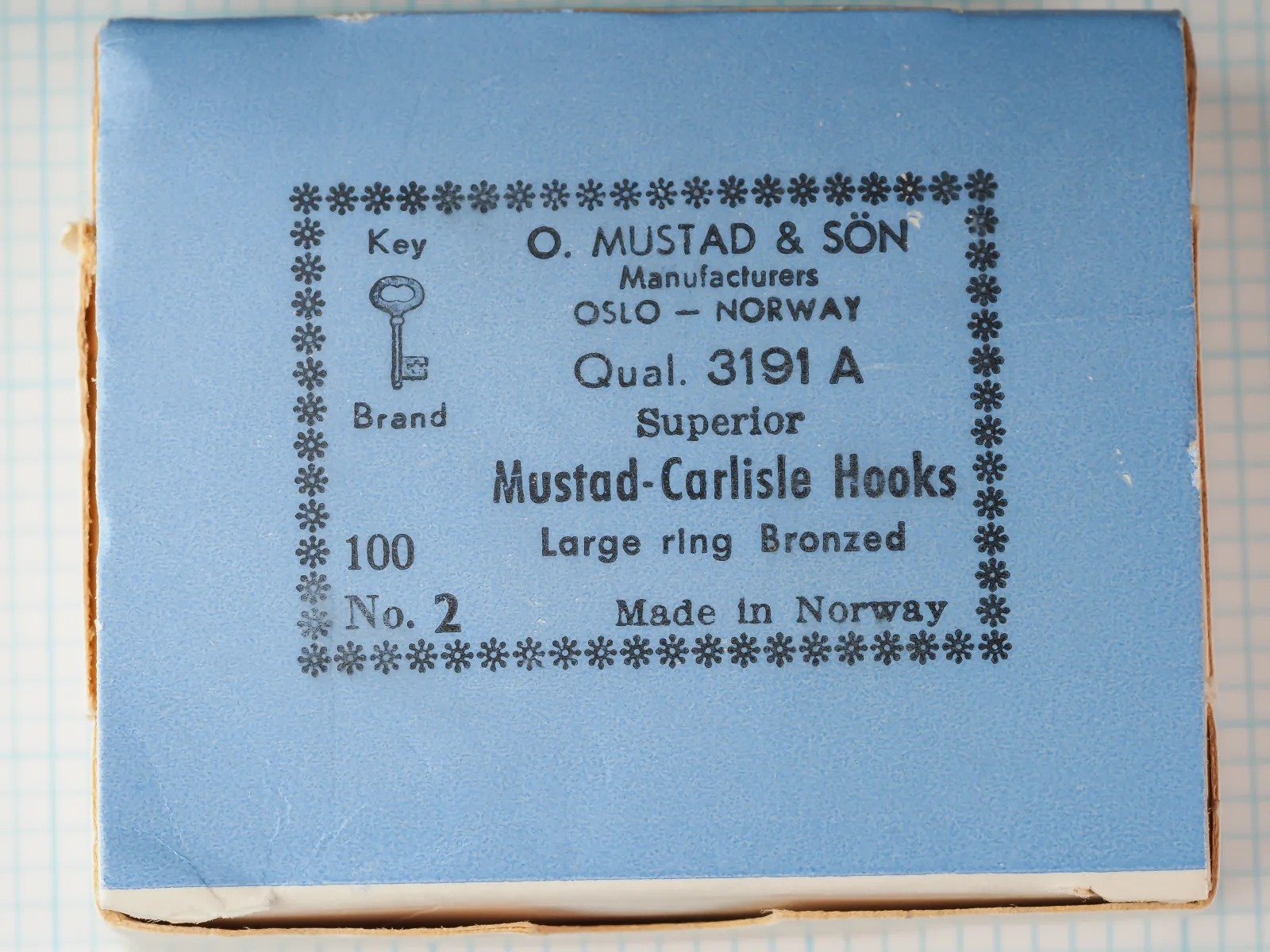
The Mustad 3191 A represents the quintessential Carlisle hook pattern, mass-produced by Norway’s industrial fishing tackle giant during the mid-20th century. This size 2 specimen features the characteristic extra-long shank and rounded bend that made the Carlisle design famous for natural bait presentation.
The ‘Key Brand’ packaging with its distinctive blue label and asterisk border dates this example to Mustad’s export heyday of the 1950s-early 1960s. The large ring eye accommodated the thicker braided lines common before monofilament dominance, while the superior point design provided reliable penetration for bait fishing applications.
Beyond its intended bait fishing role, this hook found unexpected popularity among streamer fly tyers who valued the long shank for extended fly bodies and cork popper construction. This crossover appeal adds to its historical significance in American angling culture.
Original Key Brand packaging showing the distinctive blue label with asterisk border, typical of Mustad's 1950s export market presentation.
Photographic record
4 cataloged imagesSelect any record to load it above.
4 images shown
Mustad 3191 A Key Brand Box Size 2Original Key Brand packaging showing the distinctive blue label with asterisk border, typical of Mustad's 1950s export market presentation.Open originalMustad 3191 A Point Detail Size 2Detail view of the superior point design showing the characteristic near-straight inner taper and bronzed finish.Open originalMustad 3191 A Full Profile Size 2Complete hook profile displaying the characteristic Carlisle bend and extra-long shank design on measurement grid for scale reference.Open originalMustad 3191 A Hook Comparison Size 2Two examples of the Mustad 3191 A demonstrating consistent manufacturing quality and finish uniformity from the Key Brand era.Open original
Technical profile
Eye
Ball Eye, Straight / Inline
Wire
Standard, Round
Shank
Extra-Extra Long (XXL) — Plain
Bend
Standard gapCarlisle bend - rounded profile with moderate depth, designed for natural bait presentation P
Point
Superior (near-straight inner taper)
Finish
Bronzed — Confirmed (stated on packaging)Dark bronze finish with slight warm tone characteristic of period Mustad bronzing process P
Hooks show excellent condition with intact bronzed finish. Packaging shows age-appropriate toning and edge wear but remains structurally sound with all text legible.
The superior point design features a near-straight inner taper that provides excellent penetration while maintaining strength. The large ring eye accommodates heavy lines and leaders without binding. The extended shank length (approximately 3.5-4 times the gap width) prevents natural baits from bunching while allowing multiple hook points along lengthy baits like nightcrawlers.
The 3191 series represented Mustad’s standardization of the traditional Carlisle pattern, originally developed by British hook makers in the 19th century. The ‘A’ designation indicated the large ring eye variant, distinguishing it from ball-eye and tapered-eye versions. This series remained in production through the 1960s before being superseded by lighter-wire Aberdeen-style patterns as fishing techniques evolved toward finesse presentations.
Era and Packaging Dating
Blue paper label with asterisk border pattern typical of Mustad's mid-century export packaging. 'O. MUSTAD & SÖN' spelling with umlaut indicates export market version (Norwegian 'Søn' modified for international markets). 'Key Brand' logo and overall typography consistent with 1950s-early 1960s Mustad packaging. No postal codes or modern phone formatting visible.
The Popper Connection
While designed for bait fishing, the Mustad 3191 A became a secret weapon among early streamer fly tyers who discovered its long shank was perfect for gluing cork bodies when creating poppers and sliders. This unintended application helped bridge the gap between traditional bait fishing and the emerging warm-water fly fishing techniques of the 1960s.
Design lineage and influence
Best matchRelated by Attribute
Computed automatically from catalog data — updated as new hooks are added.
Matches: Shank, Wire, Eye, Eye Orient., Forging +3 moreDiffers: Gap: Standard vs Wide; Point: Superior vs Other; Finish: Bronzed vs Bright / Uncoated Steel +3 more
Matches: Shank, Eye, Eye Orient., Point, Forging +3 moreDiffers: Wire: Standard vs Fine (1X Fine); Gap: Standard vs Narrow; Finish: Bronzed vs Black Japanned +3 more
Classic long-shank bait hook designed for natural baits such as nightcrawlers and minnows. The extra-long shank prevents bait bunching and allows for better hook sets on species like walleye, pickerel, and catfish. Also adopted by streamer fly tyers for long-bodied patterns and cork-bodied poppers P.
Secondary Applications
Streamer fly tying, particularly for classic patterns requiring long shanks such as Grey Ghost and early Woolly Buggers
Direct modern Carlisle equivalent with similar proportions
Mustad 3261
Good
Modern descendant with Aberdeen styling but similar function
Tiemco 200R
Moderate
Fly tying specific with long shank, though semi-dropped point
Collector notes
Modest collectability driven by the classic Key Brand packaging and mid-century Norwegian provenance, though limited by the hook's common production numbers.
Reference value
$8 – $25 USD estimate
Packaging condition
Good — moderate wear, legibleRecorded specimen
Packaging format
MUS-KB-01Catalog code
Positive factors include the distinctive Key Brand packaging from Mustad’s export heyday, the classic Carlisle pattern significance, and the quality Norwegian manufacture. The blue asterisk-border label represents a specific packaging era that appeals to tackle collectors. However, collectability is constrained by the large original production runs and the survival of many examples. The hook’s crossover appeal to both bait fishing and fly tying communities provides broader interest than single-application hooks.
Packaging
Small cardboard box with blue paper label featuring asterisk border pattern. Label reads 'Key Brand O. MUSTAD & SÖN Manufacturers OSLO - NORWAY Qual. 3191 A Superior Mustad-Carlisle Hooks Large ring Bronzed 100 No. 2 Made in Norway'. White base box with typical mid-century construction.
Market Value Notes
Packaged examples in good condition typically sell for $8-15, with mint examples reaching $20-25. Individual hooks have minimal value, but complete boxes with original labels command premium pricing among Mustad collectors.
Where to Find
eBay, vintage tackle shows, estate sales, occasionally at antique shops in fishing regions
Collector's Identification Tips
Look for the distinctive ‘Key Brand’ logo and blue asterisk-border label. The ‘SÖN’ spelling (rather than ‘SON’) indicates export market packaging. Original boxes should contain exactly 100 hooks in bronzed finish with large ring eyes.
Preservation
Storage and Preservation
Store in a cool, dry environment to prevent deterioration of the blue paper label and cardboard box. The bronzed finish is relatively stable but can develop patina in humid conditions. Keep hooks on original card when possible, as loose hooks have minimal collector value. Avoid handling the label directly to prevent oil transfer and fading. Original packaging adds 200-300% to the value over loose hooks.
Primary Source
Label Analysis
Source: Original Mustad 3191 A box label, photographically documented
The label provides key dating evidence through its typography and terminology. ‘Qual. 3191 A’ uses the abbreviated ‘Quality’ format typical of 1950s Mustad export packaging. The ‘OSLO – NORWAY’ location marking reflects the company’s 1946 corporate restructuring. The asterisk border pattern appears consistently on Key Brand products from this specific era, making it a reliable dating marker for collectors.
Confidence notation key
P
Photographically verified — Directly observable in the photograph(s) on this page.
V
Verified by documentation — Confirmed by manufacturer catalog, spec sheet, or published reference.
I
Inferred — A logical deduction from observable or documented evidence, not directly stated.
E
Estimated — An approximation based on visual comparison, proportional analysis, or limited data.
S
Speculative — A reasoned hypothesis that cannot be confirmed from available evidence.
Unnotated claims are the compiler’s synthesis; see Sources. All photographs on garrenwood.com are taken on a measurement grid where each square equals 1/10 inch (0.1″ / 2.54 mm).