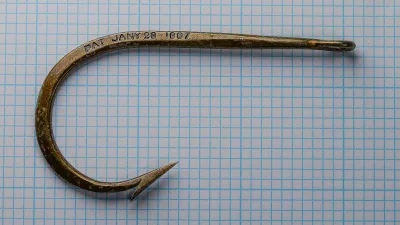
The Van Vleck Hook Co. of Toledo, Ohio, is best remembered for a distinctive heavy-duty fish hook developed during the formative years of American big-game saltwater angling. The design originated with Toledo residents George Henry Van Vleck and Louis Clyde Van Vleck, who filed a U.S. patent application on October 1, 1906. Their patent, No. 842,594, was granted on January 29, 1907—the date stamped on surviving examples such as the hook shown here. Google Patents
The Van Vlecks designed their hook specifically for tarpon and other large game fish. Rather than simply increasing the size and strength of a conventional hook, they altered its geometry. The patent describes a long, narrow point, triangular in cross section, terminating in a distinctive forked barb. The bend placed the point nearly in line with the pull from the eye, which was intended to improve penetration and reduce the chance of a hooked fish throwing the hook. Google Patents
The design quickly became associated with the rapidly developing sport of tarpon and tuna fishing. In his 1922 book The Tarpon, noted sportsman F. Gray Griswold recalled that the Van Vleck hook changed tarpon trolling because its shape made it more difficult for jumping fish to dislodge the hook. Other period accounts describe Van Vleck hooks being used for tuna as well as tarpon, placing them among the specialized tackle used by the leading big-game anglers of the era. Project Gutenberg
The Improved Van Vleck Hook became an especially recognizable version. Early tackle literature described it as having a double or forked barb positioned on the outside of the point. The example illustrated here is stamped “IMPROVED VAN VLECK HOOK” and “PAT JAN’Y 29 1907,” directly tying the surviving hook to the Van Vlecks’ patent. Lake Brooks’ Science of Fishing, first copyrighted in 1912, specifically illustrated and discussed the Van Vleck tarpon hook and its unusual barb arrangement. pdfcoffee.com
The business itself remains less well documented than its famous product, but contemporary trade records establish that it was more than simply a patent name. The 1919 Sporting Goods Trade Directory lists The Van Vleck Hook Co., Toledo, Ohio, specifically among manufacturers or suppliers of forked-barb fish hooks. Internet Archive Van Vleck hooks also found their way into premium tackle: Edward vom Hofe & Co. advertised its high-grade Sams trolling spoon fitted with the “famous hand forged ‘Van Vleck’ trolling hook.” FATC
For collectors today, the Van Vleck is an unusually tangible survivor from the early age of American big-game fishing—a hook whose patent date, maker’s name, unusual geometry, and documented use by tarpon and tuna anglers can all be connected directly to the historical record.