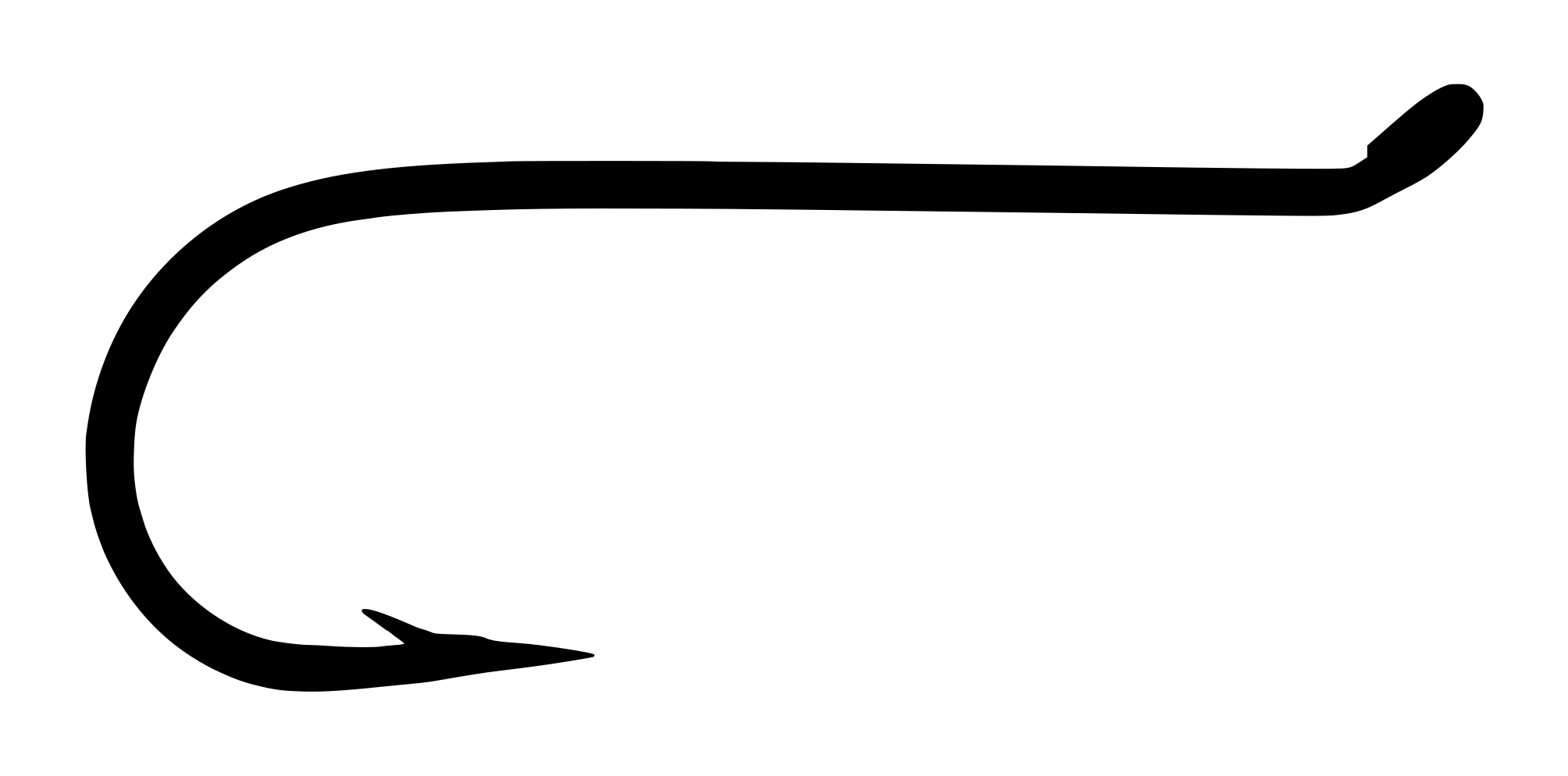
The Pflueger 5511-Br O’Shaughnessy is a heavy-forged saltwater hook manufactured by the Enterprise Manufacturing Company of Akron, Ohio, during the company’s peak production era. This size 7/0 specimen is a classic example of Pflueger’s marine tackle heritage, featuring the company’s signature forged offset point geometry and substantial wire gauge engineered to withstand the mechanical stresses of big-game fishing.
The hook exhibits a straight-ring eye with moderate diameter, a deeply forged O’Shaughnessy bend, and a mechanically filed standard-spear point. The bronzed finish—indicated by the ‘Br’ suffix on the model code—presents as a warm brown-gold metallic coating characteristic of Pflueger’s pre-1966 thermal oxidation or baked metallic lacquer process. The original 100-count hinged cardboard box with red and green letterpress printing is a classic packaging format from the interwar to postwar era, consistent with Pflueger’s documented catalog materials from the 1920s-1950s.
The absence of a UPC barcode and the austere, period-appropriate typography confirm pre-1974 manufacture, placing this hook squarely within Pflueger’s industrial dominance phase. The model code 5511-Br aligns with Pflueger’s documented four-digit naming convention with alphabetic finish suffix, a systematic taxonomy designed to streamline hardware jobber inventory management across thousands of retail outlets. This hook represents a significant artifact of American mass-production hook manufacturing and the global prevalence of Pflueger tackle in mid-twentieth-century saltwater angling.
Close-up of the mechanically filed point and offset geometry, showing the characteristic O'Shaughnessy bend angle and bronzed finish coloration on measurement grid.
Photographic record
3 cataloged imagesSelect any record to load it above.
3 images shown
Pflueger 5511-Br O’Shaughnessy Size 7/0 Point DetailClose-up of the mechanically filed point and offset geometry, showing the characteristic O'Shaughnessy bend angle and bronzed finish coloration on measurement grid.Open originalPflueger 5511-Br O’Shaughnessy Size 7/0 Full ProfileFull profile view of the Pflueger 5511-Br O'Shaughnessy hook, size 7/0, showing the entire hook geometry from straight-ring eye through shank, bend, and point on measurement grid.Open originalPflueger 5511-Br O’Shaughnessy Original 100-Count Box PackagingOriginal Pflueger O'Shaughnessy 100-count hinged box packaging showing front panel with red italic 'PFLUEGER' branding, green 'O'SHAUGHNESSY' text, 'DUBLIN POINT' and 'RINCED' descriptors, and right panel showing '100 No. 5511-Br BRONZED' specification.Open original
Technical profile
Straight-Ring Eye | O'Shaughnessy Bend | Standard Shank | Heavy Wire | Standard Spear Point | Bronzed Finish
Eye
Ball Eye, Straight / InlineStraight-ring eye with moderate diameter and smooth finish. Ring diameter approximately 2.8-3.2 mm, consistent with heavy-wire saltwater specifications P.
Wire
Heavy (1X Heavy), Forged
Shank
Standard
Bend
O'Shaughnessy, Standard gapCharacteristic deep O'Shaughnessy forged bend with pronounced offset point geometry. The inner face shows the classic offset relationship, not vertically aligned with the shank. Bend depth is substantial relative to overall hook size, engineered to maximize leverage and resist straightening forces P.
Point
Standard / SpearShort, close-cut barb positioned approximately 0.25-0.30 inches from the point. Barb angle is perpendicular to the shank axis, characteristic of mechanically filed specifications. Barb size is modest relative to heavy wire gauge, optimizing for solid hooksets without excessive tissue damage P.
Finish
Bronzed — Confirmed (stated on packaging)Bronzed finish displays a warm, brown-gold metallic tone with subtle non-reflective texture. The color is consistent with Pflueger's documented bronzed-finish specifications. Finish exhibits uniform coverage with no flaking or crazing visible on the specimen, indicating preservation in stable storage conditions over nearly a century. The tone is distinctly warmer than modern bronze platings, suggesting period-authentic chemical oxidation or baked lacquer application P.
Hook specimen exhibits bright, corrosion-free bronze finish with no pitting, rust, or mechanical damage. The eye is smooth and unworn. The point retains its original filed geometry with no blunting, rounding, or bending visible. Packaging box shows moderate toning, edge wear, and brittleness of period kraft cardboard; lid exhibits light pencil markings. No hooks are missing from the 100-count interior. Box structural integrity is sound; lid closes securely.
The O’Shaughnessy bend geometry is engineered to maximize resistance to straightening under extreme tensile and bending loads. The deep, rounded curve distributes stress evenly across the bend radius, preventing stress concentration at any single point. The offset point—angled deliberately outward from the shank axis—provides mechanical advantage during the hook-set phase, converting rotational force into the bend curve and driving the point penetration deeper into bony jaw structure. This geometry is particularly effective against large marine predators with hard jaw tissues and heavy head-shakes.
The forged wire construction employed by Pflueger represents a cold-forming or hot-forming process where raw high-carbon steel is mechanically deformed into the final hook shape, creating a dense crystalline structure superior in strength to drawn wire. The forging process aligns the steel grain along the stress paths of the finished bend, resulting in superior structural integrity and resistance to fracture under impact or sustained load. The mechanical filing of the point—applied after forging and tempering—ensures precise point geometry, acute cutting angle, and optimal barb placement relative to the shank centerline.
The Bronzed finish applied to the 5511-Br consists of a controlled chemical oxidation process or specialized baked metallic lacquer that produces a warm brown-gold surface. This finish provides minimal barrier protection against oxidation compared to hot-dip tinning, making it suitable for freshwater and light brackish environments but suboptimal for heavy saltwater service. Pflueger’s tiered finish strategy—offering the same O’Shaughnessy bend in Japanned (freshwater), Bronzed (light saltwater/traditional), and Tinned (heavy saltwater) variants—allowed anglers to select the appropriate corrosion protection for their specific fishing environment without purchasing an entirely different hook.
The straight-ring eye construction, typical of Pflueger’s saltwater offerings, provides a clean attachment point for leader material, knots, and rigging hardware without the complications of blind-eye or tapered-eye designs. The eye diameter is proportionate to the heavy wire gauge, ensuring adequate knot-holding surface and mechanical stability during the violent dynamics of big-game battles.
We don't have measured sizes for this hook yet. Own one? Submit calipered measurements and we'll review and add them. Thank you!
Historical context
pflueger
The Enterprise Manufacturing Company, operating under the Pflueger brand, was founded in Akron, Ohio, and represents one of the most significant industrial innovations in American sporting goods manufacturing. The company originated as the American Fish Hook Company, established in 1864 by Ernest F. Pflueger, a German immigrant and visionary entrepreneur. The company was formally reorganized as the Enterprise Manufacturing Company in 1881 and officially incorporated in 1886, capitalizing on E.F. Pflueger’s landmark 1883 patent for luminous phosphorescent paint on artificial fishing lures.
By the early twentieth century, Pflueger had become the largest hook-manufacturing facility in the world, employing over 350 workers and producing approximately 100 million fish hooks annually by the 1920s-1930s. The company’s industrial dominance was achieved through aggressive implementation of American mass-production techniques, replacing the artisanal guild traditions of European (particularly Redditch, England) hook manufacturers with highly automated, precision-forging machinery. In 1899, Pflueger acquired the American Fish Hook & Needle Company of New Haven, Connecticut, substantially augmenting its hook department and expanding its access to traditional British bend families (Limerick, Kirby, Carlisle, Sproat) manufactured under American conditions.
The Bulldog trademark, introduced in December 1914, became synonymous with premium American tackle worldwide and represented Pflueger’s flagship quality tier. Concurrently, the company introduced the Four Brothers brand (also trademarked December 1914) as an economy-tier product line named for the four Pflueger brothers who managed day-to-day operations, allowing the corporation to capture price-sensitive market segments without diluting the Bulldog brand prestige. By the 1920s, Pflueger’s catalog encompassed nearly every conceivable bend family and finish specification required by commercial harvesters and recreational sportsmen, bridging delicate freshwater trout patterns and brutal offshore big-game specifications.
The company’s commitment to empirical research extended beyond manufacturing. In 1928, Vice President Charles T. Pflueger acquired a farm in Green Township and constructed a private testing facility with a dammed creek, where hook penetration mechanics, wire stress tolerances, and lure hydrodynamics were observed under rigorous field conditions. This facility operated until Charles T. Pflueger’s death in 1951, after which the property was sold. Pflueger hook production remained centered in Akron throughout the company’s independent operation, maintaining the highest standards of American-made steel and finish specifications.
In 1966, the Shakespeare Company of Kalamazoo, Michigan, acquired the Pflueger tackle division, marking the end of family ownership and the gradual transition of the brand away from terminal tackle toward mechanical reels and rods. All Pflueger fish hooks are now vintage and collectible only; the company ceased primary hook manufacturing operations between 1966 and the present, though the exact discontinuation date has not been documented in open-source historical records. Today, Pflueger operates exclusively as a reel and rod subsidiary under the Pure Fishing corporate umbrella.
Series History
The O’Shaughnessy hook pattern itself predates Pflueger by decades, originating in nineteenth-century British and Irish angling traditions as a heavy-wire saltwater and bait pattern. The bend geometry—characterized by a deeply forged curve, offset point, and substantial wire gauge—was engineered specifically to resist straightening under the immense hydrostatic pressure of deep-diving or fighting large marine predators. The pattern name derives from its presumed designer or popularizer, though historical records on this specific attribution are incomplete.
Pflueger’s 5511-Br O’Shaughnessy represents the company’s industrial refinement of this traditional pattern, standardized within their documented four-digit model-numbering taxonomy. The 5511 base code and ‘Br’ (Bronzed) finish suffix indicate the pattern’s position within Pflueger’s systematic catalog hierarchy. Documentation from the manufacturer reference materials confirms that Pflueger produced O’Shaughnessy patterns in multiple finish variants (Japanned, Bronzed, Tinned) and size ranges spanning from small bait sizes to massive 16/0 big-game specifications. The Tinned finish variant (denoted 5511-T) was particularly favored for heavy saltwater environments due to its sacrificial galvanic protection against marine corrosion.
The O’Shaughnessy pattern achieved legendary status in early twentieth-century big-game angling through association with author and pioneering marine angler Zane Grey. Grey, who pursued oceanic leviathans extensively during the 1910s-1930s, grew frustrated with the structural limitations of traditional European-manufactured hooks, which frequently bent or straightened under the pressure of thousand-pound marlin. In response, Pflueger engineered an exceptionally refined O’Shaughnessy variant with extreme wire thickness, precise temper specifications, and deliberate offset geometry. Grey’s documented captures—including a 1,040-pound Tahitian striped marlin and a 976-pound black marlin—were achieved with Pflueger Sobey and O’Shaughnessy hooks, cementing the pattern’s reputation for structural superiority.
The 5511-Br O’Shaughnessy remained in continuous production throughout Pflueger’s independent operation (1881-1966) and would have been marketed to both recreational saltwater anglers and commercial harvesters. The 100-count retail hinged-box format indicates this was a mid-tier volume offering, positioned between ultra-premium hand-packed selections and economy bulk distributions. The Bronzed finish provided traditional visual appeal and moderate freshwater corrosion resistance, making the 5511-Br suitable for trophy baitfish applications in brackish estuaries and light saltwater conditions. Heavier-use saltwater applications would have demanded the Tinned finish variant (5511-T) for superior galvanic protection. The pattern was discontinued after 1966 along with Pflueger’s broader hook manufacturing operations.
Era and Packaging Dating
Pre-1974 date confirmed by complete absence of UPC barcode on packaging. Cardboard box construction, kraft-stock material, and letterpress/offset printing are consistent with 1920s-1950s manufacturing standards. The 'PFLUEGER' script in red italic and the simplified green geometric border are characteristic of Pflueger interwar-to-postwar branding conventions. No 'Made in USA' or 'Akron, Ohio' marking visible, which is consistent with pre-1950s Pflueger packaging; such country-of-origin markings became standard on American fish hooks by the 1960s. The model code format 5511-Br with alphabetic finish suffix aligns with Pflueger's documented four-digit naming taxonomy, which reached standardization by the 1910s-1920s. The 'DUBLIN POINT' and 'RINCED' (Ringed) nomenclature on the box is period-appropriate descriptive language for the O'Shaughnessy bend and eye construction. Cross-referencing with documented Pflueger catalog materials from the 1920s-1950s (per the manufacturer reference document), the O'Shaughnessy pattern was produced throughout this era for saltwater applications. The bronzed finish and 100-count hinged-box format are consistent with Pflueger's standard packaging for mid-tier saltwater offerings during the 1920s-1950s. Evidence supports a manufacturing window of c. 1910s-1950s, with highest probability in the 1920s-1940s based on typography and box construction conventions.
Zane Grey's Secret Weapon
Author and pioneering big-game angler Zane Grey, famous for novels like 'Riders of the Purple Sage,' spent hundreds of days per year hunting oceanic leviathans in the Pacific. Grey grew increasingly frustrated with traditional European hooks, which snapped or bent when fighting thousand-pound marlin. In response, Pflueger engineered an exceptionally refined O'Shaughnessy with extreme wire thickness and precise tempering. Grey's world-record captures—including a 1,040-pound Tahitian striped marlin—were achieved with Pflueger Sobey and O'Shaughnessy hooks, cementing the pattern's reputation for structural superiority. Grey's explicit endorsements of Pflueger tackle in his published fishing narratives (particularly 'Tales of Fishes,' 1929) became legendary within the angling community, transforming Pflueger from a industrial commodity manufacturer into a prestige saltwater brand.
Design lineage and influence
The O’Shaughnessy bend family traces its lineage to nineteenth-century British angling traditions, emerging as a refinement of earlier heavy-wire patterns (particularly the Limerick and Aberdeen variants) optimized for deep-diving baitfish and heavy saltwater leverage. The characteristic offset point geometry represents a departure from the near-vertical point alignment of contemporary Limerick and Sproat patterns, instead positioning the point deliberately outward to maximize rotational momentum during the hook-set phase and to prevent the bend from slipping flat against a fish’s jaw during violent head-shakes.
Pflueger’s adoption and standardization of the O’Shaughnessy pattern reflects the company’s broader strategy to bridge American mass-production manufacturing with proven traditional bend families. By acquiring the American Fish Hook & Needle Company in 1899, Pflueger gained access to historical British bend templates while simultaneously implementing American precision-forging and quality-control protocols. The result was an O’Shaughnessy pattern that maintained classical geometric properties while benefiting from Pflueger’s mechanical consistency and finish options unavailable to traditional Redditch craft-makers.
Competing manufacturers—including Mustad (Norway), Allcock (England), Partridge (England), and early American rivals such as Eagle Claw and South Bend—produced O’Shaughnessy variants throughout the early twentieth century. Pflueger’s version maintained particular prestige due to the company’s vertical integration of steel sourcing, forging, and finishing operations. The Tinned finish variant (5511-T) directly competed with Mustad’s Marine brand and specialized saltwater offerings. The pattern’s association with Zane Grey and record-breaking marlin captures further elevated Pflueger’s O’Shaughnessy above generic commodity offerings.
Contemporary modern equivalents—such as the Mustad 3407 and Gamakatsu SL-12—maintain the classical O’Shaughnessy bend geometry but employ automated chemically-sharpened points and modern electroplated finishes, departing from Pflueger’s mechanically-filed specifications and hot-dip tinning processes. Modern equivalents typically feature lighter wire gauges relative to size and utilize high-carbon steel synthetics, reducing the extreme wire thickness that characterized the Pflueger big-game standard. No modern manufacturer produces hooks that directly replicate Pflueger’s combination of forged-steel substrate, mechanical point filing, and period-authentic finish specifications.
Best matchRelated by Attribute
Computed automatically from catalog data — updated as new hooks are added.
Matches: Bend, Shank, Gap, Eye, Eye Orient. +3 moreDiffers: Wire: Heavy (1X Heavy) vs Standard; Point: Standard / Spear vs Superior; Forging: Forged vs Round
Matches: Bend, Shank, Gap, Forging, Application +1 moreDiffers: Wire: Heavy (1X Heavy) vs Standard; Eye: Ball Eye vs Tapered Eye; Eye Orient.: Straight / Inline vs Turned Down +1 more
The Pflueger 5511-Br O’Shaughnessy is a heavy-wire saltwater bait hook designed for large marine species and offshore trolling. The forged O’Shaughnessy bend, with its characteristic offset point and massive wire gauge, provides exceptional structural integrity for resisting straightening under the immense pressure of fighting large gamefish. The bronzed finish offers traditional aesthetics with minimal corrosion protection, making it suitable for freshwater and light brackish applications, though the wire weight and bend geometry are primarily optimized for saltwater environments where hook straightening is a primary failure mode.
Collector notes
Rated 5.5/10 — scarce, particularly in original 100-count box format with complete hook count and intact packaging. Pflueger O'Shaughnessy patterns are sought by specialist saltwater collectors and tackle historians, but the abundance of Pflueger reels in the collector marketplace has somewhat overshadowed the company's hook legacy. The bronzed finish variant is less desirable than the Tinned saltwater version, which limits overall demand.
Reference value
$28 – $62 USD estimate
Packaging condition
Good — moderate wear, legibleRecorded specimen
Packaging format
PF-CT-01Catalog code
Positive Factors: The Pflueger 5511-Br O’Shaughnessy is genuinely scarce in original 100-count hinged-box packaging. Complete boxes with all hooks intact are increasingly difficult to locate, as most surviving examples have been opened, pillaged, or discarded over the past 50-75 years. The original kraft-stock cardboard box with red and green letterpress printing is a distinctive artifact of 1920s-1950s packaging conventions and commands significant premium value. The O’Shaughnessy pattern itself carries historical prestige due to its association with Zane Grey and big-game angling tradition. Pflueger’s documented reputation as the world’s largest hook manufacturer during the 1920s-1940s adds broader historical significance. Specialist collectors of American-made saltwater tackle, Zane Grey artifacts, and Pflueger enterprise materials actively seek this hook. The forged construction, heavy wire gauge, and mechanically-filed point represent manufacturing standards that have been largely abandoned in favor of cost-reducing automated techniques, making vintage examples valuable for understanding historical production practices.
Limiting Factors: The Bronzed finish variant is significantly less desirable than the Tinned saltwater version (5511-T), which commands higher premiums. Bronzed finish exhibits accelerated patina development and is highly susceptible to atmospheric moisture, making preservation challenging; many survivors show advanced oxidation or surface rust even in favorable storage. The condition of original packaging—kraft cardboard brittleness, toning, edge wear—limits the number of truly museum-quality examples. Pflueger’s sheer production volume (millions of hooks annually) means that while 100-count boxes are scarce, individual loose examples remain relatively common on the secondary market, depressing the value of incomplete or heavily used specimens. Modern equivalents (Mustad 3407, Gamakatsu SL-12) are readily available at low cost, reducing the functional collecting motivation. Pflueger hooks occupy a niche within the broader hook-collecting community, which is itself smaller than reel or lure collecting; this narrows the potential buyer base compared to iconic Pflueger reel models.
Most Desirable Variants: Original 100-count boxes with all or near-all hooks intact command the highest premiums, particularly when packaging is structurally sound and shows only moderate toning. The Tinned finish variant (5511-T) is more desirable than the Bronzed version. Larger sizes (6/0, 7/0, 8/0) are more collectible than smaller sizes, as they are less commonly encountered in surviving examples. Boxes with minimal pencil markings or dealer annotations add modest value. Complete sets of multiple Pflueger saltwater patterns (e.g., 5511-Br alongside 5511-T, or O’Shaughnessy paired with Sobey) command significant premiums as comprehensive examples of the product line.
Condition Premium Factors: Sealed or near-sealed boxes command premiums of 50-75% over opened examples. Boxes with all 100 hooks intact add 25-40% premium over boxes with 1-5 missing hooks. Packaging structural integrity (lid closing securely, no major tears or crushing) adds 15-25% premium. The condition of the hooks themselves is critical: hooks showing any rust, corrosion, or mechanical damage reduce value by 20-50% depending on severity. Bright, corrosion-free hooks in unoxidized condition represent the premium tier. Storage in stable, dry conditions preserves the bronzed finish color, while humid or oxidizing storage produces dull, patinated finishes that many collectors find less aesthetically appealing (though some collectors explicitly seek the aged patina as evidence of authenticity).
Packaging
Original cardboard hinged box with slide-top lid, approximately 4.5" × 1.75" × 0.75" external dimensions. Kraft-stock cardboard with red and green letterpress printing. Front panel displays 'PFLUEGER' in red italic script (upper left), 'O'SHAUGHNESSY' in large green sans-serif capitals (center), 'FISH HOOKS' in red capitals (lower center), 'DUBLIN POINT' and 'RINCED' in green at bottom. Right panel shows '100' and 'No. 5511-Br.' in green, with 'BRONZED' in large green capitals. Simple green border rule frames the entire front panel. Lid interior shows faint pencil markings. No barcode, no country-of-origin marking visible. Paper shows moderate toning and edge wear consistent with 1920s-1950s storage. Print method is classic offset/letterpress hybrid. Box exhibits moderate brittleness of period kraft stock.
Market Value Notes
Low ($28): Good condition — opened box, 85-95 hooks present, moderate packaging wear, hooks bright with no corrosion<br />
High ($62): Excellent/Mint condition — sealed or near-sealed box, complete 100-count, minimal packaging wear, hooks in pristine condition with original bronzed finish<br />
Premium factors: Original hinged cardboard box with intact printing, complete hook count (100/100), box structural integrity, absence of corrosion, period-appropriate kraft cardboard and letterpress finish, Pflueger provenance and historical significance<br />
Platforms: eBay (UK and US vintage tackle auctions), specialist tackle dealers, regional antique fishing tackle markets, auction houses specializing in vintage sporting goods<br />
Confidence: E estimated — based on limited documented sales of Pflueger hook boxes in this size/finish range; comparable O'Shaughnessy saltwater patterns and Pflueger 100-count Bronzed assortments indicate this price range is reasonable for sealed or near-complete examples, while opened/incomplete examples typically realize $15-35.
Where to Find
eBay vintage fishing tackle auctions (both US and UK), specialist tackle dealers such as recreationx.com (UK), regional antique fishing tackle shows, estate sales in coastal or major fishing regions, Pflueger collector networks through ORCA (Old Reel Collectors Association) and regional fishing history societies. Pflueger hooks in original boxes are encountered infrequently; active searching typically yields 1-2 examples per year across major platforms.
Preservation
Storage and Preservation
Pflueger O’Shaughnessy hooks with Bronzed finish require vigilant environmental control to prevent patina development and surface oxidation. Store in a cool, dry environment with relative humidity below 50%. The original cardboard hinged box provides moderate protection if maintained in a stable climate; avoid storage in damp basements, unheated attics, or direct sunlight, all of which accelerate finish degradation.
If the box remains sealed or near-sealed, preserve it exactly as-is without opening—opening destroys the significant premium associated with sealed original packaging. If the box is already opened, keep hooks on the original cardboard insert rather than loose in tackle boxes or plastic containers. Loose hooks in contact with other metals (steel lead sinkers, brass components) risk galvanic corrosion and accelerated oxidation.
The Bronzed finish naturally develops a subtle patina over time; mild darkening is considered desirable by many collectors as evidence of age and authenticity. However, aggressive rust formation or deep pitting indicates environmental failure and should trigger immediate relocating to a more stable storage space. Do not apply solvents, polishes, or protective coatings to vintage Pflueger hooks—these damage the patina and reduce historical authenticity and value.
Original packaging is critical to collectability and resale value. Preserve any cardboard, paper inserts, tissue wrapping, or markings. Loose hooks unaccompanied by original packaging sell for 30-50% less than carded or boxed examples. If the box is deteriorating, consider placing the entire box in an acid-free archival container to prevent further environmental exposure while maintaining visibility of the original packaging. Store away from insects, which may consume kraft cardboard and paper fibers.
Primary Source
Packaging Nomenclature and Historical Implications
Source: Original Pflueger O'Shaughnessy 100-count box, model 5511-Br; manufacturer reference documentation (Enterprise Manufacturing Company catalogs, Pflueger four-digit model-numbering system)
The original Pflueger 5511-Br box employs specific nomenclature that reveals the company’s standardized taxonomy for communicating hook specifications to hardware jobbers and retail clerks. The term ‘DUBLIN POINT’ printed on the box refers to the mechanically filed point geometry, indicating a standard-spear point profile distinct from modern chemical-sharpening processes. The term ‘RINCED’ (Ringed) confirms the straight-ring eye construction, a deliberate choice for heavy saltwater applications where a clean, unobstructed eye connection point was paramount.
The model code ‘5511-Br’ encodes critical manufacturing information. The base four-digit code 5511 identifies the O’Shaughnessy bend family and basic specification. The suffix ‘Br’ unambiguously designates the Bronzed finish, distinguishing this variant from the 5511-T (Tinned) saltwater heavyweight or 5511-J (Japanned) freshwater variant. This systematic coding—documented across Pflueger’s entire hook catalog—allowed rapid inventory management and reduced order confusion at a time when telephone and written orders required absolute clarity.
The quantity designation ‘100’ on the right panel indicates this was a standard wholesale pack size for retailers and fishing clubs. One-hundred-hook boxes represented an efficient distribution quantity for tackle shops, enabling volume purchasing without the bulk of larger master cases. The surviving box suggests this was a mid-tier product offering, positioned above budget assortments but below premium hand-packed selections.
The red and green letterpress printing is characteristic of Pflueger’s interwar-to-postwar branding conventions, consistent with documented materials from the 1920s-1950s. The simple geometric border, minimal illustration (compared to the elaborate Bulldog portrait on premium packaging), and utilitarian color scheme reflect cost-conscious packaging design aimed at volume distribution rather than display prestige. This suggests the 5511-Br was marketed as a reliable, working saltwater hook for serious anglers rather than as a luxury or specialty item.
Additional
American Mass-Production vs. Redditch Craft Tradition
The Pflueger 5511-Br O’Shaughnessy represents a paradigm shift in hook manufacturing philosophy that fundamentally altered the global tackle industry in the early twentieth century. Traditional Redditch, England hook-makers—including Allcock, Partridge, and H. Milward & Sons—relied on artisanal hand-forging and finishing techniques passed down through guild apprenticeships, producing hooks with exceptional consistency but at high labor cost and limited volume. Each hook was individually formed, filed, tempered, and finished by skilled craftspeople, a process that could not scale beyond tens of millions annually.
Pflueger’s industrial strategy—particularly after acquiring the American Fish Hook & Needle Company in 1899 and implementing aggressive automation—fundamentally disrupted this craft tradition. The company deployed mechanized header machines, automated tempering furnaces, and standardized finishing baths that could produce millions of consistent hooks with minimal skilled labor input. By the 1920s-1930s, Pflueger’s output (reportedly exceeding 100 million hooks annually) exceeded the total production of all English Redditch makers combined.
Paradoxically, Pflueger did not abandon the classical bend families (O’Shaughnessy, Limerick, Sproat, Kirby) that defined Redditch tradition. Instead, the company acquired these designs, standardized them through American precision-forging and quality-control protocols, and made them available at price points that undercut traditional English imports by 30-50%. This created an interesting tension: Pflueger’s O’Shaughnessy offered comparable geometric properties and functional performance to English equivalents, yet at a fraction of the cost and with superior consistency from batch to batch.
The 5511-Br O’Shaughnessy is a direct product of this industrial philosophy. The bend geometry is authentically traditional; the point and barb are mechanically filed according to classical specifications. Yet every specimen is virtually identical to every other, a consistency that would have been impossible to achieve through hand-labor. Collectors often debate whether this represents an improvement (consistent, reliable, accessible) or a loss (industrialized, commodified, stripped of artisanal character). The Pflueger example represents the winning strategy in the broader market, demonstrating that American mass-production manufacturing could successfully displace centuries-old European craft traditions while maintaining quality and functionality.
Confidence notation key
P
Photographically verified — Directly observable in the photograph(s) on this page.
V
Verified by documentation — Confirmed by manufacturer catalog, spec sheet, or published reference.
I
Inferred — A logical deduction from observable or documented evidence, not directly stated.
E
Estimated — An approximation based on visual comparison, proportional analysis, or limited data.
S
Speculative — A reasoned hypothesis that cannot be confirmed from available evidence.
Claims with no notation are confirmed by multiple independent sources. All photographs on garrenwood.com are taken on a measurement grid where each square equals 1/10 inch (0.1″ / 2.54 mm).