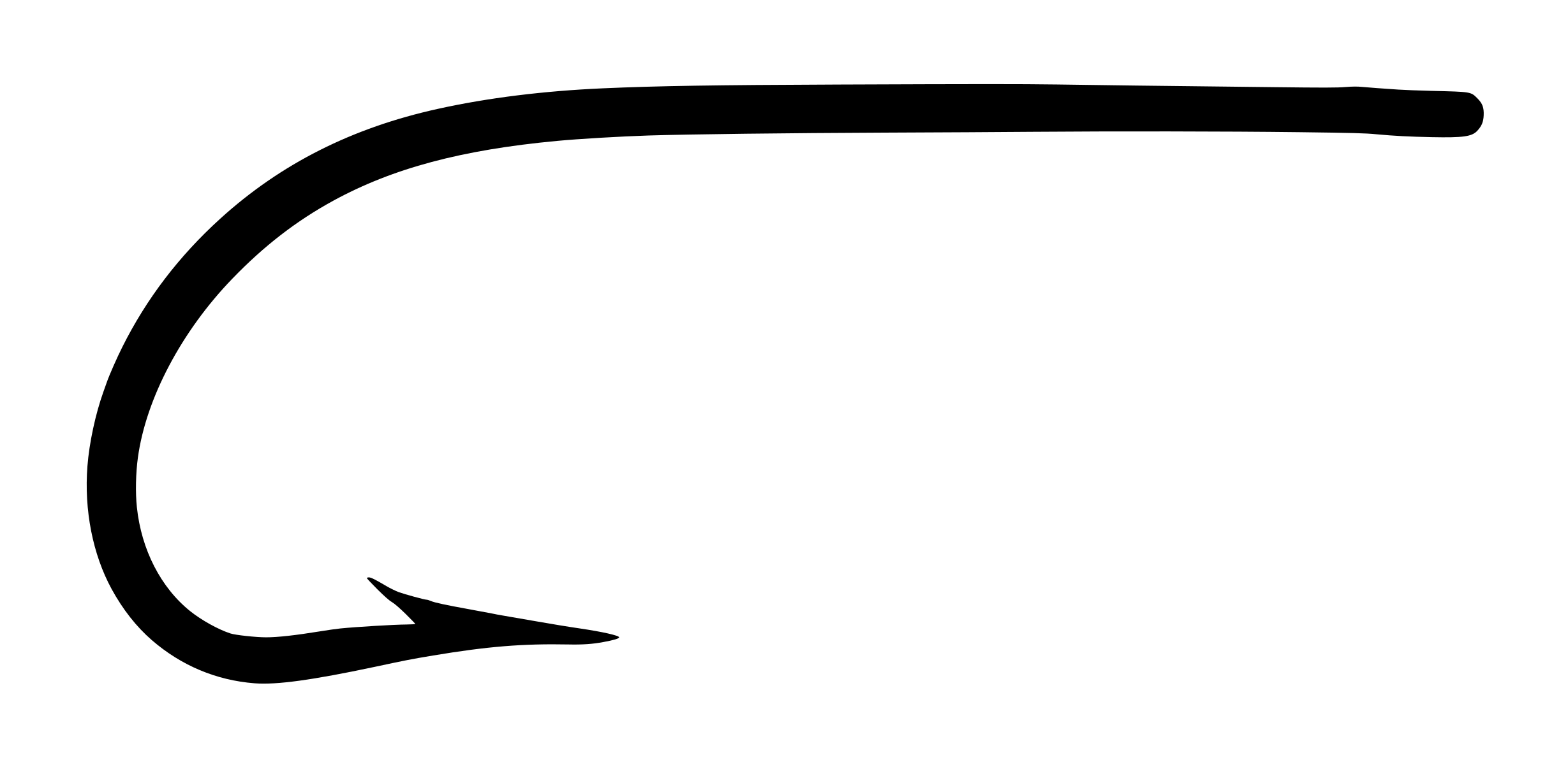
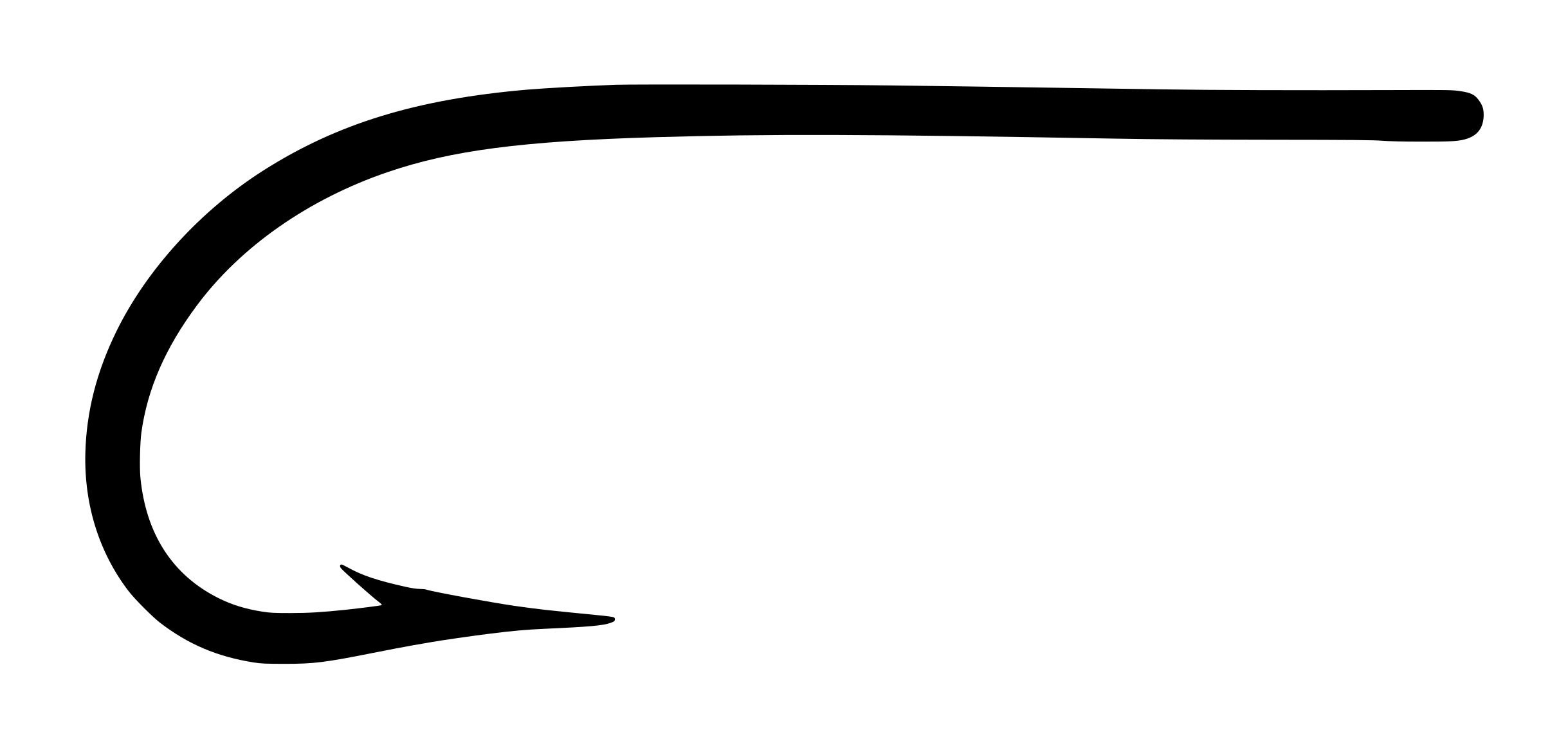
The Mustad Qual. 34081 is an extra-heavy forged O’Shaughnessy hook manufactured in Oslo, Norway, and distributed globally under the iconic Key Brand trademark. This is a salesman’s display card featuring four sizes (5/0, 3/0, 2/0, 1/0) finished in tinned silver, with hand-marked size annotations in period pencil.
The O’Shaughnessy bend is engineered for heavy-duty saltwater bait fishing—trolling and bottom work for large pelagics such as Tarpon, Grouper, and Cod. The forged wire increases structural rigidity without adding weight, and the large ring eye accommodates stiff wire traces and heavy monofilament leaders. The tinned finish was the standard anti-corrosive coating for saltwater applications before marine-grade stainless steel became cost-effective.
The red label with navy typography and Greek key border is a definitive marker of Mustad’s mid-20th-century export packaging era. The geographic origin ‘OSLO – NORWAY’ places production after 1925 (when Christiania was renamed Oslo); the absence of a barcode and the manual size notation suggest a 1930s–1960s production window. This card represents both a functional commercial tool and a significant artifact of Norwegian hook manufacturing at the height of Mustad’s global dominance.
The 34081 remains highly sought by vintage saltwater tackle collectors, maritime historians, and fly tiers working with classic big-game patterns. Its rarity as a complete, labeled display card elevates its value beyond a single hook specimen.
Salesman's display card showing four Mustad 34081 O'Shaughnessy hooks in tinned finish, each annotated with hand-marked size in purple pencil (5/0, 3/0, 2/0, 1/0 from left to right). The forged bend and large ring eye are clearly visible.
Photographic record
7 cataloged imagesSelect any record to load it above.
7 images shown
Mustad 34081 O’Shaughnessy Sizes 5/0–1/0 Tinned Display CardSalesman's display card showing four Mustad 34081 O'Shaughnessy hooks in tinned finish, each annotated with hand-marked size in purple pencil (5/0, 3/0, 2/0, 1/0 from left to right). The forged bend and large ring eye are clearly visible.Open originalMustad 34081 Red Label — Key Brand O’Shaughnessy SpecificationsClose-up of the iconic red paper label with navy ink typography, showing the complete eight-line Mustad label system: Key Brand logo, O. MUSTAD & SÖN MANUFACTURERS, OSLO - NORWAY, Qual. 34081, Superior (product line), Mustad–O'Shaughnessy Hooks, Forged / Large ring / Tinned, Made in Norway, and quantity (100).Open originalMustad 34081 Salesman Card — Full View on Measurement GridFull-view photograph of the complete salesman's display card mounted on a 1/10-inch measurement grid, showing the card's overall dimensions, Greek meander border design, label placement, and the four hooks mounted in their original positions. Card appears to be approximately 7" × 5" with four hooks securely affixed.Open originalMustad 34081 — All Around hook package labelOriginal Mustad All Around package label for model 34081 size 10/0 large ring hooks. Box contains 100 hooks and shows manufacturer details for Mustad & Son (U.S.A.) Inc. in New York.Open originalMustad 34081 — Size 10/0 O’Shaughnessy hookSingle Mustad 34081 size 10/0 O'Shaughnessy bend hook displayed on scale grid showing the characteristic sweeping curve and large ring eye. Tinned finish visible with slight age patina.Open originalMustad-34081-Hook-Size-10-0Mustad-34081-Hook-Size-10-0Open originalMustad-34081-Label-Size-10-0Mustad-34081-Label-Size-10-0Open original
Technical profile
O'Shaughnessy Bend, Extra-Heavy Forged Wire, Large Ring Eye, Tinned Finish, Sizes 5/0–1/0
Eye
Ball Eye, Straight / InlineLarge diameter ring eye, designed to accommodate heavy saltwater leaders and wire traces. Ring is heavily formed and symmetrical. P
Wire
Standard, Forged
Shank
Standard — Plain
Bend
O'Shaughnessy, Standard gapClassic O'Shaughnessy geometry with slightly incurved point and deep, sturdy parabolic-style bend. Distinctive squared shoulder at the transition from eye to bend. The bend sits deeper than standard patterns, engineered for heavy-duty saltwater work. P
Point
Superior (near-straight inner taper)Short, close-cut barb positioned at the junction of the bend — characteristic of O'Shaughnessy design. Barb is proportionate to the heavy wire gauge. P
Finish
Tinned — Confirmed (stated on packaging)Matte silver-grey tinned finish, characteristic of saltwater hooks from this era. Finish is even across the specimens shown, with minimal oxidation or patina despite age. Cool tone typical of electroplated tin coating. P
Display card shows light toning to the red paper, consistent with age and storage. All four hooks remain securely affixed and show minimal corrosion beneath the tinned finish. The pencil size annotations are faded but legible. No tears or significant wear to the card substrate.
The Mustad 34081 O’Shaughnessy exemplifies mid-century saltwater hook engineering. The ‘forged’ construction is critical: raw wire is placed in a mechanical drop-press and flattened along its lateral sides, dramatically increasing structural rigidity and tensile strength without adding weight or thickness. This prevents the hook from bending open or straightening under the sustained, violent runs characteristic of large pelagic species. The extra-heavy gauge (approximately 0.045–0.055 inch diameter) accommodates the crushing jaw pressure of offshore fish and corrosive saltwater environments. The large ring eye—rather than a tapered or looped eye—provides maximum strength and accepts heavy monofilament leaders and wire traces without stress concentration. The ‘Superior’ designation on the packaging is Mustad’s product line/brand name, not a technical point style descriptor; however, the point geometry is a near-straight taper, mechanically ground for penetration through dense bone and cartilage. The tinned finish (electroplated or dipped molten tin) provides exceptional saltwater corrosion resistance—the standard for commercial marine hooks before stainless steel economics became favorable in the 1970s–1980s.
We don't have measured sizes for this hook yet. Own one? Submit calipered measurements and we'll review and add them. Thank you!
Historical context
mustad
O. Mustad & Søn was founded in 1832 in Gjøvik, Norway, initially as Brusveen Spiger- og Staltradfabrikk, producing nails and steel wire. The company was taken over by Ole Hovelsen Mustad and his son Hans Mustad, who rebranded the firm as O. Mustad & Søn. In 1877, Mathias Topp, a visionary engineer within the company, invented the first fully automated hook-making machine—a revolutionary mechanization that allowed raw steel wire to be continuously fed, cut, bent, barbed, and pointed at unprecedented speeds. Rather than filing for patents (which would have required public disclosure), the Mustad family relied on strict corporate secrecy and non-disclosure agreements to maintain competitive advantage against rival manufacturers in Redditch, England, and emerging centers in Japan and the United States. By the 1950s, Mustad had secured approximately 50% of global hook production, establishing sales offices and manufacturing facilities across multiple continents. The company’s primary factory remained in Oslo (formerly Christiania) throughout the 20th century, serving as a hub for export to international wholesalers, tackle retailers, and individual anglers worldwide.
Series History
The O’Shaughnessy is one of the oldest and most iconic saltwater hook patterns in angling history. The pattern was reverse-engineered and standardized by Mustad in the late 19th and early 20th centuries, becoming the quintessential heavy-duty saltwater bait hook. The Qual. 34081 designation places it within Mustad’s mid-tier quality coding system (3000–3999 block = quality/mid-tier products manufactured to exacting tolerances). The forged, extra-heavy construction makes it suitable for commercial marine fisheries and high-end sport angling for large pelagics. This particular display card format—with four size variants mounted for salesman demonstration—is characteristic of Mustad’s sales and distribution strategy during the 1930s–1960s. The pattern remained in continuous production through the mid-20th century and exists in both carbon steel tinned and, later, stainless steel variants. The modern equivalent is the Mustad 34007 (Stainless Steel O’Shaughnessy), which maintains the same bend geometry but with improved corrosion resistance.
Era and Packaging Dating
The label bears the geographic origin 'OSLO - NORWAY,' which confirms production after 1925, when the city was officially renamed from Christiania. The red paper label with Greek key border design, navy ink typography, and Key Brand logo are characteristic of Mustad's mid-20th-century export card format. The absence of a barcode and the hand-marked size annotations in pencil/stamp are consistent with pre-1974 packaging. The card stock quality and offset print method suggest 1930s–1960s production window. This is a salesman's sample card or counter display, not a consumer box.
The Secret of Mustad's Global Dominance
By the 1950s, Mustad had captured approximately 50% of global hook production—a staggering market share achieved not through patents or publicity, but through corporate secrecy so stringent that Mathias Topp's 1877 automated hook-making machine was never publicly disclosed in mechanical detail. The Mustad family's decision to rely on restricted factory access and non-disclosure agreements instead of patent protection proved devastatingly effective: rival manufacturers in Redditch, England, and emerging centers in Japan and the United States could not reverse-engineer the technology without direct access to the factory floor. The result was that 'Mustad' became virtually synonymous with the fishing hook itself—a brand dominance so complete that many anglers today still think of fishhooks as inherently Norwegian.
Design lineage and influence
The O’Shaughnessy bend originated as a regional pattern in heavy saltwater fishing traditions, likely refined by British and Irish tackle makers in the 19th century. Mustad’s reverse-engineering and mass production of the pattern in the late 1800s and early 1900s standardized it globally. The 34081 sits in direct lineage between antique hand-forged saltwater hooks (e.g., from Redditch makers like Partridge or S. Allcock) and modern chemically-sharpened, stainless O’Shaughnessy hooks (Mustad 34007, Tiemco 811S, Gamakatsu SL12S). The pattern has influenced virtually every subsequent heavy saltwater hook design and remains the archetypal ‘big-game bait hook’ in contemporary tackle catalogs.
Best matchRelated by Attribute
Computed automatically from catalog data — updated as new hooks are added.
Heavy-duty saltwater bait fishing, particularly bottom fishing and trolling for large marine species. Engineered to withstand the crushing jaw pressure and sustained runs of offshore pelagics such as Tarpon, Grouper, and Cod. The large ring eye and extra-heavy forged wire are optimized for rigging large natural baits on wire traces and heavy monofilament leaders.
Secondary Applications
Classic saltwater fly patterns for Tarpon and heavy streamer applications; commercial marine fisheries.
Classic Fly Patterns
Tarpon Fly, Heavy Saltwater Streamer
Modern Equivalents
Hook
Match Quality
Notes
Mustad 34007
Excellent
Direct modern equivalent—identical O'Shaughnessy bend, heavy forged wire, large ring eye. Uses stainless steel instead of tinned carbon steel, improving long-term corrosion resistance. Chemically sharpened point.
Tiemco 811S
Very Good
Japanese O'Shaughnessy-style bend, stainless steel, extra-heavy wire. Slightly finer point geometry due to chemical sharpening. Excellent strength-to-weight ratio.
Gamakatsu SL12S
Good
Japanese heavy saltwater hook with O'Shaughnessy-inspired bend, stainless steel. Forged construction, large ring eye. Comparable in strength and saltwater utility.
Industry cross-reference
Saltwater streamer hook
Standard / long shank corrosion-resistant baitfish
Green entries are full records; amber entries are spec records.
Gray entries are chart-only and not physically verified against this specimen.
Collector notes
The Mustad 34081 is moderately scarce in display card format, particularly with all four size variants intact and original hand-marked annotations. Surviving salesman's sample cards are rarer than individual hooks, and the iconic Key Brand red label with Greek key border design appeals to both vintage tackle and industrial design collectors. Limited factors: O'Shaughnessy patterns are still in production, and individual hooks from this pattern are relatively common; condition and historical documentation of the card itself are the primary value drivers.
Reference value
$35 – $75 USD estimate
Packaging condition
Very Good — light wear, fully legibleRecorded specimen
Packaging format
GW-M-01Catalog code
Positive factors: This is a factory salesman’s display card—a functional commercial artifact rarely preserved in original condition. The red label is iconic and highly recognizable to vintage Mustad enthusiasts. The geographic origin ‘OSLO – NORWAY’ and pre-1925-to-1960 production window place it in Mustad’s industrial ascendancy. All four size variants are present and affixed. The tinned finish and forged construction are period-correct details highly valued by restoration-minded anglers. The card’s Greek key border framing and navy letterpress typography exemplify mid-century Scandinavian industrial design aesthetics. It is a documented, hand-marked artifact of mid-20th-century tackle distribution and sales.
Limiting factors: The O’Shaughnessy pattern itself remains in continuous production worldwide (Mustad, Tiemco, Gamakatsu still manufacture variants), reducing scarcity relative to discontinued patterns. Individual 34081 hooks are not rare—complete cards are. Damage to the card (tears, severe toning, loose hooks) significantly reduces value. The 34081 lacks the design novelty or specialized niche (e.g., a regional pattern or limited production run) that would elevate it to ‘rare’ status. Modern equivalent (Mustad 34007 Stainless) is widely available and inexpensive, reducing collector demand from working anglers.
Packaging
Red paper display card, approximately 7" × 5", with navy ink letterpress text. Top banner lists O. MUSTAD & SÖN MANUFACTURERS OSLO - NORWAY. Quality code Qual. 34081 is prominently displayed. Line 5 reads 'Superior' (product line name, not point style designation). Hook pattern identified as 'Mustad–O'Shaughnessy Hooks.' Lines 7 and 8 specify 'Forged Large ring Tinned Made in Norway.' Box quantity marked as 100 at bottom left. Card features iconic Key Brand logo (skeleton key) at top left. Greek meander border frame in navy surrounds entire card face. Sizes 5/0, 3/0, 2/0, and 1/0 are hand-annotated in purple pencil on the four hook specimens mounted directly to the card. No manufacturing barcode present.
Market Value Notes
Complete display cards with all four sizes intact and original hand-marked annotations command $40–$75 USD on specialist vintage tackle platforms (eBay, Etsy, specialist dealers). Condition of the card substrate (toning, creasing, paper integrity) and presence of legible size markings drive pricing within this range. Individual loose 34081 hooks in tinned finish typically sell for $3–$8 each, making a four-hook card desirable only to collectors seeking the card itself as a historical artifact rather than as a source of usable hooks. Cards with missing hooks or significant damage sell for $15–$30. Pricing varies by platform; specialty vintage tackle dealers and maritime museums may value the card higher for historical documentation purposes.
Where to Find
eBay (vintage tackle category, often listed under 'Mustad salesman card' or 'display card'); Etsy (vintage fishing tackle dealers); specialist vintage tackle fairs and auctions; maritime and fishing museums; private collections of Mustad enthusiasts and industrial design historians.
Preservation
Storage and Preservation
Store this display card in a cool, dry environment away from direct sunlight and fluctuating humidity. The red paper label is susceptible to fading with UV exposure and color shift with moisture absorption. Ideally, store the card in a flat, archival-quality folder or sleeve to prevent creasing and paper deterioration. Keep away from other metal objects to avoid galvanic corrosion between the tinned hooks and ferrous metals. If the card shows light toning or foxing (age spots), this is normal and generally considered desirable by collectors as evidence of authenticity. Do NOT attempt to clean the label or hooks with abrasive materials—gentle handling and stable storage preserve the specimen far better than restoration attempts. The original hand-marked size annotations in pencil are a key element of provenance; protect them from erasure or disturbance. If hooks become loose, consider professional conservation rather than re-mounting, which could damage the original card substrate.
Marking Analysis
Hand-Marked Size Annotations
Each hook specimen is annotated with a size marking in purple pencil: 5/0, 3/0, 2/0, 1/0 (from left to right). The handwriting is steady and confident, consistent with a professional warehouse worker or salesman’s marking rather than a casual collector’s notation. The pencil ink tone and fading pattern suggest these marks were applied during or shortly after the card’s initial manufacturing/distribution era, likely 1930s–1950s. The placement of each numeral is directly above or to the side of the corresponding hook, indicating this card was used as a functional reference tool for demonstrating available sizes to tackle shop owners. The preservation of these annotations is historically significant, as they document the card’s original purpose as a salesman’s sample and provide evidence of pre-sale inventory management.
Primary Source
Label Text Decryption
Source: Red paper display label, O. Mustad & Son, Oslo, Norway, c. 1925–1960
The red label follows Mustad’s standardized eight-line vintage labeling format. Key Brand logo and text establish the brand identity. O. MUSTAD & SON / MANUFACTURERS identifies the manufacturer and corporate function. OSLO – NORWAY confirms geographic origin and production after 1925. Qual. 34081 is the model/quality code, designating this as a mid-tier product within the 3000–3999 range. Superior (Line 5) This line is reserved exclusively for hook point specification. On this label, ‘Superior’ denotes the point style—a near-straight inner taper characteristic of superior-point geometry, providing durability and reliable penetration without the extreme delicacy of hollow points. Mustad–O’Shaughnessy Hooks (Line 6) names the standardized pattern. Forged / Large ring / Tinned (Lines 7–8) specify the physical attributes: mechanical drop-press flattening for strength, large-diameter ring eye for heavy leaders, and electroplated tin coating for saltwater corrosion resistance. 100 / No. at the bottom left indicates this box/card contained 100 hooks (standard retail/wholesale count for the era). Made in Norway confirms Scandinavian origin and quality assurance messaging to international buyers. The Greek meander border frame in navy ink is decorative, but also served as a visual security/authenticity marker on mid-century Mustad export cards.
Additional
Salesman's Sample Card — Commercial Artifact
This is not a standard consumer retail box, but a salesman’s sample or counter display card used by traveling representatives to show tackle shop owners the range of available sizes for the Qual. 34081 O’Shaughnessy pattern. Such cards were critical sales tools in the pre-digital era, allowing merchants to visualize product variants without maintaining full inventory. The display format—four sizes mounted side-by-side on a single card with branded labeling—enabled rapid comparison and order placement. The presence of four actual hooks (rather than illustrations or printed descriptions) is key: it allowed the retailer to feel the wire weight, assess the ring eye size, and inspect the tinned finish firsthand. These sample cards were often annotated with pricing, stockist information, or distribution notes before being distributed to regional sales networks. The preservation of hand-marked size annotations suggests this particular card circulated actively in the field, being used repeatedly as a reference tool. For collectors, a complete salesman’s card with all hooks intact and original annotations represents a rare intersection of industrial design history, commercial distribution logistics, and fishing tackle heritage.
Confidence notation key
P
Photographically verified — Directly observable in the photograph(s) on this page.
V
Verified by documentation — Confirmed by manufacturer catalog, spec sheet, or published reference.
I
Inferred — A logical deduction from observable or documented evidence, not directly stated.
E
Estimated — An approximation based on visual comparison, proportional analysis, or limited data.
S
Speculative — A reasoned hypothesis that cannot be confirmed from available evidence.
Claims with no notation are confirmed by multiple independent sources. All photographs on garrenwood.com are taken on a measurement grid where each square equals 1/10 inch (0.1″ / 2.54 mm).