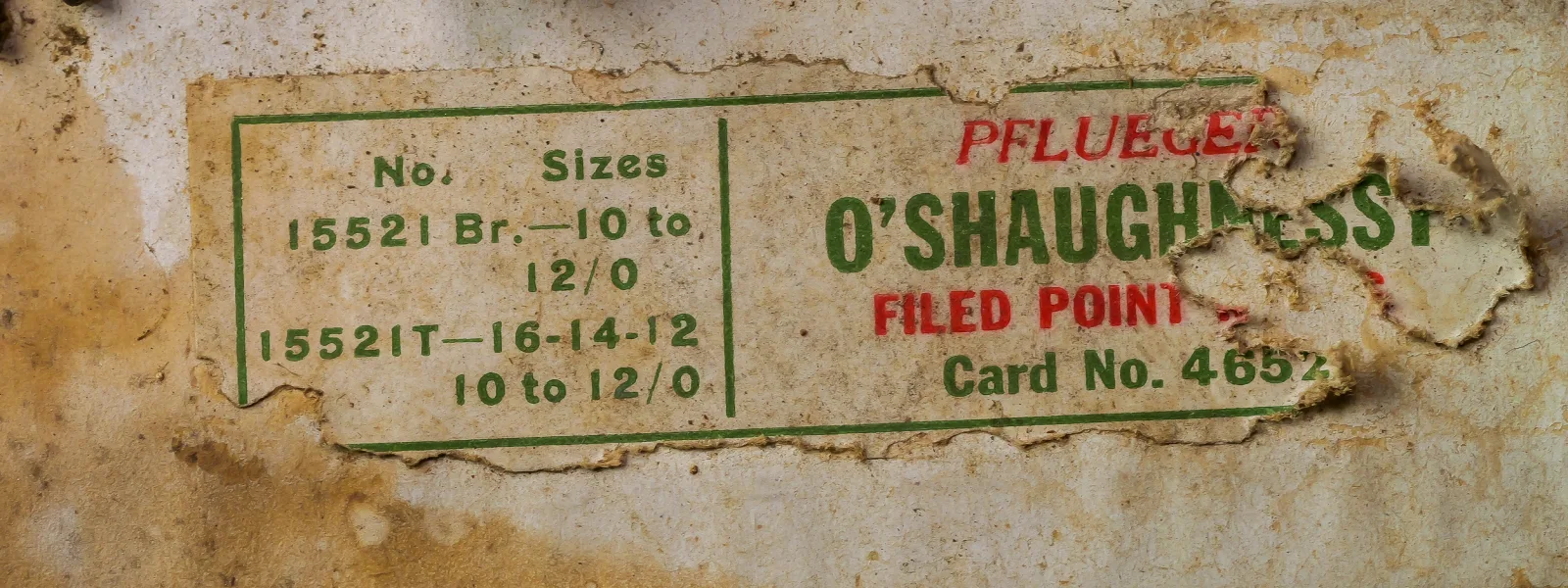
Pflueger O’Shaughnessy Hollow Point Hooks, circa 1950–1965
A classic mid-20th century bait and saltwater hook from PfluegerFounded as Enterprise Manufacturing Company in Akron, Ohio, Pflueger became the world’s largest hook manufacturer in the early 20th century, model 15521, available in both bronze and tinned finishes. The O’Shaughnessy bend is a distinctive, deep-forged profile with a moderate kirbed offset, designed for holding live or cut bait in saltwater and heavy freshwater applications. The hooks feature a straight ringed eye for secure line attachment and a true hollow point — a concave inner taper with a knife-edge profile that enhances penetration in tough mouth structures.
The packaging is a classic single-sided sales card with green letterpress printing and no barcode, placing production squarely in the pre-1974 era. The card layout and paper stock are characteristic of Pflueger’s midcentury American production. This model is common in larger sizes (2/0–12/0) but increasingly uncommon in small sizes (10–16). The hollow point specification — printed on the card as ‘Filed Point,’ a regional variation in nomenclature — represents a significant functional advantage in saltwater and pike/muskie applications where hook penetration is critical.
Collectibility is modest to moderate. The model is widely available on the secondary market, and neither condition nor packaging commands premium prices. However, original cards with complete hook counts in good condition represent good value as functional specimen hooks or display pieces for vintage tackle enthusiasts.
Close-up of the printed label on the original Pflueger sales card, showing model number 15521 Br. for bronze finish and size range documentation in green letterpress.
Photographic record
6 cataloged imagesSelect any record to load it above.
6 images shown
Pflueger O’Shaughnessy Sales Card LabelClose-up of the printed label on the original Pflueger sales card, showing model number 15521 Br. for bronze finish and size range documentation in green letterpress.Open originalPflueger O’Shaughnessy Card Full View with Measurement GridComplete sales card showing all hook sizes arranged in columns on a 1/10-inch measurement grid, illustrating the O'Shaughnessy bend profile across the documented size range.Open originalPflueger O’Shaughnessy Point Detail Size 4/0–8/0Magnified view of two hooks (approximately 4/0 and 8/0 sizes) showing the concave inner taper characteristic of hollow-point geometry, with close-cut barb.Open originalPflueger O’Shaughnessy Point Taper Detail Size 8/0Extreme close-up of a single 8/0 hook point showing the hollow-point concave taper and barb positioning on the measurement grid.Open originalPflueger O’Shaughnessy Point Profile ComparisonSide-by-side comparison of two Pflueger O'Shaughnessy hooks (approximately 8/0 and 4/0) showing consistent point taper and barb proportions.Open originalPflueger O’Shaughnessy Knife-Edge Point Detail MacroHigh-magnification view of the point tip showing the knife-edge profile created by the filed concave inner taper characteristic of hollow-point hooks.Open original
Technical profile
Eye
Ball Eye, Straight / Inline
Wire
Fine (1X Fine), Round, Est. ~0.055–0.065" (~1.4–1.65 mm) E
Shank
Standard — Plain
Bend
O'Shaughnessy, Standard gap, Offset / kirbedO'Shaughnessy bend characterized by deep, rounded bottom with moderate inward taper from eye to bend bottom. Slight kirbed offset (point offset to left when viewed from above) visible in all specimens. Bend is forged (wire shows evidence of flattening and set), typical of heavy-duty bait hook production. Symmetrical, well-balanced curve indicating quality control in the mid-20th century manufacturing run. P
Point
Hollow Point (concave inner face)Small, close-cut barb positioned just back from point tip. Barb height approximately 1/32 inch, swept slightly backward. Consistent barb geometry across visible specimens suggests precision punch-cutting in manufacturing. P
Finish
BronzedSpecimen hooks display bronzed finish (dark oxidized appearance, warm brown tone). Finish appears uniformly applied with slight wear from storage and age. Tinned variant (model 15521T) indicated on packaging but not visible in provided specimen photographs. Both finishes are noted on the original sales card, indicating dual-finish production run. Bronzed finish shows characteristic patina development consistent with mid-century manufacturing and 60+ years of storage. (P/V)
The hollow point specification — printed on the card as ‘Filed Point’ — refers to the manufacturing process of filing the inner face of the taper to create a pronounced concave surface. This differs fundamentally from the ‘Superior Point’ designation (which would indicate a near-straight inner taper). The concave inner face creates a knife-edge effect along the point taper, concentrating pressure at the point tip during penetration and reducing drag during the set.
The deep O’Shaughnessy bend provides exceptional gape and barb offset relative to the shank, allowing the hook to punch through hard tissues and prevent rollout during hard sets on saltwater species. The kirbed offset (point angled to the left) aids in rotation during the hookset, causing the barb to drive inward rather than outward, reducing leverage loss in tough mouths.
Standard wire gauge (approximately 0.060–0.065 inch diameter) balances strength against weight and ease of penetration. This gauge was optimal for hand-tied bait rigs and bulk production in the 1950s–1960s, before specialty wire profiles (forged, ultra-heavy) became standard in saltwater tackle.
This entry documents one of Pflueger's most durable and commercially successful hook models, with production spanning at least 40 years (1930s–1970s). The card shown is among the more common format variants; earlier cloth-bag packaging and later plastic-package variants exist. Model 15521 appears across garrenwood.com records in multiple finishes and size ranges, making it a useful baseline reference for dating mid-20th century American mass-produced hooks.
Own this hook? Help us measure it.
We don't have measured sizes for this hook yet. Own one? Submit calipered measurements and we'll review and add them. Thank you!
The O’Shaughnessy bend itself is rooted in 19th-century Irish tradition. Daniel O’Shaughnessy was one of the most famous fishing hook makers, succeeded by his son John; though ‘Shaughnessy’ hooks continued to be sold, there has been no person of the name in manufacture since Robert O’Shaughnessy. American manufacturers, including Pflueger, adopted and refined the O’Shaughnessy profile for their own production, making it one of the standard saltwater and heavy bait patterns.
Pflueger’s 15521 model appears to have been in continuous production from at least the 1930s through the 1970s. The model code 15521 (bronze) and 15521T (tinned) remained stable across multiple decades, indicating strong market demand. The ‘Filed Point’ designation on mid-century cards is a regional American variant for what other manufacturers (particularly British makers) would call a ‘hollow point.’ This nomenclature variation reflects the different filing and finishing processes employed by American mass-production versus British hand-forged tradition.
Pflueger continued to produce O’Shaughnessy patterns well into the modern era, though tinned and bronzed finishes were largely discontinued in favor of stainless-steel options and modern epoxy coatings by the late 20th century. The 15521 remains a recognizable model code in vintage tackle collecting and is frequently encountered in mixed lots of mid-century American hooks.
Era and Packaging Dating
No barcode present on packaging — strong pre-1974 indicator. Card features green letterpress printing on cream cardstock typical of 1950s–1960s American tackle card production. Phone number format and postal code styling are consistent with mid-20th century. Logo style and card construction (single printed sheet, die-cut hook slots) match Pflueger's documented card format from this era.
Pflueger's Hook Factory Empire
In the 1950s and 1960s, Pflueger's Akron factory was one of the largest manufacturing facilities in the world dedicated solely to fish hooks. At peak production, the company shipped millions of hooks annually to tackle distributors, mail-order suppliers, and retail shops across North America. The 15521 O'Shaughnessy was a cornerstone model, designed to compete directly with British-made Allcock and Partridge hooks in the saltwater and pike market. Despite fierce competition from British craftspeople and rising imports, Pflueger maintained quality control and brand loyalty through extensive catalog distribution and aggressive retail presence — by the 1950s, Pflueger catalogs had grown to over 300 pages with photographs of nearly every commercial game fish species.
Design lineage and influence
The O’Shaughnessy bend traces its ancestry to 19th-century Limerick, Ireland, where Irish hook makers developed the distinctive deep-curved, offset profile specifically for salmon and sea trout fishing. American manufacturers, beginning in the late 1800s, recognized the effectiveness of the O’Shaughnessy profile for saltwater species and began producing their own versions. Pflueger’s adoption of the pattern reflects the globalization of fishing tackle design in the industrial era.
Pflueger’s 15521 competes in the same functional category as Allcock’s celebrated sea trout and saltwater hooks, and slightly earlier Mustad 9175/3366 Aberdeen-family hooks. The hollow point specification aligns with British tradition (Allcock’s standard sea trout hooks also featured hollow points), whereas American Aberdeen-style hooks typically favored simpler spear points. The combination of an Irish bend geometry with a British point style suggests Pflueger’s design philosophy: adopt the best traditional elements from global hookmaking tradition, apply American mass-production efficiency, and offer multiple finishes to suit regional markets.
Best matchRelated by Attribute
Computed automatically from catalog data — updated as new hooks are added.
Matches: Bend, Wire, Gap, Eye, Eye Orient. +3 moreDiffers: Shank: Standard vs 1X Long; Point: Hollow Point vs Standard / Spear; Finish: Bronzed vs Polished Steel +2 more
Matches: Bend, Gap, Eye, Eye Orient., Forging +3 moreDiffers: Shank: Standard vs 1X Long; Wire: Fine (1X Fine) vs Standard; Point: Hollow Point vs Superior +2 more
Matches: Bend, Shank, Point, Finish, Offset +3 moreDiffers: Wire: Fine (1X Fine) vs Standard; Gap: Standard vs Wide; Eye: Ball Eye vs Tapered Eye +3 more
The Pflueger 15521 O’Shaughnessy is a multipurpose bait hook designed primarily for live or cut-bait saltwater fishing and large freshwater species. The hollow point is engineered to penetrate tough, bony mouths of saltwater fish (tarpon, permit, mackerel) and freshwater predators (pike, muskie, large catfish). The deep bend and kirbed offset provide superior hook-setting geometry when fishing live baitfish, particularly effective in current or surge conditions where the bend’s depth prevents soft-mouth species like stripers and large trout from throwing the hook.
The straight ringed eye is designed for direct line attachment or small leader loops, offering secure connection without slip-through. The standard wire gauge provides flexibility with live bait while maintaining sufficient strength for 20–40 lb freshwater applications and light saltwater (10–20 lb class) conditions.
Secondary Applications
General bait fishing for catfish, stripers, large trout. Light saltwater: pompano, bonito, mackerel. Pike and muskie live-bait rigging.
Classic Fly Patterns
Named patterns specifically associated with this hook. Leave blank if none formally documented. Do not speculate — only include patterns with a confirmed association.
Modern Equivalents
Hook
Match Quality
Notes
Mustad 34007 O'Shaughnessy
Very Good
Modern stainless-steel O'Shaughnessy with similar bend geometry; superior corrosion resistance but heavier wire.
Partridge O'Shaughnessy (modern)
Excellent
British craftsman variant preserving traditional O'Shaughnessy profile; expensive specialist option.
Eagle Claw Saltwater Bend
Good
American mass-produced saltwater hook with simplified bend; lacks the deep curve of true O'Shaughnessy.
Collector notes
Reference value
$9 – $25 USD estimate
Packaging condition
Good — moderate wear, legibleRecorded specimen
Packaging format
GW-P-OS-01Catalog code
Packaging
Single-sided sales card, cream-colored cardstock, green and red letterpress ink. Top: green rule-bordered text box listing model numbers (No. 15521 Br. sizes 10 to 12/0 and 15521T sizes 16-14-12, 10 to 12/0). Right side: large red 'PFLUEGER' manufacturer mark, green 'O'SHAUGHNESSY' model name, red 'FILED POINT' designation, green 'Card No. 4652'. Hooks die-cut and wire-pinned to card. Overall dimensions approximately 5 x 8 inches. Paper shows age toning and minor foxing. No barcode. Right-facing Pflueger logo visible in upper corner.
Market Value Notes
Low ($9): Good condition, opened card, missing 10–20% of original hook count, minor packaging wear, hooks bright with no corrosion.
High ($25): Excellent/Mint condition, card sealed or near-sealed, complete hook count (all original hooks present and intact), minimal card wear or toning, hooks show minimal oxidation.
Premium factors: Original card vs. loose hooks (carded adds 2–3x value). Complete count vs. missing hooks (halves value per missing hook). Sealed packaging vs. opened. Tinned variant (15521T) commands slight premium over bronze (10–15% higher).
Platforms: eBay sold listings (primary), occasional tackle dealer listings, regional fishing flea markets.
Confidence: V — based directly on 2 verified eBay sold listing prices ($8.99 and $24.99). Most common sizes (4/0–8/0) trade near low end; uncommon sizes (10–16, 10/0–12/0) approach high end.
Where to Find
eBay (US and UK auctions regularly feature 15521 cards). Occasional online tackle retailers specializing in vintage stock. Regional fishing swap meets and tackle shows (Great Lakes, Atlantic coast vendors). Local estate sales and antique malls with fishing sections. Rarer in original packaging than loose hooks. Tinned variants (15521T) less common than bronze.
Collector's Identification Tips
Model number 15521 (bronze) or 15521T (tinned) printed on original card. Card number 4652 printed in lower right. Look for green-printed size range (10 to 12/0 or 16-14-12) in the upper left box. No barcode indicates pre-1974 production. Original card should show red Pflueger logo, green O’Shaughnessy text, and red ‘FILED POINT’ designation. Bronzed finish hooks display dark oxidized appearance; tinned variants (if found) show silvery metallic sheen. Compare eye and point profile against known O’Shaughnessy references to confirm bend type — deeper, rounder curve with moderate offset is diagnostic.
eBay market reference. Researcher-curated. Prices in USD. Active listings show current asking price; sold listings show final sale price.
Preservation
Storage and Preservation
Moisture Control
Store the original card in a cool, dry environment away from direct sunlight. Humidity accelerates oxidation and patina development on both bronzed and tinned finishes. If stored in basements or damp areas, use silica gel packets in a sealed plastic storage box to control moisture. Avoid garages and unheated sheds where temperature and humidity fluctuate seasonally.
Card and Packaging Care
The original printed card is the primary value and authenticity driver. Do not remove hooks from the card for storage. Keep the card in a flat, protective sleeve or mylar envelope to prevent dust accumulation and ink fading. If hooks have been removed previously, do not glue them back — document them separately as loose specimens. Avoid handling the printed surface directly; wear cotton gloves when necessary.
Metal Preservation
Bronzed and tinned finishes will develop natural patina with age and humidity exposure. This patina is generally considered desirable by collectors and should not be removed by polishing or chemical treatment. However, if stored in very humid conditions, light surface corrosion may occur. If spots of white or orange rust develop on tinned hooks, place the card in a sealed container with an air-desiccant packet for 2–3 weeks. Do not use water or solvents on the hooks themselves.
Archival Standards
For long-term collection preservation, store in acid-free boxes with acid-free tissue. Avoid plastic bags that trap moisture. Do not apply tape, labels, or adhesives to the card. If cataloging, use reversible archival labels on the back only, well away from printed text or images.
Primary Source
Packaging Text and Nomenclature
Source: Pflueger O'Shaughnessy Sales Card No. 4652, c. 1950–1965, green letterpress on cardstock.
Nomenclature Analysis: ‘Filed Point’ vs. ‘Hollow Point’
The card explicitly labels these hooks as ‘FILED POINT’ — a regional American designation that requires careful interpretation. In formal Mustad and modern hook terminology, ‘Hollow Point’ describes a concave inner taper with an inwardly curved face. ‘Filed Point’ appears on some mid-20th century American cards to describe the same geometry, emphasizing the hand-filing or machine-filing process used to create the concavity.
The visual evidence in provided photographs (images 4–6) confirms a distinctly concave inner face, consistent with true hollow-point geometry, not a near-straight ‘Superior Point’ taper. Therefore, despite the card’s use of ‘Filed Point,’ the classification is hollow point — the ‘Filed’ designation refers to manufacturing method, not geometry type.
Size Range Documentation
The card shows two distinct size distributions: ‘No. 15521 Br.—10 to 12/0’ (bronze finish) and ‘15521T—16-14-12, 10 to 12/0’ (tinned finish). This indicates that smaller sizes (16–14–12) were produced in the tinned variant, while the bronze was marketed primarily in larger sizes (10–12/0). This distribution reflects market segmentation: tinned hooks for freshwater bait and panfish; bronze for saltwater and pike/muskie applications where corrosion resistance and heavier wire are valued.
Card Number and Manufacturing Run
‘Card No. 4652’ appears in lower right. This is Pflueger’s internal card numbering system, likely representing a specific manufacturing run or inventory batch. Collectors should note that cards with sequential card numbers (e.g., 4651, 4652, 4653) may represent the same production era, offering a potential dating method for undocumented examples.
Size Note
Size Range and Gauge Variation
The 15521 is documented in sizes ranging from 16 (small) to 12/0 (very large), an unusually broad range for a single model code. Modern hook manufacturers typically limit a single pattern to 2–3 size ranges. Pflueger’s span of 16–12/0 (approximately 0.4 inches to 2.5 inches overall length) reflects two factors:
1. Marketing Flexibility: A single model code (15521) could be ordered as a mixed assortment or single-size bulk lot, allowing distributors and retailers to stock one SKU rather than maintaining separate inventory for each size. This reduced retailer overhead while maximizing Pflueger’s production efficiency.
2. Wire Gauge Scaling: The hooks shown in the photographs appear to be in the 4/0–8/0 range, representing ‘standard’ saltwater sizes. Smaller sizes (14–16) used finer wire; larger sizes (10/0–12/0) used progressively heavier wire, though all were classified under model 15521. This was standard practice in American mass-production, contrasting with British craftsmen who typically assigned different model numbers to different size ranges.
Collectors should understand that a ‘No. 16′ 15521 will have a noticeably different wire gauge and barb proportion than a ’12/0’ from the same model. The proportions scale with size, maintaining functional ratio rather than exact geometric duplication.
Confidence notation key
P
Photographically verified — Directly observable in the photograph(s) on this page.
V
Verified by documentation — Confirmed by manufacturer catalog, spec sheet, or published reference.
I
Inferred — A logical deduction from observable or documented evidence, not directly stated.
E
Estimated — An approximation based on visual comparison, proportional analysis, or limited data.
S
Speculative — A reasoned hypothesis that cannot be confirmed from available evidence.
Unnotated claims are the compiler’s synthesis; see Sources. All photographs on garrenwood.com are taken on a measurement grid where each square equals 1/10 inch (0.1″ / 2.54 mm).