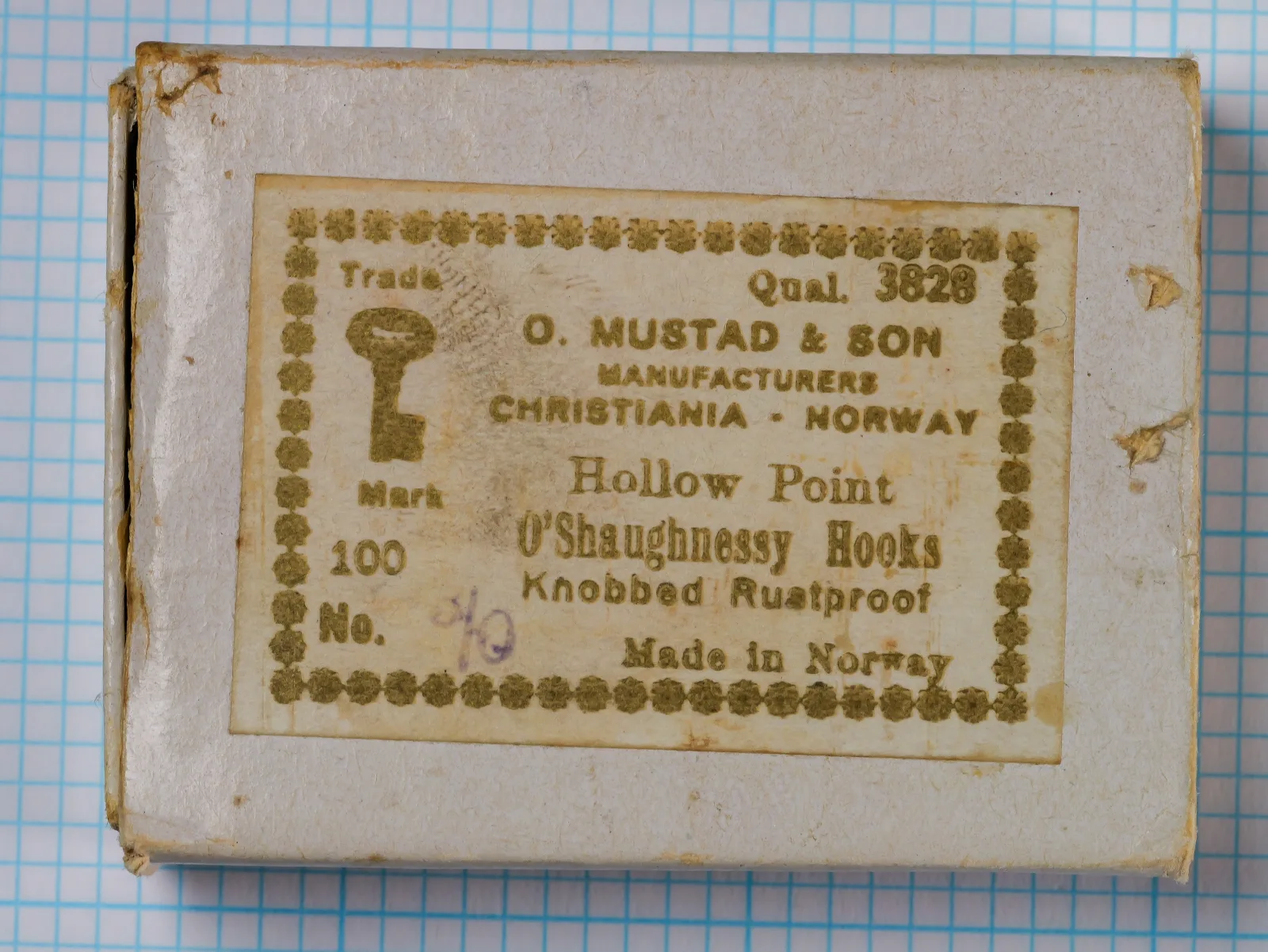
The Mustad Quality 3828 is a heavy-gauge, O’Shaughnessy-pattern bait hook manufactured in Christiania, Norway, between 1900 and 1924. The Christiania designation on the original label places this hook in the firm’s initial major expansion into American and global export markets, before the city’s January 1, 1925 rename to Oslo.
This 3/0 specimen exemplifies early-20th-century commercial saltwater and heavy freshwater bait-fishing practice. The blind, flatted shank end was designed to be ‘snelled’—a meticulous rigging technique where a soaked silkworm-gut leader was whipped directly to the shank using fine silk thread, creating an exceptionally strong, direct pull without the mechanical weaknesses of an eye.
The Hollow Point geometry provides rapid tissue penetration with minimal force, while the O’Shaughnessy’s distinctive angular bend distributes the strain of a fighting fish across the strongest arc of the steel. The ‘Rustproof’ finish notation refers to a bronzed or chemically treated surface designed to resist saltwater corrosion—a critical feature for commercial marine fisheries of the era.
This hook represents a crucial intersection of industrial manufacturing prowess and regional fishing tradition. Mustad’s strategy of reverse-engineering localized patterns—like the O’Shaughnessy from sea-fishing centers—and producing them at industrial scale fundamentally altered the global fishing tackle market. Original Christiania-era packaging is both a chronological artifact and a tangible record of Mustad’s dominance at the turn of the 20th century.
The original retail box for the Mustad Quality 3828, showing the eight-line label with the definitive 'CHRISTIANIA - NORWAY' designation, skeleton-key Key Brand trademark, and period typography. The label's pristine legibility and intact border design are characteristic of Christiania-era Mustad packaging.
Photographic record
5 cataloged imagesSelect any record to load it above.
5 images shown
Mustad Quality 3828 Original Box Christiania LabelThe original retail box for the Mustad Quality 3828, showing the eight-line label with the definitive 'CHRISTIANIA - NORWAY' designation, skeleton-key Key Brand trademark, and period typography. The label's pristine legibility and intact border design are characteristic of Christiania-era Mustad packaging.Open originalMustad Quality 3828 Hollow Point DetailClose-up of the hook point showing the characteristic concave, dished-out Hollow Point geometry. The razor-sharp tip and rapid flare toward the barb are clearly visible, demonstrating the specialized grinding technique that enabled rapid tissue penetration with minimal applied force.Open originalMustad Quality 3828 Full Hook ProfileFull side profile of the Mustad 3828 showing the O'Shaughnessy bend geometry, heavy-gauge round wire, and the flatted, spade-like shank end characteristic of blind-eye construction designed for snelling.Open originalMustad Quality 3828 Bend Geometry ComparisonTwo Mustad 3828 hooks positioned to display the bend geometry and relative scale. The parabolic-to-angular O'Shaughnessy bend profile and the consistent heavy-gauge wire are clearly visible across both specimens.Open originalMustad Quality 3828 Knobbed Shank End DetailClose-up of the flatted, spade-like shank end showing the knobbed construction designed for traditional snelling. The flattened surface prevented silk-thread whipping from slipping under tension.Open original
Technical profile
Eye
Blind — Knobbed ShankBlind, flatted shank end P. The terminal shank is mechanically flattened into a small spade-like shape, creating a flat, slightly widened terminus approximately 0.06"-0.08" wide. This flatted geometry prevents a snell knot (silk thread whipping) from slipping off the shank under tension. The flat surface provides a strong mechanical anchor point for the traditional gut-snell rigging technique. No formed loop or ring is present.
Wire
Fine (1X Fine), Round
Shank
Standard — Plain
Bend
O'Shaughnessy, Standard gapO'Shaughnessy bend exhibits the characteristic parabolic-to-angular hybrid curve typical of the pattern P. The bend bottom is slightly angular relative to a pure Sproat, with the deepest arc approximately two-thirds of the way down the bend from the shank. Wire set is clean and symmetrical. The bend distributes stress evenly across its entire arc, making it highly resistant to straightening under sustained load.
Point
Hollow Point (concave inner face)Barb is short, close-cut, and highly angled, placed at the lower transition from taper to point base P. The barb geometry is consistent with Hollow Point specification—the short barb works in concert with the concave point to create rapid tissue penetration and hold without excessive entry wound expansion.
Finish
Bronzed — Inferred (photographically likely)Bronzed finish P — a baked-on lacquer coating chemically formulated to mimic the dark brownish-gold hue of bronze alloy. The specimen exhibits a rich, warm olive-brown tone characteristic of period bronzing processes. The finish appears uniform across both hook surfaces and barb. No evidence of flaking or separation from the steel substrate, indicating effective corrosion sealing. The coating is darker and more opaque than a simple blued or polished finish, providing superior saltwater corrosion resistance relative to uncoated or japanned alternatives of the same era.
The hooks themselves are in excellent condition, displaying bright steel with no visible corrosion or damage. The original packaging (box and label) is in fair condition, with expected age-related toning, minor creasing, and light foxing. The label remains legible and the card stock is structurally sound.
The Hollow Point geometry on this hook represents Mustad’s application of specialized point-grinding to achieve rapid penetration with minimal applied pressure—a critical advantage when rigging live bait presentations where a violent hook-set might rupture the bait’s delicate internal organs. The concave, dished-out inner face of the hollow point creates an exceptionally fine, razor-sharp tip that flares rapidly toward the barb, ensuring secure hold in soft tissue without creating an entry wound so large that the hook could tear free during a fight.
The O’Shaughnessy bend pattern, inherited from traditional sea-fishing centers, combines the holding power of an angular bend with the even stress distribution of a parabolic curve. This hybrid geometry allows the hook to withstand the crushing pressure of large fish jaws while resisting the sudden jerking stresses of powerful runs and head-shakes.
The heavy-gauge round wire (approximately 0.041″-0.047″) was not forged in the cold-press sense but rather left in its natural round cross-section, providing maximum material strength relative to diameter. This balance of diameter and mass was critical for commercial fisheries where hooks would encounter underwater obstacles (rocks, logs, coral) and needed to resist bending while remaining small enough for practical bait rigging.
The ‘Rustproof’ finish—a bronzed lacquer coating—was Mustad’s pre-standardization answer to saltwater corrosion. This baked-on chemical preparation adhered strongly to the high-carbon steel and provided longer-term protection than simple bluing, making it ideal for commercial marine operations where hooks might spend days or weeks in saltwater brine.
The Quality 3828 belongs to Mustad’s broad catalog of heavy-gauge, commercial bait-hook patterns, positioned in the 3000-3999 numeric tier reserved for mid-tier products manufactured to exacting dimensional and tempering standards. Within this tier, the O’Shaughnessy pattern was available in multiple configurations: blind-eye (snelled) versions for traditional commercial rigging; ringed-eye variants for modern knotted presentations; and specialized finishes (Rustproof, Tinned, Japanned, Bronzed) matched to specific saltwater or freshwater environments.
The 3828 specifically represents the Christiania-era production of the O’Shaughnessy with Hollow Point geometry and blind, flatted-shank construction. Production likely extended through the 1920s-1930s under the Oslo designation, though surviving examples with Christiania markings are demonstrably pre-1925. The model was eventually superseded by eyed variants and modern quality codes during Mustad’s mid-20th-century rationalization of its catalog, though the fundamental O’Shaughnessy geometry remained in production continuously.
This is not a standalone specialty model but rather a standard-production commercial offering within Mustad’s vast catalog matrix. Its significance lies not in uniqueness but in its status as a foundational example of early industrial hook manufacturing and global distribution.
Era and Packaging Dating
The definitive dating indicator is the 'CHRISTIANIA - NORWAY' designation on Line 3 of the label. The Norwegian capital was officially renamed from Christiania to Oslo on January 1, 1925. Any Mustad packaging bearing the Christiania name must have been manufactured in 1924 or earlier. The label format is consistent with Mustad's rigid eight-line typographic structure documented in the reference material. The absence of a barcode, period typography, and hand-marked size (purple ink '3/0') further support an early-20th-century production date. No modern ZIP/postal codes or phone number formats are visible, confirming pre-modern era. The use of 'Rustproof' finish nomenclature (rather than later standardized terms like 'Tinned' or 'Japanned') and the knobbed/blind-eye construction are characteristic of the pre-1925 commercial bait-hook market.
Industrial Secrecy and the Hook Monopoly
During the era when this hook was manufactured, Mustad maintained its revolutionary automated hook-making machines as proprietary secrets, relying on strict corporate secrecy, non-disclosure agreements, and restricted factory access rather than patent protection. By deliberately avoiding patent filings—which would require public disclosure of the mechanical schematics—the Mustad family created an unbreakable competitive moat against rival manufacturers in Redditch, England, and Japan. This strategy proved devastatingly effective; by the 1950s, Mustad had captured approximately fifty percent of the global hook production market. The Christiania-era packaging represents the early fruit of this automated dominance, as standardized exports like the 3828 allowed Mustad to undercut regional blacksmith producers across America and Europe.
Design lineage and influence
The O’Shaughnessy pattern originated in traditional British sea-fishing tradition and was subsequently reverse-engineered by Mustad as part of their aggressive global market-cloning strategy. The pattern features both the parabolic bend strength of the Sproat and the angular bottom-arc of the Limerick, making it equally at home in heavy salmon fly construction and saltwater bait rigs. The 3828’s blind-eye, snelled design represents a direct continuation of 19th-century commercial rigging standards, remaining unchanged even as modern eyed hooks became increasingly available.
In the post-1925 era, as Oslo-designated Mustad production continued and socket-reinforced eyed versions became available, many commercial fisheries gradually transitioned to ringed-eye O’Shaughnessy variants like the later Mustad 34007 (Stainless) and 3407 (Tinned). However, the traditional snelled rigging method persisted in conservative fisheries well into the mid-20th century.
Best matchRelated by Attribute
Computed automatically from catalog data — updated as new hooks are added.
Matches: Bend, Shank, Gap, Point, Offset +4 moreDiffers: Wire: Fine (1X Fine) vs Standard; Eye: Blind — Knobbed Shank vs Tapered Eye; Eye Orient.: N/A — Blind vs Turned Down +2 more
Matches: Bend, Shank, Gap, Point, Finish +4 moreDiffers: Wire: Fine (1X Fine) vs Heavy (1X Heavy); Eye: Blind — Knobbed Shank vs Ball Eye; Eye Orient.: N/A — Blind vs Straight / Inline +4 more
The Quality 3828 was engineered for commercial and sport saltwater bait fishing, and heavy freshwater applications targeting large, powerful species such as pike, catfish, and sturgeon. The 3/0 size was particularly suited to rigging large live baits—mullet, mackerel, herring, or live crayfish—for extended ‘soaking’ presentations in estuaries, coastal bays, and deep freshwater rivers.
The knobbed eye required the angler to ‘snell’ the line directly to the shank using a traditional hitching technique, which provided a mechanically superior connection compared to knotted eyes. This rigging method was the professional standard among commercial fishermen and serious bait anglers throughout the early 20th century, particularly in American and Northern European fisheries.
Secondary Applications
Heavy salmon and sea-trout fishing; trolling applications; bottom-fishing for grouper and cod in offshore environments.
Classic Fly Patterns
Not typically used for fly tying.
Modern Equivalents
Hook
Match Quality
Notes
Mustad 34007 (Stainless)
Very Good
Modern stainless-steel O'Shaughnessy with ringed eye; maintains the bend geometry and heavy-gauge wire; replaces snelled rigging with standard knotted eye.
Mustad 3407 (Tinned)
Very Good
Mid-century Oslo-era tinned O'Shaughnessy with ringed eye; retains original bend and geometry, adds modern eye construction.
Tiemco 8089H
Good
Modern saltwater bait hook with similar heavy-gauge wire and parabolic bend; different point grind and eye geometry.
Collector notes
The Quality 3828 achieves a collectability rating of 5 (Scarce or historically significant) primarily due to its Christiania-era production marker, which places it in the pre-1925 window of Mustad's early global expansion. The combination of blind-eye construction (increasingly obsolete by the 1930s) and period-specific 'Rustproof' finish nomenclature makes surviving examples moderately scarce. Limiting factors include the model's position as a standard commercial offering rather than a premium specialty design, and the survival of substantial quantities of O'Shaughnessy variants across multiple decades and finish types, which disperses collector demand.
Reference value
$45 – $85 USD estimate
Packaging condition
Fair — significant wear, partially legibleRecorded specimen
Packaging format
GW-MUSTAD-CHRISTIANIA-01Catalog code
Positive Factors: Christiania designation is a definitive pre-1925 chronological marker; original box with intact, legible label significantly amplifies collector value. The 3/0 size is large enough to be notable without being excessively scarce. Blind-eye, snelled construction is increasingly rare among surviving examples, as eyed variants became standard during the 1930s onward. The heavy-gauge O’Shaughnessy pattern has persistent commercial and sporting heritage, maintaining baseline collecting interest. Bronzed finish is characteristic of the era and represents an earlier aesthetic than later standardized tinning and japanning processes.
Limiting Factors: Quality 3828 was a mid-tier, high-volume commercial production item—not a premium specialty hook. Mustad produced O’Shaughnessy patterns in numerous configurations (different finishes, eye types, sizes) across decades, dispersing collector demand among variants. The model code itself offers no intuitive descriptor to modern tyers, limiting appeal beyond historical-packaging collectors. Surviving examples are far less scarce than early Limerick or premium dry-fly hooks from the same era. Condition of the packaging (fair, with age-related toning and creasing) places this specimen in a lower collecting tier than mint or excellent examples.
Packaging
Original cardboard retail box with applied label, approximately 4.5" × 2.5" × 0.75". Label is a cream-colored paper affixed to the box front, printed in gold/olive typography using period letterpress or offset lithography. The label displays the iconic Mustad skeleton-key 'Key Brand' trademark in the upper left quadrant. Eight-line text block follows the rigid Mustad standard: Line 1: 'O. MUSTAD & SON'; Line 2: 'MANUFACTURERS'; Line 3: 'CHRISTIANIA - NORWAY' (critical dating marker); Line 4: 'Qual. 3828'; Line 5: 'Hollow Point'; Line 6: 'O'Shaughnessy Hooks'; Lines 7-8: 'Knobbed Rustproof' and 'Made in Norway'. Bottom left corner shows 'Mark' and '100 No. 3/0' (quantity and size, with purple-ink handwritten '3/0'). Label border consists of repeated small floral or geometric elements. Card stock is aged cream to pale yellow; surface shows light toning, minor creasing, and foxing consistent with 100+ years of storage. Original box exhibits wear consistent with period retail handling. No barcode present (confirms pre-1974 manufacture).
Market Value Notes
Comparable examples (Christiania-era Mustad O'Shaughnessy hooks with original packaging) typically sell in the $45-$85 USD range on specialist dealers and eBay, depending primarily on packaging condition and size. Excellent or near-mint examples can approach $100-$125. This specimen's fair packaging condition and standard commercial model positioning place it in the lower-to-mid range. Premiums accrue for: intact original label with clear Christiania marking; presence of unbroken original box; larger sizes (2/0 and above) command modestly higher values. Discounts apply for: extensive toning, label damage, missing hooks, or incomplete box. Dealer pricing and auction results vary significantly; private collector sales on specialized forums often yield higher prices than casual eBay listings.
Where to Find
Specialized vintage tackle dealers (especially those focusing on Mustad or early commercial patterns); eBay (search 'Mustad Christiania 3828' or 'vintage O'Shaughnessy hooks'); tackle fairs and estate sales in Northern Europe and North America; specialist online forums devoted to vintage fishing tackle. Original packaging significantly increases likelihood of discovery—loose hooks are difficult to authenticate and date.
Collector's Identification Tips
Label Authentication: The eight-line Mustad format is consistent and authentic P. The ‘CHRISTIANIA – NORWAY’ designation is the single most critical authentication marker—any Mustad box bearing this city name was definitively manufactured before January 1, 1925. The skeleton-key ‘Key Brand’ trademark, period typography, and letterpress/offset print quality all align with verified Christiania-era examples.
Size Confirmation: The purple-ink handwritten ‘3/0’ on the label is consistent with period practice (hand-marking of individual box quantities and sizes prior to shipment). The stated ‘No. 3/0’ is clearly legible.
Model Code Verification: ‘Qual. 3828’ places this hook in the mid-tier commercial category (3000-3999 range) documented in the reference material. The specific code is consistent with Mustad’s quality-tier nomenclature.
Finish Nomenclature: The term ‘Rustproof’ appears on Line 7, indicating a period-specific finish designation predating the later standardized terms (Tinned, Japanned, Blued, Bronzed). This nomenclature is characteristic of Christiania-era packaging.
Packaging Construction: The label paper stock, cardboard box construction, and applied-label format are consistent with period retail practice. No barcode is present—a definitive pre-1974 indicator.
Hook Geometry Confirmation: The blind, flatted shank end P and O’Shaughnessy bend geometry P are visually consistent with documented examples. The Hollow Point inner-face geometry shows the characteristic concave, dished-out profile distinct from a Superior or Spear point.
Preservation
Storage and Preservation
Store the original box and packaging in a cool, dry environment away from direct sunlight and humidity fluctuations. The bronzed finish is susceptible to patina development and surface oxidation with prolonged moisture exposure; however, many collectors consider a light, even patina desirable on vintage hooks. Avoid storing in basements or damp environments where condensation and mold growth are risks.
Keep the box intact rather than removing individual hooks. The original label is the primary dating and authentication tool—label preservation is essential to value retention. If the packaging is fragile, consider acid-free archival storage in a flat, rigid box or portfolio rather than standing upright, which can stress the label adhesion.
Do not attempt to clean or restore the bronzed finish; mechanical cleaning (wire brushing) will cause irreversible surface damage. Avoid contact with other metals, particularly iron or copper, as galvanic corrosion can initiate at contact points. Store at relative humidity between 40-50% if possible. If the hooks themselves will be used for fishing, understand that the patina and historical value will be diminished; most collectors preserve examples in their original state.
Insurance documentation with clear photographs of the label and box is recommended for valuable examples. For long-term preservation, maintain records of provenance and any historical documentation associated with the purchase or acquisition.
Marking Analysis
Handwritten Markings and Annotations
The most significant handwritten element is the purple-ink size designation ‘3/0’ visible in the lower left corner of the label, below the printed ‘No.’ text P. This marking is consistent with period retail practice—box lots were hand-marked with size notation prior to shipment or retail display, ensuring rapid inventory identification without requiring the clerk or angler to read the full eight-line label text.
The purple ink color and handwriting style are consistent with early-20th-century fountain-pen practice; the mark appears to be applied during the initial packaging and labeling process, not a later addition by a collector or dealer. No other significant handwritten annotations are visible on the specimen examined.
This type of hand-marked size designation is a useful authentication indicator: modern reproductions or later-era boxes typically do not include this period-accurate handwriting detail, making its presence a minor positive authentication signal.
Primary Source
Decoding the Eight-Line Label Format
Source: A Comprehensive Typology and Decryption of Vintage O. Mustad & Søn Hook Labels; Mustad-Guide.pdf
The label on this 3828 box exemplifies Mustad’s standardized eight-line typographic system documented comprehensively in the reference material provided. Each line serves a specific, strictly regulated function:
Line 1: ‘O. MUSTAD & SON’ — Corporate identity, establishing manufacturer authority and brand integrity.
Line 2: ‘MANUFACTURERS’ — Industrial role designation, differentiating Mustad from import agents, jobbers, and repackagers who frequently purchased bulk hooks and resold under secondary brands. This claim to primary manufacturing status was historically imperative for brand retention in fragmented markets.
Line 3: ‘CHRISTIANIA – NORWAY’ — Geographic origin and definitive chronological bracket. The presence of ‘Christiania’ rather than ‘Oslo’ conclusively dates this to January 1, 1925 or earlier. This transition serves as the single most reliable dating tool for Mustad packaging.
Line 4: ‘Qual. 3828’ — Quality code and model number. The 3000-3999 range denotes mid-tier products manufactured to exacting dimensional and tempering standards (as opposed to 1000-2999 economy models or 4000+ premium specialty designs).
Line 5: ‘Hollow Point’ — Hook point identifier, exclusively reserved for defining the point geometry. The Hollow Point specification indicates concave, dished-out inner-face geometry optimized for soft-tissue penetration with minimal applied force.
Line 6: ‘O’Shaughnessy Hooks’ — Pattern nomenclature, identifying the overarching bend and shank geometry. The O’Shaughnessy represents Mustad’s reverse-engineered adaptation of a traditional sea-fishing center pattern.
Lines 7-8: ‘Knobbed Rustproof’ and ‘Made in Norway’ — Anatomical modifications and metallurgical finish. ‘Knobbed’ (blind, flatted shank end) and ‘Rustproof’ (bronzed lacquer coating) synthesize the final technical specifications.
Size and Quantity: Bottom left corner: ‘Mark’ and ‘100 No. 3/0’ denote the quantity (100 hooks per box) and size (3/0, confirmed by purple-ink handwriting). The hand-marked size is a period-accurate retail detail.
This label structure served as a universal, highly technical language of tackle identification bridging global markets and linguistic barriers—a remarkable achievement in pre-barcode, pre-digital commercial standardization.
Additional
The Snelled Rig: Commercial Rigging Tradition
The knobbed, blind-eye construction of the 3828 reflects a specialized rigging tradition that dominated commercial and professional bait fishing throughout the 19th and early-20th centuries. The angler did not tie a conventional knot to an eye; instead, a soaked snood of silkworm gut (or later, braided line) was physically whipped and lashed directly to the flattened shank using fine silk thread and pitch, creating an exceptionally strong, mechanically superior connection.
The flatted spade-like shank end prevented the silk whipping from slipping off under tension, distributing the force of a fighting fish across the entire wrapped length rather than concentrating stress at a single eye knot. For commercial fisheries where hundreds of hooks might be rigged each day and where loss of tackle represented direct economic loss, the snelled rig was standard practice well into the mid-20th century.
As modern monofilament nylon lines became available and knot-tying techniques improved, the snelled rig gradually fell out of favor, and ringed-eye hooks became the commercial standard. However, the snelled construction persisted longer in conservative fisheries and among traditional anglers who valued the mechanical advantages. Today, the surviving snelled-rigged hooks from the Christiania era serve as tangible documentation of this largely-forgotten rigging methodology.
Modern fly tyers interested in historical authenticity sometimes replicate this rig using traditional silkworm gut or modern alternatives, creating ‘gut eyes’ lashed to vintage blind-shank hooks to tie classic patterns that would have been impossible with modern eyed hooks.
Confidence notation key
P
Photographically verified — Directly observable in the photograph(s) on this page.
V
Verified by documentation — Confirmed by manufacturer catalog, spec sheet, or published reference.
I
Inferred — A logical deduction from observable or documented evidence, not directly stated.
E
Estimated — An approximation based on visual comparison, proportional analysis, or limited data.
S
Speculative — A reasoned hypothesis that cannot be confirmed from available evidence.
Unnotated claims are the compiler’s synthesis; see Sources. All photographs on garrenwood.com are taken on a measurement grid where each square equals 1/10 inch (0.1″ / 2.54 mm).