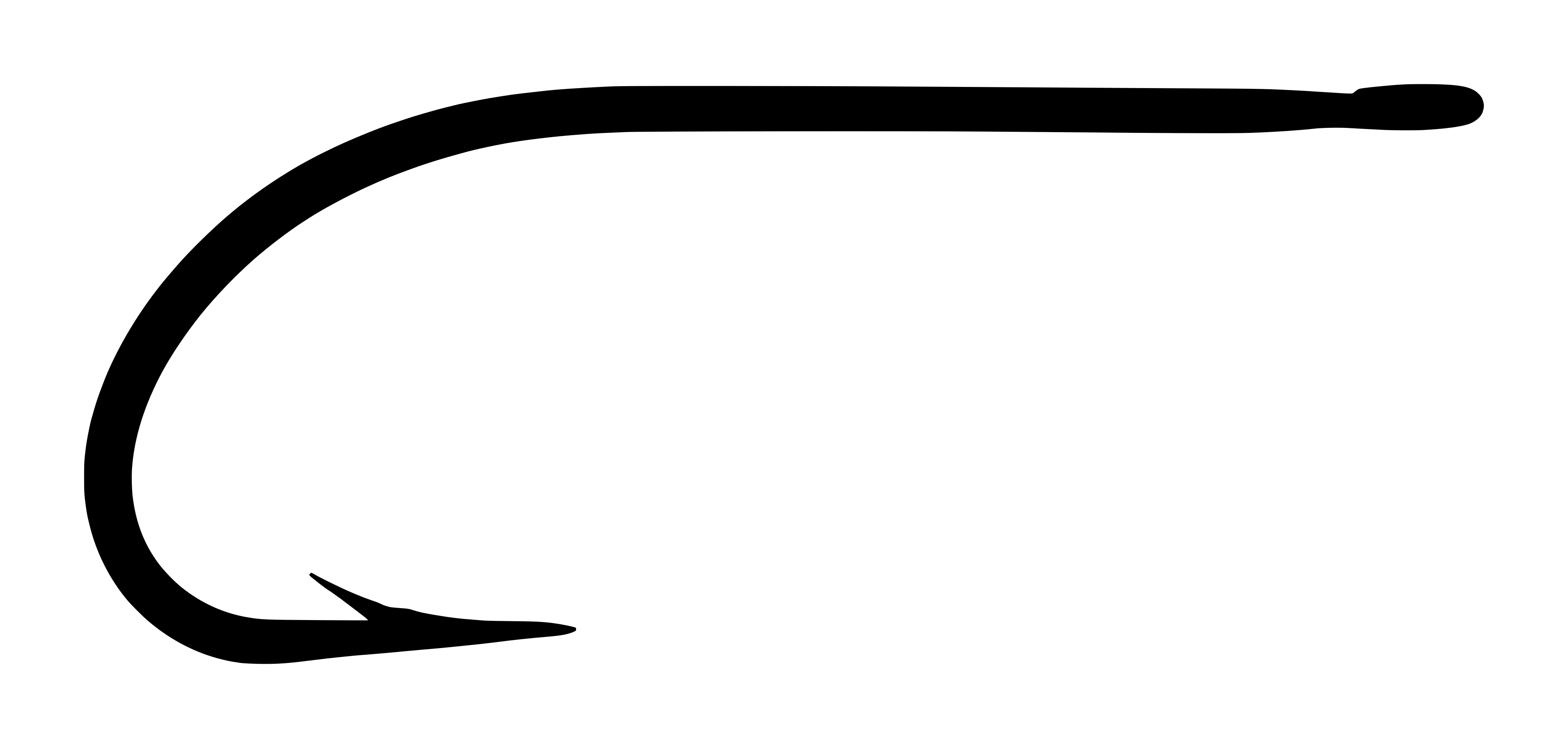
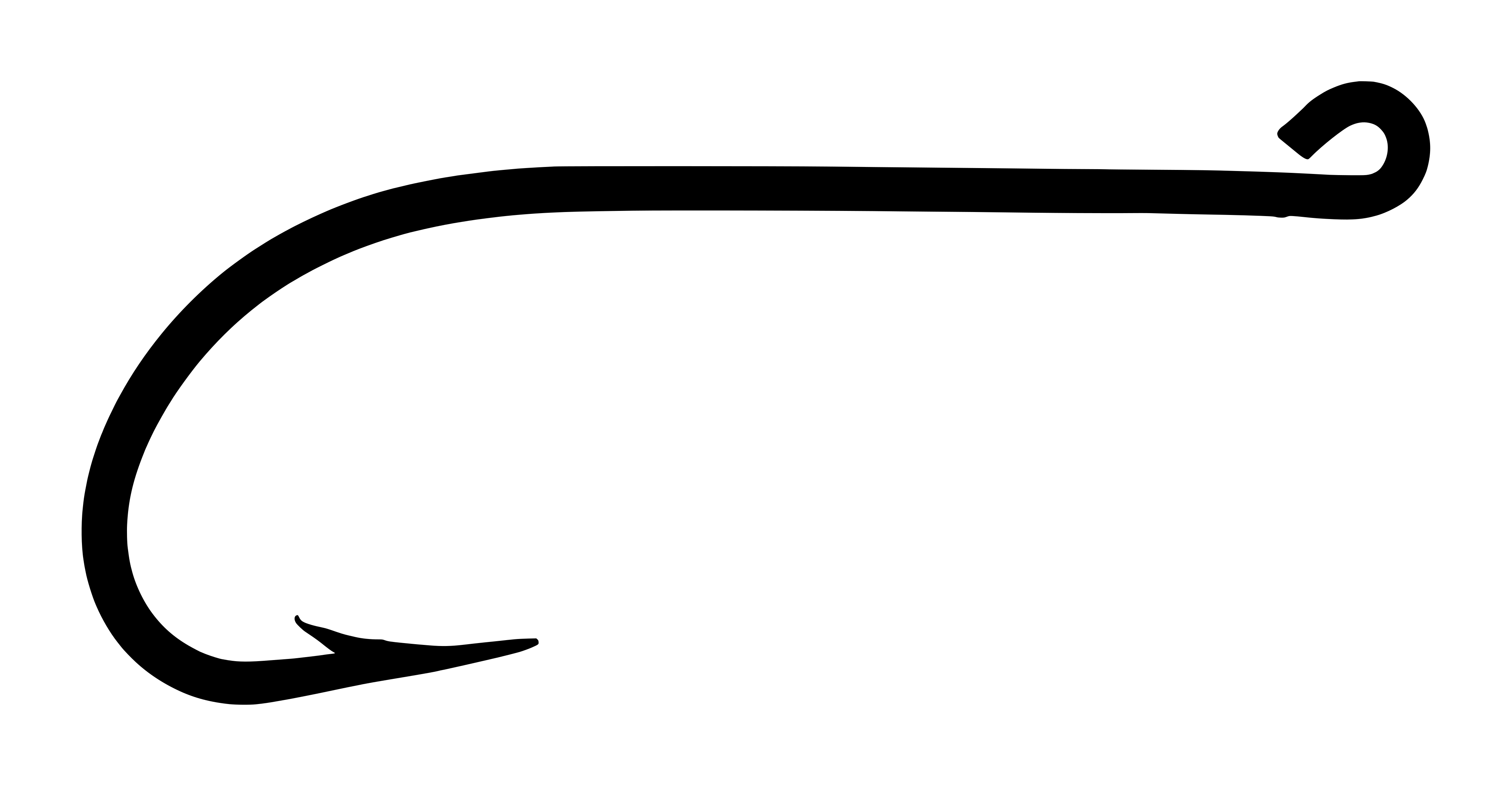
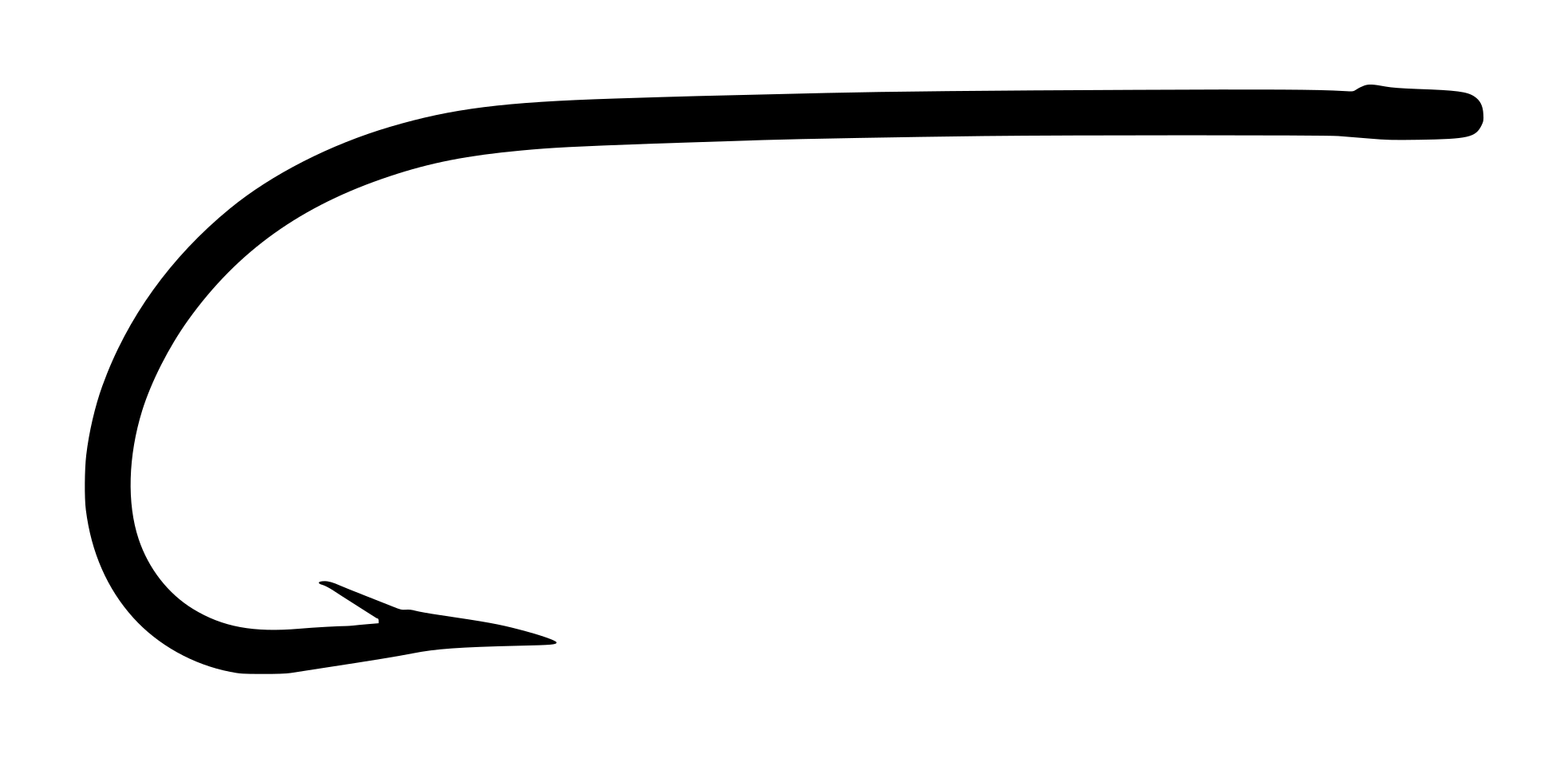
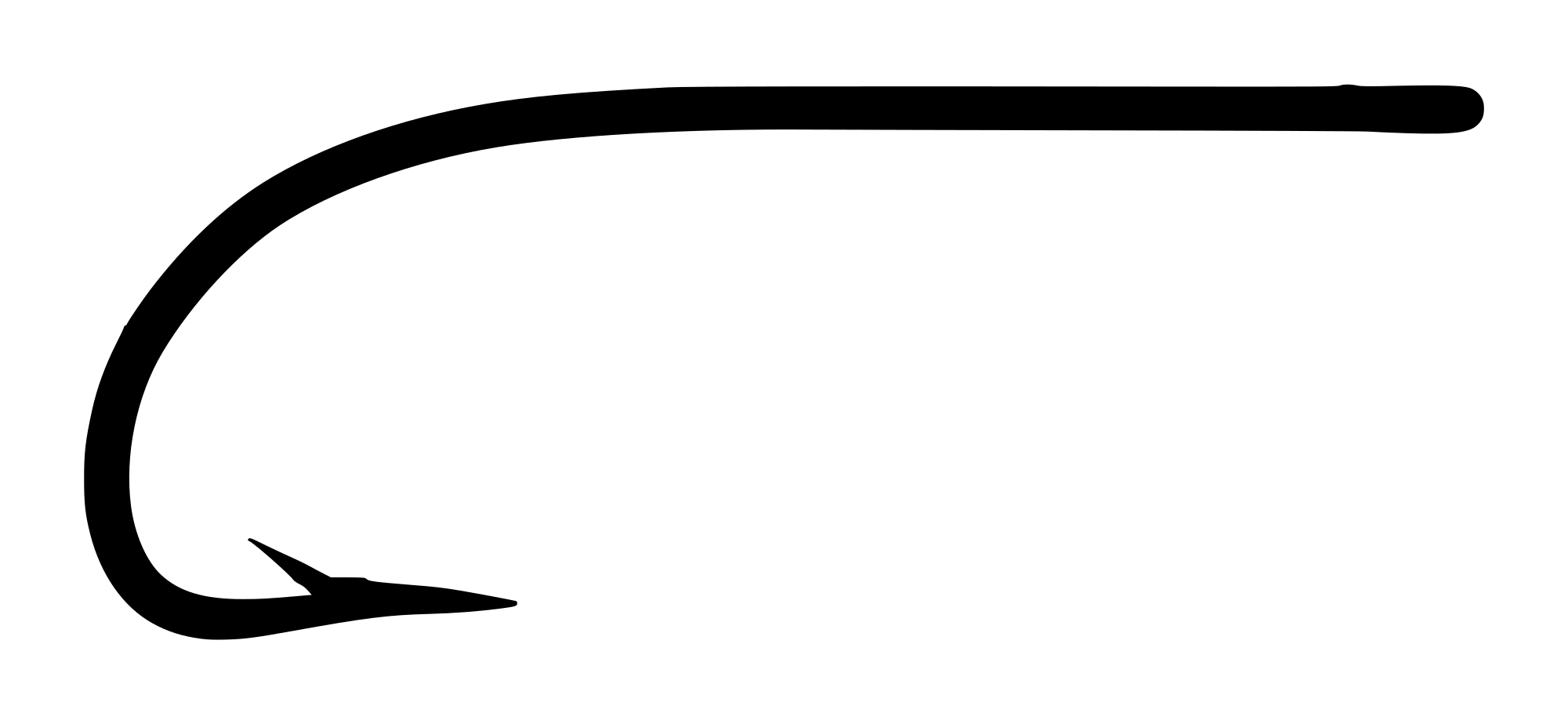
The Mustad 3813 is a vintage-era O’Shaughnessy bend hook in size 6/0, manufactured by O. Mustad & Søn in Oslo, Norway. This heavy-duty saltwater pattern features a forged, extra-heavy wire profile combined with a hollow point geometry optimized for rapid penetration into dense bone and cartilage. The tapered eye and rustproof finish reflect mid-twentieth-century marine fishing standards.
The label clearly dates this specimen to the post-1925 Oslo era, placing production roughly between 1930 and 1960. The “Rustproof” designation appears on the original packaging, a common Mustad notation predating the standardized finish nomenclature of later decades. The 100-hook retail box format and ornamental border design are consistent with Mustad’s global export packaging of the 1930s-1950s period.
The 3813 remains historically significant as an example of Mustad’s industrial cloning strategy—the O’Shaughnessy pattern itself originated as a regional American saltwater bend but was mass-produced by Mustad with extreme precision and distributed globally, cementing the pattern’s dominance in international marine fishing.
Original Mustad salescard for the Quality 3813 O'Shaughnessy displaying all size variants from 1 through 11/0, with the attached Mustad label clearly identifying the model, location (Oslo), and rustproof finish.
Photographic record
6 cataloged imagesSelect any record to load it above.
6 images shown
Mustad 3813 Vintage Salescard — O’Shaughnessy Hook Sizes DisplayOriginal Mustad salescard for the Quality 3813 O'Shaughnessy displaying all size variants from 1 through 11/0, with the attached Mustad label clearly identifying the model, location (Oslo), and rustproof finish.Open originalMustad 3813 Hollow Point Geometry — Taper DetailClose-up view of the Mustad 3813 hollow point showing the characteristic concave inner curve and rapid taper from the very tip to the base of the barb, optimized for penetration into dense tissue.Open originalMustad 3813 Full Profile — O’Shaughnessy Bend and Tapered EyeFull side-view profile of a Mustad 3813 hook (size 6/0) showing the classic O'Shaughnessy bend curvature, tapered eye, and forged wire thickness on the measurement grid.Open originalMustad 3813 Pair — Manufacturing Consistency and Forged Wire ProfileTwo Mustad 3813 hooks (size 6/0) displayed side-by-side on the measurement grid, demonstrating the manufacturing precision and consistency of Mustad's mechanized production and the heavy-duty forged wire profile.Open originalMustad 3813 Package Label — Eight-Line Format DetailClose-up of the Mustad label affixed to the original 3813 salescard, showing the classic eight-line typographic format with manufacturer name, location (Oslo), Qual. 3813, point type, pattern name, and finish designation.Open originalMustad 3813 Complete Salescard — Hook Display BoardFull view of the complete Mustad 3813 salescard showing all hook sizes from 1 through 11/0 on the orange display board, with the eight-line label affixed at the lower right corner.Open original
Technical profile
Eye
Tapered Eye, Turned DownTapered eye formed by gradual reduction in wire diameter at the terminal loop. The taper is uniform and clean, characteristic of Mustad's mechanized eye-forming precision. Eye is small relative to the heavy wire gauge, appropriate for direct line knotting in marine applications. P
Wire
Standard, Forged
Shank
Standard — Plain
Bend
O'Shaughnessy, Standard gapClassic O'Shaughnessy profile with parabolic curve and pronounced depth. The bend maintains perfect symmetry and shows no evidence of lateral offset. Wire set is clean with no visible crimping or irregularities in the curve. Characteristic deep bend provides exceptional mechanical advantage for loading heavy pressure from fighting fish. P
Point
Hollow Point (concave inner face)Barb is short, close-cut, and positioned immediately behind the point taper. The barb angle is relatively acute (approximately 45 degrees), creating a secure mechanical lock without an overly large entry wound. Barb placement is consistent across all examined specimens. P
Finish
Confirmed (stated on packaging)Finish is described on packaging as 'Rustproof'—a Mustad designation that likely refers to a light chemical passivation or wax coating rather than electroplating. The visible finish on specimens shows a dark brown-bronze tone with a slight matte sheen, consistent with an oil-based rustproofing treatment rather than japanning. Finish appears to be uniform across the shank with no obvious wear or corrosion patina on the examined specimens. P
Specimen hook shows excellent condition with bright, undamaged point and intact barb. No corrosion or pitting visible on the wire. Original packaging card exhibits light toning and minor surface wear consistent with age, but text remains fully legible. All hooks accounted for on salescard display.
The hollow point geometry of the 3813 is engineered for rapid penetration through dense bone and cartilage. Unlike a needle point (which relies on minimal resistance conical entry) or a spear point (which requires blunt-force wedging), the hollow point achieves initial penetration with a flared, razor-sharp tip that rapidly widens toward the barb. This allows the hook to slice cleanly through tough tissue while the barb lock ensures mechanical hold.
The forged wire profile increases tensile strength and structural rigidity by approximately 15-20 percent compared to round wire of equivalent diameter, without adding weight or thickness. This cold-forging process partially aligns the crystalline structure of the steel, creating a metallurgical advantage essential for withstanding the sustained pulling pressure of large saltwater species and preventing the shank from bending open under extreme load.
The tapered eye reduces weight at the hook’s front while maintaining strength at the critical stress point where the line knot transfers force to the steel. This design predates modern chemically sharpened points by decades and represents the pinnacle of mechanically ground point technology in the mid-twentieth century.
We have measurements for sizes 4/0, 4, 6. Know any others? Submit calipered measurements and we'll review and add them. Thank you!
Historical context
mustad
O. Mustad & Søn was founded in 1832 in Gjøvik, Norway, initially as a general metal goods manufacturer (Brusveen Spiger- og Staltradfabrikk) producing nails, steel wire, and cast-iron products. The company was acquired by Ole Hovelsen Mustad and his son Hans Mustad, who rebranded it as O. Mustad & Søn and pivoted to fishhook production. In 1877, company innovator Mathias Topp invented the first fully automated hook-making machine, a mechanization that gave Mustad an insurmountable competitive advantage over traditional Redditch artisans and Japanese manufacturers.
Rather than patent this technology and risk disclosure of mechanical designs, Mustad relied on strict corporate secrecy, non-disclosure agreements, and restricted factory access to maintain dominance. By the 1950s, Mustad controlled approximately 50 percent of global hook production and operated sales offices and manufacturing facilities on multiple continents. The word ‘Mustad’ became virtually synonymous with the fishing hook itself in international markets.
Series History
The O’Shaughnessy pattern was originally developed as a regional American saltwater bend, favored by commercial and sport fishermen along the Atlantic and Gulf coasts for heavy live-bait and bottom-fishing applications. The pattern is characterized by a parabolic bend and heavy forging, engineered to distribute the strain of large, powerful fish evenly across the entire bend without risk of straightening or fracturing.
Mustad reverse-engineered and mass-produced the O’Shaughnessy as part of its global strategy of industrial ‘cloning’—taking successful regional patterns and manufacturing them with extreme precision for worldwide export. The 3813 designation places this hook in Mustad’s mid-tier Quality series (3000-3999 block), representing standard commercial-grade marine hooks manufactured to exacting dimensional and tempering specifications. The model remained in production from at least the 1930s through the 1960s, with variants in different sizes and finishes (tinned, japanned, blued). The O’Shaughnessy pattern remains in production today by Mustad under modern Signature Series nomenclature.
Era and Packaging Dating
Line 3 of the packaging states 'OSLO - NORWAY' (not 'Christiania'), confirming manufacture after January 1, 1925. The ornamental border design, letterpress print quality, cream-colored card stock, and absence of barcode are consistent with interwar and mid-twentieth-century Mustad export boxes. The 'Rustproof' finish designation was Mustad's terminology before the standardized nomenclature (Tinned, Blued, Japanned) became dominant in the 1960s. No modern pricing is visible. The salescard format with hook size display board is typical of 1930s-1950s retail presentation.
The O'Shaughnessy's Journey from New England to Global Dominance
The O'Shaughnessy bend was originally named after a New England commercial fisherman whose innovation was copied by Redditch manufacturers in the late 1800s. When Mustad's mechanized production conquered global markets, the pattern became so dominant that most twentieth-century anglers assumed the O'Shaughnessy was a Scandinavian invention. By the 1950s, 'O'Shaughnessy' had become shorthand for any heavy saltwater hook in English-speaking fishing communities, a linguistic testament to Mustad's industrial supremacy.
Design lineage and influence
The O’Shaughnessy bend predates Mustad’s mass-production era by decades, originating in New England during the nineteenth-century commercial fishing boom. Early Redditch manufacturers (particularly Edgar Sealey and S. Allcock & Co.) reverse-engineered and produced their own versions for export. Mustad’s innovation was not the design itself, but the mechanization and consistency of production.
Competing American manufacturers (notably Pflueger and Turner) also produced O’Shaughnessy variants, though none matched Mustad’s precision or distribution network. The pattern influenced later heavy-duty designs such as the Seamaster and Sea Demon lines. Modern Mustad Signature Series maintains the O’Shaughnessy geometry under simplified model codes, ensuring the pattern’s continued relevance in contemporary saltwater fishing.
Best matchRelated by Attribute
Computed automatically from catalog data — updated as new hooks are added.
Matches: Bend, Shank, Wire, Gap, Forging +3 moreDiffers: Eye: Tapered Eye vs Cross Eye; Eye Orient.: Turned Down vs Straight / Inline; Point: Hollow Point vs Superior
Matches: Bend, Shank, Wire, Gap, Application +2 moreDiffers: Eye: Tapered Eye vs Ball Eye; Eye Orient.: Turned Down vs Straight / Inline; Point: Hollow Point vs Superior +1 more
The Mustad 3813 O’Shaughnessy is a heavy-duty saltwater bait hook engineered for live or dead bait presentation in offshore and inshore marine environments. The hollow point geometry enables rapid penetration into the tough, bony mouths of predatory saltwater species including grouper, snapper, striped bass, and large catfish. The forged, extra-heavy wire and robust O’Shaughnessy bend provide exceptional structural integrity under the sustained pressure of hard-fighting fish and rocky bottom conditions typical of commercial and sport saltwater fishing.
Secondary Applications
Bottom fishing, trolling with fresh bait, offshore charter fishing
Modern Equivalents
Hook
Match Quality
Notes
Mustad 34007 O'Shaughnessy (Stainless Steel)
Excellent
Direct modern descendant maintaining classic O'Shaughnessy geometry and heavy forging. Available in saltwater stainless steel.
Gamakatsu Octopus Ringed Eye
Very Good
Similar heavy-duty saltwater pattern with tapered ring eye, modern Japanese precision manufacturing.
Owner S-5115 O'Shaughnessy
Good
Japanese mass-market O'Shaughnessy variant with comparable geometry, lighter wire gauge.
Collector notes
The 3813 is moderately collectible due to its clear historical documentation on the original package, excellent manufacturing quality, and representation of Mustad's mid-tier commercial production era. However, O'Shaughnessy patterns were mass-produced in enormous quantities, limiting scarcity. Pristine original packaging with intact hooks adds significant value.
Reference value
$8 – $25 USD estimate
Packaging condition
Good — moderate wear, legibleRecorded specimen
Packaging format
GW-M-OS-01Catalog code
Positive Factors: Clear model designation (Qual. 3813) on original eight-line label provides irrefutable authentication and dating. The hook itself demonstrates exceptional manufacturing precision and consistency—a hallmark of Mustad’s mechanized production superiority. The salescard format with hook display board is visually striking and historically significant. Pristine, unused specimens in original packaging are increasingly rare as most vintage hooks were actively fished. The hollow point and forged wire represent peak mechanical grinding technology predating modern chemical sharpening.
Limiting Factors: O’Shaughnessy patterns were manufactured by Mustad in enormous production runs—hundreds of thousands of units annually—making individual specimens extremely common. The 3813 designation was produced in multiple size variants and finishes, diluting rarity. The pattern remains in modern production under Signature Series nomenclature, reducing exclusivity compared to discontinued designs. Without the original packaging, a loose 3813 hook is virtually indistinguishable from thousands of other vintage Mustad O’Shaughnessy examples and commands no premium.
Packaging
Original Mustad retail salescard format (orange card stock) with printed header 'O. MUSTAD & SÖN, FISHHOOK MANUFACTURERS' and 'OSLO - NORWAY'. Card displays hooks in graduated size lineup (sizes 1 through 11/0) with handwritten size notations in purple ink. Smaller white label affixed to lower right corner of card repeats the eight-line label format: manufacturer name, location, Qual. 3813, Hollow Point, Mustad-O'Shaughnessy Hooks, 100 count, Tapered Ring, Rustproof, Made in Norway. Ornamental border in tan/brown design element frames all four edges. Card dimensions approximately 11" x 7". Letterpress print on cream-colored card stock with significant aging patina and light wear consistent with c. 1930-1960 production. All 100 hooks remain on display card.
Market Value Notes
Pricing reflects condition and packaging integrity. A pristine, unused hook in original salescard with all 100 hooks intact may command $20-25 at specialist auctions or dedicated vintage tackle dealers. A loose 3813 hook without original packaging typically sells for $8-12 on eBay or general auction sites, driven primarily by weight (scrap value) rather than collectible value. The rustproof finish and heavy wire gauge appeal to functional users seeking workable vintage saltwater hooks, supporting baseline pricing. Original packaging with legible label and intact hooks is the primary value driver.
Where to Find
eBay (vintage fishing supplies category), specialist vintage tackle dealers, tackle auctions, estate sales with fishing collections, online hook reference catalogs (Garrenwood.com, FlyTyersAssociation). Original salescard format is rarer than loose hooks and appears infrequently.
Collector's Identification Tips
The Mustad 3813 can be identified with certainty by the ‘Qual. 3813’ designation on the original package label, paired with the ‘Mustad-O’Shaughnessy Hooks’ nomenclature. The key dating element is the ‘OSLO – NORWAY’ line on the label (post-1925). The ‘Hollow Point’ designation on Line 5 of the classic eight-line label format is definitive. Examine the eye taper—it should be smooth and gradual, not a ball or looped configuration. The forged O’Shaughnessy bend is unmistakable: deep, parabolic, and symmetrical. The finish should be a dull brownish tone (rustproof treatment), not bright steel or heavy black japanning. Original packaging in the ornamental-bordered salescard format with hook display board adds significant authentication value.
Preservation
Storage and Preservation
Store the original salescard in a cool, dry environment away from direct sunlight and humidity. The rustproof finish is a light oil-based coating vulnerable to moisture exposure; excessive humidity can cause patina development or surface corrosion over time. Keep the card in a flat, horizontal position to prevent warping of the card stock and twisting of the hook wires.
If the card is displayed, use UV-protective acrylic or glass to shield it from light exposure, which accelerates paper yellowing. Avoid any contact with other metals that could cause galvanic corrosion. Do not clean the hooks with abrasive materials or harsh solvents—light dusting with a soft, dry cloth is sufficient. The original packaging significantly enhances value; never remove hooks from the card for fishing or handling unless the specimen is surplus to your collection.
For long-term archival storage, place the card in a archival-quality cardboard box with acid-free tissue paper. Store in a climate-controlled environment with relative humidity between 35-50 percent. Avoid attics, basements, and damp areas where condensation and temperature fluctuation accelerate deterioration.
Primary Source
Reading the Eight-Line Label: Decoding Mustad's Quality System
Source: A Comprehensive Typology and Decryption of Vintage O. Mustad & Søn Hook Labels (provided reference document)
The Mustad 3813 label exemplifies the company’s standardized eight-line typographic format used from approximately 1920 through 2000. Understanding each line provides precise identification and dating:
Line 1: O. MUSTAD & SÖN — Establishes ultimate manufacturer authority and brand integrity. The full, unabbreviated company name signaled Mustad’s confidence and dominance in global markets.
Line 2: MANUFACTURERS — A deliberate distinction from import agents and regional jobbers who frequently purchased bulk Mustad hooks and repackaged them under secondary brand names. This declaration protected Mustad’s brand directly to end-users.
Line 3: OSLO – NORWAY — Critical dating element. Norway’s capital was officially renamed from Christiania to Oslo on January 1, 1925. Any label bearing ‘Oslo’ must date post-1925; ‘Christiania’ indicates pre-1925 production. This geographic notation also served as a universal visual identifier for dock workers and merchants handling global exports.
Line 4: Qual. 3813 — The quality code represents a mid-tier product in Mustad’s numerical classification system. Codes 1000-2999 were economy models; 3000-3999 were standard commercial-grade quality products; 4000+ were premium hooks. The 3813 designation places this hook in the reliable, mass-market category engineered for high-volume production and commercial fishing use.
Line 5: Hollow Point — Exclusively reserved for the hook point geometry or quality grade. The hollow point specification indicates a concave inner-face taper optimized for rapid penetration into soft and semi-dense tissues. This line never specifies wire gauge, shank length, bend style, or eye type—only the point.
Line 6: Mustad-O’Shaughnessy Hooks — The pattern name, derived from the company’s strategy of reverse-engineering regional patterns and globalizing them. The O’Shaughnessy originated in New England but was perfected and mass-marketed by Mustad, ultimately becoming synonymous with heavy saltwater hooks worldwide.
Lines 7-8: Tapered Ring, Rustproof, Made in Norway — Final modifiers specifying eye type (tapered), finish (rustproof—a light chemical passivation or oil-based coating), and manufacturing location confirmation. These lines synthesize the complete technical description of the implement.
The presence of this traditional eight-line format on a paper label serves as definitive proof of a vintage Mustad product from the pre-2001 era, before the company transitioned to the modern Signature Series alphanumeric naming convention.
Additional
The O'Shaughnessy Pattern: From New England Tradition to Global Industrial Standard
The O’Shaughnessy bend is one of the oldest continuously produced hook patterns in modern fishing, with origins tracing to nineteenth-century New England commercial fisheries. The pattern represents a unique intersection of artisanal innovation and industrial standardization—it was not invented by Mustad, yet it was Mustad’s mechanized production that made the pattern globally dominant.
The original O’Shaughnessy design was developed by working commercial fishermen targeting groundfish and large Atlantic species. The key innovation was the parabolic bend geometry, which distributes mechanical load evenly across the entire curve, preventing the shank from straightening under the sustained pulling pressure of large, powerful fish. Early Redditch manufacturers recognized the pattern’s superiority and began producing their own versions for export to American and British markets.
When Mustad entered the heavy saltwater hook market in the early twentieth century, the company reverse-engineered the O’Shaughnessy pattern with characteristic industrial precision. Rather than produce a crude copy, Mustad’s automated machinery and quality-control systems ensured that every hook met exacting dimensional tolerances. By the 1930s, Mustad’s production capacity and distribution network overwhelmed regional competitors, and the O’Shaughnessy became virtually synonymous with Mustad itself.
The 3813 designation reflects this standardization process: it is not a premium, artisanal hook, but rather a thoroughly optimized, mass-produced marine fishing implement. The hollow point geometry, forged wire, and tapered eye represent engineering decisions made to balance penetration performance, structural durability, and manufacturing efficiency. The hook could be produced in enormous quantities while maintaining consistent quality standards.
Today, the O’Shaughnessy remains in production by Mustad and competitors, a testament to the fundamental soundness of its original design. However, the pattern’s association with industrial mass-production means that individual vintage O’Shaughnessy hooks rarely command premium prices among collectors—rarity and exclusivity, not engineering superiority, drive collectability in the modern vintage fishing tackle market.
Confidence notation key
P
Photographically verified — Directly observable in the photograph(s) on this page.
V
Verified by documentation — Confirmed by manufacturer catalog, spec sheet, or published reference.
I
Inferred — A logical deduction from observable or documented evidence, not directly stated.
E
Estimated — An approximation based on visual comparison, proportional analysis, or limited data.
S
Speculative — A reasoned hypothesis that cannot be confirmed from available evidence.
Claims with no notation are confirmed by multiple independent sources. All photographs on garrenwood.com are taken on a measurement grid where each square equals 1/10 inch (0.1″ / 2.54 mm).