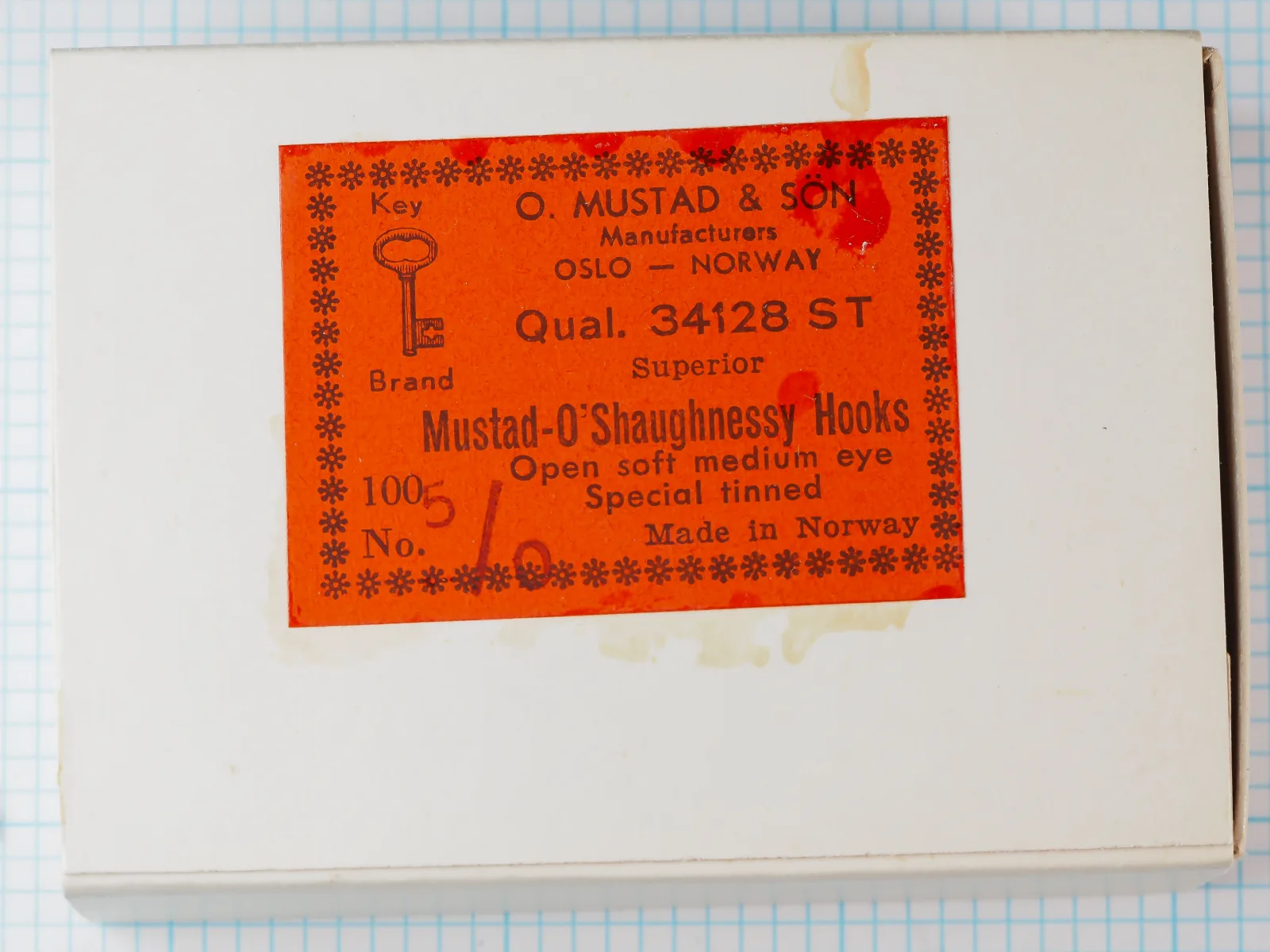
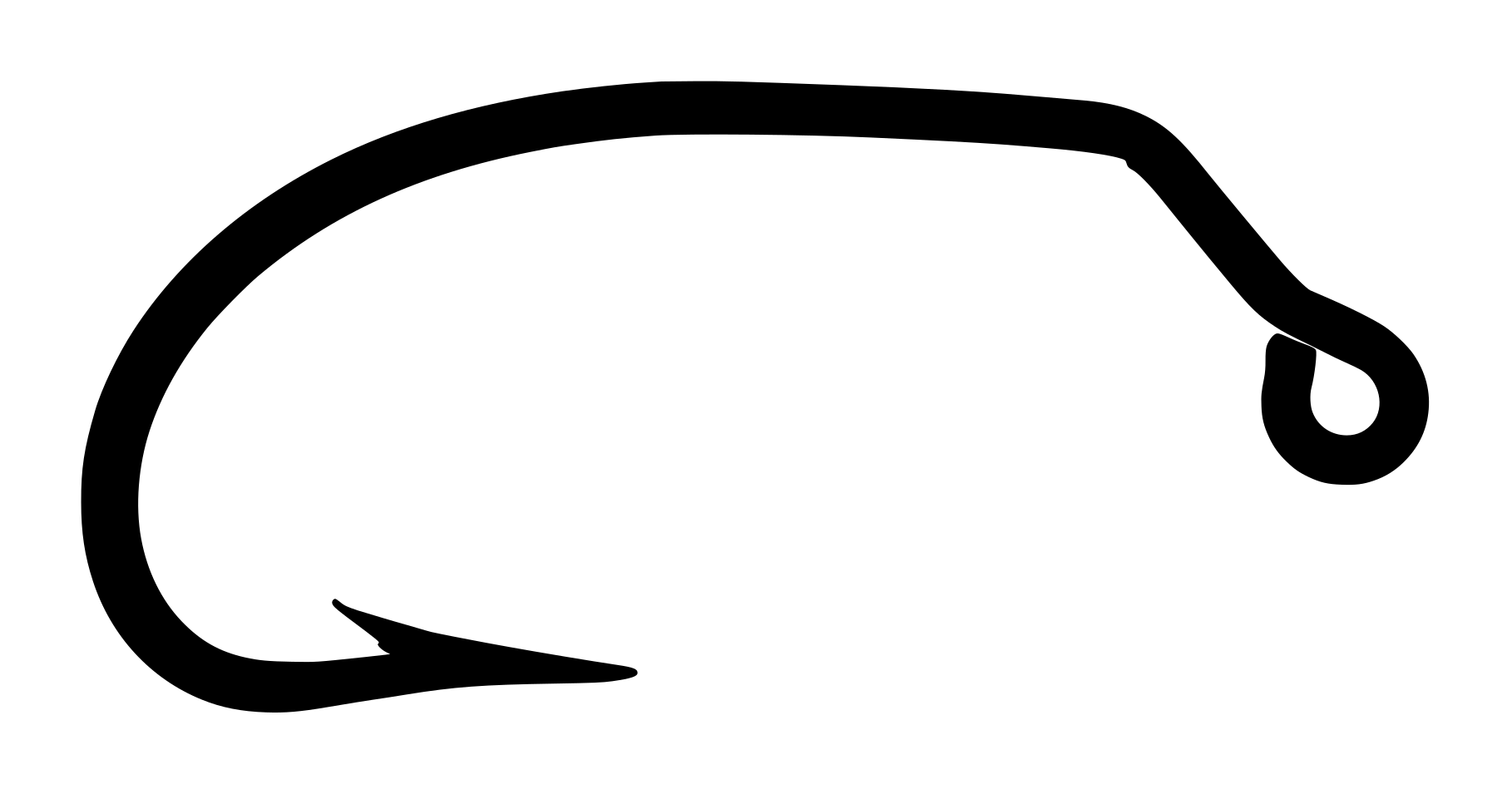
The Mustad 34128 ST is a forged, special-tinned O’Shaughnessy hook made in Norway, represented here in size 5/0. Its most distinctive documented feature is the straight, open soft medium eye: a round eye intentionally left open and sufficiently malleable to be closed after fitting another rigging component. The specimen has a conventional straight-tapered, superior point.
The package can be dated only broadly. “OSLO — NORWAY” establishes manufacture after 1925, while the Key Brand label, typography, paper stock, and box construction suggest mid-twentieth-century production. Pending a dated catalog listing, c. 1930s–1970s is best treated as an estimate E. The tinned coating and forged O’Shaughnessy form are consistent with bait, trolling, bottom-fishing, and tackle-assembly applications where corrosion resistance and resistance to deformation were important.
Mustad 34128 ST Box and Label size 5-0
Photographic record
3 cataloged imagesSelect any record to load it above.
3 images shown
Mustad 34128 ST Box and Label size 5-0Mustad 34128 ST Box and Label size 5-0Open originalMustad 34128 ST Hook size 5-0Mustad 34128 ST Hook size 5-0Open originalMustad 34128 ST Hook Point size 5-0Mustad 34128 ST Hook Point size 5-0Open original
Technical profile
Straight Open Ball Eye | O’Shaughnessy | Spear-Type Point | Tinned
Eye
Cross Eye, Straight / InlineStraight, round ring or ball eye intentionally left open, with the terminal end stopping short of the shank. The package describes it as an 'Open soft medium eye,' indicating a medium-sized eye made sufficiently malleable for closing after another rigging component is fitted. The opening is original construction rather than visible breakage. PV
Wire
Standard, Forged
Shank
Standard — Plain
Bend
O'Shaughnessy, Standard gapO'Shaughnessy bend with a broad lower curve and a comparatively straight shank. The wire is visibly flattened through much of the bend and lower shank, supporting classification as forged P. The photograph does not establish a particular cold-forging or drop-press process. Bend depth is approximately 0.95 inch when estimated from the 0.1-inch grid E. No obvious lateral offset is visible in the supplied overhead photograph P.
Point
Superior (near-straight inner taper)A short cut barb is clearly visible behind the point P. Its approximate height and cutting angle cannot be measured reliably from the available photograph and should be treated as estimated rather than photographically verified E.
Finish
Tinned — Confirmed (stated on packaging)Silver-gray tinned coating, verified both by the photograph and by the package wording 'Special tinned' PV. The surface shows age-related spotting, scratches, localized darkening, and areas of plating wear. The photograph does not establish the original plating method or rule out every instance of active oxidation.
The photographed hook is structurally intact, with no obvious bending, broken point, or eye fracture P. Its tinned surface has scratches, spotting, and localized darkening consistent with age and storage. The box and label survive in very good rather than excellent condition, with visible staining, edge wear, creasing, adhesive discoloration, and localized paper loss P. The photographs do not verify that all 100 hooks remain, that the box was unopened, or that the contents were unhandled.
The ‘Superior’ point designation on the 34128 ST indicates a near-straight inner taper that concentrates penetration force at the tip while maintaining structural strength. Unlike a Hollow Point, which features a concave inner face for delicate, rapid penetration in soft tissue, the Superior point trades immediate ease of penetration for durability and resistance to dulling or fracturing when striking hard bone, cartilage, or rocky substrates. The geometry is a compromise point — not as aggressive as a Hollow, not as blunt as a Spear, but optimized for reliability across diverse conditions.
The forged wire profile is critical to the 34128’s engineering. Mustad’s drop-press forging process flattens the lateral sides of the wire along its axis, dramatically altering the metallurgy. Cold-forging increases the hardness and tensile strength of high-carbon steel without adding weight or thickness. This allows the hook to resist bending open or straightening out under extreme stress — precisely the performance required when fighting 200-pound tarpon or tuna in strong current. The heavy gauge wire (approximately 0.055–0.065 inch diameter) coupled with forging creates a hook that can absorb tremendous lateral stress without failure.
The ‘Special tinned’ finish involves electroplating or physical dipping of the finished hook in molten tin, creating a bright silver layer typically 0.001–0.002 inch thick. This tin coating is exceptionally resistant to the highly corrosive effects of saltwater — superior to japanning or bluing for marine environments. Prior to the widespread adoption of marine-grade stainless steel in the 1970s and beyond, tinned carbon steel was the absolute standard for commercial marine fisheries and heavy offshore angling. The tin plate acts as a galvanic shield, sacrificing itself to corrosion while protecting the underlying carbon steel.
The O’Shaughnessy pattern is one of the quintessential heavy-duty saltwater hooks in angling history. Named for its namesake (records indicate attribution to a nineteenth-century Irish hook-maker, though definitive provenance is contested), the O’Shaughnessy bend features a parabolic geometry similar to the Sproat, but forged from vastly thicker, heavier-gauge wire. The O’Shaughnessy was engineered purely for brute strength, capable of withstanding the crushing jaw pressure, corrosive saltwater environments, and violent, sustained runs of offshore marine species such as tuna, marlin, and large grouper. The model 34128 ST represents Mustad’s premium O’Shaughnessy offering, with the ‘ST’ designation indicating ‘Special Tinned’ — a marketing term emphasizing the electroplated tin coating’s superiority for marine corrosion resistance. The ‘Superior’ point designation on Line 5 of the packaging confirms a near-straight inner taper geometry optimized for robust penetration. The 34128 family was produced from at least the 1920s through the 1960s, remaining a standard in commercial and sport saltwater fisheries. The model was eventually superseded by modern stainless steel variants and chemically sharpened point technologies, but the 34128 remains highly valued by vintage tackle historians and offshore fishing traditionalists.
Era and Packaging Dating
The 'OSLO — NORWAY' address establishes a post-1925 terminus. The Key Brand artwork, orange-red paper label, typography, cardboard box construction, and absence of later retail coding are broadly consistent with mid-twentieth-century production, but they do not independently establish a 1960 cutoff. Pending a dated catalog listing or securely dated package parallel, c. 1930s–1970s should be treated as an estimate E.
When 'Mustad' Became Synonymous with 'Hook'
By the 1950s, Mustad's automated hook-making machinery had become so efficient and their market control so complete that the word 'Mustad' became virtually synonymous with the fishing hook itself — much as 'Kleenex' became shorthand for facial tissues. An angler asking for 'a Mustad' rather than 'a hook' was as natural as asking for a 'Coca-Cola' instead of a soft drink. This linguistic merger of brand and product category reflected Mustad's unprecedented dominance of the global tackle industry. The company's commitment to secrecy — refusing to patent their automated machinery to avoid public disclosure — proved far more effective than any legal protection. Competing manufacturers in Redditch never fully reverse-engineered Mustad's process, and the firm maintained technological superiority well into the modern era.
Design lineage and influence
The O’Shaughnessy bend represents an evolutionary synthesis of competing design philosophies from the nineteenth-century hook-making tradition. It occupies the mechanical midpoint between the smooth, sweeping Sproat bend (favored for fly fishing and light-tackle applications) and the sharp, angular Limerick bend (prized for Atlantic salmon and heavy-duty saltwater work). The Sproat excels at distributing stress evenly across the entire bend radius, making it highly resistant to straightening under gradual, sustained load. The Limerick’s angular geometry provides a mechanical lock-point at the bottom of the bend, which physically secures the fish’s jaw and prevents slipping during violent head-shakes and erratic runs. The O’Shaughnessy marries these advantages: the parabolic curve of the Sproat provides mechanical resilience, while the deeper, more pronounced bend radius approximates the Limerick’s holding power. When forged from heavy gauge wire, this geometry becomes essentially indestructible in the hands of commercial fishermen or offshore sport anglers pursuing large, hard-fighting pelagic species.
Competing designs from other manufacturers include the Eagle Claw O’Shaughnessy variants (American production, post-1950) and the Partridge of Redditch heavy saltwater bends. However, Mustad’s 34128 series dominated the commercial market due to manufacturing efficiency and consistency. The model set a de facto standard that many competitors eventually copied or paralleled. In modern times, Mustad’s Signature Series (post-2001) includes updated O’Shaughnessy geometries with chemically sharpened points and stainless steel construction, but the classical 34128 remains unmatched in vintage tackle circles for authenticity and industrial historical value.
Best matchRelated by Attribute
Computed automatically from catalog data — updated as new hooks are added.
Matches: Bend, Shank, Point, Forging, Offset +3 moreDiffers: Wire: Standard vs Extra-Heavy (2X+); Gap: Standard vs Wide; Eye: Cross Eye vs Tapered Eye +1 more
Matches: Bend, Shank, Gap, Eye, Point +6 moreDiffers: Wire: Standard vs Heavy (1X Heavy); Eye Orient.: Straight / Inline vs Jig (60°/90°); Gap ratio: 30.4% vs 29.4%
The 34128 ST is a general-purpose heavy bait and tackle-assembly hook built around the O’Shaughnessy form. Its tinned coating suits marine use, while the forged profile provides resistance to deformation under demanding loads. Likely applications include natural-bait fishing, bottom fishing, trolling rigs, and the manufacture or repair of lures and terminal tackle. I
The package’s “Open soft medium eye” is especially important to application. The open eye allows a chain, swivel, wire leader, lure fitting, or other component to be inserted before the eye is mechanically closed. This makes the model more specialized than a conventional factory-closed ring-eye bait hook. The exact intended commercial rig or target species should not be stated definitively without a dated catalog description.
Secondary Applications
Heavy bait fishing for large freshwater catfish and pike; commercial bottom-fishing for grouper, snapper, and other hard-fighting bottom species; rigging large live baitfish for striped bass and northern pike in rivers and reservoirs.
Classic Fly Patterns
Not typically used for fly tying.
Modern Equivalents
Hook
Match Quality
Notes
Mustad 9174 O'Shaughnessy
Very Good
Current O'Shaughnessy live-bait hook related by bend family and heavy bait use, but its 3X-short proportions and modern finishes make it only a partial functional comparison, not a direct successor or close geometric equivalent.
Tiemco TMC 600SP
Good
Modern forged saltwater big-game fly hook, but 3X heavy, 3X wide and 2X short with a specialized SP point and black-nickel finish. Similar in strength-oriented saltwater use, but a poor geometric and historical equivalent.
Eagle Claw L047
Good
Potential functional comparison only if a catalog confirms its O'Shaughnessy bend, tinned finish, open-eye construction, shank proportion, and size range. Do not describe it as equivalent without that documentation.
Collector notes
A useful vintage Mustad reference specimen whose principal collector interest lies in its labeled 34128 ST pattern, open soft eye, special-tinned finish, size 5/0, and surviving Key Brand box. Exact-model new-old-stock boxes are not presently rare, so value depends primarily on label condition, completeness, and documented age rather than the hook pattern alone.
Reference value
$20 – $35 USD estimate
Packaging condition
Very Good — light wear, fully legibleRecorded specimen
Packaging format
orange-card-eight-lineCatalog code
Positive factors: The specimen retains a strongly colored Key Brand box label that documents the exact quality number, size, O’Shaughnessy pattern, open soft medium eye, special-tinned finish, and Norwegian manufacture. The unusual open-eye construction gives the model more reference value than an otherwise generic loose O’Shaughnessy hook. The hook and package together are useful for studying Mustad terminology and mid-twentieth-century export packaging.
Limiting factors: Exact-model new-old-stock boxes remain available, and current marketplace evidence does not support treating the 34128 ST as scarce or assigning a large premium solely for the orange-red label. The supplied photographs do not establish that the box contains all 100 hooks or that it was unopened. Label staining, abrasions, edge damage, and paper loss also limit condition-sensitive value.
Assessment: A complete box in comparable condition is reasonably treated as a modestly collectible reference item rather than a rare premium hook issue. Value is likely to fall around $20–35, with a higher figure requiring exceptional condition, verified completeness, or evidence of an earlier documented package variant.
Packaging
Orange-red paper label applied to a white cardboard box, with a decorative border of small floral or asterisk-like devices. Printed text includes the Key Brand skeleton-key trademark; 'O. MUSTAD & SON'; 'Manufacturers'; 'OSLO — NORWAY'; 'Qual. 34128 ST'; 'Superior'; 'Mustad-O'Shaughnessy Hooks'; 'Open soft medium eye'; 'Special tinned'; 'Made in Norway'; and the quantity and size notation '100 No. 5/0.' The label retains strong color but shows edge wear, abrasions, staining, adhesive discoloration, creasing, and localized paper loss, especially near the upper-right edge. P
Market Value Notes
Recent exact-model new-old-stock offerings indicate approximately $20–30 USD for a box of 100, with a modest premium possible for an unusually clean, demonstrably complete early box. The supplied photographs do not verify that all 100 hooks remain or that the box was unopened. Individual loose hooks generally have limited monetary value unless sold as part of a documented reference group.
Store unopened boxes in a cool, dry environment away from direct moisture and humidity. The tinned finish is highly corrosion-resistant but benefits from low-humidity storage. If opened, individual hooks should be stored on the original cardstock or in sealed paper envelopes with silica gel desiccant packets. Avoid plastic bags or airtight containers, which can trap condensation. The bright orange cardstock label is a significant portion of the hook’s value — preserve it without creasing, fading, or staining. Keep the box in a dark location, as prolonged exposure to intense sunlight can fade the orange ink.
For specimens showing minor surface oxidation, light dry brushing with a soft brass brush or pencil eraser can restore brightness without damaging the underlying tin plate. Do not use harsh solvents or abrasive polishing compounds, which will strip the protective coating. If the tin plate shows pitting or deep corrosion, the hook should be documented photographically before any cleaning, as the patina may have historical or aesthetic value to certain collectors. Original packaging dramatically increases collectability — never discard the card or box, even if empty.
Size Note
Understanding the 5/0 Size Designation
The 5/0 designation on this specimen follows the ‘aught’ scale, a sizing convention standard in saltwater and heavy freshwater hook manufacturing from the nineteenth century onward. In the aught system, larger fish hooks progress through larger whole numbers (1, 2, 3, etc.) until reaching the transition point, after which sizes are denoted as 1/0 (one aught), 2/0 (two aught), and so forth, with each increment representing progressively larger hooks. The 5/0 size on this O’Shaughnessy is a medium-to-large saltwater hook, appropriate for baitfish ranging from 4–8 inches in length and target species weighing 20–100+ pounds.
The Mustad 34128 series was manufactured in multiple sizes — surviving examples range from 1/0 through 8/0, with some regional variants extending to 10/0. The 5/0 size documented here was the most common commercial production size, appearing in the majority of surviving vintage boxes. Smaller sizes (1/0–3/0) were less frequently produced and are now scarcer in the collector market. The overall length of 2.33 inches and gap width of 0.71 inches are consistent with published Mustad size standards for a 5/0 O’Shaughnessy from this manufacturing era.
Additional
The Forging Innovation and Structural Engineering
The phrase ‘Forged’ appears frequently in vintage Mustad packaging (though not on this particular label), and its significance extends far beyond marketing terminology. The cold-forging process applied to the 34128 ST’s shank represents a critical metallurgical innovation that directly enables the hook’s performance in extreme saltwater conditions.
When high-carbon steel wire passes through a mechanical drop-press and is flattened along its lateral sides — while remaining round on top and bottom — the metal undergoes a profound change in its crystalline structure. Cold-forging does not remove material; rather, it realigns the grain boundaries and increases the density of the steel in that localized region. This produces a dramatic increase in hardness, yield strength, and resistance to bending fatigue — essentially making the hook ‘stronger’ without adding weight or thickness.
For an O’Shaughnessy bend under extreme stress (e.g., a 150-pound tuna making a violent run against a tight drag), the forged shank absorbs and distributes mechanical stress far more effectively than a regular-drawn wire of identical diameter. The hook resists ‘spreading’ or bending open at the bend apex — a catastrophic failure mode in unforged wire. This engineering advantage was particularly valued by commercial fisheries and tournament offshore anglers who demanded absolute reliability. The cost of forging was offset by the dramatic improvement in hold-and-land success rates.
Mustad’s automated machinery incorporated drop-forging stations, allowing them to forge-harden hooks at production scale. Competing manufacturers in Redditch and Japan struggled to match this capability, and many never fully integrated forging into their saltwater production lines. This technological advantage was one of the pillars of Mustad’s market dominance by the 1950s.
Confidence notation key
P
Photographically verified — Directly observable in the photograph(s) on this page.
V
Verified by documentation — Confirmed by manufacturer catalog, spec sheet, or published reference.
I
Inferred — A logical deduction from observable or documented evidence, not directly stated.
E
Estimated — An approximation based on visual comparison, proportional analysis, or limited data.
S
Speculative — A reasoned hypothesis that cannot be confirmed from available evidence.
Unnotated claims are the compiler’s synthesis; see Sources. All photographs on garrenwood.com are taken on a measurement grid where each square equals 1/10 inch (0.1″ / 2.54 mm).