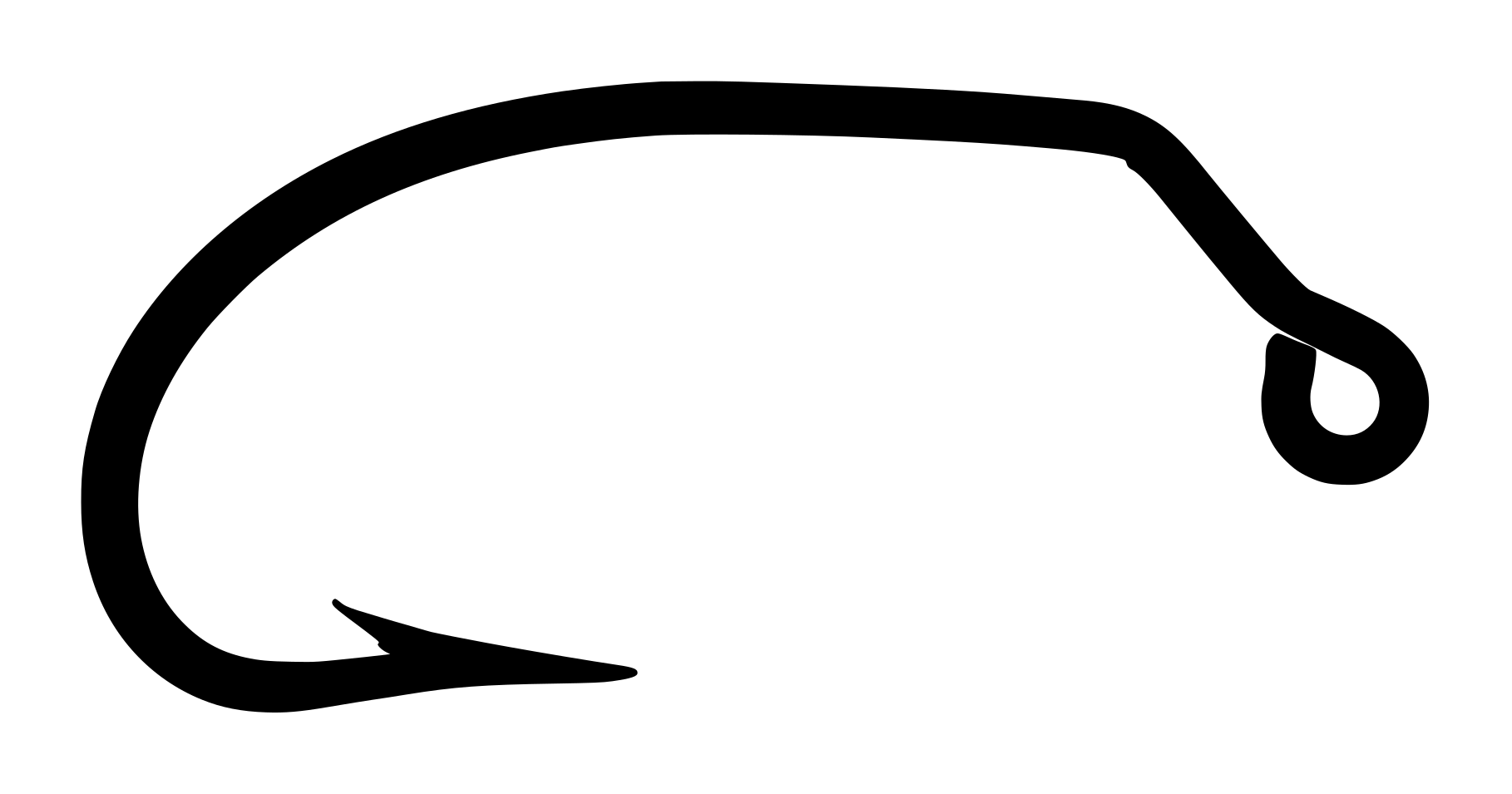
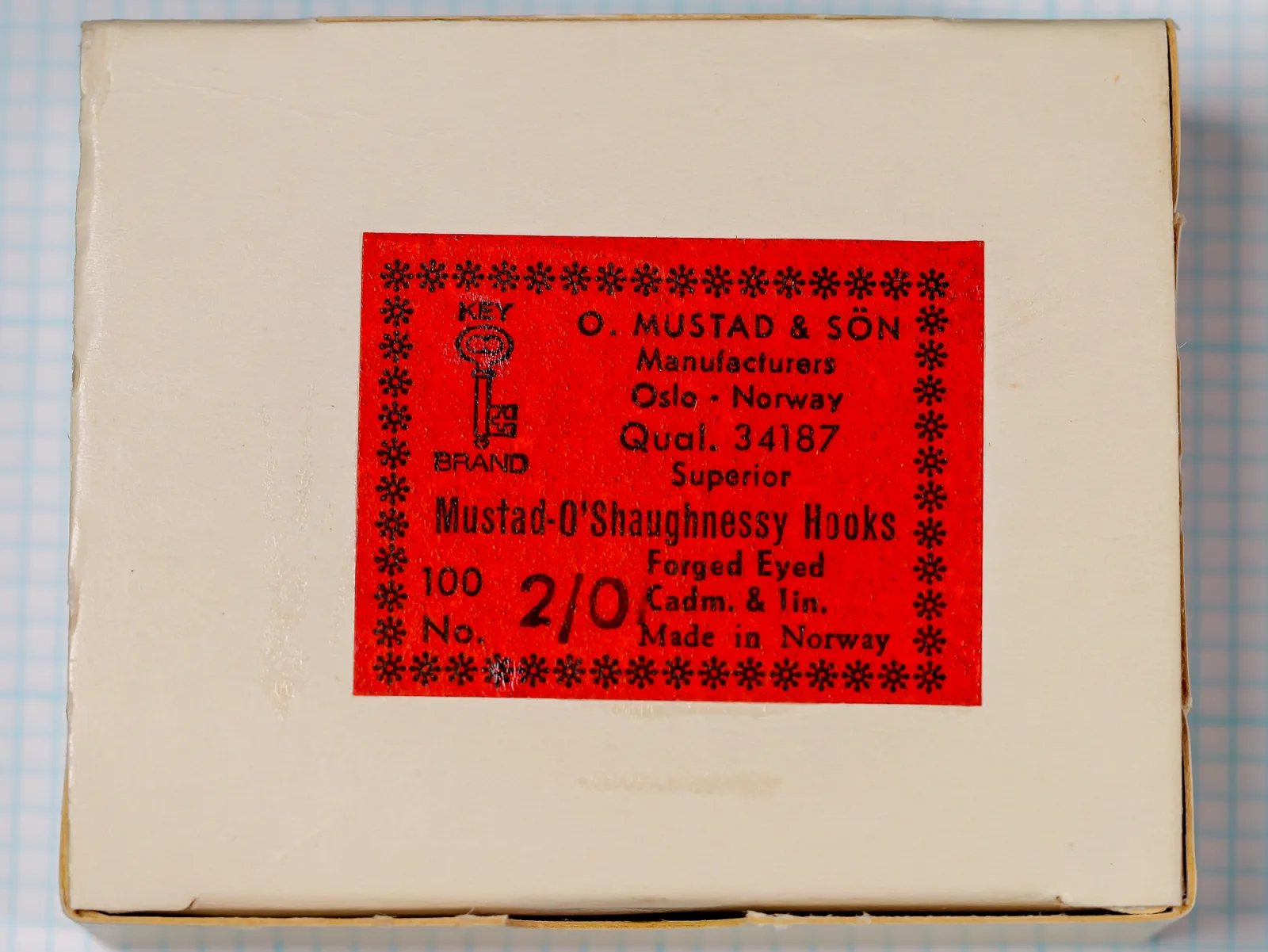
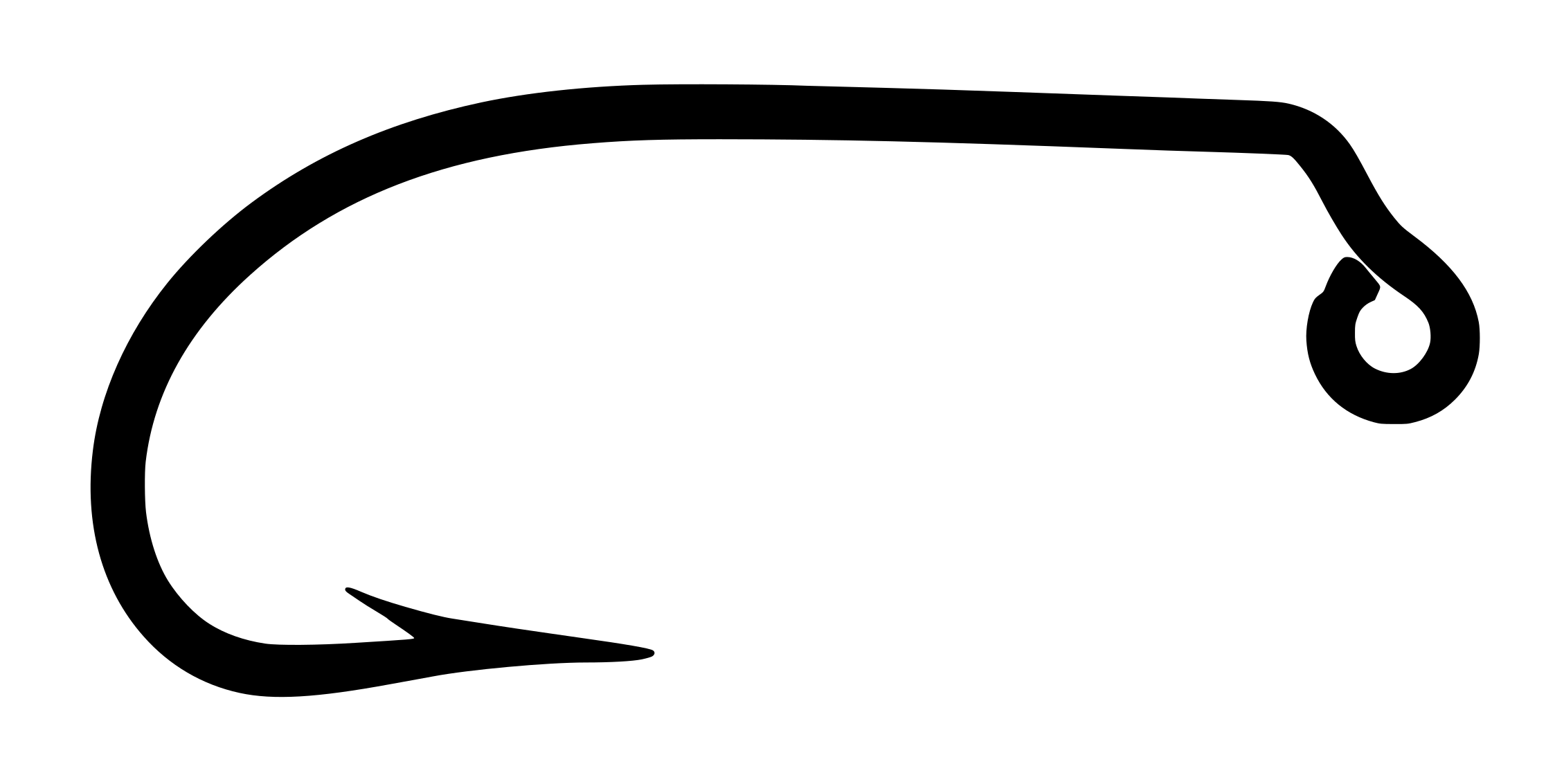
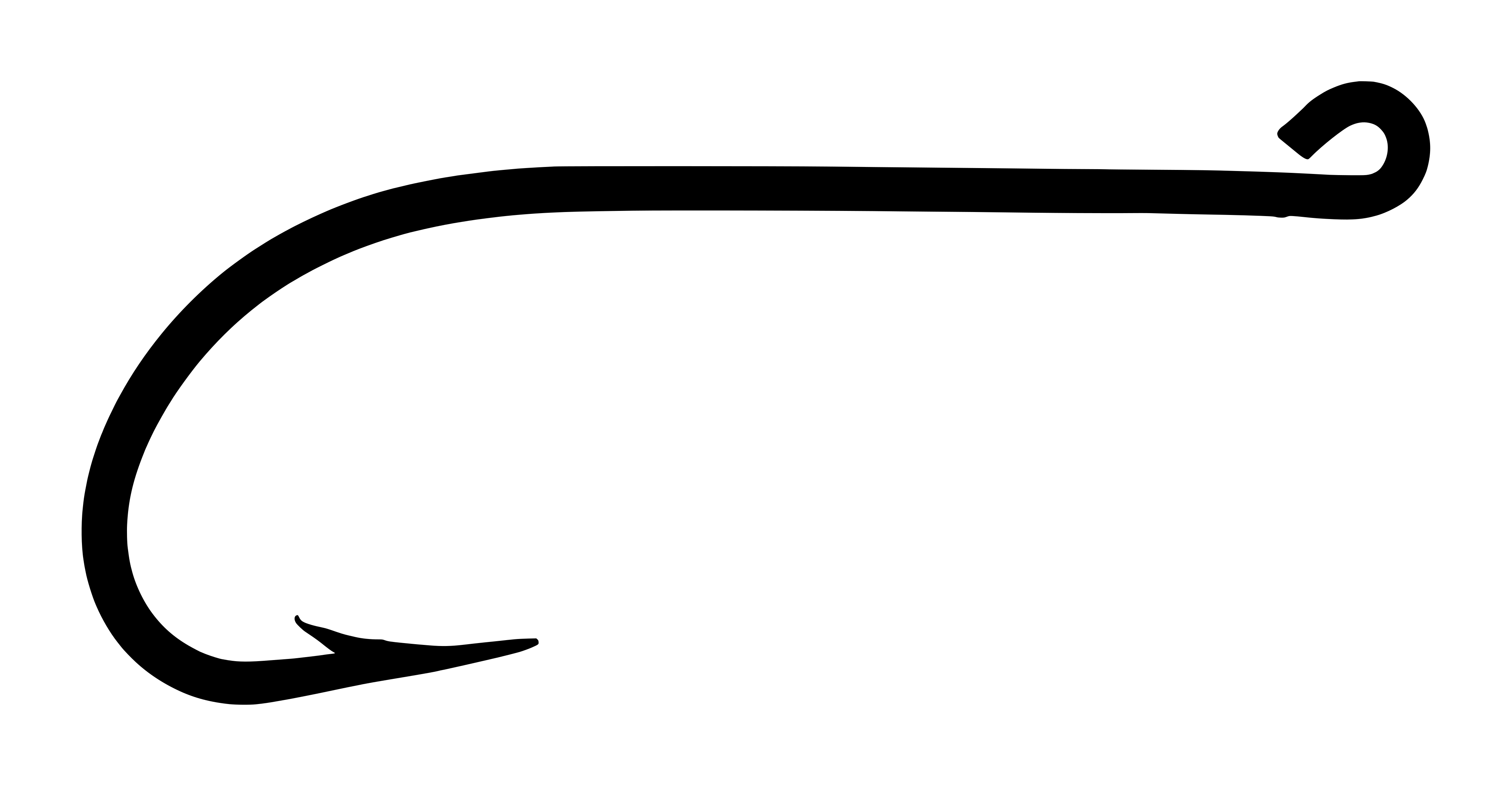
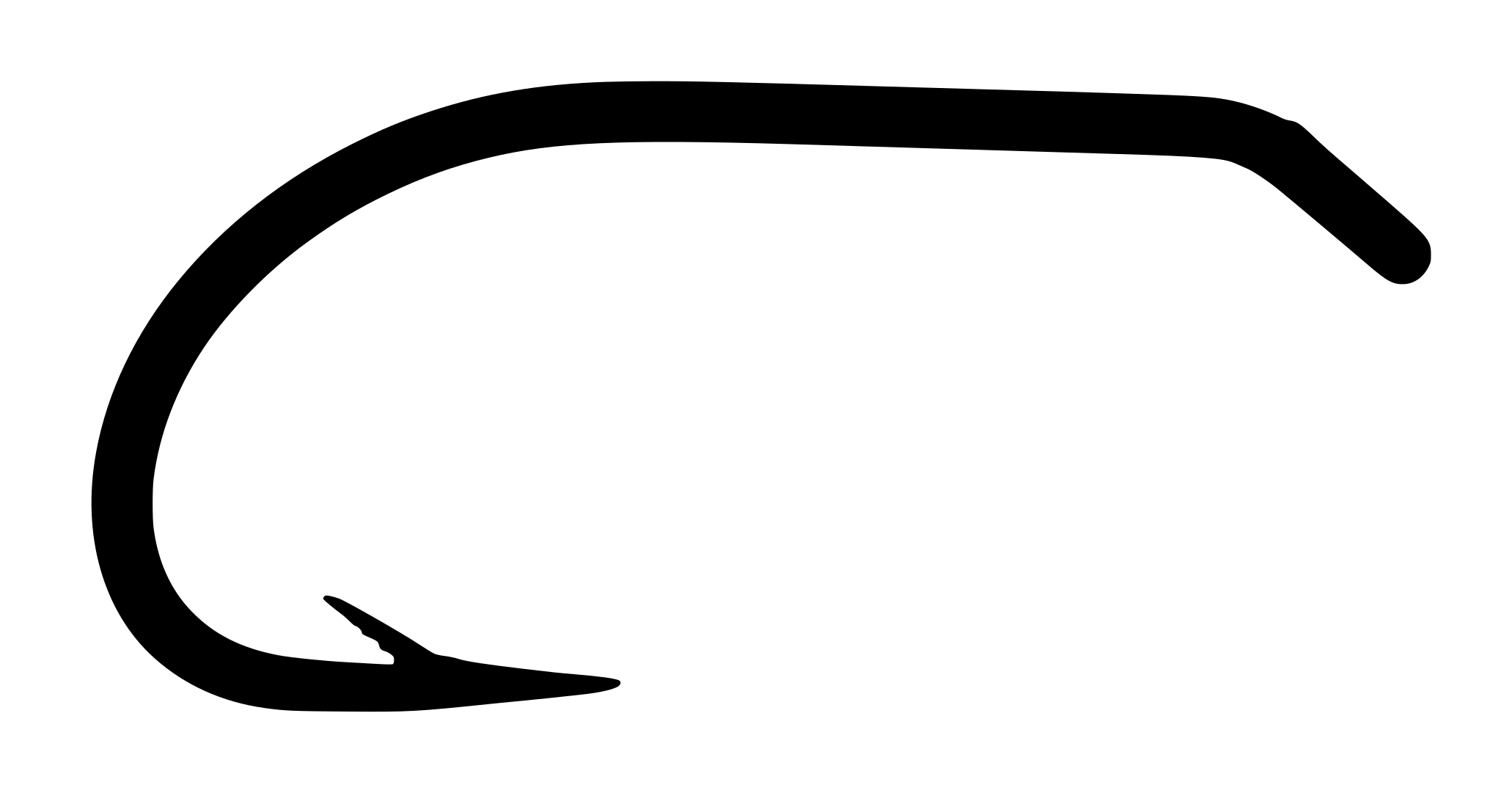
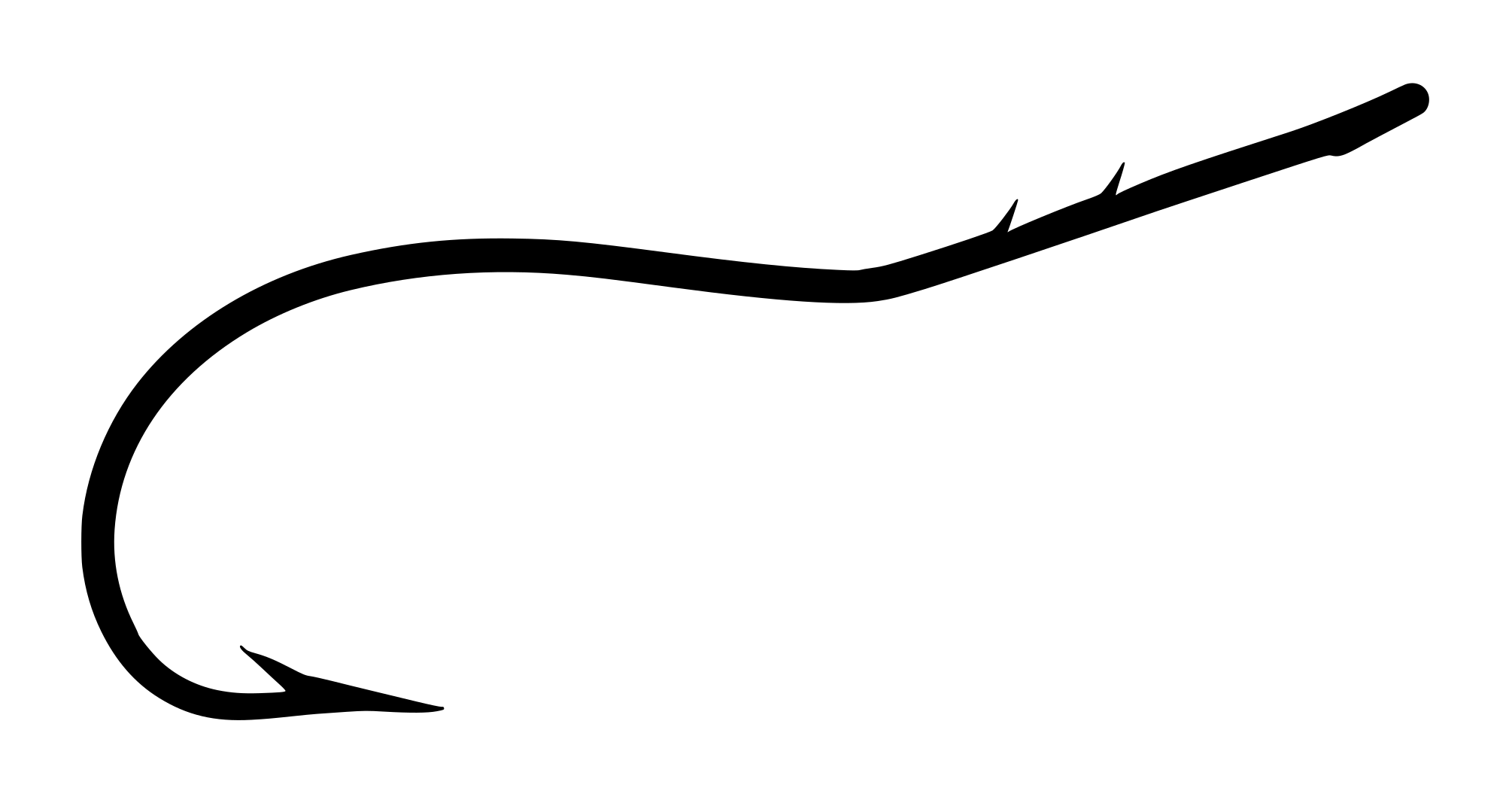
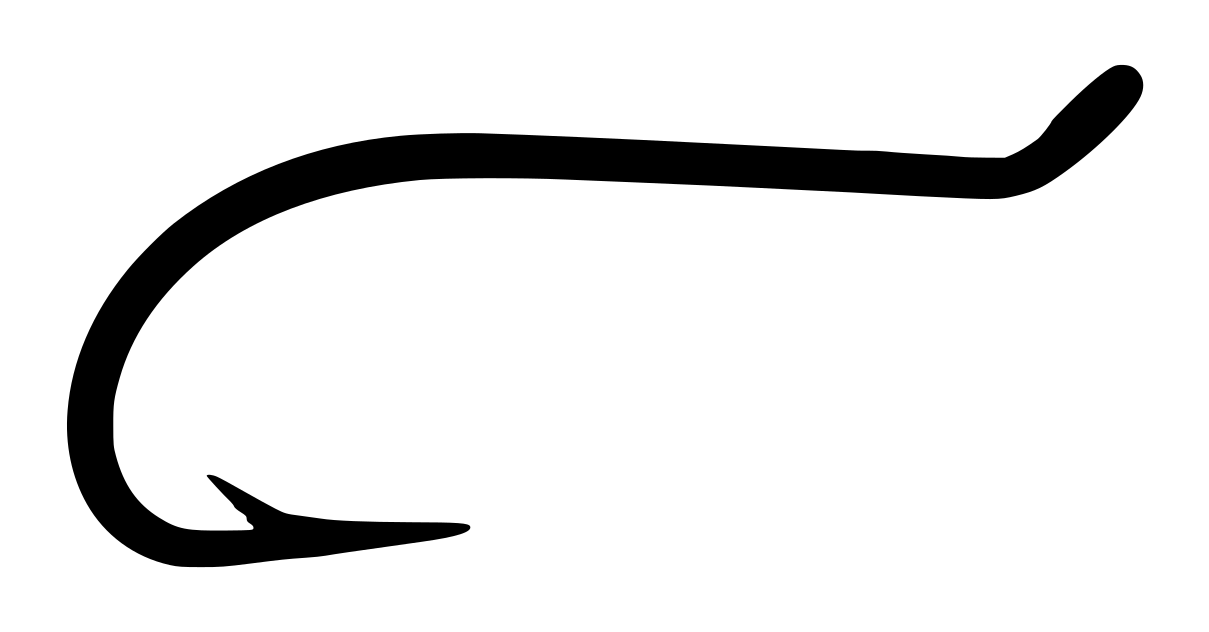
Mustad model 34187 O’Shaughnessy hook, size 2/0, tinned finish. A classic saltwater and bait hook with wide-gap O’Shaughnessy bend and standard-weight forged wire. The jig-oriented cross eye is rotated 60-90 degrees horizontal to the hook plane — a feature typically encountered on larger saltwater and pike patterns. Manufactured in Gjøvik, Norway by O. Mustad & Son.
The box dates to the mid-20th century based on packaging characteristics: no UPC barcode, letterpress print technology, simple anchor-and-crown logo treatment, and cream-colored board stock consistent with 1950s–1960s Mustad production. The label nomenclature — “Superior” as a product line designation and “Forged Eyed” indicating the forging process — reflects the commercial terminology of that era.
The hook was originally packed 100 per box, suggesting wholesale/trade distribution rather than retail carded format. Complete and sealed examples are scarce in the modern market, making this box a meaningful specimen for hook historians and Mustad collectors specializing in mid-century Norwegian production.
Original Mustad 34187 manufacturer box with period red label bearing letterpress text, anchor-and-crown logo, and product specifications for 100 size 2/0 O'Shaughnessy hooks, c. 1950–1965.
Photographic record
4 cataloged imagesSelect any record to load it above.
4 images shown
Mustad 34187 Box Exterior LabelOriginal Mustad 34187 manufacturer box with period red label bearing letterpress text, anchor-and-crown logo, and product specifications for 100 size 2/0 O'Shaughnessy hooks, c. 1950–1965.Open originalMustad 34187 O’Shaughnessy Cross-Eye DetailClose-up of the cross-eye (jig) orientation on the Mustad O'Shaughnessy, rotated 60-90 degrees perpendicular to the hook plane, photographed on 1/10-inch measurement grid.Open originalMustad 34187 O’Shaughnessy Bend and Point ProfileSide profile of the O'Shaughnessy bend showing the deep angular forged profile, Superior point taper, and barb placement on a size 2/0 specimen, photographed on measurement grid.Open originalMustad 34187 O’Shaughnessy Full ProfileOverhead view of the complete O'Shaughnessy hook showing the wide gap (relative to shank length), symmetrical bend profile, and tinned finish uniformity, on 1/10-inch measurement grid.Open original
Technical profile
Jig (60°/90°) Cross Eye | O'Shaughnessy | Standard | Standard Wire | Superior Point | Tinned
Eye
Cross Eye, Jig (60°/90°)Cross eye with jig orientation (rotated 60-90 degrees horizontal to hook plane) P. Loop quality even and well-formed. The cross eye configuration is less common on standard domestic fly hooks and indicates this series was marketed for heavier saltwater and pike applications where the sideways eye alignment was functionally advantageous.
Wire
Standard, Forged
Shank
Standard — Plain
Bend
O'Shaughnessy, Wide gapO'Shaughnessy bend characterized by a deep, angular forged profile with a pronounced point upturn and wider overall gap relative to shank length P. The bend is fully symmetrical with no kirb or reverse. Point rises at a 30-40 degree angle from the shank axis — steeper than a Limerick, less pronounced than an Aberdeen. The forged profile (visible wire flattening in the bend) adds structural rigidity beneficial for heavy bait and saltwater application I.
Point
Superior (near-straight inner taper)Barb is short and close-cut, positioned approximately 1-2 mm in from the point P. Cut angle is swept slightly rearward in line with the point taper. No double barb or micro-barb variants present. Barb size is proportional to standard wire gauge — appropriate for holding live bait without enlarging the wound channel excessively.
Finish
Tinned — Confirmed (stated on packaging)Tinned bright silver finish confirming the stated label designation V. Photograph shows cool silver-grey tone consistent with tin plating rather than nickel. Wire grain is visible beneath the finish, typical of mid-century Mustad tinning process. The finish is even and uniform across the specimen with no color variation or pitting P. Minor surface oxidation spots consistent with storage age but no corrosion pitting. Original tin plate has held well.
Box condition: cream-colored board stock with light toning and minor edge wear. Red label is bright with no fading or adhesive loss. Interior tissue wrapping not visible but likely original. Hooks appear to be full and unopened (counting visible hook heads visible at one corner). No rust, no corrosion, no broken points or bent shanks visible on inspected specimens P.
The O’Shaughnessy point is classified as “Superior” in Mustad terminology — a near-straight inner taper forming an acute angle with minimal concavity. This geometry differs from the hollow point (strongly concave inner face) or the knife-edge point (bilateral taper to an extremely fine line). The Superior point provides a balance between durability and penetration: the flat inner face resists bending under load, while the near-straight taper maintains a reasonably fine point for initial bite-through.
Wire forging (visible as flattened cross-section in the bend region) increases shear strength and bending resistance compared to drawn wire, beneficial for heavy bait and saltwater applications where the hook encounters abrasive conditions and live-fish thrashing. The standard wire gauge (0.054 inches / 1.37 mm) is typical for size 2/0, providing rigidity without excessive mass.
The cross eye orientation (rotated 60-90 degrees perpendicular to the hook plane) reduces direct in-line tension on the eye loop and distributes leader stress laterally. This configuration is particularly useful in pike rigs and saltwater applications where the eye may be lashed perpendicular to the hook shank or incorporated into a spreader bar or tandem rig.
First garrenwood.com catalog entry documenting the Mustad 34187 O'Shaughnessy with cross-eye jig orientation in original 100-hook manufacturer box format. Caliper-verified measurements (overall length 1.332 inches, gap width 0.545 inches) establish size 2/0 baseline for O'Shaughnessy bend geometry in Mustad Norwegian production. SVG-derived wire diameter (0.054 inches) and shank length (1.052 inches) contribute to proportional database for forged-wire saltwater hooks c. 1950–1965.
Own this hook? Help us measure it.
This pattern was made in sizes 1/0-3/0 (I). We have measurement for size 2/0. Know the others? Submit calipered measurements and we'll review and add them. Thank you!
Historical context
mustad
O. Mustad & Son was founded in Oslo, Norway in 1877 by Pål Mustad and remained a family-operated concern through the mid-20th century. The Gjøvik factory (established in the late 1880s) became the primary production facility for Mustad hooks, leveraging Norway’s abundant hydroelectric power and steel supply. Mustad achieved international distribution by the 1920s and became the world’s largest hook manufacturer by volume by mid-century.
During the 1950s–1960s, Mustad marketed a broad range of hook types across multiple product lines, including the O’Shaughnessy series for saltwater and bait fishing. The Oslo factory maintained strict quality control and introduced forging innovations that improved hook durability and consistency. Mustad’s industrial scale allowed bulk packaging (100-hook boxes) for wholesale distribution to tackle shops and commercial fishing suppliers, a market segment that sustained high-volume production even as consumer retail shifted toward smaller carded packages.
Series History
The O’Shaughnessy bend is a classic European hook pattern with origins in 19th-century English hand-forge manufacture. The design features a deeply angular bend and wide gap — geometry favored for saltwater work and heavy bait applications. O. Mustad & Son acquired and adapted the O’Shaughnessy profile early in their catalogue development, and it remained a constant offering throughout the 20th century.
Model 34187 represents the mid-century tinned production variant, marketed with “Forged Eyed” designation to emphasize the wire-forging process that reduced bulk and improved durability compared to rolled or drawn construction. The series was offered in size ranges from 1/0 to 3/0 (and occasionally larger for specialized trolling applications). By the 1960s, Mustad began transitioning O’Shaughnessy production from wholesale bulk boxes toward individual carded packages for retail tackle shops, though bulk box formats persisted in export and commercial supply chains.
The tinned finish was standard for saltwater and pike variants; bronzed versions were also produced for freshwater bait applications. Cross-eye and jig-eye variants were less common than turned-down ball-eye versions and suggest this particular model was positioned for heavier saltwater and pike-fishing traditions where eye orientation mattered functionally.
Era and Packaging Dating
No UPC barcode present — strong indicator of pre-1974 manufacture. Red label with black letterpress text (not offset color printing) consistent with 1950s–early 1960s packaging technology. Mustad anchor-and-crown logo style (simple outline, no shading or color gradient) matches mid-century trademark representations. Cream-colored board stock and label format typical of post-1948 (Mustad Oslo transition) through 1960s Norwegian production. The nomenclature "Superior" as a product line (not point style) and "Forged Eyed" (descriptive of manufacturing process) reflects commercial language common in 1950s–1960s tackle catalogs. The 100-hook box format (rather than smaller carded packages) suggests wholesale trade distribution, prevalent during 1950s expansion. No phone number or postal code visible on label to narrow further. Conservative estimate: c. 1950-1965 based on label design, printing method, and packaging format.
Norwegian Industrial Dominance
During the 1950s, Mustad dominated global hook supply through a combination of Norwegian hydroelectric power (enabling continuous foundry work) and industrial-scale wire drawing. The Gjøvik factory could produce hooks 24/7 with minimal labor interruptions, undercutting English and American makers who relied on hand-forge techniques. A single 100-hook Mustad box retailed for roughly equivalent to a gallon of gasoline in 1955 — approximately $1-2 wholesale cost — making bulk boxes the standard supply format for tackle shops and commercial fishermen. The cross-eye variant on this model was less common than ball-eye, partly because it required specialized tooling to rotate and close the loop at an angle; this additional setup cost meant the cross-eye version was typically reserved for specialty orders or premium saltwater product lines.
Design lineage and influence
The O’Shaughnessy bend traces to English Redditch craft traditions, likely mid-19th century. The name itself suggests an Irish or Scottish ancestry, though the bend became standardized in English and Norwegian catalogues by the 1890s. The geometry — a deep angular forging with pronounced point upturn and wide gap — evolved as a refinement of earlier broad-band hooks used in heavy saltwater fishing.
Competitors to the O’Shaughnessy in the saltwater hook market included the Aberdeen (wider, rounder gap), the Beak (offset point), and various local Irish and Scottish patterns (Crooked Minnow, Sliced Shank variants). By the mid-20th century, the O’Shaughnessy had become the industry standard for large bait hooks, and Mustad’s Norwegian manufacture made it the most widely distributed variant globally.
Modern saltwater hooks derived from this pattern include the Mustad 9175 (similar bend, modern packaging) and various Japanese clones (Daiichi, Gamakatsu). The pure O’Shaughnessy design persists in niche applications — pike fishing in Scandinavia and Eastern Europe, traditional bait rigs in UK and Ireland — but has largely been superseded in recreational fishing by inline circle hooks and offset patterns designed for catch-and-release methodology.
Best matchRelated by Attribute
Computed automatically from catalog data — updated as new hooks are added.
Matches: Bend, Shank, Wire, Eye, Forging +3 moreDiffers: Gap: Wide vs Standard; Eye Orient.: Jig (60°/90°) vs Turned Up; Point: Superior vs Hollow Point +1 more
The O’Shaughnessy bend is a standard pattern in saltwater and heavy bait fishing, characterized by its deeply forged, angular profile and wide gap. The wide gap (relative to shank length) provides adequate clearance for bulk and movement when baiting with whole fish, shrimp, or live baitfish. The tinned finish offers corrosion resistance in marine and brackish environments, standard for coastal and estuary work. The cross eye orientation — rotated 60 to 90 degrees from the hook plane — is typical of larger saltwater patterns and pike rigs where the eye must redirect leader strain at an angle rather than straight in-line. This particular size range (2/0 and larger) was used for striped bass, bluefish, pike, catfish, and general saltwater trolling in the mid-20th century.
Secondary Applications
Heavy wet fly tying (large streamers); pike and pike-perch patterns; trolling rigs; shark and large game fish; vintage bait-casting setups
Collector notes
Rated 4.0/10 — uncommon overall, but primarily among collectors of mid-century Mustad and Norwegian manufacture. Complete sealed boxes are scarce; individual loose hooks are readily available. Collector demand is modest but focused among Mustad specialists and saltwater tradition historians. The cross-eye variant and "Superior" product-line designation add specificity but do not substantially drive demand outside specialist circles.
Reference value
$12 – $35 USD estimate
Packaging format
manufacturer_boxCatalog code
Positive Factors: Original sealed or near-sealed 100-hook manufacturer box is substantially rarer than carded retail formats, commanding collector interest among Mustad specialists. Mid-century production era (c. 1950–1965) with confident dating from packaging evidence. The cross-eye jig orientation distinguishes this model from common turned-down variants and indicates specialized heritage (saltwater/pike traditions). Tinned finish and forged construction reflect deliberate engineering for saltwater use — functional heritage that resonates with vintage saltwater fishing historians. Mustad model designation (34187) with quality spec visible on label appeals to catalog collectors.
Limiting Factors: Mustad’s industrial production scale means even vintage examples survive in substantial quantities. Size 2/0 is standard and common — smaller or larger sizes within the line may command slightly higher premiums. The hook itself is not named after a famous tyer or associated with a specific iconic fly pattern; it is utilitarian saltwater/bait hardware rather than a collectible design novelty. Individual loose hooks have minimal value beyond functional re-use by fly tyers; collector value concentrates on original packaging.
Value Drivers: Sealed or near-sealed box condition commands the highest premium. Boxes with complete original tissue wrapping inside add 20-30% premium. Unspotted tinned finish (no oxidation or discoloration) preferred. Boxes with crisp, unfaded labels worth 15-25% more than those with printed creasing or label wear. Smaller sizes (1/0, 3/0) slightly more desirable if original packaging intact. Bronzed finish variant (if located) may command slight premium among freshwater collectors.
Packaging
Rigid manufacturer box with separate lid. Exterior: cream-colored board stock, ~5.5" × 3.5" × 1.25". Red rectangular label affixed to lid face with black letterpress text. Label border: repeating asterisk motif (decorative frame). Printed text: "Mustad-O'Shaughnessy Hooks | 100 No. 2/0 | Qual. 34187 | Superior | Forged Eyed | Cadm. & lin. | Made in Norway" with Mustad anchor-and-crown logo. No barcode visible. All text letterpress or stamped; no offset printing. Original tissue wrapping likely inside (not visible). Box lid shows slight toning and edge wear consistent with age.
Market Value Notes
Low ($12): Good condition — box opened, some hooks missing or loose, label wear, minor discoloration.<br />
High ($35): Excellent/Mint condition — sealed or near-sealed box, full 100-hook count, crisp label, clean tinned finish, original interior tissue intact.<br />
Premium factors: Sealed box condition (50%+ premium), complete hook count, original tissue wrapping, unfaded/crisp label, unspotted tinned finish.<br />
Platforms: eBay UK and US (occasional sold listings), specialist tackle dealer auctions, Mustad collector forums.<br />
Confidence: E Estimated — based on limited comparable 100-hook box sales data. Individual loose Mustad 2/0 hooks typically $0.50-$2.00 each; boxed retail carded versions typically $5-$12; wholesale bulk boxes are rarer and sales data is sparse. Flag: estimates weighted toward dealer pricing rather than typical eBay retail.
Where to Find
Mustad collector networks and vintage tackle dealers specializing in Norwegian manufacture. Occasional eBay listings (both eBay.com and eBay.co.uk). Antique and vintage tackle fairs in Scandinavia, UK, and US (primarily regional/specialty events, not mainstream). Fishing tackle auction houses occasionally list bulk vintage stock. Sought primarily by Mustad specialists rather than general hook collectors; less common than carded retail variants.
Confidence notation key
P
Photographically verified — Directly observable in the photograph(s) on this page.
V
Verified by documentation — Confirmed by manufacturer catalog, spec sheet, or published reference.
I
Inferred — A logical deduction from observable or documented evidence, not directly stated.
E
Estimated — An approximation based on visual comparison, proportional analysis, or limited data.
S
Speculative — A reasoned hypothesis that cannot be confirmed from available evidence.
Claims with no notation are confirmed by multiple independent sources. All photographs on garrenwood.com are taken on a measurement grid where each square equals 1/10 inch (0.1″ / 2.54 mm).