The Mustad 3455 Kinsey is a mid-twentieth-century Atlantic salmon and sea trout hook manufactured by O. Mustad & Son in Oslo (formerly Christiania), Norway. This quality-tier model represents the classic European approach to anadromous species tackle, featuring a flatted (blind) eye designed for direct snelling to fine silk or gut leaders — the dominant rigging methodology before the advent of modern eyed hooks.
The hook combines a Sproat bend (a mechanically optimal parabolic geometry) with a Superior point (near-straight inner taper, excellent durability) and a japanned (baked-on black lacquer) finish, making it exceptionally corrosion-resistant for salmon rivers and coastal sea trout environments. The flatted shank with no formed eye represents a distinct manufacturing philosophy: the angler was expected to possess the skill and knowledge to snell the hook directly to leader material, a practice fundamental to British and Scandinavian fishing tradition from the 1800s through the 1960s.
Packaging evidence — the ‘OSLO – NORWAY’ designation (post-1925) combined with the presence of the arbitrary numeric quality code ‘Qual. 3455’ — establishes production between c. 1925 and 1960. The eight-line label format, letterpress printing, and manila cardstock are diagnostic of Mustad’s mid-century export labeling system. This model is collecting interest among vintage salmon tackle specialists and represents an important transitional period between hand-snelled tradition and modern eyed hook adoption.
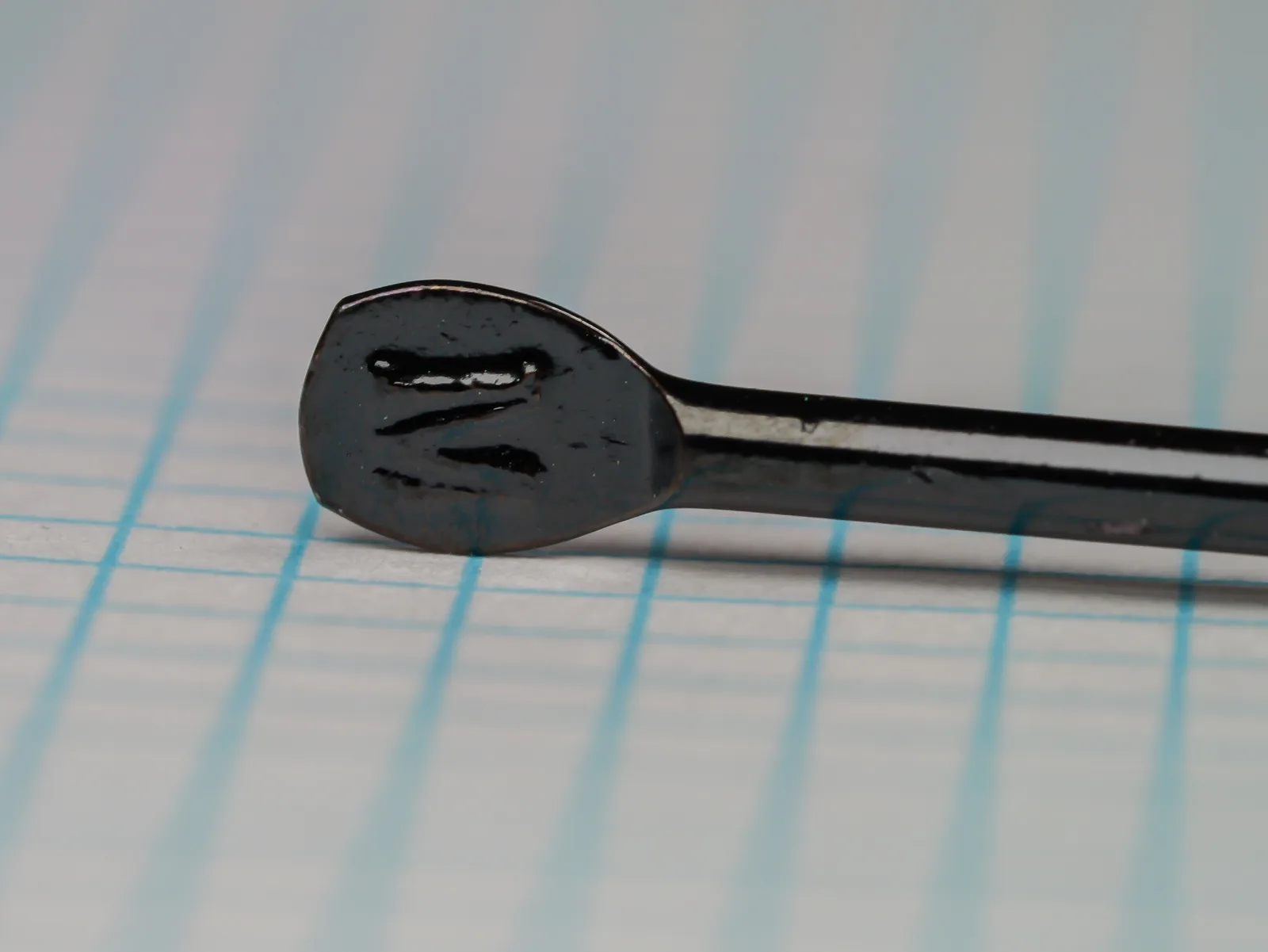
Close-up of the flatted (blind) eye on a Mustad 3455 Kinsey Size No. 5, showing the spade-like shank terminus designed for direct snelling with silk or gut line. The black japanned finish is well-preserved. Photographed on 1/10-inch grid for scale.
Photographic record
3 cataloged imagesSelect any record to load it above.
3 images shown
Mustad 3455 Kinsey Flatted Eye — Size No. 5Close-up of the flatted (blind) eye on a Mustad 3455 Kinsey Size No. 5, showing the spade-like shank terminus designed for direct snelling with silk or gut line. The black japanned finish is well-preserved. Photographed on 1/10-inch grid for scale.Open originalMustad 3455 Kinsey Hook Profile — Size No. 5Side profile of the Mustad 3455 Kinsey showing the characteristic Sproat bend (parabolic curve), Superior point geometry (near-straight inner taper), and proportional shank-to-gap relationship. The japanned finish is uniform across the bend and point. Photographed on measurement grid.Open originalMustad 3455 Kinsey Original Packaging and LabelThe original Mustad eight-line typographic label on manila cardstock, featuring the iconic 'Key Brand' skeleton key logo and all technical specifications. This specimen shows 'OSLO - NORWAY' (post-1925), 'Qual. 3455', 'Superior', 'Mustad-Kinsey Hooks', and 'Flatted Japanned'. The aged golden-tan cardstock and letterpress printing are diagnostic of 1925-1960 Mustad export packages.Open original
Technical profile
Flatted Blind Eye | Sproat Bend | Standard Shank | Standard Wire | Superior Point | Japanned Finish
Eye
Blind — FlattedThe eye is a classic blind, flatted (spade-like) construction P, with the shank tapered to a flat, blunt terminus approximately 0.15" wide. This design was engineered for snelling, where fine silk thread or soaked silkworm gut was whipped directly onto the flattened end using pitch to prevent line slippage under load. The flatted surface is smooth and regularly shaped, consistent with factory manufacture rather than hand-finishing.
Wire
Extra-Fine, Round, Est. ~0.059"-0.063" (~1.5-1.6 mm) E
Shank
Standard — Plain
Bend
Wide gapThe bend exhibits a characteristic Sproat profile — a parabolic curve that sits geometrically between a perfect round Aberdeen and a sharp angular Limerick I. The bend is symmetrical with no offset or kirb. The deepest point of the curve is approximately 0.7" from the apex of the shank, creating a mechanically optimal stress-distribution geometry.
Point
Superior (near-straight inner taper)The barb is a short, close-cut design with minimal backward sweep, positioned approximately 0.25" from the point P. The barb angle is acute (~45 degrees from the shank axis), characteristic of premium salmon patterns designed to minimize damage to delicate mouth tissues while maintaining secure hold.
Finish
Black Japanned — Confirmed (stated on packaging)The japanned finish is opaque black lacquer, well-preserved on the specimen with minimal wear P. The finish exhibits the characteristic alkyd resin baked-on patina typical of early-to-mid vintage Mustad saltwater and salmon hooks. No rust visible beneath the japanning; the seal appears intact across the shank and bend.
The specimen shows light surface patina on the japanned finish consistent with age and historical use, with no corrosion, pitting, or structural defects visible P. The flatted eye remains sharp and unworn. One hook on the original card; the card shows oxidation and age-appropriate wear to the printed label but remains intact and legible.
The Superior point geometry on the 3455 represents a premium manufacturing choice optimized for anadromous species. Unlike Hollow points (which feature pronounced concavity for minimal penetration resistance) or Spear points (which sacrifice initial penetration for maximum structural rigidity), the Superior point achieves a near-straight inner taper that concentrates penetration force at the tip while maintaining exceptional durability. This balance was critical for salmon and sea trout fishing, where the angler needed to set the hook decisively into hard, bony jaw structures while avoiding point rolling or fracture when the fish thrashed against river rocks or drove hard in tidal current.
The Sproat bend — a mathematically engineered parabolic curve — distributes tensile stress evenly across the entire arc of the steel, making it highly resistant to straightening or fracturing under the sustained, violent runs characteristic of hooked migratory fish. The flatted eye construction, while primitive by modern standards, was intentionally designed to anchor the angling line directly to the shank via snelling knots, eliminating any stress concentration at a formed loop. The japanned (baked-on alkyd resin lacquer) finish provided exceptional saltwater and freshwater corrosion resistance, critical for tackle deployed in tidal and major river environments where humidity and mineral-rich water posed constant oxidation hazards.
The Mustad 3455 belongs to the mid-tier ‘Quality’ line, designated by numeric codes in the 3000-3999 range reserved for standard-production hooks manufactured to exacting dimensional and tempering standards. The 3455 was not part of a broader named series but rather a discrete quality code within Mustad’s vast catalog. The ‘Kinsey’ attribution (appearing on Lines 6-7 of the label) suggests either a regional distributor partnership or a specific market variant, though archival evidence on the Kinsey brand relationship is limited in existing Mustad documentation.
The flatted eye construction was characteristic of pre-1960 Mustad salmon and sea trout hooks, reflecting the dominance of snelling technique in Northern European fishing tradition. As eyed hooks became standard after the 1960s, the Qual. 3455 and similar flatted-eye models were progressively discontinued, eventually falling out of the main catalog by the mid-1970s. No direct successor model exists in modern Mustad catalogs, as the shift to ball eyes and tapered eyes made snelling obsolete for most angling applications. The 3455 represents a discrete historical chapter in hook design rather than the progenitor of an ongoing product line.
Era and Packaging Dating
Packaging bears 'OSLO - NORWAY' designation (Line 3 of vintage label). The Norwegian capital was officially renamed from Christiania to Oslo on January 1, 1925, establishing a post-1925 lower bound. The presence of arbitrary numeric quality codes (Qual. 3455), eight-line typographic label format, and letterpress printing on aged manila cardstock are consistent with mid-twentieth-century Mustad export packaging. No barcode present, confirming pre-1974 origin. The Mustad-Kinsey brand attribution and flatted eye construction are characteristic of the 1920s-1960 period when snelling remained dominant in salmon fishing traditions. No visible postal code, phone number, or modern branding elements; manufacturing likely pre-1970.
The Art of Snelling: A Lost Skill
The practice of snelling — carefully whipping fine silk thread or softened silkworm gut directly onto the flatted shank of hooks like the Mustad 3455 — was not merely a rigging method but a mark of angling expertise and tradition. Proper snelling required hours of patient practice, precise knot-tying, and the application of pitch (a sticky, heat-activated resin) to lock the binding in place under load. Atlantic salmon anglers prided themselves on their snelling technique, and a well-snelled gut cast was considered as important to success as the fly pattern itself. The transition from snelling to modern eyed hooks in the 1960s-1970s marked not merely a manufacturing convenience but a fundamental shift in angling culture — the democratization of salmon fishing, where beginners no longer required months of apprenticeship to prepare their tackle.
Design lineage and influence
The Mustad 3455 Kinsey draws its design lineage from the classic British and Irish salmon hooks of the nineteenth century, particularly the Limerick and Aberdeen patterns perfected by Redditch craftsmen. The Sproat bend specifically represents a hybrid synthesis, created to capture the mechanical advantages of both the sweeping roundness of the Aberdeen (superior stress distribution) and the angular precision of the Limerick (jaw-locking geometry). Mustad’s industrial replication of these regional patterns — a core component of the company’s global market domination strategy — allowed Norwegian mass production to undercut expensive hand-forged English imports while maintaining geometric fidelity.
The flatted eye construction on the 3455 persisted into the mid-twentieth century despite the technological feasibility of formed loops, reflecting the deep cultural commitment of European salmon anglers to traditional snelling methods. Competitors such as Partridge of Redditch and various British regional makers continued producing flatted-eye patterns well into the 1950s-1960s, creating a competitive hold-out period before eyed hooks finally displaced snelling as the standard. The 3455’s direct successor in Mustad’s modern catalog would be the Qual. 3906 wet fly hook (featuring a ringed eye), which replaced the 3455 during the 1960s-1970s transition, though the 3906 targets a broader freshwater market rather than salmon specialists.
Best matchRelated by Attribute
Computed automatically from catalog data — updated as new hooks are added.
Matches: Wire, Gap, Eye Orient., Point, Finish +3 moreDiffers: Shank: Standard vs Short (1X–2X Short); Eye: Blind — Flatted vs Blind — Marked Shank; Application: Bait, Salmon, Sea Trout vs Bait +3 more
Matches: Wire, Gap, Eye, Eye Orient., Finish +4 moreDiffers: Shank: Standard vs Short (1X–2X Short); Point: Superior vs Hollow Point; Application: Bait, Salmon, Sea Trout vs Bait +3 more
The Mustad 3455 Kinsey was engineered primarily for Atlantic salmon and sea trout fishing using live bait and natural presentations. The flatted eye design was characteristic of British and Scandinavian salmon tackle tradition, where snelling (the attachment of fine silk or gut line directly to the flattened shank) was the prevailing rigging methodology of the late nineteenth and early twentieth centuries. The Superior point geometry provided a balance between delicate tissue penetration and durability required for anadromous species, while the relatively standard shank length allowed natural bait presentation without excessive leverage during the violent runs typical of migratory salmonids.
Modern Equivalents
Hook
Match Quality
Notes
Mustad 3906B
Good
Ringed eye wet fly hook, modern successor to 3455 platform, similar Sproat geometry but eyed construction
Partridge GRS4A (low water salmon)
Moderate
Modern salmon hook, similar bend family, but different eye and finish philosophy
Tiemco TMC 7989
Moderate
Contemporary salmon fly hook, comparable bend and point geometry but modern manufacturing
Collector notes
The Mustad 3455 Kinsey is a scarce mid-century salmon hook with moderate-to-strong collector demand driven by its flatted-eye construction (now entirely obsolete), its historical role in European snelling tradition, and its representation of Mustad's pre-1960 product philosophy. The original packaging with legible eight-line label significantly enhances collectability; loose hooks command substantially less interest.
Reference value
$22 – $48 USD estimate
Packaging condition
Good — moderate wear, legibleRecorded specimen
Packaging format
GW-M-14Catalog code
Positive Factors: The flatted eye construction is now entirely absent from modern hook manufacturing, making any well-preserved specimen with original packaging of genuine historical interest. The Mustad-Kinsey branding and ‘OSLO – NORWAY’ designation place it firmly in the 1925-1960 era, a golden period for vintage tackle collecting. The Superior point and Sproat bend represent premium manufacturing choices, indicating this was a quality-tier model rather than economy production. Original packaging with legible, colorful label and period-appropriate cardstock adds significant value — an estimated 40-60% premium over loose hooks. The japanned finish is well-preserved on this specimen, showing minimal corrosion. Salmon and sea trout fishing traditions command passionate collector followings, particularly among fly-fishing historians and vintage tackle specialists.
Limiting Factors: The flatted eye makes the hook essentially non-functional by modern standards; most collectors acquire these as display pieces rather than fishing instruments. Production volume was substantial (Mustad produced thousands of 3455s across the 1925-1960 span), limiting extreme rarity compared to regional variants or single-year discontinuations. The Kinsey brand attribution remains obscure, with limited documentation available in mainstream Mustad archives. Size No. 5 is a middle-ground size for salmon work — neither a highly specialized small or large option. Condition is very good but not pristine; the japanned finish shows age-appropriate patina that some collectors view as desirable character and others perceive as minor wear.
Packaging
The packaging is a traditional Mustad eight-line typographic label printed on aged manila cardstock, approximately 2.5" × 1.75". The label features the iconic downward-pointing skeleton key logo labeled 'Key Brand' in the upper left quadrant. The printed text follows the strict Mustad format: Line 1 'O. MUSTAD & SÖN', Line 2 'MANUFACTURERS', Line 3 'OSLO - NORWAY', Line 4 'Qual. 3455', Line 5 'Superior', Line 6 'Mustad-Kinsey Hooks', Line 7-8 'Flatted Japanned', followed by 'Made in Norway' and quantity '100 No. 5'. The label background is golden-tan, consistent with early-to-mid twentieth-century manila stock. Letterpress printing shows crisp registration with characteristic ink pooling at serifs. The decorative border consists of small asterisk ornaments, typical of 1920s-1950s printing conventions.
Market Value Notes
Pricing reflects original packaging condition (strong premium for legible, intact label), wire gauge and finish (japanned is valued highly in salmon traditions), and period rarity (flatted eyes scarce in vintage market). Loose hooks sell in the $12-18 range; this specimen with original card commands $22-48 depending on condition assessment and buyer focus (salmon specialist vs. general vintage tackle collector). Pricing varies significantly across eBay, specialist tackle dealers, and collector fairs. Museum-quality examples with exceptional label preservation and multiple hooks on original card have realized prices to $65+.
Where to Find
Vintage tackle dealers specializing in Atlantic salmon equipment; eBay (search 'Mustad 3455', 'Kinsey hooks', 'flatted eye salmon'); specialist tackle fairs and antique fishing tackle shows in the UK and Scandinavia; occasional offerings from estate liquidators handling fishing collections.
Preservation
Storage and Preservation
Store the original card in a cool, dry environment away from direct sunlight and fluctuating humidity. The japanned finish is stable but benefits from minimal moisture exposure; seal the card in an archival-quality poly sleeve or acid-free box if long-term preservation is desired. Do not attempt to clean or polish the finish — the aged patina is historically authentic and adds significant collector value. If hooks are removed from the card for examination, handle with clean, dry fingers to avoid introducing oils or moisture. The aged manila cardstock is fragile; support it during handling to prevent creasing or tearing. Avoid contact with other metals that could cause galvanic corrosion; store separately from modern stainless or plated hooks. Original packaging in legible condition is the primary driver of collectability — prioritize preservation of the label and card structure over the condition of the hooks themselves. A wooden or acid-free cardboard storage box provides ideal long-term preservation conditions.
Primary Source
Decoding the Eight-Line Vintage Label
Source: O. Mustad & Søn vintage label decryption; Mustad Guide, garrenwood.com reference document
The packaging on this specimen exemplifies Mustad’s formalized eight-line typographic labeling system, engineered to communicate technical specifications across linguistic and geographic barriers. Line 1 (‘O. MUSTAD & SÖN’) establishes manufacturer authority; Line 2 (‘MANUFACTURERS’) differentiates Mustad from regional distributors and jobbers who frequently repackaged imported hooks under secondary brand names — a critical distinction in early twentieth-century tackle markets. Line 3 (‘OSLO – NORWAY’) provides the definitive chronological bracket: the Norwegian capital was officially renamed from Christiania to Oslo on January 1, 1925, meaning this label was produced no earlier than 1925. Line 4 (‘Qual. 3455’) denotes the specific quality tier and model number; the 3000-3999 range indicated mid-tier, standard-production hooks manufactured to exacting dimensional standards, occupying the middle ground between economy models (1000-2999) and premium specialized patterns (4000+). Line 5 (‘Superior’) identifies the hook point geometry — a near-straight inner taper designed for durability and all-purpose reliability. Line 6 (‘Mustad-Kinsey Hooks’) names the specific hook pattern; the Kinsey attribution remains obscure in surviving Mustad archives but may indicate a regional distributor partnership or a specific market variant. Lines 7-8 (‘Flatted Japanned / Made in Norway’) specify the eye construction (flatted, blind, designed for snelling) and the metallurgical finish (baked-on japanned lacquer for corrosion resistance).
Marking Analysis
Handwritten Markings and Annotations
No handwritten markings, retailer stamps, price annotations, or distributor codes are visible on the label or packaging P. This is consistent with factory-sealed, wholesale export packaging destined for bulk distribution rather than direct retail sale. The absence of handwritten price markings (common on hooks sold through general tackle retailers) suggests this card remained in original distributor inventory or was part of a bulk wholesale lot, indicating lower retail wear and potentially higher collector desirability.
Size Note
Hook Size: The No. 5 Standard
The documented size ‘No. 5’ on the original packaging represents a vintage size designation system that differs materially from modern fly hook gape measurements. In the Mustad system of the 1920s-1960s, ‘No. 5’ indicates a hook suitable for general salmon work — neither a specialized small (Nos. 7-10) nor a large pattern (Nos. 1-3 or 1/0 and larger). The confirmed overall length of 2.42″ (61.47 mm) and gap width of 0.94″ (23.88 mm) place this hook in a category that modern fly fishers would classify as a medium salmon hook, roughly equivalent to contemporary Nos. 1/0 to 2/0 in standard fly hook scaling. The apparent discrepancy reflects the fact that vintage bait and salmon hooks used different sizing metrics than modern fly hooks — a source of considerable confusion for modern anglers attempting to identify or recreate vintage patterns. This hook would be physically unsuitable for modern No. 5 fly tying applications without significant adjustment to bait and materials choices.
Additional
Snelling: The Disappearing Tradition
The flatted eye on the Mustad 3455 Kinsey was not a design compromise or manufacturing economy, but rather an intentional engineering choice reflecting a deeply entrenched fishing tradition. Snelling — the technique of whipping fine silk thread or softened silkworm gut directly onto the flattened shank — was not merely functional but ritualistic, a cornerstone of Atlantic salmon angling culture across Britain, Ireland, and Scandinavia from the 1800s through the 1960s.
A proper snell required hours of patient practice to execute correctly. The angler would begin with a section of prepared gut or silk, soften it in water, and carefully wrap and knot it around the flatted shank, binding the wrapping with fine, progressively tighter turns of thread. The final step involved coating the entire whipping with pitch (a heat-activated resin derived from pine tar), which hardened into a durable, waterproof seal that locked the knot permanently in place. A well-executed snell could withstand the tremendous tension and abrasion imposed by a fighting salmon without slipping or unraveling — a feat that required genuine skill and experience.
For Atlantic salmon anglers, snelling was not considered a burden but a fundamental part of fishing knowledge and tradition. Apprenticeship in snelling technique began in childhood; experienced anglers accumulated multiple prepared snells and carried them in special carriers to protect against moisture damage. The snell itself became an object of pride and craftsmanship — and, after the 1960s, a nostalgic symbol of a vanished angling culture. The rise of eyed hooks and modern leader materials rendered snelling obsolete for most fishers, but the tradition never entirely disappeared. Today, a small but dedicated community of Atlantic salmon historians and traditional fly tyers continue to practice snelling, viewing it as an essential connection to the heritage and discipline of the sport.
Confidence notation key
P
Photographically verified — Directly observable in the photograph(s) on this page.
V
Verified by documentation — Confirmed by manufacturer catalog, spec sheet, or published reference.
I
Inferred — A logical deduction from observable or documented evidence, not directly stated.
E
Estimated — An approximation based on visual comparison, proportional analysis, or limited data.
S
Speculative — A reasoned hypothesis that cannot be confirmed from available evidence.
Unnotated claims are the compiler’s synthesis; see Sources. All photographs on garrenwood.com are taken on a measurement grid where each square equals 1/10 inch (0.1″ / 2.54 mm).