The Mustad 3446 is a mid-century sproat-bend hook manufactured by O. Mustad & Son in Oslo, Norway. It is designated as a general-purpose bait and wet fly hook, with a ringed eye, standard round wire, superior point, and bronzed finish. The label bears the “Kinsey” branding, reflecting Mustad’s strategic reverse-engineering of American regional patterns. The superiority of the point designation on Line 5 of the vintage label documents Mustad’s meticulous terminology for point geometry—a near-straight inner taper that balances delicate penetration with structural durability. The Oslo location and offset printing on the label establish production in the post-1925 era, consistent with circa 1925-1960. An original 100-count box carries significant collector value due to the pristine label and documentation of Mustad’s industrial dominance during this period.
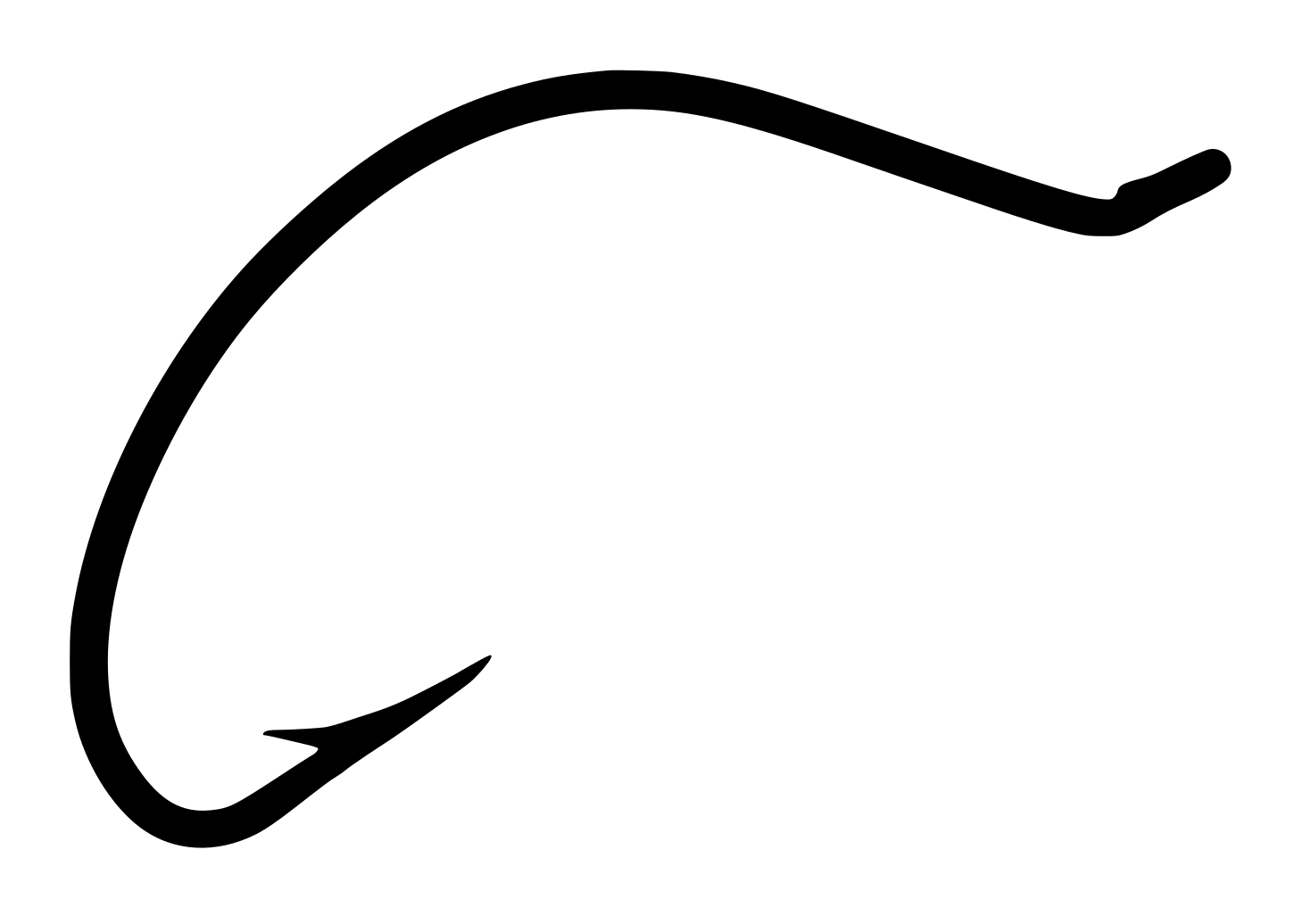
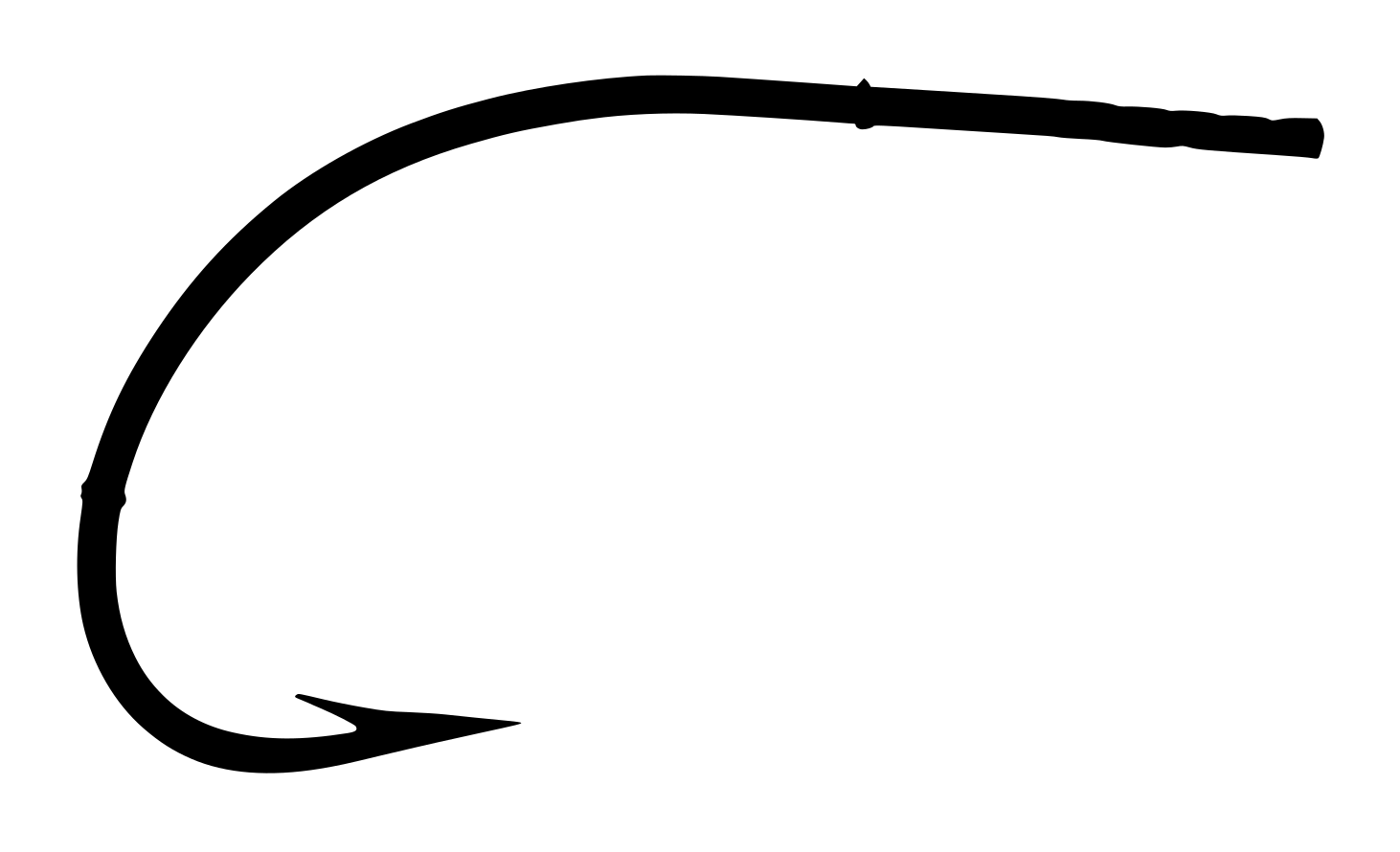
The sproat bend is one of the most universally applicable hook geometries in angling history. Its parabolic curve distributes mechanical stress evenly across the steel, resisting straightening or fracturing under sudden, heavy loads. This design made it the standard for both fly tying and bait fishing across freshwater and light saltwater applications. The superior point, distinct from the more delicate hollow point, was engineered as a premium all-purpose option—offering an optimal compromise between the razor-sharp, minimal-force penetration of a hollow point and the blunt-force durability required for hard bone and rocky substrates. The bronzed finish, achieved through a baked-on lacquer mimicking the hue of bronze, was highly favored by freshwater tyers and stealthy bait anglers seeking to avoid unnatural flash in clear water.
This hook represents a pivotal moment in industrial angling history. The Kinsey pattern exemplifies Mustad’s “cloning” strategy—the systematic reverse-engineering of every significant regional hook pattern and production at unprecedented industrial scale, undercutting local suppliers and establishing global market dominance. By 1950, Mustad controlled approximately 50% of worldwide hook production. Original packaging with intact labels is scarce and valued by collectors and historians studying the industrialization of fishing tackle and the transition from regional craft traditions to global manufacturing. The arbitrary quality code (3446) on the label is the definitive hallmark of vintage Mustad production, distinguishing this era from the modern alphanumeric Signature Series introduced around 2001.
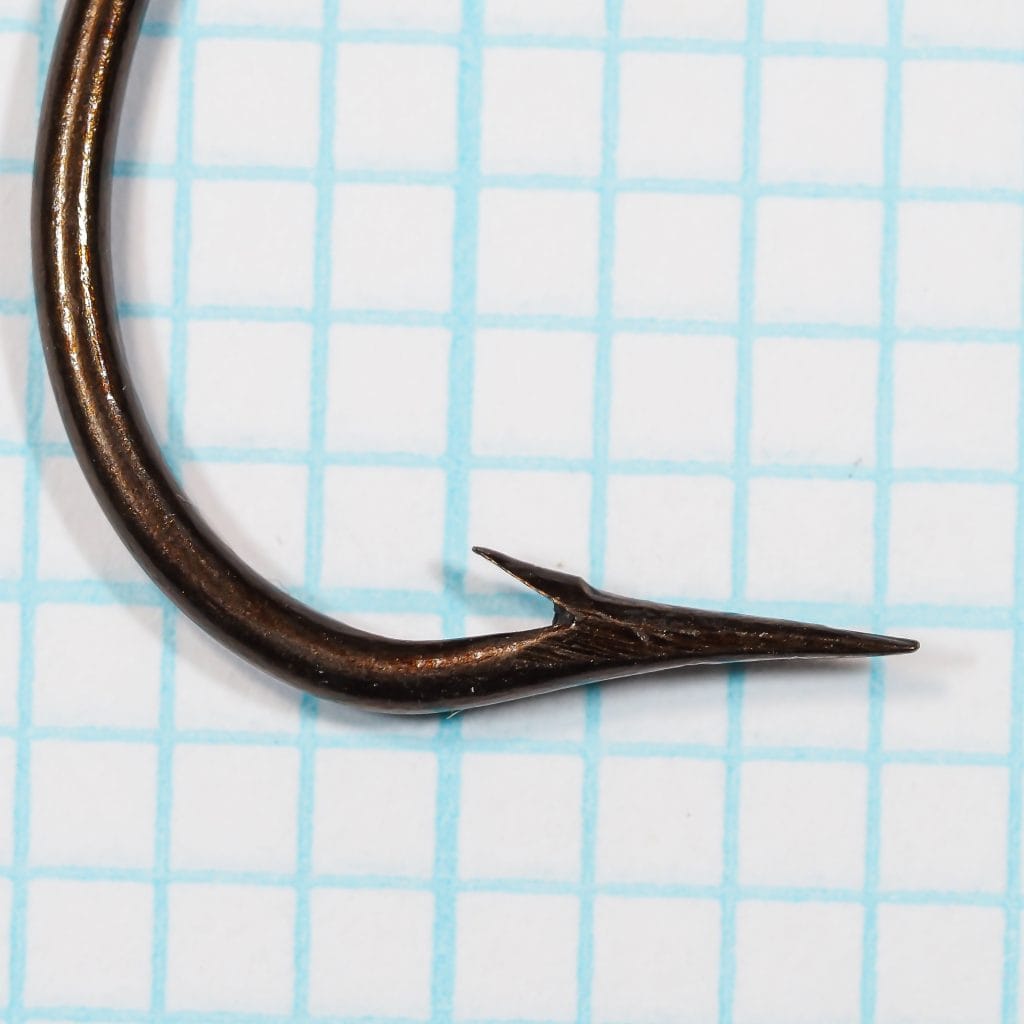
Side profile of a Mustad 3446 Kinsey hook, size 7, showing the rounded sproat bend and superior point geometry. The bronzed finish is visible with characteristic warm brown tone. Photographed on a 1/10-inch measurement grid for scale.
Photographic record
2 cataloged imagesSelect any record to load it above.
2 images shown
Mustad 3446 Size 7 Bronzed Sproat BendSide profile of a Mustad 3446 Kinsey hook, size 7, showing the rounded sproat bend and superior point geometry. The bronzed finish is visible with characteristic warm brown tone. Photographed on a 1/10-inch measurement grid for scale.Open originalMustad 3446 Kinsey Vintage Label CardOriginal vintage Mustad label card for the 3446 Kinsey hook. The eight-line typographic format clearly shows manufacturer (O. MUSTAD & SON), location (OSLO - NORWAY), quality code (Qual. 3446), point type (Superior), pattern name (Mustad-Kinsey Hooks), and finish (Ringed Rustproof). Key Brand skeleton-key logo visible in upper left. Orange paper stock with offset printing characteristic of mid-twentieth-century Mustad labels.Open original
Technical profile
Mustad 3446 — Kinsey Pattern — Sproat Bend — Ringed Eye — Superior Point — Bronzed Finish — Made in Oslo, Norway — Size 7
Eye
Ball Eye, Straight / Inline
Wire
Extra-Fine, Round, Est. ~0.056"-0.062" (~1.4-1.6 mm)
Shank
Standard — Plain
Bend
Wide gap
Point
Superior (near-straight inner taper)
Finish
Bronzed — Inferred (photographically likely)
The superior point on the 3446 exhibits a near-straight inner taper from barb to tip, concentrating penetration force while maintaining structural integrity. Unlike the hollow point (which has pronounced concavity), the superior point offers a middle path between delicate and rugged performance. The sproat bend distributes mechanical stress evenly during a hard fight due to its parabolic curve—it resists straightening under sudden loads better than a perfect round bend. The round (non-forged) wire profile keeps the hook lighter than forged variants, beneficial for light line presentation. Bronzed finish provides moderate corrosion resistance suitable for freshwater environments, though not as durable as japanning for saltwater work. The ringed eye (simple loop) allows secure knot attachment and is mass-producible, making it the global standard for twentieth-century hooks.
We don't have measured sizes for this hook yet. Own one? Submit calipered measurements and we'll review and add them. Thank you!
Historical context
mustad
O. Mustad & Son was founded in 1832 in Gjøvik, Norway, initially as Brusveen Spiger- og Staltradfabrikk, a producer of nails and steel wire. Hans Schikkelstad established the factory; his son-in-law Ole Hovelsen Mustad and grandson Hans Mustad took control and rebranded the firm as O. Mustad & Son. The defining moment came in 1877 when Mathias Topp invented the first fully automated hook-making machine—a mechanical system capable of cutting, bending, barbing, and pointing raw steel wire at unprecedented speeds. Rather than patent the technology (which would require public disclosure), the Mustad family maintained absolute corporate secrecy, relying on non-disclosure agreements and restricted factory access. This strategy proved devastatingly effective against rivals in Redditch, England, and Japan. By the 1950s, Mustad had secured 50% of the global hook production market. The company established sales offices and manufacturing facilities across Europe, North America, South America, and Australia. Oslo (formerly Christiania until 1925) remained the primary manufacturing hub. Mustad’s industrial dominance persisted into the twenty-first century, though the company shifted to modern systems and abandoned the classic arbitrary quality codes around 2001.
Series History
The Kinsey hook family does not constitute a formal numbered series within Mustad’s catalog, but rather a regional pattern designation reflecting Mustad’s aggressive reverse-engineering strategy. Kinsey patterns were derived from hooks favored by anglers in the American Great Lakes and Midwest regions (particularly Wisconsin and Michigan). The pattern name itself likely refers to a regional supplier or renowned angler who popularized the geometry. Mustad’s Qual. 3446 variant was marketed under the branding Mustad-Kinsey Hooks, positioning it as an authentic reproduction of a trusted regional pattern. The label designation “Ringed Rustproof” indicates the application of tin plating or a rust-resistant lacquer coating, a feature that became increasingly common from the 1920s onward as freshwater anglers demanded longer-lasting hooks. The Kinsey designation disappeared from Mustad’s catalogs by the 1970s, replaced by the Signature Series and other modern naming conventions. Today, Kinsey examples survive primarily in dealer stock lots and estate collections, representing a specific moment in Mustad’s mid-twentieth-century expansion into American regional markets.
Era and Packaging Dating
Label shows Oslo designation (not Christiania), establishing post-1925 manufacture. Orange paper stock and offset printing are consistent with mid-twentieth-century Mustad labeling. Presence of arbitrary quality code (3446) rather than modern alphanumeric system indicates pre-2000 production. No barcode visible, supporting pre-1974 estimate. Kinsey branding suggests production in the 1930s-1950s period when Mustad marketed regional patterns aggressively. Rustproof labeling became common from the 1920s onward.
The Kinsey Strategy: Mustad's Industrial Colonization of American Fishing
In the 1920s-1950s, Mustad pursued a calculated strategy of reverse-engineering every significant regional hook pattern used in America and then producing it more efficiently than the original craftsmen could. The Kinsey pattern, favored by Great Lakes anglers, became Qual. 3446—a mass-produced copy of astonishing fidelity. Mustad would ship thousands of Kinsey hooks to regional distributors, undercutting local suppliers through sheer manufacturing scale. Within a decade, the word Mustad became virtually synonymous with the fishing hook itself. By 1950, Mustad controlled approximately 50% of global hook production. The Kinsey hook survives today as evidence of industrial efficiency triumphing over regional craft traditions—a quiet revolution in fishing tackle.
Design lineage and influence
The Mustad 3446 Kinsey represents the apotheosis of Mustad’s industrial pattern-cloning strategy. The Kinsey hook family was derived from a regional pattern favored by anglers in the American Midwest, specifically around the Great Lakes and tributaries. Mustad engineers reverse-engineered the geometry and mass-produced it using their proprietary automated machinery, establishing local market dominance. The sproat bend geometry sits between the English Limerick (angular bottom) and the round Irish patterns, providing mechanical balance. The superior point designation—applied selectively to premium models—indicates Mustad’s recognition that point geometry was a critical performance differentiator. This line eventually evolved into post-1990 Signature Series models, though the original nomenclature and arbitrary quality codes were abandoned by 2001.
Best matchRelated by Attribute
Computed automatically from catalog data — updated as new hooks are added.
Matches: Bend, Shank, Gap, Eye, Eye Orient. +4 moreDiffers: Wire: Extra-Fine vs Fine (1X Fine); Point: Superior vs Standard / Spear; Application: Bait vs Streamer, Saltwater
Matches: Bend, Shank, Gap, Eye, Finish +4 moreDiffers: Wire: Extra-Fine vs Standard; Eye Orient.: Straight / Inline vs Turned Down; Point: Superior vs Hollow Point +1 more
Matches: Bend, Eye, Eye Orient., Point, Forging +4 moreDiffers: Shank: Standard vs Extra-Extra Long; Wire: Extra-Fine vs Fine (1X Fine); Gap: Wide vs Narrow +1 more
Matches: Bend, Gap, Eye, Eye Orient., Forging +2 moreDiffers: Shank: Standard vs Short (1X–2X Short); Wire: Extra-Fine vs Fine (1X Fine); Point: Superior vs Hollow Point +2 more
The Mustad 3446 Kinsey hook is a versatile, medium-weight pattern designed for both bait fishing and wet fly applications. The sproat bend distributes stress evenly across the steel under load, making it reliable for general freshwater angling. The superior point provides an optimal balance between delicate tissue penetration and durability against hard structures. The ringed eye and round wire profile allow secure knot attachment and are ideal for traditional snelled presentations or modern knot systems. The bronzed finish reduces visibility in clear water while providing rust resistance.
Secondary Applications
Light saltwater bait fishing, traditional wet fly tying for trout and salmon.
Classic Fly Patterns
Not typically used for fly tying; designed as a general-purpose bait hook for spinning and conventional fly presentation.
Modern Equivalents
Hook
Match Quality
Notes
Mustad C49S
Very Good
Modern Signature Series sproat pattern; same bend geometry and eye type, lacks superior point heritage nomenclature
Tiemco TMC 3761
Good
Contemporary all-purpose sproat with standard wire; fine substitute for general bait and wet fly work
Partridge SH 1521
Moderate
Sproat pattern from traditional Redditch maker; slightly different bend profile and finer wire
Collector notes
Scarce and historically significant as a documented Kinsey-pattern variant within Mustad's mid-century catalog. The superior point designation and sproat bend make it valuable for collectors studying Mustad's point engineering. Limited surviving specimens in original packaging elevate value; common in bulk lots but rare in pristine condition.
Reference value
$8 – $18 USD estimate
Packaging condition
Good — moderate wear, legibleRecorded specimen
Packaging format
GW-M-OS-01Catalog code
Positive Factors: Original vintage packaging with legible label is a strong value driver. Kinsey branding represents a specific regional pattern cloning strategy that demonstrates Mustad’s industrial philosophy. Superior point designation on Line 5 documents Mustad’s precision terminology. Oslo designation confirms post-1925 manufacture. Size 7 is a practical working size appealing to both utility collectors and fly tyers. Sproat bend is universally recognized and historically significant.
Limiting Factors: Quality code 3446 was mass-produced; not a rare variant within the Kinsey line. No exceptional metallurgical or forging treatment noted. No designer attribution or specialized construction (not extra-long, not forged, not sliced). Bronzed finish is common for freshwater hooks of this era. Condition of individual specimens varies widely; most surviving examples show oxidation or rust bloom.
Packaging
Orange paper card label, 3.5" × 2.25", mounted on plain kraft or white backing card. Offset-printed text in black and red-brown ink. Key Brand logo (skeleton key) in upper left. Eight-line format: O. MUSTAD & SON / MANUFACTURERS / OSLO - NORWAY / Qual. 3446 / Superior / Mustad-Kinsey Hooks / Ringed Rustproof / Made in Norway. Decorative ornamental borders (asterisk patterns) top and bottom. Quantity notation: 100 No. visible. Card shows light toning and surface wear consistent with vintage storage. No barcode. Print quality crisp, colors warm and muted, indicating authentic period offset lithography.
Market Value Notes
Unopened original boxes command $15-18 per 100-count. Single hooks from broken cards typically $0.50-$1.50 depending on condition. Pristine specimens with original label intact and zero corrosion trade at the higher end. Bulk lots of 10-50 mixed Kinsey hooks sell for $0.75-$1.25 per hook. Specialist dealers (vintage tackle auctions, regional fly-fishing societies) command 20-30% premiums over eBay commodity pricing. Condition of the card is the primary price driver—mint cards with crisp label can exceed $20-25 in niche auctions.
Where to Find
eBay bulk vintage hook lots, regional tackle shows and fly-fishing club auctions, specialist vintage tackle dealers, online auction houses focused on sporting antiques. Mustad archives and museum collections occasionally catalog examples.
Preservation
Storage and Preservation
Store this hook and its original packaging in a cool, dry environment away from moisture and fluctuating humidity. The bronzed finish is susceptible to patina development and verdigris formation with sustained humidity exposure; many collectors find a light, even patina desirable as it documents aging and authenticity. If hooks show active corrosion (orange or black rust bloom), place in a sealed container with silica gel for 24-48 hours to halt oxidation.
Original packaging dramatically increases value—keep hooks on the card whenever possible rather than storing loose. The orange label should be protected from direct sunlight, which may cause color fading and paper brittleness. Avoid contact with other metals (especially copper or iron) to prevent galvanic corrosion. Store cards flat in acid-free archival boxes, away from wood shelving (which can off-gas tannic acids). Periodically inspect for insect activity or mold. If hooks are used for fishing, clean them thoroughly with freshwater and dry completely before returning to storage.
Do not attempt to restore or polish vintage bronzed hooks aggressively—modern polishing compounds can remove the historical patina and diminish collector value. A gentle dust with a soft cotton cloth is sufficient for maintenance. If the card becomes creased or torn, preserve the original damage rather than attempting repair; collectors value authenticity of wear patterns as evidence of provenance and use.
Primary Source
Label Decryption: The Eight-Line Mustad Typographic System
Source: Mustad Label Typology Study (garrenwood.com research document)
The orange card label on the Mustad 3446 exemplifies the standardized eight-line typographic format that Mustad deployed globally for over a century. Each line serves a precise, regulated function in the labeling hierarchy—a system engineered to communicate technical data across linguistic and cultural barriers to international wholesalers, retailers, and anglers.
Line 1 (O. MUSTAD & SON): Establishes ultimate corporate authority and brand identity. The unabbreviated full firm name differentiated Mustad from import agents and jobbers who frequently purchased bulk hooks and repackaged them under secondary labels. By cementing their role as primary manufacturers, Mustad ensured direct brand loyalty from end users.
Line 2 (MANUFACTURERS): Reinforces industrial role distinction. In the late nineteenth and early twentieth centuries, the fishing tackle market was saturated with middlemen and regional distributors. This declaration positioned Mustad as the originating source, not a mere repackager.
Line 3 (OSLO – NORWAY): Provides critical chronological bracketing. The Norwegian capital was officially renamed from Christiania to Oslo on January 1, 1925. Any label bearing Oslo (not Christiania) therefore indicates post-1925 manufacture. This single line element allows researchers to date hooks with high precision across decades of otherwise similar packaging.
Line 4 (Qual. 3446): Introduces the quality code—an arbitrary numerical identifier representing a specific product tier within Mustad’s vast catalog. Quality codes were segmented into tiers: economy models (1000-2999), standard quality products (3000-3999), and premium models (4000+). The 3446 falls into the mid-tier category. These codes had no intuitive relationship to the hook’s actual geometry; anglers simply memorized that 3446 was the Kinsey sproat, while 94840 was a dry fly hook. This arbitrary system persisted for over a century and was abandoned only when Mustad transitioned to the modern Signature Series (circa 2001), where codes like R50 explicitly define bend type, wire strength, and shank length.
Line 5 (Superior): According to strict Mustad protocol, Line 5 is reserved exclusively for defining the point’s geometric shape or quality grade. This line never specifies wire gauges, shank lengths, bend styles, or eye configurations. The term “Superior” on this hook’s label indicates a point with a near-straight inner taper that concentrates penetration force while maintaining structural strength. Superior points were marketed as premium, all-purpose options—superior to the delicate hollow point in ruggedness, superior to the blunt spear point in delicate tissue penetration.
Line 6 (Mustad-Kinsey Hooks): Identifies the overarching geometric pattern and shank/bend proportions. Mustad became the world’s largest hook manufacturer through systematic reverse-engineering and mass production of highly localized, regional hook patterns. The Kinsey pattern was derived from American Great Lakes preferences; other cloned patterns included Cincinnati (Midwest bass fishing), Limerick (Ireland), Sproat, Aberdeen, and Virginia. Line 6 formalizes these cloned names, effectively stamping Mustad’s industrial standardization over regional craft traditions.
Lines 7 & 8 (Ringed Rustproof, Made in Norway): Specify supplementary anatomical features and metallurgical finishes. Because a single foundational pattern could be manufactured in dozens of distinct variations, these modifiers are essential. The designation “Ringed” confirms the eye type (a simple loop formed by bending the terminal wire onto the main shank). “Rustproof” indicates a corrosion-resistant finish—either tinning, light japanning, or a rust-resistant lacquer coating. “Made in Norway” reinforces geographic origin for export markets where this distinction carried weight and authenticity.
This label system remained virtually unchanged from the 1880s through the 1990s, serving as a dense, highly encrypted historical document detailing metallurgical standards, regional pattern preferences, and industrial strategies. By decoding each line systematically, researchers can reconstruct not only the specific hook’s technical specifications but also the broader economic and angling traditions of its era.
Additional
The Superior Point: Engineering Nuance in Mid-Century Hook Design
The “Superior” point designation on Line 5 of the Mustad 3446 label represents a specific engineering philosophy unique to vintage Mustad manufacturing. During the era of mechanical grinding (pre-chemical sharpening baths and laser-guided grinding), Mustad distinguished between several point geometries, each engineered for different biomechanical purposes.
The Superior point creates a near-straight inner taper from the barb to the tip, with a nearly flat inner face (unlike the hollow point’s pronounced concavity). This geometry concentrates penetration force at the tip while maintaining structural strength. Superior points were marketed to discerning anglers as a premium, all-purpose choice. They provided an optimal balance: sharper and faster-penetrating than a blunt spear point, yet far more durable and resistant to rolling, dulling, or fracturing when encountering hard bone, cartilage, or rocky aquatic substrates.
The marketing position of the Superior point reveals Mustad’s technical sophistication. The company did not homogenize hook design for lowest manufacturing cost; instead, they fielded multiple point geometries to match specific environmental conditions and target species. A hollow point was ideal for soft-mouthed panfish or delicate trout presentations. A Dublin point (angled outward) was essential for heavy-tackle salmon and steelhead where powerful hook-sets were required. A knife-edge point (triangulated cutting geometry) was reserved for billfish with hard, bony mouths. And a superior point served the broad middle ground—reliable, versatile, and engineered for professional commercial and serious sport anglers who needed a workhorse hook that would not fail under unexpected stress.
By the 1950s, when the Mustad 3446 Kinsey was in full production, the superior point represented the accumulated knowledge of seven decades of automated manufacturing experimentation. It remains one of the most underappreciated engineering achievements in vintage hook design—a geometry that is neither famous nor exotic, but rather a statement of balanced competence: “not the sharpest, not the strongest, but optimized for the real world of unpredictable fishing conditions.”
Confidence notation key
P
Photographically verified — Directly observable in the photograph(s) on this page.
V
Verified by documentation — Confirmed by manufacturer catalog, spec sheet, or published reference.
I
Inferred — A logical deduction from observable or documented evidence, not directly stated.
E
Estimated — An approximation based on visual comparison, proportional analysis, or limited data.
S
Speculative — A reasoned hypothesis that cannot be confirmed from available evidence.
Claims with no notation are confirmed by multiple independent sources. All photographs on garrenwood.com are taken on a measurement grid where each square equals 1/10 inch (0.1″ / 2.54 mm).