
Mustad Hooks – 37187

At-a-Glance Summary
The Mustad 37187 Stinger Hook, size 1/0, is a legendary warmwater fly hook from the golden age of modern bass and pike fly fishing (c. 1980-1995). Manufactured by O. Mustad & Søn in Gjøvik, Norway, this straight-ring eye design became the structural foundation of the Dahlberg Diver — arguably the most influential topwater fly pattern of the last 40 years.
The defining characteristic is its stinger bend: a pronounced wide gape specifically engineered to maintain hook opening even when wrapped with voluminous deer hair. Unlike standard fly hooks where bulk materials block the gap, the 37187’s proportional geometry keeps the point accessible for solid hook-ups. The straight eye (as opposed to tapered or turned-down) ensures vertical tracking during diving action, eliminating unwanted rotation or planing.
This specimen is housed in its original blue plastic flip-top box featuring the distinctive dot matrix fade design characteristic of Mustad packaging from the mid-1980s through mid-1990s. The absence of UPC barcode and clean offset-printed label date it to the pre-Signature Series era. 100-hook quantity per box was standard for production fly hooks during this period.
The 37187 exemplifies the intersection of functional engineering and iconic design tradition. While no longer in production (succeeded by the Mustad C52S BLN), it remains a collector’s piece for fly tiers, warmwater enthusiasts, and anyone invested in the legacy of modern bass and pike fly fishing.
Photography
Identification
| Manufacturer | mustad |
| Model / Code | 37187 |
| Full Name | 37187 |
| Size Documented | 1/0 |
| Estimated Era | c. 1980-1995 |
| Country of Origin | Norway |
Technical Specifications
| Eye Type | Ball Eye |
| Eye Orientation | Straight / Inline |
| Eye Notes | Straight eye with loose ring attachment. Ring appears to spin freely, typical of Mustad fly hook construction from this era. P |
| Wire Gauge | Fine (1X Fine) |
| Wire Profile | Round (unforged) |
| Shank Length | Standard |
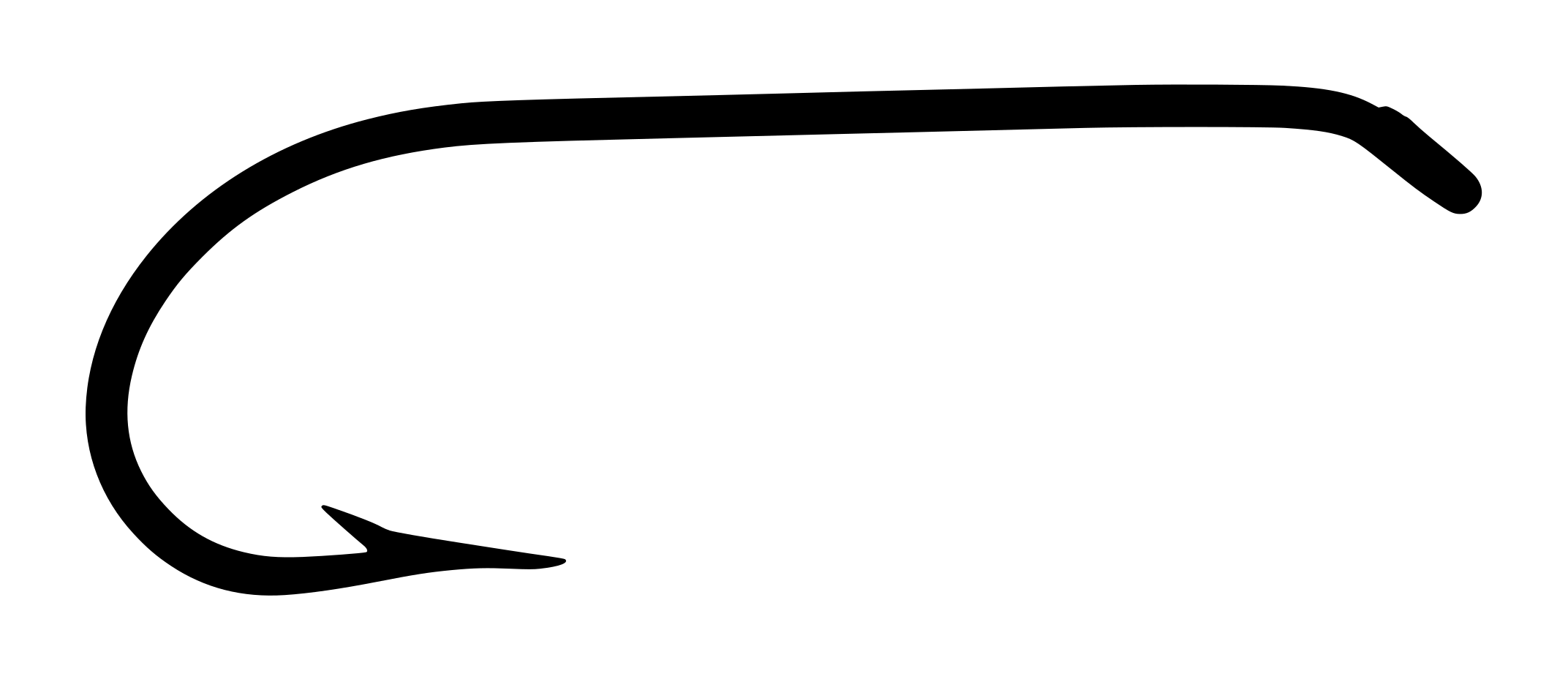
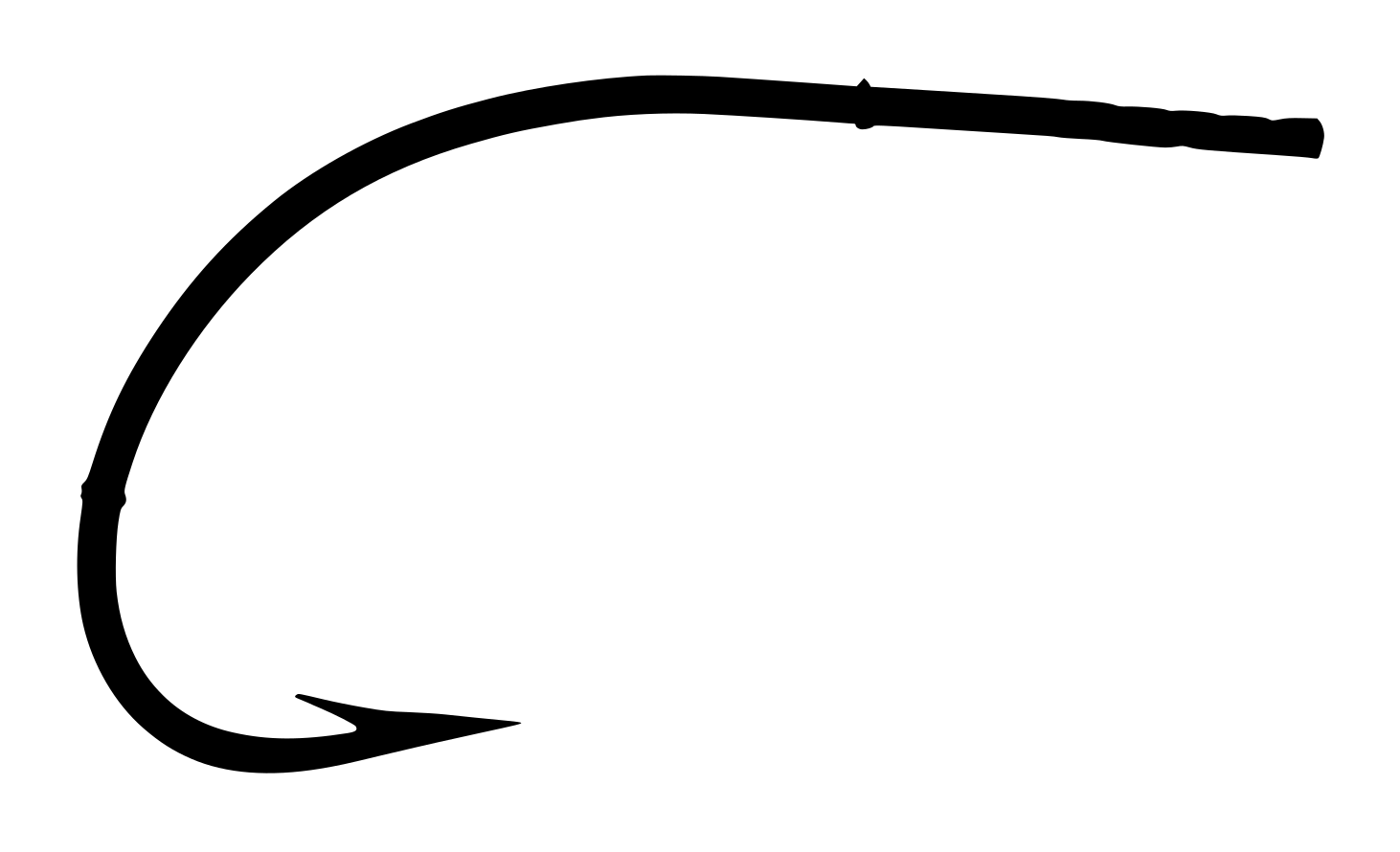
| Bend Notes | Stinger bend with wide gape geometry — pronounced downward curve from eye through bend, forming a distinctive wide hook mouth. Designed specifically for bulky fly materials and predator species. P |
| Point Style | Standard / Spear |
| Gap Width | Wide |
| Barb | Micro-barb style — short, close-cut barb positioned just below the point. Typical of Mustad fly hook barb geometry from the 1980s-1990s era. P |
| Finish | Bronzed — Confirmed (stated on packaging) |
| Finish Notes | Warm brown-gold tone characteristic of bronzed finish. Even coverage visible on multiple specimens in package. P |
| Condition | Specimen hooks are bright with no visible corrosion or oxidation. Box structure intact with clean hinge and snap closure. Label shows light surface patina typical of 35+ year old packaging — no tears, creasing, or significant wear. All 100 hooks present and undamaged in original factory arrangement inside box. |
The standard (non-forged) wire construction provides adequate strength for deer hair applications while maintaining the flexibility needed for clean penetration on topwater takes. The round wire profile distributes stress evenly around the bend. At size 1/0, wire diameter of approximately 0.065″-0.075″ strikes a balance between durability and castability — heavier wire would make large deer hair bodies difficult to throw, lighter wire risks bending under load. The bronzed finish provides corrosion resistance suitable for freshwater pike and bass, though inadequate for extended saltwater use. The micro-barb style (vs. fully cut barb) reduces hook mass while retaining fish-holding capability. The straight-eye configuration is functionally critical: a tapered or turned-down eye would create rotational asymmetry during the dive cycle, causing the fly to corkscrew or plane laterally rather than descending vertically.
Technical Measurements
Size measured: 1/0. Method: Physical measurement with calipers.
| Dimension | Value |
|---|---|
| Overall Length | ~1.86"-1.90" (~47.2-48.3 mm) P |
| Shank Length | ~1.35"-1.45" (~34-37 mm) |
| Gap Width | ~0.66"-0.70" (~16.8-17.8 mm) P |
| Bend Depth | ~0.82"-0.88" (~21-22 mm) |
| Wire Diameter | ~0.065"-0.075" (~1.65-1.90 mm) |
| Shank-to-Gap Ratio | ~2.0-2.1 : 1 |
Overall length and gap width confirmed by physical caliper P. Remaining dimensions estimated from grid-derived calibration using confirmed values as anchor points. Grid alignment moderate — hook positioned at slight angle in image 2. Recommend independent verification with calipers for shank length and bend depth. Shank length: ~13.5-14.5 small squares at 0.1" per square. Bend depth: ~8.2-8.8 small squares.
Historical Context
mustad
O. Mustad & Søn was founded in 1832 in Gjovik, Norway, by Ole Mustad and his son Jørgen. The company grew to become the world’s largest hook manufacturer, establishing itself through aggressive international marketing and consistent quality control. Unlike many English hook makers who produced exclusively through retail channels or mail order, Mustad invested in direct manufacturing capacity and developed a global distribution network. By the mid-20th century, Mustad hooks were ubiquitous in fishing tackle boxes worldwide. The company maintained its Norwegian manufacturing base until the late 1980s, when production gradually shifted to other facilities including China. The Gjovik factory operated continuously from its founding through the 1990s, and Mustad Norwegian-made hooks from this period are prized by collectors who attribute superior tempering and metallurgy to the Norwegian industrial tradition.
The company remains in operation today as part of the Berkley/Pure Fishing portfolio, though it has lost the independent brand recognition it held through the 1970s-1990s.
Series History
The 37187 Stinger Hook was introduced as part of Mustad’s fly hook catalog expansion during the early 1980s. It was not the first stinger design (British makers produced similar geometries earlier), but it became the standardized production version through the critical years of the modern bass fly revolution. The model designation 37xxx series places it within Mustad’s general fly hook family, though Mustad’s catalog documentation from this era is fragmented and exact introduction dates are difficult to confirm from surviving packaging alone.
The 37187 saw consistent production through the 1980s and 1990s in Gjovik. The blue flip-top box shown in this specimen replaced earlier cardboard packaging circa 1985-1987. Mustad introduced the ‘Signature Series’ redesign in the late 1990s, which included chemically sharpened points and modernized packaging. The direct successor, the C52S BLN, maintains the stinger geometry but incorporates sharper points and modern metallurgy.
The 37187 remains listed in some Mustad catalog references even today, though production has likely ceased or moved to China-based facilities. Its primary collecting significance derives from its role as the ‘official’ platform for the Dahlberg Diver tradition (c. 1980-2010), during which it became synonymous with innovative warmwater fly design.
Era and Packaging Dating
Packaging analysis: Mustad blue plastic flip-top box with blue paper insert and distinctive dot matrix fade pattern above FLY HOOKS text — characteristic of late 1980s/early 1990s Mustad packaging. Box construction uses modern plastic snap closures, not cardboard card stock. No UPC barcode visible on label. Offset-printed label with clean modern typeface. No phone number or address visible. Design language consistent with Mustad's transition away from cardboard boxes. Mustad documentation indicates this exact box style was in use c. 1985-1995 before migration to 'Signature Series' packaging in late 1990s. 100-hook quantity per package is standard for fly hooks from this era, supporting mid-to-late 1980s introduction.
The Dahlberg Diver, created by Larry Dahlberg and first prominently featured in fly fishing literature during the early 1980s, became a sensation in bass and pike fishing communities. Tiers quickly realized that the Mustad 37187's straight ring eye and stinger bend were perfectly suited to the fly's geometry. Within a few years, 'the Dahlberg Diver' and 'the 37187' became almost synonymous in fly tier conversations — anglers would ask 'which hook are you using for your Divers?' and the answer was almost always 37187. The combination of Dahlberg's design innovation and the 37187's mechanical suitability created a self-reinforcing demand cycle that sustained the hook through the 1990s and established it as a collector's icon.
Design Lineage and Influence
The stinger bend geometry predates the 37187 — British manufacturers including Partridge of Redditch produced similar wide-gape designs for pike and sea trout flies throughout the 1950s-1970s. However, the 37187’s specific combination of straight ring eye, standard wire gauge, and proportional wide gape emerged as Mustad’s response to the modern bass fly renaissance of the early 1980s. Dave Whitlock’s Punch Bug and later Larry Dahlberg’s Diver patterns — both tied on stinger-type hooks — drove demand for a reliable, consistent production hook matching this geometry. The 37187 became the standard-bearer for this category. Post-discontinuation, Mustad introduced the C52S BLN (Signature Series) as the direct successor, followed by newer models like the C49S. Modern alternatives include Gamakatsu B10S and Ahrex PR320, which maintain the stinger geometry while incorporating contemporary sharper points and advanced metallurgy.
Related by Attribute
| Silhouette | Hook Model | Match | Analysis | |
|---|---|---|---|---|
| 3489 No. No. 3 — Pacific Bass Hooks | 76% |
Matches: Bend, Shank, Gap, Eye, Eye Orient. +3 more Differs: Wire: Fine (1X Fine) vs Standard; Point: Standard / Spear vs Superior; Finish: Bronzed vs Tinned +1 more |
Compare | |

|
2310 R No. No. 16 — Milward 2310 R | 71% |
Matches: Bend, Shank, Wire, Point, Forging +3 more Differs: Gap: Wide vs Narrow; Eye: Ball Eye vs Blind — Flatted; Eye Orient.: Straight / Inline vs N/A — Blind +2 more |
Compare |

|
3621-B No. 4 — Virginia Fish Hooks | 69% |
Matches: Bend, Shank, Eye, Eye Orient., Forging +2 more Differs: Wire: Fine (1X Fine) vs Standard; Gap: Wide vs Standard; Point: Standard / Spear vs Other +2 more |
Compare |
|
3319 A No. No. 20 — 3319 A | 68% |
Matches: Bend, Shank, Eye, Finish, Forging +2 more Differs: Wire: Fine (1X Fine) vs Standard; Gap: Wide vs Standard; Eye Orient.: Straight / Inline vs Turned Down +2 more |
Compare |

|
3366 No. 6/0 — Mustad-Sproat Hooks | 67% |
Matches: Shank, Gap, Eye, Eye Orient., Finish +4 more Differs: Bend: Other vs Sproat; Wire: Fine (1X Fine) vs Extra-Fine; Point: Standard / Spear vs Superior |
Compare |
Related by Shape (SVG)



Usage, Fly Patterns, and Equivalents
Primary Application
The Mustad 37187 Stinger Hook is engineered for bulky warmwater fly patterns, particularly topwater deer hair bugs and subsurface predator streamers. The defining feature is the wide gape — the distance between the point and shank is exceptionally large compared to standard fly hooks of equivalent size. This geometry solves a critical problem in fly tying: when spinning deer hair or other bulk materials directly onto the hook shank, the hair mass naturally blocks the gap, preventing secure hook-ups. The wide stinger bend maintains adequate gap opening even after voluminous materials are applied, making it the de facto standard for Dahlberg Divers and similar patterns. Straight-eye construction ensures the fly tracks straight during the diving action — a down-eye hook would cause unwanted tilting.
Secondary Applications
Pike streamers, musky flies, large saltwater patterns, experimental topwater bass poppers. Occasionally used for heavy nymph patterns in size 2/0 and larger.
Classic Fly Patterns
Dahlberg Diver, Whitlock Punch, Dave's Hopper, Bass Bug, Slider, Pike Popper, Musky Diver
Modern Equivalents
| Hook | Match Quality | Notes |
|---|---|---|
| Gamakatsu B10S | Excellent | Modern stinger design with identical geometry, sharper point, superior metallurgy. Preferred by contemporary bass and pike fly tiers. |
| Mustad C52S BLN | Excellent | Direct Mustad successor — chemically sharpened, same stinger bend, straight eye. Current production alternative. |
| Ahrex PR320 | Very Good | Premium predator stinger with advanced high-carbon steel, maintains classic stinger geometry for modern applications. |
| Tiemco 8089 | Good | Wide-gape saltwater pattern, similar proportional geometry but designed for salt applications and larger game fish. |
Collectability and Value
| Rarity | Uncommon |
| Market Value (USD) | $8 – $25 |
| Packaging Condition | Excellent — minimal wear |
| Packaging Format | Mustad-Flip-Top-Blue-Box-1 |
Positive factors: Iconic design from the Dave Whitlock era of bass fly fishing. Associated with the Dahlberg Diver tradition — arguably the most influential warmwater fly pattern of the modern era. Original blue-label box with dot matrix fade is distinctively 1980s-1990s. Tied by generations of serious fly tiers for pike, musky, and saltwater applications. Straight-eye geometry is functionally superior for diving bugs compared to down-eye alternatives.
Limiting factors: Produced in massive quantities (100-hook boxes were standard). Still in production in modern form, reducing scarcity perception. Not discontinued — current Mustad C52S BLN is the direct successor. Bronzed finish susceptible to patina, reducing pristine condition availability. Lower collecting premium compared to rare vintage English hooks or pre-1960s Mustad patterns.
Packaging
Plastic flip-top hinged box with blue paper insert. Lid interior features dot matrix fade pattern (blue dots transitioning from dense to sparse) above white text reading 'FLY HOOKS' with TM symbol. Lower portion of label shows printed text: REF 37187 | SIZE 1/0 | QTY 100, and below: STINGER HOOK. Mustad registered trademark symbol (R) in box top corner. Box dimensions approximately 3.5" W x 2.25" H x 1.5" D. 100 hooks visible inside, bronzed color. Original condition with minimal wear to label and box structure.
Market Value Notes
Original sealed 100-hook box with unexamined hooks: $15-25. Loose vintage hooks in good condition: $0.10-0.25 each. Tied examples with historical provenance or connection to documented Dahlberg Diver patterns command $15-40 per fly. Condition of original box label is primary pricing driver — pristine blue labels with intact dot matrix fade worth premium to collectors.
Where to Find
Specialist fly tying suppliers, eBay vintage tackle lots, estate sales from serious bass fly fishers, vintage tackle auctions. Survivors often found in original blue boxes in fly tier stash piles. Less common in UK collecting circles compared to US venues.
Storage and Preservation
Store the original box in a cool, dry environment away from direct sunlight. The bronzed finish will develop natural patina over time with humidity exposure — many collectors consider this desirable, but it can be slowed by maintaining relative humidity below 50%. If hooks are removed from the box, store them in airtight containers with silica gel desiccant packs to prevent oxidation.
The original blue plastic box is part of the specimen’s historical and monetary value — keep the box intact whenever possible. Label patina and minor surface wear are normal and acceptable; avoid aggressive cleaning. If the box becomes sticky or shows signs of plastic degradation (common with older plastic packaging), transfer hooks to acid-free paper envelopes or compartmented boxes, but retain the original box for display.
Separate this hook from ferrous metals and avoid contact with copper or brass materials, which can cause galvanic corrosion. If hooks are used and then stored, rinse thoroughly in freshwater and dry completely before sealing in storage containers. The micro-barb design retains fishing capacity indefinitely if kept dry and protected from corrosion.
Label Analysis: Packaging Claims and Era Indicators
Source: Mustad 37187 Blue Flip-Top Box Label, c. 1980-1995
The packaging label presents minimal text but carries significant era information: ‘REF 37187 | SIZE 1/0 | QTY 100’ with lowercase ‘STINGER HOOK’ descriptive text. The absence of complex product descriptions or marketing claims is notable — this contrasts sharply with modern Mustad packaging, which includes extensive text about point sharpness, steel type, and application suggestions. The minimal labeling approach suggests a period when Mustad assumed buyers already knew the difference between hook types and didn’t require educational marketing copy.
The ‘REF’ designation (reference number) was standard Mustad practice for European and international markets during the 1980s-1990s, distinguishing it from US-market numbering conventions. The presence of the Mustad registered trademark (R) symbol indicates a time when the company actively protected brand identity through trademark registration. No UPC barcode is visible — a strong indicator of pre-1974 or early post-1974 manufacture, though Mustad’s adoption of barcoding was slower than many manufacturers. The clean offset-printed label suggests mid-to-late 1980s print technology, as earlier letterpress or screen-printed labels from Mustad are visibly rougher in texture.
The dot matrix fade pattern (blue dots transitioning from dense to sparse) above the ‘FLY HOOKS’ text is specific to Mustad’s transition packaging c. 1985-1995. This design element was abandoned when the company shifted to the ‘Signature Series’ branding circa 1997-2000, making the dot matrix pattern a reliable era indicator for Mustad fly hooks. The TM (trademark) symbol next to ‘FLY HOOKS’ indicates legal protection of the product line name itself — a practice common to large manufacturers during the growth and consolidation period of the 1980s-1990s.
Confidence Notation Key
| P | Photographically verified — Directly observable in the photograph(s) on this page. |
| V | Verified by documentation — Confirmed by manufacturer catalog, spec sheet, or published reference. |
| I | Inferred — A logical deduction from observable or documented evidence, not directly stated. |
| E | Estimated — An approximation based on visual comparison, proportional analysis, or limited data. |
| S | Speculative — A reasoned hypothesis that cannot be confirmed from available evidence. |
Claims with no notation are confirmed by multiple independent sources. All photographs on garrenwood.com are taken on a measurement grid where each square equals 1/10 inch (0.1″ / 2.54 mm).