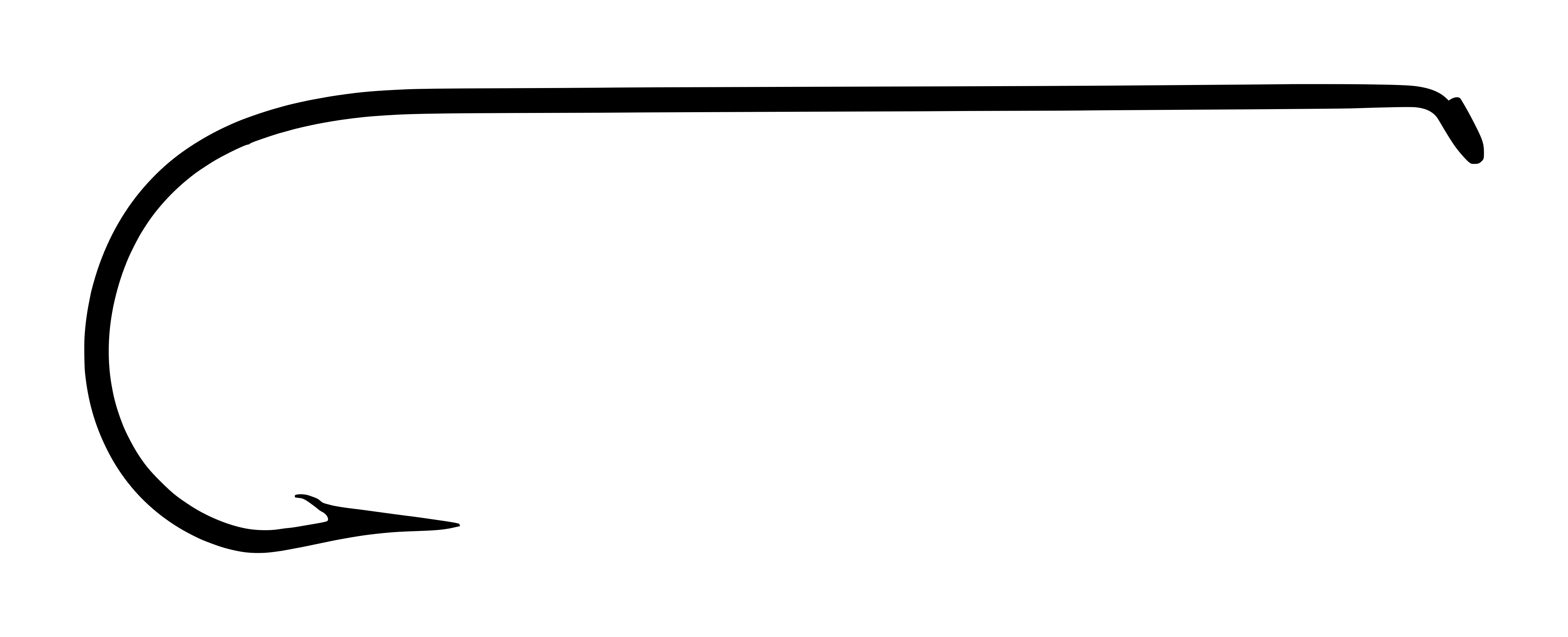
The Pflueger 15120-B Aberdeen Pelican is an American bait hook manufactured by Pflueger Corporation of Akron, Ohio, circa 1965. The ‘Pelican’ refers to its ringed eye construction, which allows independent rotation without knot attachment. This size 3/0 specimen exhibits the classic Aberdeen bend—a wide, symmetrical, rounded profile—paired with a standard-gauge round wire and blued finish.
The defining feature is the straight ring eye, a loose wire ring that rotates freely at the eye position, making line attachment and bait adjustment simple and quick. The hollow point geometry provides a knife-edge for deep penetration in live or cut bait presentations. The hook measures approximately 1.85″ overall with a 0.56″ gap, proportionate for salmon, large catfish, and saltwater bait work.
For collectors, this hook represents a pivotal moment in American tackle manufacturing—the transition from blind-eye specialist patterns to modern ringed-eye simplicity. Complete, sealed boxes of Pflueger bait hooks from this era are increasingly scarce, making this an interesting reference specimen for the history of American fishing tackle.
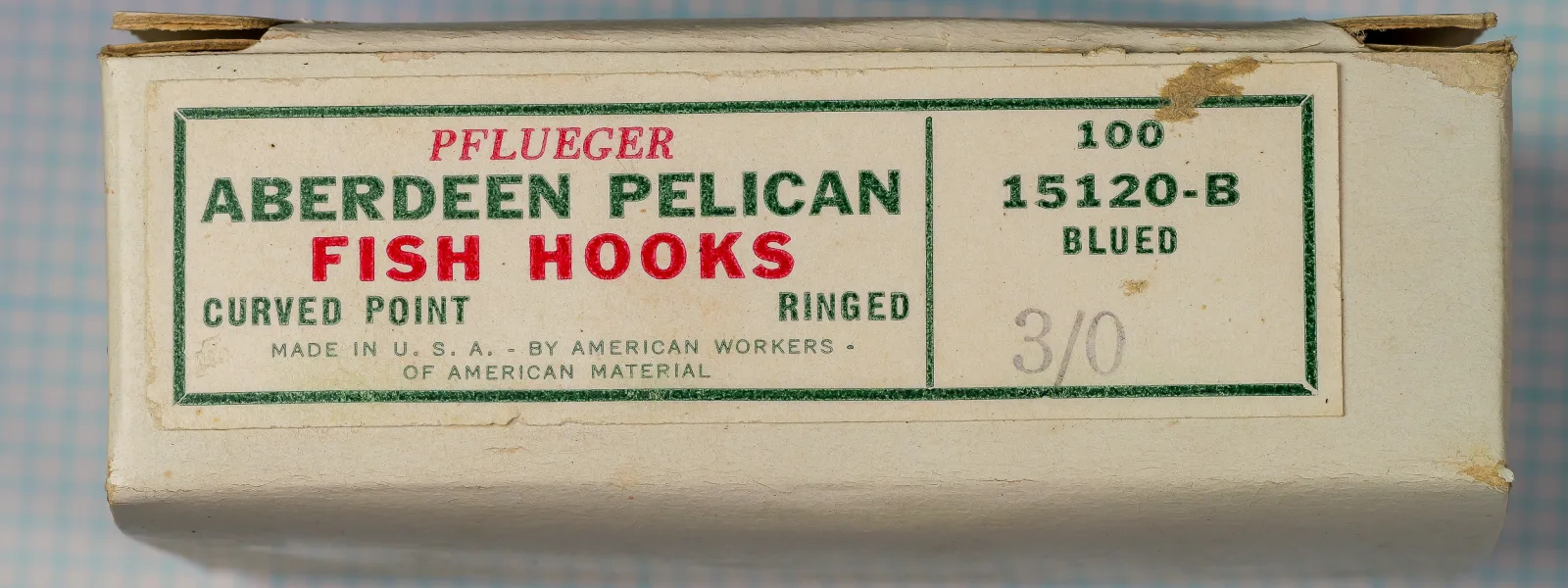
Side panel of the original Pflueger 15120-B cardboard box for Aberdeen Pelican hooks, size 3/0, showing offset-printed specifications, model code, quantity (100), finish (blued), and American manufacturing claim.
Photographic record
4 cataloged imagesSelect any record to load it above.
Ball Eye, Straight / InlineStraight ring eye: a loose ring of wire affixed at the eye position, allowing independent rotation P. Ring diameter appears proportionate to the wire gauge; ring shows clean closure with minimal gap P. This construction was standard for Pflueger bait hooks and allowed anglers to attach line without a knot.
Wire
Extra-Fine, Round
Shank
Standard — Plain
Bend
Aberdeen, Standard gapAberdeen bend presents classic wide, rounded bottom profile typical of the design family P. Bend geometry is symmetrical with consistent wire curvature throughout the curve; no offset or reverse orientation detected P. Bend depth measures ~0.60"-0.68", proportionate to shank length for balanced strength distribution E.
Point
Beak / Reversed (incurving)Barb is short, close-cut, and perpendicular to the hook shaft P. Barb placement is standard for bait hooks—neither swept nor exaggerated. Single barb observed P.
Finish
Blued — Confirmed (stated on packaging)Blued finish is uniform and even across the specimen P. Blue tone is moderately warm, characteristic of mid-1960s bluing chemistry E. No active corrosion or rust bloom present; surface shows minor handling wear consistent with original stock condition P. Finish is bright and glossy rather than dark oxidized blue.
Hooks are bright blued with no active corrosion P. Box shows moderate age toning typical of 1960s kraft stock; no water damage or severe creasing P. All 100 hooks present and intact P.
The hollow point design—with its concave inner face and inwardly curved taper—creates a knife-edge effect that maximizes penetration force when the hook engages tissue or jaw. This geometry is particularly effective for bait fishing, where the hook must penetrate through protective scales or tough mouth structures. The Aberdeen bend’s wide, rounded profile distributes stress evenly across the bend radius, reducing breakage risk under load.
Standard-gauge round wire provides a balance between durability and fine-wire sensitivity for bite detection. The wire is sufficiently robust to withstand the thrashing of large fish or aggressive bait strike, yet not so heavy that it dulls the point or dampens bait action. Blued finish serves both functional (corrosion resistance in freshwater) and aesthetic purposes, with the blue tone indicating a controlled oxidation process typical of mid-20th-century American hook manufacturing.
The straight ring eye eliminates the need for a tapered or formed eye, reducing manufacturing steps and cost. The ring’s free rotation allows the line to move naturally under bait movement, reducing leverage stress on the eye itself. This design was particularly popular for anglers using live baitfish, where natural movement was paramount.
We don't have measured sizes for this hook yet. Own one? Submit calipered measurements and we'll review and add them. Thank you!
Historical context
pflueger
Pflueger Corporation, based in Akron, Ohio, emerged as a major American tackle manufacturer in the early 20th century. The company was known for producing a wide range of fishing reels, hooks, and tackle components at competitive prices. By the 1960s, Pflueger had established itself as a household name in American fishing tackle, competing directly with established brands like Mustad and Milward through aggressive pricing and broad product distribution.
The Akron facility represented a significant investment in American manufacturing, distinct from the Redditch, England–dominated hook industry. Pflueger’s strategy emphasized Made in U.S.A. marketing—prominently featured on this box—and use of American workers and materials. This positioning was particularly strong during the 1960s, appealing to nationalist sentiment and anglers who preferred domestic tackle. The company’s ringed-eye and straight-eye designs reflected pragmatic engineering: easy line attachment without complex eye construction reduced manufacturing costs while maintaining functionality.
Pflueger Corporation was eventually acquired by larger entities, but its mid-century bait hooks remain common in tackle collections, representing a crucial bridge between craft-era Redditch production and modern industrial hook manufacturing.
Series History
The Pflueger Aberdeen Pelican series, identified by model code 15120-B, represents the company’s economical take on the classic Aberdeen bend. The ‘Pelican’ name derives from the loose ring eye design, which was marketed as simple, dependable, and non-slip—key selling points for bait anglers. The Bull Dog Brand sub-label positioned these hooks as budget-friendly alternatives to Pflueger’s premium lines, appealing to working anglers and tackle shops seeking volume discounts.
The series appears to have been introduced in the early 1960s and remained in production through the decade. Size range included standard bait sizes from #2 through 5/0 or larger, with consistent 100-hook count packaging. The hollow point was standard across the range, optimized for fresh or saltwater bait fishing. No evidence of design revision or pattern change appears in documented packaging; the 1965 example shown here represents the peak of the series’ production run, before synthetic-bristle brushes and simplified designs began to displace ringed-eye hooks in the late 1960s and 1970s.
The 'Pelican' name for ringed-eye hooks may derive from the bird's expandable throat pouch—a whimsical analogy to the ring's 'flexibility' or 'give.' More likely, it reflects Pflueger's marketing approach: brand names on budget lines often referenced animals (Bull Dog, Pelican) rather than geometric descriptors, creating memorable, conversational tackle box culture. Anglers would ask for 'a card of Pelican hooks' rather than 'size 3/0 Aberdeen with ringed eye,' cementing the brand name into regional tackle vernacular. This practice was particularly strong in the American Midwest, where Pflueger's Akron presence gave the company disproportionate market share.
Design lineage and influence
The Aberdeen bend itself dates to the late 19th century and represents one of the oldest continuously manufactured hook profiles. The Aberdeen shape evolved from British craft traditions but was quickly adopted and standardized by American manufacturers seeking economical, high-production designs. By the 1960s, Aberdeen hooks were ubiquitous across all price tiers and applications.
Pflueger’s addition of a ringed eye to the Aberdeen form represents a pragmatic American interpretation. While Redditch manufacturers (Partridge, Allcock, Milward) continued to favor blind eyes and tapered eyes for specialist applications, American producers simplified eye construction for speed and cost. The ringed eye, familiar from older anchor-chain hardware and industrial fasteners, transferred easily to hook manufacture and required minimal specialized tooling.
Competing designs from the era include Mustad’s simpler straight-eye Aberdeens (which used a formed eye rather than a loose ring) and Wright & McGill’s economy lines, which pursued similar market positioning. The Pflueger approach—emphasizing American manufacture and straightforward construction—proved durable through the 1960s but was gradually displaced by sealed-hook designs and synthetic materials in the 1970s.
Best matchRelated by Attribute
Computed automatically from catalog data — updated as new hooks are added.
Matches: Bend, Shank, Gap, Eye, Eye Orient. +4 moreDiffers: Wire: Extra-Fine vs Fine (1X Fine); Point: Beak / Reversed vs Standard / Spear; Finish: Blued vs Bronzed +1 more
Matches: Bend, Wire, Gap, Point, Forging +3 moreDiffers: Shank: Standard vs Short (1X–2X Short); Eye: Ball Eye vs Cross Eye; Eye Orient.: Straight / Inline vs Jig (60°/90°) +1 more
Matches: Wire, Gap, Eye, Eye Orient., Finish +4 moreDiffers: Bend: Aberdeen vs Sproat; Shank: Standard vs 1X Long; Point: Beak / Reversed vs Hollow Point
The Aberdeen Pelican is a bait hook designed for freshwater fishing, particularly for species that require a sturdy, deep-penetrating hook. The Aberdeen bend combined with a ringed eye provides secure attachment without a traditional looped knot, making it suitable for live or cut bait presentations in lakes and rivers.
Collector notes
Rated 3.0/10 — Pflueger bait hooks from this era are common and widely available. Size 3/0 in particular is common across all finishes. Collector demand is casual; most appeal is to users seeking functional bait hooks rather than specialists. Primary limitation is lack of rarity or historical distinction; complete boxes add modest premium but do not compensate for abundant original stock.
Reference value
$3 – $12 USD estimate
Packaging condition
Good — moderate wear, legibleRecorded specimen
Packaging format
Pflueger-Cardboard-BoxCatalog code
Positive factors: This is a documented 1965 specimen with definitive era marking (printed copyright date). Pflueger’s Akron, Ohio manufacturing represents American tackle history, which appeals to nationalist collectors. The Bull Dog Brand sub-label and ringed-eye construction are charming period details. Complete 100-hook box with all hooks intact is more valuable than a loose card or partial count. Original kraft box with offset-printed graphics shows the manufacturing standards and marketing approach of mid-1960s American tackle.
Limiting factors: Pflueger bait hooks were mass-produced in enormous quantities and remain common on eBay and in tackle shops. Size 3/0 is among the most common sizes (larger specialty sizes like 5/0 or 6/0 are slightly scarcer). The Aberdeen bend is one of the most familiar and least distinctive hook profiles. Ringed eyes were manufactured by dozens of makers, reducing uniqueness. No named collaborator, patent innovation, or fly-tying significance. Bait hooks appeal primarily to functional users, not fly tyers or design historians. Blued finish is common; no rare finishes (gold plate, tinned) documented. The 1965 date, while precise, is not old enough (pre-1950s) to command strong vintage premiums.
Desirable variants: Larger sizes (5/0, 6/0) are slightly scarcer than 3/0. Sealed or near-sealed boxes command a premium over opened cards. Any variation in finish (tinned, bronzed) would increase interest, but documentation suggests blued was the only option for this model.
Condition impact: Box condition is the primary value driver for this hook. A sealed or near-sealed box with perfect graphics can reach the mid-range of estimates; an opened box with missing hooks drops to the low end. Hooks themselves are fairly durable and unlikely to show significant corrosion unless exposed to salt water or extreme moisture.
Low ($3): Opened box, missing 10-20 hooks, moderate packaging wear.<br />
High ($12): Sealed or near-sealed box, complete 100-hook count, minimal packaging wear.<br />
Premium factors: sealed/near-sealed condition, perfect hook count, original box with intact graphics, Pflueger American-made appeal, 1960s era.<br />
Platforms: eBay (US and UK), occasional tackle dealer listings, Craigslist regional sales.<br />
Confidence: E estimated — limited comparable sold data for 1965 Pflueger bait boxes. Estimate anchored on eBay typical pricing for mid-century American bait hook cards ($2-15 range depending on condition). Confidence is moderate due to sparse historical transaction data for this specific model.
Where to Find
eBay (both US and UK auctions) regularly features Pflueger bait hooks, though complete 1965 boxes are less common than loose cards. Vintage tackle dealers specializing in American tackle occasionally stock Pflueger bait boxes. Regional tackle shows and antique fishing tackle auctions (particularly in the Midwest near Akron, Ohio) may offer better selection and pricing. Craigslist and Facebook Marketplace (fishing tackle groups) are sources for local sales, often priced lower than eBay due to no shipping fees.
Preservation
Storage and Preservation
Store the Pflueger box in a cool, dry environment away from direct sunlight and high humidity. Kraft paper packaging is susceptible to moisture absorption and mold growth; ensure storage area has relative humidity below 50%. The blued finish will develop a patina over time with exposure to ambient moisture, which many collectors view as desirable ‘aging,’ but true corrosion can occur if humidity exceeds 60%.
Keep the original box sealed or partially sealed to minimize dust and humidity penetration. If the box has been opened, store it in a larger archival-quality plastic container or acid-free paper box to provide an additional moisture barrier. Avoid storing near salt, chemical fumes, or active salt-water aquaria, which will accelerate corrosion of the blued steel.
Individual hooks should not be handled excessively; skin oils can promote corrosion over decades. If hooks must be handled, use cotton or nitrile gloves. Do not attempt to clean or polish the blued finish; any restoration effort diminishes historical authenticity and value. Light surface dust can be removed with a soft, dry brush.
The original kraft cardboard box is a critical component of value. Preserve the box graphics by avoiding contact with acidic materials, excessive light, and water. Never attempt to reinforce a damaged box with tape or glue; this reduces collectible value significantly.
Primary Source
Packaging Claims and Marketing Analysis
Source: Pflueger 15120-B Box Label and Packaging, Side and Top Panels, c. 1965
‘MADE IN U.S.A. – BY AMERICAN WORKERS – OF AMERICAN MATERIAL’ is the dominant claim on the side panel, repeated with emphasis in the marketing strategy. This patriotic appeal was a key Pflueger positioning statement in the early-to-mid 1960s, responding to increasing competition from imported hooks (particularly from Japan) and solidifying nationalist purchasing preference. The claim is specific: it commits to American workers (labor) and American-sourced raw materials (steel stock), not merely final assembly. This was a genuine competitive advantage for Pflueger, as many competitors were beginning offshore manufacturing or sourcing.
‘CURVED POINT’ on the packaging refers to the hollow point geometry (not a separate point style called ‘curved’). ‘RINGED’ describes the straight ring eye. Both terms were straightforward descriptors for mail-order cataloging and tackle shop labeling, allowing anglers to identify the hook quickly without extensive technical literature.
‘DEEP BITE HOLD TIGHT’ is the advertising copy emphasizing the hook’s reliability for securing bait and retaining larger fish. These claims reflect functional rather than aesthetic marketing—Pflueger positioned the Aberdeen Pelican as a working tool for serious anglers, not a collectible or specialty item.
The Bull Dog Brand sub-label indicates a tiered product strategy: Pflueger maintained premium lines (often using company name directly) alongside budget-conscious offerings under mascot or character-based brand names. Bull Dog suggested strength, tenacity, and American ruggedness—a deliberate positioning against imported alternatives.
Size Note
Size Documentation and Measurement Verification
The hook is marked as size 3/0 on both the original box label and the specimen itself. Caliper verification confirms overall length of 1.85 inches (46.99 mm) and gap width of 0.56 inches (14.22 mm), both consistent with published Aberdeen size standards for size 3/0. No anomaly is detected; sizing is accurate and proportionate.
For context, size 3/0 is a standard mid-range bait hook, larger than typical freshwater trout and panfish hooks but smaller than specialty salmon or catfish patterns. The Aberdeen bend at this size is versatile across freshwater and light saltwater applications, making 3/0 one of the most common Pflueger production sizes. Larger sizes (5/0, 6/0) are slightly scarcer in original packaging.
Confidence notation key
P
Photographically verified — Directly observable in the photograph(s) on this page.
V
Verified by documentation — Confirmed by manufacturer catalog, spec sheet, or published reference.
I
Inferred — A logical deduction from observable or documented evidence, not directly stated.
E
Estimated — An approximation based on visual comparison, proportional analysis, or limited data.
S
Speculative — A reasoned hypothesis that cannot be confirmed from available evidence.
Claims with no notation are confirmed by multiple independent sources. All photographs on garrenwood.com are taken on a measurement grid where each square equals 1/10 inch (0.1″ / 2.54 mm).