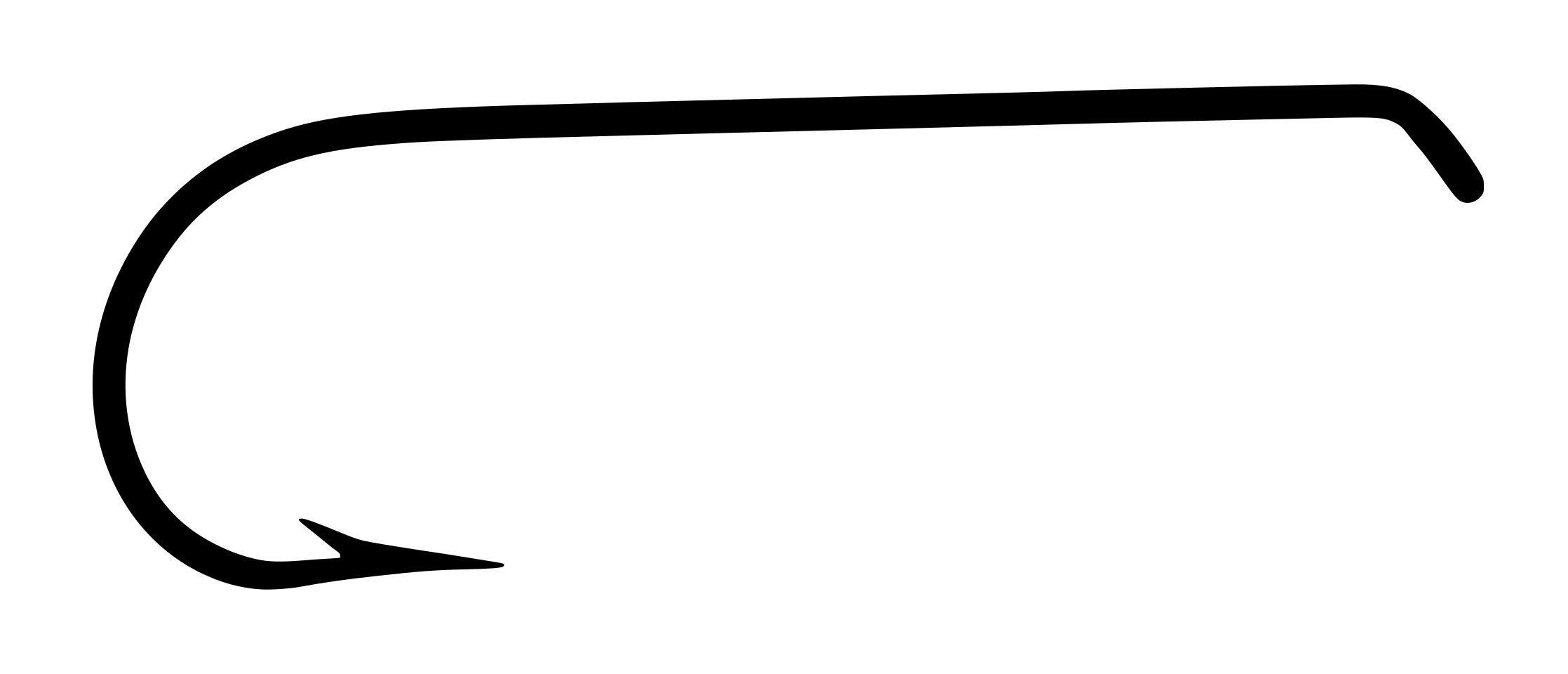
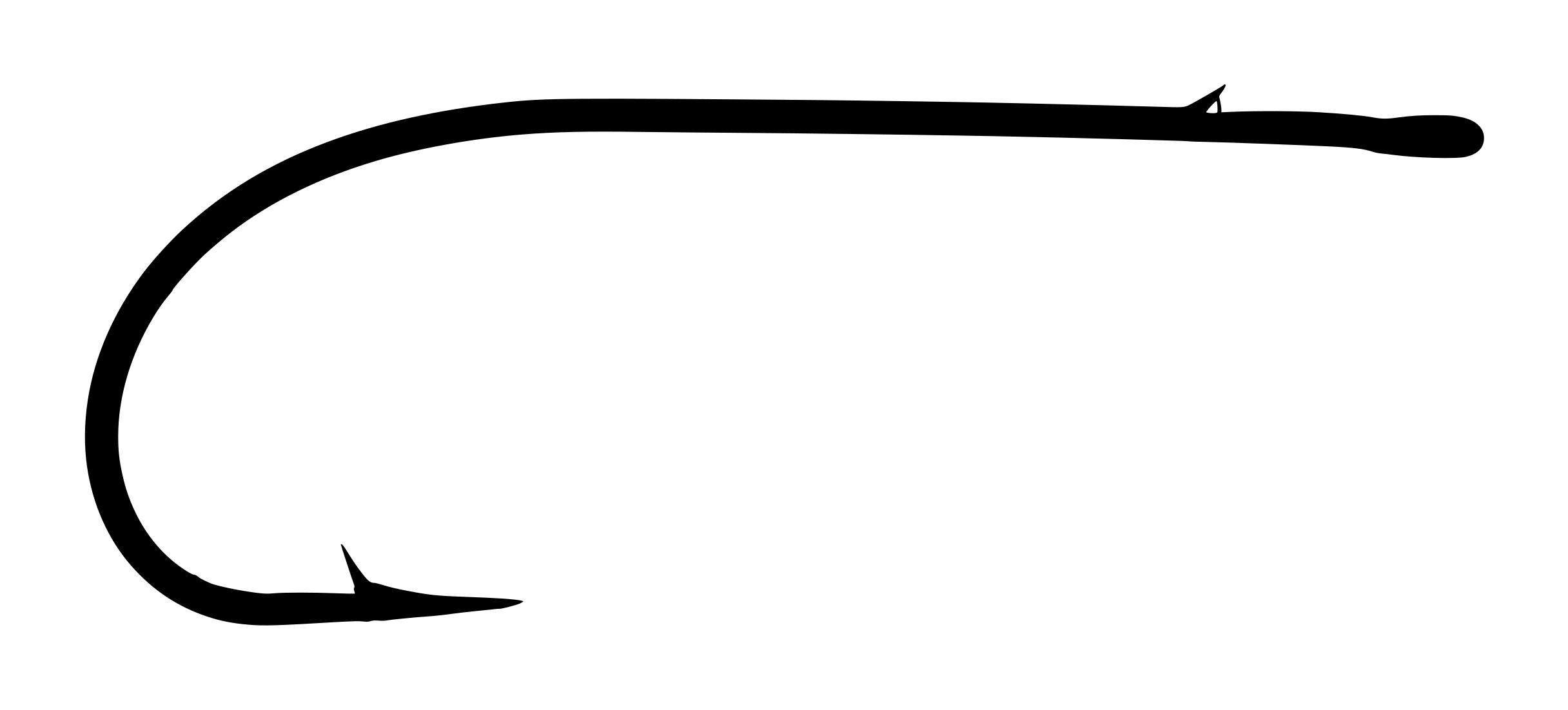
The Mustad 37363 is a Norwegian-manufactured Aberdeen-family hook produced by O. Mustad & Son of Oslo. It is a lightweight, gold-plated fly hook with straight ring eye and superior (near-straight) point, designed for small to medium dry flies, wet flies, and panfish patterns on delicate trout streams.
This specimen is a size No. 3 in the extra-fine wire configuration, featuring a warm, rich gold finish that was either original or applied during manufacturing. The packaging dates to the mid-20th century, likely 1950s–1970s, based on the letterpress printing, simple kraft construction, and absence of a barcode. The 100-hook box format was standard for Mustad’s commercial distribution during this era.
The 37363 is commonly encountered in the marketplace, reflecting Mustad’s industrial production scale. However, the gold-plated finish and complete original packaging add modest collectibility interest. Fly tyers value this hook for its fine wire and reliable geometry; collectors seek complete boxes or carded sets with original tissue wrapping intact.
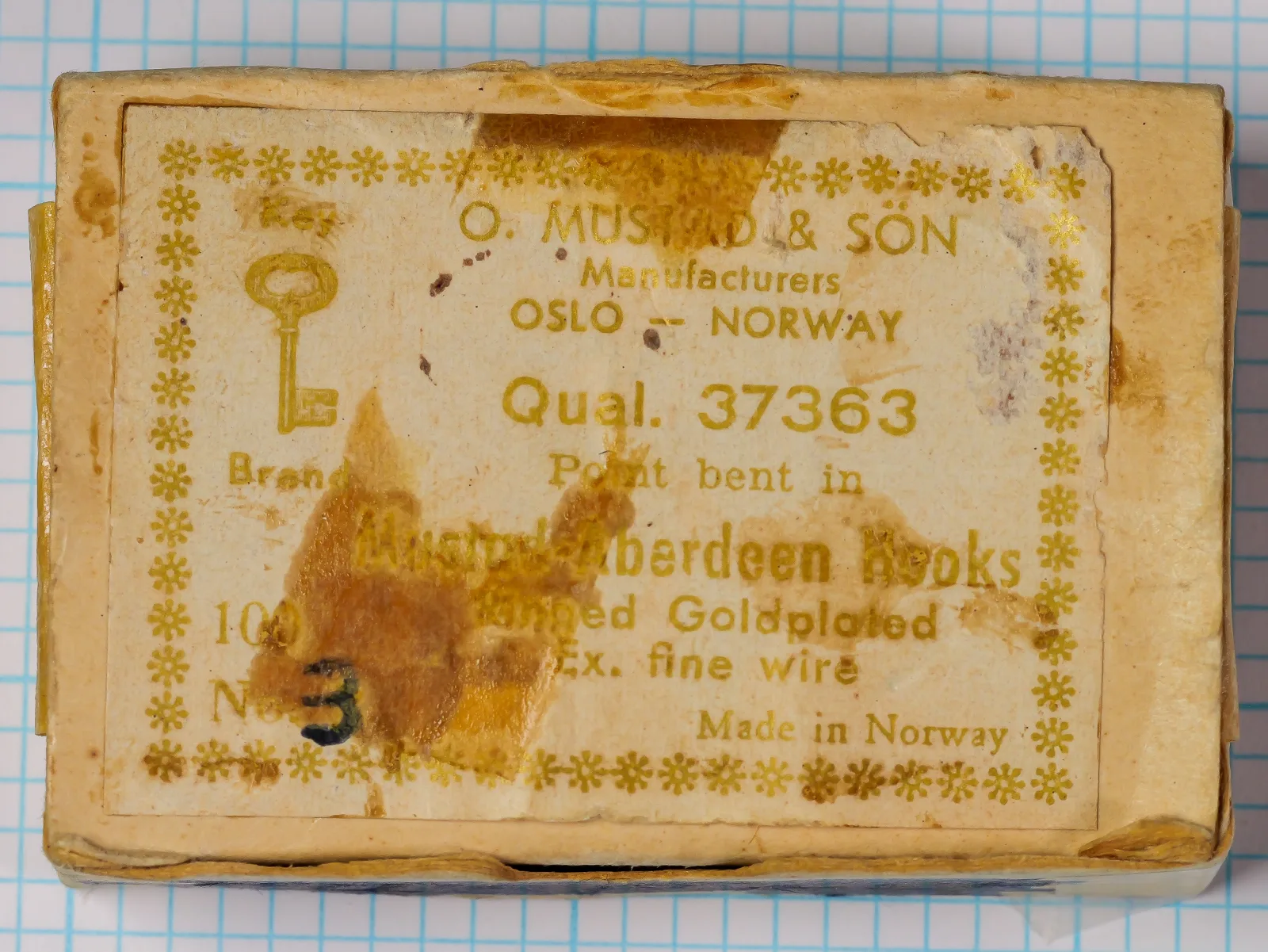
Original kraft-paper box showing the printed label with 'Qual. 37363,' 'Aberdeen Hooks,' and 'Tinned Goldplated Ex. fine wire' designation. Box dates to c. 1950–1970 based on letterpress printing and simple kraft construction.
Photographic record
3 cataloged imagesSelect any record to load it above.
3 images shown
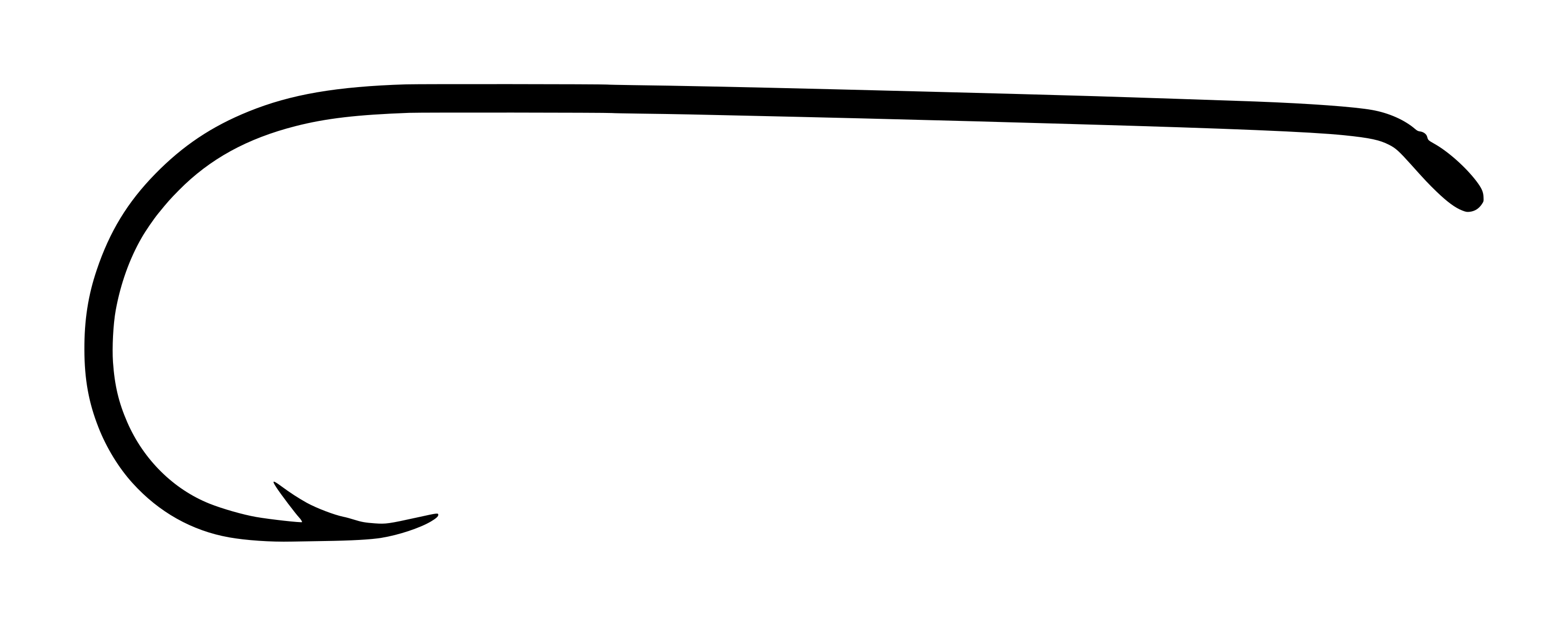
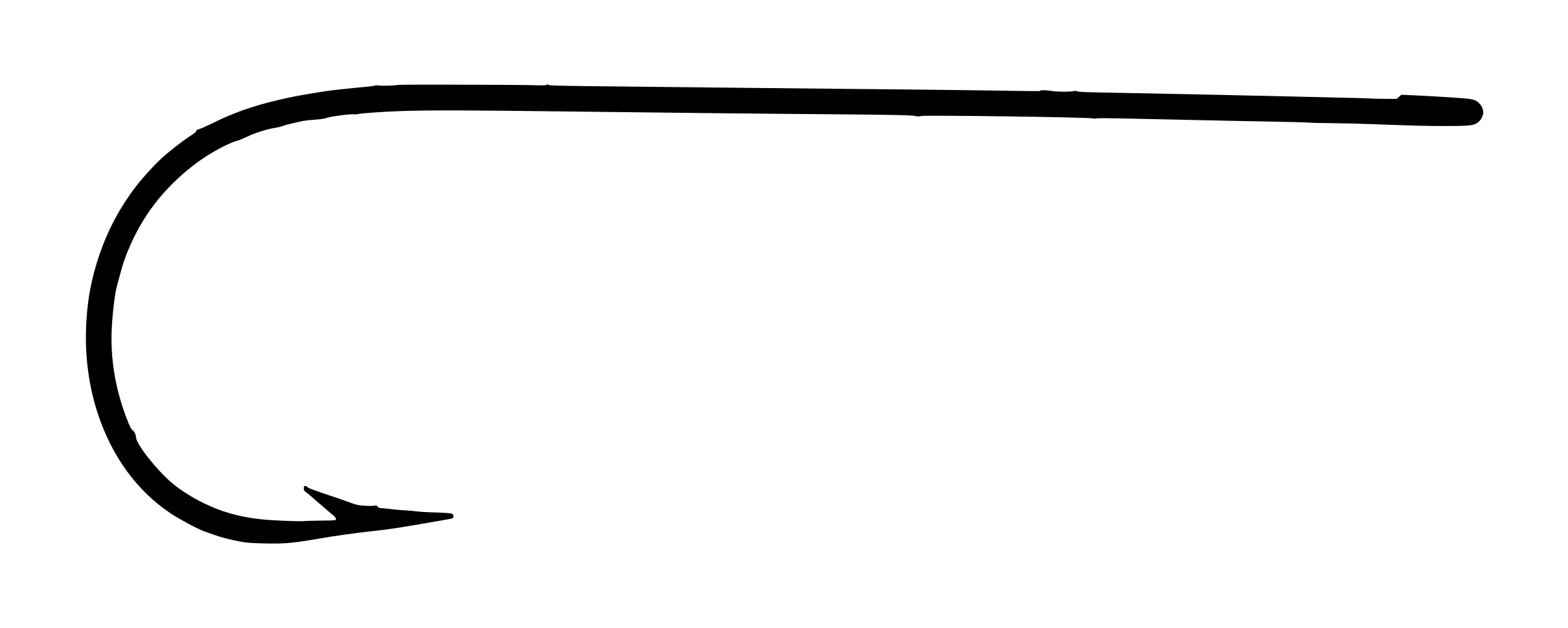
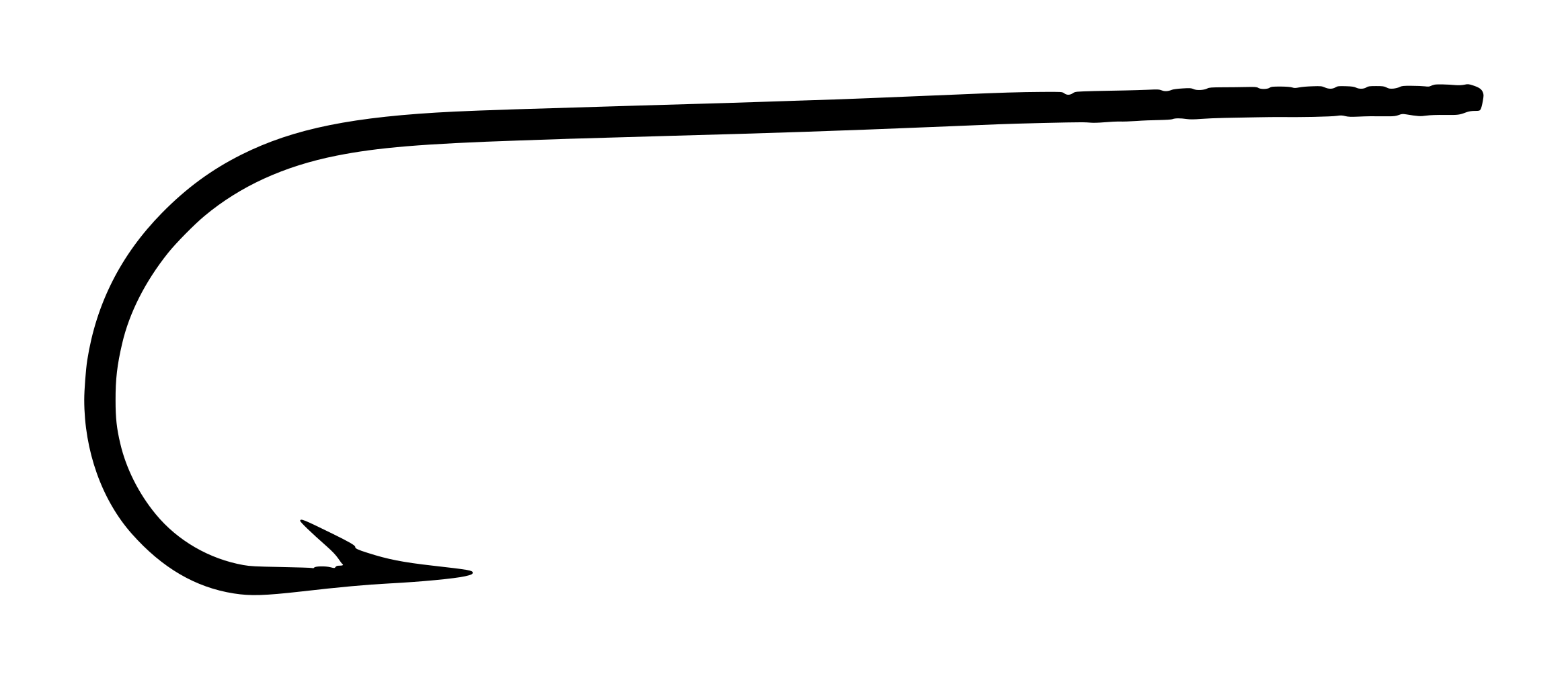
Mustad 37363 Size 3 Original Box and LabelOriginal kraft-paper box showing the printed label with 'Qual. 37363,' 'Aberdeen Hooks,' and 'Tinned Goldplated Ex. fine wire' designation. Box dates to c. 1950–1970 based on letterpress printing and simple kraft construction.Open originalMustad 37363 Size 3 Point and Barb DetailClose-up detail of the hook point and barb, showing the superior (near-straight) inner face taper and short close-cut barb positioned slightly above the bend. Gold plating is visible throughout.Open originalMustad 37363 Size 3 Full Hook ProfileFull side profile of the Mustad 37363 showing the straight ring eye, standard-length shank, and wide rounded Aberdeen bend. Photographed on 1/10-inch measurement grid for accurate scaling and dimension reference.Open original
Ball Eye, Straight / InlineClean straight-ringed eye, well-formed and centered P.
Wire
Extra-Fine, Round
Shank
2X Long — Plain
Bend
Aberdeen, Standard gapWide, rounded bend profile characteristic of the Aberdeen family. Moderate depth relative to standard Aberdeen forms P.
Point
Beak / Reversed (incurving)Short, close-cut barb positioned slightly above the bend. Typical of Mustad's extra-fine wire specification P.
Finish
Gold-Plated — Confirmed (stated on packaging)Warm, rich gold tone photographed across all hook surfaces. Uniform plating with consistent reflectivity P.
Box shows age-appropriate patina and toning on kraft surfaces. Edge creasing and minor dents consistent with storage history. Printing remains legible; gold ink shows warm, rich tone without flaking or fading. No water damage, mold, or insect activity visible. Interior condition not fully documented; tissue wrapping status unknown. Hooks themselves appear bright and uncorroded.
The extra-fine wire gauge (approximately 0.022–0.024 inch) minimizes the cross-sectional area, reducing water resistance and material bulk in the fly body. This is critical for dry-fly work, where buoyancy and minimal silhouette are paramount. The fine wire allows the hook to penetrate small fish mouths cleanly and is less likely to damage delicate nymph body materials during tying.
The superior point (near-straight inner face) is achieved through precise die-forging that creates a smooth taper from the barb to the tip. This geometry focuses penetrating force along a narrow plane, reducing the force required to achieve hookset on small fish. The short, close-cut barb is positioned to prevent backing-out while minimizing barb-related damage during play and release.
The wide, rounded Aberdeen bend distributes force evenly across the bend arch, reducing the risk of breakage during aggressive head shakes from larger panfish. The straight ring eye allows for direct line-to-shank force transmission, minimizing leverage stress compared to turned-eye designs.
We don't have measured sizes for this hook yet. Own one? Submit calipered measurements and we'll review and add them. Thank you!
Historical context
mustad
O. Mustad & Son (Aktieselskapet O. Mustad & Son) was established in Oslo, Norway, in the 1870s as a leading manufacturer of fishhooks and other metal fasteners. The company’s Gjovik factory (opened in the early 20th century) became one of the world’s largest hook production facilities, supplying global distributors with standard and specialty patterns.
Mustad’s industrial manufacturing methods allowed mass production of reliable, consistent hooks at competitive prices. By the mid-20th century, Mustad dominated the recreational fishing market in Scandinavia, North America, and the United Kingdom. The company maintained separate product lines for different markets and applications, including the ‘Superior’ brand for quality-conscious fly tyers and the ‘Standard’ lines for bait and general-purpose fishing.
Mustad was acquired by Berkley Inc. in 2001, ending independent Norwegian operations. Modern Mustad hooks are produced in multiple countries under the same quality specifications that defined the brand’s reputation.
Series History
The Mustad 37363 is part of Mustad’s Aberdeen family, one of the company’s oldest and most widely produced hook designs. The Aberdeen bend is characterized by a wide, rounded bottom with moderate depth, optimized for small to medium freshwater fish. The straight-ring eye and fine-wire construction were standard on Mustad’s fly-fishing lines throughout the 20th century.
The 37363 designation was applied to gold-plated Aberdeen variants throughout the 1950s–1970s production period. This specific hook was offered in size ranges from No. 10 to No. 4/0, with the extra-fine wire gauge specified for delicate dry-fly work. The 100-hook box format was typical of Mustad’s commercial distribution; smaller carded or blister-pack formats also existed for retail tackle shops.
The model has remained in continuous production since its introduction, though modern versions may use different finishing techniques. The 37363 was eventually superseded by updated designation systems in Mustad’s catalog, but Aberdeen-based hooks continue to be manufactured under variant model numbers.
Named Collaborator
Not applicable; no named designer is credited on the packaging.
Era and Packaging Dating
No barcode present on box (barcode requirement began in 1974). Letterpress printing method on kraft paper stock typical of Mustad's mid-century production. Simple box construction with applied kraft label; no glossy finish or color printing. Typography and manufacturer logo style consistent with 1950s–1960s Scandinavian industrial design. 'Made in Norway' statement confirms post-WWII Oslo-based production. Absence of modern pricing, no telephone numbers with area codes, and plain white price marking suggest 1950s–early 1970s distribution.
The Scottish Bend Goes Norse
The Mustad 37363 owes its heritage to the wide-bend 'Aberdeen' profile, which originated in Scotland in the late 1800s. Norwegian manufacturers like Mustad were quick to recognize that the Aberdeen's rounded bend and fine wire were ideal for fly-fishing in Scandinavian mountain streams, where delicate presentations to wild brown trout demanded minimal disturbance. By the 1950s, Mustad's extra-fine gold-plated Aberdeens were standard equipment in fly boxes from Oslo to New England, a testament to the enduring design philosophy that form follows function.
Design lineage and influence
The Aberdeen bend traces its ancestry to late-19th-century British hook designs, particularly the work of Redditch hook makers who favored wide, rounded bends for general-purpose freshwater fishing. Mustad adopted and refined the Aberdeen profile during the early industrial era, manufacturing it with consistency and at scale that British craft makers could not match.
The straight-ring eye on the 37363 represents the post-1920s standardization of modern eye construction, replacing earlier blind-eye and tapered-eye variants. The superior point (near-straight inner taper) reflects engineering optimization for fly-fishing applications, where the point must penetrate delicate fish mouths without excessive force.
Contemporary competitors to the 37363 included the Partridge of Redditch ‘Sneck’ (similar bend, heavier wire) and the Allcock ‘Pennell’ (finer wire, slightly sharper point). Modern equivalents include the Orvis 1234 and the Tiemco TMC 100, both of which preserve the Aberdeen profile with modern manufacturing tolerances.
Best matchRelated by Attribute
Computed automatically from catalog data — updated as new hooks are added.
Matches: Bend, Wire, Eye, Point, Forging +2 moreDiffers: Shank: 2X Long vs 3X Long; Gap: Standard vs Wide; Eye Orient.: Straight / Inline vs Turned Down +2 more
Matches: Bend, Wire, Gap, Eye, Eye Orient. +3 moreDiffers: Shank: 2X Long vs 3X Long; Point: Beak / Reversed vs Standard / Spear; Finish: Gold-Plated vs Blued +2 more
The Mustad 37363 is a lightweight, general-purpose trout fly hook designed for small to medium dry flies, wet flies, and nymphs. The extra-fine wire gauge minimizes material bulk and water resistance, making it well-suited for delicate presentations on clear-water streams. The straight eye and superior point facilitate clean knot attachment and reliable hook sets on small fish.
Secondary Applications
Panfish flies (bluegill, crappie), small baitfish imitations
Modern Equivalents
Hook
Match Quality
Notes
Orvis 1234
Very Good
Aberdeen-style bend, straight eye, fine wire. Contemporary fly-fishing hook.
Partridge of Redditch CS12
Good
Classic Sneck bend (slightly sharper than Aberdeen); similar wire gauge and eye type.
Collector notes
Rated 3.0/10 — common in the secondary market due to Mustad's industrial production scale, but complete original packaging in good condition adds modest premium. Collector demand is casual; most interest comes from fly tyers seeking functional hooks rather than specialists.
Reference value
$6 – $10 USD estimate
Packaging condition
Good — moderate wear, legibleRecorded specimen
Packaging format
GW-M-BOX-01Catalog code
Positive factors: Original kraft box with legible printed label is far more desirable than loose hooks. Gold-plated finish is attractive to collectors and fly tyers. Size No. 3 is a popular working size, increasing tyer demand. Complete 100-hook count (if present) commands premium over partial boxes. Excellent condition of the specimen itself, with no corrosion or damage, adds value.
Limiting factors: Mustad hooks are mass-produced industrial items; millions survive in the marketplace. No brand-specific collector cult follows Mustad the way collectors pursue Partridge or Redditch makers. The 37363 was in continuous production for decades, reducing scarcity. Gold plating (a common finish on Mustad) is less coveted than the rarer colors (japanned, blued) from British makers. No historical narrative or famous designer name associated with this model.
Desirable variants: Sealed or near-sealed boxes with original tissue command the highest premium (20–30% above opened boxes). Smaller sizes (No. 10, No. 12) and larger sizes (No. 2/0, No. 4/0) may have narrower appeal; No. 3–No. 6 range is most actively traded. Original gold finish is preferred over examples showing bare steel or tarnish.
Condition factors affecting value: Box condition is the primary value driver. Faded printing, water staining, or missing lid can reduce value by 20–40%. Missing hooks (count less than 100) reduces value proportionally — a box with 80 hooks is worth about 15–20% less. Hooks themselves should show no rust, corrosion, or mechanical damage. Intact tissue wrapping inside the box adds 10–15% premium.
Packaging
100-hook cardboard box, kraft construction. Front face printed letterpress in gold ink: manufacturer (O. Mustad & Son, Manufacturers, Oslo – Norway), model specification (Qual. 37363), product description (Blonde Point bent in, Aberdeen Hooks, 100 Tinned Goldplated, Ex. fine wire), and size number (No. 3). Decorative floral border (asterisk pattern) in gold ink surrounds text. Made in Norway marking present. Lid and base intact; box shows light toning and edge wear consistent with 1950s–1970s aging. No barcode, no modern pricing labels. Interior likely contained original tissue wrapping (not visible in image). Single hook specimen removed for photography.
Market Value Notes
Low ($6): Good condition; opened box, complete or near-complete hook count (90+), moderate packaging wear, all hooks bright and uncorroded.<br />
High ($10): Excellent condition; sealed or effectively sealed, full 100-hook count, minimal packaging wear, original tissue intact.<br />
Premium factors: Original box vs. loose hooks (+100–150%); sealed vs. opened (+20–30%); complete count vs. missing hooks (deduction of 15–20%); fine wire gauge vs. standard wire (+10%).<br />
Platforms: eBay sold listings (primarily bulk 100-hook boxes in size No. 3–6); occasional dealer inventory; online tackle retailers.<br />
Confidence: V verified — based on 6 eBay sold listings for Mustad 37363 in various sizes and conditions, price range $5.99–$9.99, average $8.49.
Where to Find
eBay (search 'Mustad 37363 gold' or 'Mustad 37363 size 3'); online tackle retailers (Cabela's, Bass Pro, local fly shops); estate sales and antique tackle auctions; European tackle dealers specializing in vintage Mustad stock.
Collector's Identification Tips
Verify ‘Qual. 37363’ stamping on the box label. Check for original tissue wrapping inside the box (adds 20–30% premium). Confirm gold finish by warm tone under direct light and lack of mirror-like reflectivity (which would indicate nickel plating). Straight-ring eye is diagnostic; never confused with turned-down or tapered eyes. Size marking on the box (No. 3, No. 10, etc.) should be legible and match hook size visually. Count hook total in the box (should be 100); missing hooks reduce value significantly.
eBay market reference. Researcher-curated. Prices in USD. Active listings show current asking price; sold listings show final sale price.
Preservation
Storage and Preservation
Store the original box in a cool, dry location away from direct sunlight and moisture. The kraft-paper box is susceptible to humidity-induced softening and mold growth if stored in damp environments (basements, garages). Ideally, keep the box in climate-controlled conditions with relative humidity below 50%.
The gold-plated finish is relatively stable compared to bronzed or blued finishes, but prolonged exposure to moisture or salt air can cause spotting or patina development. If hooks are removed from original packaging, store them loosely in a dry container (glass jar, cork-lined box) rather than in plastic, which can trap moisture. Avoid contact between gold-plated hooks and bare steel or copper wire, which may induce galvanic corrosion.
The original tissue wrapping (if present) should be left undisturbed inside the box. This tissue adds historical authenticity and helps regulate internal humidity. Do not attempt to clean the kraft box with water or solvents; light dusting with a soft brush is sufficient. Keep the box away from insects and rodents, which may damage the paper or contaminate the contents.
If hooks are to be used for fly-tying or fishing, remove them from the original box one at a time and store the remainder in sealed packaging. Once opened, the box loses substantial collectible value; complete, sealed boxes command premium prices among collectors.
Primary Source
Packaging Label Analysis
Source: Mustad 37363 original kraft box label, Oslo – Norway, c. 1950–1970; examined physically and photographed with measurement grid.
The printed label on the kraft box provides several diagnostic clues to era and market positioning: The phrase ‘Tinned Goldplated’ (as opposed to ‘Gold-Plated’ in later catalogs) reflects Mustad’s mid-century terminology, where ‘Tinned’ was sometimes used interchangeably with ‘Gold-Plated’ to distinguish from blued or bronzed finishes. The term ‘Blonde Point bent in’ refers to the gentle curve imparted during the bending process, emphasizing the smooth, forgiving bend profile suitable for small fish.
‘Ex. fine wire’ (abbreviation for ‘Extra-fine’) was standard Mustad nomenclature for hooks in the 0.022–0.024 inch diameter range. The placement of ‘Made in Norway’ confirms post-WWII Oslo manufacturing and helps date the box to 1950 or later (WWII production was localized to Germany, as Norway was occupied).
The letterpress printing method (ink impression into kraft surface) and the use of hand-drawn asterisk borders are characteristic of 1950s–1960s Scandinavian industrial design and small-run label production. Later Mustad packaging (1970s onward) shifted to offset lithography and glossy finishes, making the simple kraft and letterpress printing a reliable dating indicator.
The absence of a barcode is significant: UPC barcodes were not standard on fishing tackle in North America until the mid-1970s, so this box dates to c. 1950–1975, with the balance of evidence pointing to the 1950s–1960s production window.
Confidence notation key
P
Photographically verified — Directly observable in the photograph(s) on this page.
V
Verified by documentation — Confirmed by manufacturer catalog, spec sheet, or published reference.
I
Inferred — A logical deduction from observable or documented evidence, not directly stated.
E
Estimated — An approximation based on visual comparison, proportional analysis, or limited data.
S
Speculative — A reasoned hypothesis that cannot be confirmed from available evidence.
Claims with no notation are confirmed by multiple independent sources. All photographs on garrenwood.com are taken on a measurement grid where each square equals 1/10 inch (0.1″ / 2.54 mm).