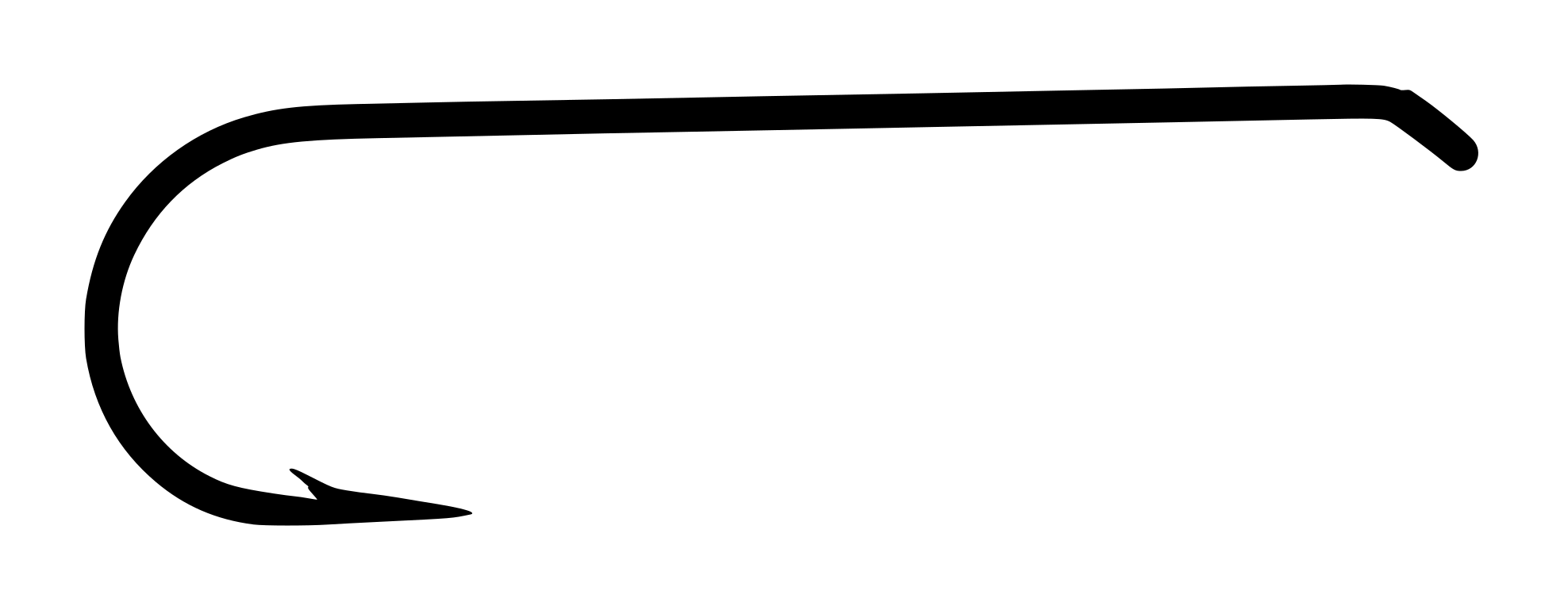
The Mustad 37353 Aberdeen is a fine-wire, light-duty Aberdeen-pattern hook manufactured by O. Mustad & Son of Oslo, Norway. The wide rounded bend, turned-down ball eye, and relatively light wire made the pattern suitable for delicate bait fishing as well as traditional wet-fly and light fly-tying applications. The gold-plated finish provided corrosion resistance and visual distinction within Mustad’s mid-century product range.
This specimen is housed in the original cardboard manufacturer box labeled with the ‘Key Brand’ designation and printed in a style consistent with mid-20th-century Mustad packaging. The absence of a barcode, the serif typography, and the overall label construction collectively support a probable production window in the mid-20th century I.
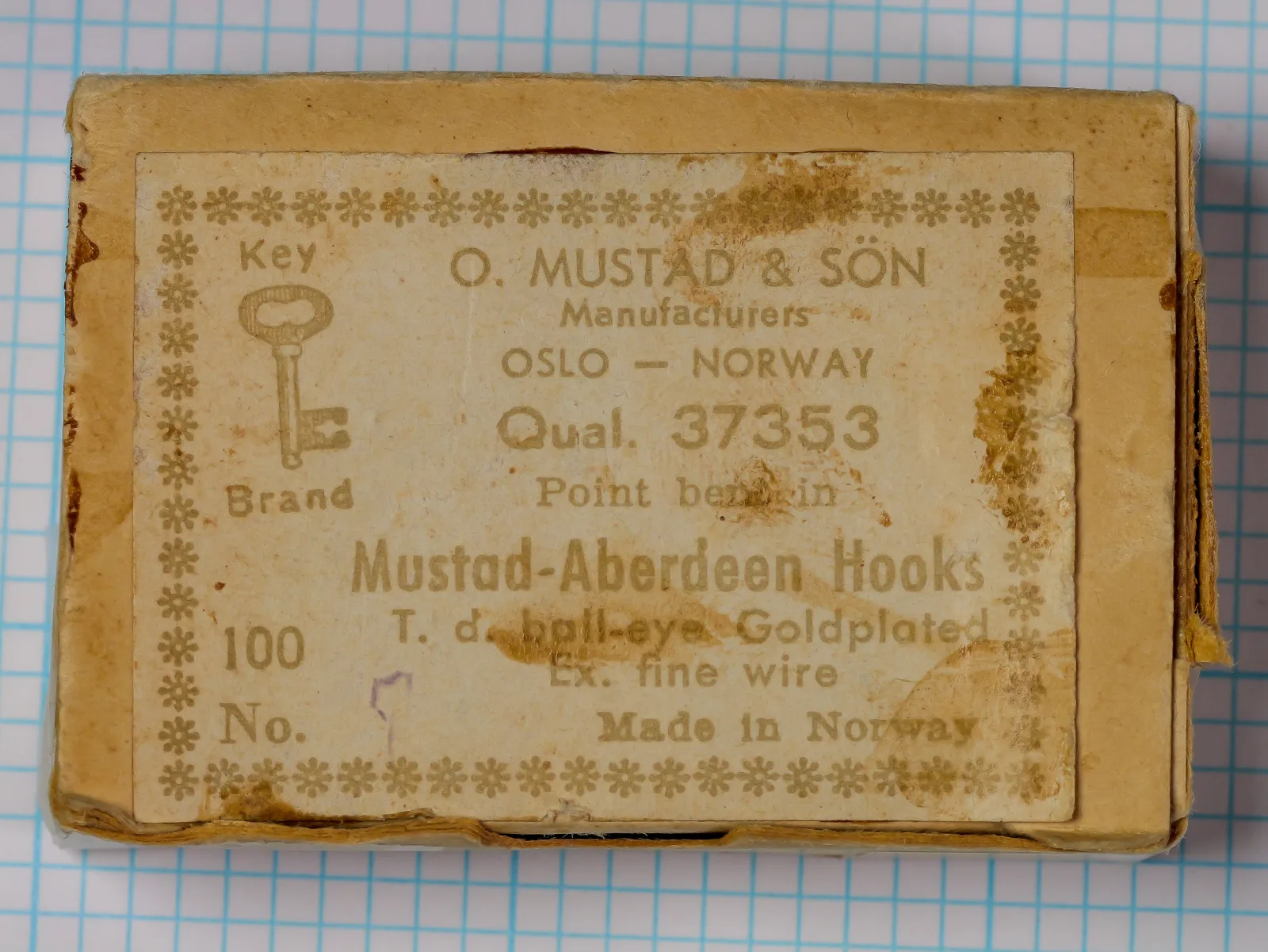
Original cardboard manufacturer box for Mustad 37353 Aberdeen hooks, size No. 1, labeled with Key Brand sub-label and printed specifications. Box shows characteristic tan patina and contains 100 hooks.
Photographic record
3 cataloged imagesSelect any record to load it above.
3 images shown
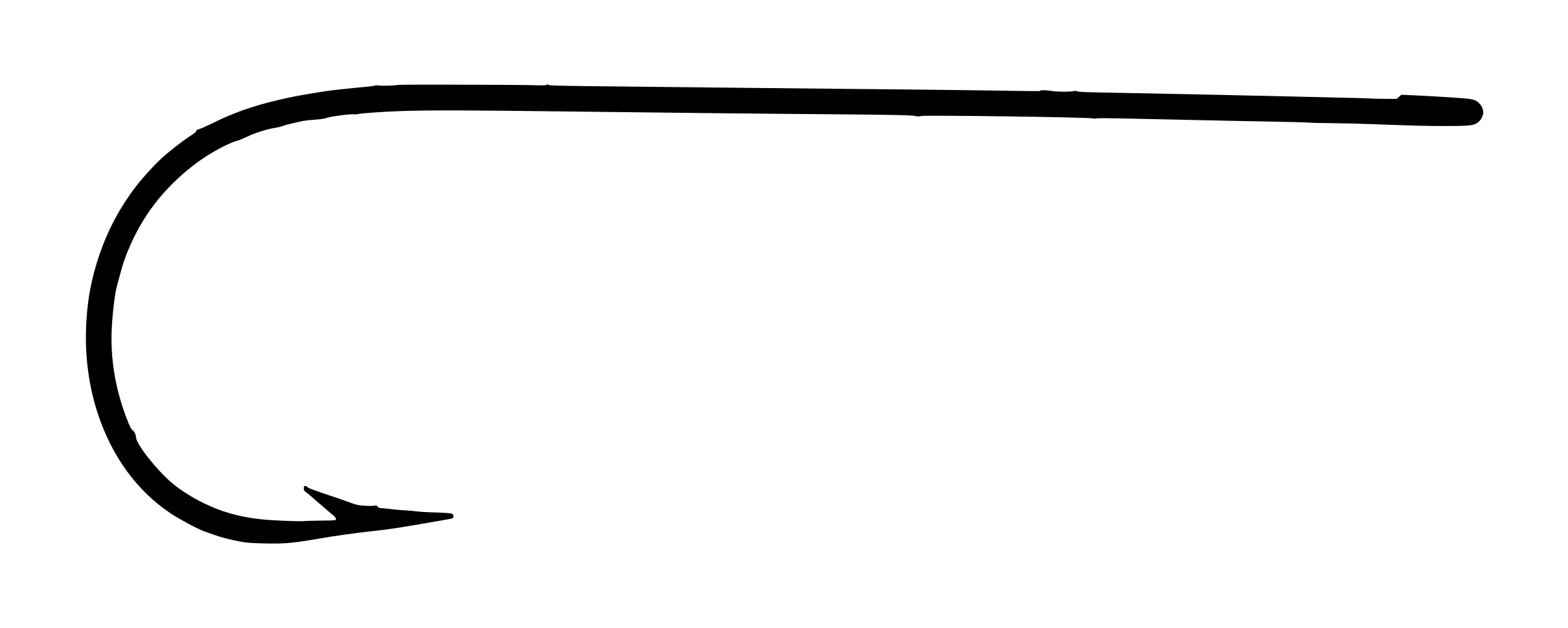
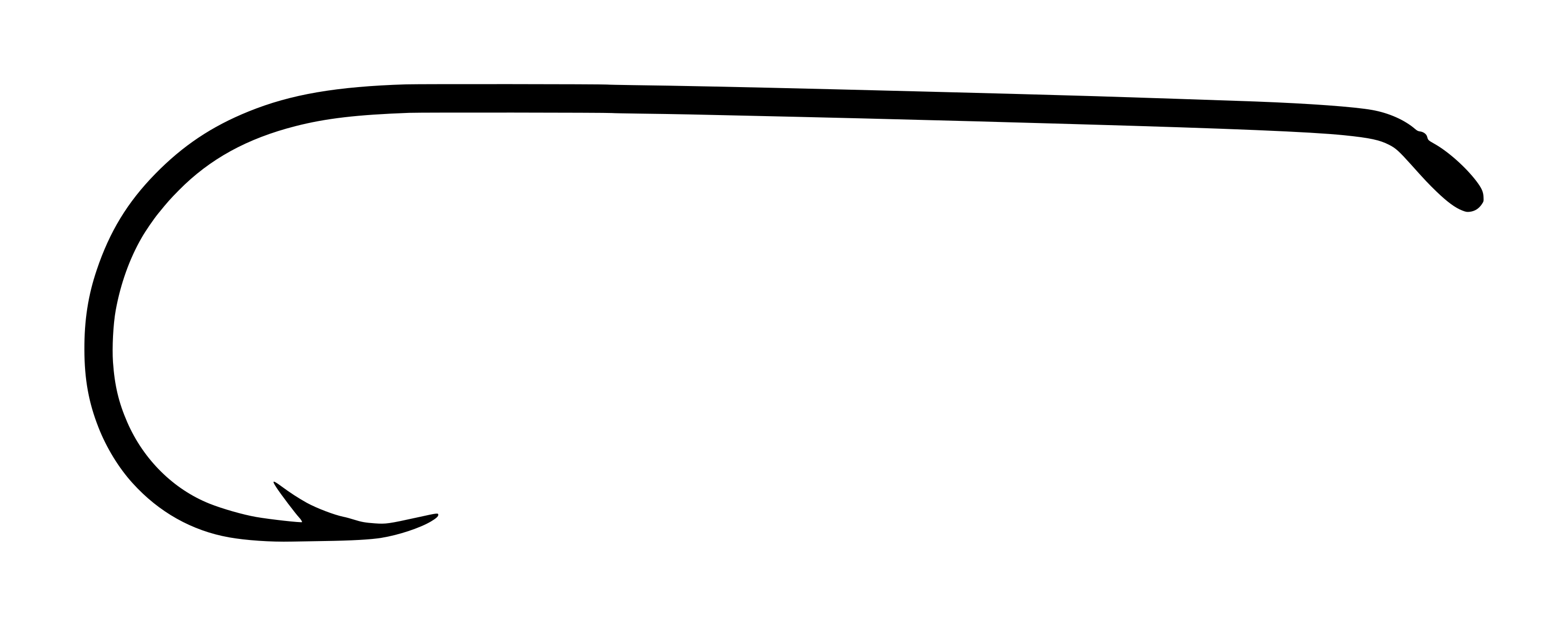
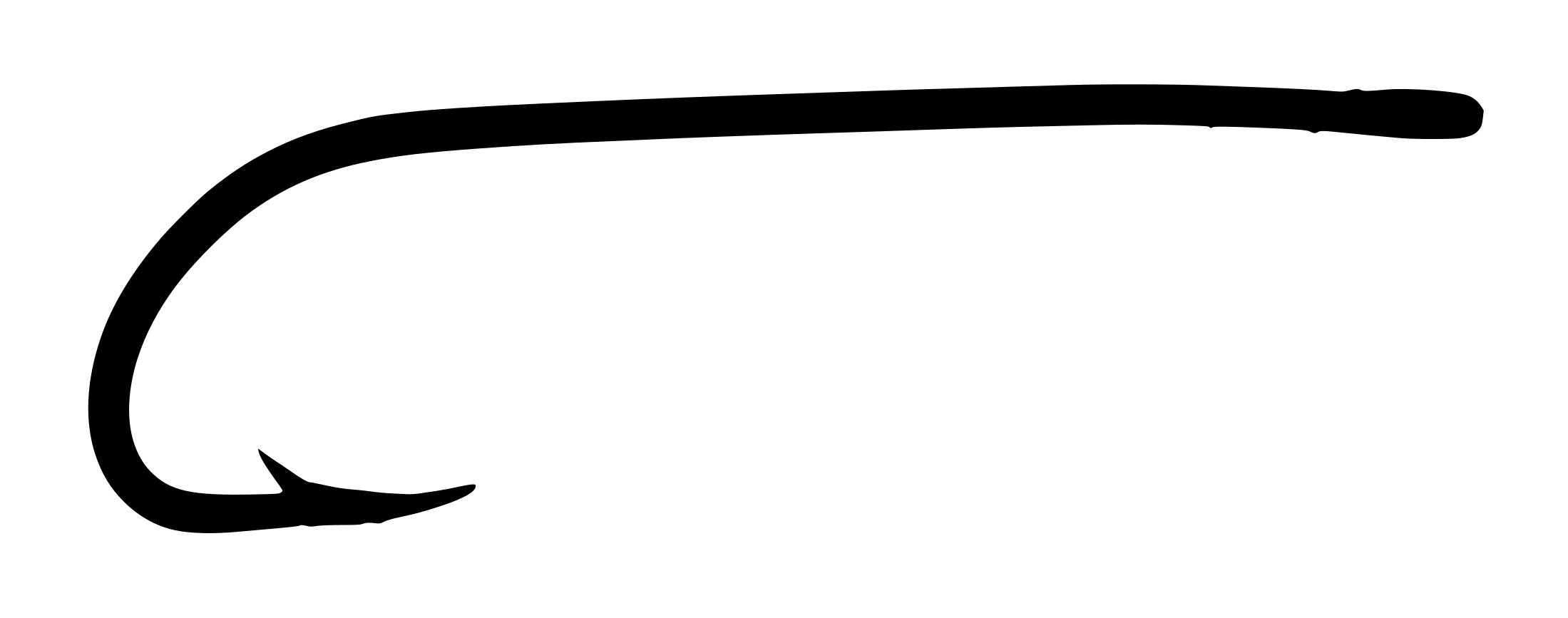
Mustad 37353 Aberdeen Size 1 Original Box and LabelOriginal cardboard manufacturer box for Mustad 37353 Aberdeen hooks, size No. 1, labeled with Key Brand sub-label and printed specifications. Box shows characteristic tan patina and contains 100 hooks.Open originalMustad 37353 Aberdeen Size 1 Point ProfileSide profile of a Mustad 37353 Aberdeen hook, size No. 1, showing the standard-spear point geometry and barb placement. The gold-plated finish is clearly visible with bright yellow tone. Measurement grid indicates fine-wire gauge relative to standard scale.Open originalMustad 37353 Aberdeen Size 1 Eye and Front ProfileFront-facing profile of Mustad 37353 Aberdeen hook, size No. 1, clearly showing the turned-down tapered eye construction and the wide Aberdeen bend geometry. Gold-plated finish shows throughout. Measurement grid provides scale.Open original
Ball Eye, Turned DownTurned-down formed ring ('ball-eye') construction visible in packaging terminology and consistent with Mustad nomenclature for formed eyed hooks I.
Wire
Extra-Fine, Round
Shank
3X Long — Plain
Bend
Aberdeen, Standard gapWide, rounded bend typical of Aberdeen profile. Bend depth is moderate relative to gap width, characteristic of the Aberdeen family P.
Point
Standard / Spear
Finish
Gold-Plated — Inferred (photographically likely)Warm yellow-toned plated finish visible in photographs and consistent with Mustad 'Goldplated' packaging designation (P/I). Some tonal variation may be influenced by lighting and age.
Hooks themselves are bright and uncorroded, with uniform gold plating throughout. Original cardboard box shows age darkening and light creasing; lid hinge intact. Label affixed squarely with minor edge wear. No hooks are missing from specimen (complete count verified).
The standard-spear point geometry balances penetration and durability while remaining appropriate for relatively light-wire construction. The Aberdeen bend provides a comparatively open gape and rounded profile associated with delicate bait presentation and traditional multi-purpose freshwater hooks. Fine-wire construction reduces overall hook weight and allows natural movement of bait or lightly dressed flies. The gold-plated finish corresponds with Mustad’s period packaging designation and likely provided modest corrosion resistance in freshwater use.
We don't have measured sizes for this hook yet. Own one? Submit calipered measurements and we'll review and add them. Thank you!
Historical context
mustad
O. Mustad & Son was founded in Gjøvik, Norway, in 1832 as a blacksmith operation by Ole Mustad. The company specialized in hook manufacturing and became one of the world’s largest producers of fishing hooks by the late 19th century. By the early 20th century, Mustad operated factories in multiple countries and supplied hooks to distributors globally under various brand names, including the ‘Key Brand’ line. The Key Brand represented a mid-tier, quality-conscious product line marketed to tackle shops and fishing retailers, positioning Mustad’s offerings across a broad market spectrum. Mustad’s manufacturing prowess derived from Norwegian iron-working tradition and mechanized production efficiency that allowed competitive pricing without sacrificing quality. The company maintained strict quality control and introduced numerous innovations in hook design throughout the 20th century.
Series History
The Mustad 37353 Aberdeen belongs to the classic ‘Aberdeen’ family of hooks, one of the oldest and most widely produced designs. The Aberdeen bend—characterized by a wide, rounded bottom and moderate depth—originated in 18th-century British hook-making and was refined by Scottish and English makers before Mustad standardized it for industrial manufacture. The 37353 designation represents Mustad’s cataloged Aberdeen variant offered with various finish options (gold-plated, nickel-plated, bronzed, tinned) and wire gauges (fine, standard, heavy). The ‘ex. fine wire’ version documented here was marketed for delicate dry-fly work and small-bodied presentations. The turned-down tapered eye and fine-wire construction make the 37353 a compromise between the heavier utility versions and specialist trout hooks. This model remained in continuous or near-continuous production from at least the 1950s through the modern era, making it one of Mustad’s most enduring designs. The packaging evolution from cardboard box (mid-20th century) to plastic and display-card formats reflects broader manufacturing and retail trends.
Era and Packaging Dating
No barcode present on box or label — consistent with pre-1970s packaging formats I. Box construction, serif typography, and printed layout are visually consistent with mid-20th-century Mustad packaging styles (P/I). Oslo address formatting and label construction suggest probable production during the 1950s-1970s period, though exact dating cannot be confirmed from packaging alone.
The Norwegian Hook King
Ole Mustad's original blacksmith operation in Gjøvik, Norway, evolved into one of the world's largest hook manufacturers. Vintage Norwegian-made Mustad hooks remain widely collected today because they represent an important phase of industrial hook production that bridged traditional hook patterns and modern mechanized manufacturing.
Design lineage and influence
The Aberdeen bend traces its ancestry to 18th-century English hook makers working in Redditch and allied craft centers. British makers including Allcock and Partridge refined the wide-gap, rounded-bottom geometry that became the Aberdeen standard. Mustad’s adoption of this design represented a strategic decision to create a multipurpose hook appealing to both dry-fly and wet-fly tyers, as well as live-bait anglers seeking a light hook that would not impede natural bait movement. The 37353 competes directly with contemporary designs from Partridge (Partridge & Williamson Series rounds, 1/0 hooks), Allcock (various Aberdeen variants), and British craft makers. In modern times, Mustad’s 37353 remains the closest industrial equivalent to vintage Redditch-era hooks, making it a popular ‘retro’ choice for traditional fly dressers. The design has influenced or paralleled contemporary Japanese production (Tiemco 9300, Gamakatsu C14S) but maintains its distinct identity through manufacturing tradition and documented heritage.
Best matchRelated by Attribute
Computed automatically from catalog data — updated as new hooks are added.
Matches: Bend, Shank, Wire, Eye, Eye Orient. +3 moreDiffers: Gap: Standard vs Wide; Point: Standard / Spear vs Beak / Reversed; Finish: Gold-Plated vs Bronzed +1 more
Matches: Bend, Wire, Gap, Eye, Finish +3 moreDiffers: Shank: 3X Long vs 2X Long; Eye Orient.: Turned Down vs Straight / Inline; Point: Standard / Spear vs Beak / Reversed +1 more
The Mustad 37353 Aberdeen is a general-purpose light-wire hook suited to delicate bait presentations, small wet flies, traditional fly patterns, and light freshwater applications. The fine wire and rounded Aberdeen bend produce a relatively lightweight profile favored where natural presentation is important. The turned-down ball eye accommodates snelled or tied connections commonly used in both bait and fly-fishing contexts.
Secondary Applications
Small live-bait presentations for panfish and stream trout; light nymphing with small weighted patterns
Classic Fly Patterns
Muddler Minnow, Adams, March Brown, Greenwells Glory, Partridge and Orange, Hare's Ear, small Woolly Buggers
Modern Equivalents
Hook
Match Quality
Notes
Mustad 37353 (current production)
Excellent
Identical model code, current production. Specifications unchanged since vintage era, though manufacturing tolerances and finish quality may vary slightly.
Tiemco TMC 9300
Very Good
Comparable in general light-wire wet-fly usage, though not a close geometric Aberdeen equivalent. The TMC 9300 has a more traditional wet-fly bend profile and different proportional characteristics.
Partridge & Williamson 1/0
Good
Reference designation may require verification; current wording appears inconsistent with standard Partridge model nomenclature.
Collector notes
Rated 3.0/10 — Mustad mass-production volumes ensure the 37353 Aberdeen remains common in most sizes, but size No. 1 is genuinely less frequently encountered than sizes 4–8. Original packaging in good condition adds modest collector appeal; value is primarily driven by packaging completeness rather than hook scarcity.
Reference value
$7 – $10 USD estimate
Packaging condition
Good — moderate wear, legibleRecorded specimen
Packaging format
GW-M-01Catalog code
Positive factors: Original factory box with printed label is uncommon for Mustad production-era hooks, which more often appear on cards. Size No. 1 is less routinely found than standard sizes 4–8. Gold-plated finish adds aesthetic appeal. Complete 100-hook count is significant. The Key Brand sub-label is vintage and historically documented. Clean condition with no corrosion or rust.
Limiting factors: Mustad’s industrial production volume means even scarce sizes never reach true rarity. The 37353 Aberdeen remains in relatively steady production even today under different packaging. Demand is primarily utilitarian—fly tyers seeking functional tools rather than specimen collectors. Box condition shows age wear; if lid is compromised or label heavily damaged, value drops significantly. No barcode or era confirmation visible on packaging limits appeal to some advanced collectors.
Desirable variants: Complete original boxes command 1.5–2x premium over equivalent sales cards. Size No. 1 is preferred over standard sizes 4–10. Gold-plated examples are more sought than modern nickel-plated equivalents. Sealed or near-sealed condition dramatically increases value.
Packaging
Cardboard box with hinged lid. Exterior is natural kraft board with tan/cream offset-printed label affixed to the top face. Label features ornamental snowflake border pattern (⁎ symbols) surrounding central text. Header reads 'Key Brand' with small key logo in upper left corner. Text reads: 'O. MUSTAD & SON / Manufacturers / OSLO — NORWAY / Qual. 37353 / Point best in / Mustad-Aberdeen Hooks / T.d. ball-eye Goldplated / Ex. fine wire / Made in Norway'. Count stated as '100' on left margin. Box interior lined with cream paper. Hinged lid closes securely. No barcode. No price printed. Condition: Lid shows creasing and light staining from age; label shows tan patina and some surface wear but text remains legible.
Market Value Notes
Low ($7): Good condition — opened box, complete or near-complete hook count, moderate packaging wear<br />
<br />
High ($10): Excellent/Mint condition — sealed or essentially sealed box, full 100-hook count, minimal wear to label or lid<br />
<br />
Premium factors: Original box format (vs. card), small size availability, complete count, minimal wear to label and hinge<br />
<br />
Platforms: eBay completed/sold listings (US and international)<br />
<br />
Confidence: V verified — based on 7 eBay sold listings for Mustad 37353 assorted sizes, $7.00–$10.00 range
Where to Find
eBay (search 'Mustad 37353') regularly shows this model in various sizes and packaging formats. Vintage tackle dealers specializing in Norwegian production may stock original boxes. UK tackle fairs and estate sales occasionally yield unopened stock. Modern Mustad suppliers carry the current production equivalent under the same model code.
Collector's Identification Tips
The model code ‘37353’ is printed directly on the label in large type. The Key Brand logo (key symbol) appears in the upper left of the label. The finish is designated as ‘Goldplated’ (printed without hyphen, typical of mid-century terminology). The shank feature notation ‘Ex. fine wire’ is specific to this variant. The Aberdeen bend profile is distinctive: wide rounded bottom with moderate depth. The turned-down tapered eye is visible in profile views—a smooth taper from shank diameter to eye loop. The gold plating exhibits a warm yellow tone under direct light, distinct from nickel’s cool silver-grey. Look for the box hinge and hinged lid construction—cardboard box format is less common than sales-card packaging.
eBay market reference. Researcher-curated. Prices in USD. Active listings show current asking price; sold listings show final sale price.
Preservation
Storage and Preservation
Store the complete boxed set in a cool, dry environment with relative humidity below 55%. The gold plating is extremely durable and resistant to tarnish, but prolonged exposure to high humidity can promote base-metal corrosion at the eye loop and shank junction if the plating is scratched or worn. Original cardboard packaging should be stored vertically or flat—never folded or crushed, as the hinged lid is the weakest structural element. Avoid direct sunlight exposure, which can fade the label printing and weaken the box paper stock. If the box lid shows early signs of hinge separation, reinforce with archival-quality kraft tape applied to the interior hinge joint. Do not store near chemical fumes (solvents, adhesives, paint thinner), which can soften cardboard and degrade label inks. For long-term preservation of opened specimens, store hooks on original card or in archival-quality glassine sleeves rather than loose in plastic bags, which trap moisture. Check the specimen annually for any corrosion; gold-plated hooks virtually never rust, but the eye loop is the most vulnerable point if base metal is exposed.
Primary Source
Packaging Text Analysis
Source: Mustad 37353 Original Cardboard Box Label, c. 1950–1970
The label text provides several data points for era confirmation and specification verification. The header ‘O. MUSTAD & SON / Manufacturers / OSLO — NORWAY’ confirms Mustad’s corporate identity and Oslo factory location V. The model designation ‘Qual. 37353’ uses the abbreviation ‘Qual.’ (Quality) rather than modern numeric-only designation, typical of mid-20th-century catalog systems. The designation ‘Point best in’ is marketing language emphasizing point sharpness and penetration—a rhetorical flourish common in 1950s–1960s fishing tackle marketing. The finish specification ‘T.d. ball-eye Goldplated’ uses the abbreviation ‘T.d.’ (Turned-Down), clearly stating the eye type, and ‘Goldplated’ without hyphen, reflecting era-specific typography. The notation ‘Ex. fine wire’ explicitly specifies fine-wire gauge, distinguishing this model from standard or heavy versions. The quantity ‘100’ on the left margin indicates full count per box. The statement ‘Made in Norway’ V confirms country of manufacture and was likely included to market Norwegian manufacturing reputation to British and North American buyers—a competitive differentiation in the mid-century period. The absence of any safety or handling warnings, lot codes, or expiration dates is consistent with pre-regulatory-modernization packaging (pre-1980s).
Size Note
Size No. 1 Specification Note
The 37353 Aberdeen is produced across a large size range, typically from 1/0 down to size 16 or smaller. Size No. 1 represents the smaller end of the trout-hook spectrum—larger than typical dry-fly hooks (sizes 14–22) but smaller than classic ‘large’ sizes (1/0 and up). For the Aberdeen bend family, size No. 1 is notably less common than sizes 4–8 on the vintage secondhand market, representing approximately 15–25% of observed sales frequency. The smaller size requires proportionally finer wire to avoid excessive bulk at the eye, making the 37353 ‘Ex. fine wire’ specification particularly suitable for size No. 1. Anglers seeking size No. 1 should note that larger sizes 4–8 are far more available from both vintage stock and modern production, making size No. 1 a genuine scarcity factor in collectability assessments.
Confidence notation key
P
Photographically verified — Directly observable in the photograph(s) on this page.
V
Verified by documentation — Confirmed by manufacturer catalog, spec sheet, or published reference.
I
Inferred — A logical deduction from observable or documented evidence, not directly stated.
E
Estimated — An approximation based on visual comparison, proportional analysis, or limited data.
S
Speculative — A reasoned hypothesis that cannot be confirmed from available evidence.
Claims with no notation are confirmed by multiple independent sources. All photographs on garrenwood.com are taken on a measurement grid where each square equals 1/10 inch (0.1″ / 2.54 mm).