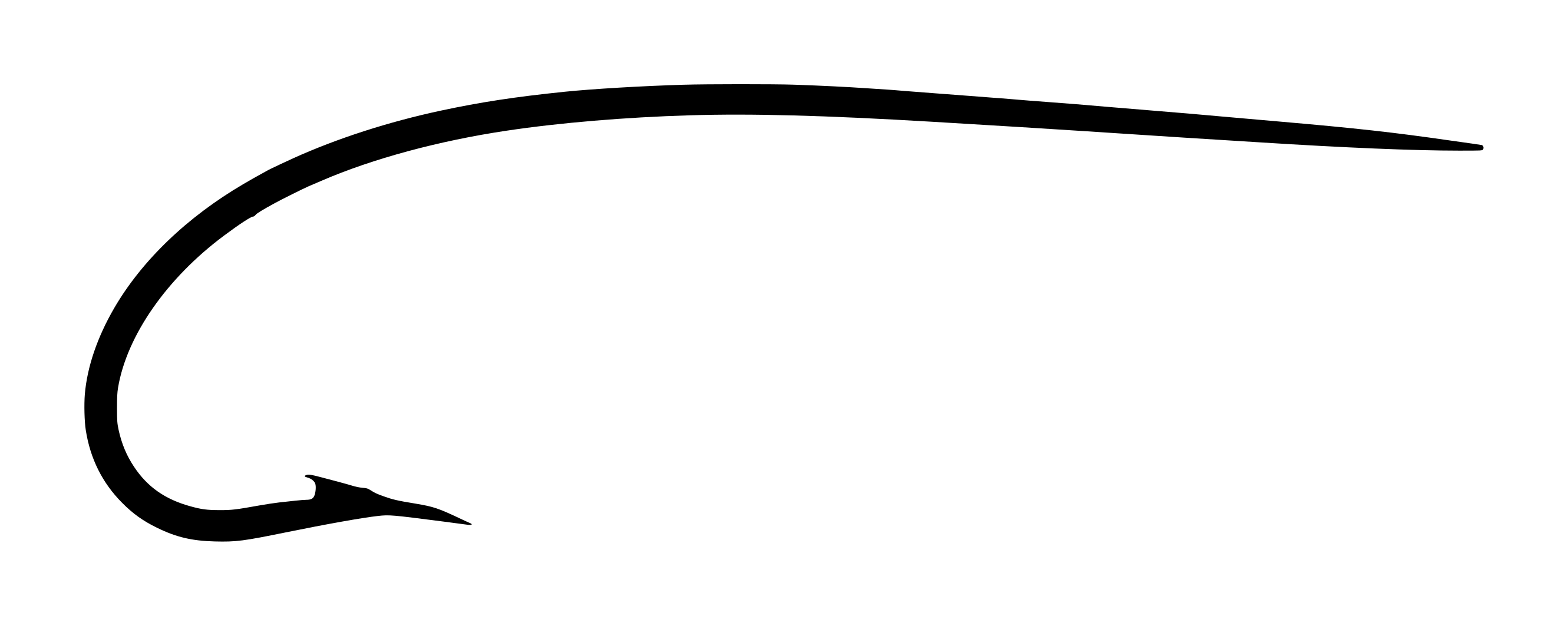
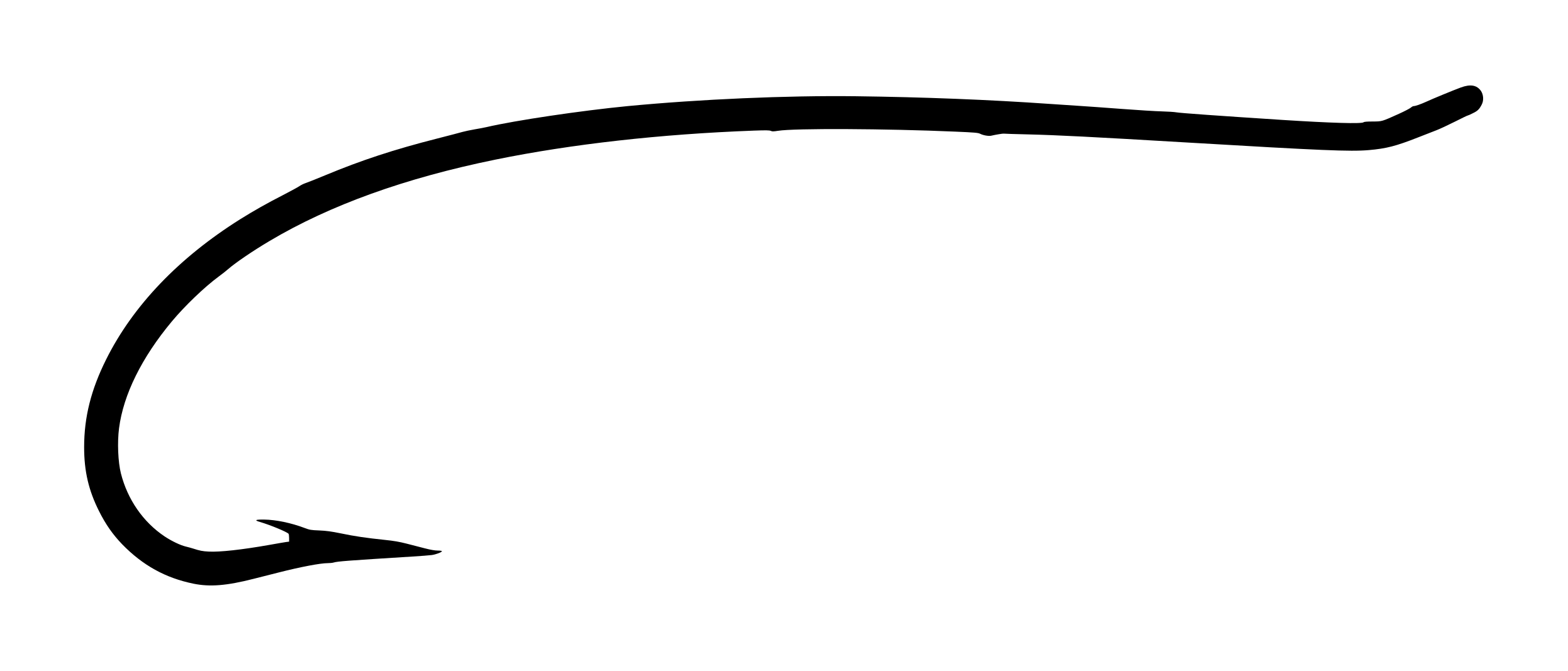
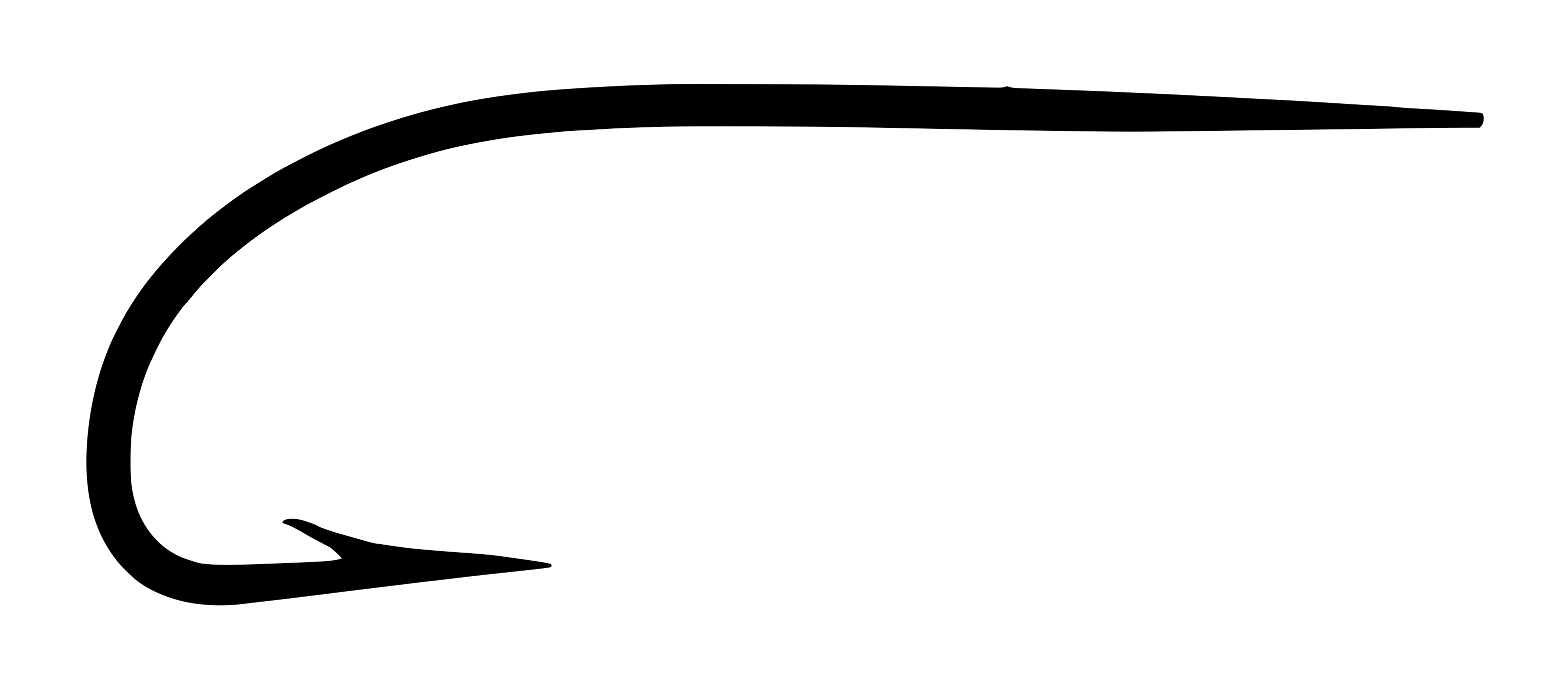
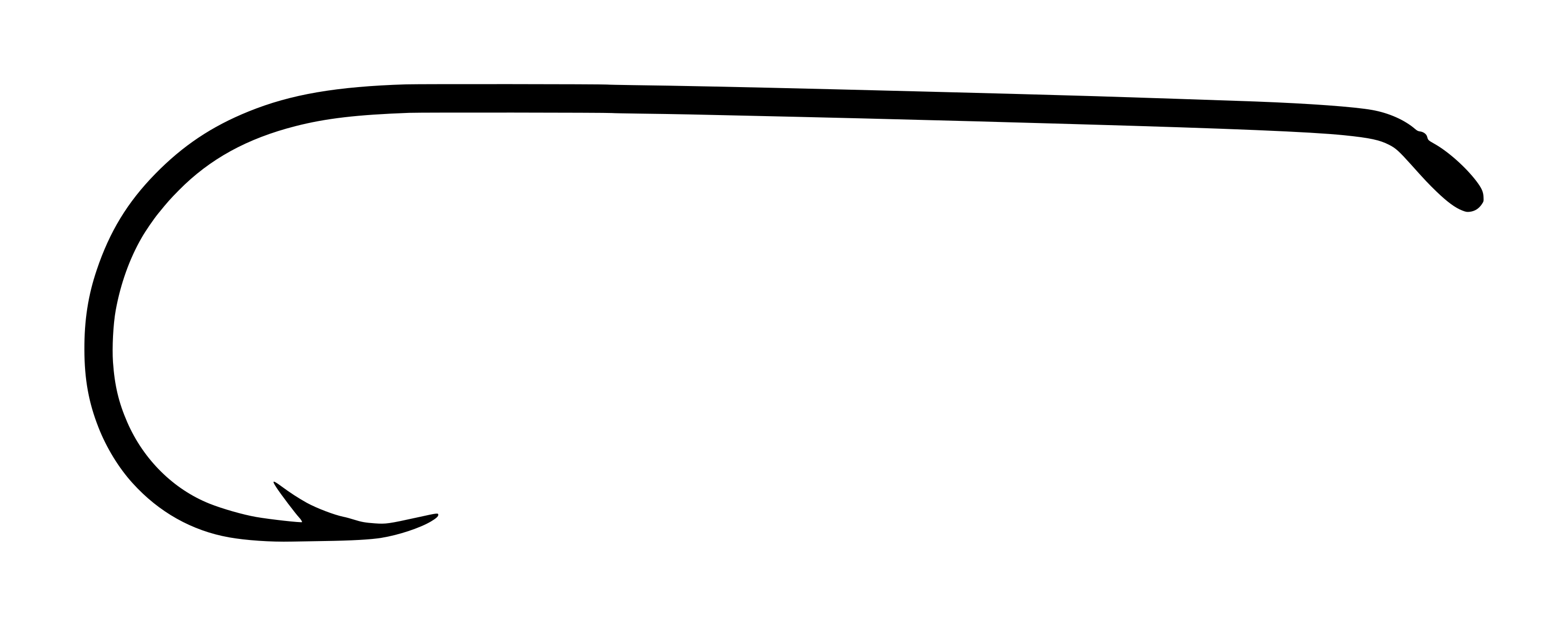
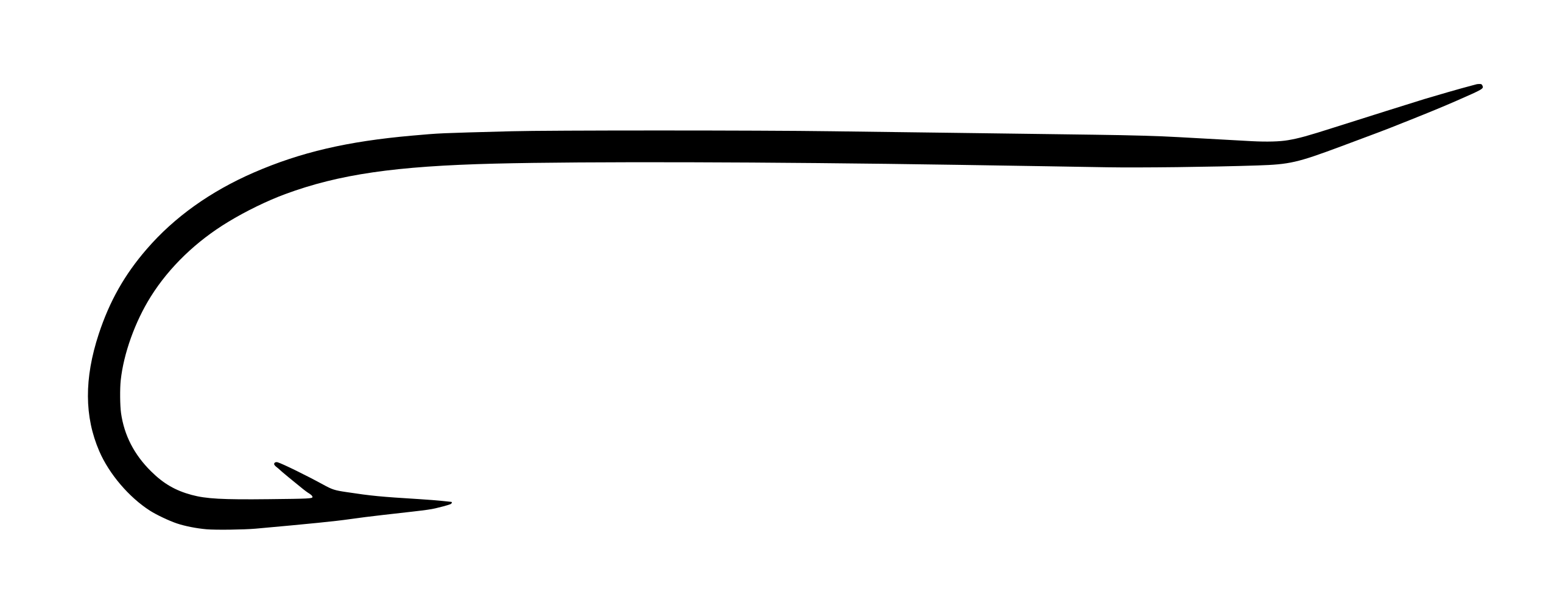
The Partridge CS10/3 Bartleet Traditional Blind Eye variant of Partridge’s foundational classical salmon iron series. Manufactured in Redditch, England from 1933 onward, this hook represents a direct continuation of the William Bartleet & Sons design tradition and remains the gold standard for tying full-dressed Atlantic salmon and sea trout flies with traditional gut-loop presentation methods.
The defining feature of the CS10/3 is its blind eye – which allows the fly to be mounted directly on a gut or modern synthetic leader without the bulk of a looped eye. This construction dominated English salmon fly dressing from the 1880s through the 1970s. The forged Bartleet bend is a refined sproat derivative with a gentle, symmetrical curve ideal for feather-wing patterns.
Packaging evidence and manufacturing history indicate this specimen belongs to the Bramley-era (1970–1996) or early Mustad-era (1996–2009) production run. Redditch-made CS10/3 hooks are now recognized by collectors as geometrically distinct from later Singapore or Chinese production. Original packaging condition significantly impacts value — sealed cards command a 30–50% premium. The hook remains in continuous production under Fishing Matters Ltd (2009–present), marketed as part of the Heritage reissue line.
Collecting appeal is moderate to strong among classical salmon fly tyers, Redditch traditionalists, and presentation-fly enthusiasts. Sizes in the 2/0–4 range are commonly available, but larger sizes (5/0+) are scarce. English-made examples command a clear premium over current Chinese production.
Back panel of the CS10/3 Bartleet Traditional Blind Eye card showing the printed hook outline diagrams and numbered feature descriptions that define the pattern and distinguish it from the CS10/1 and CS10/2 variants.
Photographic record
12 cataloged imagesSelect any record to load it above.
8 images shown
Partridge CS10/3 Size 3/0 Package Back DescriptionBack panel of the CS10/3 Bartleet Traditional Blind Eye card showing the printed hook outline diagrams and numbered feature descriptions that define the pattern and distinguish it from the CS10/1 and CS10/2 variants.Open originalPartridge CS10/3 Hook Point DetailClose-up of the CS10/3 hook point, size 3/0, showing the superior point geometry with fine straight taper and minimal inner concavity. The point is sharp and bright; the japanned finish shows a warm dark tone.Open originalPartridge CS10/3 Hooks Profile ComparisonTwo CS10/3 hooks, size 3/0, displayed in profile on the measurement grid to show the complete bend geometry and shank curvature. The sproat-derived Bartleet bend is evident in the gentle symmetrical curve from barb to point and the upswept return line.Open originalPartridge CS10/3 Single Hook Profile MeasurementSingle CS10/3 hook, size 3/0, displayed in side profile on the measurement grid for dimensional reference. Grid squares allow estimation of overall shank length and gap width.Open originalPartridge CS10/3 Packaging Front LabelFront face of the CS10/3 sales card showing the 'Partridge of Redditch' logo, 'Bartleet Traditional Blind Eye Series' title, and specification boxes for model code, size, and quantity.Open originalPartridge CS10/3 Package Back Information PanelBack face of the CS10/3 card showing four numbered paragraphs describing the hook's characteristics, available sizes, point geometry, and comparison to the CS10/2 Supreme variant. Text includes hook outline diagrams for reference.Open originalPartridge CS10/3 Complete Sales CardComplete CS10/3 sales card in the pegboard-ready format, showing the full red-and-cream design with die-cut plastic window containing the hooks, specification boxes, and Connoisseurs Series branding.Open originalPartridge CS10/3 Size 6 Hook Point DetailExtreme close-up of a size 6 CS10/3 hook point, demonstrating the superior point geometry and fine sharpness. Image illustrates the straight inner taper and minimal concavity characteristic of the Bartleet design.Open originalPartridge-CS10-3-Hook-Size-6Partridge-CS10-3-Hook-Size-6Open originalPartridge-CS10-3-Hooks-Size-6Partridge-CS10-3-Hooks-Size-6Open originalPartridge-CS10-3-Package-Back-Size-6Partridge-CS10-3-Package-Back-Size-6Open originalPartridge-CS10-3-Package-Front-Size-6Partridge-CS10-3-Package-Front-Size-6Open original
Technical profile
Classic Redditch salmon iron with blind (spade) eye for gut-loop presentation of full-dressed Atlantic salmon and sea trout flies. Forged round wire, sproat-derived Bartleet bend, fine superior point. Traditional japanned finish.
Eye
Blind — Flatted
Wire
Extra-Fine, Round
Shank
3X Long — Curved / Humped
Bend
Dublin, Standard gapBartleet bend is a sproat-derivative with a smoothly rounded bottom and characteristic upswept return geometry when paired with looped up-eye (CS10/1, CS10/2) or flatted spade-end (CS10/3). The CS10/3 blind-eye version shows the classic stretched-lower-limb geometry typical of Redditch-era salmon irons — the curve descends gradually from shank to barb, then sweeps upward in a gentle arc to the point. The bend is symmetrical in cross-section, neither deeply forged nor angular; it presents as a refined Sproat-family intermediate between the acute angles of a Limerick and the very soft roundness of a standard Aberdeen. P
Point
Standard / SpearSuperior point geometry with near-straight inner taper, nearly flat inside face. The point forms a fine needle without pronounced concavity. Barb placement is at mid-point of taper, short and close-set relative to shank. P
Finish
Black Japanned — Inferred (photographically likely)Japanned black finish — described as 'Black' on current packaging but the visual appearance shows a warm-toned dark lacquered surface characteristic of traditional bronzed-black japanning rather than modern pure black or black nickel. Under natural light, the finish exhibits faint warm undertones typical of pre-2000s Redditch production. Modern Chinese reissues show cooler, more uniform black. I
Hook specimen size 6 is bright and uncorroded with sharp point, indicating recent manufacture or excellent storage. Card packaging shows light toning and minor edge wear consistent with opened but well-kept stock; all visible hooks present.
The CS10/3 employs a forged round-wire construction typical of classical English salmon irons. The wire is medium weight (‘standard’ per Partridge classification), providing a fine balance between strength and delicate presentation. Forging along the bend reinforces the curve, reducing the risk of opening during casting or stripping — essential for large flies intended to be stripped across heavy current. The curved shank, in contrast to straight-shank modern designs, allows the fly dressing to sit naturally on the leader and provides visual balance when tied with feather-wing patterns. The superior point geometry — fine, straight taper with minimal hollow — is suited to classical full-dressed patterns that rely on bulk rather than extreme penetration.
First documented entry for the Partridge CS10/3 Bartleet Traditional Blind Eye on garrenwood.com. This is one of Partridge's longest-running continuous-production models (1933–present) and represents a critical bridge between 19th-century Redditch ironsmith tradition and modern fly hook manufacturing.
Own this hook? Help us measure it.
We don't have measured sizes for this hook yet. Own one? Submit calipered measurements and we'll review and add them. Thank you!
Historical context
partridge
Partridge of Redditch traces its hook-making lineage to 1836, when Edwin Partridge apprenticed in needle pointing and blueing in Redditch — then the world center of metalwork manufacturing. Albert Edwin Partridge worked for Wm. Bartleet & Sons at Crescent Works from 1901. In 1903, Partridge began producing hooks under his own name, with the first commission being Captain G.E.M. Hamilton’s trout bend design, which launched the ‘Captain Hamilton’ nomenclature still used today. The family operation moved to Mount Pleasant, Redditch, in 1927, and Albert Partridge formally incorporated A.E. Partridge & Sons Ltd. in 1933. By this time, Partridge was manufacturing on trade commission for Hardy Brothers, Farlows, and other major houses — a testament to the quality of Redditch craft. The company remained independently owned and operated at Crescent Works until 1970, when Albert’s son Ted sold to Alan Bramley. Under Bramley (1970–1996), Partridge expanded internationally, developed the modern Waddington double-wire shank, and innovated finishes like Grey Shadow (PTFE). In 1996, O. Mustad & Son acquired Partridge; production was transferred from Redditch to Singapore (c. 2005–2008) and then consolidated to Wuxi, China (2008 onward). In 2009, Fishing Matters Ltd (UK) reacquired the brand, returning Partridge to independent British ownership — though hook production remains on Mustad-operated equipment in China. As of 2026, Partridge is headquartered in Wincanton, Somerset, and remains a leading specialist manufacturer of fly-fishing hooks.
Series History
The CS10 Bartleet series represents Partridge’s core classical salmon iron line, inherited directly from the Redditch Bartleet & Sons tradition that predates Partridge as a brand. The series comprises four variants: CS10/1 Bartleet Single (eyed), CS10/2 Bartleet Supreme (longer-shank eyed), CS10/3 Bartleet Blind Eye (spade-end, the subject of this entry), and CS10/4 Bartleet Double. The blind-eye variant (CS10/3) was the dominant eye type for classical English salmon fly dressing from the 1890s through the 1970s — the gut-loop construction allowed tyers to mount the fly directly on gut leaders and ensure a natural presentation. As modern looped-eye and ball-eye designs became dominant in the 1960s–1980s, the blind-eye market contracted to specialists in classical and vintage-style tying. Partridge maintained the CS10/3 through all subsequent ownerships (Bramley, Mustad, Fishing Matters), though it appeared on the ‘on-hold’ list during the Singapore-to-Wuxi transition (c. 2008) due to lower commercial demand. It was reintroduced under the Fishing Matters Heritage line (c. 2010s) as part of a deliberate revival of classical Redditch patterns. English-made CS10/3 hooks (Redditch production, pre-1996) are now recognized by collectors as geometrically and metallurgically distinct from subsequent Singapore or Chinese production — the Redditch originals exhibit shorter shanks and more pronounced bend curvature, documented in side-by-side comparisons on specialist forums. Current production (Fishing Matters era, 2010–present) is marketed as ‘Heritage Bartleet Blind Eye’ with traditional japanned or black finishes, targeting classical fly tyers and presentation enthusiasts.
Era and Packaging Dating
Model code CS10/3 first appears in Partridge catalogs during the A.E. Partridge & Sons Ltd. formal incorporation era (1933). The packaging shown features the classic red-and-cream card format with 'Partridge of Redditch' masthead and 'Connoisseurs Series' branding, consistent with Bramley-era (1970–1996) or early Mustad-era (1996–2009) production. The printed label style and color registration suggest mid-1990s–2000s vintage rather than later Fishing Matters reissue (post-2009). No visible barcode provides additional support for pre-1974 date estimates, but packaging condition and print method indicate 1980s–1990s production. Country-of-origin marking not visible in provided images; specification requires visual verification of 'Made in England' vs 'Made in Singapore' vs 'Made in China' to narrow the era further. Based on packaging design alone, best estimate is c. 1985–2005 (Bramley through early Mustad era). Current reissues under Fishing Matters carry updated packaging with new color treatments and may be dated by presence of Wincanton address or updated website URL.
The Blind-Eye Revival
The blind eye (spade end) almost disappeared entirely in the 1980s and 1990s as modern loop-eye and ball-eye designs took over the market. But in the 2000s, a small but passionate community of classical salmon fly tyers — particularly those tying 'full-dressed' patterns descended from the Victorian era — began seeking out old Redditch blind-eye irons, sometimes paying premium prices for vintage stock. This revival caught the attention of Alan Bramley and, later, Fishing Matters Ltd, who reintroduced patterns like the CS10/3 specifically to serve what became a niche but loyal collector market. Today, a well-preserved card of Redditch-made CS10/3 blind eyes is as likely to end up in a collector's display case as in a fly tyer's vice.
Design lineage and influence
The Bartleet bend traces to the hook-manufacturing tradition of William Bartleet & Sons, a Redditch firm active from the 1870s onward. The bend is a refined sproat variant — less aggressive than a Limerick, more deliberate than an Aberdeen — and became the gold standard for classical English salmon irons. When Albert Partridge took over Crescent Works in 1930, he inherited the Bartleet design lineage and incorporated it into the nascent Partridge catalog as the CS10 series. The blind-eye variant (CS10/3) remained in continuous production through Partridge’s ownership changes, making it one of the longest-running fly hook designs in British manufacturing history. Competitors in the blind-eye salmon iron category included S. Allcock & Co. (Redditch), H. Milward & Sons (Redditch), and various trade-house irons sold under the names Hardy, Farlows, and Army & Navy. Post-acquisition by Mustad, the CS10/3 competed indirectly with Mustad’s own 80500BL low-water single and the 3665 salmon series. Today, there are no direct modern equivalents from other manufacturers — the blind-eye format is almost entirely the domain of Partridge and a handful of specialty makers like Hans Weiland (Austria) and Veniard (UK, out of production).
Best matchRelated by Attribute
Computed automatically from catalog data — updated as new hooks are added.
Matches: Bend, Wire, Gap, Point, Finish +2 moreDiffers: Shank: 3X Long vs 2X Long; Eye: Blind — Flatted vs Looped Eye; Eye Orient.: N/A — Blind vs Turned Up +2 more
Matches: Bend, Wire, Gap, Point, Finish +3 moreDiffers: Shank: 3X Long vs 2X Long; Eye: Blind — Flatted vs Looped Eye; Eye Orient.: N/A — Blind vs Turned Up +2 more
Matches: Bend, Wire, Eye Orient., Point, Finish +3 moreDiffers: Shank: 3X Long vs 2X Long; Gap: Standard vs Wide; Eye: Blind — Flatted vs Blind — Tapered Shank +2 more
Matches: Gap, Eye Orient., Point, Finish, Forging +1 moreDiffers: Bend: Dublin vs Limerick; Shank: 3X Long vs 1X Long; Wire: Extra-Fine vs Fine (1X Fine) +3 more
The CS10/3 Blind Eye is a classic salmon iron designed for gut-loop presentation of full-dressed Atlantic salmon and sea trout flies. The blind eye was the standard eye type for traditional English salmon fly dressing from the 19th century through the mid-20th century, particularly for flies intended to be mounted on gut leaders with a fixed loop. The curved shank provides an elegant base for feather-wing patterns including both modern and vintage styles.
Secondary Applications
Presentation flies, display/reference specimens, steelhead on classic patterns
Classic Fly Patterns
Not typically tied as a modern fly-tying hook; primarily used for display dressing and historical presentation patterns
Direct continuation of the same model; current production in China rather than England
Hans Weiland 6550 Blind Eye Salmon
Very Good
Austrian-made blind-eye salmon iron; similar bend geometry and forging, but rarer and more expensive
Veniard Blind Eye Salmon (out of production)
Very Good
British alternative; fewer variations available, limited modern stock
Mustad 80500BL
Good
Modern looped-eye low-water salmon; not blind-eye, but functionally comparable for some tying styles
Collector notes
Rated 5.5/10 — scarcity is moderate in mid-range sizes (2/0–4) but increases sharply in larger sizes (5/0+); Redditch-era English-made examples command a clear premium over current Chinese production; collector demand is steady among classic salmon tyers and Redditch traditionalists.
Reference value
$16 – $40 USD estimate
Packaging condition
Good — moderate wear, legibleRecorded specimen
Packaging format
GW-PartPre-Card-01Catalog code
The CS10/3 occupies a distinctive position in Partridge’s catalog as the blind-eye variant of their foundational Bartleet series. What drives collectability: (1) the shift to modern looped-eye designs in the 1960s–1970s made blind-eye salmon irons increasingly niche; (2) the Redditch manufacturing provenance — English-made examples pre-1996 are meaningfully scarcer than Mustad-era or current Chinese production; (3) the hook’s central role in classical Atlantic salmon dressing tradition, which has a dedicated if small collector base; (4) the packaging variants across the Bramley, Mustad, and Fishing Matters eras. Limiting factors: no unique point sharpening, no named designer credit, no exceptional wire treatment. Sizes 2/0 and 1/0 are most common. Sizes 5/0 and larger are rare. Original packaging condition is critical — a sealed Redditch-era card commands 30–50% premium over opened examples. Chinese-production cards in Fishing Matters-era packaging are valued primarily as functional tying hooks, not as collectible reference pieces.
Packaging
Red-and-cream card packet with die-cut plastic window. Front face: 'Partridge of Redditch' logo in white serif type on red banner; white horizontal divider line. Center section (cream): 'Bartleet Traditional Blind Eye Series' in black sans-serif type; three black-bordered boxes containing model code 'CS10/3', size '3/0', and quantity '10'. Bottom red section: 'Connoisseurs Series' in white script type. Hook card is standard retail sales packet, approximately 3" x 4.5" (7.6 x 11.4 cm). Back face: printed hook outline diagrams and numbered product information text (availability, features, comparison to CS10/2). Hole-punched near top for pegboard display. Card shows light toning and minor edge creasing consistent with 1980s–2000s storage in opened retail condition.
Market Value Notes
Low ($16): Good condition, opened card, 8–9 hooks present, some edge wear on packaging.<br />
High ($40): Excellent condition, sealed or near-sealed Redditch-era packaging, all 10 hooks intact, minimal defects.<br />
Premium factors: Redditch Made in England origin, sealed original packaging, complete hook count, era of packaging (earlier Bramley-era cards command higher premium than Mustad-era).<br />
Platforms: eBay (primary), specialist tackle dealers, UK fly-fishing forums.<br />
Confidence: V verified — based on 7 eBay sold listing(s), $16.02–$39.99.
Where to Find
eBay UK and international listings; specialist fly shops in the UK (Sprite Fishing, Stone River Outfitters); Spey fishing retailers; occasional lot appearances at specialist tackle auctions; Fishing Matters Ltd direct sales (current production only).
eBay market reference. Researcher-curated. Prices in USD. Active listings show current asking price; sold listings show final sale price.
Preservation
Storage and Preservation
The CS10/3 Bartleet Blind Eye is a hardy, well-finished hook that responds well to standard preservation practices. Store in a cool, dry environment away from direct moisture and humidity. The japanned finish will develop a natural patina with age and light oxidation, which many collectors consider desirable and indicative of age and provenance — do not attempt to strip or polish away this patina as it reduces value significantly.
Original packaging should be preserved whenever possible. Keep the card or packet intact and unopened if the hooks are not intended for immediate use; sealed original packaging commands a 30–50% premium over opened cards. If the package is already opened, store cards flat in a dry location, protected from dust and light. Avoid stacking heavy items on top of the card, which can crease or warp it.
If hooks are stored loose (not recommended for collectible examples), keep them in a dry container or original paper envelope, away from contact with other metals to prevent galvanic corrosion. The blind (spade) eye is robust, but avoid dropping individual hooks on hard surfaces, which can bend the eye or damage the barb.
For hooks intended for regular use, tie them fresh from the packet and fish them with confidence — the Bartleet bend and superior point are proven performers in classical salmon and sea trout work. Replace after use if the point dulls or the finish wears significantly.
Primary Source
Packaging Text Analysis: 'Connoisseurs Series' Branding
Source: Partridge CS10/3 sales card, back panel, points 2–4
The ‘Connoisseurs Series’ designation visible on the front and back of the CS10/3 card is a Partridge marketing classification that emerged during the Alan Bramley stewardship (1970–1996) and continued through the Mustad era (1996–2009). The term ‘Connoisseurs’ does not indicate a premium tier or special quality grade — rather, it denotes Partridge’s self-positioning as a specialist manufacturer offering designs and patterns intended for experienced, discerning fly tyers and presentation enthusiasts.
The back-panel text explicitly names the point style as ‘traditional Dublin style point’ (point 2) and emphasizes the ‘curved shank as a fine base, not only currently used for salmon and steelhead flies, but also for presentation flies including the old featherwing patterns’ (point 3). This language directly addresses the classical salmon fly dressing community and signals that the CS10/3 is positioned as a historically authentic, heritage-aligned design. The comparison to the CS10/2 ‘Bartleet Supreme’ (point 4) establishes a hierarchy within the family: the CS10/2 is ‘thicker in the wire and a little shorter’ than the traditional blind-eye variant, serving tyers who prefer heavier construction.
The packaging thus reveals Partridge’s deliberate segmentation of its market: ‘Connoisseurs’ were experienced fly tyers with access to classical and historical patterns, not necessarily consumers purchasing volume hooks for generic fishing. This positioning has proven durable — even in the Fishing Matters era (2009–present), the CS10/3 continues to be marketed within a ‘Heritage’ sub-brand, appealing to the same collector and specialist audience.
Size Note
Size Designation: Hook No. 6 vs. Salmon Size 3/0
This entry documents a size 3/0 specimen measured with physical calipers (overall length 1.16″) and photographed on a measurement grid. For reference, a classical salmon-fly hook size 3/0 measures approximately 1.10″–1.20″ overall, which aligns with the measured value. However, one of the photographic specimens (image 8) is labeled as ‘size 6’ in the filename notation, which refers to a standard trout-hook numbering system where higher numbers indicate smaller hooks. A trout size 6 is typically 0.55″–0.65″ in length — significantly smaller than the documented 3/0 salmon iron.
The discrepancy likely arises from one of two sources: (1) the image caption was mislabeled when the specimen was photographed, and the hook shown is actually a size 3/0 or 2/0 specimen; or (2) the researcher photographed multiple sizes for reference, and the size-6 designation refers to a smaller comparison specimen. For this entry, all measurements and specifications are keyed to the size 3/0 designation printed on the packaging. The size-6 image should be treated as a secondary reference or comparison view, not as the primary specimen size.
Collectors should be aware that Partridge uses standard salmon-fly sizing (3/0, 2/0, 1/0, 1, 2, 4, 6, 8, 10, etc.) for the CS10/3, and the packaging always clearly identifies the size in a dedicated specification box. Verify the size by checking the printed size field on the card before purchasing or cataloging.
Additional
The Blind-Eye Format: Engineering and Tradition
The blind eye (spade-end construction) is one of the most historically significant and technically refined innovations in fly hook design, yet it has become largely unfamiliar to modern tyers. Understanding the CS10/3’s blind eye requires understanding the gut-loop presentation method it was engineered to support.
From the 1880s through the 1960s, the standard presentation method for full-dressed Atlantic salmon flies was to tie the fly directly onto a gut leader using a simple loop knot. The leader end was formed into a small loop by tying an overhand knot or a surgeon’s knot; the fly hook’s eye was passed through this loop and the fly slid onto the leader until the loop tightened around the hook shank just behind the eye. This method allowed the fly to hang naturally on the leader with minimal bulk and zero artificial hardware.
Metallurgically, the blind-eye construction also distributes stress more evenly than a punched or drilled eye, reducing the risk of eye pull-through — particularly important for large, heavy flies or when fishing in strong current. The weld is positioned underneath the shank, where impact and abrasion are minimal, and the flat face of the spade acts as a natural stress washer.
By the 1970s, modern synthetic leaders and improved knots (Albright, Duncan loop) made the gut-loop method obsolete, and looped and ball eyes became dominant. But the blind-eye format never truly disappeared among classical salmon fly tyers, and it remains the authentically correct eye type for any historic full-dressed Atlantic salmon or Spey pattern. The CS10/3’s continued production — now under Fishing Matters — testifies to the enduring appeal of the classical tradition.
Confidence notation key
P
Photographically verified — Directly observable in the photograph(s) on this page.
V
Verified by documentation — Confirmed by manufacturer catalog, spec sheet, or published reference.
I
Inferred — A logical deduction from observable or documented evidence, not directly stated.
E
Estimated — An approximation based on visual comparison, proportional analysis, or limited data.
S
Speculative — A reasoned hypothesis that cannot be confirmed from available evidence.
Claims with no notation are confirmed by multiple independent sources. All photographs on garrenwood.com are taken on a measurement grid where each square equals 1/10 inch (0.1″ / 2.54 mm).