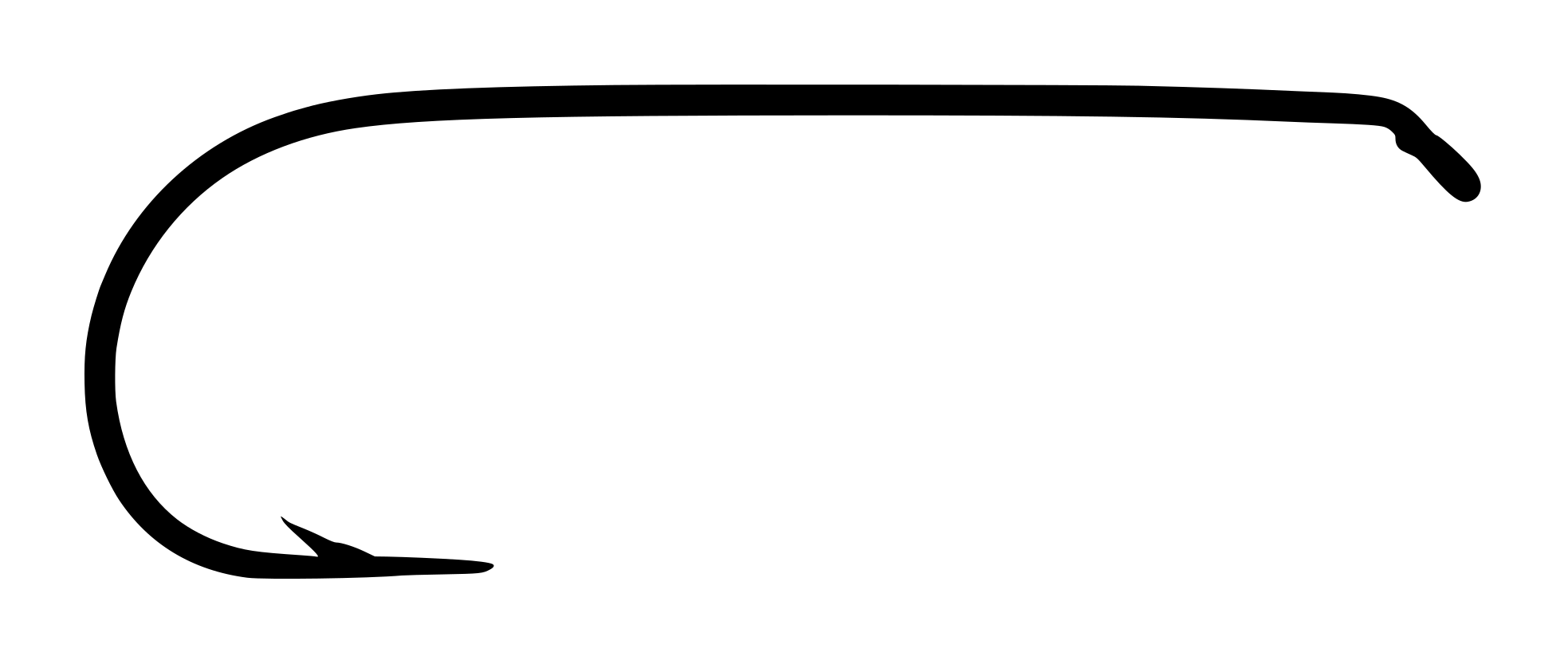
The Mustad Quality 37350 is a mid-century Aberdeen-pattern hook in extra-fine wire, sized No. 7, produced in Gjøvik, Norway between approximately 1950 and 1965. Distinguished by its turned-down (T.d.) ball eye and bronzed finish, this hook exemplifies Mustad’s strategy of manufacturing specialized regional patterns for global export markets.
The Aberdeen family is characterized by a perfectly round, sweeping bend and exceptionally wide gap — engineered specifically for live-bait fishing with delicate baits such as small minnows and worms. The extra-fine wire gauge was intentional: thin enough to thread through living baitfish without immediately killing them, yet strong enough to handle active fish. The Quality 37350 variant featured a turned-down ball eye rather than the more common ringed eye, providing anglers with a specialized option for delicate drift presentations.
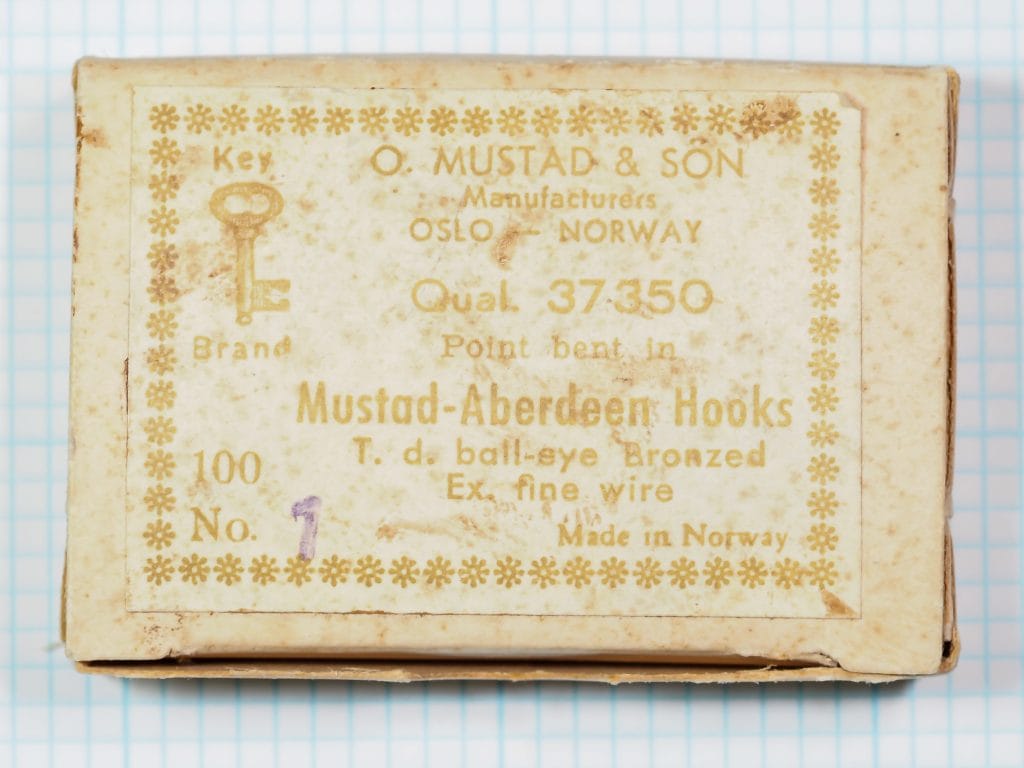
Original packaging for Mustad-Aberdeen hooks, model 37350, marked "100 No. 1" bronzed ball-eye hooks manufactured in Norway.
Photographic record
3 cataloged imagesSelect any record to load it above.
3 images shown
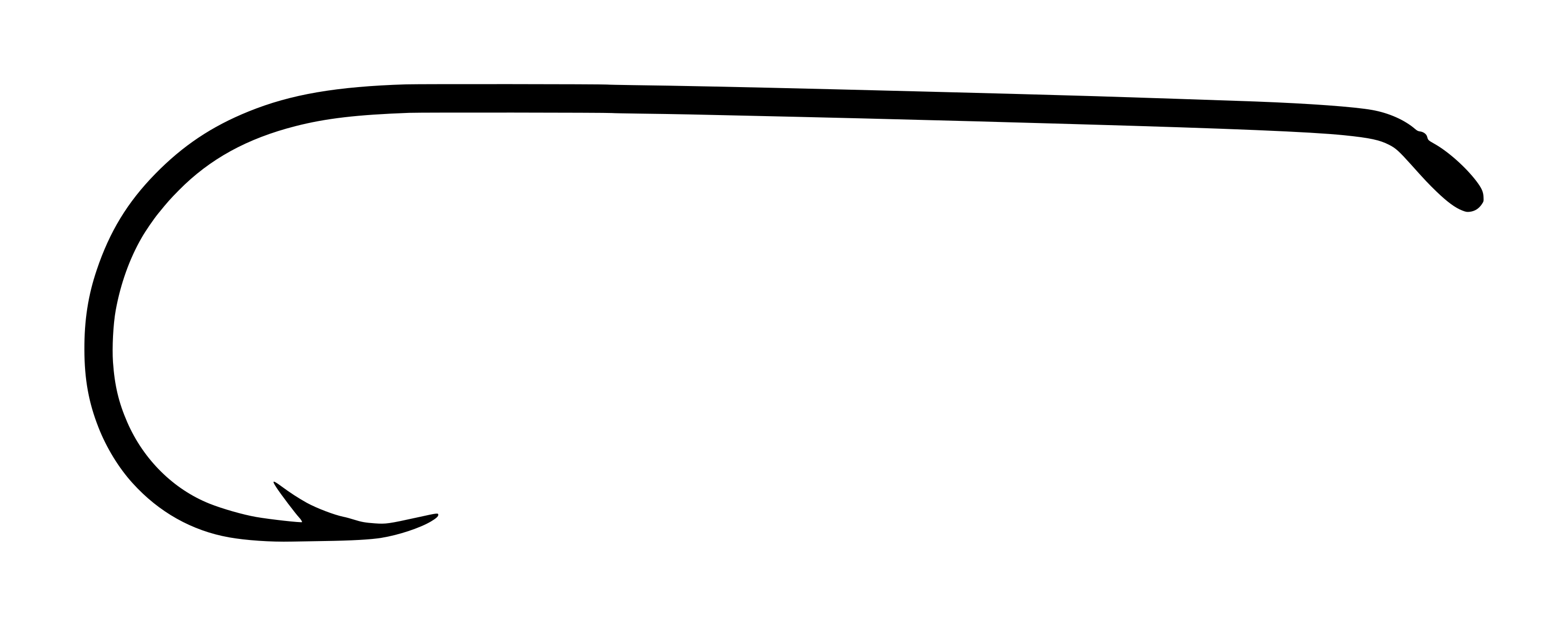
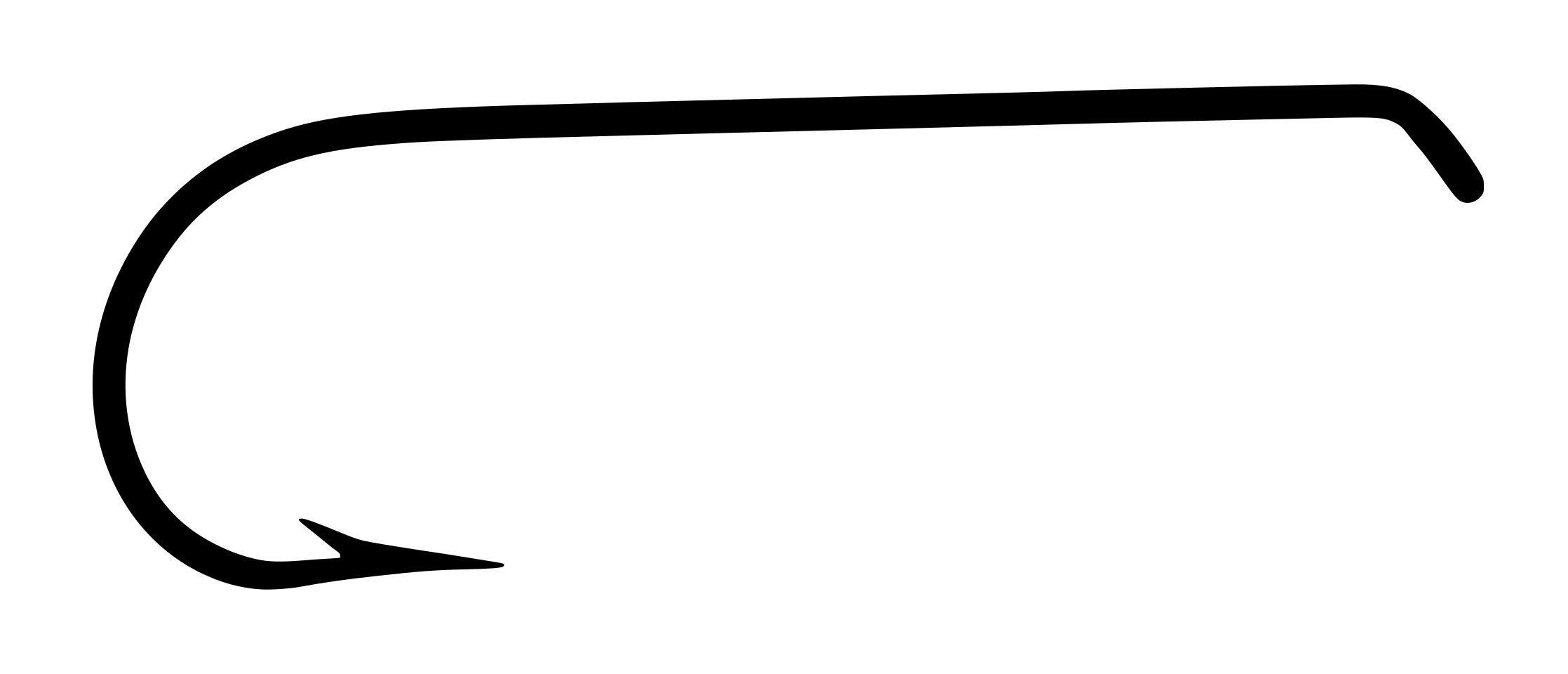
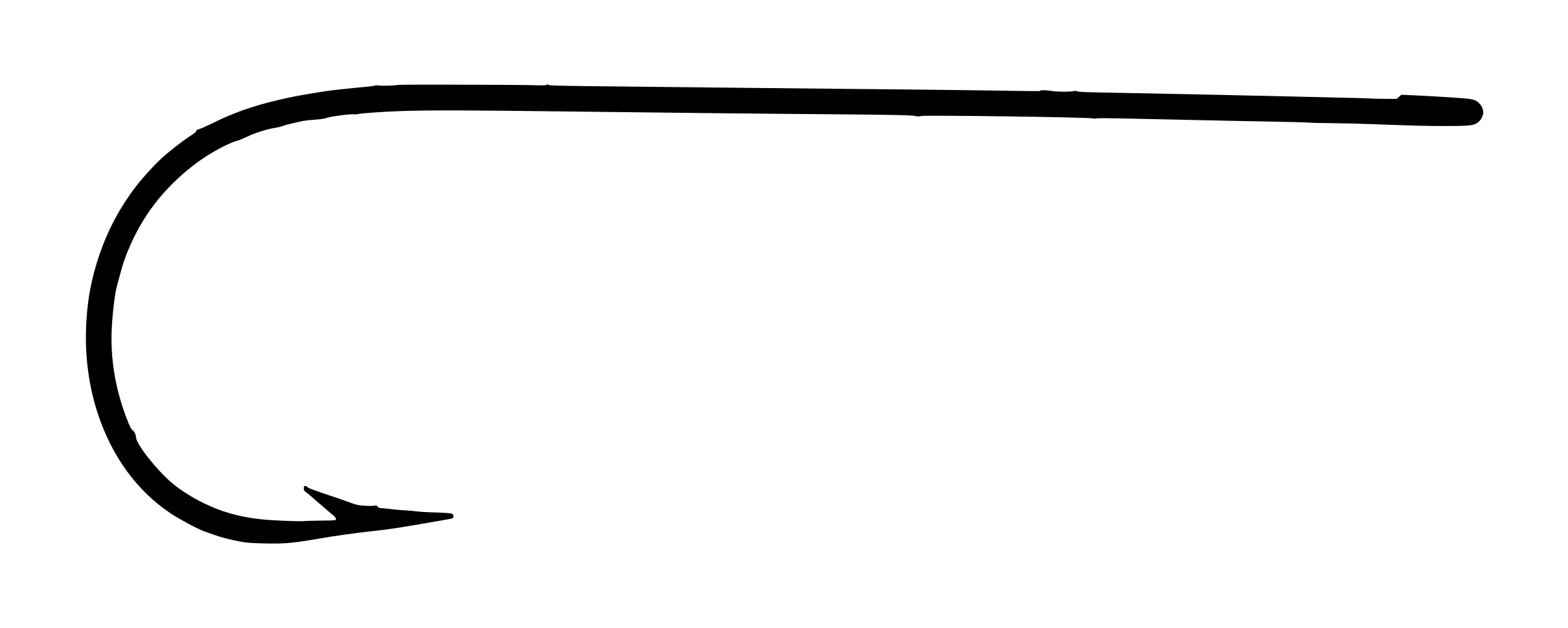
Mustad 37350 Aberdeen Hooks Box LabelOriginal packaging for Mustad-Aberdeen hooks, model 37350, marked "100 No. 1" bronzed ball-eye hooks manufactured in Norway.Open originalMustad 37350 Aberdeen Profile ViewProfile view of a Mustad 37350 size 1 Aberdeen hook showing the characteristic long shank, moderate bend, and turned-down ball eye in bronzed finish.Open originalMustad 37350 Aberdeen Straight-Eye ViewTwo Mustad 37350 Aberdeen hooks displayed straight-on, showing the turned-down eye and barb geometry in bronzed finish.Open original
Technical profile
Eye
Ball Eye, Turned DownTurned-down (T.d.) ball eye: wire maintains uniform thickness throughout the eye loop, with the eye angled downward at approximately 30–40 degrees from the vertical. This geometry is characteristic of commercial bait and utility fly hooks, distinct from the tapered eyes of premium dry-fly patterns. Eye is cleanly formed with no visible casting flaws P.
Wire
Extra-Fine, Round, Est. ~0.45 mm E
Shank
3X Long — Plain
Bend
Aberdeen, Wide gap, Offset / kirbedClassic Aberdeen geometry: nearly perfect round bend with sweep radius approximately equal to the gap width, creating the characteristic wide, open profile. Point is distinctly offset to the left (Kirbed), labeled on packaging as "Point bent in." This lateral deflection is subtle but visually distinct in profile view, designed to prevent the hook from lying flat in the fish's mouth P.
Point
Beak / Reversed (incurving)Small, close-cut barb positioned approximately 0.15–0.20 inches from the point tip. Barb angle is swept slightly rearward, standard for bait-hook designs of the era. Single barb; clean, sharp cut with no visible deformation P.
Finish
Bronzed — Confirmed (stated on packaging)Bronzed finish displays a warm, dark brownish-gold tone characteristic of the era. The specimen shows even color coverage with light patina development consistent with age and storage. No active rust or corrosion visible; patina tone suggests the finish has aged gracefully and is stable. Finish tone is distinctly warmer than blued steel, confirming bronzed rather than blued P.
Specimen hooks are bright with no active corrosion or rust. Original packaging shows moderate yellowing and edge wear consistent with age, but label text remains fully legible. Card construction intact; no visible mold, foxing, or water damage. Two of the original 100 hooks are present in the box (documented in separate catalog entry as display specimen).
The extra-fine wire specification was a deliberate engineering choice, not a cost-cutting measure. Fine wire reduces tissue damage when inserting the hook through living baitfish, preserving the bait’s mobility and natural pheromone release—both critical for triggering predatory strikes. The wide, round bend distributes force evenly across the hook during a fight, reducing the risk of straightening under load. The turned-down eye reduces overall hook weight and centers the attachment point directly above the barb, improving the mechanical advantage during hook-set. The Kirbed (laterally offset) point prevents the hook from laying flat in the fish’s mouth, increasing the probability that the point will catch tissue immediately upon initial contact. The bronzed finish provides excellent surface protection while minimizing unnatural glare in the water.
The Aberdeen pattern itself originated in Scotland and became one of the most universally recognized hook designs in angling history. Mustad produced the Aberdeen in numerous anatomical variations. The Quality 37350 represents a specific variant engineered for commercial and sport-angling markets simultaneously. In Mustad’s nomenclature, “Qual.” (Quality) designated the specific pattern or model number, rather than a tiered quality hierarchy. The 37350 offered dimensional consistency and reliable performance, cementing its place as a staple in Mustad’s mid-century export lineup.
Era and Packaging Dating
Oslo designation on label (post-1925, when Christiania was renamed). Snowflake/asterisk border pattern and yellowed paper stock are characteristic of Mustad mid-century packaging. Typography and printing method (offset letterpress) consistent with 1950s–1960s production. No barcode present, confirming pre-1974 manufacture.
The Scottish Genesis of a Norwegian Icon
The term 'Aberdeen' derives from the Scottish city where nineteenth-century hook-makers first perfected the wide-gap, round-bend design specifically for live-minnow fishing in cold-water salmon and trout streams. When Mustad began manufacturing Aberdeens in the 1880s, they retained the name despite producing them in Norway—a testament to the design's universal reputation. The extra-fine wire specification became so strongly associated with Aberdeen patterns that modern anglers often assume 'Aberdeen' automatically means 'light wire,' even though other Aberdeen variants exist in standard and heavy gauges. The Mustad Quality 37350 exemplifies this: a highly functional bait hook that remains a documented historical artifact of mid-century global tackle production.
Design lineage and influence
The Aberdeen pattern traces its lineage to nineteenth-century Scottish hook-makers and represents a fundamental departure from earlier English patterns (Limerick, Kirby) in that it prioritizes wide gap and light wire over structural strength and jaw-locking geometry. When Mustad reverse-engineered the Aberdeen for export, they maintained fidelity to the essential geometry while standardizing the production process. The Quality 37350’s turned-down eye distinguishes it from ringed-eye Aberdeens (such as the Qual. 3261), suggesting it occupied a specialist niche for anglers who preferred fly-tying flexibility or who valued the reduced weight at the hook front for delicate drift presentations. Modern equivalents (Kamasan B980, Daiichi 1280) maintain the Aberdeen’s essential DNA while adapting to contemporary manufacturing standards.
Best matchRelated by Attribute
Computed automatically from catalog data — updated as new hooks are added.
Matches: Bend, Wire, Eye, Eye Orient., Finish +4 moreDiffers: Shank: 3X Long vs 2X Long; Gap: Wide vs Standard; Point: Beak / Reversed vs Superior +3 more
Matches: Bend, Shank, Wire, Eye, Forging +3 moreDiffers: Gap: Wide vs Standard; Eye Orient.: Turned Down vs Straight / Inline; Point: Beak / Reversed vs Standard / Spear +4 more
The Quality 37350 was engineered for live-bait fishing with delicate presentations. The extra-fine wire and wide gap made it ideal for threading small live minnows (2–3 inches) or garden worms through the flesh without immediately killing them, allowing the baitfish to swim naturally and trigger strikes from trout, panfish, and perch in freshwater streams and lakes. The long shank prevented sharp-toothed fish from easily swallowing the bait and biting through the leader.
Secondary Applications
Wet-fly and nymph tying in vintage styles; light-tackle stream fishing; panfish applications.
Classic Fly Patterns
Not typically used for traditional fly patterns; historically associated with vintage wet-fly constructions and streamers where extra-fine wire and long shank were valued for subtle presentation.
Modern Equivalents
Hook
Match Quality
Notes
Kamasan B980 Aberdeen
Very Good
Maintains Aberdeen bend geometry and wide gap; similar wire gauge for bait applications; modern production standards.
Daiichi 1280 Long Shank Dry
Good
Long shank and fine wire similar to 37350; tapered eye differs; fly-tying focused rather than bait.
Tiemco 200R Wet Fly
Good
Continuous curve/curved shank bend, fine wire, suitable for vintage-style wet flies; eye geometry differs.
Collector notes
The Quality 37350 is moderately scarce, driven upward by its role as a documented mid-century Mustad production variant and by the rarity of intact original boxes with legible labels. Collectability is constrained by its utilitarian designation and lack of premium fly-tying cachet compared to specialized dry-fly hooks (e.g., Qual. 94840 Viking). Mint condition boxes command a modest premium.
Reference value
$25 – $75 USD estimate
Packaging format
GW-M-MID-01Catalog code
Positive Factors: Documented eight-line label with clear quality code; Oslo designation provides reliable dating; turned-down eye is a distinctive anatomical feature; extra-fine wire specification has become increasingly rare in modern production; complete original box (100-count) with all hooks intact is highly desirable; mid-century packaging aesthetic has broad appeal among tackle archivists.
Limiting Factors: Utilitarian, non-specialized fishing purpose limits appeal to fly-tying enthusiasts; size No. 7 is an obsolete scale oddity that confuses modern anglers accustomed to even-numbered sizing; no famous fly patterns or historical publications specifically reference this model; supply on secondary markets (eBay, tackle fairs) is adequate, preventing premium pricing for anything less than mint condition.
Packaging
Eight-line vintage Mustad label on kraft cardboard box, approximately 3.5 × 2.25 inches. Label printed in golden-yellow ink with Key Brand skeleton-key logo in upper left. Border consists of repeating snowflake or asterisk motifs (characteristic of 1950s–1960s Mustad export packaging). All eight lines clearly printed: Line 1, O. MUSTAD & SÖN; Line 2, Manufacturers; Line 3, OSLO — NORWAY; Line 4, Qual. 37350; Line 5, Point bent in; Line 6, Mustad-Aberdeen Hooks; Line 7, T.d. ball-eye Bronzed; Line 8, Ex. fine wire / Made in Norway. Quantity notation (100 No. 7) handwritten in purple ink in lower left corner. Paper stock is cream-colored kraft with moderate yellowing consistent with 60+ years of storage. Printing method is offset letterpress. Box edges show light wear; no water damage or mold visible. Original hooks remain intact on card (100 total, though display specimen has 2 hooks removed for photography).
Market Value Notes
A complete original box (100 hooks) in very good condition with legible label commands $40–75 USD. Individual hooks from broken boxes trade at $0.50–1.50 each. Premium pricing (upper range) applies to mint condition boxes with strong label contrast and no yellowing; lower range reflects fair condition with moderate label fading or minor edge wear. Prices reflect modest collector demand and the utilitarian nature of the pattern. Regional market variations exist; European collectors value mid-century Mustad exports more highly than North American buyers.
Where to Find
Surviving examples appear regularly on eBay (search: Mustad 37350, Mustad Aberdeen No. 7); specialist vintage tackle dealers; UK-based tackle fairs and auctions; online forums dedicated to vintage fishing equipment. Complete original boxes are less common than individual hooks salvaged from broken lots.
Collector's Identification Tips
Packaging: Verify the eight-line label format with Mustad Key Brand logo and the quality code (Qual. 37350). The Oslo designation must be present; Christiania labels would indicate pre-1925 manufacture and command a premium. The snowflake/asterisk border pattern is specific to mid-century Mustad production (1950s–1960s).
Hook Specifications: The turned-down ball eye is the most distinctive identifier—it distinguishes the 37350 from standard ringed-eye Aberdeens. The extra-fine wire is visibly thinner than standard or heavy-gauge patterns. The size No. 7 is an “old scale” oddity; modern production rarely uses odd-numbered sizes. The laterally offset (Kirbed) point should be subtle but visible in profile view.
Finish Verification: The bronzed finish should present as a warm, dark brownish-gold. Avoid specimens that have been stripped or chemically cleaned, as this destroys the historical patina P.
Preservation
Storage and Preservation
Store the original box in a cool, dry environment away from direct light and moisture. The bronzed finish is stable but will develop deeper patina with exposure to humidity—most collectors consider this desirable as evidence of age. Maintain the hook card in the original packaging; storing hooks loose accelerates oxidation and damage.
Inspect annually for signs of active corrosion (reddish rust) or mold growth. If minor surface oxidation appears, it can be carefully stabilized with a light coat of microcrystalline wax (Renaissance Wax or equivalent), applied with a soft brush and immediately buffed dry. Do not attempt to remove or polish historical patina, as this reduces collectability and authenticity.
Avoid contact with other metals to prevent galvanic corrosion. Store away from PVC storage materials, which can off-gas corrosive chloride compounds. Acid-free tissue or archival glassine can be used to wrap the box for long-term storage.
The label is the most vulnerable component; protect it from light exposure (which causes fading) and humidity (which can cause ink bleeding). Display boxes should be stored flat or in a vertical position, never folded or bent.
Size Note
The Obsolete Size No. 7: Old Scale Oddities
Modern hook sizing has largely standardized on even-numbered scales (No. 6, 8, 10, 12, 16, 20, etc.), particularly for fly hooks. The size No. 7 documented on this box is an artifact of the ‘Old Scale,’ a pre-standardization sizing system that remained common in bait-hook production well into the mid-twentieth century. This creates immediate confusion for modern anglers: is No. 7 equivalent to No. 6 or No. 8?
The caliper measurements provide the definitive answer: overall length approximately 1.48 inches (37.6 mm), gap width 0.40 inches (10.2 mm). By modern fly-hook gape standards, this hook is closest to a No. 8 in the contemporary even scale. However, vintage bait-hook sizing was not rigidly standardized—different manufacturers used slightly different increments—so the original No. 7 designation should be treated as a historical label rather than a functional equivalent.
This sizing oddity has several collecting implications: modern anglers often overlook these hooks because they cannot easily match them to contemporary scale references; the unusual size increases historical interest among tackle archivists; and it reinforces the necessity of physical measurement rather than reliance on printed sizing.
Marking Analysis
Handwritten Annotations and Marks
The lower left corner of the label displays a handwritten notation in purple ink: ‘7’ (the size number), written in a rapid, utilitarian hand consistent with mid-century warehouse or retail inventory marking. This is almost certainly a warehouse marking applied during packing, distribution, or retail display—not a collector’s mark or modification. The handwriting is legible and appears to have been applied with a fountain pen or brush pen, typical of the era before ballpoint pens dominated.
No other handwritten marks, initials, or price notations are visible on the specimen. The absence of retail price markup (common on hooks destined for retail sale in the 1950s–1960s) suggests this box may have been part of a bulk wholesale shipment or has been carefully preserved since original distribution.
Primary Source
Decoding the Eight-Line Label: A Case Study
Source: A Comprehensive Typology and Decryption of Vintage O. Mustad & Søn Hook Labels (garrenwood.com reference document)
The Mustad Quality 37350 packaging exemplifies the eight-line labeling system documented in the reference source ‘A Comprehensive Typology and Decryption of Vintage O. Mustad & Søn Hook Labels.’ Each line communicates specific technical and manufacturing information:
Line 1–2 (Corporate Identity): ‘O. MUSTAD & SÖN / Manufacturers’ establishes unambiguous brand ownership and manufacturing authority—critical in an era saturated with import agents and regional repackagers who often obscured the original manufacturer.
Line 3 (Geographic Dating): ‘OSLO — NORWAY’ provides the most powerful dating evidence: prior to 1925, the Norwegian capital was known as Christiania. The Oslo designation confirms post-1925 manufacture. Combined with the label style and paper yellowing, this suggests 1950s–1960s production.
Line 4 (Quality Tier): ‘Qual. 37350’ places this hook in the mid-tier product range (3000–3999), manufactured to exacting dimensional and tempering standards for both wholesale and retail sport-angling markets.
Line 5 (Point Identifier—Exclusive Rule): ‘Point bent in’ identifies the specific point geometry. The notation ‘bent in’ refers to the inward deflection (Kirbed offset) that distinguishes this Aberdeen from standard straight-point variants. This line exclusively defines point geometry per Mustad’s rigorous labeling protocol.
Lines 6–8 (Pattern, Features, Finishes): ‘Mustad-Aberdeen Hooks / T.d. ball-eye Bronzed / Ex. fine wire’ synthesizes the bend family (Aberdeen), eye type (turned-down ball), finish (bronzed), and wire gauge (extra-fine) into a complete technical specification.
This packaging represents one of the most sophisticated pre-digital systems for communicating hook specifications across global markets, predating barcodes and standardized product databases by decades.
Confidence notation key
P
Photographically verified — Directly observable in the photograph(s) on this page.
V
Verified by documentation — Confirmed by manufacturer catalog, spec sheet, or published reference.
I
Inferred — A logical deduction from observable or documented evidence, not directly stated.
E
Estimated — An approximation based on visual comparison, proportional analysis, or limited data.
S
Speculative — A reasoned hypothesis that cannot be confirmed from available evidence.
Unnotated claims are the compiler’s synthesis; see Sources. All photographs on garrenwood.com are taken on a measurement grid where each square equals 1/10 inch (0.1″ / 2.54 mm).