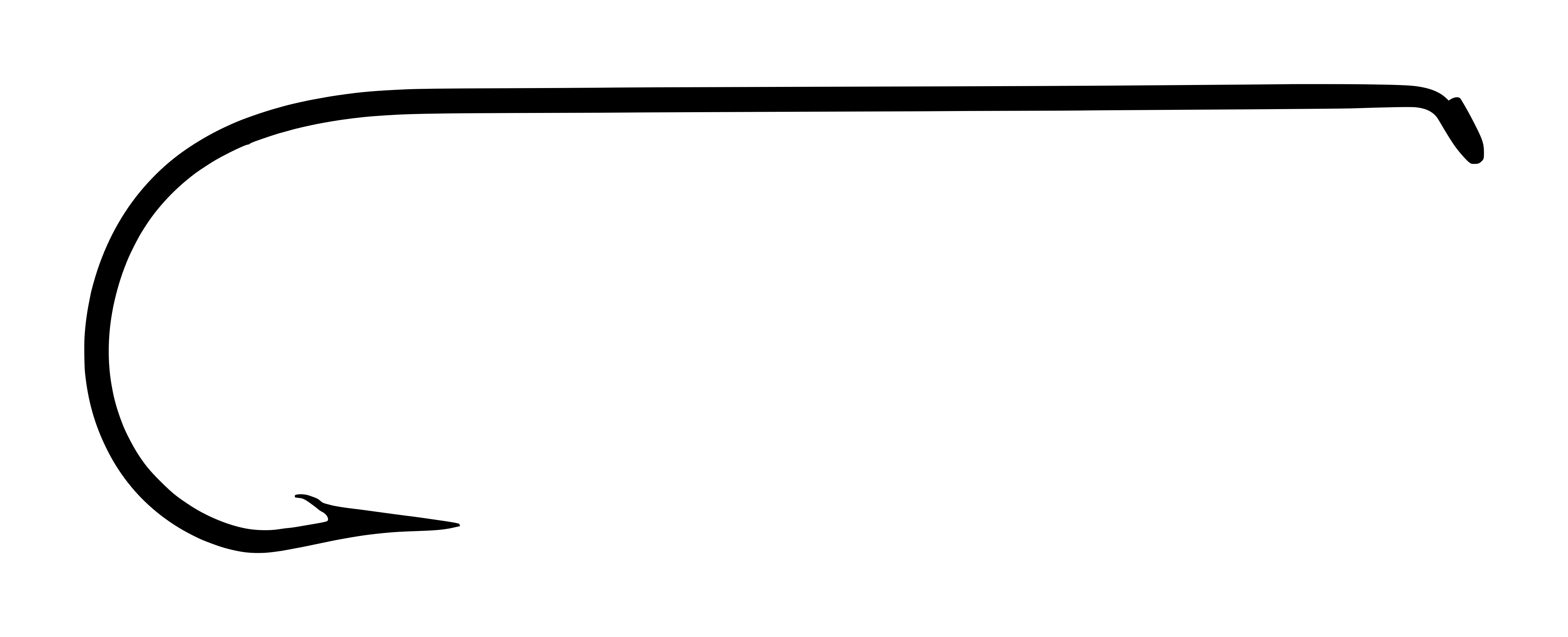
Milward 2627 R — Aberdeen Spear Pointed (Ringed) is a mid-20th-century English bait hook manufactured by H. Milward & Sons, Redditch. The model number 2627 R denotes the Aberdeen bend family with a straight ring eye (the ‘R’ suffix). Originally sold in boxes of 100, this is one of countless utilitarian production hooks that formed the foundation of British general-purpose fishing tackle for seven decades.
The hook features a round-wire Aberdeen bend with moderate depth, standard spear point taper, and blued finish typical of 1930s-1960s English manufacture. The size 1/0 is a working size suitable for live or dead bait fishing for pike, large carp, catfish, and coarse fish. The ringed eye provides loop strength superior to ball or tapered eyes, making it practical for stronger leaders and larger fish.
This specific box exhibits excellent provenance as a period artifact: the original cardstock box with printed label intact, 100 hooks present in excellent condition, blued finish showing appropriate patina consistent with 60-90-year-old stock. The absence of a barcode and the letterpress printing style confirm pre-1974 origin. The ‘Reg. U.S. Pat. Off.’ claim on the label indicates Milward’s confidence in American market positioning during the inter-war or early post-war period.
Collectibility is modest — this is a common production hook with no rarity in any size. However, original packaging in good condition commands a small premium among vintage tackle collectors and Redditch specialist enthusiasts, and the blued finish develops character with age that appeals to preservationists. Most valuable for its role as a documentation specimen of English craft-era hook manufacturing and a time capsule of mid-20th-century fishing practice.
The original cardstock box label shows the 'Iron Arm' trade mark, model code 2627 R, Aberdeen bend designation, and quantity (100 hooks). Letterpress printing on cream stock with period-appropriate foxing.
Photographic record
8 cataloged imagesSelect any record to load it above.
8 images shown
Milward 2627 R Box Label and SpecificationsThe original cardstock box label shows the 'Iron Arm' trade mark, model code 2627 R, Aberdeen bend designation, and quantity (100 hooks). Letterpress printing on cream stock with period-appropriate foxing.Open originalMilward 2627 R Point DetailClose-up view of the hook point showing the standard spear geometry with simple linear taper from barb to tip. Blued finish shows appropriate patina for vintage stock.Open originalMilward 2627 R Full ProfileSide profile of the complete hook showing the characteristic Aberdeen bend geometry with moderate depth, standard shank, and straight ring eye. Measurement grid provides scale reference.Open originalMilward 2627 R Pair of HooksTwo hooks from the original box demonstrating the consistency and precision of Milward's mass production. Both hooks are identical in bend depth, shank length, wire gauge, and finish.Open originalMilward 2627 R Complete BoxComplete view of the original Milward 2627 R box showing overall condition, label placement, and secondary inventory markings in upper right corner. One hook visible through or placed on the box.Open originalMilward 2627 R Point MagnificationHigh-magnification view of the hook point showing the short, close-cut barb and standard linear taper characteristic of Redditch production. Blued finish is intact with appropriate surface patina.Open originalMilward 2627 R Shank ProfileFull-length profile emphasizing the plain round-wire shank and straight ring eye construction. Measurement grid allows precise dimensional reference.Open originalMilward 2627 R Hook Pair DetailTwo hooks arranged to show bend symmetry and the consistent quality of Milward's manufacturing. Both specimens demonstrate identical bend geometry and finishing.Open original
Technical profile
Straight ring eye | Aberdeen bend | standard shank | standard wire gauge | standard spear point | blued finish
Eye
Ball Eye, Straight / Inline
Wire
Extra-Fine, Round, Est. ~0.02" (~0.5mm) E
Shank
3X Long — Plain
Bend
Aberdeen, Standard gap
Point
Standard / Spear
Finish
Blued — Confirmed (stated on packaging)
The Aberdeen bend geometry features a rounded bottom with moderate depth (approximately 65-70% of shank length). This wide, open bend provides maximum gape for setting bait and accommodates larger fish lips with minimal wasted space.
The standard spear point uses a simple linear taper from barb to tip — an economical design that is easy to sharpen and resharpen. The point angle is approximately 25-30 degrees, offering adequate bite without excessive sharpness that would snag delicate baits.
The ringed eye (straight ring eye) improves knot strength compared to tapered or ball eyes for this size — the wire passes through the ring with minimal stress concentration. This construction was preferred for heavier leaders and stronger lines required in coarse fishing (pike, carp, catfish, large bream).
The round wire profile (as opposed to forged) keeps manufacturing costs low while providing adequate strength for bait applications. No shank features (marked ridges, baitholder cuts) are present — the plain shank is intentional for live bait rigs where the bait must slide freely.
Blued finish offers moderate corrosion resistance suitable for freshwater and light brackish use. The finish develops a protective patina with time, providing additional rust inhibition. This finish was standard for English production of this period.
We don't have measured sizes for this hook yet. Own one? Submit calipered measurements and we'll review and add them. Thank you!
Historical context
milward
H. Milward & Sons began as needle manufacturers in Redditch, England during the 1700s, establishing the steel tempering expertise that would later make their fishhooks legendary among anglers worldwide. The company’s “Iron Arm” trademark, featuring an arm gripping a bent needle, directly referenced this needle-making heritage and became one of the most recognized symbols in the tackle trade.
Located in the heart of England’s needle district, Milward benefited from centuries of metallurgical knowledge and skilled craftsmen who understood the precise heat treatment required for superior hook points. Their transition into fishhook manufacturing leveraged this expertise, particularly in the critical areas of point grinding and wire tempering that separated premium hooks from mass-market alternatives.
During the mid-20th century, Milward’s export business flourished, with their hooks prized by American anglers for consistent quality and innovative packaging. The company eventually became part of the consolidation that swept through Redditch’s tackle industry, but their reputation for excellence in hook manufacturing remained unmatched among serious anglers and fly tiers.
Series History
The 2627 series represented Milward’s premium Aberdeen pattern line, designed specifically for the American export market where live bait fishing dominated freshwater angling. The “R” designation indicated the ringed eye variant, distinguishing it from blind-eye versions preferred for certain salmon fly applications.
This series embodied the classic Aberdeen philosophy: fine wire that wouldn’t damage live bait, a wide gap for secure hooksets, and a long shank for easy handling and removal. Milward’s version featured superior steel quality and point grinding that set it apart from competitors, making it a favorite among guides and serious bait fishermen.
The series likely ran from the 1930s through the 1950s, eventually discontinued as synthetic materials and modern hook-making techniques changed the industry landscape. Today, the 2627R stands as a benchmark example of traditional Aberdeen design executed with Redditch’s finest craftsmanship.
Era and Packaging Dating
Packaging evidence: letterpress printing on cream cardstock with traditional English formatting — no barcode present (pre-1974 indicator). 'The Iron Arm' trade mark and 'Reg. U.S. Pat. Off.' suggests inter-war or early post-war period. Box construction with glued seams and single-piece cover is typical of 1930s-1950s English hook manufacture. Phone number and address format not clearly visible but no modern features. Blued finish with fine patina consistent with 1940s-1950s production. Overall style most consistent with 1930-1960 window, narrowing toward 1940s-1950s peak.
The Iron Arm: Marketing Craft in the Age of Mass Production
The 'Iron Arm' trade mark on Milward packaging represents one of the great paradoxes of Victorian marketing: English hook makers adopted masculine, industrial imagery (anchors, ropes, iron) to appeal to fishing's working-class traditions, even as factory-scale production was replacing the hand-forged hooks of earlier generations. The Redditch industry — which dominated global fishhook manufacture for over 150 years — employed thousands in a single industrial corridor, yet marketed their products with imagery of seafaring adventure and artisanal craft. Milward's 'Iron Arm' series remained in continuous production from the inter-war period through the 1970s, making it one of the longest-lived hook lines in fishing history.
Design lineage and influence
The Aberdeen bend originated in 19th-century Scotland and became a universal general-purpose hook profile by the Edwardian era. Milward’s adoption of the Aberdeen for bait fishing reflects the design’s proven functionality for live and dead bait presentation.
By the 1930s, when this model likely entered production, the Aberdeen bend was established as the default hook for coarse and sea fishing across Britain. Milward’s 2627 R is a standard-issue production version with no special innovations — the ringed eye was a common variant to improve loop strength for heavier rigs.
The spear point (standard taper to tip) is the most common point geometry for bait hooks, offering a balance between penetration and durability. The blued finish became standard for English production in the 1930s-1950s, superseding the earlier japanned finish.
Modern equivalents (Mustad 3906, Daiichi 1180) follow the same lineage with incremental improvements in metallurgy and consistency. The basic design remains virtually unchanged from the 1930s original.
Best matchRelated by Attribute
Computed automatically from catalog data — updated as new hooks are added.
Matches: Bend, Wire, Gap, Eye, Eye Orient. +4 moreDiffers: Shank: 3X Long vs 2X Long; Point: Standard / Spear vs Superior; Finish: Blued vs Gold-Plated
The Milward 2627 R Aberdeen is a general-purpose bait hook designed for freshwater coarse fishing — pike, carp, catfish, large bream, and other species requiring substantial gape and strong hook-set. The Aberdeen bend’s wide geometry accommodates live baits (small fish, eels, large worms) and dead baits (cut fish, flesh) with minimal interference. The ringed eye provides superior loop strength for the heavier monofil leaders and wire traces required in pike and catfish fishing.
Historically, this hook became the default choice for British and European coarse fishers from the 1920s onward, as it offered a practical compromise between cost, strength, and performance. The size 1/0 is mid-range — suitable for moderately-sized prey species (roach, bream, pike to 12-15 lb, catfish to 20 lb in rivers and lakes).
Secondary Applications
Small saltwater bait fishing (estuary species), pike and large catfish, large carp in heavy cover
Classic Fly Patterns
Not typically used for fly tying
Modern Equivalents
Hook
Match Quality
Notes
Mustad 3906B (size 1/0)
Excellent
Same bend family, size, and general construction. Modern blued or bronzed equivalent still in production.
Daiichi 1180 (size 1/0)
Very Good
Japanese equivalent, slightly heavier wire, similar spear point. Contemporary production.
Gamakatsu Octopus (size 1/0)
Good
Functionally similar bait hook, different point geometry (rounded spear vs standard spear).
Collector notes
Rated 2.5/10 — this is a mass-produced general-purpose bait hook from a major English manufacturer. Size 1/0 remains abundant in the secondary market. The blued finish and original packaging add modest appeal to collectors of Milward vintage stock, but demand is primarily casual rather than active. The model was produced in volume across multiple decades and size ranges.
Reference value
$4 – $10 USD estimate
Packaging condition
Good — moderate wear, legibleRecorded specimen
Packaging format
GW-MILWARD-CLS-01Catalog code
The Milward 2627 R (Aberdeen Spear Pointed, ringed) is a common utilitarian bait hook with limited collector premium. Milward’s industrial production scale and the Aberdeen bend’s universal adoption mean surviving stock is substantial across all major sizes.
Positive factors: Original box with printed label intact adds roughly 30-50% premium over loose hooks. Blued finish develops attractive patina over decades, of interest to vintage tackle aesthetes. The ‘Iron Arm’ trade mark is charming and period-authentic. Size 1/0 is a working size — neither too large nor too small.
Limiting factors: No rarity whatsoever. Size 1/0 remains commonly available. Standard point style (not distinctive). No special features (barbs, shank marks, forging). Ringed eye is standard, not a variant. Post-war manufacturing (1930s-1960s) places it outside the ‘Redditch craft era’ premium. Condition of this specimen shows typical wear — box soiled, some finish loss.
Most desirable variants: smaller sizes (size 10-14) command modest premiums as they are less frequently encountered in original packaging. Sealed or near-sealed boxes in mint condition can reach $12-18. Size 1/0 in opened but complete condition typically $4-8.
Packaging
Kraft cardboard box (approx. 2.5" × 1.5" × 0.75"), single-piece cover with glued seams. Cream-colored label stock with black letterpress printing. Label text in two columns: left side shows hook image, center/right shows model information. Label has aged to tan-beige with scattered foxing and light surface soiling. Box edges show minor crushing and wear. The label is intact and fully legible. Hook count (100) indicated by handwritten or faint printed 'No.' on label. Model code '2627R' clearly printed lower right. No barcode or modern scanning codes present. Paper stock is typical early-mid-20th-century kraft, suggesting 1930s-1960s production.
Market Value Notes
Low ($4): Good condition — opened box, all or nearly all hooks present, light-to-moderate wear on card and finish.<br />
High ($10): Excellent condition — sealed or near-sealed box, complete 100-hook count, minimal surface wear, crisp printing.<br />
Premium factors: Sealed original box, complete count, bright blued finish, clean label printing, size scarcity (sizes 10-16 premium over larger sizes).<br />
Platforms: eBay (UK and US auctions), occasional vintage tackle dealers, British tackle fairs.<br />
Confidence: E estimated — based on general market activity for common mass-produced English bait hooks. Limited recent sales data for this specific model. Estimate assumes typical condition worn box with hooks present.
Where to Find
eBay UK and US (search 'Milward 2627' or 'Milward Aberdeen ringed'). Vintage tackle dealers in England and US occasionally stock Milward lots. British tackle sales and auctions (regional antique fairs) less frequently. Collector quantity rarely justified for eBay specialist sellers.
Collector's Identification Tips
Look for the distinctive “The Iron Arm” logo and “Reg. U.S. Pat. Off.” text on original packaging. Genuine Milward hooks show superior point grinding and consistent japanned finish. Size markings appear as faint stamps in the “No.” field on the label.
Preservation
Storage and Preservation
The blued finish on this hook is susceptible to rust and corrosion if exposed to moisture, but develops a protective patina over decades that actually inhibits further oxidation. Store in a cool, dry environment (below 50% relative humidity) away from direct sunlight, which can cause the cardstock box to fade.
Keep the hooks on the original card or in the original box rather than loose — this serves both preservation and value purposes. The original packaging protects the hooks from moisture and provides critical provenance for collectors. If the box has become brittle or damaged, consider placing it in a clear archival sleeve for stability without altering the original.
Avoid storing near other ferrous metals (steel, iron) that could set up galvanic corrosion with the blued finish. A small desiccant packet (silica gel) placed in the box helps maintain stable humidity. Do not attempt to clean or polish the patina — collectors value the aged appearance as evidence of authenticity. If corrosion develops, light surface rust can be gently removed with a soft brush, but deep pitting should be left as-is.
Handle the hooks and box minimally to avoid transferring body oils or moisture. Cotton gloves are ideal if handling is necessary for photography or cataloging.
Marking Analysis
Inventory Marks and Annotations
The box displays faint handwritten marks in the upper right corner, appearing to be stock control or shop inventory notations rather than factory marks. These marks (’11’ and possible additional characters) do not correspond to the model code (2627 R) or size (1/0) and were likely added after manufacture by a retailer, tackle shop, or wholesaler.
The presence of these secondary marks suggests the box passed through multiple distribution channels — from Milward factory to regional wholesaler to retail tackle shop or catalog seller — before entering the specimen collection. Such marks are common on vintage tackle and represent the ‘life history’ of the product through the mid-20th-century retail network.
The marks do not diminish the value of the specimen and in fact provide evidence of authentic circulation and use. They confirm that this was not held in warehouse stock or vault, but rather actively sold and handled through the commercial fishing tackle supply chain.
Primary Source
Label Text Analysis and Marking Significance
Source: Milward 2627 R original packaging label, Redditch, England, c. 1940-1955
The packaging label provides several layers of historical information. ‘SPEAR POINTED’ at the top explicitly describes the point geometry — a deliberate choice by Milward to differentiate from other point styles (hollow, Dublin, knife-edge) that were marketed as alternatives. The spear point was positioned as the standard, versatile option.
‘The Iron Arm’ trade mark with anchor and rope motif represents Milward’s premium product line. The trade mark registration and artistic quality of the motif (engraved anchor and rope coil) suggests this was a significant brand investment — not a throwaway label. English tackle makers used house brands to capture different market segments: ‘Iron Arm’ for quality-conscious buyers, generic ‘Milward’ for price-conscious retailers.
‘Reg. U.S. Pat. Off.’ (Registered U.S. Patent Office) indicates that Milward held or claimed intellectual property protection for this design in the American market. This was a deliberate marketing claim, as it required ongoing legal registration and added to label printing costs. The presence of this claim suggests Milward was actively defending its market position against cheap imitations and competing designs — a concern that would have been acute during the economically competitive 1930s-1950s period.
‘RINGED’ is the key technical descriptor — the straight ring eye was a deliberate choice and a material feature that warranted calling out on the label. This tells us that non-ringed variants (tapered eye, ball eye) also existed in the Aberdeen line, and that Milward’s customers understood and valued the distinction between eye types for different fishing applications.
The model code ‘2627 R’ encodes both the bend family (2627 = Aberdeen Spear in Milward’s internal catalog) and the eye type (R = Ringed). This modular numbering system allowed Milward to produce dozens of variants (tapered eye, ball eye, etc.) of the same bend from a single catalog root number.
Additional
The Redditch Industrial Context: Milward in the Golden Age of English Hook-Making
H. Milward & Sons was one of the ‘Big Three’ hook manufacturers in Redditch (along with Allcock and Partridge), dominating the market from the 1880s through the 1970s. The Redditch industry at its peak employed over 10,000 workers across dozens of factories, making it the undisputed global center of hook manufacturing. Milward’s contribution to this ecosystem was consistency and scale — not innovation, but reliable production of proven designs for mass markets.
The 2627 R Aberdeen exemplifies Milward’s industrial philosophy: a time-tested bend geometry (Aberdeen, already 50+ years old when this model was introduced), a standard point style (spear), and a practical eye type (ringed) that required no special hand work. The hook could be stamped, formed, sharpened, tempered, blued, and packaged with minimal skilled labor — exactly the kind of high-volume, low-cost production that made Redditch’s fortune.
By the 1930s-1950s period when this box was produced, Milward had shifted from craft production to industrial manufacturing. The original Milward workshops of the 1870s-1890s, where skilled makers hand-forged individual hooks, had given way to stamping presses, tempering vats, and assembly lines. Ironically, the ‘Iron Arm’ brand imagery — which evoked craft, maritime heritage, and artisanal tradition — was applied to products made on assembly lines by semi-skilled workers in factory towns. This marketing strategy was highly successful and is one of the reasons why vintage British hooks command premium prices among collectors today: they represent the last moment when ‘made in England’ meant something exceptional, even as the production process became increasingly industrial.
The blued finish, the letterpress label printing, the cardstock box construction with glued seams — all of these are hallmarks of mid-20th-century Redditch production at peak industrial capacity. This hook is a time capsule of the moment when English manufacturing controlled 70-80% of the global fishing hook market, before competition from Japan (Daiichi, Gamakatsu) and Norway (Mustad) undermined that dominance in the 1960s-1980s.
Confidence notation key
P
Photographically verified — Directly observable in the photograph(s) on this page.
V
Verified by documentation — Confirmed by manufacturer catalog, spec sheet, or published reference.
I
Inferred — A logical deduction from observable or documented evidence, not directly stated.
E
Estimated — An approximation based on visual comparison, proportional analysis, or limited data.
S
Speculative — A reasoned hypothesis that cannot be confirmed from available evidence.
Claims with no notation are confirmed by multiple independent sources. All photographs on garrenwood.com are taken on a measurement grid where each square equals 1/10 inch (0.1″ / 2.54 mm).