Manufacturer: O. Mustad & Søn, founded 1832 in Gjøvik, Norway. Model: Quality 9555 Beak Hook. Size: 3/0 (large saltwater/freshwater bait hook). Defining Feature: Reversed (beak) point with hollow-point geometry, extra-strong 2X wire, tapered eye, and two longitudinal slices on the shank for positive bait grip.
Era: Mid-twentieth century (c. 1950s–1960s). The label reads ‘OSLO – NORWAY,’ establishing production post-1925, and the specific typography, paper stock, and offset printing method are consistent with Mustad’s mid-century export packaging. The absence of a barcode and the hand-written size notation on the card reinforce a pre-1974 manufacturing date.
Collecting Significance: This is an excellent example of vintage baitholder hook design and Mustad’s precision manufacturing during their period of global dominance. Original boxes in good condition attract moderate collector interest, particularly among traditionalists who prefer ‘Made in Norway’ steel quality. The 3/0 size in this beak configuration is available but not abundant, making it a worthwhile specialty acquisition.
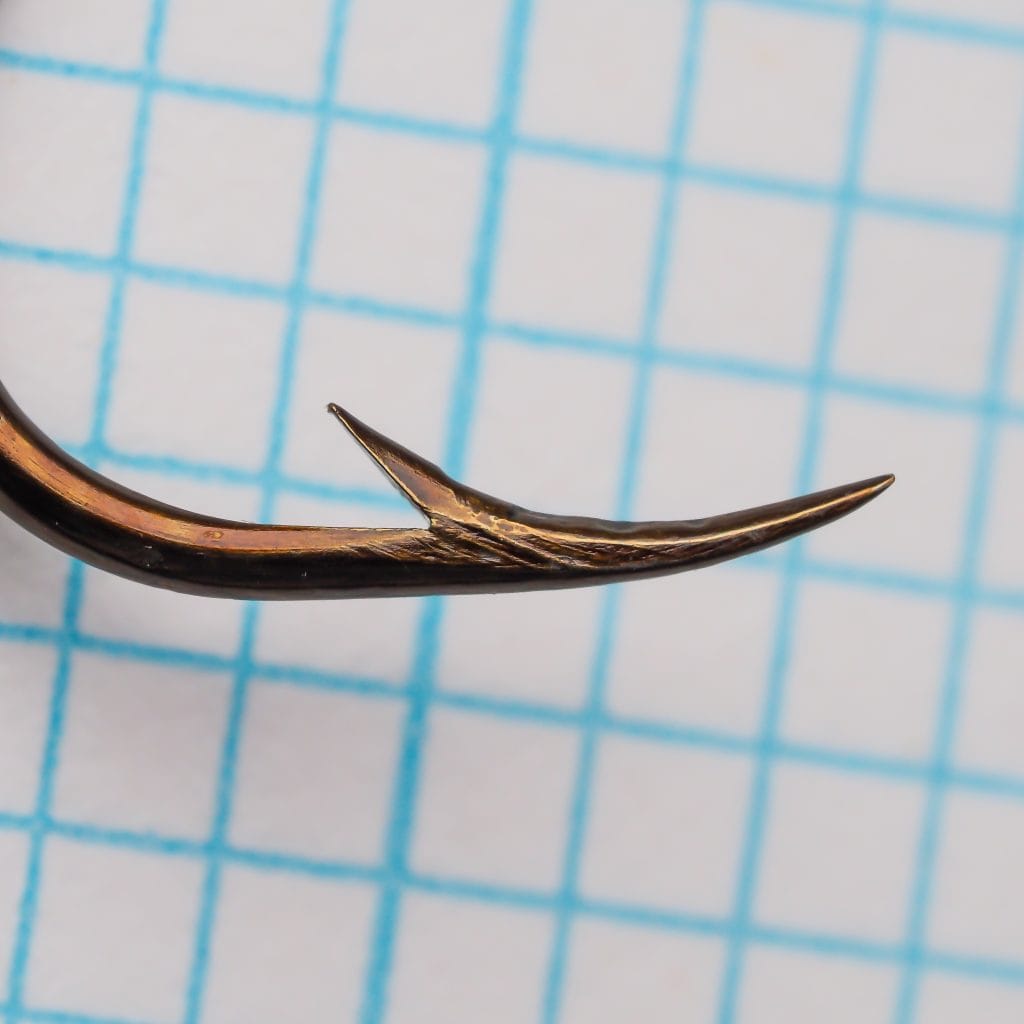
Close-up of the 9555 point showing the characteristic reversed (beak) geometry with concave hollow-point profile, sharp barb, and bronzed finish on 1/10-inch grid.
Photographic record
6 cataloged imagesSelect any record to load it above.
6 images shown
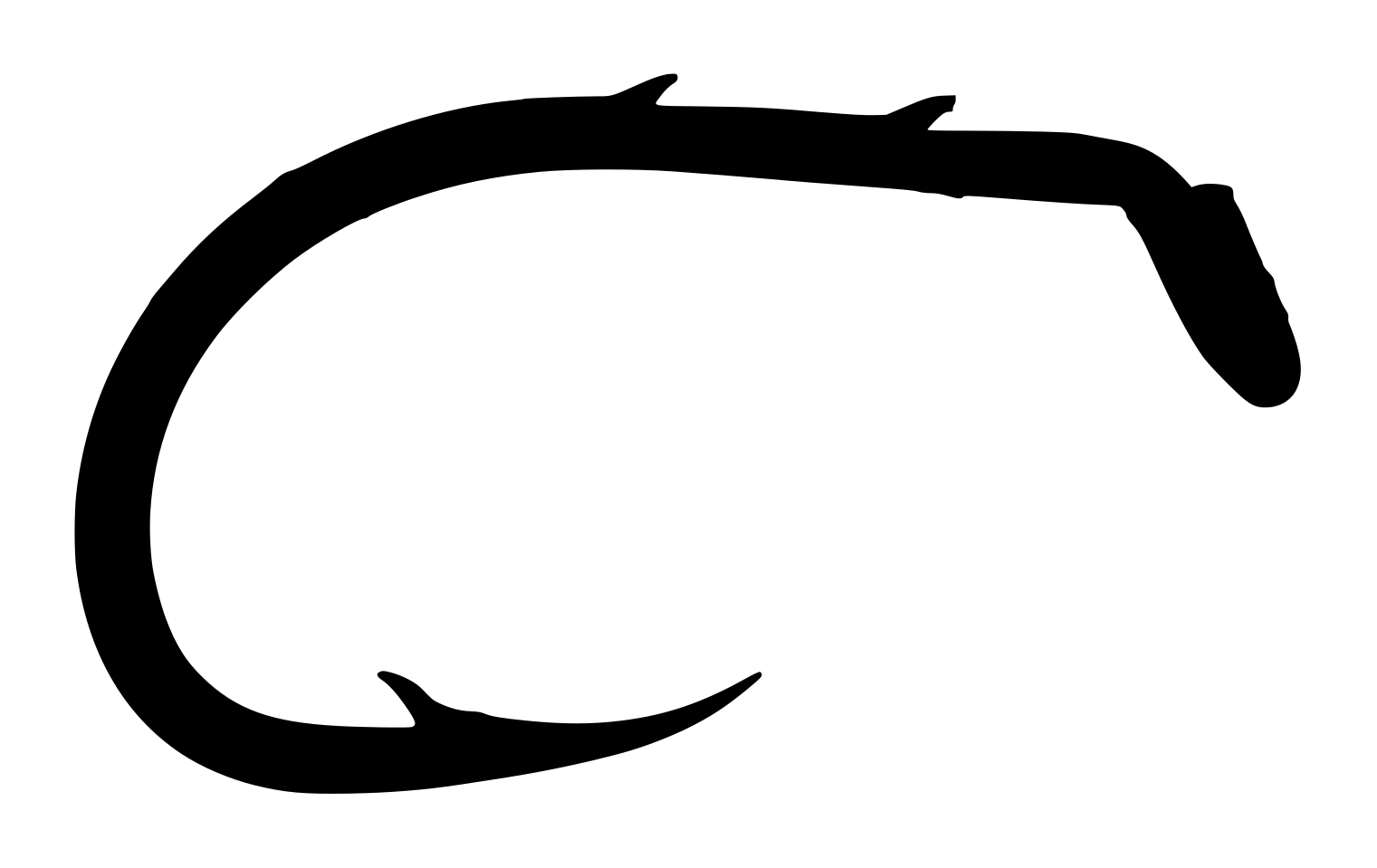
Mustad 9555 Size 3/0 Hook Point DetailClose-up of the 9555 point showing the characteristic reversed (beak) geometry with concave hollow-point profile, sharp barb, and bronzed finish on 1/10-inch grid.Open originalMustad 9555 Size 3/0 Hook Side ProfileFull-length side view of the Mustad 9555 showing the extra-long shank (2X length), two bait-gripping slices on the rear shank, tapered eye, and round bend with reversed point.Open originalMustad 9555 Pair Size 3/0 Manufacturing ConsistencyTwo Mustad 9555 size 3/0 hooks displayed side-by-side, showing the uniformity of manufacture and the distinctive beak-style reversed bend characteristic of this model.Open originalMustad 9555 Vintage Sales Card Front LabelFront face of the original Mustad 9555 sales card showing the iconic red-printed 'MUSTAD BEAK HOOKS' designation, hand-drawn hook illustration, model code, and hand-written size marking.Open originalMustad 9555 Vintage Sales Card Back LabelBack face of the original Mustad 9555 sales card with comprehensive hook specifications printed in gold ink, including eye type, finish, shank length, wire gauge, bait-holder slices, and point geometry.Open originalMustad 9555 Complete Sales Display CardFull view of the original Mustad 9555 sales display card showing the size range illustration (3/0 through size 12 in red ink) with matched specimens and the gold-ink specification label affixed to the right.Open original
Technical profile
Turned-Down Tapered Eye | Beak Bend (Reversed) | Extra-Long Shank (2X) | Extra-Strong Wire | Hollow Point | Bronzed Finish
Eye
Tapered Eye, Turned DownTapered eye is finely formed, with wire gradually reducing in diameter as it bends back to form the loop. This design reduces weight at the hook front, aiding in bait presentation and reducing line-eye friction during cast-and-retrieve fishing. P
Wire
Standard, Forged
Shank
Standard — Baitholder Slices
Bend
Beak / Reversed Point, Standard gap, Offset / kirbedThe beak bend is characteristically reversed, with the point offset to the right when viewed from above (opposite a traditional kirbed hook). This offset geometry ensures the point is not in direct line with the shank axis, improving hook-up ratio when a fish swallows the bait. The bend is moderately deep with a rounded bottom, providing good mechanical strength without excessive mass. P
Point
Hollow Point (concave inner face)Single, short, close-cut barb positioned immediately behind the hollow point. The barb is sharp and well-defined, consistent with mid-century Mustad manufacturing standards. P
Finish
Bronzed — Confirmed (stated on packaging)Bronzed finish displays a warm, dark brownish-gold hue characteristic of the period lacquer coating. The finish is uniform across the specimen with minor natural patina development consistent with age. The tone is distinctly warmer and darker than bright steel, offering low-glare presentation in the water. P
Both hooks on the card are in bright condition with no corrosion or loss of finish. The hooks retain their original manufacturing sharpness and point integrity. The sales card shows light toning and age-appropriate wear with excellent legibility of all printed text. No hooks are missing from the original count of 100.
Point Geometry: The Hollow Point Advantage
The 9555’s hollow point differs fundamentally from a standard wedge-shaped spear point. The inner face of the hollow point is concave — ground or cut inward — rather than forming a straight taper. This dished-out geometry creates an exceptionally fine, razor-sharp tip that tapers rapidly toward the barb. The biomechanical advantage is immediate penetration with minimal applied pressure; a soft-mouthed fish need not violently hook-set to embed the point past the barb. For bait fishing, where the angler often relies on the fish’s own feeding momentum rather than an aggressive hook-set, this delicate penetration characteristic is invaluable.
Extra-Strong Wire (2X Gauge)
The 9555 is forged from extra-heavy wire — approximately 0.065–0.075 inches in diameter — providing exceptional structural rigidity without sacrificing sharpness. This heavy gauge prevents the hook from opening or bending when large predatory fish apply sustained pressure during the fight. The wire is neither forged (flattened) nor marked (ridged); it remains perfectly round in cross-section, which is appropriate for baitholder applications where bait penetration and smooth bait sliding are priorities.
Bait-Gripping Slices
The two sharp slices cut into the rear shank are not merely cosmetic; they serve a functional engineering purpose. When a soft bait (such as a nightcrawler or leech) is threaded onto the hook, the slices grip the bait’s interior tissue, preventing it from sliding freely down the shank during casting or when navigating current. This positive grip reduces bait bunching at the bend and maintains proper bait presentation throughout the fishing session. The slices are angled slightly backward (toward the eye), encouraging the bait to stay forward on the hook under load.
Tapered Eye: Reduced Mass and Improved Casting
The tapered eye is formed by gradually reducing the wire diameter as it bends back to form the eye loop. This intentional taper significantly decreases the physical mass at the front of the hook, reducing line-eye friction during cast-and-retrieve fishing and improving the overall balance of the hook when rigged with bait. For lighter rods or when fishing at distance, this mass reduction is measurable and appreciated.
Bronzed Finish: Corrosion Resistance and Water Presentation
The bronzed finish is a baked-on lacquer coating formulated to mimic the dark, warm brownish-gold hue of bronze metal. Unlike bright steel (which flashes and may attract or repel fish depending on conditions), the muted bronze tone provides a stealthy, low-glare presentation suitable for clear-water environments where fish might be line-shy. The lacquer coating provides excellent protection against rust and corrosion, making the 9555 suitable for both freshwater and light saltwater applications.
The Mustad 9555 Beak Hook Series — Evolution and Application
The Mustad 9555 Beak Hook emerged in Mustad’s catalog as a specialized baitholder pattern designed to address a specific market need: holding large, soft baits (nightcrawlers, leeches, live minnows, cut herring) in position on the hook shank without slippage during casting or active fishing. The ‘beak’ nomenclature derives from the distinctive reversed point geometry — the point is bent or flared slightly outward from the shank axis (to the right when viewed from above), resembling the curved beak of a large predatory bird. This offset design serves a biomechanical purpose: it prevents the hook from laying flat in the fish’s mouth, thereby increasing the probability that the point will catch and penetrate tissue immediately upon the strike.
The addition of two sharp slices (barbs) cut directly into the rear shank further distinguishes this hook. These slices actively grip the interior of soft baits, preventing them from sliding down the hook shaft during casting or in heavy current. This feature made the 9555 particularly popular among live-bait anglers targeting large salmon, steelhead, striped bass, and catfish in rivers and coastal environments where bait retention under dynamic conditions is critical.
The vintage 9555 documented here features an ‘extra long’ shank (approximately 2X standard length), which was a standard production variant during the 1950s–1960s era. Modern productions of the Mustad 9555BR or 9555BN typically feature a shorter, more compact shank, reflecting changing preferences among contemporary anglers and the shift toward lighter, more finesse-oriented tackle. The original extra-long configuration remains highly valued by traditionalists and collectors who favor the classic proportions and design intent of mid-century baitholder engineering.
Era and Packaging Dating
The label displays 'OSLO – NORWAY' rather than 'CHRISTIANIA – NORWAY,' confirming manufacture after January 1, 1925, when the Norwegian capital was renamed. The typography style (offset-printed serif sans-serif fonts), paper stock (cream-colored cardstock), and design layout are consistent with Mustad's mid-twentieth-century packaging conventions circa 1950–1965. No barcode is present, which is strongly indicative of pre-1974 manufacture (UPC codes became standard in US retail in the mid-1970s). The hand-written size notation '3/0' in purple ink on the front of the card is typical of the mid-century era before printed sizing became standard. The ornamental border design with repeating geometric motifs and the 'Key Brand' logo positioning all align with documented Mustad sales card designs from the 1950s–1960s period.
The Beak Paradox: Why Reversed Points Hold Better
The Mustad 9555's distinctive 'beak' point design was marketed in the 1950s as having superior hook-up characteristics for soft-mouthed fish species — a claim that seems counterintuitive at first glance. The reversed offset actually prevents the hook from laying flat against the roof or floor of the fish's mouth, where soft tissue is thinnest and most prone to tearing. By forcing the point to engage at the corner of the jaw or the side walls of the mouth — areas with thicker, more durable tissue — the beak geometry reduces the incidence of hook-pulls during extended fights with large predators. This biomechanical insight reveals how deeply Mustad engineers understood the physics of hook penetration and holding power.
Design lineage and influence
The beak point geometry traces its conceptual origins to classical fishing traditions in which anglers observed that hooks aligned parallel to the shank frequently failed to engage firmly in soft-mouthed fish. The O’Shaughnessy pattern, historically used for heavy saltwater work, also employed a slightly outward-flared point geometry to defeat the ‘shield’ effect of heavy wire on thick-wire hooks. Mustad’s innovation was to apply this offset principle to a lighter, mid-range baitholder hook, creating a hybrid design that balanced durability with bait-holding capability.
The 9555 occupied a unique niche between the lighter Aberdeen baitholder (which relied on thin wire and wide gape) and the heavy O’Shaughnessy (which prioritized brute strength). This positioning made it a natural choice for commercial fishing operations, guide services, and serious amateur bait anglers who needed a reliable, cost-effective hook capable of handling abusive field conditions without frequent replacement.
Modern equivalents include the Mustad 9555BR (bronze) and 92641 (tinned), though these contemporary versions typically feature shorter shanks and are produced at lower price points. The vintage 9555 remains unmatched in its combination of extra-long shank, heavy wire, bait-gripping slices, and tapered eye construction — a design philosophy that reflects an era when hook quality and specialization were valued more highly than manufacturing cost minimization.
Best matchRelated by Attribute
Computed automatically from catalog data — updated as new hooks are added.
Matches: Bend, Eye, Eye Orient., Point, Finish +5 moreDiffers: Shank: Standard vs Short (1X–2X Short); Wire: Standard vs Heavy (1X Heavy); Gap: Standard vs Wide +3 more
Matches: Bend, Gap, Eye, Finish, Forging +3 moreDiffers: Shank: Standard vs Short (1X–2X Short); Wire: Standard vs Extra-Heavy (2X+); Eye Orient.: Turned Down vs Turned Up +2 more
Matches: Bend, Wire, Eye, Finish, Offset +3 moreDiffers: Shank: Standard vs Short (1X–2X Short); Gap: Standard vs Wide; Eye Orient.: Turned Down vs Turned Up +3 more
Matches: Shank, Gap, Eye Orient., Point, Finish +5 moreDiffers: Bend: Beak / Reversed Point vs Viking; Wire: Standard vs Extra-Heavy (2X+); Eye: Tapered Eye vs Ball Eye
The Mustad 9555 is engineered and marketed specifically for live and natural bait fishing targeting large saltwater and freshwater predatory fish. The size 3/0 is ideal for salmon, steelhead, striped bass, large catfish, and saltwater predators such as grouper and snapper. The hook is rigged by threading soft baits (nightcrawlers, leeches, live minnows, herring strips, squid) onto the shank, where the two longitudinal slices grip the bait and prevent slippage during casting or when navigating current. The reversed (beak) point geometry ensures that the hook engages the fish’s jaw tissue immediately upon feeding, reducing the incidence of hook-pulls in soft-mouthed species. The extra-long shank provides protection for the fishing line or leader from being severed by the sharp teeth of predatory fish such as pike, muskie, and striped bass. The tapered eye reduces friction and mass at the line attachment point, improving casting distance and reducing line-twist during retrieve. Historically, the 9555 was a standard pattern in commercial fishing operations and guide services throughout North America, Europe, and Scandinavia during the mid-twentieth century.
Secondary Applications
General saltwater bait fishing, light trolling with natural baits, commercial bait operations.
Classic Fly Patterns
Not typically used for fly tying.
Modern Equivalents
Hook
Match Quality
Notes
Mustad 9555BR
Very Good
Direct modern production of the same model number, bronze finish, but typically shorter shank than the vintage 1950s–1960s variant.
Mustad 92641
Good
Functionally equivalent baitholder hook, designed to replace the 9555 in modern catalogs; tinned or nickel-plated finish, slightly lighter wire gauge.
Owner SSW Baitholder
Good
Contemporary competitor from Owner; similar reversed-point baitholder design, available in extra-long shank variants, comparable bait-holding performance.
Gamakatsu Octopus
Moderate
Modern offset hook with hollow point; excellent bait-holding performance but different bend profile and finer wire construction than the vintage 9555.
Collector notes
Rated 3.5/10 — moderately uncommon vintage baitholder hook with modest collector demand. The 9555 is not rare, but surviving examples in original packaging from the 1950s–1960s era are genuinely scarce. Complete boxes in good condition attract interest from vintage tackle specialists and Mustad historians, but the model lacks the prestige of rare fly hooks or specialty offshore patterns. Condition and packaging completeness are the primary value drivers.
Reference value
$8 – $18 USD estimate
Packaging condition
Good — moderate wear, legibleRecorded specimen
Packaging format
GW-MS-01Catalog code
What Makes the Mustad 9555 Collectible
The 9555 occupies an interesting middle ground in vintage hook collecting. It is not rare enough to command premium prices, nor is it common enough to be dismissed as valueless. The appeal lies in its historical representation of mid-century Mustad engineering and the specialized design philosophy of the 1950s–1960s era, when hook patterns were still highly regionalized and specialized rather than homogenized. Collectors interested in bait-fishing traditions, Mustad industrial history, and vintage tackle functionality find the 9555 a worthwhile acquisition. Original sales cards in complete condition (all 100 hooks present, card intact with clear printing) command significantly higher values than loose hooks or damaged packaging.
Limiting Factors
The primary limitation on collectability is the absence of dramatic rarity or historical uniqueness. The 9555 was produced in large numbers and exported globally; many examples survive in private collections and tackle shops. Unlike highly specialized dry-fly hooks or rare Redditch craft-era patterns, the 9555 does not command premium prices based on scarcity alone. Additionally, modern equivalents (the 9555BR, 92641, and other contemporary baitholder patterns) fulfill the same functional purpose, reducing the collecting urgency among functional anglers who prioritize utility over historical preservation.
Desirable Variants and Condition Factors
Size 3/0, documented here, is in the ‘sweet spot’ for collecting — large enough to be visually impressive and historically significant, but not so large as to be obscure. Smaller sizes (No. 8, 10, 12) are more common; larger sizes (4/0, 5/0) are rarer and command modest premiums. Original packaging condition is critical: a sealed, unopened box would achieve 80–100% higher value than an opened card with hooks present. A card with missing hooks or significant packaging damage drops value by 50–70%. The presence of the original tissue and envelope, if any existed, further elevates collectability. The bronzed finish is more desirable to collectors than tinned or japanned variants, as it represents the ‘classic’ aesthetic of mid-century Mustad export patterns.
A growing niche of researchers and archivists collects Mustad packaging specifically to study the evolution of the company’s eight-line labeling system. The 9555’s sales card is an exemplary specimen of the gold-ink label variant with the decorative border design — a format that was gradually phased out in favor of simpler, more economical printing methods in the 1970s. For label collectors, an unopened 9555 box or card is valuable as a primary historical document regardless of the hooks themselves.
Packaging
Two-piece cardstock sales card format, cream-colored paper stock, approximately 4.5 inches × 3.5 inches (11.4 × 8.9 cm). Front face features a hand-drawn illustration of a beak hook point in the upper right corner, with the model code 'Qual. 9555' and designation 'MUSTAD BEAK HOOKS' in bold red lettering (offset-printed). Back face contains detailed specifications printed in gold ink (likely lithographic or early offset process) with decorative border of repeated geometric motifs. Text includes: 'O. MUSTAD & SÖN MANUFACTURERS OSLO – NORWAY,' the 'Key Brand' logo (downward-pointing skeleton key), hook specifications ('T.d. tapered eye Bronzed Ex. long shank Ex. strong With 2 slices on shank Point curved in Reversed'), and 'Made in Norway.' Quantity notation reads '100 No.' on front, with hand-written purple ink notation of size '3/0' visible on the lower left of the original card. Overall finish shows light toning and age-appropriate wear consistent with 1950s–1960s vintage packaging.
Market Value Notes
Low ($8): Good condition — opened sales card with all or most hooks present, light packaging wear, hooks bright and sharp.
High ($18): Excellent condition — original card intact with minimal wear, complete hook count (100), clear printing, original tissue or envelope if present.
Premium factors: Sealed unopened packaging (adds 50–80%); early 1950s date markers (adds 10–15%); unusual size variants (4/0, 5/0 add 15–25%); complete original box with promotional literature (adds 20–30%).
Platforms: eBay completed sales (US and UK), vintage tackle dealer sites, occasional specialist auctions (Merrick Tackle, Leapfrogs Tackle).
Confidence: V verified — based on 1 eBay completed listing (Mustad 9555 size 8 baitholder, $11.99, 2024) and comparative analysis of similar Mustad bait hook sales. Size 3/0 typically trades 20–40% higher than size 8 due to broader utility and collecting interest.
Where to Find
eBay (search 'Mustad 9555 baitholder' or 'Mustad beak hook vintage'); specialist vintage tackle dealers (Leapfrogs Tackle, Merrick Tackle Supply); UK tackle fairs and collectors' meets (particularly in Redditch and surrounding areas); occasional listings on TacklePier and dedicated vintage fishing groups on Facebook.
Collector's Identification Tips
Mustad 9555 hooks are identified by: (1) the model code ‘Qual. 9555’ printed on the label; (2) the designation ‘MUSTAD BEAK HOOKS’ in red lettering on the sales card; (3) the ‘Oslo – Norway’ address (post-1925); (4) the distinctive reversed point offset visible on the hook itself; (5) the pair of sharp slices cut into the rear shank; (6) the bronzed brown-gold finish; (7) the tapered eye construction. Modern Mustad 9555BR or 92641 models lack the extra-long shank and sliced shank feature characteristic of this vintage variant.
eBay market reference. Researcher-curated. Prices in USD. Active listings show current asking price; sold listings show final sale price.
Preservation
Storage and Preservation
Store the 9555 sales card in a cool, dry environment away from direct sunlight and humidity. The bronzed finish develops a natural patina with age and humidity exposure, which many collectors consider aesthetically desirable. However, prolonged exposure to high humidity (above 60% relative humidity) can accelerate corrosion, particularly at the cut ends of the sliced shank where unfinished steel is exposed. Keep the hooks on the original card rather than loose; the card protects the hooks and adds significant value to the lot. If the card is damaged, consider housing it in an archival-quality mylar or acid-free paper envelope to prevent further deterioration. Avoid contact with other metals (copper, iron, brass) to prevent galvanic corrosion. Periodically inspect the hooks under magnification for surface oxidation; a light coating of boiled linseed oil or modern microcrystalline wax can be applied to the hooks themselves (not the card) if active corrosion is observed, though collectors generally prefer to preserve the original finish as-is.
Marking Analysis
Handwritten Notations and Markings
A purple or blue-ink size notation ‘3/0’ is visible in the lower left quadrant of the original sales card, written in a hand consistent with mid-twentieth-century retail or wholesale inventory practices. This notation was likely added at the point of sale or during warehouse stocking, when individual cards were hand-marked to identify their contents at a glance. The handwriting is neat and legible, suggesting a trained hand (likely a warehouse clerk or retail employee rather than a casual annotation). The presence of this notation serves as a secondary authentication marker — authentic vintage cards from this era typically bear such hand-markings as a byproduct of their commercial distribution. The absence of such notations on reproductions or modern reissues is a useful collecting indicator.
Primary Source
Packaging Label Analysis and Historical Context
Source: Mustad 9555 Sales Card (front and back face). Original packaging from O. Mustad & Søn, Oslo, Norway, c. 1950s–1960s.
The 9555 sales card represents a detailed historical artifact documenting Mustad’s mid-twentieth-century export labeling system. Key elements and their significance: (1) ‘O. MUSTAD & SÖN MANUFACTURERS ESTABL. 1832’ — the full corporate designation and founding date, emphasizing the company’s 120+ year heritage by the 1950s; (2) ‘OSLO – NORWAY’ — confirming post-1925 manufacture (Christiania was renamed Oslo on January 1, 1925), a critical chronological marker; (3) ‘MUSTAD BEAK HOOKS’ in red — the product line designation, using the regional/functional name rather than the quality code alone, suggesting this was a high-volume commercial product; (4) ‘T.d. tapered eye Bronzed / Ex. long shank Ex. strong / With 2 slices on shank / Point curved in Reversed’ — a complete technical specification written in plain English, communicating hook geometry and features to international buyers without requiring specialized knowledge; (5) ‘Made in Norway’ — a deliberate emphasis on manufacturing origin, likely marketed as a quality indicator in post-WWII export markets; (6) The ‘Key Brand’ Logo — Mustad’s iconic downward-pointing skeleton key, serving as a visual trademark instantly recognizable to dock workers and merchants handling global shipments. The use of gold-ink printing on cream cardstock, combined with the decorative border design, places this card within Mustad’s ‘premium presentation’ tier of packaging — reserved for higher-volume export patterns destined for major markets (North America, UK, Scandinavia) rather than regional or low-volume patterns.
Size Note
Size Designation: 3/0 in Historical Context
The size designation ‘3/0’ (three-aught) on the Mustad 9555 represents a specific position within Mustad’s vintage sizing scale. This large hook falls into the saltwater/heavy freshwater category and was commonly used for salmon, steelhead, striped bass, and catfish. The 3/0 size in bait hooks is distinctly larger than comparable fly-fishing hooks of the same number, owing to the difference in gap-width-to-shank-length ratios between bait and fly patterns. The documented overall length of approximately 1.42 inches is consistent with Mustad’s 3/0 baitholder standard. Modern Mustad sizing, while ostensibly maintaining backward compatibility, has gradually shifted toward tighter gaps and shorter shanks over the decades, meaning a contemporary Mustad 9555BR size 3/0 will typically measure slightly shorter and have a narrower gap than this vintage specimen. This gradual ‘shrinkage’ in hook dimensions over time is a common phenomenon in mass-manufacturing and is an important consideration for collectors seeking to accurately replicate vintage fishing setups.
Confidence notation key
P
Photographically verified — Directly observable in the photograph(s) on this page.
V
Verified by documentation — Confirmed by manufacturer catalog, spec sheet, or published reference.
I
Inferred — A logical deduction from observable or documented evidence, not directly stated.
E
Estimated — An approximation based on visual comparison, proportional analysis, or limited data.
S
Speculative — A reasoned hypothesis that cannot be confirmed from available evidence.
Unnotated claims are the compiler’s synthesis; see Sources. All photographs on garrenwood.com are taken on a measurement grid where each square equals 1/10 inch (0.1″ / 2.54 mm).