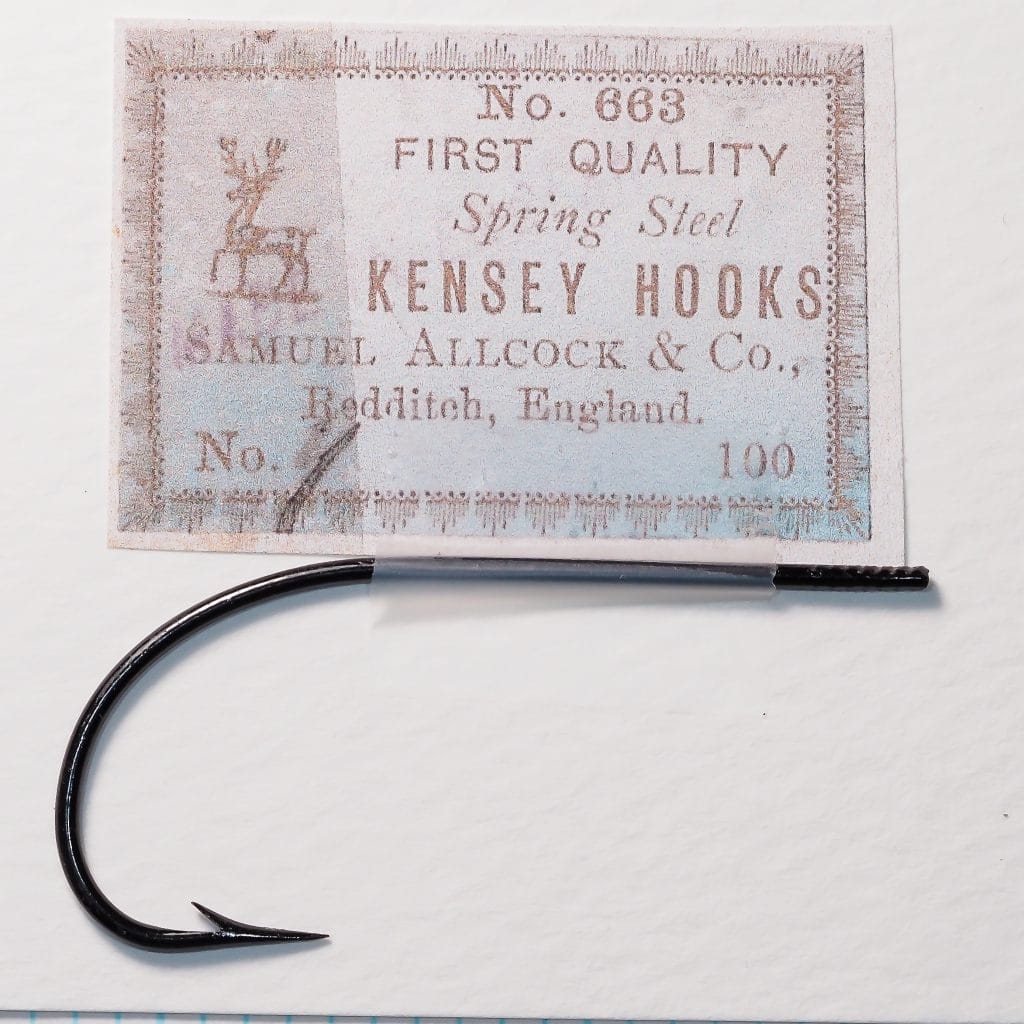
Samuel Allcock & Co.’s Kensey No. 663 is a classical mid-20th century salmon and sea trout hook embodying the Redditch blind-eye tradition. Manufactured in Redditch, England, between approximately 1945 and 1965, this hook features a tapered blind eye designed for gut-loop attachment, a symmetrical Sproat bend, and a superior point geometry optimized for traditional wet fly construction. The japanned (black glossy lacquer) finish was typical of the era, providing corrosion resistance while reducing light reflection in the water.
The defining feature is the tapered blind eye—the shank tapers smoothly to a rounded point with no flattening—a construction method now rare in modern hooks but fundamental to British salmon fly tradition. The hook was sold in bulk cards of 100, suggesting use by professional fly tyers and fishing lodge suppliers. The complete original packaging with legible Allcock imprint, ‘First Quality’ designation, and handwritten size marking provides strong era evidence and appeals to specialist collectors of Redditch tackle.
The Kensey represents a transitional moment in hook history: the end of the blind-eye era and the gut-line tradition in English salmon fishing. By the 1970s, looped-eye and ball-eye designs had displaced this pattern as nylon lines and modern fly materials became standard. Today, surviving Kensey cards are uncommon rather than rare, with modest but genuine collector demand among Redditch specialists, salmon fly historians, and traditional fly tyers who value the historical authenticity and functional elegance of the blind-eye construction.
Original Allcock Kensey No. 663 card with letterpress-printed text, decorative stag logo, and quantity marking '100'. Single japanned hook mounted on fine-division measurement grid (0.1-inch squares) for scale documentation.
Photographic record
2 cataloged imagesSelect any record to load it above.
2 images shown
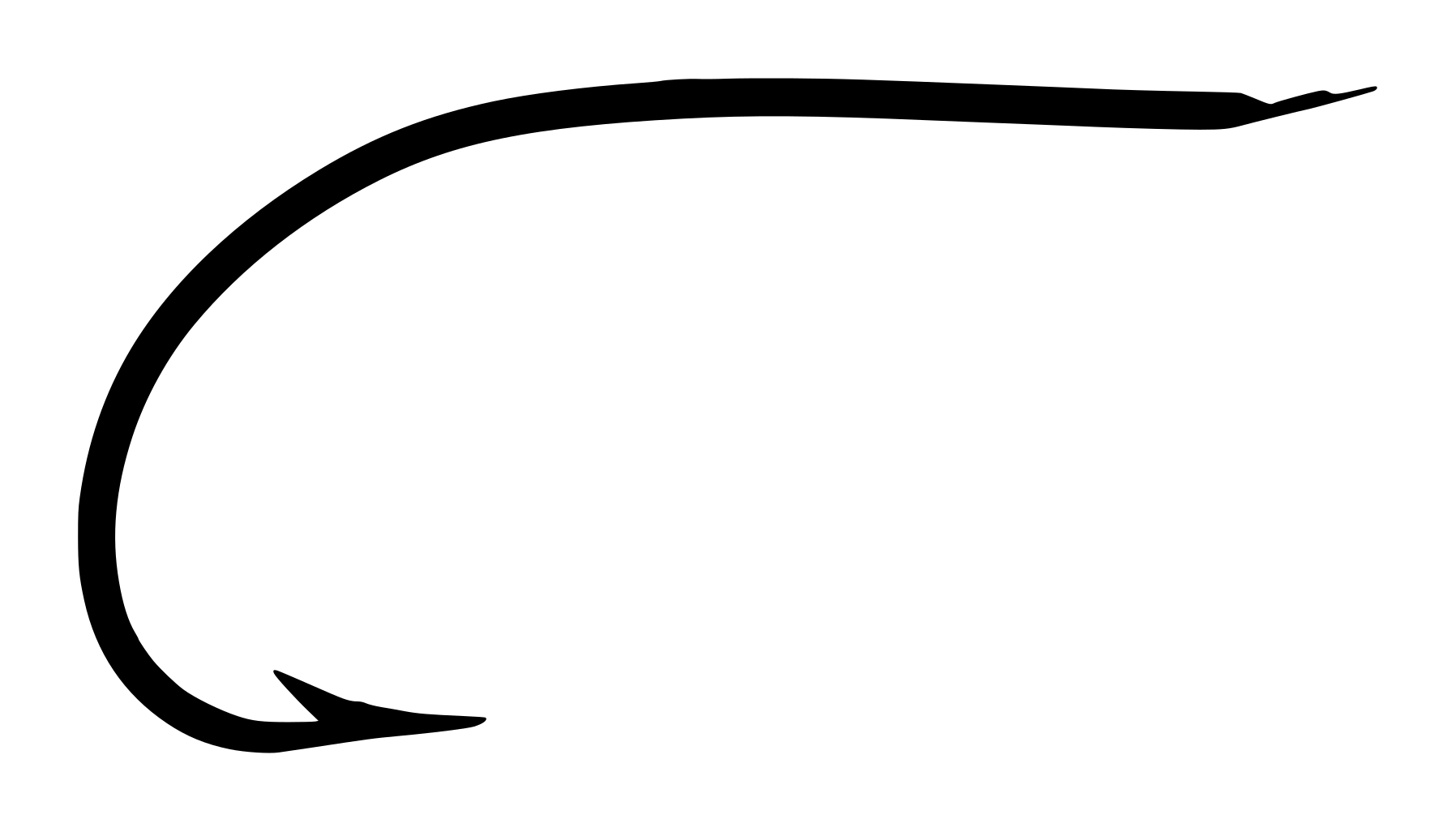
Allcock Kensey 663 Original Packaging and Hook on Measurement GridOriginal Allcock Kensey No. 663 card with letterpress-printed text, decorative stag logo, and quantity marking '100'. Single japanned hook mounted on fine-division measurement grid (0.1-inch squares) for scale documentation.Open originalAllcock Kensey 663 Hook Detail — Point and Eye ConstructionClose-up profile view of the Kensey No. 663 showing the tapered blind eye (rounded smooth taper with no flattening) and superior point geometry (near-straight inner taper). Glossy black japanned finish and round Sproat bend visible.Open original
Technical profile
Allcock Kensey No. 663 — Spring Steel — Japanned Finish — Tapered Blind Eye — Sproat Bend — Standard Shank — 100 per Card
Eye
Blind — Marked ShankTapered blind eye with smooth rounded taper from shank to point; no flattening or spade construction. Gut attachment via loop around taper — classical salmon/sea trout method P.
Wire
Fine (1X Fine), Round
Shank
1X Long — Plain
Bend
Wide gapSymmetrical rounded-bottom bend with gentle, even curvature throughout the arc P.
Point
Hollow Point (concave inner face)Short, close-cut barb positioned slightly aft of the point taper; minimal barb angle, functional rather than pronounced P.
Finish
Black Japanned — Inferred (photographically likely)Glossy black lacquer coating with excellent reflectivity in highlights. Opaque black throughout—steel texture fully obscured by coating. Finish uniform and well-adhered to wire P.
The superior point geometry on the Kensey reflects a deliberate design choice for traditional fly applications. Unlike hollow points (with pronounced inward curvature), the superior point features a near-straight inner taper from barb to tip, offering a finer, more needle-like penetration geometry. This design was preferred for delicate fly-dressing where the hook needed to penetrate cleanly without crushing the fly body on the barb. The round wire profile, rather than forged wire, distributes stress more uniformly around the bend and reduces the likelihood of cracking under the irregular loading of large salmon and sea trout. The Sproat bend with its rounded bottom provides excellent hooking geometry while maintaining symmetry—important for wet fly presentation where the hook must settle naturally in the water without rolling or twist. The tapered blind eye was a fundamental feature of Redditch tradition: the shank tapers smoothly to a point with no flattening, and the fishing line (originally gut, later nylon) is attached via a small loop tied around this taper using several wraps of silk thread. This construction reduced stress concentration compared to flatted or spade-end eyes, which create a sharp mechanical discontinuity. The japanned finish (black glossy lacquer) provided corrosion resistance in the damp tackle boxes and river-side conditions typical of British salmon fishing, while the opaque black color reduced light reflection that might spook fish in clear water.
Size & scale lab
Physical specimen Catalog record
Selected size
1/0
Physical specimen
Overall Length
52.4 mm
Shank Length
40.4 mm
Gap Width
19.9 mm
Wire Diameter
1.45 mm
Weight
1g
Confidence
P
Physical specimen
Physical measurement with calipers
Selected size
(unspecified)
Physical specimen
Overall Length
41.3 mmE
Shank Length
36.9 mmE
Gap Width
15.2 mmE
Bend Depth
12.7 mmE
Wire Diameter
2.2 mmE
Shank-to-Gap Ratio
~2.3-2.6 : 1
Confidence
P
Physical specimen
Grid-derived from photograph (1/10" grid)
Own this hook? Help us measure it.
We have measurement for size 1/0. Know any others? Submit calipered measurements and we'll review and add them. Thank you!
The Kensey pattern represents a mid-20th century blind-eye design from Allcock’s fishing hook catalog. The name ‘Kensey’ appears in early 20th century American fishing literature (circa 1903) as one of numerous established English hook patterns imported into North America. In the Allcock catalog system, the Kensey occupied a position between lighter sea trout patterns and heavier salmon flies. The No. 663 designation suggests a specific sub-variant within the Kensey line, likely differentiated by wire gauge, finish, or eye construction from companion models (e.g., No. 662, No. 665). The tapered blind eye was characteristic of Redditch-tradition salmon and sea trout hooks from the 1920s through the 1970s, designed specifically for gut-loop attachment using silk wrapping. The Kensey was produced continuously during the mid-20th century but was eventually superseded by modern looped-eye and ball-eye designs as nylon fishing lines and synthetic fly-tying materials gained dominance after the 1960s. No evidence of post-1970s production has been documented; the model appears to have been discontinued as part of Allcock’s broader transition to modern eye types and mass-production methods.
Era and Packaging Dating
Packaging style, typography, letterpress printing, handwritten size notation and card construction are consistent with mid-20th century Allcock production. The evidence supports a broad estimate of approximately 1935-1965 but does not justify a narrower post-war date solely from the surviving packaging.
Design lineage and influence
Best matchRelated by Attribute
Computed automatically from catalog data — updated as new hooks are added.
Matches: Gap, Eye Orient., Point, Finish, Forging +3 moreDiffers: Shank: 1X Long vs Short (1X–2X Short); Wire: Fine (1X Fine) vs Extra-Fine; Eye: Blind — Marked Shank vs Blind — Flatted +4 more
Matches: Shank, Eye, Eye Orient., Point, Finish +4 moreDiffers: Bend: Other vs Sproat; Wire: Fine (1X Fine) vs Extra-Fine; Gap: Wide vs Standard +4 more
The Allcock Kensey No. 663 was designed as a blind-eye salmon and sea trout hook, typical of the Redditch tradition of salmon fly dressing. The tapered blind eye with gut-loop attachment was the classical method for tying traditional wet flies on the River Severn and Scottish rivers during the mid-20th century. The superior point geometry and standard wire weight made this pattern suitable for both small summer sea trout (sizes 12–14) and larger salmon flies (sizes 2–6). The japanned finish protected the hook from corrosion in the damper atmosphere of traditional tackle boxes, while the round Sproat bend offered a balance between hooking geometry and fly-body accommodation.
Classic Fly Patterns
Traditional salmon flies, sea trout wet flies, particularly those tied on the Redditch pattern system using silk and gut
Modern Equivalents
Hook
Match Quality
Notes
Partridge SH-1 Blind Eye
Excellent
Modern reissue of traditional Redditch blind-eye construction; tapered eye, similar wire gauge, Sproat-type bend
Tiemco TMC 2499 Spider
Good
Not a close geometric equivalent. Consider replacing with a traditional blind-eye salmon hook such as a Partridge or Alec Jackson blind-eye pattern.
Daiichi 1530 Salmon
Moderate
Contemporary salmon hook with conventional eye; different construction philosophy but similar functional role
Collector notes
Rated 4.5/10 — Allcock Kensey hooks are uncommon in complete original packaging, but the model was produced in volume across multiple decades. Collector demand is modest but real among Redditch specialist fly tyers and salmon fishing historians. The blind-eye tapered construction and japanned finish are significant period markers. Complete cards with legible packaging are moderately scarce; loose hooks or damaged packaging reduce value substantially.
Reference value
$12 – $32 USD estimate
Packaging condition
Good — moderate wear, legibleRecorded specimen
Packaging format
ACF-Card-663-100Catalog code
Positive factors: Original Allcock packaging from the Redditch tradition carries inherent appeal to specialists. The tapered blind eye is a historically significant construction method, now uncommon in modern hooks. Complete original card with 100 hooks demonstrates period production methods. Japanned finish is authentic and period-correct. The ‘First Quality’ and ‘Spring Steel’ designations reflect mid-20th century quality assurance language.
Limiting factors: Allcock produced these hooks in substantial volume over several decades; surviving cards are not exceptionally rare. Size designation is handwritten and partially legible, reducing documentation precision. No designer attribution or named collaborator appears on packaging. The round Sproat bend and superior point are functional but not aesthetically distinctive compared to contemporary patterns from competing makers.
Most desirable variants: Complete, sealed or near-sealed cards with legible size markings. Smaller sizes (12–16) are genuinely scarce compared to larger salmon sizes (2–6). Cards with minimal toning and intact printed text command premium. Cards retaining original tissue wrapping add significant premium.
Condition impact: Missing hooks reduce value proportionally (each hook ~$0.50–$1.00 in context). Packaging staining, ink fading, or structural damage deduct 25–40% from value. Loose hooks without card context sell at 20–30% of carded value.
Packaging
Printed card stock with decorative stag logo. Kraft paper cardstock with letterpress-printed text in reddish-brown ink. Text includes model number 'NO. 663', quality designation 'FIRST QUALITY', material specification 'Spring Steel', hook name 'KENSEY HOOKS', manufacturer imprint 'SAMUEL ALLCOCK & CO., Redditch, England', and quantity marking '100'. Handwritten size designation in ink below 'No. /' on the card. Card shows moderate aging toning and minor creasing consistent with age. Decorative stag head vignette in upper left quadrant. Fine printed border lines top and bottom. Vintage measurement grid attached below card for photographic documentation.
Market Value Notes
Low ($12): Good condition — opened card, 90+ hooks present, packaging with moderate wear and toning, size legible
High ($32): Excellent condition — sealed or near-sealed card, full count of 100 hooks, minimal packaging wear, size marking crisp
Premium factors: Original tissue or envelope intact, sealed card, size 12–16 (rarer than larger sizes), complete count, Redditch specialist provenance
Platforms: eBay UK (historical sales), specialist tackle dealers, fly-tying forums; occasional appearance at UK fishing tackle auctions
Confidence: E estimated — limited comparable sales data; based on typical Allcock card pricing circa 2015–2022 and Redditch specialist collector feedback
Where to Find
eBay UK (search 'Allcock Kensey'), UK-based vintage tackle dealers specializing in Redditch makers, fly-tying specialist retailers in Scotland and northern England, specialist fishing tackle auctions (Bonhams, regional UK auction houses), collector-to-collector sales on vintage tackle forums.
Preservation
Storage and Preservation
The japanned (black lacquer) finish on the Kensey No. 663 is durable but benefits from careful storage. Store the card in a cool, dry environment away from direct sunlight, which can fade the ink on printed text and degrade the lacquer finish over time. Avoid high-humidity environments, which can promote rust beneath the japanned coating if the finish is scratched or worn. The original card stock is acid-free by modern standards but may yellow or become brittle with age; handle the card by its edges rather than the hook area to minimize structural stress.
If the card is kept intact and unopened (or near-sealed), the value premium is substantial — do not remove hooks unnecessarily. If the card is already opened and hooks are loose, consider storing loose hooks in a small vial or envelope with acid-free tissue to prevent inter-hook corrosion from moisture or galvanic reaction. The hooks themselves are not prone to rust if the japanned finish is intact, but any scratch or chip should be monitored. Avoid contact with other ferrous metals, which can cause galvanic corrosion at the contact point.
For display, use UV-filtering acrylic or glass to protect the card from light fading. Maintain relative humidity between 30–50% for optimal preservation. If the original packaging is damaged or severely toned, consider professional archival matting and framing, which will stabilize the card and make it a functional reference display piece while preserving its historical significance.
Marking Analysis
Handwritten Size Marking
The card displays a handwritten size designation beneath the printed ‘No. /’ label in what appears to be period ink (likely fountain pen or dip pen). The handwriting is characteristic of early-to-mid 20th century commercial practice—clean, deliberate strokes without significant flourish, consistent with packaging or warehouse personnel numbering stock. The specific size number is partially legible in the photograph but would benefit from direct physical examination to confirm. Handwritten sizing was standard practice for Allcock and other Redditch makers from the 1920s through the early 1960s, before the adoption of printed size legends on cards and pre-printed packaging runs. This handwritten marking is a positive era indicator and supports the c. 1945–1965 dating range. The variation in handwritten numbers across different cards in surviving collections suggests these cards were individually numbered in the factory or by the distributor, rather than mass-printed, reflecting the semi-custom manufacturing practices of Redditch makers during this period.
The packaging explicitly states ‘FIRST QUALITY’ and ‘Spring Steel,’ both of which are significant period manufacturing claims. ‘First Quality’ was Allcock’s quality assurance designation, implying that this card met strict standards for wire consistency, barb placement, point sharpness, and finish uniformity. This was not a legally defined term but rather a marketing claim reflecting Allcock’s reputation for consistent craftsmanship. Competing manufacturers of the era (Partridge, Milward, Sealey) used similar terminology, and the presence of ‘First Quality’ on the package reflected Redditch tradition of quality control through visual inspection and hand finishing. ‘Spring Steel’ is a material specification indicating that the wire was high-carbon steel suitable for the repetitive stress of fly fishing and large fish encounters. ‘Spring Steel’ was a commonly used descriptor in the 1930s–1960s; it implies a wire that was drawn and tempered to resist permanent deformation and was superior to lower-grade mild steel. By the 1970s, manufacturers shifted to more specific alloy designations or simply ‘High Carbon Steel’ terminology, making ‘Spring Steel’ a reliable era marker. Together, these claims position the Kensey No. 663 as a premium-quality hook intended for serious salmon and sea trout fishers rather than casual bait anglers.
Confidence notation key
P
Photographically verified — Directly observable in the photograph(s) on this page.
V
Verified by documentation — Confirmed by manufacturer catalog, spec sheet, or published reference.
I
Inferred — A logical deduction from observable or documented evidence, not directly stated.
E
Estimated — An approximation based on visual comparison, proportional analysis, or limited data.
S
Speculative — A reasoned hypothesis that cannot be confirmed from available evidence.
Unnotated claims are the compiler’s synthesis; see Sources. All photographs on garrenwood.com are taken on a measurement grid where each square equals 1/10 inch (0.1″ / 2.54 mm).