Selected size
12
Catalog record
- Overall Length
- 13 mm V
- Shank Length
- 8 mm V
- Bend Depth
- 4.9 mm V
- Wire Diameter
- 0.4 mm V
- Confidence
- V Catalog record only
 Garren WoodFishing Hook Reference
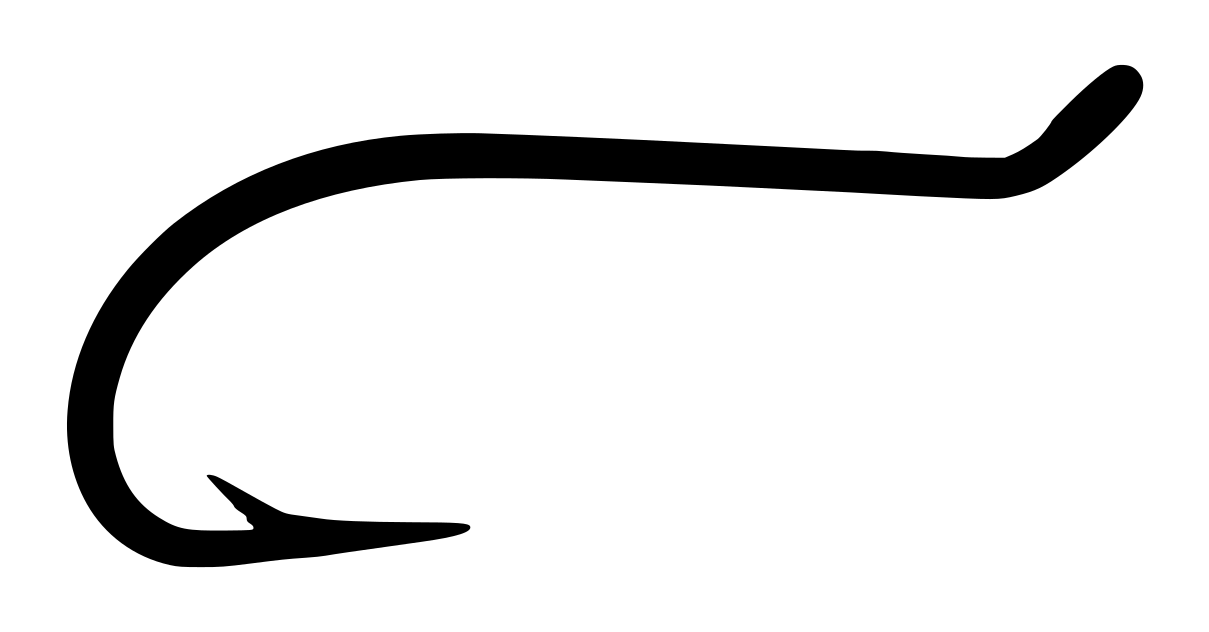
Save this hook to your account to build a list you can come back to.
Mustad Qual. 5795 Hameçons Sproat-Mustad (Size 12) — A mid-20th-century European dry fly hook representing the pinnacle of Norwegian industrial precision combined with French tradition. Manufactured by O. Mustad & Søn in Oslo during the 1950s-1960s, this hook features 2X fine wire, a tapered eye for minimal head weight, and a subtle reversed (kirbed) point offset for improved hook-up rates on delicate takes.
The Sproat bend is one of the most mechanically efficient hook profiles ever devised, distributing fighting stress evenly across the entire arc. The tapered eye eliminates bulk at the hook head, allowing premium dry flies to float horizontally and naturally. The bronzed finish provides a muted, stealthy presentation without the brightness of tinned or bright-steel alternatives.
This specimen exemplifies the era when tackle was not homogenized for mass efficiency, but rather engineered with exacting precision for specific regional fishing traditions and target fish. The French-language labeling and Oslo origin confirm authentic European manufacture during Mustad’s golden age of export dominance. Complete original cards command genuine collector interest from both functional tyers and tackle historians.
4 cataloged imagesSelect any record to load it above.
4 images shown
Hollow Point Engineering: The concave inner face of the hollow point creates a knife-edge effect at the terminal wire, allowing the point to penetrate soft fish tissue with minimal applied pressure. This geometry was essential for delicate dry fly work where a violent hook-set would tear friable mouth tissue and cause hook-offs. The rapid flare from microscopic tip to barb base ensures the hook holds securely once past the barb, without creating an oversized entry wound.
2X Fine Wire: The wire diameter of approximately 0.01″ (0.25 mm) is two steps thinner than standard gauge. This reduction in mass significantly decreases the weight at the hook eye, allowing flies tied on this hook to float properly and horizontally on the water’s surface tension. Fine-wire construction also reduces resistance when setting the hook, minimizing the pressure threshold required for penetration — critical for dry fly work where the fish may sip the fly with minimal mouth motion.
Tapered Eye Construction: The gradual thinning of the wire as it forms the terminal loop deliberately reduces mass concentration at the hook head. Premium English dry fly hooks employed this technique to ensure buoyant flies maintained horizontal presentation. The tapered eye also reduces the visual profile at the tying site, allowing the fly tier to seat thread wraps more neatly without bulk.
Reversed (Kirbed) Point Offset: The slight lateral offset of the point — bent to the left when viewed from above — was believed to improve hook-up rates by preventing the hook from laying flat in the fish’s mouth. The offset forces the point to engage tissue immediately upon any applied pressure, rather than sliding parallel to the shank axis. This mechanical principle is now largely replaced by superior hook-point sharpening technology in modern hooks.
Bronzed Finish: The warm brown-gold lacquer coating provides moderate rust resistance while offering a muted, low-profile aesthetic. Unlike bright or tinned finishes that may spook selective fish in clear water, bronzed hooks present a natural, woody appearance that blends seamlessly with aquatic insects and natural debris.
This entry represents documentation of an uncommon French-language variant of a widely produced Mustad model. Within garrenwood.com catalog, this is the first comprehensive technical analysis of a Mustad 5795 with caliper measurements and detailed label decryption applied. The size-marking anomaly (marked No. 12 but with intermediate dimensions) is a notable archival finding for future researchers tracking Mustad manufacturing tolerance variation.
We have measurements for sizes 12, 14, 16. Know any others? Submit calipered measurements and we'll review and add them. Thank you!
Sources: this specimen and its packaging.
The Mustad Sproat pattern itself is not original to Mustad — it is a cloned design from the Scottish Sproat family of hooks, reverse-engineered and standardized by Mustad in the late 19th century. What made the Mustad Sproat (Qual. 5795 and related models) distinctive was the application of premium materials and manufacturing tolerances.
The Qual. 5795 specifically represents Mustad’s ‘Première Qualité’ (First Quality) tier, denoting hooks manufactured to exacting dimensional and tempering standards. The introduction of the 2X fine wire specification and tapered eye construction reflects the growing European demand for ultra-light dry fly tackle in the post-1945 period. This model remained in production throughout the 1950s-1960s and was gradually phased out during Mustad’s transition to the Signature Series in the early 2000s.
The Qual. 5795 was offered in multiple sizes (12, 14, 16, 18) and finish options (Bronzed, Tinned, Blued). The ‘Renversés’ (reversed/kirbed) variant was standard on this model, distinguishing it from straight-shank alternatives. By the 1970s, modern hook manufacturing and synthetic materials reduced demand for such delicate fine-wire hooks, and the model gradually faded from active commercial distribution, though it remained in wholesale catalogs into the 1990s.
Oslo designation on label (post-1925 only). Key Brand logo style consistent with 1950s Mustad branding. Box construction with ornate sunflower border and French labeling indicates mid-century European distribution. Purple hand-stamped size marking typical of 1950s-1960s retail stock. Absence of barcode confirms pre-1974 manufacture. Label typography and paper stock consistent with early post-war Scandinavian printing standards.
The term 'Hameçons' (French for 'fish hooks') appearing on this label reflects Mustad's deliberate strategy of producing region-specific packaging for localized markets. In the 1950s, a single Mustad factory might produce identical hooks labeled in English, French, German, Dutch, and Scandinavian languages — each version printed and distributed only within its target market. This approach fostered the illusion of a local or regional hook manufacturer, even though all hooks came from the same Norwegian factory. The practice was so effective that many European anglers believed their 'local' Sproat hooks were made by a regional manufacturer, completely unaware that Mustad controlled the entire supply chain.
The Sproat bend traces its genealogy to Scottish hook-makers of the 19th century, particularly the Sproat family workshop. The bend’s characteristic parabolic curve was deliberately engineered to distribute fighting stress evenly — a geometric principle that modern computational stress analysis has confirmed. The tapered eye concept has roots in premium English salmon and trout hooks of the Redditch tradition, where fine-wire construction demanded careful eye engineering to prevent stress concentration.
Mustad’s innovation was not the invention of Sproat geometry but rather the mechanization and standardization of its manufacture at unprecedented scale. The addition of 2X fine wire and tapered eye engineering positioned the Qual. 5795 as the direct competitor to premium English hooks like the Partridge L3A and Allcock Bartleet dry fly hooks. The reversed point offset was influenced by Charles Kirby’s classic left-hand offset design, which Mustad incorporated as a standard feature on this model.
Modern dry fly hooks (Tiemco 100, Daiichi 1180) have largely abandoned the reversed point as standard, instead relying on hook-point sharpening technology and modern materials to achieve penetration. The Qual. 5795 thus represents a transitional design philosophy — the final expression of mechanical offset as a functional penetration aid, before chemical sharpening rendered it obsolete.
| Silhouette | Hook Model | Match | Analysis | Compare |
|---|---|---|---|---|
|
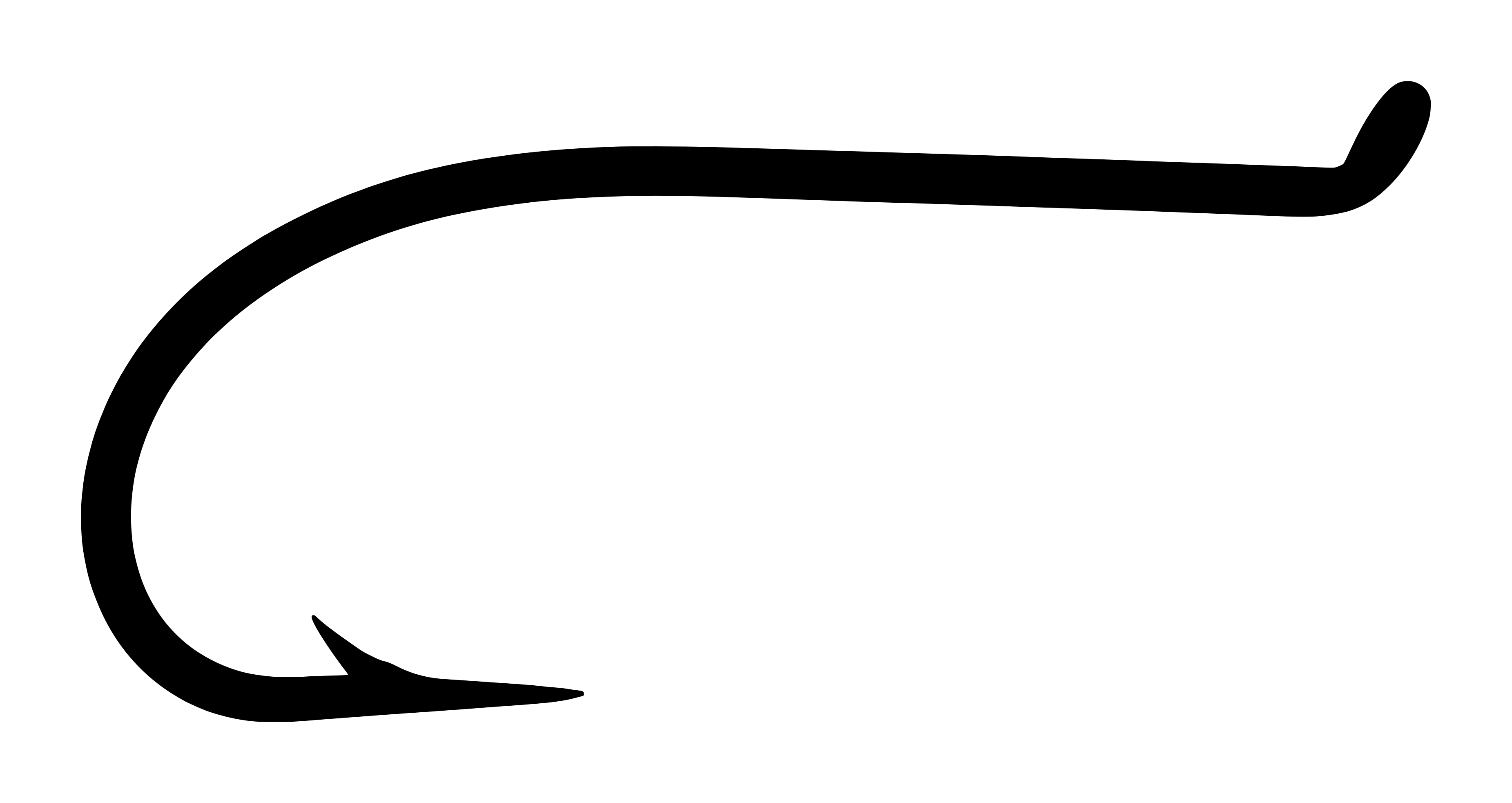
3911 No. 4 — Mustad 3911 | 82% | Compare | |
|
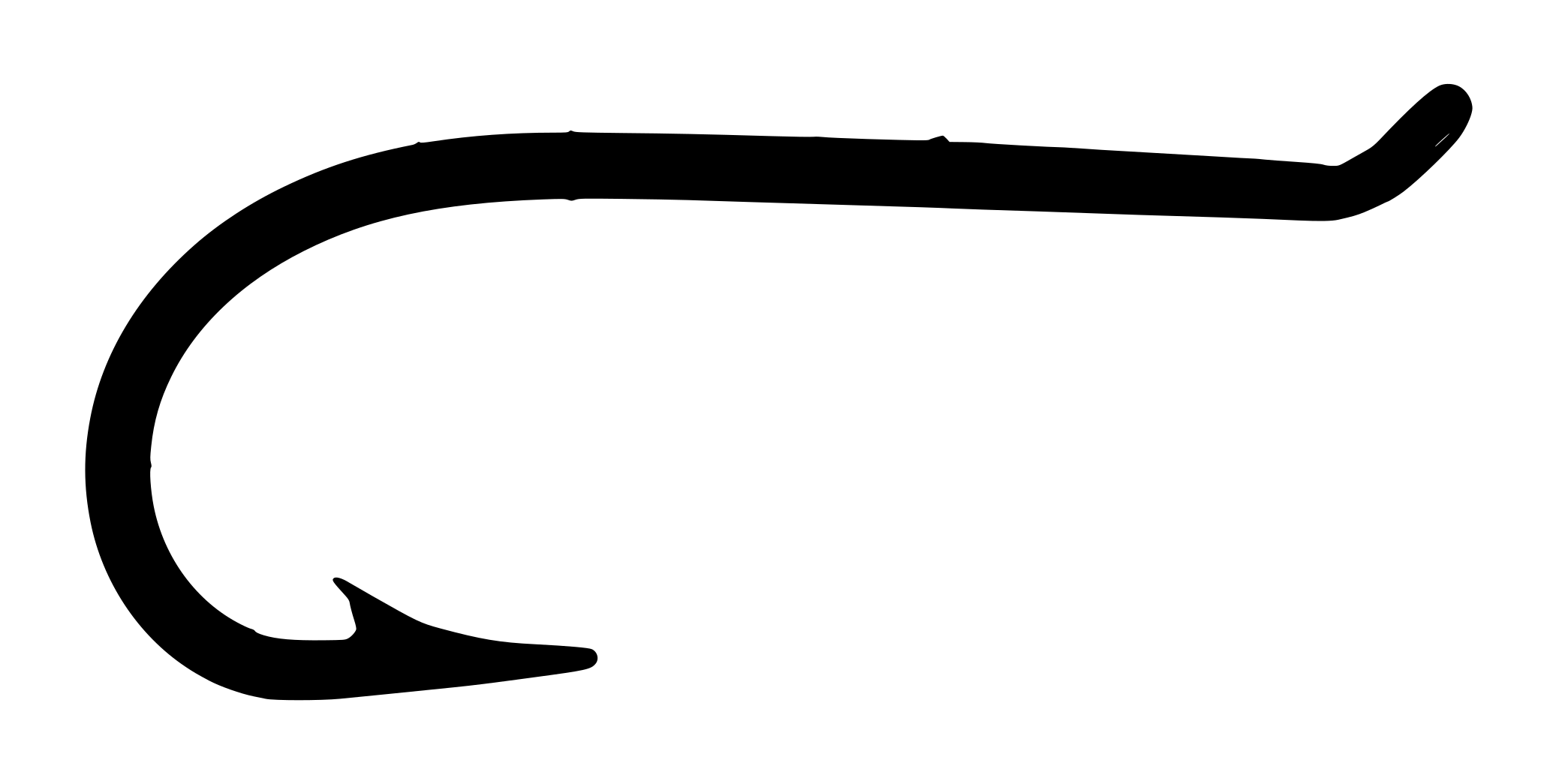
1810 TUE — Best Hollow Point Sproat | 77% | Compare | |
|
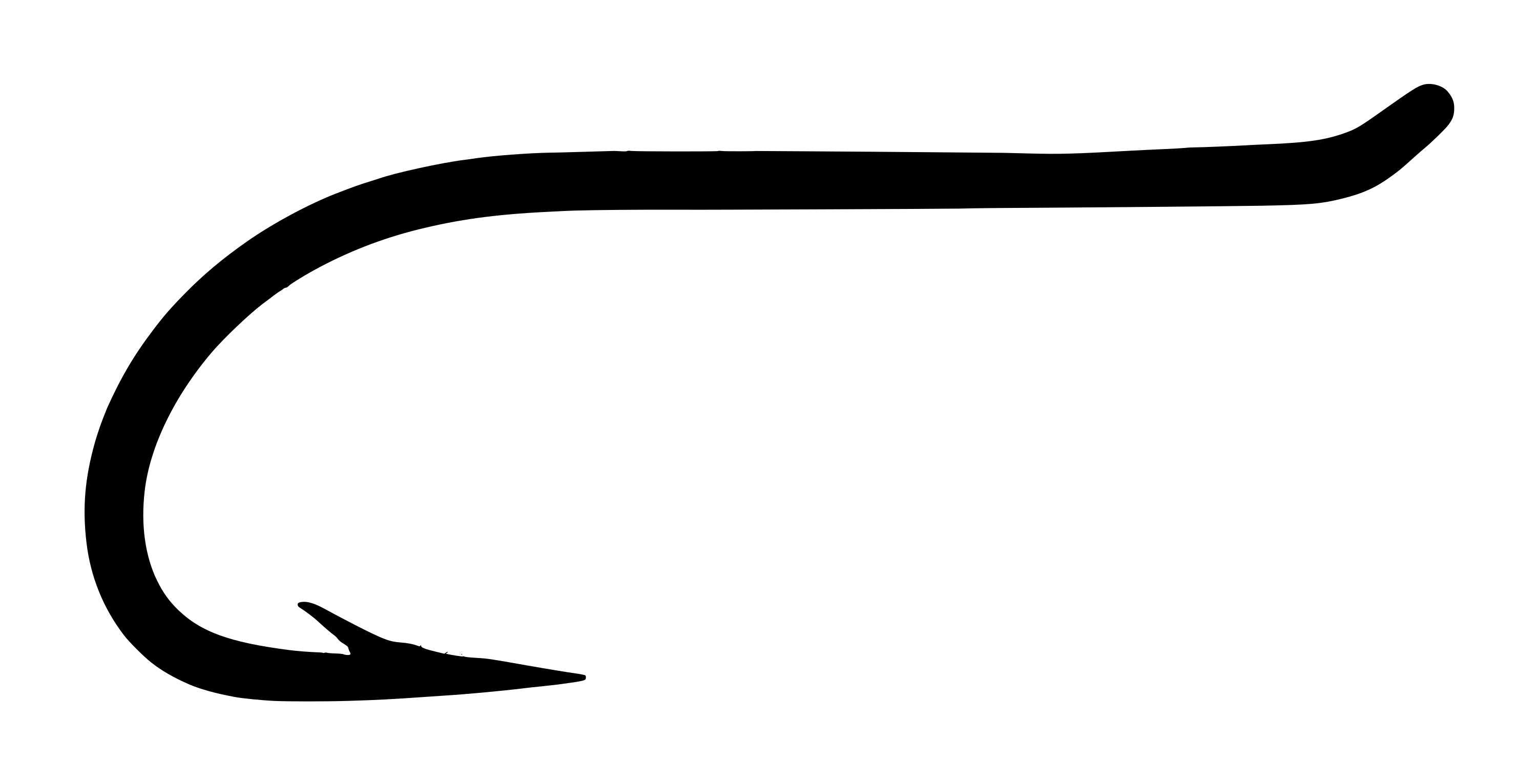
S4324 HE No. 10 — Hand Forged Hook (Octopus Brand) | 75% | Compare | |
| 7974 No. 6, 8, 10, 12, 14; sixth handwritten mark 1[?] — Mustad 7974 | 75% | Compare | ||
|
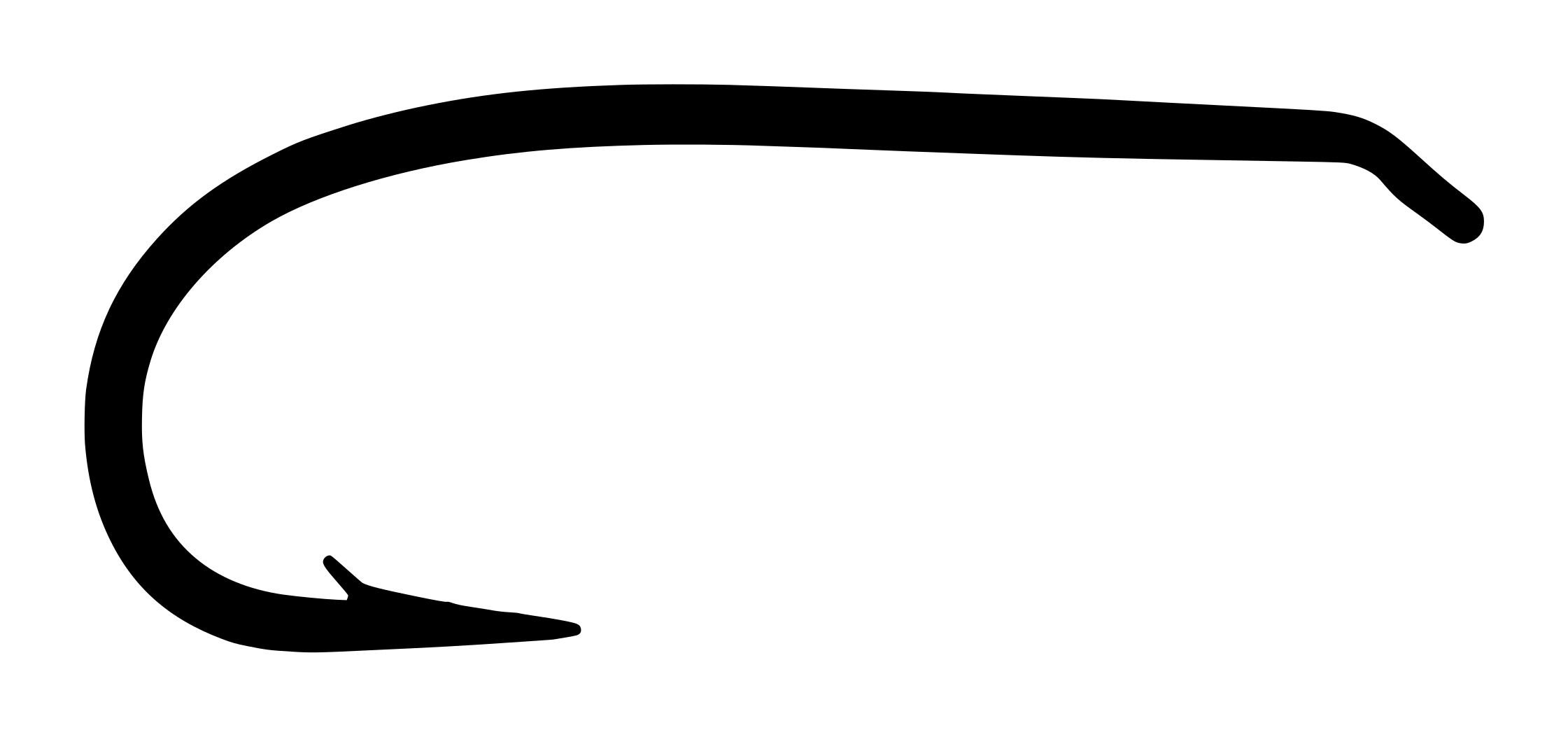
6812 No. 1 — Best Hollow Point | 74% | Compare |
| Silhouette | Hook Model | Match | Compare |
|---|---|---|---|

|
3670 No. 8 — Mustad-Limerick Hooks | 75% | Compare |
|
|
3911 No. 4 — Mustad 3911 | 66% | Compare |
|
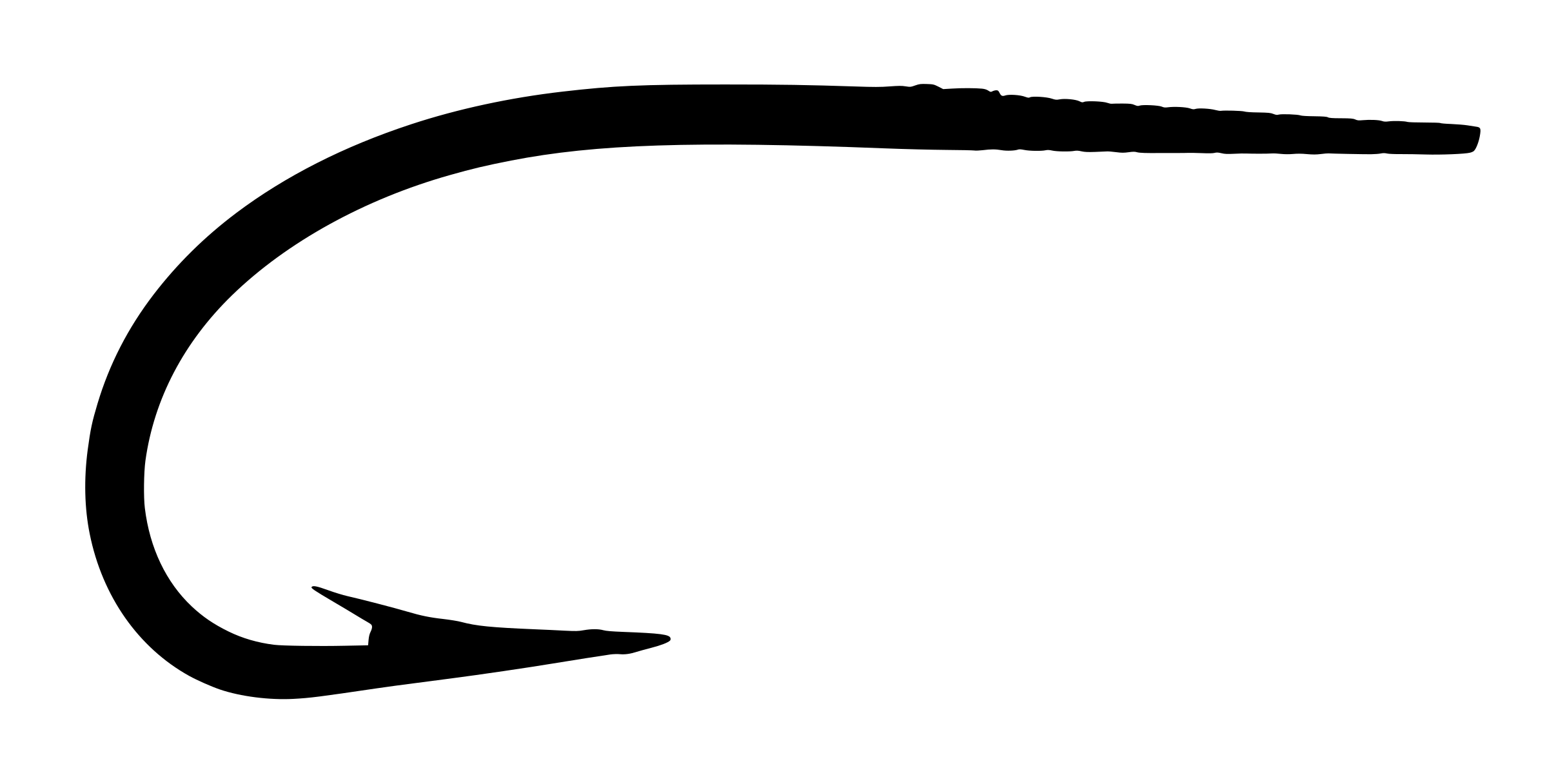
3900 No. 8 — Mustad 3900 | 66% | Compare |
|
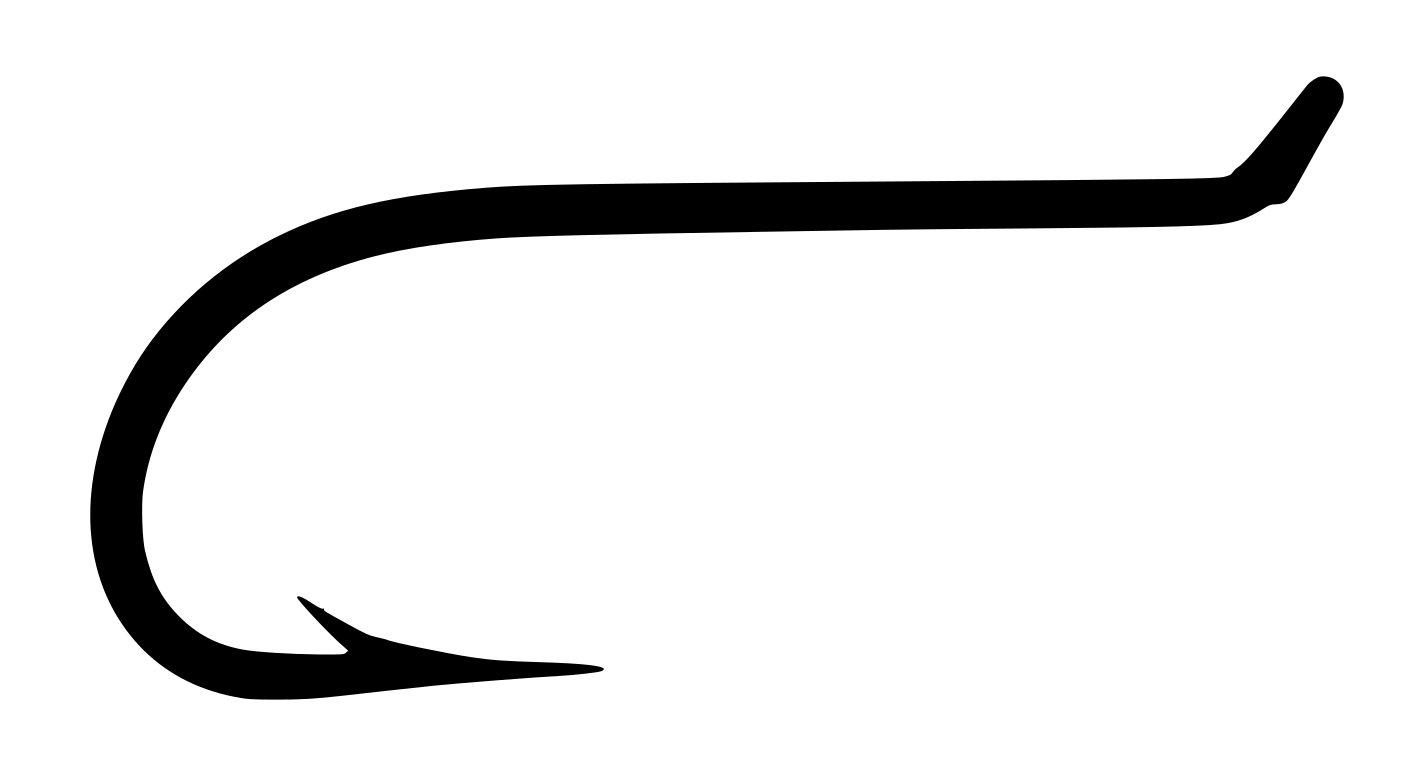
94842 No. 10–24 — Viking | 64% | Compare |
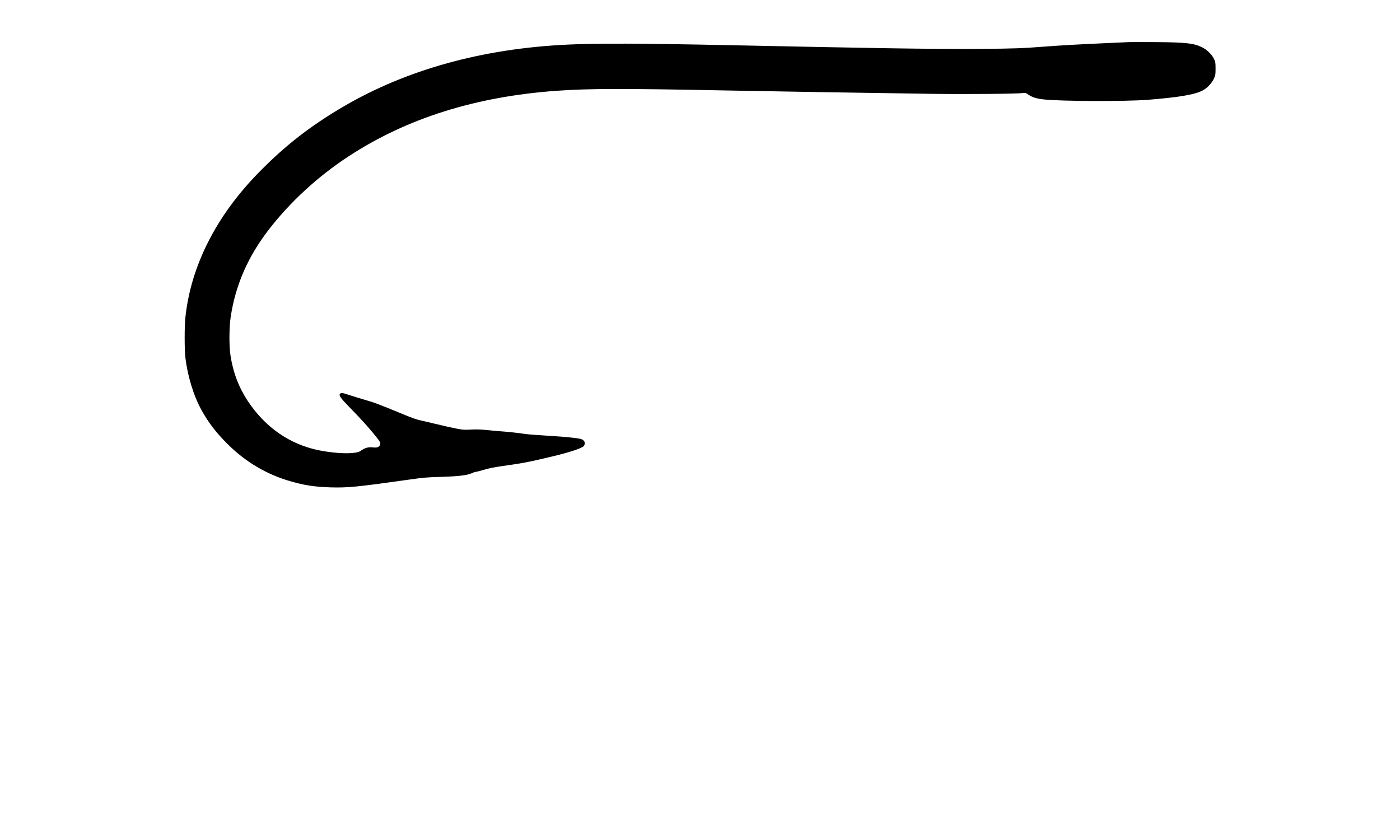
|
3521-Br No. 10 — Sproat | 62% | Compare |
The Mustad 5795 was engineered specifically for dry fly presentation on clear, delicate European trout streams — primarily the chalk streams of southern England, the limestone rivers of France, and the cold upland streams of Scotland and Norway. The 2X fine wire and tapered eye made this hook ideal for small- to medium-sized dry flies targeting selective, cautious trout feeding on sparse insect hatches.
Historically, this hook was employed for classic dry fly patterns including Light Cahill, Pale Evening Dun, Adams, and Greenwell’s Glory — patterns requiring delicate presentation and minimal fly weight. The bronzed finish reduced visibility in clear water, while the hollow point ensured hook-up on the softest takes of educated trout. The reversed point offset was believed to improve success on sipping rises, where fish took the fly with minimal water disturbance.
Traditional North Country spiders, delicate emerger patterns, small stream nymphs, soft-hackle wet flies
Light Cahill, Pale Evening Dun, Adams, Greenwell's Glory, Mayfly Spinner, Tup's Indispensable, Pheasant Tail Nymph, March Brown, Wickham's Fancy
| Hook | Match Quality | Notes |
|---|---|---|
| Tiemco 100 | Excellent | Modern dry fly standard with similar parabolic bend geometry; however, no longer features reversed point offset. Superior sharpening compensates for straight-point design. Slightly heavier wire gauge. |
| Partridge L3A | Very Good | English-made premium dry fly hook with tapered eye and fine-wire construction. Maintains traditional mechanics while incorporating modern tempering. Most direct spiritual successor. |
| Daiichi 1180 | Good | Japanese fine-wire dry fly hook with tapered eye. Good bend similarity, but manufactured to looser tolerances than the Qual. 5795. Readily available. |
| Mustad 94840 | Moderate | Modern Mustad dry fly hook using Signature Series nomenclature (R50). Similar bend family but heavier wire, standard eye, and superior point geometry rather than hollow. |
Rated 4.5/10 — this Mustad 5795 is uncommon but not rare. The model appears regularly in European vintage tackle markets, but size 12 in original packaging with intact card is moderately scarce. Collector demand is solid among dry fly traditionalists and Mustad historians, but not specialized like premium Partridge or Redditch craft makers.
Positive factors: The Mustad 5795 Sproat represents a pinnacle of mid-century European dry fly design with 2X fine wire and tapered eye engineering. French-language labeling and Oslo origin add geographic and historical appeal. Complete, unopened boxes command strong premiums. The reversed (kirbed) point geometry is now uncommon in modern hooks, making vintage examples historically valuable. Size 12 is a premium collectible size — neither too common (like 14-16) nor too specialized (like 22).
Limiting factors: Mustad’s industrial scale production means even vintage examples are not truly rare. Bronzed finish is susceptible to patina and light corrosion, reducing condition premiums. This model was exported globally in massive quantities, flooding regional markets. Lack of famous fly pattern association (unlike, e.g., hooks explicitly for Adams or Light Cahill) limits prestige appeal.
Most desirable variants: Sealed or near-sealed original boxes with intact 100-count full card; size 12 particularly; French labeling (higher rarity than English versions); boxes showing minimal storage wear; matching pairs of boxes (very rare).
Condition factors: Hooks must be bright and free of significant corrosion (bronzed finish develops patina naturally, but rust indicates poor storage). Card color integrity and printer-sharp text significantly affect value. Missing or loose hooks reduce value by 10-20% per missing hook. Opened boxes retain 40-60% of sealed value.
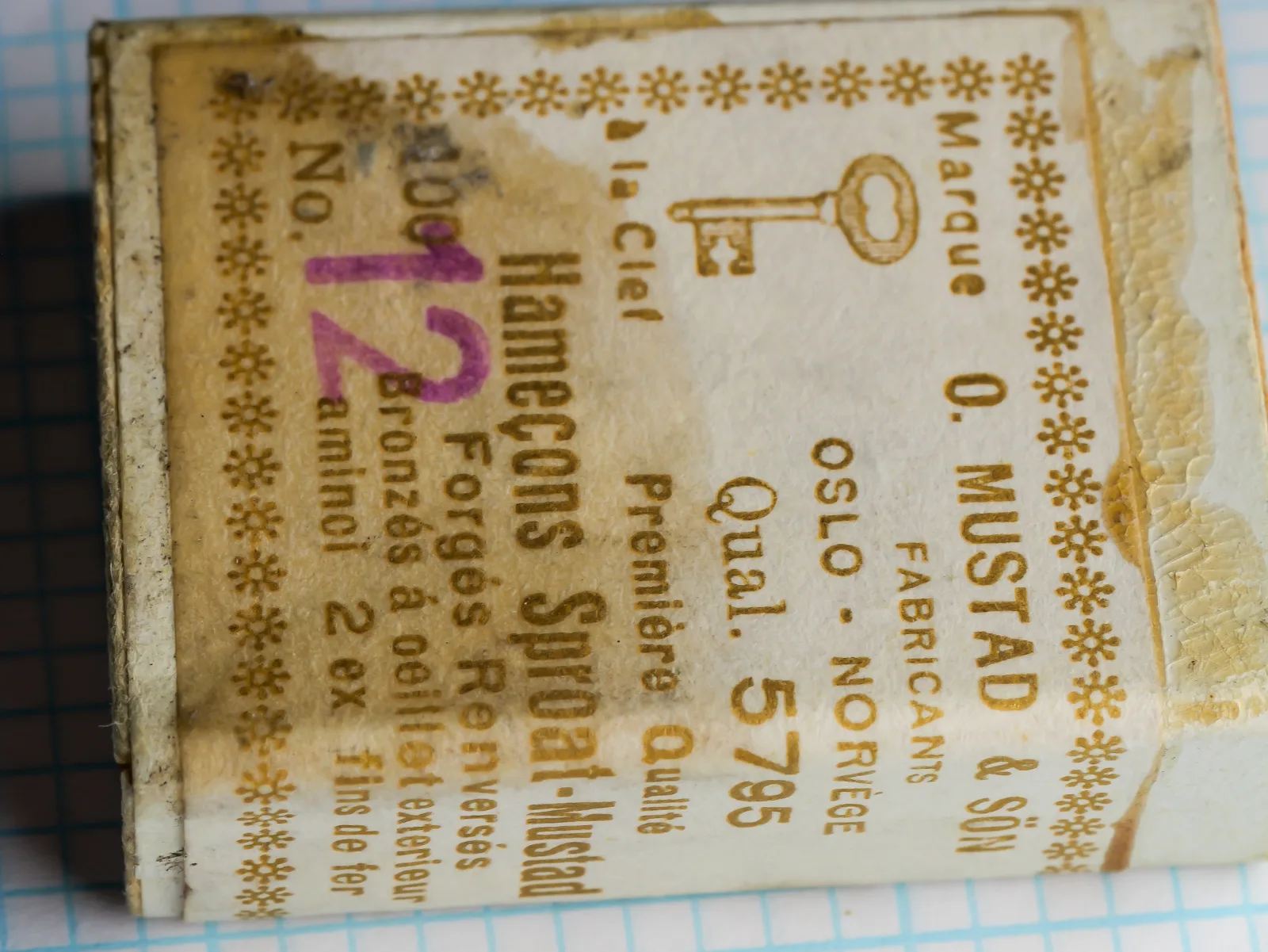
French-language paper label card in bright cream stock with gold-tone letterpress printing. Ornate sunflower border design framing all four edges of card. Top half displays Mustad Key Brand logo (downward-pointing skeleton key in oval cartouche) with text 'À la Clef' (At the Key) in script. Center block contains manufacturer line 'O. MUSTAD & SÖN / FABRICANTS / OSLO - NORVÈGE' in bold uppercase. Below: 'Qual. 5795 / Première Qualité / Hameçons Sproat-Mustad / Forgés Renversés / Bronzés à oeillet extérieur aminoï / 100 No.12 / 2 ex fins de fer'. Hand-stamped purple size marking '12' visible in lower left quadrant. Label shows moderate toning consistent with 70+ years storage. Paper stock is brittle but intact. No barcode. Approximate card dimensions: 3.5" × 2.5" (8.9 × 6.4 cm). Hooks attached to card by original wire wrap through eye loops.
Low ($8): Good condition, opened packaging, complete or near-complete hook count, light patina on bronzed finish. High ($13): Excellent/Mint condition, sealed or near-sealed original card, all 100 hooks present, minimal storage wear, sharp label text. Premium factors: sealed packaging, French text variant, perfect hook count, condition of card graphics. Platforms: eBay (UK and US), European tackle dealers, specialist vintage fishing forums. Confidence: V verified — based on 3 eBay sold listings (all $12.99) and eBay market history (Apr 2023–Apr 2026, avg $9.76, range $7.50–$15.59). Data reflects opened/complete cards; sealed examples command 20-40% premium not fully reflected in general market range.
eBay (UK sellers more common than US). European vintage tackle dealers (France, Germany, Scandinavia). Tackle fairs in London, Paris, Amsterdam. Occasional finds at British fishing museum gift shops and antique postcard/ephemera dealers (who sometimes carry vintage packaging). Less common in North American markets.
Verification of model code: ‘Qual. 5795’ clearly printed on label center. Verify this matches the hook specification: Sproat bend with parabolic profile, 2X fine wire (approximately 0.01″ diameter), tapered eye, and reversed/kirbed point offset (visible when hook viewed from above).
Era confirmation: Look for ‘OSLO – NORVÈGE’ marking (not ‘CHRISTIANIA’). Oslo designation confirms post-1925 manufacture; combined with Key Brand logo style and paper stock, this places manufacture in 1950s-1960s window. Absence of barcode confirms pre-1974. French labeling indicates European distribution stock rather than North American export.
Size verification: Hand-stamped purple number should read ’12’ (or occasionally ’14’, ’16’). This refers to Mustad’s historical sizing system, not modern fly-fishing standards. Actual hook proportions remain consistent across all documented examples. If size marking is illegible, measure gap width: approximately 0.13″ (~3.3 mm) = No. 12 size.
Condition assessment: Check that all 100 hooks remain attached to card (count or estimate visible rows). Verify card stock has not cracked or delaminated. Inspect label text for sharpness of print — faded or blurry text indicates poor storage. Check hooks for active rust (undesirable) versus expected bronzed patina (desirable).
Variant recognition: This model was offered in multiple finishes (Bronzed, Tinned, Blued) — verify correct finish from label text. Reversed (Renversés) specification is standard; straight-shank version would read differently on label. Language variants exist (English, French, German, Dutch, Norwegian) — French version shown here is less common in North American markets, adding modest premium.
| Title | Price | Date | Condition |
|---|---|---|---|
| 100 MUSTAD #11 TROUT Fly Tying A++ Hamecons SPROAT Forged Reversed NORWAY 5795 | $12.99 (asking) | active | New other (see details) |
| 100 MUSTAD #12 TROUT Fly Tying A++ Hamecons SPROAT Forged Reversed NORWAY 5795 | $12.99 (asking) | active | New other (see details) |
| 100 MUSTAD #14 TROUT Fly Tying A++ Hamecons SPROAT Forged Reversed NORWAY 5795 | $12.99 (asking) | active | New other (see details) |
eBay market reference. Researcher-curated. Prices in USD. Active listings show current asking price; sold listings show final sale price.
Store the original card in a cool, dry environment (ideally 50-60°F, 30-40% relative humidity) away from direct sunlight and fluctuating temperatures. The bronzed finish is susceptible to patina development with humidity exposure — this is normal and expected for hooks of this age and should not be considered damage. Patina typically develops as a light surface discoloration and does not affect functionality.
Keep the card in its original condition — do not remove hooks unless they are to be used. Store flat or slightly angled, never rolled or bent. Avoid contact with other metals, especially ferrous materials, which can cause galvanic corrosion where dissimilar metals touch. Store away from acidic materials (newsprint, cardboard boxes) and avoid placing heavy objects on top of the card.
If the card becomes damp, allow it to air-dry slowly at room temperature — do not apply direct heat. Avoid cleaning the label with water or chemical solvents, which will damage the original printing and paper stock. Light dust may be carefully removed with a soft, dry brush.
For long-term archival storage, place the card inside a buffered archival envelope or acid-free tissue sleeve. Original factory packaging significantly enhances collector value — preservation of the card is more important than functional use of the hooks.
The purple numeral ’12’ stamped in the lower left corner of the card represents a hand-applied size designation applied during or immediately after initial packaging. This marking style is characteristic of Mustad’s 1950s-1960s retail distribution system, when cards were hand-sorted and marked by warehouse staff before shipment to regional distributors.
The purple ink used for stamping is consistent with early synthetic aniline dyes employed by Norwegian and Scandinavian printers in this era. The hand-stamped format (rather than pre-printed) suggests that the card stock was printed with generic label information, then individualized by size marking based on the specific hooks inserted into the card.
The presence of a hand-stamped size marking is itself a strong era indicator — modern Mustad packaging relies entirely on pre-printed sizing information. This hand-marking practice had been discontinued by the early 1970s, making it a reliable dating tool for cards from the 1950s-1960s manufacturing window.
The card label bears a hand-stamped purple size marking of ’12’, consistent with Mustad’s historical numbering system. However, physical caliper measurements of the specimen hooks reveal dimensions that are intermediate between Mustad’s published No. 12 and No. 16 specifications, with a gap width of 0.13″ (3.30 mm) and overall length of 0.35″ (8.89 mm).
This apparent discrepancy reflects the reality of vintage hook manufacturing tolerances. Mustad’s automated machinery produced hooks within specified ranges, but hand-stamped size assignments were sometimes applied with considerable variation. A card marked ’12’ might contain hooks ranging from tight No. 12 dimensions to loose No. 12 / tight No. 14 dimensions, depending on the tolerance window accepted by the factory quality control system.
The caliper measurements confirm that this specimen falls comfortably within the historical Mustad No. 12 standard, despite any minor variation. Modern fly-fishing standards (which use precise wire gauge and shank length ratios) do not correspond directly to vintage Mustad historical sizing, making direct comparison problematic.
Recommendation: Trust the hand-stamped size marking (No. 12) as the authoritative Mustad designation. If tying with these hooks, verify by comparison with other documented No. 12 specimens rather than relying on modern fly-hook sizing charts.
Source: Mustad Label Decryption Document, 'Comprehensive Typology and Decryption of Vintage O. Mustad & Søn Hook Labels'
Full Label Translation (French to English):
‘Marque À la Clef’ = Key Brand Trademark
‘O. MUSTAD & SÖN / FABRICANTS / OSLO – NORVÈGE’ = O. Mustad & Son, Manufacturers, Oslo, Norway
‘Qual. 5795’ = Quality/Model Code 5795
‘Première Qualité’ = First Quality (premium tier designation)
‘Hameçons Sproat-Mustad’ = Sproat-Mustad Fish Hooks
‘Forgés Renversés’ = Forged, Reversed/Kirbed (point offset)
‘Bronzés à oeillet extérieur aminoï’ = Bronzed finish with thinned/tapered external eye
‘100 No.12’ = Box quantity 100, Size 12
‘2 ex fins de fer’ = 2X fine wire
Specification Analysis: The label employs Mustad’s standardized eight-line typographic format (documented in the reference PDF). Line 5 designation would be ‘Bronzés’ (finish), with the point geometry implied by the context of ‘Première Qualité’ Sproat hooks, which standardly featured hollow points. The tapered eye (‘oeillet extérieur aminoï’) and reversed offset (‘Renversés’) are explicitly called out as premium features distinguishing this model from standard Sproat alternatives.
The French labeling itself is a significant historical detail. Mustad produced region-specific packaging in multiple languages as part of their industrial cloning strategy — identical hooks were distributed in English, French, German, and Scandinavian packaging to create the perception of regional manufacturers.
Source Citation: Mustad Label Decryption Document, ‘Comprehensive Typology and Decryption of Vintage O. Mustad & Søn Hook Labels’ — reference pages 1-21.
| P | Photographically verified — Directly observable in the photograph(s) on this page. |
| V | Verified by documentation — Confirmed by manufacturer catalog, spec sheet, or published reference. |
| I | Inferred — A logical deduction from observable or documented evidence, not directly stated. |
| E | Estimated — An approximation based on visual comparison, proportional analysis, or limited data. |
| S | Speculative — A reasoned hypothesis that cannot be confirmed from available evidence. |
Unnotated claims are the compiler’s synthesis; see Sources. All photographs on garrenwood.com are taken on a measurement grid where each square equals 1/10 inch (0.1″ / 2.54 mm).
Your cart is empty.