Hook Reference › S. Allcock & Co’s Hooks › Allcock 1810 TUE — Best Hollow Point Sproat

S. Allcock & Co. 1810 T.U.E.

Best Hollow Point Sproat

Marks: P photographically · V verified · I inferred · E estimated · S speculative What they mean

Photographic record

2 photographs

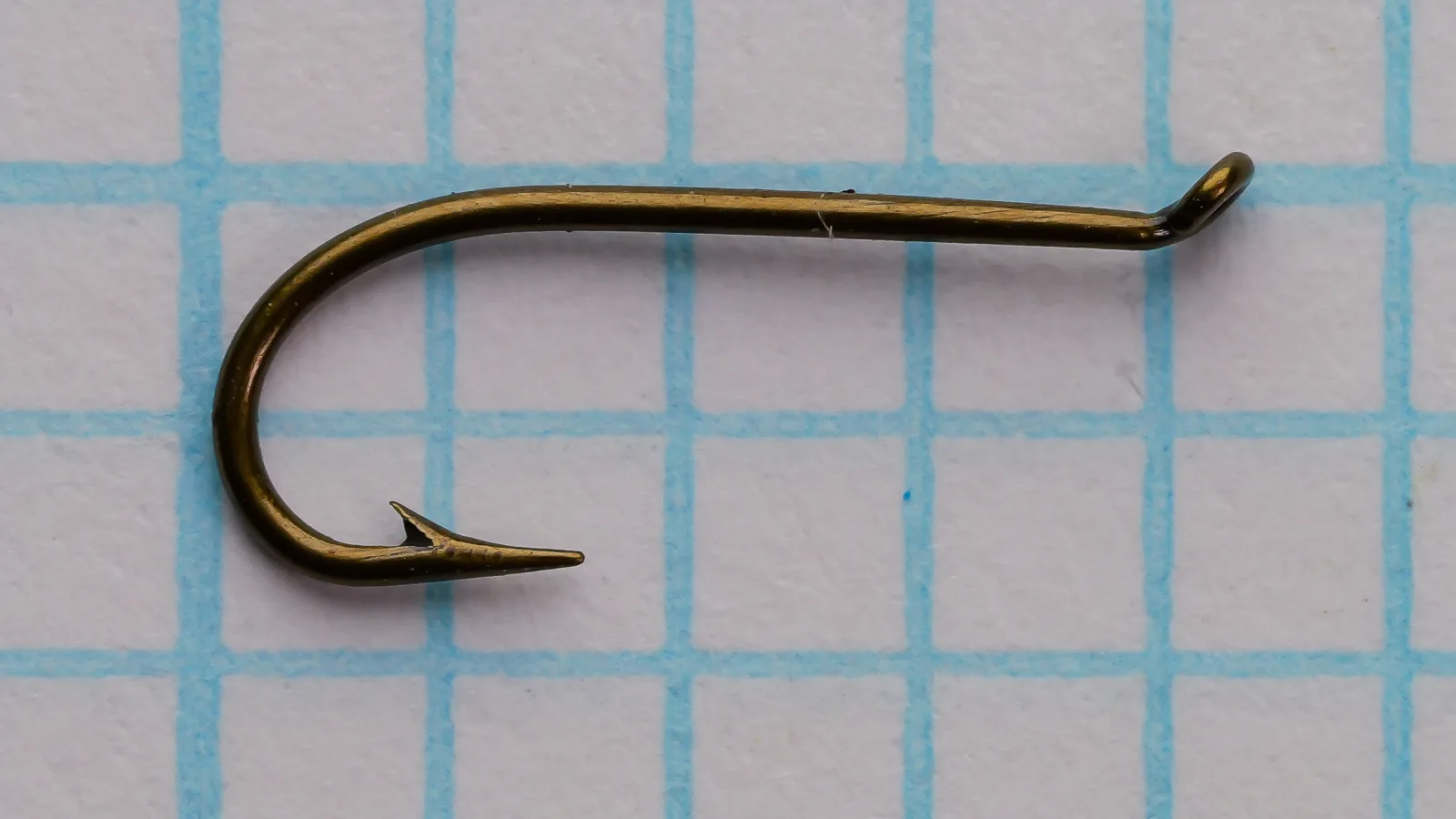
Side profile of an Allcock 1810 T.U.E. size-14 fishing hook with upturned eye, deep rounded bend and pronounced barb on blue measurement-grid paper.
IMG-2Allcock — New entry — image 2 Paired size-14 Allcock 1810 T.U.E. specimen shown on a measurement grid. The upturned eye, rounded bend and raised barb are visible (P).

Identify

S. Allcock & Co. Ltd.’s 1810 T.U.E. is identified on its original box as a Best Hollow Point Sproat hook P. The paired size-14 specimen provides a documented example of this Redditch-marked pattern, with its original labeling preserved alongside the physical hook P.

How to identify it

Look for the exact designation 1810 T.U.E. above Best Hollow Point and SPROAT on the box label P. The manufacturer’s line reads S. Allcock & Co. Ltd., followed by Redditch, England. P.

The photographed specimen has an upturned eye, a deep rounded bend and a pronounced barb P. Those physical features are useful for narrowing a comparison, but the printed identification provides the strongest connection to this exact model.

Inferred Identification · Specimen S1

The strongest practical identification combines the labeled box with the hook's upturned eye and rounded Sproat profile. These features help distinguish it from similarly numbered hooks with other eye orientations or bend descriptions.

How we got there

Basis: The paired box names the manufacturer and pattern. The hook has an upturned eye, and secondary reference entries using 1810 describe differently specified configurations.

Reasoning: Combining physical shape with printed nomenclature is more discriminating than comparing a numeric model code or general outline alone.

Measurements & specifications

Features of the model, as recorded
FeatureRecordedEvidence
EyeTapered Eye, Turned Up
Show noteHide note

The formed eye turns upward from the shank and narrows toward its junction P. Deliberate grinding or tapering of the eye wire is not established.

OBS-1
WireStandard, Round, est. ~0.55 mm (E; unvalidated grid trace)MEA-4
ShankStandard — PlainOBS-5
BendSproat, Standard gap
Show noteHide note

The box identifies the bend as SPROAT P. The specimen shows a deep rounded curve ending in a nearly horizontal point leg P. Lateral offset remains undetermined.

LBL-2OBS-2
PointHollow Point
Show noteHide note

A single pronounced barb rises from the inner point section and projects back toward the bend P. It appears intact, although functional sharpness is untested.

OBS-4
FinishBronzed — judged from the photographs
Show noteHide note

The specimen appears dark olive-bronze with warm metallic highlights P, consistent with a bronzed finish I. The box label contains no finish specification.

OBS-6LBL-1LBL-2LBL-3LBL-4

The box specifies a Best Hollow Point design P. Hollow-point terminology refers to a hollow-ground point, although the precise concavity and extent of grinding cannot be resolved from this side photograph. The point is long and relatively straight, with a visibly raised barb P.

The shank is predominantly straight, leading into a formed upturned eye P. Grid-derived dimensions describe the photographed example rather than a manufacturer’s published size standard E. In the platform’s comparative silhouette measurement, the shank proportion falls closest to its standard-length class and relative wire thickness to its extra-heavy class I. These are comparative classifications, not documented Allcock grades.

Measurements

Known manufactured size range: 2-16 I

Overall length10.9 mm Egrid photoMEA-1
Shank length8.4 mm Egrid photoMEA-2
Gap width3.7 mm Egrid photoMEA-3
Wire diameter0.55 mm Egrid photoMEA-4

Size 14, specimen S1. Bend depth, weight and the shank-to-gap ratio are in the full table.

All recorded values
Per size, with how each dimension was taken
SizeOverall lengthShank lengthGap widthBend depthWire diameterWeightShank:gap
14Specimen S110.9 mm Egrid photoMEA-18.4 mm Egrid photoMEA-23.7 mm Egrid photoMEA-3—0.55 mm Egrid photoMEA-4—~2.3
Calibrated SVG True-scale preview

How the measurements are defined
How hook dimensions are measuredA hook outline with dimension lines for overall length, shank length, gap, bend depth, and wire diameter.Overall lengthShank lengthGapBend depthWire diameter
Overall length
Eye to the farthest point of the bend.
Shank length
Eye to the start of the bend.
Gap
Point to shank, at right angles to the shank.
Bend depth
Shank to the bottom of the bend.
Wire diameter
Across the wire, measured by caliper where possible.

Inferred Design · Model

The combination of an extended point, pronounced barb and deep bend suggests a design balancing point exposure with retention after penetration.

How we got there

Basis: The hook photograph shows a relatively long, straight point, one raised barb and a deep rounded bend.

Reasoning: The exposed point profile provides clearance ahead of the barb, while the barb presents a backward-facing obstruction to withdrawal. These are plausible functional consequences of the geometry, not measured performance or proof of the original designer's intentions.

Use & alternatives

  • Dry fly
  • Wet fly
  • Nymph

Primary application

For present-day fly tying, the size-14 hook’s straight shank, upturned eye and relatively compact proportions make it a plausible choice for small wet-fly and dry-fly dressings I. Its pronounced barb and long point should be considered when choosing body length and available gape. These are practical assessments of the photographed specimen, not documented historical recommendations from Allcock.

Other uses

The photographed size-14 hook could also accommodate compact nymph dressings as a modern tying choice I. No original manufacturer application list is documented.

Inferred Application · Model

The size-14 1810 T.U.E. looks suitable for compact wet-fly and dry-fly dressings, including patterns that benefit from a straight tying section and an upturned eye.

How we got there

Basis: The paired specimen has a size-14 marking, predominantly straight shank, turned-up eye, pronounced barb and deep rounded bend.

Reasoning: These features offer a practical tying platform for compact traditional-style fly bodies. The application is inferred from the visible geometry and standard fly-tying considerations rather than a documented manufacturer recommendation.

Modern equivalents

Estimate Comparison · Specimen S1

The recorded size-14 hook has an approximate shank-to-gap ratio of 2.3, making its physical proportions a useful comparison target for other photographed Sproat hooks.

How we got there

Basis: The carried-forward grid measurements are 8.43 mm for shank length and 3.71 mm for gap width.

Reasoning: Dividing 8.43 by 3.71 gives approximately 2.27. This ratio provides a scale-independent proportion for comparing documented specimens, while the individual endpoints and absolute measurements remain subject to direct measurement confirmation.

Label & packaging

Specimens, packaging, and label

This record documents one specimen. It describes that specimen only, not every example of the model.

S1 · Allcock 1810 T.U.E. — Size 14, Original Box

Size
14 (printed on the label)
Container
Box
Hook condition
Complete single hook with intact eye, point and barb. Minor surface marks are visible, without obvious extensive corrosion or structural deformation (P). Functional sharpness has not been tested.
Packaging condition
Good — moderate wear, legible
Measured
size 14
Photographs
IMG-1IMG-2
Detailed condition observations
Wear
lid label, upper and lower margins: Uneven yellow-brown staining and discoloration, particularly across the upper label and along the bottom edge. LBL-7
Wear
box lid, perimeter: Minor edge abrasion, small surface marks and discoloration on the pale box surround. Printed border and manufacturer text remain legible. LBL-8

One size-14 hook paired with its original Allcock 1810 T.U.E. box. The box face measures approximately 39 × 32.5 mm from the photographic grid E. The printed quantity is 100 hooks, but the surviving contents have not been counted. The label has yellow-brown staining and minor peripheral wear P.

Full label transcription
LBL-1 printed · lid label, upper center from IMG-1
1810 T.U.E.
LBL-2 printed · lid label, center from IMG-1
Best Hollow Point
SPROAT
LBL-3 printed · lid label, lower center from IMG-1
Manufactured by
S. Allcock & Co. Ltd.
Redditch, England.
LBL-4 printed · lid label, bottom from IMG-1
100 Hooks.     Size
LBL-5 trademark · lid label, upper left from IMG-1
TRADE MARK.
LBL-6 handwritten · lid label, lower right beside Size from IMG-1
Purple handwritten or manually applied numeral appearing to read 14. The first character is a vertical stroke and the second has an angular form consistent with 4. The medium and person responsible are not established.
Trademark
Black printed standing deer or stag with branching antlers, positioned above the words TRADE MARK. P.
As entered on the specimen record
TRADE MARK.
1810 T.U.E.
Best Hollow Point
SPROAT
Manufactured by
S. Allcock & Co. Ltd.
Redditch, England.
100 Hooks.     Size
Layout
Cream-colored label within a black rectangular printed border. The model code appears in large bold type at the top, followed by the point designation and SPROAT. Manufacturer and location occupy the lower center. The nominal quantity and Size designation run along the bottom. A purple 14 appears beside Size P.
Typeface
Mixed serif lettering, with larger bold uppercase model and pattern text. Smaller serif lettering is used for the manufacturer, location and quantity P. The printing process is not established.
Printed marks
1810 T.U.E.; Best Hollow Point; SPROAT; Manufactured by S. Allcock & Co. Ltd.; Redditch, England.; 100 Hooks.; Size; TRADE MARK.
Later marks
Purple numeral appearing to read 14, located beside the printed Size designation at the lower right P.

Care of this specimen: Keep the specimen and box together in a stable, dry environment. Protect the printed surface from abrasion and direct sunlight, and avoid adhesive repairs or aggressive cleaning.

Condition

The hook appears complete, with intact eye, bend, point and barb P. Minor surface marks are visible, but no extensive corrosion or major deformation is apparent. Sharpness is untested.

Storage and Preservation

Store the card in a cool, dry environment away from direct sunlight and high humidity. The bronzed finish will develop a natural patina over time; this is characteristic and acceptable for vintage examples. To prevent active oxidation, avoid exposure to damp or salt-laden air. Keep the original packaging intact — do not remove individual hooks from the card unless required for tying. If the card becomes damp, allow it to air-dry slowly in a well-ventilated space; rapid heating can cause warping.

Original cardboard packaging is archival-quality when stored properly; rag-content stock from the 1920s–1950s shows excellent longevity. Do not laminate or seal the card in plastic sleeves unless absolutely necessary for conservation. Keep the hooks separated from ferrous metal objects (iron, steel) to prevent galvanic corrosion. Acid-free storage containers or archival tissue are recommended for long-term preservation. Avoid contact with rubber bands or non-stainless fasteners, which can cause staining.

Inferred Packaging · Packaging

The purple numeral beside Size was probably applied to distinguish the contents of this box as size 14.

How we got there

Basis: The numeral appears in the lower-right size position, directly beside the printed word Size, and matches the paired hook's recorded size.

Reasoning: The location and legible numeral indicate a functional size designation on a stock container. The mark provides a practical link between packaging information and the hook itself.

Label and source analysis

Handwritten Size Annotation

A purple handwritten or manually applied mark appears beside the printed word Size at the lower right of the box label P. The two characters appear to read 14, identifying the size of the paired hook P.

The numerals are distinct from the black printed label. Their application method, writer and date have not been established.

History & dating

Series

The original label records the designation 1810 T.U.E. with the name Best Hollow Point SPROAT P. T.U.E. is an abbreviation for turned-up eye V, matching the photographed construction P.

Two separate FlyHooks reference entries use the number 1810 for differently described Allcock hooks: a 1XL Sproat T.D.E. and an Extra Long Limerick configuration V. Those records document differing descriptions under the number 1810, but do not establish a production sequence, shared size range or direct relationship with this exact T.U.E. pattern.

Design lineage

The photographed box identifies this design as a Sproat with a hollow-point designation P. The specimen’s upturned eye and rounded bend provide physical features for comparing it with other patterns P. A documented manufacturing lineage connecting the separately listed 1810 configurations has not been established.

Dating

No barcode visible on packaging — indicates pre-1974 manufacture P. Letterpress print method and paper stock consistent with 1920s-1950s production. Typography and border design align with S. Allcock & Co. Ltd. house style of that period. The red/purple handwritten annotation suggests field use or dealer mark typical of mid-20th-century tackle commerce. TUE suffix notation (possibly indicating a catalog edition or lot variant) not independently datable but consistent with Allcock practice of mid-century.

Working hypothesis Period · Packaging

Packaging: 1900–1969

The box appears consistent with an early-to-mid-twentieth-century retail presentation of British fishing hooks.

How we got there

Basis: The box carries the S. Allcock & Co. Ltd. Redditch identification, an illustrated trade mark, serif lettering, a nominal 100-hook quantity and an applied size mark.

Reasoning: Its compact labeled format, printed presentation and visible age-related wear suggest a period retail container. This is an approximate contextual reading of the packaging rather than a manufacturer-documented date.

Working hypothesis Lineage · Model

The differing 1810 descriptions may reflect several contemporaneous configurations or changes in catalog nomenclature over time.

How we got there

Basis: The photographed label identifies an 1810 T.U.E. Best Hollow Point Sproat, while separate reference entries describe a 1XL Sproat T.D.E. and an Extra Long Limerick.

Reasoning: The shared numeric designation, alongside different eye and bend descriptions, suggests a possible historical naming structure more complex than one fixed design. A documented succession or manufacturer-defined family remains a working hypothesis.

Value & buying

Rarity: Uncommon

The original labeled box and associated size-14 hook preserve a useful, directly identifiable example of Allcock's 1810 T.U.E. pattern P. This record does not establish how difficult the model is to find or how strongly it is sought by collectors.

Basis: The available evidence identifies a labeled size-14 specimen but contains no model-specific availability or collector-demand observations sufficient to establish a rarity band.

The principal identifying strength of this specimen is its original labeled box, which preserves the exact model designation, point description, manufacturer’s name and size annotation P. The paired hook can be examined against those markings rather than relying on its silhouette alone.

For assessing this example, examine the condition of the point and eye, legibility of the box label and whether any additional original contents survive. The box states a nominal quantity of 100 hooks, but the surviving quantity has not been recorded P.

This record does not establish scarcity or collector demand for the model. A model-level collectability rating requires evidence about availability and specialist interest beyond this individual specimen.

No recorded sold sales are available in this evidence record for the exact model. A published sold-price range therefore remains unset. The surviving hook count, box condition and completeness would materially affect an appraisal of a boxed example.

Where to find

Search using both 1810 T.U.E. and Best Hollow Point Sproat. Check the complete label wording and eye orientation when comparing examples, because other reference entries using 1810 describe different configurations.

Estimate Value · Value scenario

Indicative collector value

USD 10.00–25.00 per lot

1 hook(s); Legible but stained and lightly worn original box; one complete associated hook with minor visible surface marks; Original labeled Allcock 1810 T.U.E. box, with valuation limited to one documented hook. Estimated November 16, 2026. Our best estimate.

Our indicative collector-value estimate is $10-$25 USD for the photographed original box and one associated size-14 hook, in the condition shown.

How we got there

Basis: The pair has a readable manufacturer and model label, an applied size mark and a physically complete hook. The box has visible staining and minor wear. The scenario values only the photographed box and one hook.

Reasoning: As an editorial estimate, the range reflects the modest standalone utility of a single vintage fly hook, supplemented by the identification value of its matching labeled box. The legible branding and exact model attribution improve its research interest, while the condition and limited assessed contents constrain the scenario. This estimate is category-based judgment, not a recorded transaction price.

Inferred Collector interest · Model

The pattern has clear research appeal because the box preserves the maker, exact model code, named point style and traditional bend designation together.

How we got there

Basis: All four identifying elements are present in the printed label, and the photographed hook retains the associated physical features.

Reasoning: A precisely labeled surviving example permits comparisons among historical terminology, product identification and actual hook geometry. This is a specific documentary appeal rather than a claim about market scarcity or collector demand.

Sources & research

Sources & documentation

This specimen and its packaging — photographed, 2 images
Supports: Model codeSize documentedQuantity per packagePackaging format codeFinishShank
+31 morefewerMeasurement methodSize measuredOverall lengthShank lengthGap widthWire diameter measuredWireShank gap ratioDating rangeMarket value lowMarket value highRarity basisIs snelledFly patternsSecondary applicationsFun fact titleFun factSummaryIdentificationEyeBendBarbCondition notesTechnical notesSeries historyDesign lineagePrimary applicationCollectability detailCollectability summaryMarket value notesWhere to find

Open questions

  1. Do you have a dated Allcock catalog or price list showing the 1810 T.U.E. Best Hollow Point Sproat?The photographed box establishes the exact model and manufacturer, but the supplied documentation does not establish its first or last production dates.Can you help? Send a scan or photograph of the catalog entry, including the cover, publication date and relevant hook listing.

Entry updated November 16, 2026.