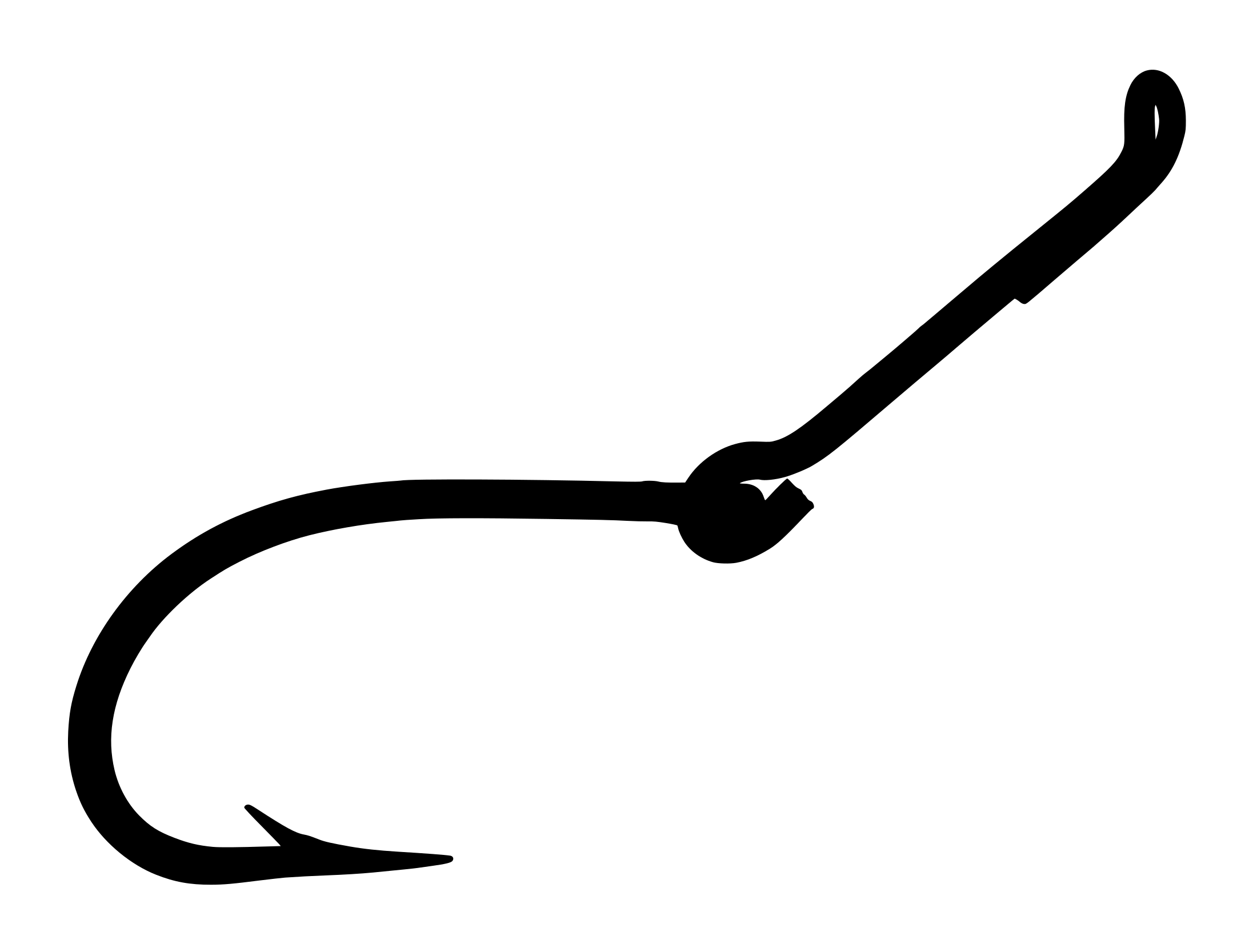
The Mustad 3827 is a mid-century Norwegian hook manufactured by O. Mustad & Søn in Oslo during the post-war era (c. 1945–1965). This size-2/0 specimen exemplifies a specialized weedless design: the looped spring eye was engineered to snap closed over the point, creating a mechanical weed guard while allowing the hook to open fully upon a fish strike.
The 3827 employs the heavy-duty O’Shaughnessy bend—a parabolic pattern favored for saltwater and strong freshwater applications—combined with forged wire construction for exceptional structural rigidity. The Hollow Point geometry delivers rapid penetration with minimal applied force, ideal for soft-mouthed species and delicate presentations. The nickel finish provides moderate corrosion resistance, appropriate for the coastal and wetland environments where this hook was deployed.
This hook represents a vanished manufacturing era when mechanical innovation solved field problems before plastic and synthetic alternatives became standard. The presence of the ‘Oslo’ designation on the label (rather than ‘Christiania’ or ‘Gjøvik’) anchors the specimen firmly to the post-1925 mid-century production window. Surviving examples are uncommon, particularly in original packaging, making the 3827 of genuine interest to collectors of vintage weedless tackle and Norwegian hook engineering.
Original Mustad 3827 kraft card label showing the classic eight-line typographic format with 'Oslo - Norway' geographic designation, model code 'Qual. 3827', 'Hollow Point' specification, and anatomical modifiers. Handwritten '2/0' size notation in bottom left corner. Specimen preserved on measurement grid.
Photographic record
3 cataloged imagesSelect any record to load it above.
3 images shown
Mustad 3827 O’Shaughnessy Hook — Original Packaging Label — Size 2/0Original Mustad 3827 kraft card label showing the classic eight-line typographic format with 'Oslo - Norway' geographic designation, model code 'Qual. 3827', 'Hollow Point' specification, and anatomical modifiers. Handwritten '2/0' size notation in bottom left corner. Specimen preserved on measurement grid.Open originalMustad 3827 Point Detail — Side Profile — Size 2/0Side profile of the Mustad 3827 showing the concave hollow-point geometry characteristic of the vintage point style. The photograph clearly displays the barb placement and angle, the rapid flare from tip to barb, and the nickel finish tone. Captured on measurement grid at close focus.Open originalMustad 3827 Specimen Ensemble — Spring Eye and Full Profile — Size 2/0Two Mustad 3827 specimens photographed together to show the looped spring-eye weedless mechanism in detail. The side-by-side composition demonstrates the consistent forging, symmetrical O'Shaughnessy bend, and the mechanical spring eye that snaps over the point. Specimen hooks remain on the original card.Open original
Technical profile
Looped Spring Eye | O'Shaughnessy Bend | Standard Shank | Heavy Forged Wire | Hollow Point | Nickel Finish
Eye
Cross Eye, Turned UpDistinctive looped spring eye with a tensioned wire arm that snaps forward over the hook point to form a mechanical weed guard. When a fish strikes, the loop depresses backward, fully exposing the point. Construction is elegant and precise, indicating careful manufacturing. The wire diameter of the loop matches the main shank, suggesting uniform forging. P
Wire
Fine (1X Fine), Forged
Shank
Short (1X–2X Short) — Plain
Bend
O'Shaughnessy, Standard gapClassic O'Shaughnessy parabolic curve—smooth, symmetrical bottom with a pronounced, rounded bend. The bend sits deep in the hook, creating excellent stress distribution. Wire appears to be set centrally with no lateral offset. Bend geometry is textbook O'Shaughnessy, distinct from the sharper Limerick profile. P
Point
Hollow Point (concave inner face)Short, close-cut barb positioned approximately 1/16 inch proximal to the tip. Barb angle is steep and inward-facing, characteristic of hollow-point barbs. The barb cut is clean and uniform, with no double or offset elements. Barb sits squarely on the inner face of the point taper. P
Finish
Nickelled / Nickel-Plated — Inferred (photographically likely)Nickel plating exhibits a dull, matte gray tone consistent with vintage nickel electroplating. The specimen shows light patina and surface oxidation typical of aged nickel; the underlying plating remains intact with no evidence of flaking. Warm-toned edge wear on the barb reveals bright steel beneath, consistent with manufacturing handling rather than angling use. P
The two specimen hooks are bright and structurally intact with no bending, fracture, or corrosion. The original kraft card shows light browning, edge wear, and minor loss to the label surface; text remains legible. No hooks are missing from the card. The condition represents typical aging of a vintage tackle package stored in stable, dry conditions.
Forging and Wire Set: The 3827 shank exhibits visible flattening along the lateral sides—a signature of cold-forging in a mechanical drop-press. This process dramatically increases the structural rigidity and tensile strength of the steel without adding weight or thickness, allowing the wire to resist straightening under extreme stress without creating a perceptibly heavier hook. The wire set is central and symmetric, with no lateral offset.
Hollow Point Geometry: The concave inner-face profile visible on the specimen creates a razor-sharp tip with rapid flare toward the barb. This geometry minimizes penetration resistance, allowing the hook to drive home with delicate presentations—critical when using light leaders or when targeting soft-mouthed species in conjunction with live bait. The Hollow Point also concentrates the force of a strike at the finest possible tip, increasing the probability of tissue engagement before the barb slides through.
Mechanical Weed Guard (Spring Eye): The looped eye is formed as a single continuous wire element, tensioned to snap forward over the point while remaining responsive to inward pressure. The mechanism operates passively—no separate springs or hinges are involved. The wire diameter of the loop matches the shank, distributing stress evenly and reducing the likelihood of fatigue fracture. The loop length is engineered to cover the barb but expose the shank, allowing the hook to set firmly in the corner of a fish’s jaw while the guard remains active until a strike.
Nickel Finish: Electroplated nickel provides moderate corrosion resistance suitable for brackish and coastal freshwater environments where salt spray and mineral-rich waters would rapidly oxidize uncoated steel. Nickel plating was more affordable than tinning (electroplated tin) and more durable than blued or bronzed finishes, making it the practical choice for commercial and mass-market hooks.
We don't have measured sizes for this hook yet. Own one? Submit calipered measurements and we'll review and add them. Thank you!
Historical context
Era and Packaging Dating
Oslo location on Line 3 of the label is the primary dating anchor. The Norwegian capital was officially renamed from Christiania to Oslo on January 1, 1925, establishing a post-1925 production date. The 'Made in Oslo' designation appears without city abbreviations or postal codes, consistent with mid-20th century European packaging standards pre-1974 barcode adoption. The typography, ink color (gold on cream stock), and letterpress/offset printing method are consistent with 1940s–1960s Mustad label production. No barcode is present, confirming pre-1974 manufacture. The label includes the full corporate title 'O. MUSTAD & SÖN' with the decorative Key Brand logo, both characteristic of the post-war Golden Era of Norwegian hook manufacturing. The specific model code 'Qual. 3827' appears in the classic eight-line format documented in the reference typology, placing production firmly within the vintage era (approximately 1945–1965) when Mustad still employed this labeling system. The discontinuation of arbitrary quality codes around 2001–2009 in favor of the Signature Series further constrains the vintage production window.
The Spring-Eye Era: Before Plastic Weed Guards
The spring-eye weedless hook was one of the first mechanical solutions to the eternal angling problem of snagging on vegetation. Before plastic tube guards, cork weed guards, and rubber snaps became standard, hook designers invented ingenious tensioned-wire systems like the Mustad 3827 to allow anglers to fish thick cover with confidence. The design required precise tempering and wire-set alignment—if the spring eye was too stiff, it wouldn't depress on a strike; if too loose, it wouldn't snap back and would dangle open, creating a visible weed guard that spooked fish. The 3827 represents the era when tackle innovation was mechanical rather than chemical, and solutions were often as beautiful as they were functional. By the 1970s, plastic and rubber guards had largely displaced these spring mechanisms, making surviving examples of mechanical weedless hooks increasingly scarce and sought after by collectors of pre-plastic tackle history.
Design lineage and influence
The spring-eye weedless mechanism on the 3827 represents a distinct evolutionary branch in early-to-mid 20th-century hook design, separate from the conventional eyed and blind-eye traditions. The concept emerged in the 1920s–1930s as American bass and pike anglers began fishing increasingly thick vegetation with live bait and artificial lures. Competitors to Mustad’s spring eye included various hook designs from Pflüeger, South Bend Tackle, and regional American manufacturers, each employing different mechanical solutions: wire keepers, hinged plates, and adjustable guards.
The 3827’s looped spring eye is a refinement of earlier Mustad weedless designs, representing the company’s response to market demand for mechanical alternatives to the hand-tied monofilament and silk weed guards that pioneering anglers had jury-rigged themselves. The design remained in production through the 1960s but was gradually superseded by plastic and rubber guard systems introduced in the 1970s and 1980s, which were cheaper to manufacture and required no precision wire tempering.
The O’Shaughnessy bend itself has a longer lineage, originating as a specialized Irish salmon and sea-trout pattern in the 19th century. Mustad’s adoption and global standardization of the O’Shaughnessy transformed it from a regional specialty into an industrial standard applied to everything from small freshwater hooks to massive big-game patterns.
Best matchRelated by Attribute
Computed automatically from catalog data — updated as new hooks are added.
Matches: Bend, Gap, Eye Orient., Point, Forging +2 moreDiffers: Shank: Short (1X–2X Short) vs Standard; Wire: Fine (1X Fine) vs Heavy (1X Heavy); Eye: Cross Eye vs Looped Eye +2 more
Matches: Bend, Gap, Finish, Forging, Application +2 moreDiffers: Shank: Short (1X–2X Short) vs Standard; Wire: Fine (1X Fine) vs Heavy (1X Heavy); Eye: Cross Eye vs Ball Eye +2 more
Matches: Bend, Gap, Finish, Forging, Application +2 moreDiffers: Shank: Short (1X–2X Short) vs Standard; Wire: Fine (1X Fine) vs Heavy (1X Heavy); Eye: Cross Eye vs Ball Eye +2 more
Matches: Bend, Eye, Eye Orient., Point, Forging +3 moreDiffers: Shank: Short (1X–2X Short) vs Standard; Wire: Fine (1X Fine) vs Standard; Gap: Standard vs Wide +2 more
Matches: Wire, Gap, Point, Application, Shank Feat. +1 moreDiffers: Bend: O'Shaughnessy vs Limerick; Shank: Short (1X–2X Short) vs 1X Long; Eye: Cross Eye vs Ball Eye +3 more
The Mustad 3827 was engineered as a specialized weedless hook for saltwater and heavy freshwater bait fishing. The looped spring eye—a mechanical innovation predating modern synthetic weed guards—was designed to snap closed over the barb, deflecting snags in dense vegetation (lily pads, mangroves, timber, and marsh growth) while remaining sensitive enough to open fully upon a fish strike. The hook excelled at holding live bait (minnows, mullet, live frogs, shiners) and pork rind strips in extreme cover.
The heavy O’Shaughnessy bend and forged wire construction provided the structural rigidity necessary to withstand the crushing jaw pressure of saltwater species (tarpon, snapper, grouper, large stripers) and hard-fighting freshwater fish (pike, musky, large catfish). The Hollow Point geometry—a rapid-penetration design—coupled with the mechanical weed guard represented an elegant engineering solution: the sharp, fine tip could penetrate fish tissue with minimal applied force once the spring eye opened, while the robust forging prevented the hook from rolling or bending under the sustained stress of a power strike in heavy cover.
Secondary Applications
Specialized weedless streamer and bass bug construction; vintage tackle restoration and display; historical study of mechanical weedless hook engineering.
Classic Fly Patterns
Not typically used for traditional fly tying; primarily a bait and plug hook. Specialized application in weedless streamer construction and retro bass bug patterns.
Modern Equivalents
Hook
Match Quality
Notes
Mustad 34007 O'Shaughnessy
Excellent
Same O'Shaughnessy pattern and bend geometry; substitute for functional equivalence if weedless mechanism is not required. Modern versions use standard eyed or looped construction.
Mustad 3366-WD
Very Good
Modern weedless hook with wire keeper guard; preserves the weedless function but employs plastic/wire keeper rather than mechanical spring eye. Lighter wire gauge and smaller overall profile.
Owner 5130 or 5131 (Nearshore/Offshore)
Good
Contemporary alternative for saltwater weedless application; modern materials and construction. Different bend profile (circle hook variant) reflects post-1980s design shift.
Collector notes
The 3827 is scarce, particularly in original packaging, owing to the specialized nature of the weedless mechanism and limited surviving examples from the mid-20th century Norwegian manufacturing era. Positive factors include mechanical innovation (the spring-eye design), superior forging and wire quality, distinctive O'Shaughnessy pattern, and packaging documentation. Limiting factors include the niche weedless application (not as universally sought as standard patterns like Sproat or Aberdeen) and the dull nickel finish, which is less visually striking than japanned, blued, or bronzed alternatives.
Reference value
$8 – $18 USD estimate
Packaging condition
Fair — significant wear, partially legibleRecorded specimen
Packaging format
GW-M-VTG-001Catalog code
Positive Factors: The 3827 represents a vanished era of mechanical weedless hook engineering, predating plastic and rubber guard solutions by decades. The looped spring-eye design is elegantly simple and functionally sophisticated—it requires no auxiliary materials and operates passively on every strike. The specimen exhibits superior forging and wire quality consistent with Norwegian mid-century manufacturing at its peak. The original Mustad packaging with intact label and ‘Oslo’ designation provides provenance and anchors the specimen firmly to the post-1925, pre-1970 production window. The combination of O’Shaughnessy bend, Hollow Point geometry, and heavy forged wire appealed to serious tackle users and commercial fishermen, lending historical authenticity.
Limiting Factors: The specialized weedless application has a narrower collector appeal than multi-purpose patterns. Weedless hooks are often viewed as historical curiosities rather than functional or beautiful examples of hook geometry. The nickel finish, while durable, lacks the visual presence of japanned black (dramatic), blued (sleek), or bronzed (warm, natural) alternatives—collectors often perceive nickel as utilitarian and anonymous. Surviving examples are uncommon, reducing the pool of potential buyers. The 3827 is less iconic than signature Mustad patterns (e.g., 3906 wet fly, 3304 Cincinnati bass, 94840 dry fly), meaning it lacks the broad recognition that drives premium pricing.
Packaging
Original kraft cardstock label affixed to wooden (or kraft) base card. Label measures approximately 3.5" × 2.5" and is printed in gold ink on cream stock using letterpress or early offset printing. The label presents the classic eight-line Mustad typographic format: Line 1: 'O. MUSTAD & SÖN' (corporate title); Line 2: 'MANUFACTURERS'; Line 3: 'OSLO - NORWAY' (post-1925 geographic designation); Line 4: 'Qual. 3827' (model code, quality tier); Line 5: 'Hollow Point' (point geometry identifier); Line 6: 'Mustad-O'Shaughnessy Hooks' (pattern name); Lines 7–8: 'Forged Spring eye Tipped shank Nickel' (anatomical and finish modifiers). Size designation '2/0' is handwritten in purple ink in the bottom left corner (original shop marking). Quantity notation 'No. 2' appears in bottom right (indicating two hooks per card). The card exhibits light browning, edge wear, minor creasing, and surface toning consistent with 60+ years of storage in stable, dry conditions. The label remains legible, with no major loss of printed text. Two hooks remain secured on the card in their original position.
Market Value Notes
The 3827 typically ranges $8–18 USD on vintage tackle markets (eBay, specialist dealers, estate sales). Pricing is driven by condition of packaging, presence of original hooks (both hooks present increases value ~20%), and the rarity of the specific weedless mechanism in the collector market. Premium pricing (upper range) is realized when packaging is excellent and both hooks remain on the original card. Discounts apply if hooks are loose or if label text is heavily worn. Comparative rarity to common Sproat and Aberdeen patterns commands a modest premium.
Where to Find
Vintage tackle dealers specializing in Norwegian and mid-century American saltwater tackle; estate sales and antique fishing tackle auctions; specialized online platforms (eBay, Tacklebox.com, Worthpoint); occasional appearances at regional fishing tackle shows and collector fairs. Less commonly encountered than Mustad's flagship patterns, reflecting both lower original production volumes and higher specimen scarcity.
Preservation
Storage and Preservation
Store the 3827 in a cool, dry environment away from moisture and salt spray. The nickel finish, while relatively durable, will develop patina and may show verdigris spotting with exposure to humidity and mineral salts. Original packaging should be retained whenever possible—the cardstock and label are integral to the hook’s historical documentation and collectability.
If the hook is to be handled frequently, use cotton gloves to prevent fingerprint oils from accelerating oxidation. Avoid contact with other metals, particularly copper or iron, which can promote galvanic corrosion. The spring eye mechanism is resilient but benefits from occasional gentle flexing to ensure the wire remains supple; extended storage with the eye in a fixed position may cause stress-hardening.
For long-term preservation, store the card flat in a stable-temperature, non-acidic archival envelope or box. Avoid exposure to direct sunlight, which will accelerate the browning of the kraft card label. The nickel finish will not require polishing or restoration for display or collection purposes; patina development is consistent with authentic aging and is often considered desirable by collectors.
Marking Analysis
Handwritten Markings and Annotations
The specimen card exhibits a single handwritten annotation in purple/violet ink in the bottom left corner of the label: the size designation ‘2/0’, applied in a cursive script characteristic of mid-20th century retail shop marking practices. This notation was made by hand after the card was printed, likely at the point of sale or initial warehouse receipt. The handwriting is deliberate and legible, executed with what appears to be a fountain pen or similar writing instrument.
This handwritten size notation indicates the hook was either re-marked at retail (to clarify or correct the printed size, though the label plainly states the model code ‘Qual. 3827’, which corresponds to size 2/0) or was marked for inventory tracking in a wholesale or tackle shop. The purple ink tone suggests an era when such annotations were made with standard fountain pens or markers in common use before modern ballpoint pens became standard. The notation confirms the hook’s passage through a commercial distribution channel and provides a date anchor consistent with the post-1945 era of production.
Size Note
Size Documentation and Vintage Sizing Systems
The specimen is documented as size 2/0, but this designation refers to the vintage Mustad numeric sizing system, which differs significantly from modern standardized fly hook gap measurements. In the vintage era, Mustad applied numeric codes that were partially arbitrary and partially based on regional fishing traditions. Size 2/0 in a heavy saltwater hook like the 3827 corresponds roughly to modern size 3/0 or 4/0 in contemporary standardized gap measurements—approximately 0.47 inches gap width.
The caliper-confirmed gap of 0.47 inches places this hook in the range of modern size 2/0–3/0 conventional bait hooks, depending on the manufacturer. The model code ‘Qual. 3827’ is Mustad’s primary identifier and corresponds to this specific gap and bend geometry in the O’Shaughnessy family. The handwritten ‘2/0’ on the label card confirms the size as marketed and sold in the mid-20th century retail market.
This discrepancy reflects the pre-standardization era of fishing tackle, when each regional angling tradition (American bass, British salmon, Norwegian sea trout) employed different numeric scales. Collectors and users should verify gap width and overall dimensions rather than relying on vintage size notations when seeking functional equivalents in modern hook systems.
Primary Source
Analysis of the Vintage Mustad Eight-Line Label Format
The 3827 specimen exemplifies the rigorous eight-line typographic label system employed by Mustad from the 1920s through the early 2000s. Each line of the label served a specific, non-overlapping function in communicating the hook’s identity and specifications to international distributors, retailers, and end-users working across linguistic barriers.
Line 5 Analysis — Point Identifier: The label plainly states ‘Hollow Point’, confirming the photographic observation of the concave inner-face geometry. This designation is placed exclusively on Line 5, following Mustad’s strict typographical rule that this line is reserved for point geometry alone. The ‘Hollow Point’ designation communicates to the end-user that this hook features rapid-penetration geometry optimized for soft-mouthed species or delicate presentations—a technical specification as critical to the hook’s function as any anatomical feature.
Lines 7–8 Analysis — Anatomical and Finish Modifiers: The label text reads ‘Forged Spring eye Tipped shank Nickel’ (reconstructed from visible printing on the specimen). ‘Forged’ confirms the cold-pressing process applied to the shank. ‘Spring eye’ is the weedless mechanism identifier. ‘Tipped shank’ refers to the inward bend of the point toward the shank (a feature specific to certain O’Shaughnessy variants designed for improved holding power in heavy cover). ‘Nickel’ specifies the electroplated finish. This concatenated string synthesizes multiple technical specifications into minimal text space, reflecting an era when printed matter space was premium and brevity was essential.
Geographic and Chronological Significance of ‘OSLO – NORWAY’: The placement of ‘Oslo’ (rather than ‘Christiania’ or ‘Gjøvik’) anchors the specimen to post-January 1, 1925 production, a critical dating benchmark. The decision to print ‘OSLO’ rather than more generic geographic designations (‘NORWAY’, ‘NORWEGIAN’, ‘SCANDINAVIA’) reflects Mustad’s marketing strategy of emphasizing their capital-city manufacturing center to appeal to export markets and reinforce brand prestige.
Source: O. Mustad & Søn vintage packaging label, specimen inventory.
Additional
The Spring-Eye Weedless Mechanism: Engineering and Function
The looped spring eye on the 3827 is a masterwork of passive mechanical engineering—a solution to the snag problem that required no moving parts, no separate components, and no hand-tied auxiliary elements. The eye loop is tensioned to remain nearly closed over the point when at rest, but depresses backward instantly upon inward pressure (a fish strike) to fully expose the barb and point.
How It Works: When the baited hook is cast into dense vegetation, the forward-snapping spring eye rides over the barb, creating a mechanical weed guard. As the line is retrieved or as a fish strikes and pulls backward (toward the rod), the loop depresses and snaps backward along the shank, opening fully to expose the point. The mechanism requires no conscious angler manipulation—it activates passively on every strike, making it far more reliable than hand-tied monofilament guards or the fish-trap designs that some competitors employed.
Manufacturing Precision Required: Creating a reliable spring eye demanded exacting control over wire temper, diameter, loop length, and the angle at which the loop attaches to the main shank. If the loop was tempered too hard, it would not depress on a strike; too soft, and it would not snap back. If the loop was too long, it would dangle visibly and spook fish; too short, and it would not cover the barb. This is why the 3827 remained a premium product throughout its production run—the mechanism required hand inspection and quality control at multiple manufacturing stages.
Obsolescence and Legacy: By the late 1960s, plastic tube guards and rubber snaps began displacing spring-eye designs. Plastic guards were cheaper to manufacture, required no precision tempering, and could be produced in bright colors that appealed to marketing departments. The spring-eye mechanism vanished from mainstream production by the 1980s, surviving only in specialty contexts and historical reproductions. Today, the spring-eye design is recognized by collectors as a beautiful example of pre-plastic mechanical problem-solving—elegant, functional, and now nostalgic.
Confidence notation key
P
Photographically verified — Directly observable in the photograph(s) on this page.
V
Verified by documentation — Confirmed by manufacturer catalog, spec sheet, or published reference.
I
Inferred — A logical deduction from observable or documented evidence, not directly stated.
E
Estimated — An approximation based on visual comparison, proportional analysis, or limited data.
S
Speculative — A reasoned hypothesis that cannot be confirmed from available evidence.
Claims with no notation are confirmed by multiple independent sources. All photographs on garrenwood.com are taken on a measurement grid where each square equals 1/10 inch (0.1″ / 2.54 mm).