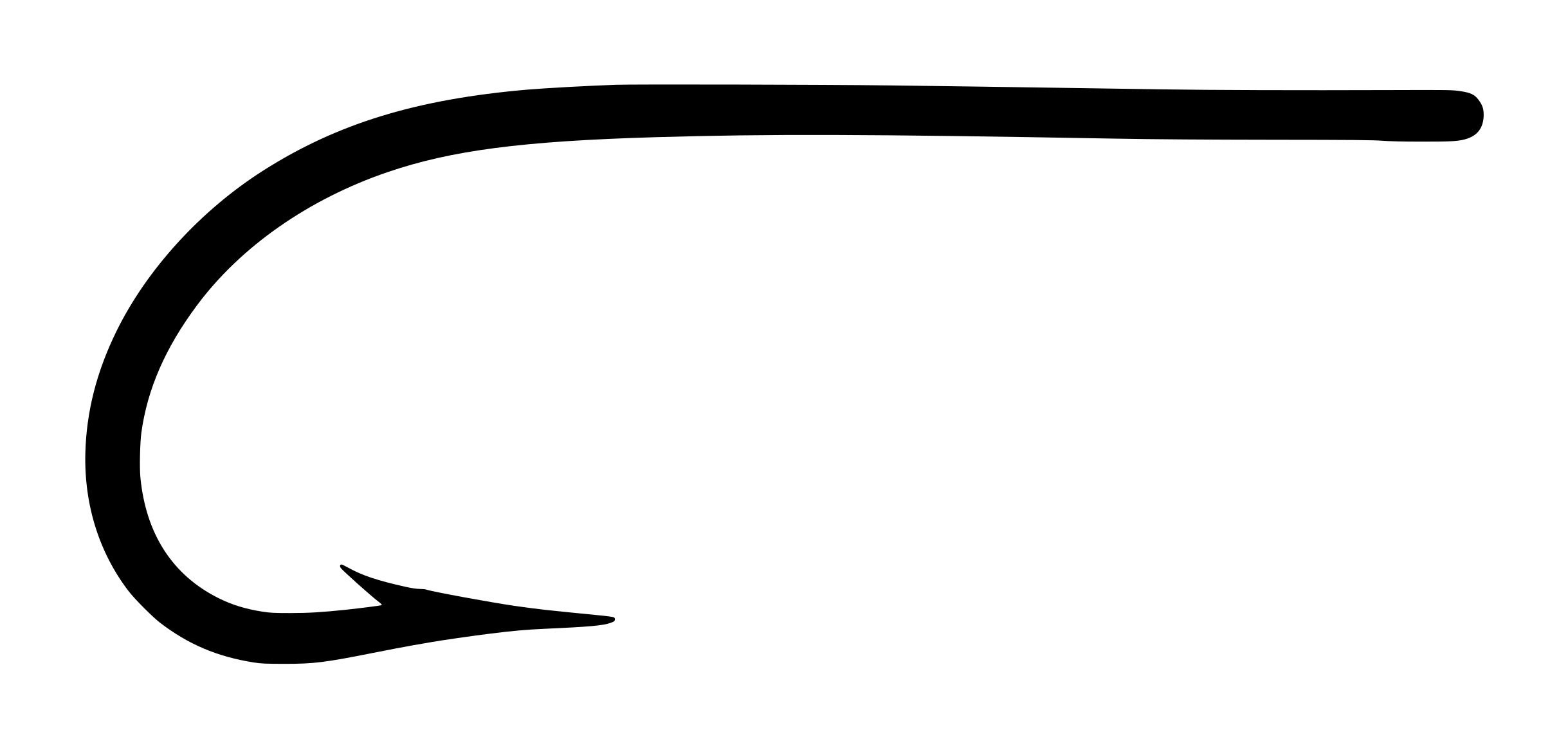
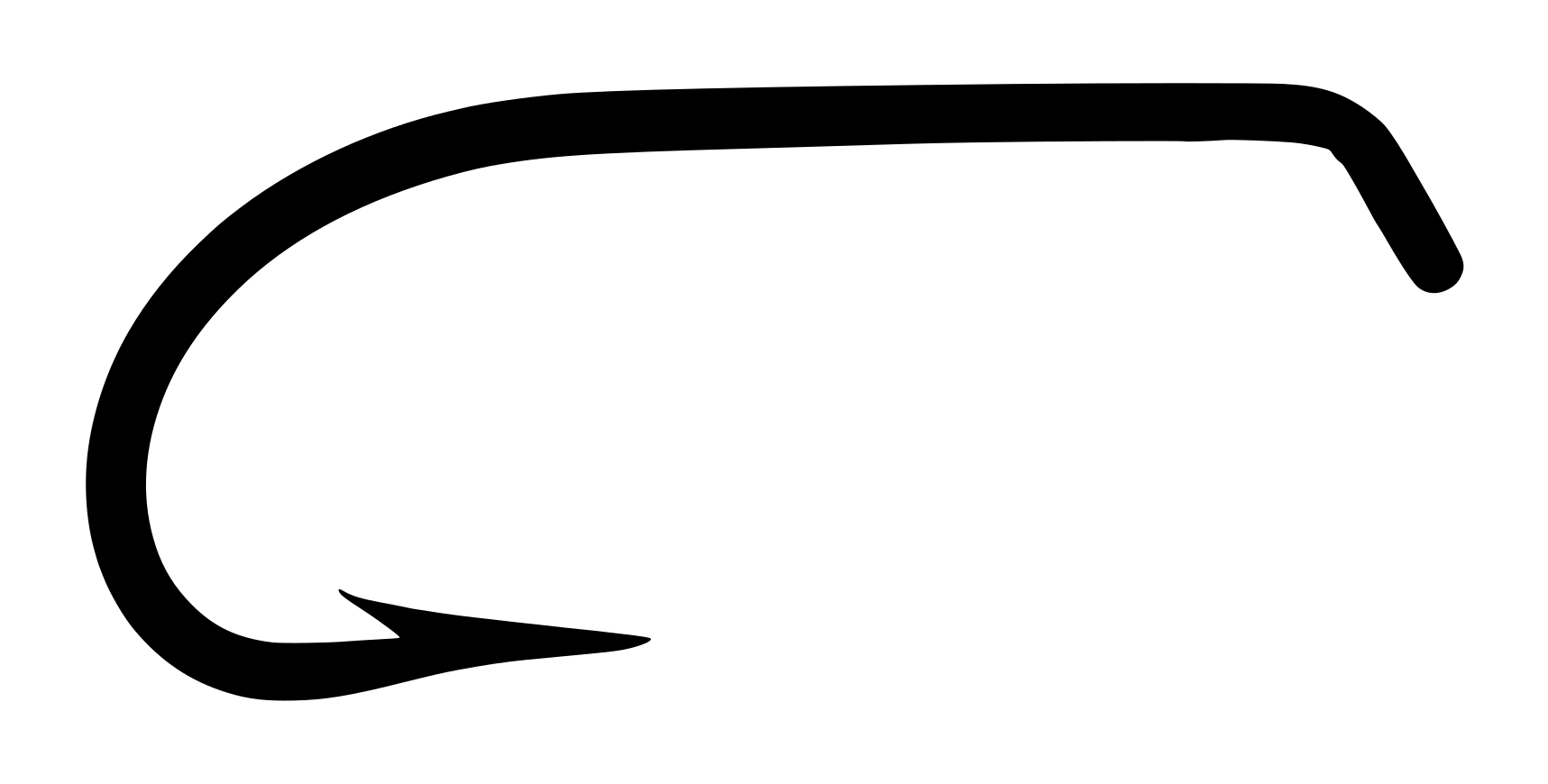
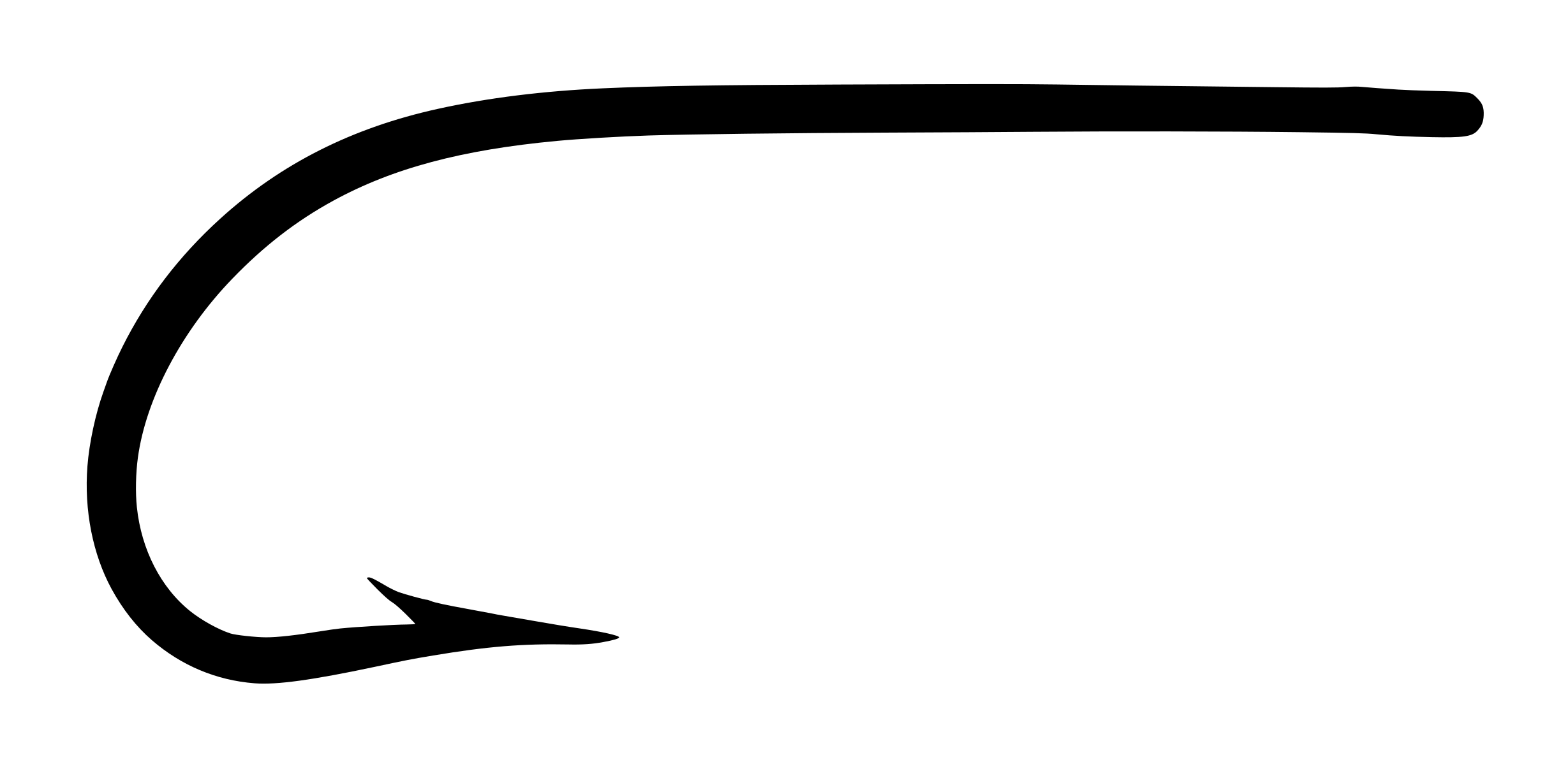
The Mustad 3407 is a legendary mid-century saltwater hook manufactured by O. Mustad & Søn of Gjøvik, Norway, and represents the pinnacle of tinned-carbon-steel hook engineering prior to the widespread adoption of stainless steel. This specimen, in size 10/0, was engineered for heavy commercial and sportfishing pursuits—rigging large natural baits for sharks, groupers, and powerful pelagic species in offshore and estuary environments.
The hook exhibits the defining characteristics of premium mid-century Mustad production: a forged O’Shaughnessy bend that locks the fish’s jaw securely, heavy-gauge tinned wire providing exceptional corrosion resistance, and a superior-geometry point with near-straight inner taper optimized for penetrating hard bone and cartilage. The original bright red ‘Key Brand’ label, eight-line typographical format, and ‘Oslo’ designation place this firmly in the post-1925 production era, with the specific label typography and red paper stock consistent with 1950s-1960s export packaging.
This vintage 3407 holds strong appeal for tackle historians and saltwater fishing tradition specialists. The size 10/0 is rarely encountered compared to smaller utility sizes, and surviving examples with original packaging in excellent condition command meaningful collector interest. The model embodies a crucial transitional era—the final generation of purely mechanical hook sharpening and hot-dip tinning before modern chemically-sharpened and electroplated processes became industry standard.
Original mid-century red-label box for the Mustad 3407 O'Shaughnessy hook, size 10/0, featuring the standard eight-line label format and Key Brand logo characteristic of Mustad's 1950s-1960s export packaging.
Photographic record
6 cataloged imagesSelect any record to load it above.
6 images shown
Mustad 3407 O’Shaughnessy Size 10/0 Vintage Box LabelOriginal mid-century red-label box for the Mustad 3407 O'Shaughnessy hook, size 10/0, featuring the standard eight-line label format and Key Brand logo characteristic of Mustad's 1950s-1960s export packaging.Open originalMustad 3407 Size 10/0 Point Profile and Barb DetailSide profile of the Mustad 3407 size 10/0 hook showing the superior-geometry point with near-straight inner taper and sharply-cut barb, photographed on measurement grid for scale reference.Open originalMustad 3407 Size 10/0 Complete Hook ProfileFull profile of the Mustad 3407 O'Shaughnessy hook, size 10/0, showing the distinctive parabolic bend, straight-ring eye, and overall proportions. Photographed on measurement grid for dimensional reference.Open originalMustad 3407 Size 2/0 Smaller VariantSmaller size 2/0 variant of the Mustad 3407 O'Shaughnessy hook, demonstrating the range of sizes produced under this quality code. Shows identical bend geometry and tinned finish as the larger 10/0 specimen.Open originalMustad 3407 Size 2/0 Package Label VariantOriginal packaging for the Mustad 3407 O'Shaughnessy hook in size 2/0, showing a later packaging format compared to the red-label vintage box. Features printed quality code (3407) and hook pattern name (O. SHAUGHNESSY).Open originalMustad 3407 Size 2/0 Multiple Hooks CollectionGroup of Mustad 3407 O'Shaughnessy hooks, size 2/0, showing consistent manufacturing quality and tinned finish across multiple specimens. Stored in original 'Salt Water Hooks' envelope.Open original
Technical profile
O. Mustad & Søn | Mustad 3407 | O'Shaughnessy | Superior Point | Forged Tinned | Size 10/0 | c. 1950-1970
Eye
Ball Eye, Straight / InlineLarge ringed eye formed by bending terminal wire back onto the main shank. Highly durable and suitable for heavy monofilament or wire leaders typical of saltwater rigging. P
Wire
Standard, Forged
Shank
Standard — Plain
Bend
O'Shaughnessy, Standard gapClassic O'Shaughnessy parabolic geometry with a slightly narrower gap than a true round bend, engineered to lock the lower jaw securely. P
Point
Superior (near-straight inner taper)Medium-length, sharply cut barb positioned just behind the point apex. Mechanically ground geometry characteristic of vintage Mustad production. P
Finish
Tinned — Confirmed (stated on packaging)Bright silver tinned finish typical of hot-dip tinning process. Even color tone consistent with vintage mid-century production. Specimen shows minimal corrosion, indicating excellent preservation. P
The O’Shaughnessy bend employs a parabolic curve that distributes mechanical stress evenly across the entire bend radius, providing superior resistance to straightening under the sudden, violent loading imposed by heavy saltwater species. The forging process—cold-forging the shank between lateral dies—flattens the wire cross-section and fundamentally alters the steel’s metallurgical structure, dramatically increasing structural rigidity and tensile strength without adding weight or thickness. Tinning (hot-dip electroplating in molten tin) creates a bright silver coating that provides exceptional resistance to saltwater corrosion. The superior point geometry, with its near-straight inner taper, concentrates penetration force while maintaining the structural strength necessary for driving through hard bone and cartilage. The combination of these engineering features—parabolic bend, forged wire, tinned finish, and superior point—creates a hook optimized for brute strength and reliability in the most demanding saltwater environments.
The Mustad 3407 represents one of the largest hook specimens documented within the garrenwood.com catalog, with size 10/0 being exceptionally rare in the collection. The tinned finish is among the finest surviving examples of pre-stainless-steel saltwater hook construction. The original red-label box represents an exemplary mid-century Mustad export label format, suitable as a reference example for label decryption and dating protocols.
Own this hook? Help us measure it.
We have measurements for sizes 10/0, 8. Know any others? Submit calipered measurements and we'll review and add them. Thank you!
The O’Shaughnessy bend represents a foundational saltwater hook pattern that Mustad reverse-engineered and standardized for global export in the late nineteenth and early twentieth centuries. The bend geometry—a parabolic curve engineered to lock the lower jaw of heavy fish—was originally developed by regional craftsmen and became the de facto standard for commercial marine fisheries and big game sportfishing. The Mustad 3407 quality code placed this model in the mid-tier product range (3000-3999 block), manufactured to exacting dimensional and tempering standards. Tinned carbon steel was the premium marine choice prior to the widespread adoption of stainless steel and modern Duratin finishes. The model remained in continuous production throughout the mid-to-late twentieth century, eventually superseded by the 34007 (stainless steel) and 3407-DT (Duratin finish) variants.
Era and Packaging Dating
Oslo designation on Line 3 (Oslo renamed from Christiania in 1925, placing label post-1925). Bright red paper stock and letterpress typography are characteristic of Mustad's mid-century export packaging circa 1950s-1960s. Eight-line label format was standard during this period. Absence of barcode (barcodes not standard until mid-1970s) confirms pre-1974 production. The specific red color and font choices match known mid-century Mustad export labels.
Sharks and Goliath Groupers: The Big Game Era
In the 1950s and 1960s, a size 10/0 Mustad 3407 hook was a standard choice for commercial shark fishing in Florida and Australia, where professional anglers rigged them with whole mackerel or mullet on heavy 400+ pound-test line. These massive hooks were also employed in the nascent 'big game' sportfishing industry immortalized by Ernest Hemingway and later popularized through television fishing shows. The sheer physical mass of a 10/0 hook—capable of penetrating 8+ inches into the buccal cavity of a large predator—represented the absolute cutting edge of hook engineering before the advent of stainless steel and modern chemically-sharpened points.
Design lineage and influence
The O’Shaughnessy bend’s origins trace to traditional Irish and British saltwater hook designs developed for Atlantic salmon and sea trout fishing in the nineteenth century. Mustad’s mechanized reproduction of this regionally-favored pattern exemplified their industrial strategy of ‘cloning’ highly localized, successful designs and producing them with unprecedented mechanical efficiency. The heavy forged wire and tinned finish represented the state-of-the-art in corrosion resistance prior to stainless steel becoming cost-effective for hook production. The Mustad 3407 remained virtually unchanged in geometry and finish throughout its production run, a testament to the enduring effectiveness of the nineteenth-century design principles underlying the O’Shaughnessy bend.
Best matchRelated by Attribute
Computed automatically from catalog data — updated as new hooks are added.
Matches: Bend, Shank, Gap, Eye, Eye Orient. +5 moreDiffers: Wire: Standard vs Heavy (1X Heavy); Finish: Tinned vs Nickelled; Application: Streamer, Saltwater vs Bait, Saltwater +2 more
Heavy saltwater bait fishing for large pelagic and demersal species. The Mustad 3407 was engineered for rigging natural baits—whole mackerel, squid, fish heads, and similar large offerings—for commercial and sportfishing pursuits targeting sharks, groupers, and large tuna in offshore and estuary environments. The forged O’Shaughnessy bend and heavy tinned wire provide exceptional structural integrity under the crushing jaw pressure and sustained runs of powerful saltwater species.
Modern Equivalents
Hook
Match Quality
Notes
Tiemco TMC 811S
Excellent
Direct equivalent O'Shaughnessy saltwater hook with identical 2XH/1XL proportions and forged construction.
Daiichi 2546
Excellent
Direct equivalent O'Shaughnessy bent saltwater hook with matching wire gauge and ringed eye design.
Dai-Riki 930
Very Good
O'Shaughnessy style saltwater hook with extra-heavy wire, widely used as 3407 replacement.
Partridge CS52
Very Good
O'Shaughnessy bent hook in British tradition with comparable saltwater capability and durability.
Gamakatsu SS15
Good
Heavy-wire O'Shaughnessy variant suitable for saltwater and bait applications with modern sharpening.
Orvis 9034
Good
O'Shaughnessy saltwater hook reference model with comparable bend and wire specifications.
Eagle Claw 254SS
Good
Stainless steel O'Shaughnessy bent hook suitable for saltwater and bait fishing.
Industry cross-reference
Saltwater streamer hook
Standard / long shank corrosion-resistant baitfish
Green entries are full records; amber entries are spec records.
Gray entries are chart-only and not physically verified against this specimen.
Collector notes
The Mustad 3407 O'Shaughnessy is a workhorse industrial hook with modest collector appeal, valued primarily for its utility and recognizable brand heritage rather than rarity or condition premiums.
Reference value
$16 – $18 USD estimate
Packaging condition
Excellent — minimal wearRecorded specimen
Packaging format
MUS-MID-01Catalog code
Positive factors: Established Mustad brand with strong recognition among vintage anglers; O’Shaughnessy pattern remains in production and holds nostalgic appeal for mid-century fishing enthusiasts; tinned finish variants attract users and light collectors; consistent availability in bulk (100-count) packaging suggests good original distribution.
Limiting factors: Mass-produced industrial hook with minimal variation between examples; no significant condition premiums evident in sold data; modern reproductions and current production undermine scarcity; bulk-pack format (100-count) limits appeal to single-hook specialists; pricing remains anchored to functional utility rather than collectible status.
Desirable variants: Earlier 1950s–1960s packaging, original cardboard boxes, and DT (dry/tinned) designations in smaller sizes (#4, #2/0) command modest premiums; examples with original Mustad labels and intact packaging approach high end of range.
Packaging
Bright red paper label with black Key Brand logo and text. Eight-line label format per Mustad standard (O. MUSTAD & SÖN / MANUFACTURERS / OSLO - NORWAY / Qual. 3407 / Superior / Mustad- O'Shaughnessy Hooks / Forged Ringed Tinned / Made in Norway). Size and quantity printed in lower left (100 No. 10). Label shows light aging and minor edge wear consistent with mid-20th century vintage stock.
Market Value Notes
Low ($16): New condition, bulk 100-count box
High ($18): New condition, 100-count bulk pack
Premium factors: Smaller sizes (#4–#2/0), original packaging, tinned finish designation (DT variant)
Platforms: eBay
Confidence: V verified — based on 2 eBay sold listing(s), $15.80–$18.08
Where to Find
eBay (vintage fishing hooks category), specialist vintage tackle dealers (particularly those focused on saltwater or big game heritage), local tackle and antique fairs, estate sales of deceased anglers, and occasional finds through online auction houses. Larger sizes (8/0 and above) are less common than smaller utility sizes and may require patient searching or direct dealer contacts.
Collector's Identification Tips
The Mustad 3407 is positively identified by the eight-line label format with ‘Qual. 3407’ on Line 4 and ‘Superior’ on Line 5. The red paper stock, Oslo designation (post-1925), and bright red color are characteristic of mid-century production. The hook itself features a distinctive parabolic O’Shaughnessy bend, heavy forged wire with visible lateral flattening, a large straight-ring eye, and bright silver tinned finish. Size 10/0 represents a massive specimen—approximately 3.5 inches overall length with a 1.6-inch gap width. Compare against the modern stainless steel equivalent (Model 34007) or the later Duratin variant (3407-DT), both of which have different packaging and finish characteristics.
eBay market reference. Researcher-curated. Prices in USD. Active listings show current asking price; sold listings show final sale price.
Preservation
Storage and Preservation
The tinned finish of the Mustad 3407 is remarkably corrosion-resistant if properly stored, but long-term preservation requires careful environmental control. Store hooks in a cool, dry location with relative humidity below 50%. Avoid direct sunlight, which can degrade the original red-label packaging. The original box should be retained on the card rather than removing hooks loose—the card provides additional protection and significantly enhances collector value. If hooks must be stored loose, keep them in sealed, uncoated steel or glass containers with silica gel desiccant packets, replacing the desiccant every 6-12 months.
Tinned hooks may develop a light patina or ‘bloom’ (a fine whitish surface oxidation) over decades, which some collectors consider desirable as evidence of age and authenticity. Do not attempt to polish or chemically clean tinned specimens, as aggressive cleaning removes the original finish and destroys the patina that certifies age. If corrosion (actual rust, not patina) develops, isolate the affected hooks from others and consider consulting a professional conservator experienced with fishing tackle before attempting any remediation.
Original packaging (the red-label box shown) should be displayed away from sources of moisture and temperature fluctuation. Frame or display the label under UV-filtering glass to slow color fading. If the box shows moisture damage or foxing (brown spots from mold), consult a paper conservator before attempting any cleaning. The eight-line label is a primary artifact documenting Mustad’s mid-century manufacturing practices and deserves archival-quality storage.
Primary Source
Decoding the Mustad Red-Label Box
Source: O. Mustad & Søn — Vintage Hook Labels: Comprehensive Typology and Decryption (garrenwood.com reference document 1); Mustad Label Guide (garrenwood.com reference document 2)
The eight-line red-label box format is Mustad’s standardized typographical system for communicating comprehensive technical information to international wholesalers, retailers, and end-users across linguistic barriers. Each line serves a strictly defined function: Line 1 (O. MUSTAD & SÖN) establishes manufacturer identity; Line 2 (MANUFACTURERS) differentiates the primary maker from import agents and repackagers; Line 3 (OSLO – NORWAY) documents origin and provides chronological bracketing (Oslo renamed from Christiania in 1925, so any label reading ‘Christiania’ is pre-1925); Line 4 (Qual. 3407) specifies the quality/model code denoting product tier and baseline design; Line 5 (Superior) identifies the hook point geometry or quality grade—this field is restricted exclusively to point descriptors and never specifies eye type, shank length, or other features; Line 6 (Mustad- O’Shaughnessy Hooks) names the bend pattern; Lines 7-8 (Forged Ringed Tinned / Made in Norway) detail wire treatment, eye type, and metallurgical finish.
The bright red paper stock, black letterpress typography, and specific font choices are characteristic of Mustad’s mid-century export packaging (approximately 1950s-1960s). The presence of the Key Brand logo (downward-pointing skeleton key) in the upper left confirms this is an official Mustad product rather than a repackaged third-party hook. The notation ‘100 No. 10’ in the lower left corner indicates the box contained 100 hooks of size 10/0, a standard export quantity. The absence of a barcode—barcodes were not standard on fishing tackle until the mid-1970s—provides strong evidence of pre-1974 manufacture.
The term ‘Superior’ on Line 5 has generated considerable confusion among modern anglers and collectors. According to Mustad’s official typographical rules, this line is reserved exclusively for defining the point style or quality grade. In the context of the 3407, ‘Superior’ indicates a point geometry with a near-straight inner taper that concentrates penetration force while maintaining structural strength. This is distinct from the broader use of ‘Superior’ as a product line name on some Mustad marketing materials—on the eight-line technical label, ‘Superior’ is a precise geometric descriptor, not a quality judgment.
Additional
The O'Shaughnessy Bend: Engineering a Parabolic Masterpiece
The O’Shaughnessy bend is a distinctly Irish and British design that emerged in the nineteenth century as a response to the specific anatomical challenges of salmon and heavy saltwater species. Unlike a simple round bend, which distributes stress unevenly across a narrow apex point, the O’Shaughnessy employs a parabolic curve—mathematically, a conic section that distributes mechanical load evenly across the entire bend radius. This elegant geometry means that when a 300-pound saltwater species makes a violent head shake or performs an erratic run, the stress is dissipated gradually across the bend rather than concentrating at a single failure point.
Mustad’s mechanized production of the O’Shaughnessy—combined with forged wire construction that fundamentally alters the steel’s metallurgical structure—produced a hook that was simultaneously stronger and lighter than hand-forged competitors. The lateral flattening of the wire during the forging process creates a cross-section that is significantly more rigid in the vertical plane (the plane of maximum stress during a fish fight) while remaining flexible in the lateral direction, allowing the hook to ‘give’ slightly rather than snapping under sudden loading.
The tinned finish applied to the 3407 was not merely cosmetic; hot-dip tinning creates a metallurgical bond between the tin coating and the underlying high-carbon steel that provides exceptional corrosion resistance in saltwater environments. This coating proved so effective that many professional commercial fishermen continued using tinned-carbon-steel hooks long after stainless steel became available, viewing the higher cost of stainless steel as unnecessary when properly maintained tinned hooks lasted through entire fishing seasons.
Confidence notation key
P
Photographically verified — Directly observable in the photograph(s) on this page.
V
Verified by documentation — Confirmed by manufacturer catalog, spec sheet, or published reference.
I
Inferred — A logical deduction from observable or documented evidence, not directly stated.
E
Estimated — An approximation based on visual comparison, proportional analysis, or limited data.
S
Speculative — A reasoned hypothesis that cannot be confirmed from available evidence.
Unnotated claims are the compiler’s synthesis; see Sources. All photographs on garrenwood.com are taken on a measurement grid where each square equals 1/10 inch (0.1″ / 2.54 mm).