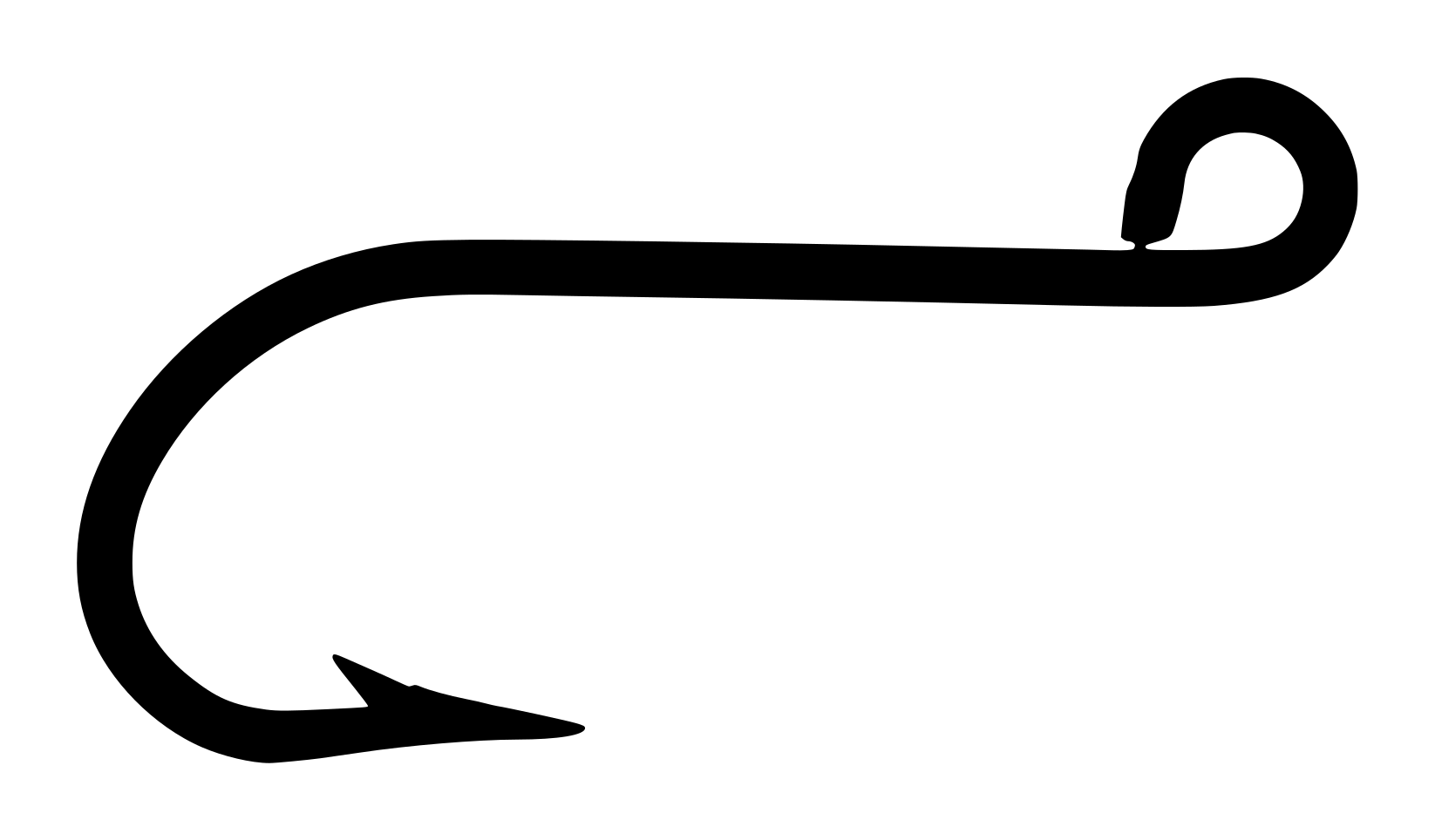
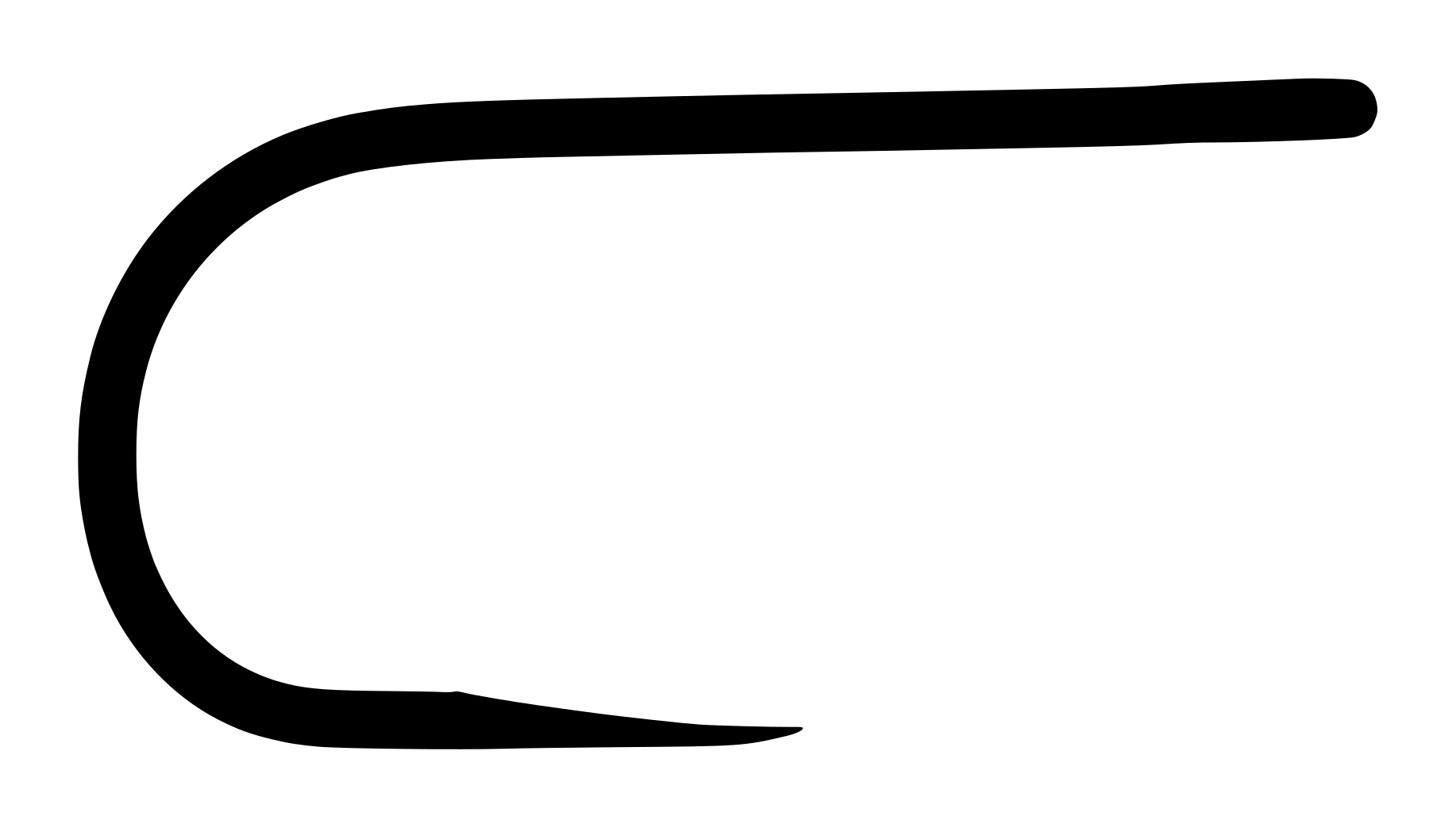
The Mustad 3739 A is a diminutive Aberdeen-pattern bait hook manufactured by O. Mustad & Søn in Oslo during the mid-20th century. This model represents a specialized niche in vintage hook production: an extra-short-shank Aberdeen with a marked (serrated) blind eye, designed for the snelling technique that was routine before the modern ringed eye became standard.
The defining characteristic is its blind flatted shank with raised transverse grooves—a feature engineered to grip silkworm gut or early monofilament snood when hand-whipped directly to the hook with silk thread. The hollow point delivers rapid penetration suitable for soft-mouthed bait fish and panfish. The exceptionally short shank distinguishes this from traditional Aberdeen patterns and suggests use as a ‘hiding’ hook, burying the entire hook inside soft paste, dough balls, or salmon eggs.
Packaged in a gold-foil label with decorative floral border—a hallmark of Mustad’s mid-century export boxes—this model embodies an era when angling knowledge was transmitted through memorization of arbitrary quality codes and hands-on mastery of tackle preparation. The 3739 A is now scarce in original packaging, making it a valuable artifact of vintage bait-fishing culture.
The original gold-foil retail box for Mustad 3739 A Aberdeen hooks, featuring the distinctive Key Brand logo and decorative six-pointed star border characteristic of Mustad's mid-century export packaging.
Photographic record
3 cataloged imagesSelect any record to load it above.
3 images shown
Mustad 3739 A Original Retail Box — Size 4The original gold-foil retail box for Mustad 3739 A Aberdeen hooks, featuring the distinctive Key Brand logo and decorative six-pointed star border characteristic of Mustad's mid-century export packaging.Open originalMustad 3739 A Hooks — Profile View — Size 4Side profile of two Mustad 3739 A hooks showing the blind flatted eye with transverse grooves (marked shank), extra-short shank, wide round bend, and tapered hollow point. Bronzed lacquer finish is uniform.Open originalMustad 3739 A Point Detail — Size 4 — Hollow PointClose-up detail of the Mustad 3739 A hook point showing the distinctive hollow (concave) inner face profile, the fine sharp tip, and the short, clean-cut barb positioned at the junction of point and shank.Open original
Technical profile
Eye
Blind — Marked ShankBlind eye with transverse ridging/serrations. No loop formed. Design reflects pre-modern ringed-eye era and snelling tradition. P
Wire
Heavy (1X Heavy), Round, Est. ~0.040"-0.050" (~1.0-1.3 mm)
Shank
Short (1X–2X Short) — Marked / Ridged
Bend
Aberdeen, Wide gapClassic Aberdeen round bend with generous depth and gape. The gape is notably wide relative to shank length, characteristic of Aberdeen pattern and consistent with Aberdeen family geometry. Bend symmetry is clean and uniform. No lateral offset. P
Point
Hollow Point (concave inner face)Short, clean-cut barb positioned at the junction of point and shank. Barb angle is moderate; appears to be swept slightly back. Barb size proportionate to fine wire gauge. P
Finish
Bronzed — Inferred (photographically likely)Bronzed lacquer finish with warm brownish-gold hue. Uniform surface with minimal wear on specimen. Labeled 'Marked Rustproof,' indicating proprietary heat-treatment or lacquer designed for corrosion resistance. Color tone suggests period-appropriate bronzed lacquer rather than japanned black. P
Hooks are bright and undamaged with no visible corrosion. Original packaging shows light toning and minor creasing but remains legible and intact. Gold foil label maintains color and adhesion.
The hollow point geometry on the 3739 A creates a concave, dished-out inner face that tapers rapidly from the tip toward the barb. This design yields an exceptionally sharp tip that penetrates soft tissue with minimal applied pressure—ideal for fish species with tender mouth structures (crappie, panfish, delicate trout). The rapid flare from the hollow point’s razor edge to the barb creates a mechanical ‘lock’ once the point penetrates past the barb, preventing the hook from tearing free during gentle hand-line fishing or light-rod presentations.
The marked (transversely grooved) shank was engineered to grip the snelling material (originally silkworm gut, later monofilament) under the tension created by a hand-whipped silk thread wrap. The grooves—typically 3–5 shallow ridges running perpendicular to the shank axis—prevent the snood from rotating or sliding along the steel, distributing load evenly across the entire wrapped length rather than concentrating stress at a single knot point. The fine wire gauge minimizes trauma to soft baits while maintaining sufficient tensile strength for typical freshwater species. The broad Aberdeen bend distributes stress evenly across the arc, preventing the hook from straightening under moderate load.
We have measurement for size 2. Know any others? Submit calipered measurements and we'll review and add them. Thank you!
Historical context
mustad
O. Mustad & Søn was founded in 1832 in Gjøvik, Norway, initially as a general metalware manufacturer (Brusveen Spiger- og Staltradfabrikk), producing nails, steel wire, and cast-iron goods. The company was rebranded as O. Mustad & Søn under the ownership of Ole Hovelsen Mustad and his son Hans Mustad. The defining moment in the company’s history came in 1877 when Mathias Topp invented the first fully automated hook-making machine—a mechanized process that could continuously feed raw steel wire, cut, bend, barb, and point hooks at unprecedented speed and scale. Rather than filing patents (which would require public disclosure), the Mustad family protected their monopoly through corporate secrecy, non-disclosure agreements, and restricted factory access.
This strategy proved devastatingly effective against competitors in Redditch, England, and various manufacturing hubs across Japan and the United States. By the 1950s, Mustad had secured approximately 50% of the global hook production market, establishing sales offices and manufacturing facilities across multiple continents. The company’s dominance persisted through the mid-20th century, making the Mustad name virtually synonymous with the fishing hook itself. The 3739 A represents the apex of Mustad’s mid-century production era, when the company was distributing hooks to every major fishing market on Earth.
Series History
The 3739 A belongs to Mustad’s Aberdeen-pattern family, a widely produced line of light-wire, open-bend hooks intended primarily for delicate bait applications. However, the 3739 A is a specialized variant within that family: while traditional Aberdeen patterns feature long shanks (2X to 4X long) designed to accommodate large live baits like minnows, the 3739 A introduces an ‘Extra short shank’ configuration. This shorter profile, combined with the marked flatted eye, suggests this hook was engineered for a very specific fishing technique—the concealment of the entire hook inside soft, cohesive baits (dough, paste, salmon eggs) rather than the live-minnow presentation typical of standard Aberdeen hooks.
The marked (serrated) shank reflects the snelling tradition, which peaked in the early-to-mid 20th century. As modern monofilament line and pre-formed eye construction became widespread in the 1960s–1970s, the demand for blind-eye, snelled hooks declined sharply. By the 1980s, the 3739 A and similar marked-shank models had been discontinued in favor of ringed-eye variants. The 3739 A thus represents a transitional moment in tackle history—a hook design optimized for hand-prepared rigs and direct-to-shank line attachment, soon to be rendered obsolete by manufacturing advances and changing angling practices.
Era and Packaging Dating
Gold foil label with floral star-pattern border is characteristic of Mustad mid-century packaging. Location stated as Oslo (not Christiania), confirming post-1925 manufacture. Typography of 'Key Brand' logo and label layout matches Mustad's 1950s–1960s styling. Absence of barcode (pre-1974 standard). Paper stock and letterpress print method typical of era. No plastic packaging or modern binding visible.
The Lost Art of Snelling
The practice of 'snelling' a hook—wrapping the line directly to the shank with fine silk thread and pitch—was so fundamental to 19th-century angling that manufacturers like Mustad engineered entire hook families around it. The marked shank on the 3739 A represents embedded knowledge about line physics and knot mechanics that pre-dates the modern improved clinch knot. A skilled angler could produce a snelled hook connection that was nearly unbreakable, distributing load evenly along the wrapped section. The very existence of blind-eye hooks in the Mustad catalog serves as a time capsule: when you hold a 3739 A, you are holding a tool designed for a fishing technique that required practice, patience, and tacit knowledge—a far cry from the cast-and-retrieve culture of modern angling.
Design lineage and influence
The 3739 A’s marked shank design traces its ancestry directly to 18th- and 19th-century British hook-making traditions, particularly the ‘spade-end’ or blind-eye hooks produced by Redditch craftsmen for salmon and sea-trout fishing. In that era, all hooks lacked formed eyes; instead, anglers ‘snelled’ their hooks using soaked silkworm gut whipped tightly to the shank with fine silk thread. The serrated or grooved shank end served to anchor the thread wrap and prevent the knot from sliding under the pressure of a fighting fish.
When O. Mustad & Søn industrialized hook production in the late 1800s, they reverse-engineered and mass-produced regional patterns, including blind-eye variants. The 3739 A appears to represent Mustad’s interpretation of a compact Aberdeen-style snelled hook, possibly adapted from regional British or Scandinavian fishing traditions. As ringed eyes became the de facto standard (driven by mechanization and the shift to direct line knotting), blind-eye models like the 3739 A persisted in niche markets—particularly among traditional bait anglers and in geographic regions where hand-snelling remained culturally entrenched. Modern spade-end hooks, still produced by European manufacturers (Drennan, Kamasan) for match fishing, represent the direct evolutionary descent of this design.
Best matchRelated by Attribute
Computed automatically from catalog data — updated as new hooks are added.
Matches: Bend, Gap, Eye, Eye Orient., Point +4 moreDiffers: Shank: Short (1X–2X Short) vs 1X Long; Wire: Heavy (1X Heavy) vs Extra-Fine; Finish: Bronzed vs Blued
Matches: Bend, Gap, Eye, Eye Orient., Point +4 moreDiffers: Shank: Short (1X–2X Short) vs 3X Long; Wire: Heavy (1X Heavy) vs Fine (1X Fine); Finish: Bronzed vs Blued +1 more
Matches: Shank, Gap, Eye, Eye Orient., Forging +2 moreDiffers: Bend: Aberdeen vs Round / Kendal; Wire: Heavy (1X Heavy) vs Standard; Point: Hollow Point vs Standard / Spear +2 more
Matches: Bend, Eye, Eye Orient., Forging, BarbDiffers: Shank: Short (1X–2X Short) vs Standard; Wire: Heavy (1X Heavy) vs Standard; Gap: Wide vs Standard +3 more
The Mustad 3739 A is a bait hook engineered for soft-mouthed freshwater species—primarily panfish (crappie, bluegill), small trout, and dace. The hollow point delivers delicate initial penetration with minimal applied force, ideal for fish with friable mouth tissues that tear easily under aggressive hook-sets. The extra-short shank allows the angler to conceal the entire hook inside soft baits such as dough balls, pasta, single salmon eggs, or small grubs, reducing visibility to wary fish. The marked shank accommodates the snelling process, a pre-1970s technique where the angler hand-whipped braided silk or early monofilament snood directly to the flattened, grooved shank.
Secondary Applications
Historic fly tying (spider patterns, wet flies), though less common than bait fishing applications due to size and blind-eye design.
Classic Fly Patterns
Not typically used for fly tying.
Modern Equivalents
Hook
Match Quality
Notes
Tiemco 2487 (Scud)
Good
Similar short-shank, wide-gape geometry; modern ringed eye replaces blind design. Used for bait and nymph presentations.
Drennan Spade End (sizes 16–20)
Moderate
Blind-eye, marked-shank design still produced for European match fishing. Much smaller sizes; similar snelling concept.
Mustad 37140 (Modern Aberdeen)
Moderate
Mustad's contemporary Aberdeen pattern. Standard shank, ringed eye, hollow point. Retains the core Aberdeen geometry but abandons blind-eye design.
Collector notes
The 3739 A is scarce in original packaging and represents a specialized niche—marked-shank, blind-eye bait hooks are increasingly difficult to find as the snelling tradition has faded. However, demand is modest compared to rare fly hooks or premium salmon patterns, limiting collector premium.
Reference value
$8 – $18 USD estimate
Packaging condition
Good — moderate wear, legibleRecorded specimen
Packaging format
GW-M-01Catalog code
Positive Factors: Original gold-foil mid-century label is distinctive and visually striking. Marked (serrated) shank represents a defunct manufacturing technique and fishing method, making it historically significant. No. 4 size is notably large for a blind-eye hook, suggesting specialized commercial use. Complete, legible packaging with handwritten size mark adds documentary value. Perfect artifact for collectors interested in pre-modern tackle history and snelling techniques. Mustad’s dominance in the global market makes their products universally recognized.
Limiting Factors: Blind-eye designs hold far less collector appeal than ringed-eye hooks; most modern anglers are unfamiliar with the snelling technique. Bait hooks are generally less valued than fly hooks by the collector base. No. 4 size is large and unwieldy by modern standards, limiting functional curiosity. Aberdeen pattern is extremely common (still produced); the unique features are the marked shank and extra-short configuration, which are difficult to spot in quick online searches. Supply is steady but not abundant—original boxes do appear at estate sales and antique tackle dealers, preventing extreme scarcity pricing.
Packaging
Cardboard retail box, approximately 3.5" × 2.5" (89 × 64 mm). Gold foil label with decorative floral (six-pointed star) border in gold ink on cream/off-white paper stock. Letterpress printing. Label text: 'Key Brand' logo (skeleton key motif, upper left); 'O. MUSTAD & SÖN' (Line 1); 'MANUFACTURERS' (Line 2); 'OSLO - NORWAY' (Line 3); 'Qual. 3739 A' (Line 4); 'Hollow Point Special' (Line 5); 'Mustad-Aberdeen Hooks' (Line 6); 'Marked Rustproof / Extra short shank' (Lines 7–8); '100 No. 4' (quantity and size, handwritten in purple ink). Box construction: thin cardboard, intact edges, minimal creasing. Interior likely compartmentalized for 100 hooks. No barcode, no UPC, no modern safety labeling. No modern adhesive remnants or restocking marks visible.
Market Value Notes
Original boxed examples in good condition command $12–18 USD depending on collector interest. Condition of original label and paper stock significantly affects value. Loose hooks of this pattern are common and inexpensive ($0.50–2 USD); value derives entirely from original packaging and model rarity. High demand among vintage bait-fishing enthusiasts and tackle historians. European collectors often pay premiums for marked-shank models due to cultural connection to spade-end traditions.
Where to Find
Vintage eBay listings, specialist tackle dealers, estate auctions. Less commonly seen than modern Mustad stock; searches should include 'marked shank,' 'blind eye,' or 'snelled hook' terms. Redditch and Gjøvik collector networks occasionally stock original boxed examples.
Collector's Identification Tips
Identify by the distinctive marked (grooved/serrated) flatted shank end—a feature almost never seen on modern hooks. Label will read ‘Qual. 3739 A,’ ‘Marked Rustproof,’ and ‘Extra short shank.’ The gold foil label with decorative border is characteristic of Mustad’s mid-century export packaging. Size No. 4 is quite large for a blind-eye hook, making it immediately recognizable. Look for the ‘Oslo – Norway’ location line; absence of barcode confirms vintage status. Compare to modern Mustad equivalents (Signature Series), which feature entirely different alpha-numeric nomenclature (R-series).
Preservation
Storage and Preservation
Store the original boxed hooks in a cool, dry environment away from direct sunlight and humidity. The bronzed lacquer finish is durable but can develop patina with age—collectors generally consider this desirable and evidence of authenticity. Keep the box intact and undisturbed; original packaging is the primary driver of collectability and historical value.
If removing hooks from the original card for study or fishing use, store them separately in a rust-resistant container with silica gel packets to control moisture. Do not use hooks that have been stored in damp conditions without inspection for rust initiation at the point or barb.
Avoid contact with other metals, particularly copper-containing alloys, which can trigger galvanic corrosion on the high-carbon steel. If the specimen becomes wet during fishing use, dry thoroughly with a soft cloth and store with desiccant. The marked (grooved) shank should be cleaned carefully—dried salt or mineral deposits can accumulate in the grooves and promote localized corrosion.
Original labels sometimes fade or become brittle with time. Avoid handling the label excessively or attempting to ‘restore’ it; patina and aging are authentic markers of vintage status. If the box is very fragile, consider archival storage in a stable-humidity environment (40–50% RH, 65–70°F) and minimize handling.
Marking Analysis
Manuscript Annotation — Size Mark
A purple-ink hand-written size mark (‘No. 4’) appears in the lower right corner of the gold foil label. The hand is deliberate and rapid, consistent with factory production-line annotation rather than collector markup. Numerals are clean and legible, without decorative flourish or personalization. This mark was likely applied at the point of packaging or quality-control fulfillment by a Mustad employee, and is entirely consistent with period factory practice for size verification or lot identification.
The presence of this annotation in factory-style script (as opposed to collector’s notation in different ink or hand) supports the authenticity of the original packaging and suggests the hooks were part of an active commercial lot, not a specialty or commemorative run.
Size Note
Unusual Size: No. 4 in a Blind-Eye Pattern
The No. 4 size designation is notably large for a marked-shank, blind-eye hook. Historical blind-eye patterns—particularly those descended from British salmon and sea-trout traditions and refined by Redditch craftsmen—typically appear in much smaller sizes (8–16), where the delicate presentations and hand-snelled connections were most appropriate.
The No. 4 size on the 3739 A suggests specialized use cases: possibly larger panfish (bluegill, crappie) or small catfish applications; regional commercial fishing in markets where blind-eye hooks remained standard; or a deliberate variant combining modern Aberdeen short-shank geometry with traditional marked-shank construction for reasons of manufacturing continuity or regional preference.
The size remains unusual within the secondary market and among collector networks. Marked-shank Aberdeens of sizes 8–12 are significantly more common. This unusually large No. 4 variant may represent a limited regional production run or a specialized product line not widely distributed through Mustad’s global export network.
Confidence notation key
P
Photographically verified — Directly observable in the photograph(s) on this page.
V
Verified by documentation — Confirmed by manufacturer catalog, spec sheet, or published reference.
I
Inferred — A logical deduction from observable or documented evidence, not directly stated.
E
Estimated — An approximation based on visual comparison, proportional analysis, or limited data.
S
Speculative — A reasoned hypothesis that cannot be confirmed from available evidence.
Claims with no notation are confirmed by multiple independent sources. All photographs on garrenwood.com are taken on a measurement grid where each square equals 1/10 inch (0.1″ / 2.54 mm).