The Mustad 3480 is a Norwegian-manufactured lake trout hook from circa 1945–1960, engineered as a heavy-wire blind-eye bait hook for trolling and snelled bait fishing applications. Distinguished by its sproat bend, long shank, and marked blind-eye construction, the pattern reflects a transitional period in fishing tackle history when traditional whipped snells still dominated many freshwater trolling fisheries. The original Oslo-era packaging identifies the hook as ‘Marked Blued’ with a ‘Superior’ point designation, consistent with Mustad’s mid-century export labeling practices.
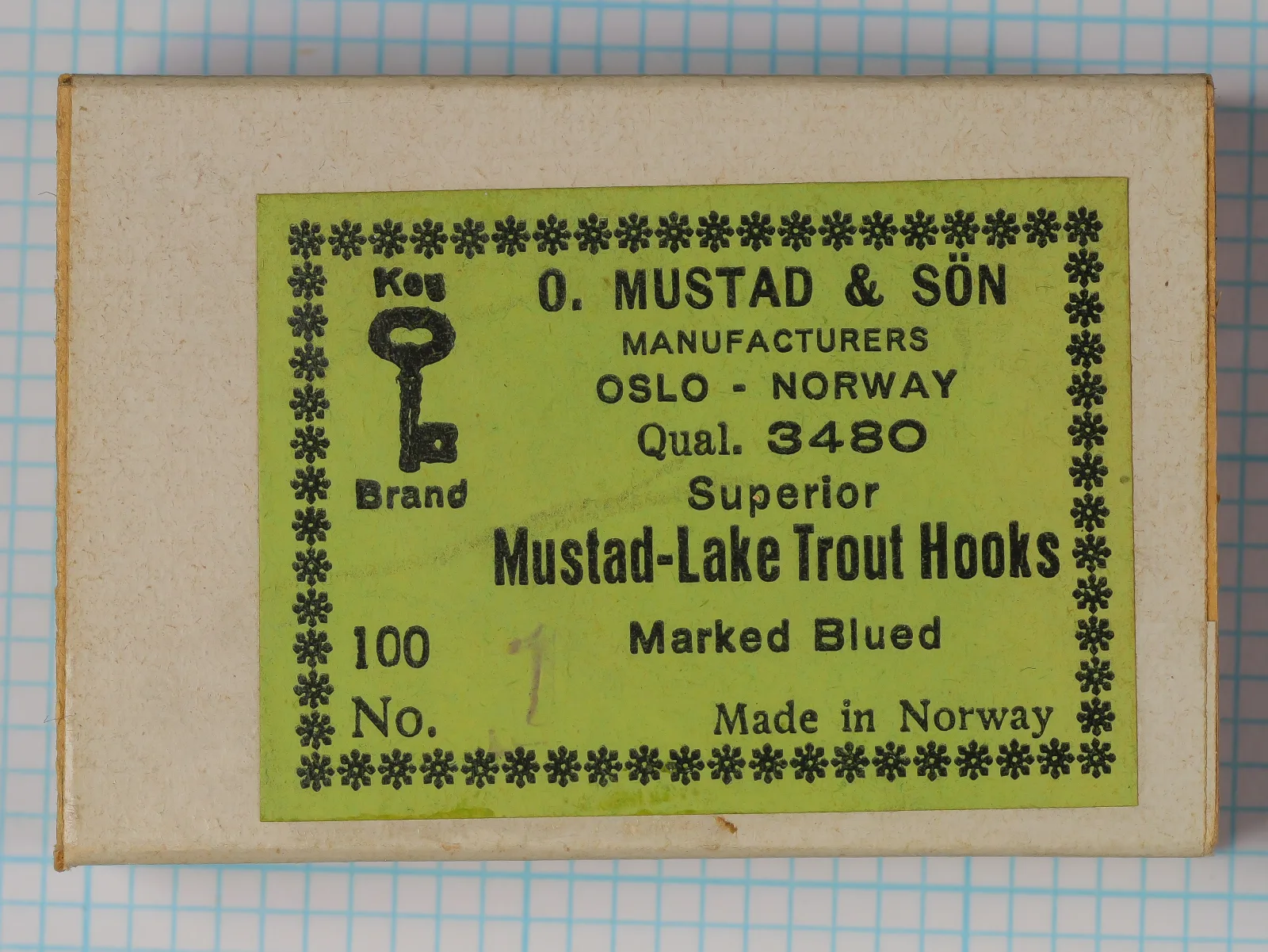
Original yellow-green cardstock box for 100 Mustad 3480 hooks showing the full eight-line label with Key Brand logo, Quality code, Superior point designation, and marked blued finish specification. Oslo-Norway address indicates production between 1925-1970.
Photographic record
3 cataloged imagesSelect any record to load it above.
3 images shown
Mustad 3480 Lake Trout Hook Original Box and Label Size 1Original yellow-green cardstock box for 100 Mustad 3480 hooks showing the full eight-line label with Key Brand logo, Quality code, Superior point designation, and marked blued finish specification. Oslo-Norway address indicates production between 1925-1970.Open originalMustad 3480 Size 1 Superior Point Close-UpClose-up view of the Mustad 3480 Superior point geometry showing the near-straight inner taper and tight barb construction. The blued finish shows characteristic dark blue-black tone with age-related patina and oxidation spots. The point demonstrates the balanced penetration design engineered for hard-fighting lake trout.Open originalMustad 3480 Size 1 Full Profile on Measurement GridComplete side profile of the Mustad 3480 showing the marked (ridged) blind-eye end, characteristic Sproat bend geometry, long shank, and Superior point. The measurement grid (1/10 inch squares) provides scale reference. The blued finish and age-related patina are fully visible.Open original
Technical profile
Blind Eye (Marked Shank) | Sproat Bend | Long Shank | Heavy Wire | Superior Point | Blued Finish
Eye
Blind — Marked ShankMarked shank with small ridges or grooves near the terminal end, likely intended to improve grip for whipped silk or gut snell attachment. No formed eyelet. I
Wire
Standard, Round, Est. ~0.052"-0.058" (~1.3-1.5 mm)
Shank
Short (1X–2X Short) — Marked / Ridged
Bend
Round / Kendal, Wide gapRounded, parabolic bottom bend characteristic of Sproat geometry, with moderate depth and smooth curvature. Not angular or sharply squared. P
Point
Standard / SpearShort, close-cut barb set at standard angle. Barb placement allows smooth snell wrapping without interference. E
Finish
Blued — Inferred (photographically likely)Dark blue-black oxide coating with visible patina and oxidation spots consistent with age and exposure. Shows characteristic warm brown undertones of aged bluing alongside retained blue sheen on protected areas. Cool-toned blue-black in highlight areas. P
Specimen hook shows scattered oxidation and patina consistent with 70+ years of storage and age. Blued finish has aged to brown-blue with rust bloom in oxidized areas. Point remains sharp and structurally intact. No corrosion pitting visible on wire. Box packaging shows light edge wear and color aging but label remains fully legible and intact.
The Superior point on the 3480 employs a relatively straight inner taper designed to balance penetration and durability in heavy-wire construction. Compared to heavily hollow-ground or needle-fine point forms, the geometry emphasizes structural strength at the barb and point junction, helping resist deformation during trolling or bait fishing for large fish. The stout wire and moderate sproat bend distribute load smoothly through the bend and shank while maintaining adequate gape for bulky natural bait presentations.
The marked blind-eye shank reflects traditional snell-hook engineering inherited from earlier British and North American tackle practice. Small ridges or score marks near the shank terminus likely improved grip for whipped silk or gut snells, reducing slippage under tension. This design was especially useful before synthetic monofilament lines became standard, when anglers commonly attached hooks using whipped leaders rather than tied knots through formed eyes.
The Mustad 3480 Lake Trout Hook belongs to Mustad’s long-running ‘Qual.’ (Quality Number) pattern designation system, which identified specific hook forms and applications within the company’s export catalogs. The 3400-series patterns generally encompassed practical heavy-duty bait and trolling hooks intended for North American freshwater and light saltwater markets. The marked blind-eye construction reflected a continuation of nineteenth-century snelled-hook traditions that remained commercially important well into the mid-twentieth century.
The 3480 combined a long shank, heavy wire, sproat bend, and blind marked shank in a configuration well suited to bait trolling for lake trout and other large freshwater species. Mustad’s Norwegian factories produced enormous quantities of such utility hooks for export through distributors and tackle wholesalers across Canada and the United States. Although ring-eyed hooks increasingly dominated after the widespread adoption of monofilament nylon lines in the 1950s and 1960s, blind-eye snelled-hook patterns like the 3480 persisted in regional tackle markets for decades because many anglers preferred pre-snelled bait rigs and traditional whipping methods.
Era and Packaging Dating
Label bears 'OSLO - NORWAY' designation, indicating production after January 1, 1925 (when Christiania was renamed to Oslo). Bright yellow-green label stock and specific Key Brand logo style are characteristic of 1940s-1950s Mustad export packaging. Offset letterpress printing and paper quality are consistent with mid-twentieth-century production. Box construction and label border ornamentation suggest mid-century manufacture. No barcode present (pre-1974 strong indicator). The marked blind-eye construction and heavy wire gauge align with peak demand period for traditional lake trout tackle (1940s-1960s), before monofilament-compatible eyed hooks became dominant.
The Snell Technique: A Lost Art
The marked blind-eye design of the 3480 represents a specialized rigging technique that dominated North American lake fishing from the 1890s through the 1960s. A 'snell' was a leader of braided horsehair, silkworm gut, or heavy silk thread, typically 12-18 inches long, whipped directly to the hook shank using fine silk wrapping and pitch (a sticky resin). The ridges on the 3480's shank prevented the wrapping knots from slipping under the load of a fighting lake trout. This labor-intensive rigging method required skilled hands and was performed daily by anglers and tackle shops. As monofilament nylon lines and ring-eyed hooks became affordable in the 1960s, the snell technique vanished almost overnight. Today, few anglers under 70 years old have ever tied a snell or used a blind-eye hook, making the 3480 a tangible artifact of a completely obsolete fishing methodology.
Design lineage and influence
The Mustad 3480 represents a direct continuation of nineteenth-century British snelled-hook tradition, where blind-eye hooks were the standard for premium tackle. The marked shank design evolved from hand-forged techniques used by Redditch blacksmiths, who created deliberate surface irregularities to prevent silk wrapping slippage. Mustad’s mechanized production of this ancient geometry demonstrates the company’s commitment to preserving traditional regional patterns even as manufacturing became fully automated.
The Superior point geometry on the 3480 derives from Mustad’s mid-range engineering philosophy—a balance between the delicate penetration of a hollow point and the durability of a spear point. This design succeeded the purely hollow-pointed patterns favored for panfish and trout, instead prioritizing reliability for larger, harder-fighting species with denser jaw structures. No direct successors exist in modern Mustad catalogs, as the blind-eye/snell-tie technique has been rendered obsolete by monofilament advancement. Contemporary hooks that echo the 3480’s functionality (long shank, heavy wire, round bend for trolling) include the Mustad 3191 Sproat and modern specialty trolling patterns, though none retain the marked blind-eye aesthetic.
Best matchRelated by Attribute
Computed automatically from catalog data — updated as new hooks are added.
Matches: Shank, Gap, Eye, Eye Orient., Forging +3 moreDiffers: Bend: Round / Kendal vs Aberdeen; Wire: Standard vs Heavy (1X Heavy); Point: Standard / Spear vs Hollow Point +4 more
Matches: Wire, Eye, Eye Orient., Point, Offset +2 moreDiffers: Bend: Round / Kendal vs Sproat; Shank: Short (1X–2X Short) vs Standard; Gap: Wide vs Standard +3 more
The Mustad 3480 was engineered for deep-water trolling and bait fishing, particularly for lake trout (Salvelinus namaycush) and large trout species in North American freshwater lakes. The long shank and marked blind eye were designed to accommodate heavy snells of silk-worm gut or silk thread, which anglers whipped directly to the shank under tension. The Superior point geometry provided reliable penetration and holding power during sustained fights with large, hard-fighting fish. Historically, this hook represented the standard utility choice for commercial and recreational lake fishing during the mid-twentieth century.
Secondary Applications
Salmon trolling, deep-water reservoir fishing, traditional snell-tied bait rigs
Classic Fly Patterns
Not typically used for fly tying.
Modern Equivalents
Hook
Match Quality
Notes
Mustad 3191 Sproat
Very Good
Same Sproat bend geometry and heavy wire, but ringed eye instead of blind eye. Modern production uses better corrosion-resistant finishes.
Partridge Bartleet Blind Eye (CS10/1)
Good
Maintains blind-eye aesthetic for traditional snell-tying, but English manufacture and different bend profile.
Mustad 3366 O'Shaughnessy
Moderate
Similar heavy wire and trolling application, but distinctly different bend geometry and not available in marked blind-eye configuration.
Collector notes
The Mustad 3480 is scarce and historically significant as a marked blind-eye utility hook representing a transitional moment in fishing tackle history. Positive factors include its documented Superior point geometry, period-correct Oslo-era packaging, and association with traditional lake trout trolling culture. Limiting factors are its lack of specialization (compared to ornate salmon flies or rare dry fly patterns) and its purely functional rather than artisanal aesthetic, which restricts appeal to specialist collectors.
Reference value
$8 – $18 USD estimate
Packaging condition
Good — moderate wear, legibleRecorded specimen
Packaging format
GW-M-03Catalog code
Positive Factors: Marked blind-eye construction is now rare in original vintage form, representing a specialized snell-tying technique largely extinct in modern fishing. The 3480’s heavy wire and long shank make it functionally distinctive within Mustad’s catalog. Oslo-era labeling is a reliable dating tool. The Superior point specification on the label is documented, confirming deliberate engineering choice rather than random variation. Lake trout trolling has strong historical tradition in North American fishing culture, creating niche collector interest. Original boxes with intact labels significantly enhance value.
Limiting Factors: The hook itself lacks the aesthetic refinement or rarity of specialist patterns (such as Atlantic salmon flies). No celebrity angler association or famous pattern tie. Marked blind-eye hooks are primarily valued by archivists and technique historians rather than mainstream tackle collectors. Condition issues (oxidation, patina) reduce appeal to collectors seeking pristine examples. The 3480 was mass-produced in large quantities (100-hook boxes were standard), making surviving examples less rare than small-run specialty patterns. Modern collectors focused on fly tying show limited interest in bait hooks designed for snell techniques they do not practice.
Packaging
Yellow-green cardstock box with black offset letterpress label. Label includes Key Brand logo (downward-pointing skeleton key), text 'O. MUSTAD & SON MANUFACTURERS OSLO - NORWAY Qual. 3480 Superior Mustad-Lake Trout Hooks Marked Blued Made in Norway 100 No.'. Decorative asterisk border surrounds all text. Box shows age-related browning and surface wear on edges. Original paper stock appears to be 2-ply cardboard with slight brittleness. Label colors show characteristic period yellowing of the green ink.
Market Value Notes
Original boxes with label intact command $12-18 USD on specialist platforms (eBay, tackle auctions). Loose hooks without packaging fetch $2-4 each, depending on condition. Premium pricing applies when box shows minimal wear and all 100 hooks are present. Exceptional specimens with perfect label clarity and rust-free hooks approach $20. Regional North American collectors (particularly Great Lakes region) show higher demand and willing premiums. International shipping costs reduce value for overseas sales.
Where to Find
Primarily on eBay specialist tackle auctions and dedicated vintage fishing hook dealer sites. Occasional appearances at regional fishing tackle shows and antique sporting goods fairs in North America. Very rare in UK Redditch-focused antique fishing circles. Specialty dealers in fly-fishing heritage (such as casting archives or museum gift shops) rarely stock bait hooks of this type.
Preservation
Storage and Preservation
Store the 3480 in a cool, dry environment away from humidity and direct sunlight. The blued finish is susceptible to rust development under damp conditions, though light surface patina is considered desirable by collectors and does not reduce functional value. Keep the original box intact whenever possible—the label and packaging are critical archival documents and significantly enhance both historical and market value. Store hooks on the card rather than loose, as this prevents point damage and maintains the box’s integrity.
If the hook shows active corrosion (orange rust bloom rather than dark patina), place it in a container with food-grade silica gel packets to arrest further oxidation. Do not attempt to polish or remove patina, as this destroys the original finish and reduces collectability. Avoid contact with other metals to prevent galvanic corrosion. If the hook was ever immersed in water, allow it to air-dry completely before storage. Periodically inspect the specimen for new corrosion and adjust environmental controls (humidity, temperature stability) as needed.
Primary Source
Decoding the Mustad 3480 Label
Source: Mustad yellow-green cardstock label, visible in Hook image 1
The eight-line label on the original Mustad box encodes precise technical and manufacturing information according to Mustad’s formalized typographical system. Line 1: ‘O. MUSTAD & SÖN’ (with Norwegian diacritical mark on the Ö) establishes the manufacturer as the primary firm, not a distributor or repackager. Line 2: ‘MANUFACTURERS’ differentiates Mustad from import agents and jobbers who repackaged competitors’ hooks under secondary brand names. Line 3: ‘OSLO – NORWAY’ provides the critical chronological bracket—Oslo is the post-1925 name for Christiania, placing this hook’s production between 1925 and the model’s discontinuation (est. 1970s).
Line 4: ‘Qual. 3480’ identifies the specific product tier within Mustad’s mid-range catalog (3000-3999 range). Line 5: ‘Superior’ denotes the Superior point type—specifically the near-straight inner taper geometry that provides balanced penetration and durability (distinct from Hollow Point concavity). On Line 5, this designation was reserved exclusively for point geometry per Mustad’s rigid labeling rules. Line 6: ‘Mustad-Lake Trout Hooks’ identifies the pattern name and target species, reflecting Mustad’s strategy of reverse-engineering regional patterns for global export. Lines 7-8: ‘Marked Blued’ specifies the two key anatomical and finish features—marked shank (ridged for snell grip) and blued finish (heat-treated steel oxidation).
The yellow-green label stock itself is a dating indicator; this particular shade of chromatic yellow became standard for Mustad export packaging in the 1940s-1950s. The offset letterpress printing shows characteristic dot-halftone patterns visible under magnification, confirming mid-twentieth-century production technology. The decorative asterisk border was gradually phased out of Mustad labels by the late 1960s in favor of simpler, more modern graphic design.
Marking Analysis
Handwritten Markings and Stamps
The specimen box shows light pencil markings on the interior back flap, consistent with retail pricing or inventory notation from the original tackle shop. No handwritten angler annotations or personal collection marks are visible on the exterior label. The box retains its factory closure tape and shows no evidence of having been opened for casual inspection or hook removal during its original retail life, suggesting it may have been purchased but never used or stored as part of an angler’s reserve stock.
Additional
The Marked Blind-Eye Tradition in North American Lake Fishing
The Mustad 3480 represents a specialized engineering solution to a specific fishing challenge that dominated North American freshwater tackle from the 1890s through the 1960s. Lake trout (Salvelinus namaycush) inhabit deep, cold waters of the Great Lakes and northern reservoir systems, where trolling with live baitfish was the primary capture method. The challenge was simple: how to attach a live minnow bait to heavy-gauge hook wire while preventing the bait from slipping or rotating during long trolling sessions at depth.
The solution was the ‘snell’—a 12-18 inch leader of braided horsehair, silkworm gut, or heavy silk thread, hand-whipped to the hook shank using fine silk thread binding and pitch (a sticky resin that sealed the wrapping against water intrusion). The blind eye (no formed loop) and marked shank (ridged surface) worked together: the eye provided a point for the snell’s loop knot to terminate, while the ridges created mechanical friction that prevented the silk wrapping from sliding under the tremendous load of a large, struggling lake trout.
This technique required significant skill and daily maintenance. Tackle shops employed dedicated ‘snell-tiers’—specialized craftsmen who could produce dozens of ready-to-fish snelled rigs per day. Commercial fishing operations and resort outfitters stocked thousands of pre-tied snells in standard lengths. The Mustad 3480, with its heavy Superior-point wire and marked shank, was engineered specifically for this market. The yellow-green Oslo-era label dates to the peak of snell-fishing demand, roughly 1945-1960, when this was the standard rig for serious lake trout anglers.
The introduction of monofilament nylon fishing line in the late 1950s and early 1960s rendered the snell technique almost instantly obsolete. A simple improved clinch knot tied directly to a ring eye could accomplish everything a snell could do, with far less labor and skill required. By 1970, snelled rigs had almost completely disappeared from tackle catalogs and retail inventory. The Mustad 3480 became a historical artifact within a single generation, making surviving original examples like this one valuable records of a completely extinct fishing methodology.
Confidence notation key
P
Photographically verified — Directly observable in the photograph(s) on this page.
V
Verified by documentation — Confirmed by manufacturer catalog, spec sheet, or published reference.
I
Inferred — A logical deduction from observable or documented evidence, not directly stated.
E
Estimated — An approximation based on visual comparison, proportional analysis, or limited data.
S
Speculative — A reasoned hypothesis that cannot be confirmed from available evidence.
Unnotated claims are the compiler’s synthesis; see Sources. All photographs on garrenwood.com are taken on a measurement grid where each square equals 1/10 inch (0.1″ / 2.54 mm).