The Mustad 9531 is a Norwegian bait hook manufactured by O. Mustad & Son in Gjøvik during the mid-twentieth century. The model number 9531 corresponds to a turned-up ball eye, short shank, wide-gap design intended for live bait and natural fished presentations in sea-trout and pike fishing. The hook is forged from fine wire, nickelled for corrosion resistance, and features a hollow point — a geometry that concentrates penetration force on impact.
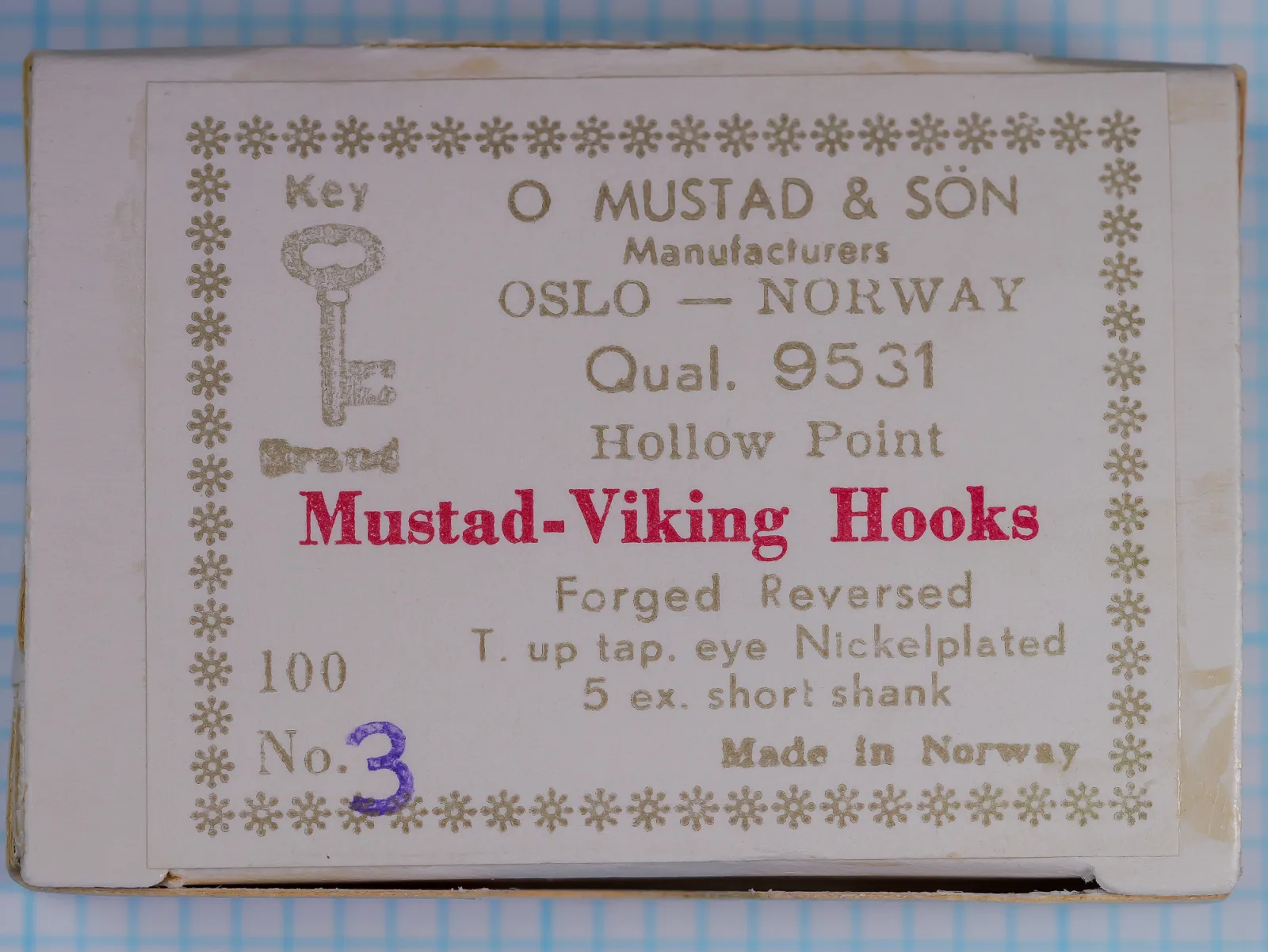
This specific specimen is size 3, preserved in its original rigid manufacturer box with a printed lid stating specifications including “Qual. 9531, Hollow Point, Forged Reversed, T. up tap. eye Nickelplated, 5 ex. short shank.” The box contained 100 hooks. Absence of a barcode and the printing style are consistent with production between 1950 and 1970. The term “Reversed” on the lid indicates kirbed offset — a design feature typical of Scandinavian bait hooks for better hook setting in live-fish mouths.
As a collecting specimen, the 9531 represents competent mid-century Norwegian hook engineering and documents Mustad’s product diversification beyond fly-fishing hooks. The intact manufacturer box adds significant premium over loose hooks. Collector interest is modest but steady among bait-fishing traditionalists and Mustad historians. The hook remains functional for its original purpose.
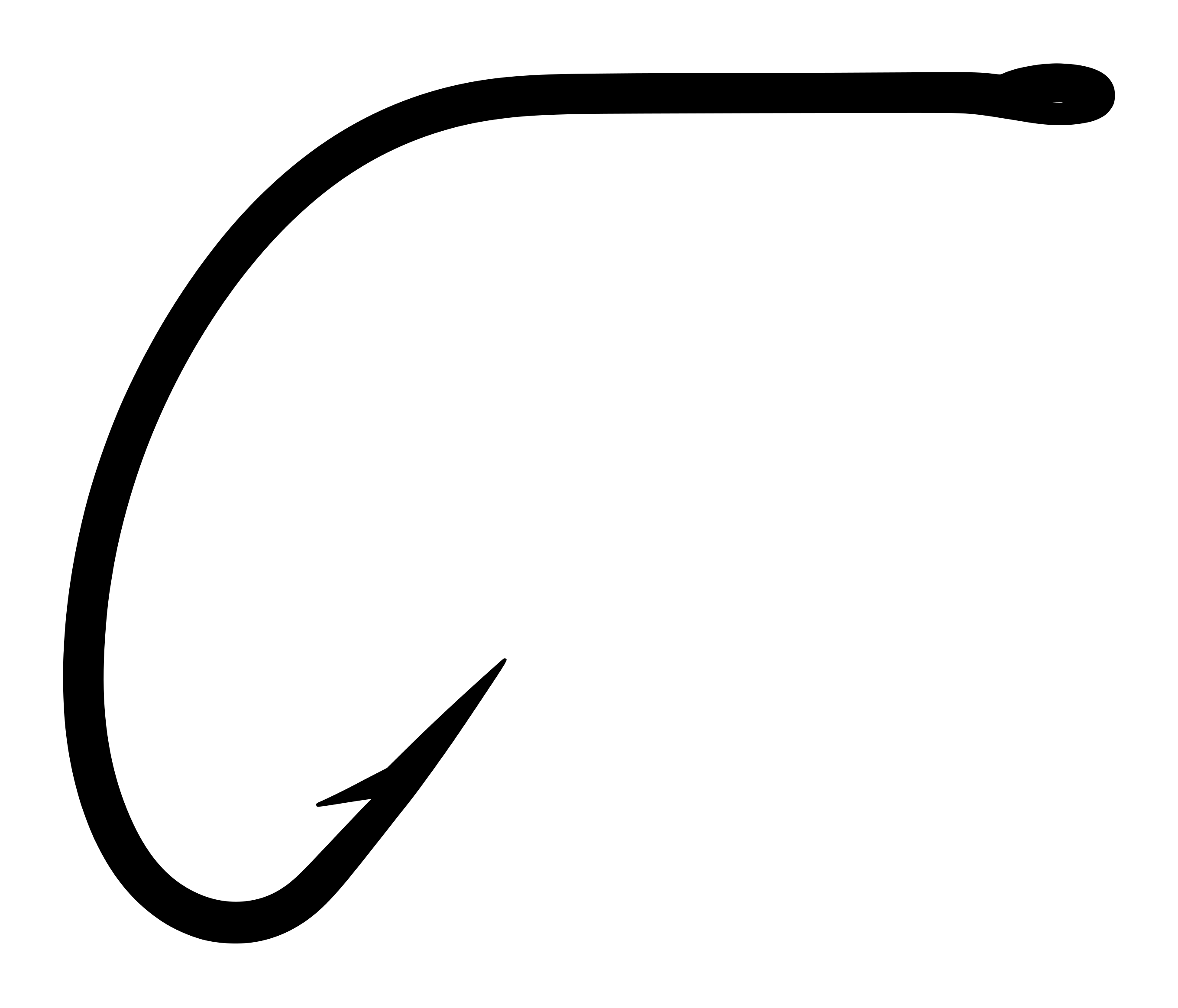
Lid of the original Mustad 9531 manufacturer box showing printed specifications: Quality 9531, Hollow Point, Forged Reversed, Turned-Up Tapered Eye, Nickelplated, 5 Extra Short Shank, Made in Norway, 100 hooks, size No. 3.
Photographic record
3 cataloged imagesSelect any record to load it above.
3 images shown
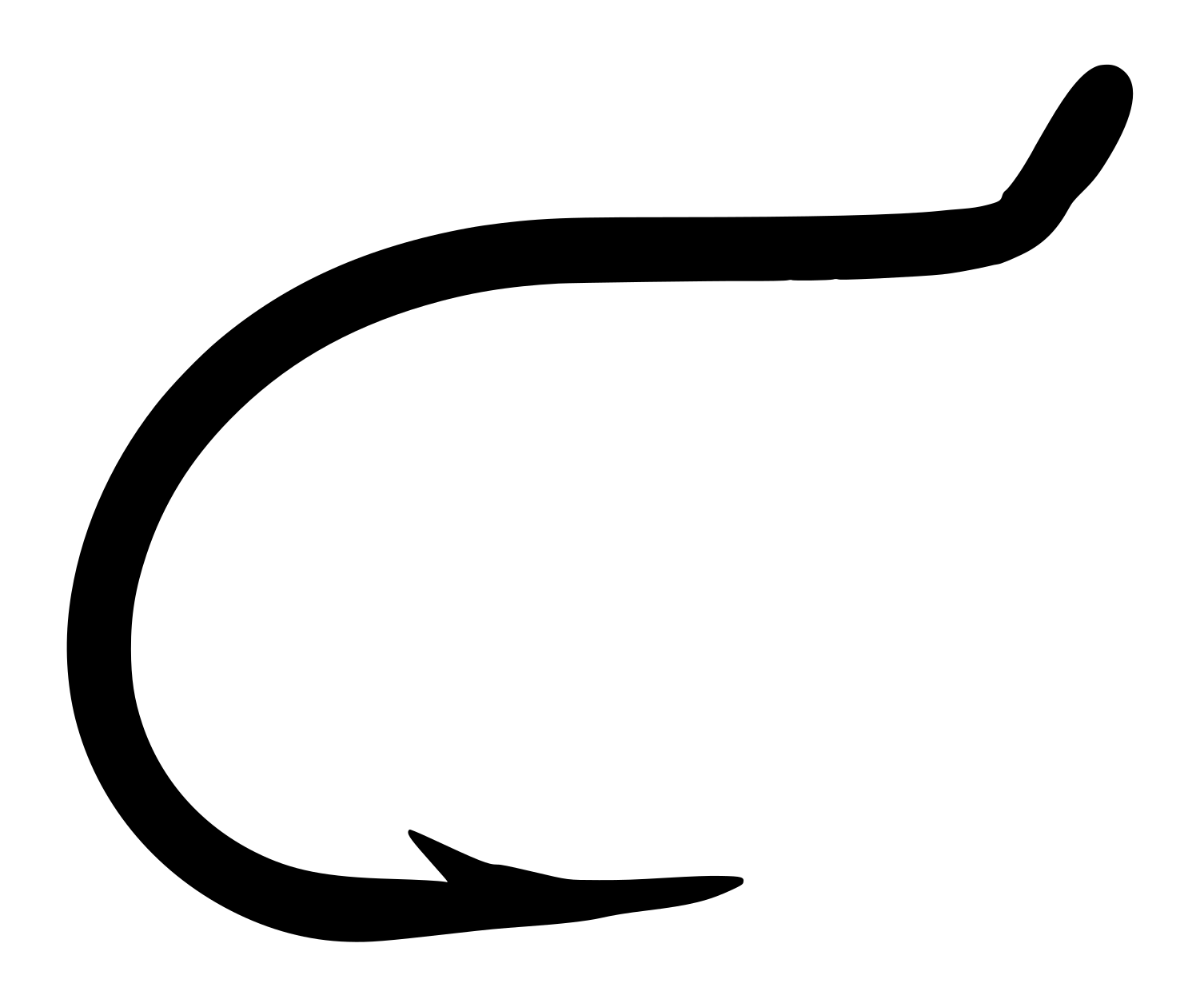
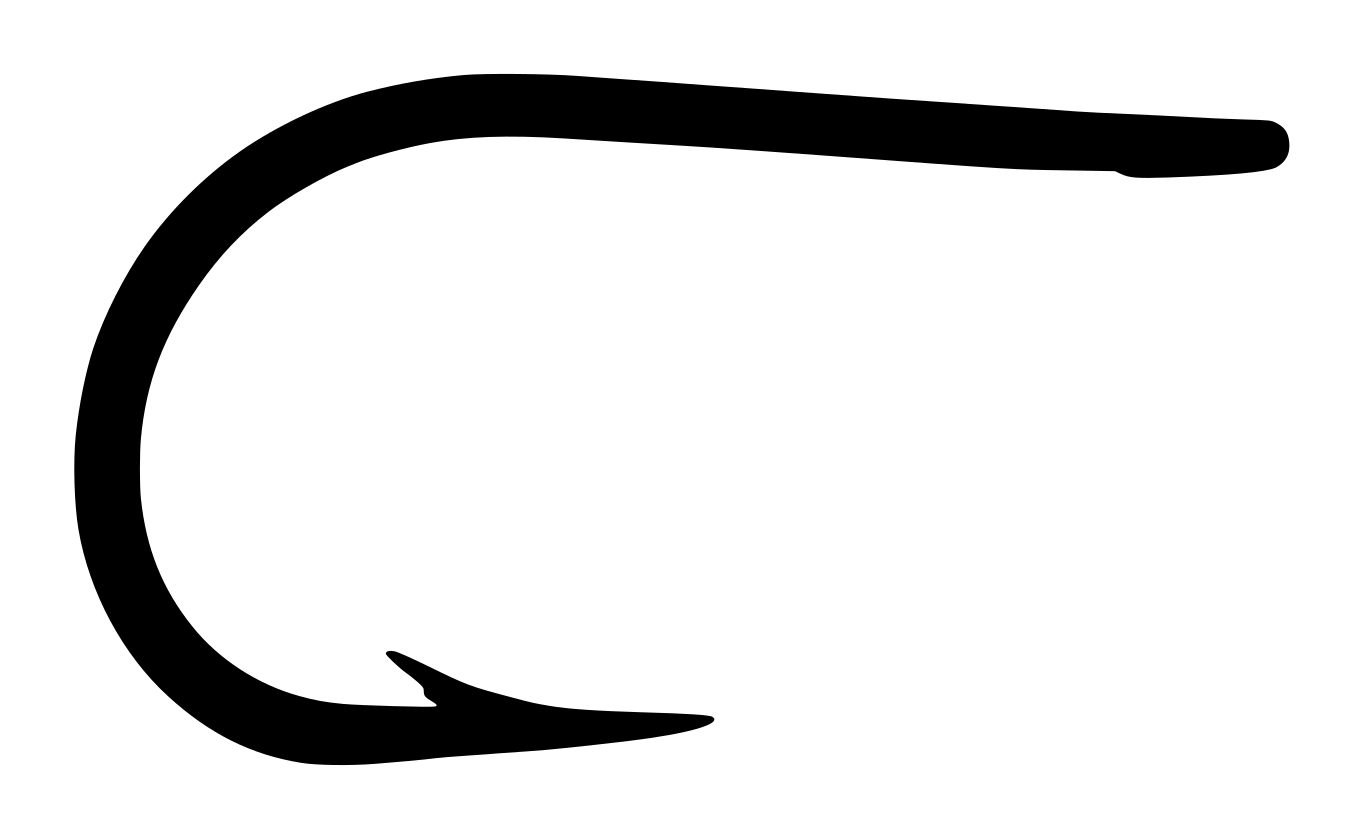
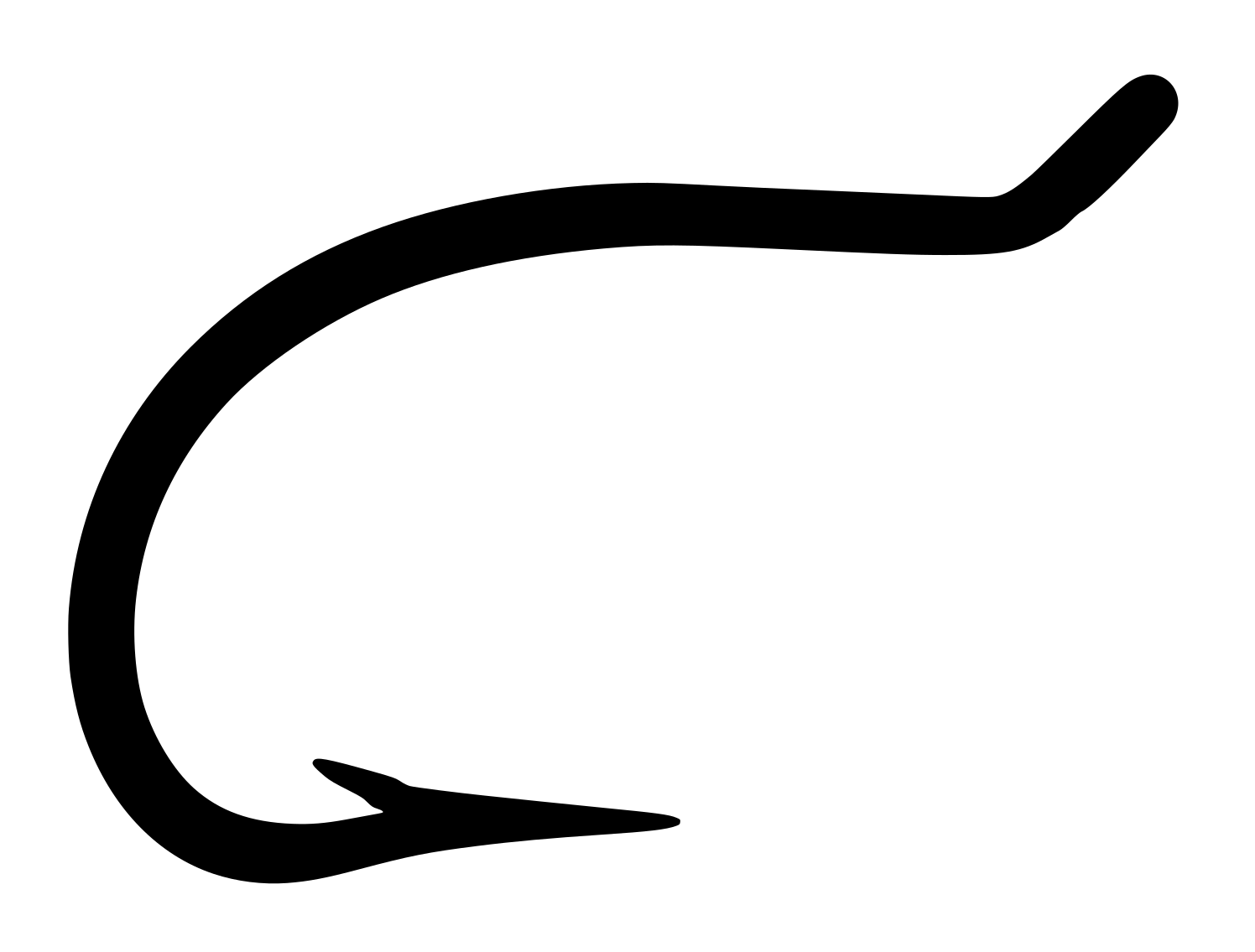
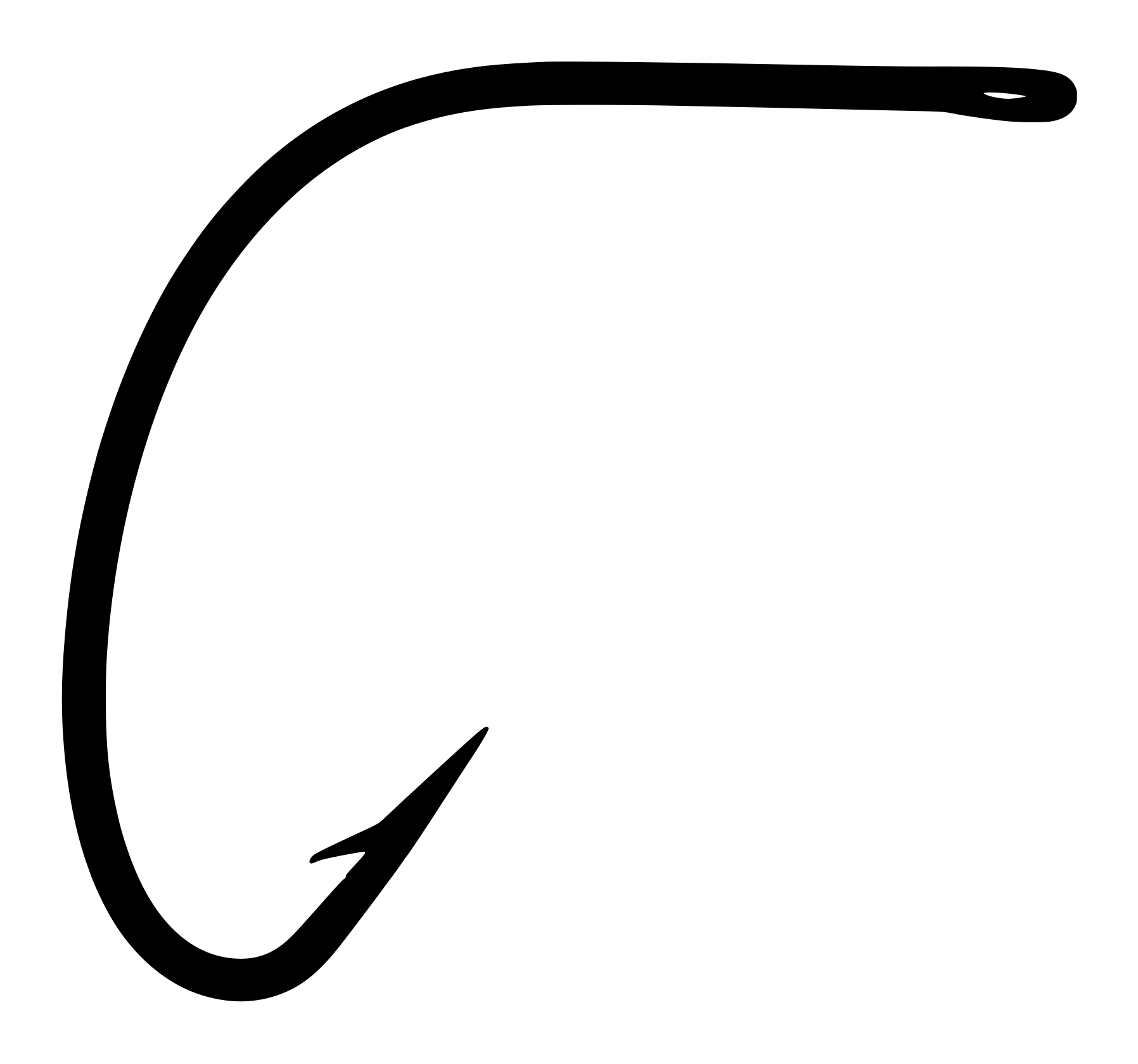
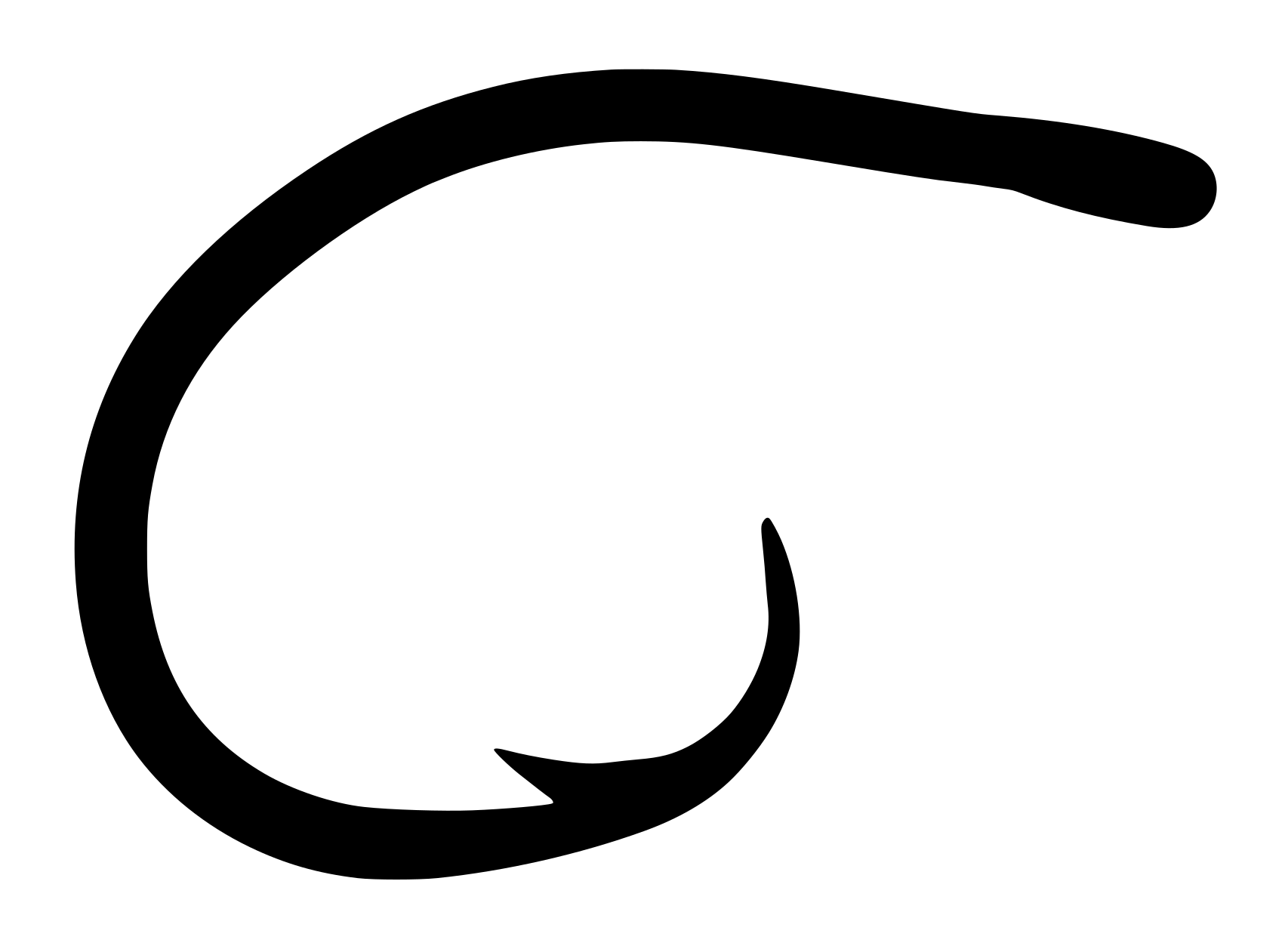
Mustad 9531 Viking Hooks Manufacturer Box LidLid of the original Mustad 9531 manufacturer box showing printed specifications: Quality 9531, Hollow Point, Forged Reversed, Turned-Up Tapered Eye, Nickelplated, 5 Extra Short Shank, Made in Norway, 100 hooks, size No. 3.Open originalMustad 9531 Viking Hook Size 3 Profile ViewProfile view of a size 3 Mustad 9531 Viking Hook on measurement grid, showing the short shank, wide gap, and the concave hollow-point inner face. The turned-up ball eye is visible at the shank terminus.Open originalMustad 9531 Viking Hook Size 3 Front ViewFront-face view of the Mustad 9531 size 3 showing the formed ball eye with turned-up orientation, the forged wire shank, and the slightly hollow point with visible barb placement and kirbed (left-side) offset.Open original
Technical profile
Turned Up Ball Eye | Viking | Short Shank | Fine Wire | Hollow Point | Nickelled
Eye
Ball Eye, Turned UpBall eye is uniformly spherical, formed by butting the return wire end to the shank and then rounding the junction. The eye diameter is appropriate for size 3 — approximately 0.110" (2.8 mm) estimated. The turned-up orientation is set at approximately 45 degrees from the shank plane. Eye closure (gap between wire return and shank) is tight with no play visible when manipulated P. No irregularities in the ball formation or asymmetry P.
Wire
Fine (1X Fine), Forged
Shank
Short (1X–2X Short) — Plain
Bend
viking, Wide gap, Offset / kirbedThe Viking bend is a moderate-radius offset curve with the point offset to the right when viewed from above (kirbed offset, confirmed by packaging text "Reversed") V. The bend profile is more open and rounded than a Limerick or O'Shaughnessy, giving a somewhat wider hook mouth. Bend depth is moderate relative to gap width — the curve does not approach a tight round or sproat profile. The shank-to-bend transition is smooth with no abrupt angle P.
Point
Hollow Point (concave inner face)Barb is short and closely cut, placed approximately 1/32" (0.8 mm) above the point. Barb angle is acute and set inward P, consistent with Mustad's mid-century hollow-point barbing standard. No evidence of a second barb or secondary barbing P.
Finish
Nickelled / Nickel-Plated — Confirmed (stated on packaging)Nickelled finish displays a cool silver-grey tone with high reflectivity under direct light. Finish is uniform across the hook surface with no visible patina or oxidation spotting on this specimen. The finish shows minor dulling on the shank from handling and contact with the paper tray, but the point and eye retain sharp brightness P. No evidence of verdigris or rust bloom. The cool tone is consistent with nickel plating (as opposed to warm-toned bronzing) V.
The specimen box is in good condition. The lid shows light toning of the off-white cardstock and minor edge wear consistent with 60+ years of storage. The printed text (gold and red ink) remains readable and crisp, with no significant fading. The interior tray is intact and has retained its shape. All 100 hooks are present and exhibit uniform nickelled finish with no corrosion spotting, oxidation, or bent specimens. No evidence of water damage, mold, or insect activity. The hinged lid closure is intact and functional. The box is free of extraneous markings beyond the size indicator.
The hollow point is achieved by drawing the wire around a mandrel and then shaping the inner face of the point into a concave taper — creating a knife-edge effect on the inside curve. This geometry concentrates the penetrating force into a narrower zone, reducing the pressure required to drive the hook through a fish’s mouth or jaw structure. The hollow point is particularly effective on bony fish (trout, pike) and on hard-palate species like sea trout. Forging — stamping the completed hook under high pressure between dies — work-hardens the steel, increasing tensile strength without adding wire diameter. This allows fine-wire hooks to achieve strength comparable to thicker standard-wire variants, while maintaining the delicate point geometry necessary for rapid penetration. The turned-up eye (45–60 degrees above the plane of the shank) is the traditional configuration for bait hooks, facilitating knot tying and providing clearance for baits that slide along the shank.
This entry documents a size 3 Mustad 9531 Viking Hook in original manufacturer box — a relatively uncommon format for documented Mustad bait hooks in the garrenwood.com catalog. The tight shank-to-gap ratio (1.1:1) is notable for the Viking bend family and may be the most extreme short-shank variant documented.
Own this hook? Help us measure it.
This pattern was made in sizes 1-16 (I). We have measurement for size 3. Know the others? Submit calipered measurements and we'll review and add them. Thank you!
Historical context
mustad
O. Mustad & Son was founded in 1832 in Gjøvik, Norway, and grew into one of the world’s largest industrial hook manufacturers. By the mid-twentieth century, Mustad operated large-scale stamping and forging facilities in Gjøvik, with distribution networks across Europe and North America. The company maintained separate product lines for fly-fishing hooks (Aberdeen, Sneck, Limerick patterns) and utility/bait hooks (Viking, O’Shaughnessy, Baitholder variants). Norwegian manufacturing gave Mustad advantages in cost and scale; the Gjøvik factory employed hundreds of workers by the 1960s. Mustad’s quality control and standardization of hook specifications (the “Qual. XXXX” numbering system) became industry benchmarks. The firm remained independent until the late 20th century, when it was acquired by a Swiss holding company.
Series History
The Viking bend is a mid-range offset pattern with a relatively open, rounded hook form — wider than a standard O’Shaughnessy but less angular than a Limerick. Mustad produced the 9531 variant (hollow point, turned-up eye, fine wire, short shank) specifically for Scandinavian and northern European markets where bait fishing and sea-trout fishing were dominant traditions. The “5 ex. short shank” designation on the packaging indicates that this is a 5X short variant — substantially shorter than standard for the size. This allowed bait anglers to use very large baits without excessive hook length. Production of the 9531 appears to span the 1950s and 1960s, with surviving examples primarily in European tackle collections. No major design changes or discontinuation are evident from available packaging; the model likely remained in production into the 1970s before being superseded by nylon-snelled and pre-tied rig systems.
Era and Packaging Dating
No barcode visible on box — pre-1974 V. Printed specifications on lid (Qual. 9531 format, turned-up eye abbreviation "T. up tap.", nickelled finish designation) are consistent with Mustad's mid-century labeling conventions. Paper stock and letterpress/offset printing quality suggest 1950s-1960s manufacture. No postal code or phone number visible to narrow further. Edge toning and wear consistent with 60+ year storage.
The Norwegian "Reversed" Convention
The term "Reversed" on Mustad packaging refers to kirbed (left-side) offset when the hook is viewed from above — a counterintuitive naming convention by modern standards. Norwegian anglers preferred this offset for sea-trout and pike fishing because the inward curve of the point was believed to provide better hook setting on the hard palate of these species. Mustad standardized this feature across their Scandinavian bait-hook line (9530, 9531, 9532 series) and exported them primarily to the UK, Iceland, and Scandinavia. The "Reversed" nomenclature appears consistently on boxes from the 1950s and 1960s, but North American distributors often omitted this specification or used different terminology — a source of confusion among modern collectors trying to decode older Mustad documentation.
Design lineage and influence
The Viking bend is a Mustad design from the early-to-mid twentieth century. It occupies a design space between the widely-used O’Shaughnessy (heavier, more angular) and the Limerick (more angular, narrower gap). The hollow-point, turned-up-eye variant (9531) was specifically developed for Scandinavian bait-fishing traditions where heavy tidal fishing and sea-trout work required robust, wide-gapped hooks. British makers (Allcock, Partridge) produced comparable patterns (Beak, Killers) for sea-trout fishing, but the 9531 is distinctly Norwegian in its proportions and finish specifications. No direct downstream influence of the 9531 is evident — the design did not become a standard pattern for fly tyers. However, the turned-up ball-eye configuration remained relevant for snelled rigs and contemporary bait presentations into the 1990s.
Best matchRelated by Attribute
Computed automatically from catalog data — updated as new hooks are added.
Matches: Bend, Shank, Gap, Eye, Point +5 moreDiffers: Wire: Fine (1X Fine) vs Heavy (1X Heavy); Eye Orient.: Turned Up vs Straight / Inline; Application: Bait vs Saltwater, Bait
Matches: Bend, Shank, Point, Forging, Shank Feat. +1 moreDiffers: Wire: Fine (1X Fine) vs Standard; Gap: Wide vs Standard; Eye: Ball Eye vs Tapered Eye +3 more
Matches: Shank, Gap, Point, Forging, Offset +3 moreDiffers: Bend: Viking vs Round / Kendal; Wire: Fine (1X Fine) vs Standard; Eye: Ball Eye vs Tapered Eye +2 more
The 9531 Viking was designed for live-bait and dead-bait fishing in Scandinavian waters, particularly for sea trout and pike. The short shank and wide gap accommodate substantial baits — whole sandeel, small herrings, and chunked mackerel. The turned-up eye accommodates traditional snellings and knots used in European bait-fishing rig systems. The hollow point provides rapid penetration when a fish strikes a slowly retrieved or drifted bait. The forged construction tolerates the stress of heavy tidal flows and large toothy species without breakage.
Secondary Applications
Trolling with natural or preserved baits; estuary work in cold climates; occasional use in northern European reservoir and lake pike fishing.
Collector notes
Rated 4.0/10 — a functional Norwegian bait hook with modest collector interest driven primarily by the original manufacturer box (scarcer than loose hooks or cards) and mid-century Mustad branding. Not a specialty design or rare variant; general Mustad production volume limits scarcity. Size 3 is a moderate size with practical bait-fishing utility; very small or very large sizes would command higher premiums.
Reference value
$8 – $22 USD estimate
Packaging condition
Good — moderate wear, legibleRecorded specimen
Packaging format
GW-M-BOX-01Catalog code
Positive factors: Original rigid manufacturer box with intact lid and printed specifications V. Turned-up ball eye and hollow point geometry appeal to bait anglers and traditional tyers. Forged construction and fine wire gauge demonstrate Mustad’s mid-century engineering. Nickelled finish is durable and historically documented. No barcode places it securely pre-1974. Limiting factors: Mustad hooks in general were mass-produced in large quantities; the 9531 is not a named-designer pattern or specialty variant. Size 3 is neither diminutive nor large — sizes 1, 5, or larger would attract more specialist interest. Missing hooks or damaged box lid would reduce value significantly. This is a working hook for traditional sea-trout and pike fishing, not a display piece or pattern collectible. Collector demand is steady but not intense — appeal is primarily to tackle historians and utility-focused bait anglers.
Packaging
Rigid manufacturer box with separate lid and interior tray. Lid features Mustad branding (Oslo-Norway), Key logo, model designation, and product specifications printed in gold and red ink on off-white cardstock. Text reads: "Qual. 9531, Hollow Point, Mustad-Viking Hooks (red), Forged Reversed, T. up tap. eye Nickelplated, 5 ex. short shank, Made in Norway." Box contains 100 hooks, size No. 3 (marked with purple ink). Paper interior tray. Printed lid and exterior in fair condition with light toning and edge wear; no barcode visible.
Market Value Notes
Low ($8): Box with light wear, 90-95 hooks present, lid printing readable. High ($22): Box excellent condition, all 100 hooks intact, printing crisp, minimal handling marks. Premium factors: Complete hook count, original box in good condition (boxes command 2-3x card value), no missing or bent specimens, lid intact and hinged properly. Platforms: eBay.uk, eBay.us, specialty tackle dealers. Confidence: E estimated — limited comparable sales data; range reflects uncertainty in vintage Mustad bait-hook market.
Where to Find
eBay (UK and US listings), specialist vintage tackle dealers, occasional tackle fairs in northern Europe and Scandinavia. More commonly found in European markets than North America. Not typically stocked by modern fly-fishing retailers.
Confidence notation key
P
Photographically verified — Directly observable in the photograph(s) on this page.
V
Verified by documentation — Confirmed by manufacturer catalog, spec sheet, or published reference.
I
Inferred — A logical deduction from observable or documented evidence, not directly stated.
E
Estimated — An approximation based on visual comparison, proportional analysis, or limited data.
S
Speculative — A reasoned hypothesis that cannot be confirmed from available evidence.
Claims with no notation are confirmed by multiple independent sources. All photographs on garrenwood.com are taken on a measurement grid where each square equals 1/10 inch (0.1″ / 2.54 mm).