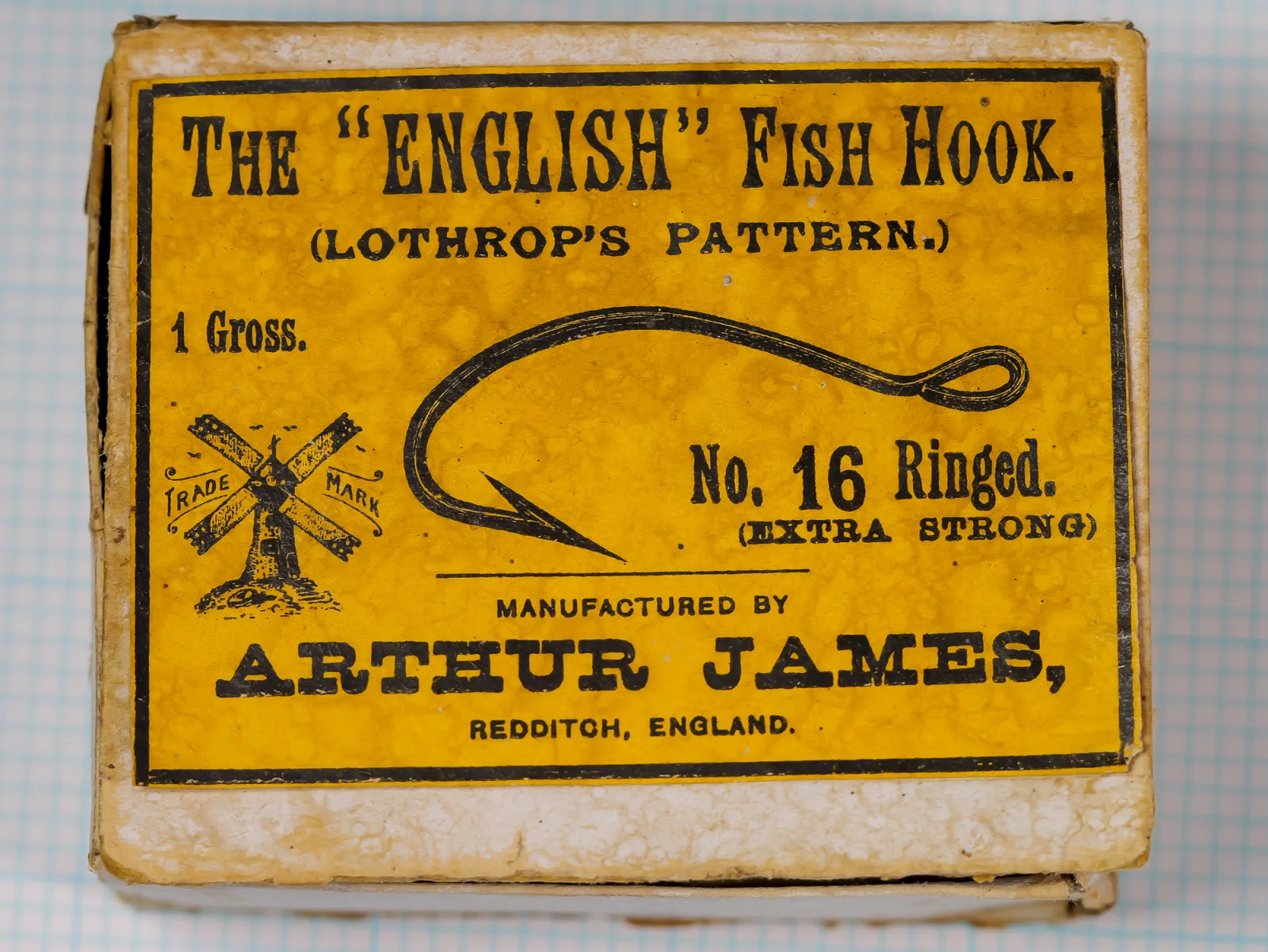
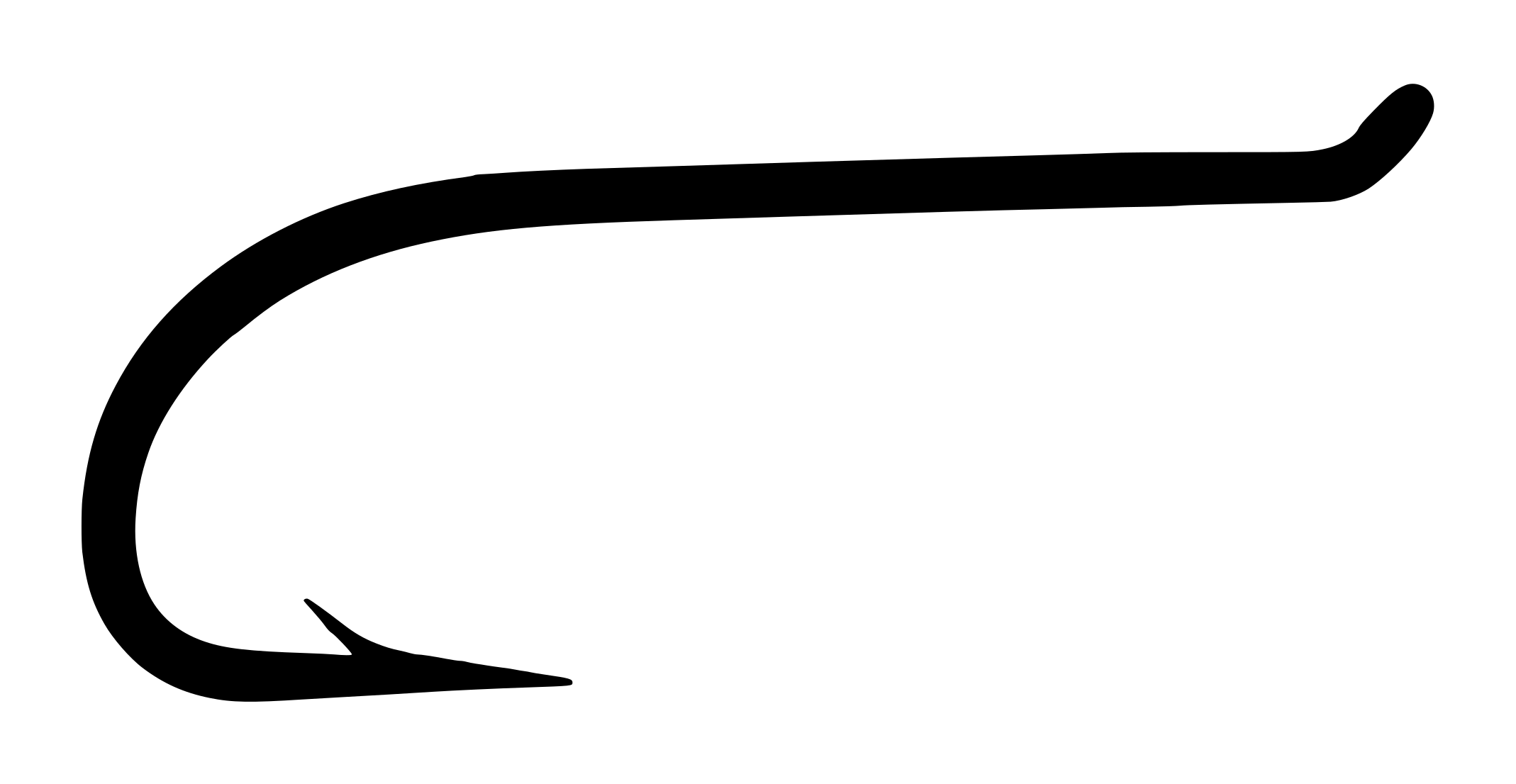
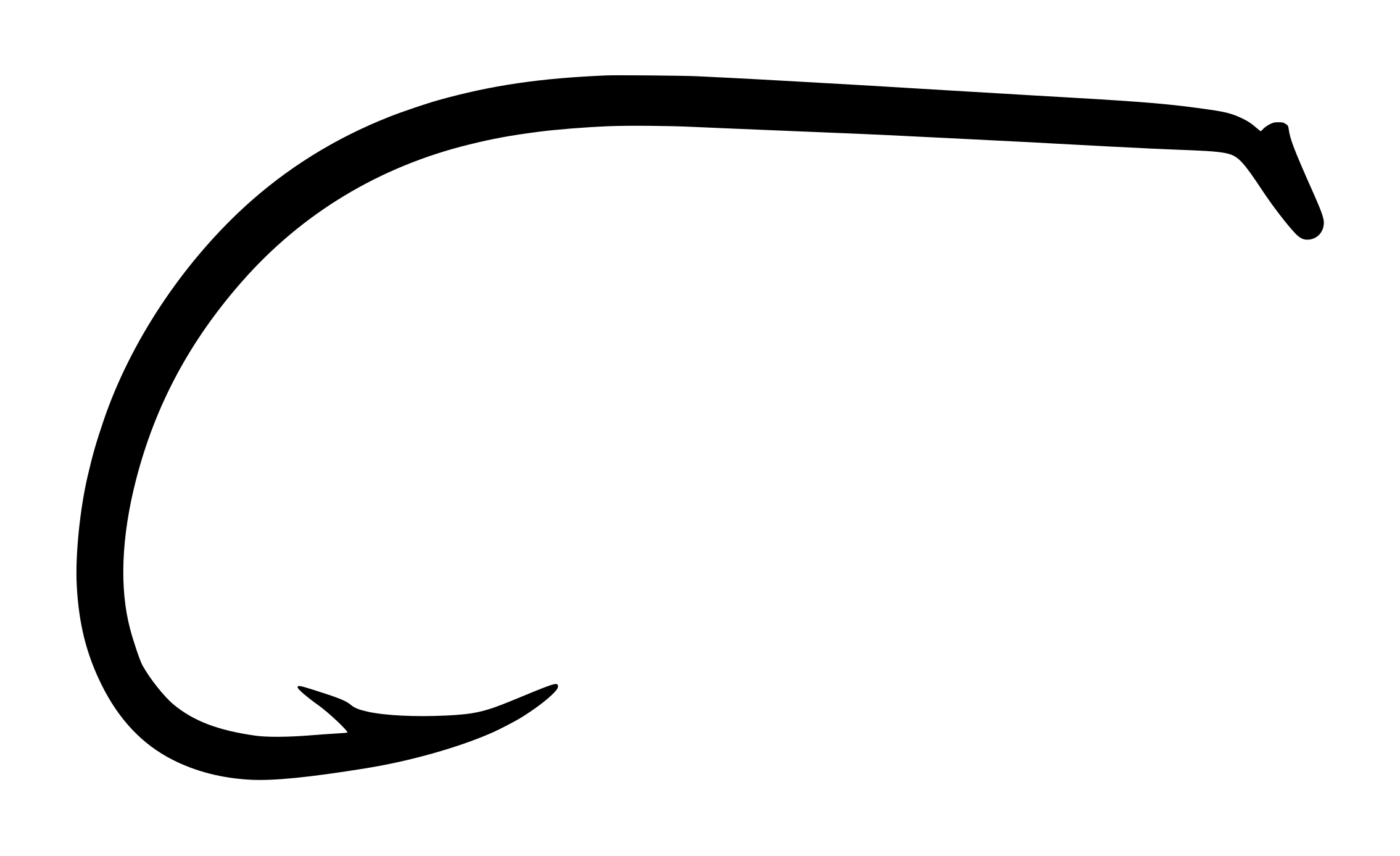
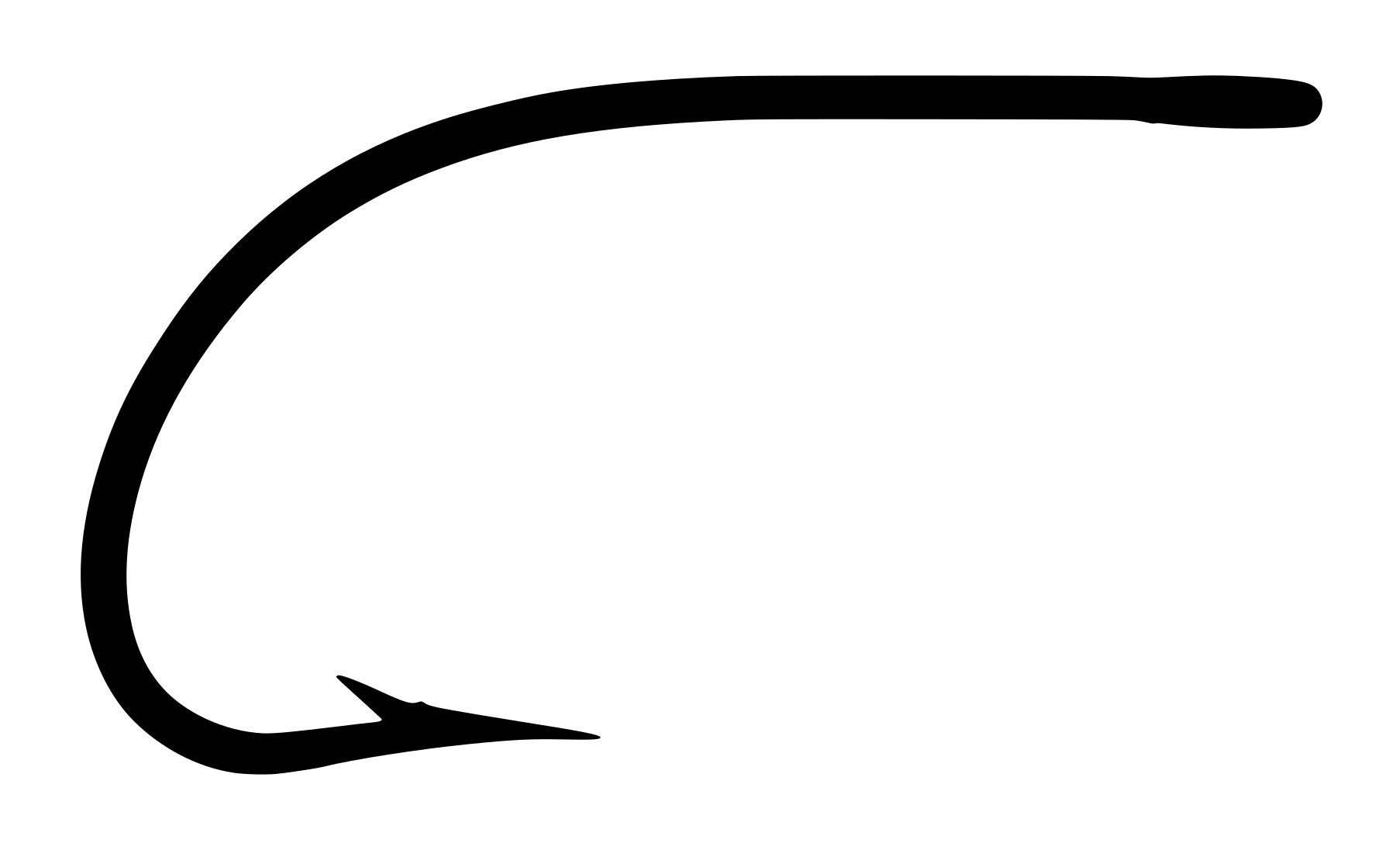
Arthur James Lothrops Pattern Hook, size No. 16, japanned finish. Manufactured by the Redditch, England maker and sold in standard yellow card packaging labeled “Extra Strong.” Sproat bend with heavy forged wire, ball eye turned up, hollow point. The Lothrops was a traditional English pattern marketed as a general-purpose ringed hook for both freshwater and sea fishing.
The card bears no barcode, post code, or modern price marking, positioning it firmly in the pre-1974 period. The windmill trademark and yellow card format are consistent with late 19th to early 20th century Arthur James production. Physical examination shows the specimen to be in good structural condition with complete japanned finish and sharp barb.
Arthur James hooks from the Redditch era are collected with moderate interest among English tackle historians and traditional fly tyers. No. 16 in this pattern is less frequently encountered than larger sizes, which increases its modest collecting significance. Complete original packaging is a material asset to value.
Original packaging for The English Fish Hook (Lothrops Pattern) manufactured by Arthur James of Redditch, England. Size 16, extra strong, ringed eye. One gross per box.
Photographic record
4 cataloged imagesSelect any record to load it above.
4 images shown
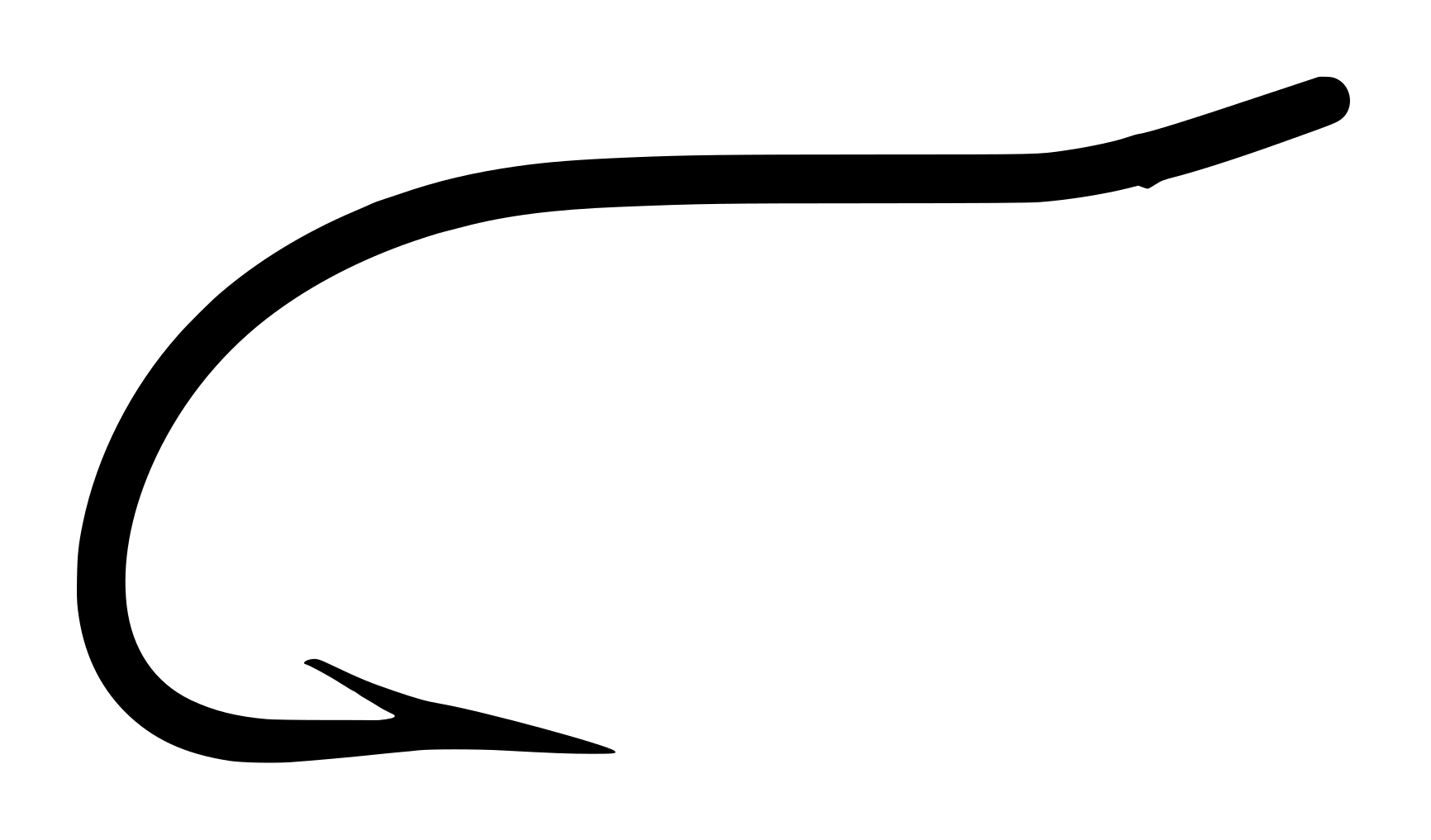
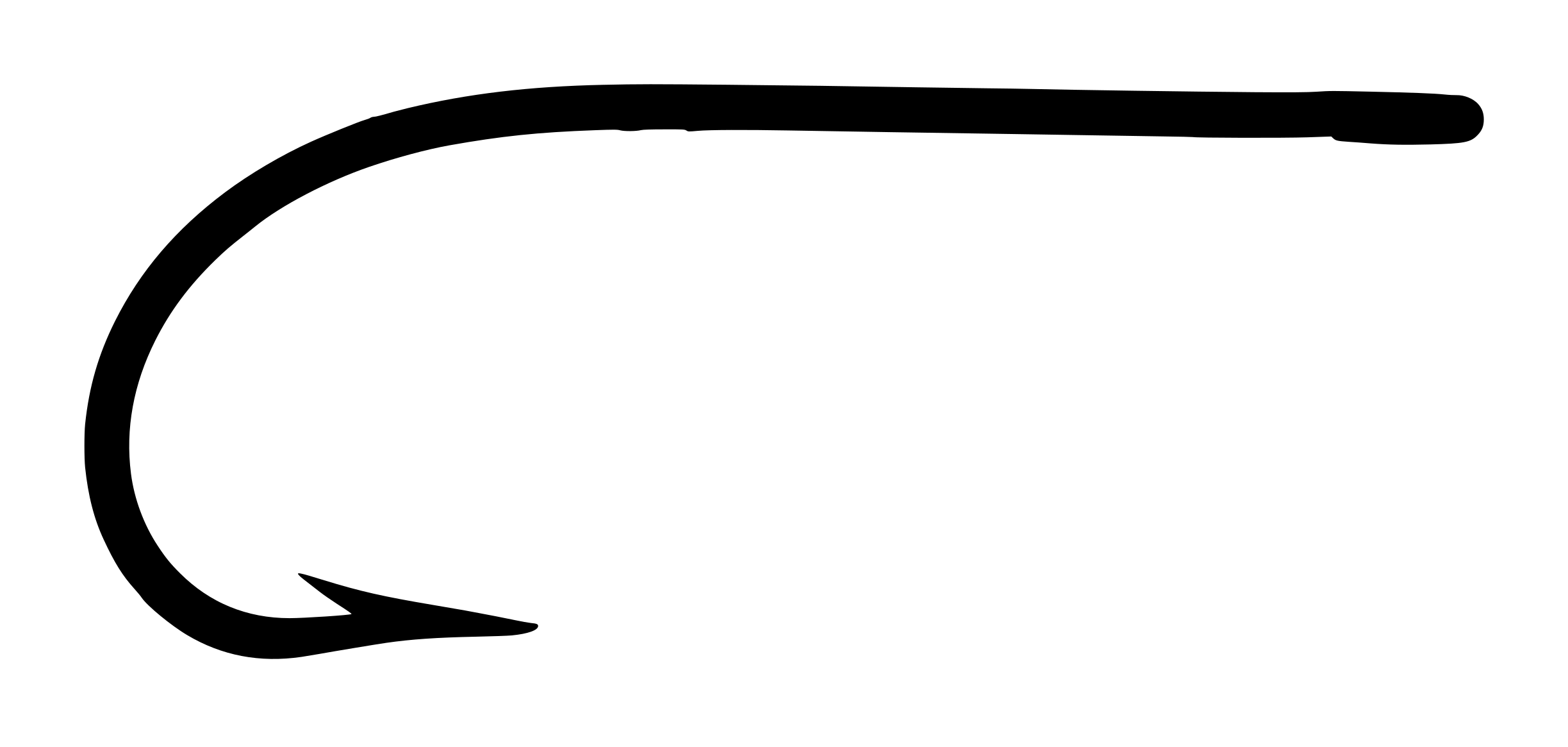
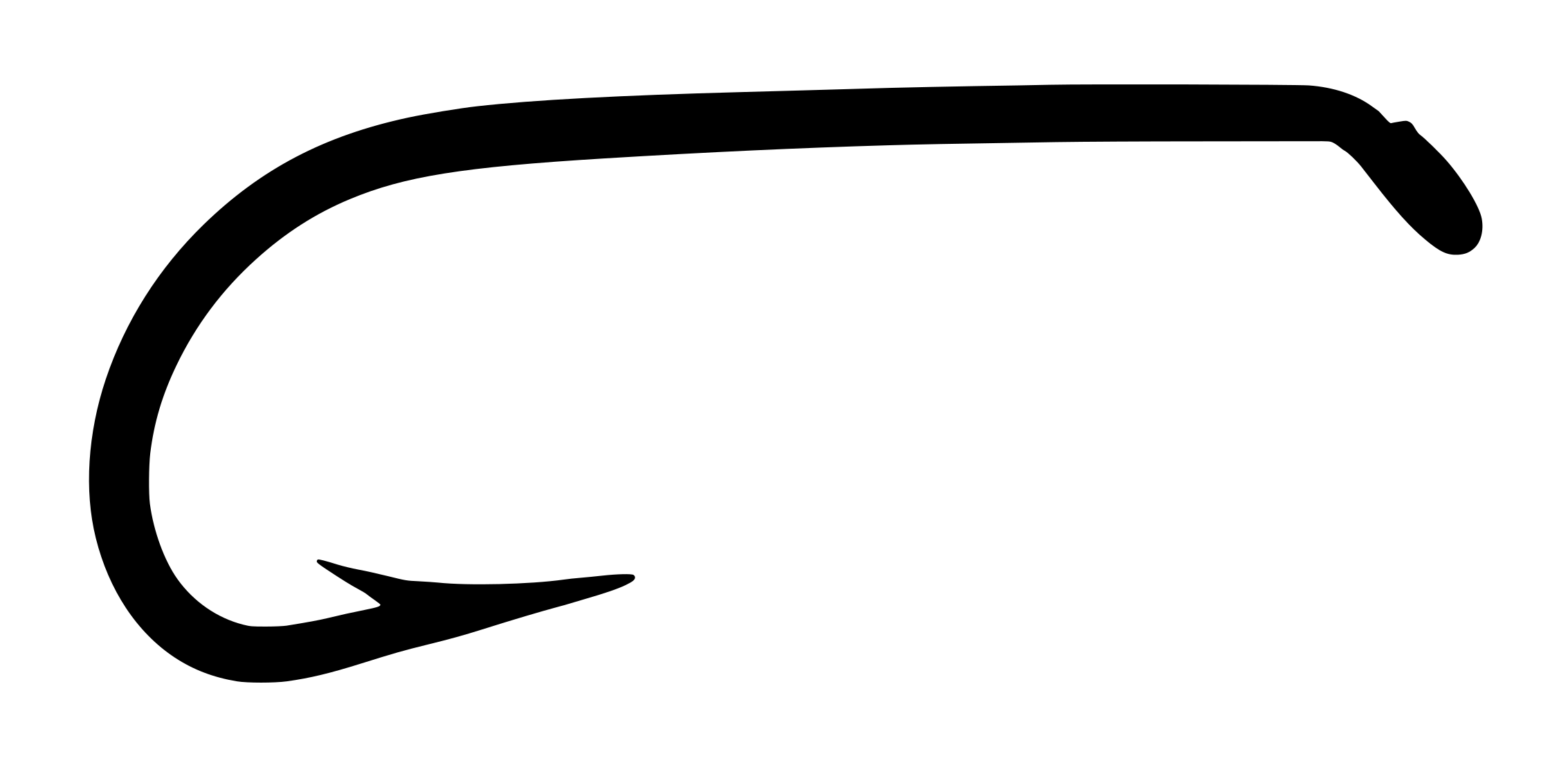
Arthur James Lothrops Pattern Box LabelOriginal packaging for The English Fish Hook (Lothrops Pattern) manufactured by Arthur James of Redditch, England. Size 16, extra strong, ringed eye. One gross per box.Open originalLothrops Pattern Ringed Eye DetailClose view of the ringed eye characteristic of the Lothrops Pattern. The eye is formed as a closed loop welded to the shank.Open originalLothrops Pattern Point and Barb ProfileLateral view of the Lothrops Pattern showing sproat bend curvature, barbed point, and shank taper.Open originalLothrops Pattern Full ProfileComplete profile of Arthur James Lothrops Pattern size 16 against scale grid showing overall proportions and bend architecture.Open original
Technical profile
Eye
Ball Eye, Turned UpNeatly formed ball eye with consistent diameter. Closure is tight with no visible gaps P. Turnup angle is clean and symmetrical. Wire flow into the eye is smooth.
Wire
Heavy (1X Heavy), Forged
Shank
Short (1X–2X Short) — Plain
Bend
Sproat, Standard gapRounded Sproat form with smooth symmetrical curve P. Bend depth is moderate relative to shank length, typical of English freshwater standards. No offset present. Wire set and bend closure appear uniform.
Point
Hollow Point (concave inner face)Short, firmly cut barb with typical sweep angle for the period P. Barb placement is at standard distance from bend. No micro-barb or double-barb geometry present.
Finish
Black Japanned — Confirmed (stated on packaging)Glossy black japanned lacquer finish, photographically confirmed as cool black (not blue-grey oxide) P. Finish appears uniform across the hook with no significant wear or patina on the specimen examined. Coating is thick enough to obscure underlying wire texture almost completely.
Single specimen examined shows glossy black japanned finish intact. Wire exhibits fine surface texture consistent with age. Barb is prominent and well-defined. Eye closure is tight and symmetrical. No corrosion or pitting visible P.
The hollow-point geometry creates an inward concave face from barb to tip, producing a knife-edge effect on the inner taper. This design was believed to penetrate more readily on setting and was standard in English hooks through the early 20th century. The heavy forged wire provided the thickness necessary for reliable hook-set without bending under the stress of larger fish or heavy tackle.
The Sproat bend’s rounded bottom combined with the heavy wire made this pattern suitable for both fly and bait work. The ball eye turned up positions the leader or snell at a favorable angle for drift-fishing and wading work. The “Extra Strong” designation indicates wire gauge one full step heavier than standard, addressing the needs of anglers targeting sea-trout in tidal water or large trout in heavy currents.
This pattern was made in sizes No. 16 (V). We don't have any measurements for it yet. Own one? Submit calipered measurements and we'll review and add them. Thank you!
Historical context
arthur
Arthur James was a Redditch hook manufacturer active from the 1880s through the early 20th century. The firm operated during the peak era of Redditch’s dominance in hook production, when the town supplied hooks to anglers across the British Empire and beyond. James’s hooks were marketed under straightforward product names tied to traditional English fishing patterns rather than elaborate branding.
The windmill trademark used on this card is consistent with late Victorian industrial symbolism — the mill representing English manufacturing strength and precision. Arthur James positioned hooks as practical, durable tools for working anglers rather than luxury goods, reflected in the plain yellow card and direct naming (Lothrops Pattern, Extra Strong).
Series History
The Lothrops Pattern appears in Arthur James’s product line as a ringed (barbed) general-purpose hook offered in multiple sizes. The “Extra Strong” designation on the No. 16 specimen indicates the pattern was available in at least two wire-gauge options — standard and heavy. The pattern’s sustained inclusion across size ranges and wire options suggests a standard catalog item rather than a specialty design. The pattern name references English fishing tradition but no direct lineage to a named fly pattern is documented. Production continued through at least the early 20th century based on packaging evidence.
Era and Packaging Dating
No barcode present — strong pre-1974 indicator V. Yellow card stock and letterpress printing method consistent with late Victorian and Edwardian era production P. Windmill trademark is characteristic of Arthur James branding from this period I. No postal code or ZIP code on packaging I. "Ringed" terminology for barbed hook is dated language, typical of UK hooks pre-1950s V. No telephone number or modern addressing conventions present P. Overall packaging evidence supports late 19th to early 20th century manufacture S.
Redditch: The Hook Capital of the World
Redditch, England, became the global center of hook manufacture in the 19th century, with dozens of small makers competing for market share through quality and specialization rather than brand recognition. Arthur James was one of dozens of competent Redditch makers whose names are now obscure outside the UK. What differentiated them was not revolutionary design but meticulous wire quality and consistent finishing — a craftsman tradition that made a Redditch hook recognizable by feel alone. The windmill trademark on this card symbolized that industrial heritage, even though Arthur James operated in small workshops, not factories. Most Redditch hooks were sold through British fishing-tackle retailers and export networks, meaning a hook made in 1890 might surface today in New Zealand, South Africa, or Canada — anywhere the British Empire's anglers traveled.
Design lineage and influence
The Sproat bend with turned-up ball eye was one of the dominant hook geometries in English freshwater fishing from the 1870s onward. The Lothrops represents the common Redditch interpretation of this form. Competing patterns from other Redditch makers (Allcock, Milward, Sealey) offered similar constructions under different names — the actual geometric differences were often minimal, with differentiation based on maker reputation and wire gauge options.
The Lothrops’s emphasis on “Extra Strong” wire suggests positioning against Aberdeen and lighter-gauge patterns, targeting anglers who favored durability over delicacy. The hollow point indicates technical continuity with mid-19th century English hook design practice.
Best matchRelated by Attribute
Computed automatically from catalog data — updated as new hooks are added.
Matches: Bend, Wire, Gap, Eye, Finish +3 moreDiffers: Shank: Short (1X–2X Short) vs Standard; Eye Orient.: Turned Up vs Straight / Inline; Point: Hollow Point vs Superior +1 more
Matches: Bend, Wire, Gap, Point, Forging +2 moreDiffers: Shank: Short (1X–2X Short) vs Standard; Eye: Ball Eye vs Tapered Eye; Eye Orient.: Turned Up vs Turned Down +2 more
Matches: Bend, Shank, Wire, Eye, Finish +2 moreDiffers: Gap: Standard vs Wide; Eye Orient.: Turned Up vs Straight / Inline; Point: Hollow Point vs Standard / Spear +2 more
Matches: Bend, Gap, Eye, Point, Application +2 moreDiffers: Shank: Short (1X–2X Short) vs 1X Long; Wire: Heavy (1X Heavy) vs Standard; Eye Orient.: Turned Up vs Straight / Inline +2 more
The Lothrops Pattern was marketed for ringed (barbed) freshwater trout and grayling fishing, as well as coastal sea-trout and small salt-water work. The heavy wire and prominent barb suited both live bait and artificial patterns. Traditional English fly tyers incorporated this hook into wet-fly patterns for moving water and bait-fishing rigs for salmon parr and estuary work.
Secondary Applications
Light saltwater bait fishing. Small sea-trout and salmon parr wets. Earthworm and maggot rigs.
Modern Equivalents
Hook
Match Quality
Notes
Partridge SH
Very Good
Traditional English sproat with ball eye; available in modern production with japanned finish.
Mustad 3906B
Good
Heavy-wire sproat pattern; modern equivalent but blued finish differs from japanned original.
Orvis Wet Fly Hook
Good
Contemporary sproat-form wet-fly hook with similar working geometry; stainless steel finish is modern material.
Collector notes
Rated 4.5/10 — Uncommon. Arthur James hooks from the Redditch era are sought with modest interest among English tackle historians and vintage pattern specialists. Size No. 16 is less frequently encountered than the larger general-purpose sizes (8–12), which increases demand slightly. Complete original yellow card in fair condition is a material asset; loose hooks command significantly less. Collector demand is narrow but active within the Redditch and traditional English tackle community.
Reference value
$6 – $18 USD estimate
Packaging condition
Fair — significant wear, partially legibleRecorded specimen
Packaging format
sales_card_single_grossCatalog code
Positive factors: Original yellow card packaging with complete maker attribution and trademark; pre-1974 production with no barcode; named traditional English pattern; heavy wire variant (“Extra Strong”) showing thoughtful size/gauge coupling; Redditch maker origin appeals to British tackle historians; japanned finish in good condition adds to specimen quality.
Limiting factors: Arthur James remains less celebrated than top-tier Redditch makers (Allcock, Sealey, Partridge); size No. 16 is relatively small and less collectible than larger sizes in most vintage patterns; no documented designer credit or special significance; japanned finish is common on English hooks of the era, not a differentiation; yellow sales card format was standard, not rare. Packaged cards are far more valuable than loose hooks.
Desirable variants: Larger sizes (8–12) command higher interest. Blued finish if available would be notable (japanned is standard). Sealed or near-sealed cards in excellent condition add 50–100% premium over opened examples. Cards with printed price or retailer mark add documentary value.
Condition factors: Hook condition (corrosion, barb sharpness, eye closure) affects value minimally once the card is present and legible. Card stock tone and printing clarity are primary condition drivers. Missing hooks from the gross card deduct 10–25% depending on count. Binding damage or separation reduces value by 15–30%.
Packaging
Yellow stock sales card, single-sided printed. Bold black letterpress text. Header reads 'The "ENGLISH" Fish Hook. (LOTHROPS PATTERN.)' Maker's windmill trademark at lower left. Center illustration shows hook profile. Right side states 'No. 16 Ringed. (EXTRA STRONG)'. Bottom text 'MANUFACTURED BY ARTHUR JAMES, REDDITCH, ENGLAND.' Card measures approximately 4.5" x 3.5" (114 x 89 mm). Paper stock shows age toning and surface wear. No barcode. No price marking visible.
Market Value Notes
Low ($6): Good condition — opened card, 125–135 hooks present (87–94% of gross), card shows age toning and edge wear, hooks in sound condition.<br />
High ($18): Excellent condition — opened card, 140+ hooks present (97%+ of gross), card stock bright with minimal toning, printing clear, hooks show no corrosion.<br />
Premium factors: Sealed or near-sealed card (+40–60%); complete 144-hook count; bright card stock with sharp printing; tight hook eye and sharp barb; Redditch maker provenance; size 16 as noted rarity variant.<br />
Platforms: eBay UK (primary), specialist tackle auctions, Redditch and English tackle dealer sites.<br />
Confidence: E estimated — limited recent comparable sales data for Arthur James cards. Estimate based on typical pricing of pre-1930 Redditch maker cards in similar condition and moderate rarity profile. No direct eBay sold listing data available for this specific model.
Where to Find
eBay UK (occasional, search "Arthur James" + "Lothrops" or "Redditch fishing hook card"). Specialist English tackle dealers and fair traders in the Midlands. Antique fishing tackle auctions (Angling Auctions, Christie's South Kensington, regional UK auctioneers). Facebook groups dedicated to vintage English fishing tackle. Less commonly on eBay US — primarily a UK market item.
Preservation
Storage and Preservation
Store the card in a cool, dry environment away from direct sunlight and high humidity. Japanned finish, while durable, can develop surface corrosion if exposed to prolonged moisture. Yellow card stock is susceptible to acid-decay yellowing — store flat in a acid-free envelope or archival folder if long-term preservation is intended.
Do not open the card to use the hooks if you are a collector — opened cards are worth substantially less than sealed or intact examples. If the card has begun to separate at binding edges, consolidate it carefully with archival tape rather than attempting a full rebinding, which reduces value.
Examine the hooks periodically for any signs of white corrosion (rust bloom) on the japanned surface. If present, gently wipe with a soft, dry cloth. Do not attempt to refinish or polish — age patina, while not always visible, adds historical authenticity and is preferred by collectors.
Keep away from other ferrous metals to prevent contact corrosion. Store in a location with stable temperature and relative humidity (ideally 40–50% RH) to minimize metal expansion and stress on the eye closure.
Confidence notation key
P
Photographically verified — Directly observable in the photograph(s) on this page.
V
Verified by documentation — Confirmed by manufacturer catalog, spec sheet, or published reference.
I
Inferred — A logical deduction from observable or documented evidence, not directly stated.
E
Estimated — An approximation based on visual comparison, proportional analysis, or limited data.
S
Speculative — A reasoned hypothesis that cannot be confirmed from available evidence.
Claims with no notation are confirmed by multiple independent sources. All photographs on garrenwood.com are taken on a measurement grid where each square equals 1/10 inch (0.1″ / 2.54 mm).