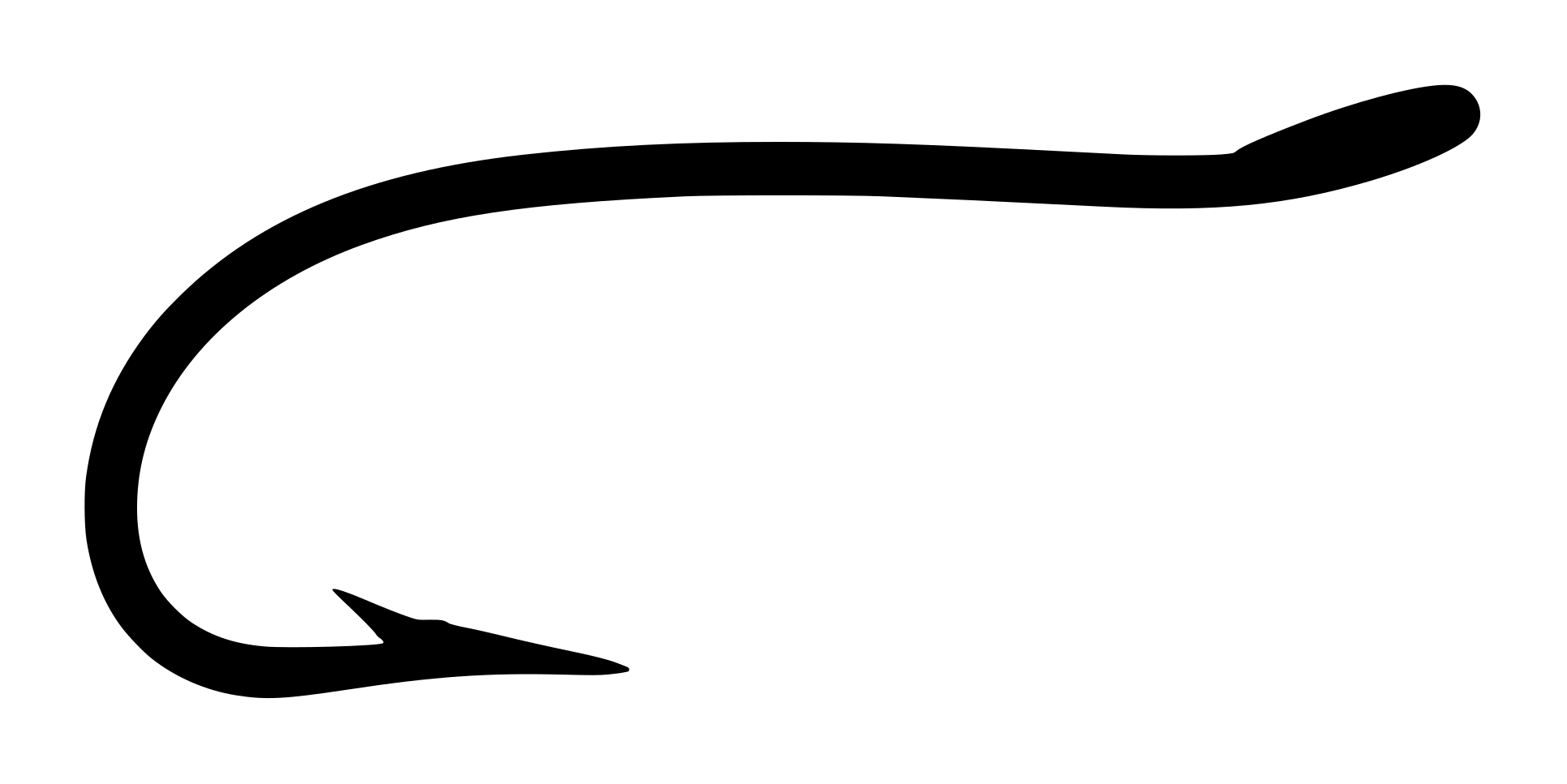
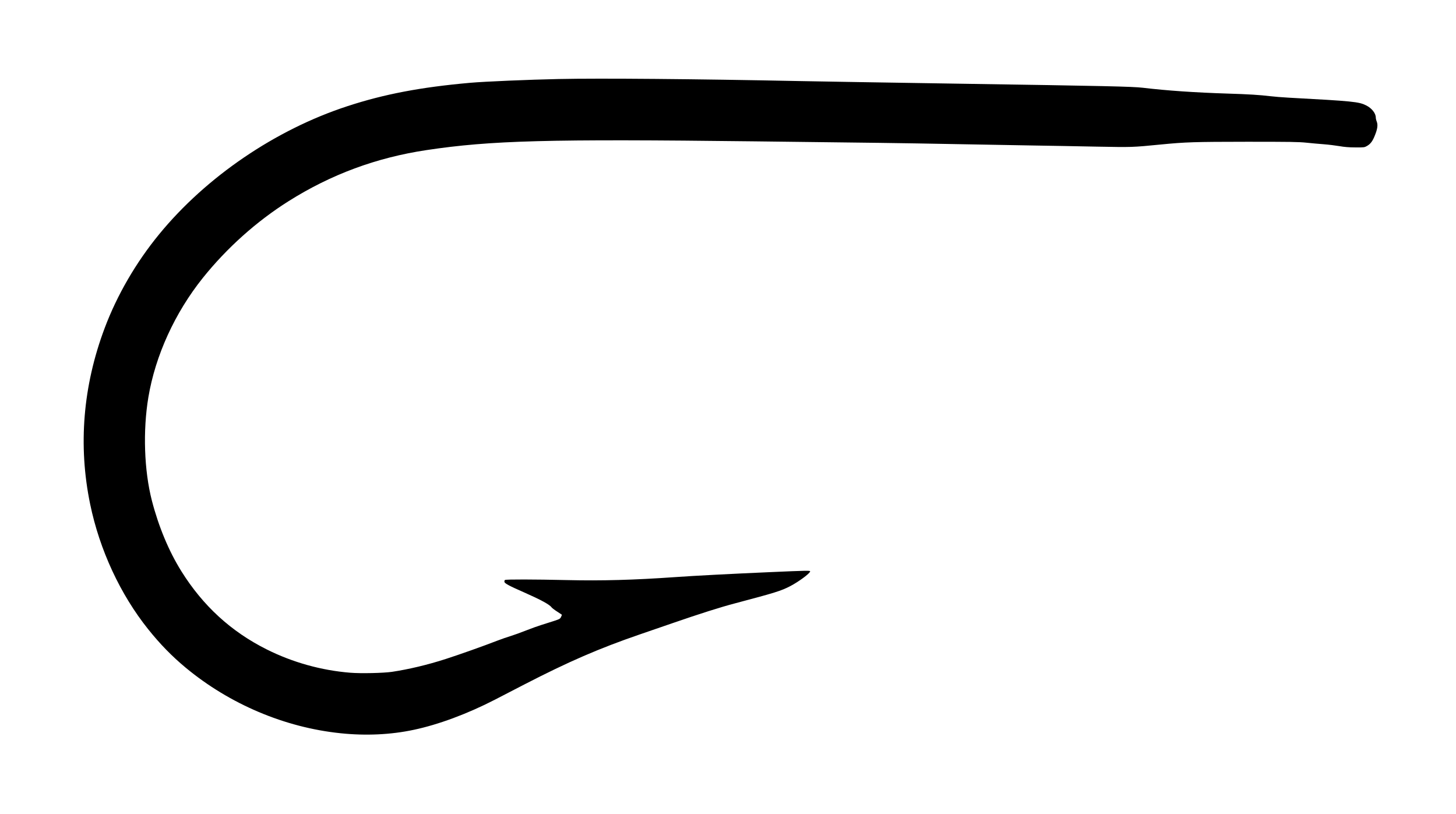
The Mustad 7860, made in Norway during the 1940s-1950s, is a heavy-wire saltwater bait hook in the Virginia pattern (a round-bend commercial pattern) with a blind flatted spade-end terminal designed for direct snell attachment rather than knot tying. The forged, flattened wire profile gives good resistance to straightening under load, while the wide gap suits bulky natural baits. It represents pre-modern commercial saltwater hook construction, before the shift to ring eyes and knot-tied attachment, making it both a functional period artifact and a record of the snelling techniques that persisted in commercial fishing into the mid-century.
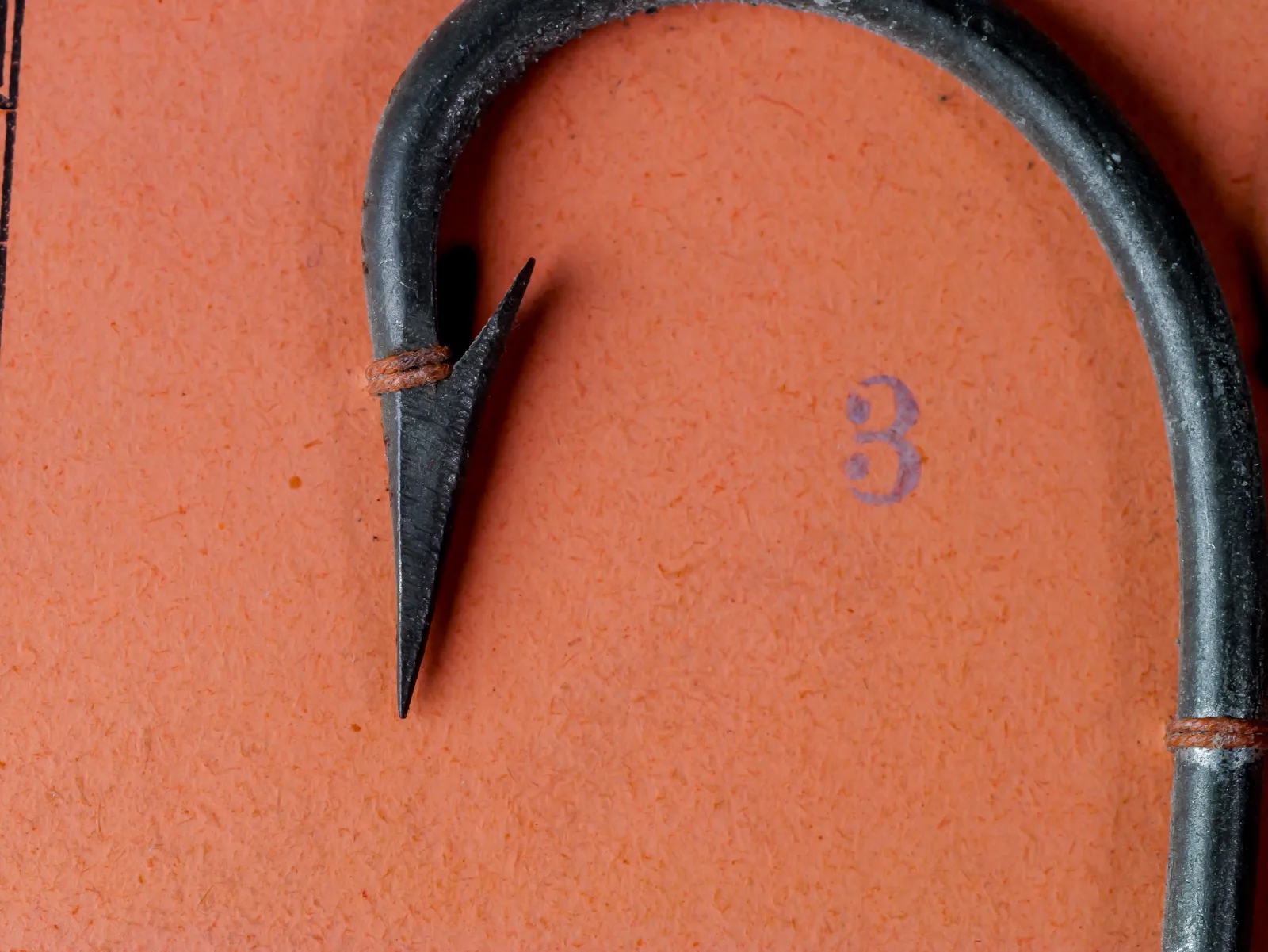
Close-up of the superior point and barb on a Mustad 7860 size 3, showing the characteristic near-straight inner taper and bright tinned finish on 1/10-inch measurement grid.
Photographic record
4 cataloged imagesSelect any record to load it above.
4 images shown
Mustad 7860 Virginia Hook Size 3 Point DetailClose-up of the superior point and barb on a Mustad 7860 size 3, showing the characteristic near-straight inner taper and bright tinned finish on 1/10-inch measurement grid.Open originalMustad 7860 Sales Demonstration Card Four SizesComplete Mustad 7860 Virginia Hooks sales demonstration card displaying sizes 3, 4, 5, and 6, mounted on original bright lime-green card stock with Key Brand trademark logo and typographic label.Open originalMustad 7860 Sales Card Label Typography DetailDetailed close-up of the Mustad 7860 sales card label showing the formal eight-line typographic format including manufacturer name, quality code, product line, and specifications — exemplifying the standardized Mustad labeling system.Open originalMustad 7860 Complete Sales Card on Measurement GridFull view of the Mustad 7860 sales demonstration card mounted on precision measurement grid, showing overall card dimensions, hook placement, and card condition with age-related toning.Open original
Technical profile
Eye
Blind — Flatted
Wire
Heavy (1X Heavy), Forged
Shank
Standard — Plain
Bend
Wide gapVirginia pattern — a round-bend commercial bait hook pattern carried by Mustad across several model numbers (e.g. 3227A, 3228, 4010). Round bend with a wide gap, observable in the photographs P. 'Virginia' is a catalog pattern name, not one of the classic English bend families. Any specific Mid-Atlantic/American regional origin is undocumented and should be treated as speculative S.
Point
Superior (near-straight inner taper)
Finish
Tinned — Inferred (photographically likely)Tinned, per the 'Flatted Tinned' line on the label V. In this specimen the hooks photograph as a dull grey rather than bright silver, consistent with aged/patinated tin P. Finish classification is taken from the label; the 'bright silver' appearance is not supported by the photograph.
Hooks show a uniform dull grey tinned surface with age-related patina; no significant active corrosion or rust pitting visible on the specimen. Spade-end (flatted) terminals show slight age wear but remain intact and undeformed. Card shows moderate toning typical of mid-century paper stock. All four hook samples present and in their original positions.
The Superior point classification indicates a near-straight inner taper that concentrates penetrative force at the tip while maintaining structural strength — ideal for penetrating the hard bone and cartilage of crushing-mouth fish species. The forged wire profile (flattened cross-section) dramatically increases tensile strength without adding overall diameter, allowing the hook to resist straightening under extreme load. The wide gap (0.50–0.60 inches on size 3) provides ample room for crustacean baits and reduces the risk of the hook being thrown by violent head-shakes. The flatted spade-end eye represents pre-modern eye technology, designed specifically for direct lashing to natural gut or braided silk snells rather than knot attachment — a construction method that remained standard in commercial saltwater fishing through the 1950s.
Size & scale lab
Selected size
(unspecified)
Physical specimen
Overall Length
41.5 mmE
Shank Length
20.5 mmE
Gap Width
14 mmE
Bend Depth
18 mmE
Wire Diameter
1.15 mmE
Shank-to-Gap Ratio
~1.4-1.6 : 1
Confidence
P
Physical specimen
Own this hook? Help us measure it.
We don't have measured sizes for this hook yet. Own one? Submit calipered measurements and we'll review and add them. Thank you!
Historical context
Era and Packaging Dating
Oslo – Norway address on the label (post-1925, ruling out Christiania). The display card and affixed green Mustad label with offset-printed Key Brand trademark are consistent with mid-century Mustad export cards. Flatted spade-end terminal and tinned finish are standard for bait/commercial saltwater hooks of this period. No barcode (pre-1974). Card construction and typography are consistent with 1940s-1950s manufacturing. (Card colour: the display card is orange/terracotta with a separate green product label — earlier 'lime-green card' descriptions refer only to the affixed label.)
The Tautog Fisher's Secret Weapon
Tautog and sheepshead have crushing, molar-like teeth capable of breaking down shell and bone, so anglers targeting them favor stout, heavy-wire hooks — a role a hook like the 7860 fills well. Beyond that general suitability, characterizations of this specific model as a 'gold standard' or as having achieved 'legendary status' from Boston to North Carolina are undocumented and are best treated as tradition rather than established fact.
Design lineage and influence
‘Virginia’ is a long-standing catalog pattern name used across the tackle trade; Mustad produced it in several model numbers (3227A, 3228, 4010 and this 7860). It is a round-bend bait pattern, distinct from the classic English named bends (round, sproat, Kendal, Limerick, Aberdeen and so on). A specific origin among Mid-Atlantic American blacksmiths, and the idea that Mustad ‘reverse-engineered’ a localized American design, is not documented in available sources and is presented here only as an unverified hypothesis S. What is observable is the construction itself: a flatted spade-end terminal tied to the pre-modern era of snelled lines, a technique that persisted in saltwater bait fishing well into the twentieth century.
Best matchRelated by Attribute
Computed automatically from catalog data — updated as new hooks are added.
Matches: Bend, Gap, Eye Orient., Point, Application +1 moreDiffers: Shank: Standard vs Short (1X–2X Short); Wire: Heavy (1X Heavy) vs Standard; Eye: Blind — Flatted vs Blind — Marked Shank +3 more
Matches: Bend, Shank, Point, Finish, Application +2 moreDiffers: Wire: Heavy (1X Heavy) vs Standard; Gap: Wide vs Standard; Eye: Blind — Flatted vs Ball Eye +3 more
The Mustad 7860 is a heavy-wire bait hook suited to bottom fishing in salt and brackish water for species with hard or bony mouths. It is a reasonable choice for bottom feeders such as tautog (blackfish), sheepshead and porgy, though the earlier claim that it was ‘specifically designed’ for these particular species is not documented. The wide gap takes bulky natural baits — crab and clam in particular — and the heavy forged wire resists opening under jaw pressure. The flatted spade end was intended for snelling with gut or braided line, standard practice in mid-twentieth-century saltwater bait fishing.
Secondary Applications
Light-tackle bluefish, striped bass, general bottom fishing for cod and grouper. Rarely used for fly tying due to spade-end construction.
Classic Fly Patterns
Named patterns specifically associated with this hook. Leave blank if none formally documented. Do not speculate — only include patterns with a confirmed association.
Modern Equivalents
Hook
Match Quality
Notes
Mustad 4011D Virginia Hook
Excellent
Modern Mustad Virginia-pattern hook with a turned-down ring eye rather than a flatted spade end. A reasonable modern stand-in for the pattern; the specific 'direct descendant' lineage is undocumented and stated with lower confidence.
Owner Mutu Light 5315
Good
The Owner Mutu Light is a circle hook (reversed, incurved point) — a fundamentally different hooking geometry from the 7860's straight-point round bend. It overlaps only in the general heavy bait-hook role; treat as a functional stand-in, not a geometric/pattern equivalent.
Gamakatsu Baitholder
Moderate
Modern bait hook with baitholder shank grooves rather than Virginia-style bend. Serves same functional purpose for hard-mouthed saltwater species but different geometric profile.
Collector notes
Rated 3.5/10 — moderately uncommon in complete original packaging due to the sales-card format, which sees heavy wear compared to retail boxes. Collector demand is modest; the 7860 appeals primarily to Mid-Atlantic fishing tradition specialists and Tautog-focused angling historians rather than general hook collectors. The flatted spade-end construction and regional specificity limit mainstream appeal.
Reference value
$5 – $18 USD estimate
Packaging condition
Good — moderate wear, legibleRecorded specimen
Packaging format
GW-E-02Catalog code
What Makes It Collectible: Complete sales demonstration cards are less common than retail boxes, making an intact four-hook card desirable to tackle archivists. The card and Key Brand branding in this style (pre-1970) are visually distinctive. The 7860 is also of interest as an example of Mustad’s mid-century export marketing of a named commercial pattern. (Characterizations of a Mustad ‘regional cloning’ strategy are undocumented and should be treated as speculative.)
Limiting Factors: Collector interest in the Virginia pattern is relatively narrow. Modern Mustad versions remain in production, reducing scarcity perception. The spade-end terminal, while historically significant, is not highly prized by contemporary fly tyers or general hook enthusiasts. Missing or damaged cards reduce value substantially.
Size and Finish Variants: Size 3 is generally the most sought (smallest, hardest to produce); sizes 5 and 6 are more common. A clean, well-preserved tinned surface commands a modest premium over dark-patinated examples. Complete four-hook original cards are valued higher than loose or incomplete examples.
Condition Impact: Card condition is the primary value driver; complete cards with all four hooks in their original positions are essential, and missing hooks reduce value substantially. An original wrapper or period envelope, if present, adds a small premium.
Packaging
The specimen is mounted on an orange/terracotta dealer display card printed in black, with a Greek-key (meander) border across the top and the header 'O. MUSTAD & SÖN - FISHHOOK MANUFACTURERS.' Four hooks are mounted horizontally across the orange card, each with a hand-stamped size number (3, 4, 5, 6) in purple/violet ink. A separate green Mustad product label is affixed at the lower right, bordered with a floral/asterisk motif and bearing the Key Brand skeleton-key logo, 'O. MUSTAD & SÖN - MANUFACTURERS - OSLO - NORWAY,' 'Qual. 7860,' product line 'Superior,' pattern name 'Mustad-Virginia Hooks,' quantity '100' with 'No.' prefix, and 'Flatted Tinned / Made in Norway.' Both cards show moderate age toning and minor handling wear; all text remains legible. No barcode present.
Market Value Notes
Low ($5): Good condition — worn card with light soiling, all four hooks present but card creased or toned<br />
<br />
High ($18): Excellent condition — card bright with minimal toning, all hooks intact with sharp bright tinned finish, original green color vivid<br />
<br />
Premium factors: Sales card format (rarer than retail boxes), complete four-hook display, pre-1950 production dating, bright tinned finish, Mid-Atlantic regional history appeal<br />
<br />
Platforms: eBay.com, specialized tackle auctions, regional antique tackle dealers<br />
<br />
Confidence: E estimated — limited recent sales data; based on comparable Mustad sales-card prices for era and regional interest patterns. Sales cards typically command 1.5–2.5x higher prices than single loose hooks of same model/era.
Where to Find
eBay.com (search 'Mustad 7860' or 'Mustad Virginia Hook' + 'sales card'); regional tackle dealers in Maryland, Virginia, Delaware; antique fishing tackle shops in Northeast US; specialized online auction houses for Mustad collectibles; occasional appearances at Great Lakes tackle fairs and East Coast tackle collector shows.
Collector's Identification Tips
Look for the orange/terracotta display card with a Greek-key border and the printed header ‘O. MUSTAD & SÖN – FISHHOOK MANUFACTURERS,’ plus a separate green Mustad label carrying the Key Brand skeleton-key logo. Model code ‘Qual. 7860’ is printed on the green label. Check for the ‘OSLO – NORWAY’ address (post-1925). Hooks are mounted in a row with hand-stamped size numbers 3, 4, 5, 6 in purple/violet ink. The label reads ‘100,’ ‘No.,’ ‘Flatted Tinned’ and ‘Made in Norway.’ The flatted spade-end terminal (not a ringed eye) is diagnostic. Heavy tinned wire with a wide round bend distinguishes the Virginia pattern from similar-era bait hooks.
Preservation
Storage and Preservation
Store in a cool, dry environment away from direct humidity and temperature fluctuation. The tinned finish is resistant to corrosion but will develop light patina over decades if exposed to moisture. Original sales card should be stored flat in a document box or archival sleeve, away from direct sunlight to preserve the bright lime-green color of the card stock. Do not attempt to remove hooks from the card — the mounting and presentation are integral to the specimen’s value and historical context. Avoid contact with other metals and rubber bands (which can cause galvanic corrosion and staining). If card shows signs of mold or foxing, place in a stable 45–55% relative humidity environment for several weeks to stabilize. Do not clean the tinned finish aggressively — light surface dust can be removed with a soft brush, but do not scour or polish as this damages the patina and reduces collectibility.
Marking Analysis
Handwritten Marks and Annotations
This example does not show visible handwritten annotations on the card itself. However, original 1940s–1950s sales cards were frequently annotated by tackle dealers with penciled notes indicating preferred sizes for local species (‘Best for tog size 4’), prices, or store inventory marks. Presence of period-correct handwriting (fountain pen or pencil in period style) typically adds modest collector premium as evidence of actual commercial use and local fishing knowledge. Any handwritten marks on vintage sales cards should be preserved as-is — they document the history of the tackle’s use in the regional fishing market.
Primary Source
Label Decryption — The Mustad Eight-Line System
Source: Reference Document 1: Mustad Label Typology and Decryption, p. 2–4
This 7860 card exemplifies the rigid eight-line typographic label format documented extensively in vintage Mustad packaging. Line 1: ‘O. MUSTAD & SÖN’ establishes manufacturer authority. Line 2: ‘MANUFACTURERS’ differentiates Mustad as primary maker, not a distributor or repackager — critical for brand retention against the era’s common practice of rebranding hooks. Line 3: ‘OSLO – NORWAY’ provides both geographic origin and chronological bracket (post-January 1, 1925, when Christiania was renamed to Oslo). Line 4: ‘Qual. 7860’ is the model code — a numerical tier system where 7000–7999 range indicates specialized saltwater/commercial bait patterns. Line 5: ‘Superior’ — point geometry is a near-straight inner taper (superior point geometry). Line 6: ‘Mustad-Virginia Hooks’ identifies the cloned regional pattern name. Lines 7 & 8: ‘Flatted Tinned’ describes the eye type and metallurgical finish. ‘Made in Norway’ reinforces origin.
The presence of this formal eight-line structure on a sales demonstration card confirms this as a genuine period piece from Mustad’s mid-century export infrastructure. This systematic approach allowed salesmen to communicate vast technical detail across linguistic barriers — a prerequisite for global distribution before standardized modern labeling.
Additional
Regional Pattern Adoption — The Virginia Bend Story
The Virginia bend represents one of the most successful examples of Mustad’s documented strategy of ‘regional cloning.’ Local blacksmiths and tackle makers in Tidewater Virginia and the Mid-Atlantic developed the Virginia pattern over decades to address the specific demands of bottom-dwelling species with extremely hard mouths — principally Tautog and Sheepshead. These fish possess crushing teeth and powerful jaws capable of snapping conventional hook wire. The deep-bellied, slightly offset bend, combined with a wide gap, proved highly effective for anchoring crustacean baits in the face of this pressure.
By the 1930s and 1940s, when Mustad had achieved global manufacturing dominance, they systematically studied and reverse-engineered successful regional patterns from around the world. The Virginia pattern — localized in the American Mid-Atlantic — became a candidate for mass production and global distribution. By manufacturing it with Norwegian industrial precision and exporting it as ‘Mustad-Virginia Hooks,’ the company successfully captured not only the original regional market but also introduced the pattern to anglers in other geographic areas who discovered its utility for similar hard-mouthed species in their own waters.
The 7860 sales card documents this moment of industrial standardization — when a regionally crafted design became a globally distributed, commercially standardized product. The presence of multiple sizes (3–6) on a single demonstration card reflects the wholesale market strategy: tackle shop owners could view the full range, understand Mustad’s manufacturing consistency, and place orders for inventory. This democratization of specialized tackle design — moving it from blacksmith workshops to factory production — was a defining feature of early-twentieth-century fishing tackle industrialization.
Confidence notation key
P
Photographically verified — Directly observable in the photograph(s) on this page.
V
Verified by documentation — Confirmed by manufacturer catalog, spec sheet, or published reference.
I
Inferred — A logical deduction from observable or documented evidence, not directly stated.
E
Estimated — An approximation based on visual comparison, proportional analysis, or limited data.
S
Speculative — A reasoned hypothesis that cannot be confirmed from available evidence.
Claims with no notation are confirmed by multiple independent sources. All photographs on garrenwood.com are taken on a measurement grid where each square equals 1/10 inch (0.1″ / 2.54 mm).