Ronn Lucas, Sr. was an Oregon hook maker and accomplished fly tyer whose work became closely associated with the modern revival of classic Atlantic salmon flies. He occupied an unusual position within the craft: Lucas not only tied elaborate salmon flies, but also made by hand the traditional-style hooks on which he and other tiers dressed them. During the last decades of his life, those two interests—fly tying and historical hook making—became inseparable parts of his work. Classic Fly Rod Forum
Lucas was already an active and experienced fly tyer well before he became a professional hook maker. By the 1990s he was creating both traditional and original salmon flies, and examples of his work were being published online. His Ghost of a Chance, for example, appeared through Fly Anglers Online in the 1990s and demonstrates the elaborate full-dress style that became a major part of his tying: complex bodies, unusual feathers, carefully layered components, and strong use of color. FlyAnglers Online
Over time Lucas became particularly interested in the artistic possibilities of the salmon fly. Although he could tie conventional fishing patterns and taught practical steelhead and salmon techniques, his personal work increasingly explored freestyle and exhibition flies. He was known for looking beyond the conventional catalog of expensive tying materials and finding uses for ordinary, overlooked, or unconventional feathers and fibers. Friends in the tying community later remembered this willingness to experiment as one of the distinguishing features of his work. Classic Fly Rod Forum
His articles for Fly Anglers Online reveal the breadth of that approach. Lucas wrote and demonstrated material on Atlantic salmon flies, Spey flies, steelhead flies, hairwings, featherwings, and contemporary fishing patterns. His instructional writing stressed proportion, clean construction, small heads, material preparation, and understanding why a technique worked rather than simply copying a dressing. At the same time, he encouraged tiers to experiment rather than regard historical practice as an inflexible set of rules. In discussing traditional blind-eye hooks, for example, he acknowledged their historic importance while encouraging tiers to choose hooks and techniques appropriate to the purpose of the finished fly. FlyAnglers Online
Lucas also spent considerable time teaching other tiers. Through online lessons and tying contests he offered detailed critiques and invited participants to contact him for help improving their flies. The international participation in these contests—with tiers from the United States, Europe, Japan and elsewhere—illustrates the increasingly international community of classic salmon-fly tying that developed through the Internet during this period. Lucas was an active part of that community, exchanging techniques and ideas with tiers around the world. FlyAnglers Online
Becoming a hook maker
The second major phase of Lucas’s work began in 2006, when he purchased the handmade salmon-hook business established by Ron Reinhold. Reinhold had begun making blind-eye hooks in 1993 and had developed specialized tooling for straightening wire, forming barbs, bending hooks and producing consistent reproductions inspired by nineteenth- and early-twentieth-century salmon hooks. Lucas spent approximately a week with Reinhold learning the process before the equipment was shipped to Oregon, where Lucas established his own hook-making shop.
Lucas did not simply preserve Reinhold’s operation unchanged. He adapted parts of the manufacturing process to his own working methods and expanded the range of patterns he could offer. For roughly the next sixteen years, from 2006 through 2022, he produced handmade hooks primarily for the classic salmon-fly community. His work included blind-eye patterns modeled on historic forms such as the Harrison & Bartleet, Noble, Jock Scott, and other Victorian-style salmon hooks. Examples survive in exceptionally large sizes as well; documented Harrison & Bartleet-pattern hooks made by Lucas include 9/0, 10/0, 12/0 and even 14/0 examples intended largely for exhibition tying.
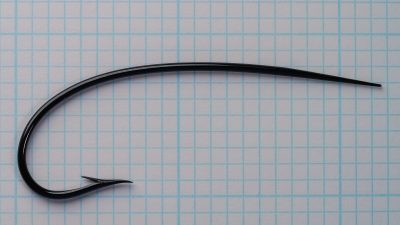
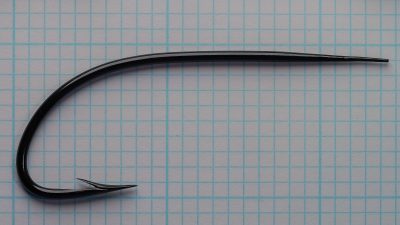
These were not merely bent pieces of wire intended to imitate the general appearance of an antique hook. In the tradition established by Reinhold, attention was given to bend shape, shank proportions, barb and point geometry, wire diameter and historically appropriate appearance. The hook itself mattered aesthetically. On a large full-dress salmon fly, the curve of the bend, the length of the shank and the relationship between point, barb and body all contribute to the proportions of the finished dressing. That relationship between hook and fly was especially important to Lucas because he understood both crafts from the tyer’s side of the vise.
His hooks consequently found their way onto the work of accomplished salmon-fly tiers. Italian tier Stefano Farkas used Lucas-made Harrison & Bartleet patterns for a number of large exhibition flies and specifically emphasized that the quality and shape of the hook were integral to the composition of a fully dressed salmon fly. Farkas’s 10/0 and 9/0 Lucas hooks appear beneath elaborate versions of patterns such as the Jock Scott and Green Highlander. Paul Rossman’s Creative Salmon Fly Art work likewise incorporated Lucas hooks. Global Fly Fisher
Lucas’s hook making also supported historical reconstruction. ClassicFlyTying.net described him as a “master-hookmaker” in connection with the Blacker Project, where historically appropriate hooks were needed to reproduce nineteenth-century salmon flies at the proportions intended by their original dressers. This was an important function of modern handmade hooks: surviving antique examples are scarce, inconsistent and often unsuitable for tying, while ordinary modern salmon hooks frequently lack the shapes and proportions shown in nineteenth-century literature. Classic Fly Tying
The hook and the fly
Lucas’s most distinctive legacy comes from the way his two crafts complemented one another. He could design or reproduce a hook while thinking about how a tier would actually use it, then dress that hook himself and judge whether the proportions worked. Some of his own patterns explicitly list a Lucas handmade blind-eye hook as part of the dressing. His Ron’s Favorite, Gold Ringneck, and Voyager are examples in which the hook is not simply an anonymous foundation but part of the identity and appearance of the finished fly. FlyAnglers Online
That combination placed Lucas in a relatively small modern tradition. Victorian salmon-fly dressers worked in a world in which specialized hook patterns from Redditch, Dublin and elsewhere were readily available. By the late twentieth century, many of those forms had disappeared from commercial production. Makers such as Ron Reinhold and, later, Ronn Lucas recreated them by hand for tiers who wanted something closer to the hooks illustrated in the works of Francis Francis, George Kelson, T. E. Pryce-Tannatt and other historic authors. Lucas helped keep those shapes available during a period of renewed interest in historically informed salmon-fly dressing.
In 2022, after Lucas became ill with cancer, he chose to pass the hook-making operation and its specialized tooling to Garren Wood. Lucas spent a series of weekends teaching Wood the process, continuing the direct transfer of knowledge that had begun when Reinhold trained Lucas sixteen years earlier. Thus the craft passed through three makers: Ron Reinhold → Ronn Lucas, Sr. → Garren Wood, with the tools, techniques and accumulated understanding moving with the business rather than disappearing when one maker stopped production.
Ronn Lucas, Sr. died on January 12, 2023, following a battle with cancer. Within the classic-fly community he left two closely connected bodies of work: the salmon flies he tied and taught others to tie, and the handmade hooks that continue to appear beneath the work of tiers around the world. His significance lies especially in that combination. He approached the salmon fly as a complete composition, beginning not with thread or feathers, but with the shape of the hook itself.