W. Woodfield & Sons was a Victorian-era manufacturer of fish hooks, fishing tackle, needles, and related steel goods based in Redditch, England. Although less familiar today than Allcock, Milward, or Hardy, Woodfield was an established participant in the Redditch tackle industry and supplied anglers with products ranging from individual hooks to complete rods, reels, lines, and dressed flies.
Origins in the Redditch needle trade
The company was founded by William Woodfield, who was born in Redditch in 1834. Woodfield worked as a needle maker, and his factory was located at Easemore Works on Elm Road. He died in 1913 at the age of 79.
The exact founding year is not entirely settled. Some historical summaries give 1850, while more detailed research places the establishment of W. Woodfield & Co. sometime between 1853 and 1861. By 1865, the business was trading as William Woodfield & Sons, apparently reflecting the development of the firm into a family enterprise.
Like several other Redditch tackle manufacturers, Woodfield’s origins were closely connected to needle making. Needles and fish hooks required many of the same industrial skills: selecting and drawing wire, cutting it to length, forming eyes and bends, hardening and tempering the steel, grinding points, and applying protective finishes. This made the transition from sewing needles to fish-hook production a natural expansion for an ambitious Redditch manufacturer.
Woodfield continued to manufacture needles alongside fishing goods. In February 1868, the company registered a patent relating to improvements in the construction of needle packets for sale, showing that packaging and presentation were already important parts of the business.
Fish-hook manufacturing at Easemore Works
By 1873, trade-directory records identified William Woodfield & Sons of Easemore Works both as a fish-hook manufacturer and as a general fishing-tackle manufacturer. This confirms that hooks were not simply a minor sideline but an established part of the company’s business by the early 1870s.
Woodfield operated during one of the most important periods in the development of the eyed fishing hook. Traditional hooks were commonly attached to gut or line by whipping or snelling, but improved eyed designs became increasingly important during the late nineteenth century. An advertisement published in the Fishing Gazette in 1891 promoted the company’s “Easemore Eyed Hooks” in salmon and trout sizes, connecting the product directly with the name of the Woodfield factory.
The Easemore name appears to have served both as a factory identity and as a mark of quality. Later advertisements placed the company at Easemore Works and Victoria Mills, Redditch, and described it as a manufacturer of fishing rods, reels, lines, tackle, and fish hooks.
A complete angling-tackle manufacturer
Although hooks are of greatest interest to collectors today, Woodfield offered a much broader range of angling equipment. A period advertisement described the company as a manufacturer of:
“Superior” fish hooks
Fishing rods
General fishing tackle
Waterproof tapered silk lines
Salmon and trout flies
This indicates that Woodfield was capable of supplying much of an angler’s outfit rather than functioning only as a hook-making workshop.
Surviving Woodfield rods further demonstrate the breadth of the business. One recorded example is a 12-foot 6-inch Tonkin-cane rod with a pigskin-covered handle and bayonet-lock ferrules, believed to date from the late nineteenth century. Woodfield appears to have remained independent rather than becoming part of one of the larger Redditch tackle combines.
International exhibitions
Woodfield participated in the major international exhibitions through which Victorian manufacturers presented their products to overseas buyers.
The company exhibited at the Vienna Universal Exhibition of 1873, where it received an honourable mention, although the award appears to have related to its needle products rather than fishing tackle. Woodfield was also represented at the Paris Universal Exhibition of 1878, where the British-section catalogue recorded the broad assortment manufactured by the firm.
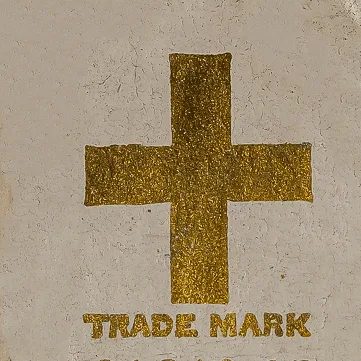
By 1877, the company’s addresses were given as Easemore Works and Victoria Mills. Historical records also associate Woodfield with cross, vine, and floral trademarks. Correspondence surviving from 1889 concerns a trademark disagreement between W. Woodfield & Sons and the major Redditch needle manufacturer Henry Milward & Sons, illustrating the importance manufacturers placed on recognizable marks and packaging.
Woodfield hooks
A complete Woodfield hook catalogue has not yet been widely digitized, but surviving packets, advertisements, display cases, and collector examples demonstrate a varied output.
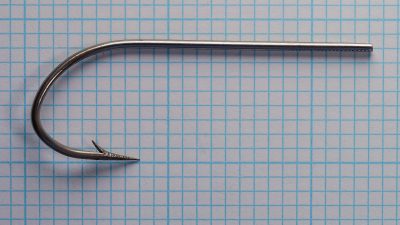
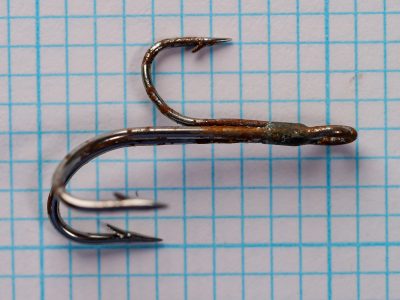
Known examples include Pennell-pattern down-eye sproat hooks sold on double gut, bronzed hooks marked “Extra Quality,” japanned salmon hooks in Kinsey-style forms, and bright ringed treble hooks. A surviving Woodfield salesman’s case contained samples of hooks in numerous sizes, suggesting that the firm offered a much larger assortment than the relatively small number of packets encountered by collectors today.
These surviving hooks should not be treated as a complete model list. They do, however, show that Woodfield manufactured hooks for several branches of angling, including trout fishing, salmon-fly dressing, bait fishing, and general-purpose tackle.
The limited company and closure
At some point after 1912, the business became a limited-liability company and adopted the name W. Woodfield & Sons Ltd. The precise incorporation date is not clear from the readily accessible historical record, but the limited-company name appears in advertising by 1937.
The company remained independent until it closed and was liquidated in 1945, bringing to an end roughly ninety years of manufacturing in Redditch.
For collectors, the presence or absence of “Ltd.” can therefore provide a useful general dating clue. Objects marked simply W. Woodfield & Sons are normally associated with the earlier business, while W. Woodfield & Sons Ltd. indicates production after incorporation. Packaging was sometimes retained or used for extended periods, however, so the company name should be considered alongside typography, address, hook construction, finish, and other packaging details.
Legacy
W. Woodfield & Sons occupied an important position within Redditch’s interconnected needle and fishing-tackle industries. Its history reflects the way skilled needle manufacturers adapted their knowledge of wire working, tempering, pointing, and finishing to the production of fish hooks.
The company may not have achieved the lasting name recognition of Redditch giants such as Allcock or Milward, but its long period of operation, international exhibition appearances, extensive tackle range, and distinctive Easemore products show that it was a substantial manufacturer rather than an obscure local workshop.
Today, Woodfield hooks, packets, salesman’s samples, rods, and needle cases provide evidence of a business that served both practical anglers and the international tackle trade during a period of rapid change in hook and fishing-tackle manufacture.