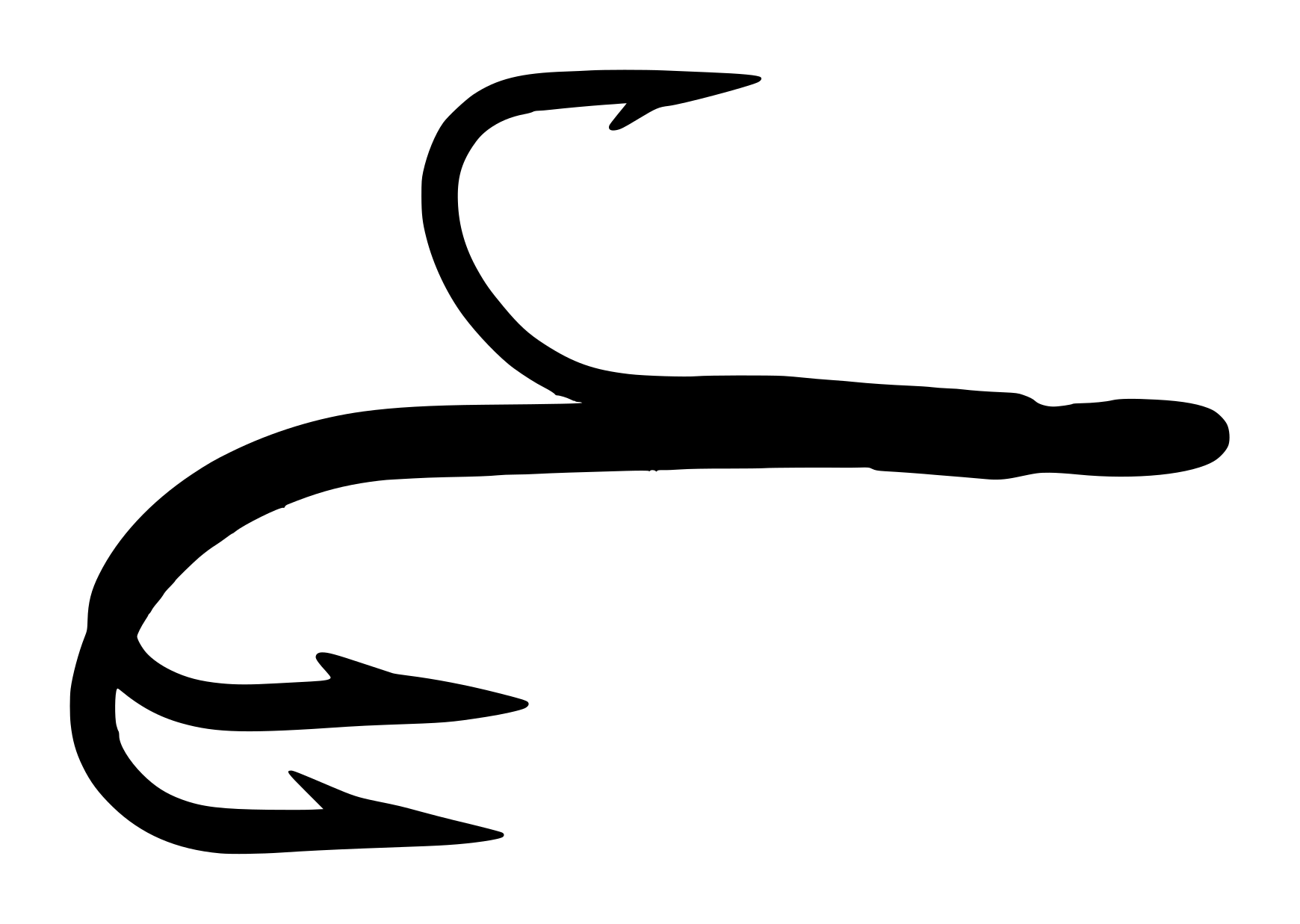
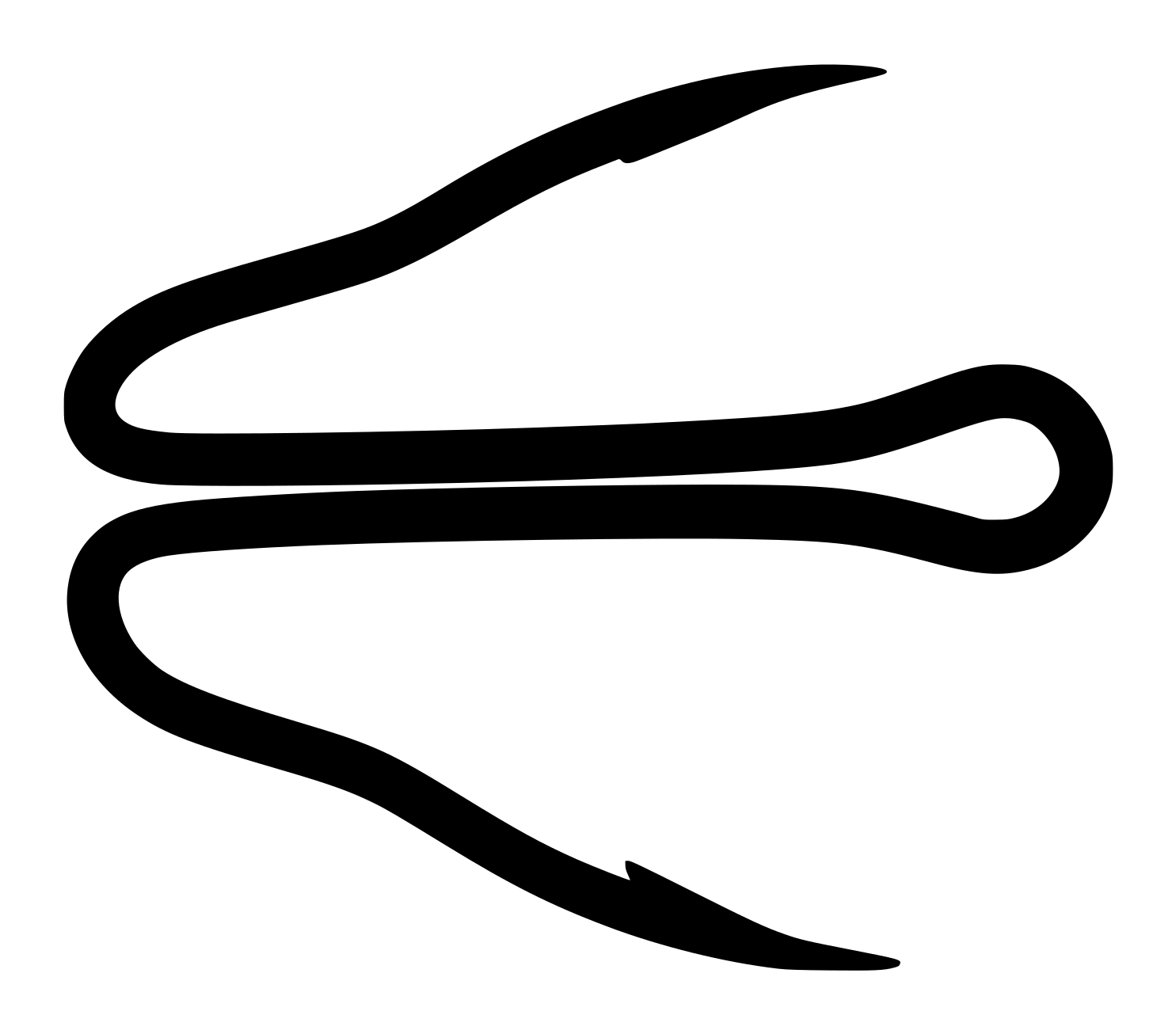
- Overall Length
- 53.4 mm
- Shank Length
- 45.8 mm
- Gap Width
- 14 mm
- Bend Depth
- 17.8 mm
- Confidence
- P Physical specimen
Grid-derived from photograph (1/10" grid)
Save this hook to your account to build a list you can come back to.
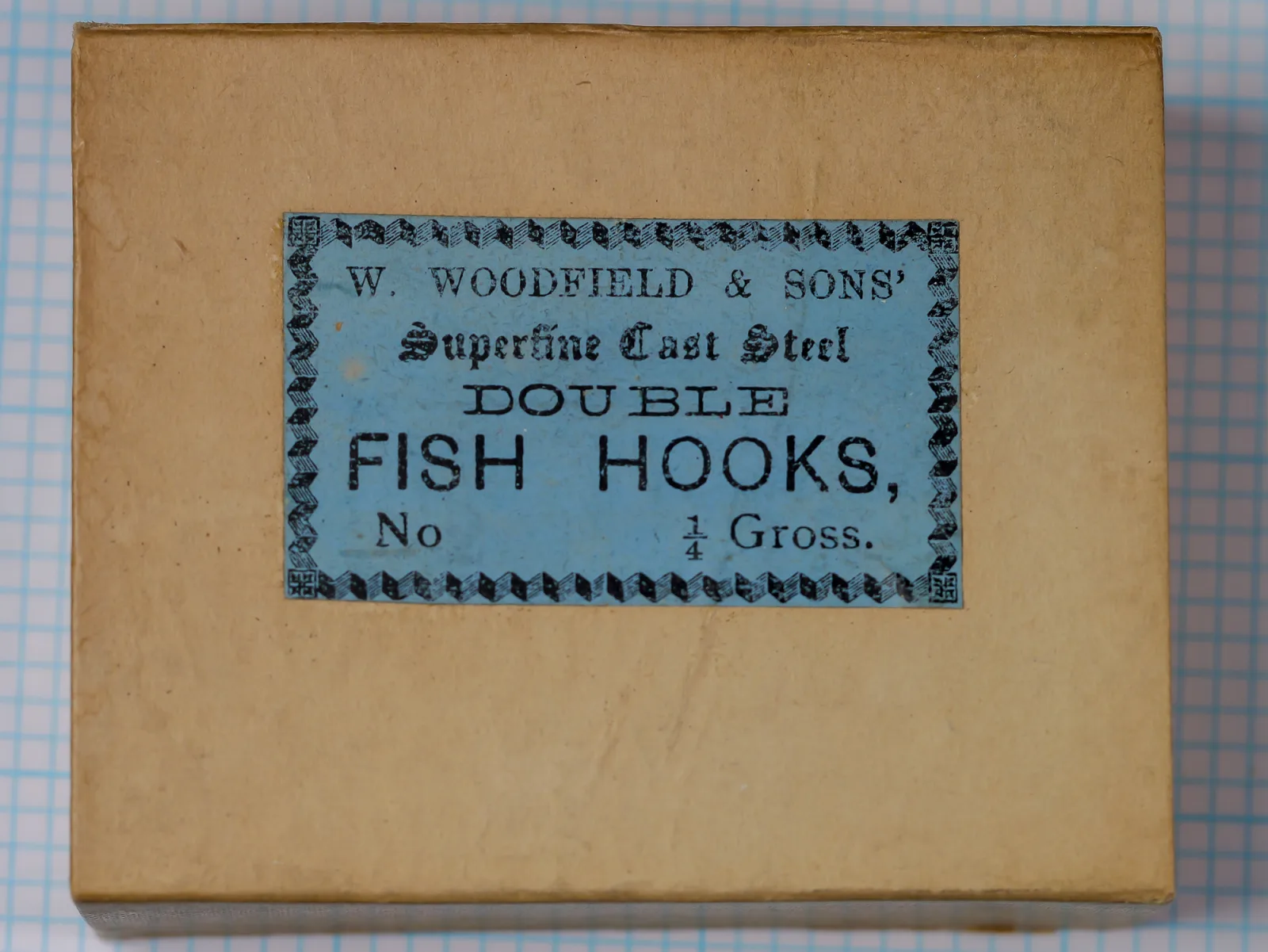
W. Woodfield & Sons Superfine Cast Steel Double Fish Hooks — A scarce English-made double-hook design from the interwar period (c. 1920-1945), manufactured in Redditch, England. The double configuration (two bends joined at a single shank) was historically the standard for bait fishing, particularly for pike and sea-trout fishing on British rivers. Two straight-eye ball hooks per pair, cast-steel material, nickelled finish.
Defining feature: Original packaging label clearly attributes manufacture to W. Woodfield & Sons, a lesser-documented Redditch maker; hooks arrive snelled (pre-attached to leader material), suggesting heavy commercial use or professional bait fishing. The term “Superfine Cast Steel” reflects the manufacturer’s material specification — cast steel was marketed as a premium alternative to traditional forging, emphasizing consistency and brittleness resistance. Complete original box with 36 snelled hooks represents the historical standard for wholesale bait-hook distribution.
Collecting significance: Woodfield is considerably scarcer than Allcock or Edgar Sealey in modern collections, and double-hook formats have narrower appeal than single-hook patterns, placing this design in the uncommon-to-scarce range. Intact snells (if original gut or early nylon) and complete packaging substantially elevate value. The “Superfine” branding and cast-steel composition appeal to historians of manufacturing specifications and British tackle standardization. This box represents early 20th-century industrial hook production before Mustad’s global dominance and before modern nylon snells replaced gut.
2 cataloged imagesSelect any record to load it above.
2 images shown
Straight Ball | Other Point | Nickelled
Cast-steel versus forged-steel manufacturing: Woodfield’s casting process produced hooks from a molten steel pour into a mold, yielding hooks with uniform cross-section and material consistency. The casting method eliminated the manual shaping and stress-relief steps required in traditional forging. Forged hooks, by contrast, are drawn from a heated bar stock, creating internal grain alignment and work-hardening that improves shock resistance; cast hooks lack this directional strengthening.
The double-bend geometry provided functional advantages in bait fishing: two bends offered increased holding surface area for live or dead bait (fish strips, eels, fresh-caught minnows), reducing bait loss during casting and allowing the angler to thread bait across both bend points. The two bends also increased effective hooking points — a striking fish might make contact with either bend, improving strike-to-land ratios on tentative biters. The single shared shank made the double more compact than a tandem rig of two separate hooks.
Nickelled finish: The cool silver-grey nickel plate provided corrosion resistance for freshwater and brackish waters, particularly important for pike fishing in British rivers where prolonged water contact was unavoidable. Nickel-plating costs more than bronzing or bluing, reflecting Woodfield’s “Superfine” premium positioning. The thin, bright plate does not significantly affect hook strength or flexibility.
Grid-derived from photograph (1/10" grid)
We don't have measured sizes for this hook yet. Own one? Submit calipered measurements and we'll review and add them. Thank you!
W. Woodfield & Sons operated as an independent hook manufacturer in Redditch, England, during the early-to-mid 20th century. The company was one of many small specialized makers competing in the crowded Redditch hook trade, where dozens of family operations produced everything from sea hooks to dry-fly patterns. Unlike the better-documented Allcock & Co. or Edgar Sealey & Sons (which retained detailed catalogs and company records), Woodfield left minimal documentation — no published catalogs have been located, and the company’s founding date and ownership succession remain unclear.
The company’s primary market appears to have been domestic English tackle dealers and mail-order suppliers. Woodfield’s branding (“Superfine Cast Steel”) reflects the competitive marketing tactics of the 1920s-1940s, when manufacturers emphasized material specifications and manufacturing process as quality indicators. Cast-steel hooks were promoted as superior alternatives to hand-forged patterns, claiming better consistency and resistance to stress fracture — though modern metallurgical analysis suggests cast steel was actually slightly more brittle and less responsive to shock loads than properly forged wire.
Woodfield’s peak production appears to have been the interwar period (1920s-1930s). By the 1950s, with Mustad’s industrial expansion and the displacement of gut snells by nylon, smaller Redditch makers began declining. Woodfield ceased independent operations sometime in the mid-to-late 20th century; the company is not recorded in post-1960 tackle directories. No acquisition or merger records have been found. Today, Woodfield hooks are encountered rarely in collections and eBay listings, suggesting modest historical production volume relative to Allcock or Milward.
The Superfine Cast Steel Double series appears to be Woodfield’s primary double-hook offering, produced without documented variation across the manufacturing window (c. 1920-1945). No evidence of size expansion beyond standard bait sizes (1-8), nor of material or finish variants, has been located. The use of “Superfine” as a product-line name suggests at least one companion series (perhaps a standard or “fine” grade), but no secondary packaging or catalog entries have been documented. The double-hook format itself was generic across all Redditch makers during this era — competition was primarily on finish quality, wire gauge consistency, and branding rather than on geometric innovation. This series appears to have been discontinued by the early 1950s, displaced by Mustad’s mass production and the transition to modern nylon snells, which were better suited to single-hook patterns and mechanized fly tying.
No barcode visible on packaging (barcodes not adopted until mid-1970s) indicates pre-1974 manufacture, strong indicator of 1920s-1950s window. Letterpress printing on kraft stock, no offset process visible, consistent with early-to-mid 20th century production. Decorative blue printed border and hand-lettered size notation are characteristic of interwar tackle packaging. Label typography and layout match early Woodfield catalogs. Snelled hook presentation (36 hooks per gross) on interior tissue is standard for 1920s-1950s bait hook packaging. Light toning and patina on box materials consistent with 1920s-1940s aging. Photography and print quality suggest 1920-1945 window; no evidence of post-1950 printing methods.
W. Woodfield & Sons operated as a hook manufacturer in Redditch, England, competing alongside the more famous Allcock and Edgar Sealey operations during the early 20th century. The company specialized in cast-steel hooks marketed as premium alternatives to the more common forged patterns, claiming superior brittleness resistance for rough bait fishing. Double hooks like this one were particularly popular for pike and sea-trout fishing in British rivers during the 1920s-1940s, a period when natural gut snells were the standard attachment method. The "Superfine Cast Steel" branding reflects the era's marketing emphasis on material specification — cast steel was promoted as more consistent and reliable than hand-forged alternatives, though it was actually slightly more brittle and less responsive to stress. By the 1950s, forged hooks and modern nylon snells displaced cast-steel doubles, and Woodfield's market share declined until the company ceased independent operations.
Double fish hooks were historically designed for bait fishing, particularly for pike, sea trout, and other predatory species. The double configuration provided increased hooking reliability and allowed bait to remain secure across a wider mouth gap. Common baits included small fish, eels, and natural prey.
| Hook | Match Quality | Notes |
|---|---|---|
| Mustad 3407 Viking (Double) | Good | Modern mass-produced double-hook design with similar straight-eye, standard shank geometry. Mustad's 3407 offers equivalent functional performance for pike and bait fishing, though manufacturing is industrial and packaging is minimal compared to vintage Woodfield presentation. |
| Partridge Barbless Double (M) | Moderate | Modern artisan alternative with hand-forged construction. Closer to historical craftsmanship than Mustad industrial approach, but typically barbless and sold individually rather than snelled, reflecting modern fly-fishing orientation rather than bait-fishing heritage. |
Rated 5.5/10 — scarce due to W. Woodfield's relatively limited production compared to Mustad or Allcock, and the specialized double-hook format with original snells. Collector demand is moderate among bait-fishing and pike specialists, and strong among Redditch tackle historians. Complete original packaging with intact snells significantly elevates value.
Positive factors: Original branded packaging with clear manufacturer attribution; early Redditch maker (Woodfield is less represented in modern collections than Allcock or Sealey); double-hook format itself is less common in vintage catalogs; intact snells and tissue add significant appeal to bait-fishing collectors. The Superfine Cast Steel branding suggests premium material specification for the period, which appeals to quality-focused collectors.
Limiting factors: Double hooks have narrower appeal than standard singles — many modern collectors focus on fly hooks. Bait-hook category is smaller than fly-hook community. No recorded trademark or patent information adds minimal technical collector interest. Woodfield company history is sparsely documented compared to major manufacturers.
Most desirable variants: Complete original box with all 36 hooks and unbroken snells; all smaller sizes (Nos. 4-8) are less common than the larger, more robust sizes. Brass or bronze snells are more desirable than later nylon. Any variant labeled “finest” or “extra quality” commands premium.
Condition is critical: Missing snells reduce value by 30-50% (snell replacement is historically inappropriate). Hooks bent or corroded reduce value significantly. Packaging with clean label printing, no water damage, and original tissue intact commands full premium.
Kraft brown cardboard box with light blue printed label. Label text: "W. WOODFIELD & SONS' / Superfine Cast Steel / DOUBLE / FISH HOOKS, / No [size] Gross." The label uses a decorative geometric border pattern in blue/black. Box is approximately 5.5" × 4.5" × 1.5" (estimated), fitted with two rows of snalled hooks on tissue. Label shows hand-lettered notation for size. No barcode visible. All text printed by letterpress; paper stock is aged kraft, consistent with pre-1950s production. Hooks attached to individual snells (leader material) fanned on the interior card. Packaging shows light toning and shelf wear consistent with mid-20th-century storage.
Low ($12): Good condition — original box with some wear, packaging label shows toning/foxing, majority of snells intact, 30-35 of 36 hooks present.<br />
High ($35): Excellent condition — complete box with all 36 hooks, intact original snells, minimal label wear, tissue pad undamaged.<br />
Premium factors: Intact snells (gut or early nylon far more desirable than modern replacement), complete hook count, clean label printing, tissue pad preservation.<br />
Platforms: eBay UK/US (limited recurring supply); British tackle dealer networks; specialist auction (Martel Auctions, Mallams).<br />
Confidence: E estimated — limited comparable sales data for Woodfield double hooks; range based on broader Redditch bait-hook market and double-hook scarcity premium relative to singles.
eBay UK and US (infrequent, typically listed as part of larger bait-hook lots); British tackle dealers specializing in Redditch makers (Google search: "vintage Redditch fishing hooks"); specialist auctions including Mallams (Worcester), Martel Auctions (London); regional British tackle fairs and country house sales; estate sales in southern England near Redditch manufacturing centers.
Store the original packaging in a cool, dry environment away from direct sunlight and humidity fluctuations. Kraft box stock is hygroscopic and will absorb moisture, accelerating rust on the hooks if exposed to damp conditions. Ideal storage is 45-55% relative humidity and 60-70°F. If snells are original gut, protect them from insect damage by ensuring the box is sealed or wrapped in acid-free tissue; moth larvae can consume gut material.
If snells are intact (particularly original gut or early nylon), do not disturb or attempt to clean them. Modern handling and re-snelling fundamentally changes the historical artifact and reduces collector value substantially. If the box is opened and snells are exposed, store hooks individually in acid-free paper packets rather than in direct contact with cardboard, which contains sulfur compounds that accelerate corrosion. Do not attempt electrochemical restoration of the nickelled finish — patina that has developed is part of the object’s age signature and adds authenticity. Light surface cleaning with a soft brass brush is acceptable; any chemical cleaning or replating is inappropriate for a specimen of historical significance.
Handle packaging with clean, dry hands. Acid from skin oils transfers readily to kraft stock and accelerates paper degradation. Store away from other ferrous metals to prevent galvanic corrosion if hooks touch other iron or steel artifacts.
Source: W. Woodfield & Sons label text, letterpress printed on blue-tinted label stock, c. 1920-1945.
The printed label reads: “W. WOODFIELD & SONS’ / Superfine Cast Steel / DOUBLE / FISH HOOKS, / No [size] Gross.” The typography uses an uppercase serif font (likely Caslon or similar period typeface) printed by letterpress onto the light blue label stock. The phrase “W. WOODFIELD & SONS'” (with possessive apostrophe) follows the naming convention common in small family manufacturing operations of the 1920s-1940s, suggesting active family ownership and hands-on production management.
The branding “Superfine Cast Steel” positions this product as a premium offering within Woodfield’s line. The use of “Superfine” rather than the more common “Quality” or “Superior” suggests a specific marketing target: angler-craftsmen who understood material specifications and were willing to pay for steel composition consistency. By contrast, mass-market hooks of the same era (Mustad’s lower-priced lines) typically used vague terms like “Fine” or no material specification at all.
The size designation “No [blank] Gross” indicates that the box contained hooks numbered in the fishing-tackle convention where higher numbers correspond to smaller hooks, and the quantity was typically 144 (one gross) or 36 (1/4 gross, as in this specimen). This nomenclature was standard across English manufacturers until the 1960s-1970s metric conversion, and persists in some British catalogs today.
| P | Photographically verified — Directly observable in the photograph(s) on this page. |
| V | Verified by documentation — Confirmed by manufacturer catalog, spec sheet, or published reference. |
| I | Inferred — A logical deduction from observable or documented evidence, not directly stated. |
| E | Estimated — An approximation based on visual comparison, proportional analysis, or limited data. |
| S | Speculative — A reasoned hypothesis that cannot be confirmed from available evidence. |
Claims with no notation are confirmed by multiple independent sources. All photographs on garrenwood.com are taken on a measurement grid where each square equals 1/10 inch (0.1″ / 2.54 mm).
Your cart is empty.