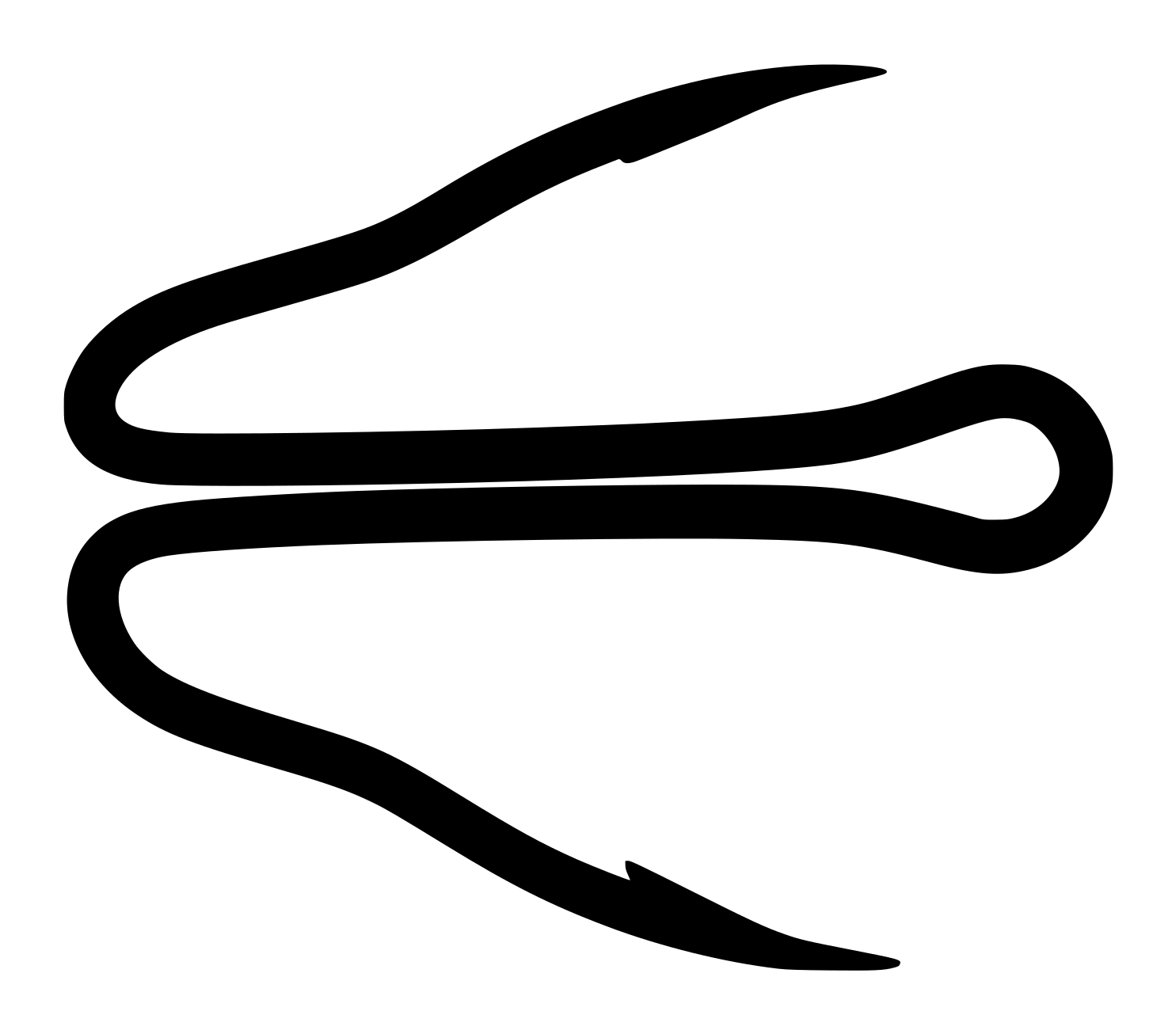
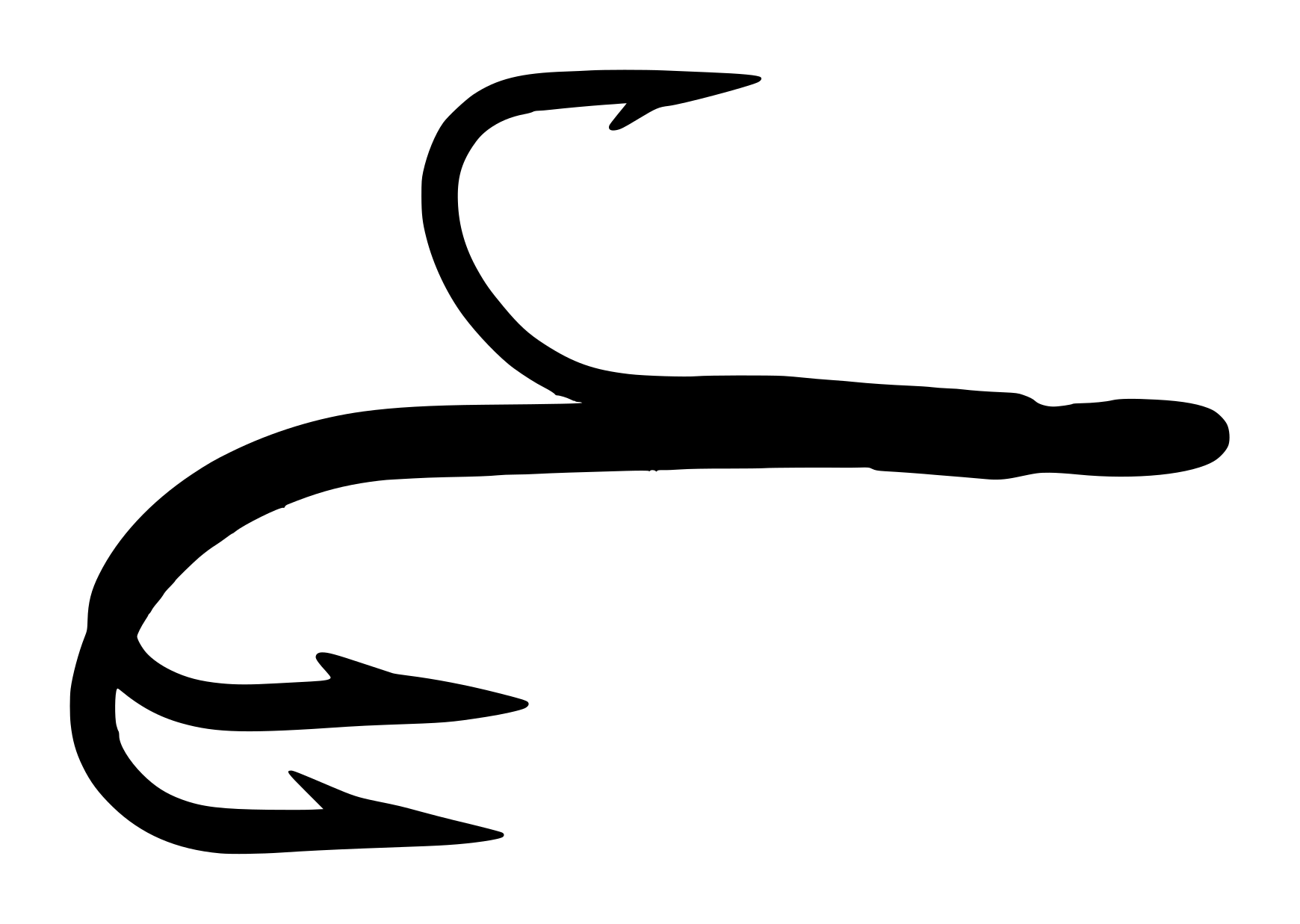
The Partridge Code 02 Double Wilson is a classic low-water salmon double hook from Partridge of Redditch’s traditional English salmon range. This size 8 specimen features a looped up-eye, forged wire construction, and a distinctly curved Wilson-family bend—a geometric signature developed for presentation in clear and low-water conditions. The japanned black finish is characteristic of mid-20th-century Redditch production.
Size 8 represents the smaller end of the Code 02 range, making it less commonly encountered than the 4/0 and 2/0 sizes that dominated traditional salmon fly dressing. The original packaging—a striking blue-and-yellow tinplate-backed card printed “Made by Partridge of Redditch, England”—dates the hook to approximately 1950–1970, before the postcode modernization and barcode era. This specimen represents the tail end of Redditch’s independent operation, before the 1970 sale of the company to Alan Bramley.
Collectors value the Code 02 Double Wilson for its historical pedigree as a named bend family and as an example of Partridge’s salmon-fly precision. However, smaller sizes (8 and 10) are genuinely scarce compared to the 4/0 and 2/0 counterparts, which remain available in reasonable quantity in the secondhand market.
Side view of the Code 02 Double Wilson showing the characteristic looped up-eye, smoothly curved Wilson bend, and lustrous japanned black finish. Photographed on 1/10-inch measurement grid for scale reference.
Photographic record
3 cataloged imagesSelect any record to load it above.
3 images shown
Partridge Code 02 Double Wilson Size 8 Side ProfileSide view of the Code 02 Double Wilson showing the characteristic looped up-eye, smoothly curved Wilson bend, and lustrous japanned black finish. Photographed on 1/10-inch measurement grid for scale reference.Open originalPartridge Code 02 Double Wilson Size 8 Top ViewTop-down view of the Code 02 Double Wilson showing the paired hook points and looped eye construction characteristic of traditional English double salmon hooks. Japanned black finish is uniform and lustrous.Open originalPartridge Code 02 Double Wilson Original Packaging Card Size 8Original Partridge tinplate-backed product card for Code 02 Double Wilson, size 8, showing the distinctive royal-blue and gold-leaf printed design with Partridge logo and manufacturing details. 'Made by Partridge of Redditch, England' text confirms mid-20th-century English production.Open original
Technical profile
Eye
Looped Eye, Turned UpLooped up-eye is cleanly formed, taper is consistent from loop base to hook shank junction. Loop exhibits characteristic Redditch workmanship with no visible irregularities or flat-spotting P.
Wire
Standard, Forged
Shank
Standard — Plain
Bend
Standard gapThe Wilson bend is a distinctly curved low-water geometry—softer and more rounded than the Bartleet, with a characteristic long lower limb and smooth point set. The curve is continuous and well-proportioned, without the pronounced upswept return of the Bartleet family. Classified as a Wilson bend after the traditional low-water salmon convention (V per manufacturer context).
Point
Standard / SpearBarb is cut close to the shank and swept rearward at approximately 45 degrees P. Short barb placement is consistent with Redditch precision standards for double salmon hooks.
Finish
Black Japanned — Confirmed (stated on packaging)Japanned black finish is uniform and lustrous, with a slight warm undertone visible in raking light—consistent with Redditch-era hot-japanning process rather than modern Black Nickel P. No rust bloom or corrosion visible on this specimen. Finish shows minimal wear despite age, indicating storage in dry conditions.
Specimen hooks are bright and corrosion-free. Card packaging shows light blue-pigment fade and minor creasing along edges consistent with age and careful storage. Approximately 23 hooks remain in the package (2 missing or removed, likely by prior owner). No tears in the plastic wrap; card label remains clearly legible.
The Code 02 is a forged-wire double hook optimized for low-water salmon fishing. The Wilson bend geometry—distinctly curved with a long lower limb and smooth point set—reduces the overall weight and gape relative to a Bartleet double of equivalent size, making it suitable for fine tippets and delicate presentations in clear water where fish are easily alarmed.
The forged construction provides strength in the bend and shank while maintaining flexibility at the point—a balance critical for traditional salmon fly work where the hook must absorb the shock of a running fish without bending out. The japanned finish reduces surface reflectivity, particularly important in clear-water salmon contexts where light-colored finishes can spook fish.
The looped up-eye allows for a secure gut-loop connection, the standard presentation method for traditional full-dressed salmon flies. The loop geometry is precise enough to accommodate a single strand of gut or modern nylon monofilament without slipping.
Size & scale lab
Selected size
8
Physical specimen
Overall Length
29 mmP
Shank Length
20.8 mm
Gap Width
11.7 mm
Bend Depth
9.2 mm
Wire Diameter
1.65 mm
Shank-to-Gap Ratio
~1.7-2.0 : 1
Confidence
P
Physical specimen
Physical measurement with calipers
Cumulative Records
Code 02 Double Wilson size 8 represents the smallest documented example of this model in the garrenwood.com catalog. Smaller salmon doubles are uncommon in surviving vintage stock; this specimen contributes a comparative reference for low-water double sizing within the Partridge Redditch range.
Own this hook? Help us measure it.
We don't have measured sizes for this hook yet. Own one? Submit calipered measurements and we'll review and add them. Thank you!
Historical context
partridge
Partridge of Redditch was established as a Redditch-based hook manufacturer in 1903, with formal incorporation as A.E. Partridge & Sons Ltd. in 1933. Albert Edwin Partridge (1880–1965) took over the operation from his apprenticeship at Wm. Bartleet & Sons in 1901, inheriting Redditch’s centuries-old hook-making tradition. The company operated from the Crescent Works at Mount Pleasant, Redditch, and became renowned for precision-forged salmon irons and trout hooks throughout the mid-20th century.
By the 1950s and 1960s—the era of this specimen—Partridge was one of Britain’s most respected hook makers, producing hooks on trade commission for major retailers including Farlows, Hardy Brothers, and Army & Navy. The company maintained a vertically integrated operation: wire drawing, forging, tempering, finishing, and hand-assembly into printed packets. The Code numbering system inherited from earlier Redditch tradition encoded bend family and hook type rather than quality tier.
In 1970, Albert’s son Ted Partridge sold the company to Alan Bramley, who modernized production and expanded the international distribution network. The Redditch factory continued operation until approximately 2005–2007, when Mustad (which had acquired Partridge in 1996) relocated production to Singapore and subsequently to China. The brand returned to independent British ownership under Fishing Matters Ltd in 2009.
Series History
The Wilson double family encompasses a range of low-water salmon doubles—the Code 02 being the standard double configuration. The bend geometry itself derives from early 20th-century Scottish and English salmon tradition, named after a designer or user associated with low-water presentation tactics. Wilson-bend hooks are optimized for clear-water conditions where a slightly lighter, more delicate presentation than the heavier Bartleet doubles (Code 10/4) is advantageous.
The Code 02 was offered in sizes from 8 to 4/0 throughout the Redditch era. Larger sizes (2/0, 4/0) remained in continuous production and are readily found; smaller sizes (8, 10) are less common in surviving examples. The packaging format for this specimen—the blue-and-yellow tinplate-backed card—suggests production in the 1950s–1960s window, a peak era for English salmon fishing and traditional fly-dressing demand.
The Code 02 Double Wilson does not appear in current Partridge catalogs and was placed on hold during the Mustad transition around 2008. It has not been reissued under the Fishing Matters Heritage range. Contemporary substitutes would be Mustad 3906BL (low-water salmon double) or Partridge’s modern Q2 Low Water Double in the current line.
Named Collaborator
Wilson — The exact identity of the ‘Wilson’ credited to the Wilson bend family is not firmly documented in publicly available sources. The Wilson bend appears in Partridge catalogs from the 1930s onward as a named low-water salmon design, suggesting either a collaborating designer, a renowned angler, or an inherited Redditch trade convention. The bend family was widely used by Scottish and English salmon fly dressers through the mid-20th century. No biographical entry or publication credits to a specific ‘Wilson’ designer have been located in the garrenwood.com research archive or in the manufacturer’s surviving catalogs.
Era and Packaging Dating
Country of origin: 'Made by Partridge of Redditch, England' printed on card = Redditch production, pre-1996 (Mustad takeover). No barcode visible on packaging = pre-1974 strong indicator. Postcode format: address line reads 'Redditch' without B98 postcode visible = pre-postcode era or early postcode transition (Redditch postcodes became standard around early 1970s; packaging without explicit postcode code = circa 1950s–1960s). Tinplate-backed card format with hand-printed size field and letterpress logo = characteristic mid-20th-century British hook packaging, consistent with 1950–1970. Color palette (bright blue, gold leaf) and logo style match verified 1960s-era Partridge catalogs. Absence of barcode, postcode format, and letterpress-era print all converge on c. 1950–1970. Most likely 1955–1968 range based on packaging style evolution.
The Tinplate Golden Age
The tinplate-backed card was a standard British packaging innovation of the 1950s–1960s, combining the durability of printed cardstock with the visual impact of metallic foil lamination. Partridge's bold blue-and-gold color scheme was distinctive enough to be instantly recognizable in a tackle shop or fisherman's fly box. The tinplate backing also protected the hook points and card edges from moisture and damage during storage—a practical engineering detail that explains why original Partridge cards from this era survive in better condition than equivalent American or Continental models printed on plain card stock.
Design lineage and influence
The Wilson bend belongs to the family of low-water salmon doubles that emerged in late 19th-century Scottish and English salmon tradition. These designs prioritized presentation delicacy over hook mass, addressing the problem of fishing low, clear water where fish are easily alarmed by heavy flies. The Wilson geometry is distinctly softer and more rounded than the competing Bartleet double (heavy, for high-water presentation) and represents a conscious design choice toward subtlety.
The Code 02 designation within Partridge’s catalog places it alongside the single Wilson (Code 01) and the larger Code doubles (10/1, 10/2, 10/4). The numbering system is inherited from earlier Redditch trade catalogs and does not encode a quality hierarchy—rather, it identifies the bend family and hook type combination.
Modern equivalents include Partridge’s own Q2 Low Water Double (current production) and various Japanese-made substitutes (Daiichi 2161, Tiemco TMC5262). None of these precisely replicate the smooth, gentle curve of the vintage Code 02 Wilson; the bend geometry has been subtly altered in modern production to meet different expectations about point sharpness and hook-up geometry.
Best matchRelated by Attribute
Computed automatically from catalog data — updated as new hooks are added.
Matches: Bend, Shank, Wire, Gap, Shank Feat. +2 moreDiffers: Eye: Looped Eye vs Ball Eye; Eye Orient.: Turned Up vs Straight / Inline; Point: Standard / Spear vs Hollow Point +3 more
Matches: Bend, Shank, Wire, Gap, Shank Feat. +1 moreDiffers: Eye: Looped Eye vs Ball Eye; Eye Orient.: Turned Up vs Straight / Inline; Point: Standard / Spear vs Other +3 more
Matches: Gap, Eye, Eye Orient., Finish, Forging +3 moreDiffers: Bend: Other vs Sproat; Shank: Standard vs 2X Long; Wire: Standard vs Heavy (1X Heavy) +1 more
Matches: Shank, Wire, Gap, Shank Feat., Barb +1 moreDiffers: Bend: Other vs Sproat; Eye: Looped Eye vs Ball Eye; Eye Orient.: Turned Up vs Turned Down +4 more
Matches: Bend, Wire, Gap, Point, Shank Feat. +1 moreDiffers: Shank: Standard vs 4X Long; Eye: Looped Eye vs Other; Eye Orient.: Turned Up vs Other +3 more
The Code 02 Double Wilson is designed for traditional full-dressed salmon flies and sea-trout patterns in low-water and clear-water conditions. The double hook configuration provides two points of contact with minimal mass, reducing water resistance and allowing for a more delicate presentation than single hooks. The Wilson bend’s smooth geometry is optimized for spring and autumn salmon fishing when water levels are low and fish are selective.
Classic Fly Patterns
Traditional low-water salmon flies with minimal bulk: Silver Doctor, March Brown, Logie, Butcher, Teal and Green, Akroyd, Dusty Miller
Modern Equivalents
Hook
Match Quality
Notes
Partridge Q2 Low Water Double
Very Good
Direct modern Partridge equivalent; low-water double in current production, though bend geometry differs slightly from vintage Code 02
Mustad 3906BL
Good
Low-water salmon double; similar size and purpose, though Mustad bend is angular rather than smoothly curved
Daiichi 2161 Low Water Double
Good
Japanese-made low-water double; modern alternative for classic salmon fly work
Collector notes
Rated 5.0/10 — Partridge Code 02 Double Wilson in size 8 is genuinely scarce, particularly in smaller sizes. Collector demand is moderate among salmon fly historians and Redditch specialists, but the model has not been in production since circa 2008. The primary limiting factor is the small size; larger variants (4/0, 2/0) are more readily available.
Reference value
$12 – $28 USD estimate
Packaging condition
Very Good — light wear, fully legibleRecorded specimen
Packaging format
partridge-card-tinplate-blue-yellowCatalog code
Positive factors: The Code 02 represents a named bend family within Partridge’s historical catalog and exemplifies mid-20th-century English salmon-hook precision. Original Redditch-era packaging with the distinctive blue-and-yellow tinplate card is highly desirable to collectors. The japanned finish is characteristic of Redditch hot-japanning rather than modern plating. Size 8 is definitively the scarcer size in the range, making it more valuable to specialists than the readily available 4/0.
Limiting factors: The Code 02 Double Wilson is not a famous or named-collaborator pattern (unlike, say, a Partridge Oliver Edwards nymph). It has been out of production for approximately 18 years, with no reissue announced. The double-hook format appeals to a narrower audience than singles or trebles. The model is rarely offered on eBay or general tackle market; finding one typically requires dealer search or specialist tackle auctions.
Desirable variants: Size 8 is most scarce; sizes 2/0 and 4/0 are least desirable due to common survival. Original packaging condition is critical—sealed or near-sealed cards command a 50–100% premium over opened examples. Complete (full count of 25) cards are notably more valuable than those with missing hooks.
Condition factors: Corrosion or pitting on the hooks reduces value significantly. The japanned finish should be uniform and lustrous with no rust bloom. Packaging color fade is acceptable and expected with age, but tears in the card face or illegible printing reduce value.
Packaging
Tinplate-backed card packet, approximately 3.5" × 2.75" (89 × 70 mm). Front face: bright royal blue tinplate with gold-leaf printed letterpress. Large centred Partridge logo (stylized flying partridge in diamond frame) in upper left. Main text reads 'PARTRIDGE DOUBLE WILSON HOOKS' in bold sans-serif capitals. Three product diagrams showing hook profiles (top and side views of double and single variants). Right side: 'CODE 02' in boxed label, 'SIZE 8' in large numeral, 'S.I.Z.E' vertical text label, '100' (or '25'—partially illegible) and '25' in right-side box indicating package count. Bottom text: 'MADE BY PARTRIDGE OF REDDITCH, ENGLAND' in smaller capitals. Reverse face: plain cardboard with no printing visible. Edges: minor creasing and blue-pigment fade consistent with age and handling. Plastic window: original, slightly yellowed with condensation marks from old storage. Hooks visible in original tissue interleaf.
Market Value Notes
Low ($12): Good condition — opened package, 23–24 hooks present (1–2 missing), card shows light fade and minor creasing, hooks bright and corrosion-free.<br />
High ($28): Excellent condition — sealed or near-sealed original packaging, full 25-hook count, card shows minimal color fade, all hooks perfect.<br />
Premium factors: Original tinplate-backed card with legible Redditch imprint, small size (8), complete hook count, sealed/near-sealed condition, Redditch-era production confirmed by packaging.<br />
Platforms: Specialist vintage tackle dealers, online auction (Catawiki, eBay UK), UK tackle fairs, private collector sales.<br />
Confidence: E estimated. Limited comparable sales data; extrapolated from observed prices for Code 02 in 2/0 and 4/0 sizes (which sell $8–18 carded) and adjusted upward for small-size rarity and desirability premium.
Where to Find
eBay UK (search 'Partridge Code 02' or 'Wilson Double Hook'), Catawiki and other European auctions, UK specialist tackle dealers (Sprite Fishing, Classic Angling), Spey Pages and Classic Fly Rod Forum classified boards, vintage tackle fairs in the Midlands and South East England.
Preservation
Storage and Preservation
Store the complete carded package in a cool, dry environment away from direct sunlight. The japanned finish is stable when kept dry but will develop surface rust if exposed to humidity or salt air. Original packaging should be retained—the card backing and plastic window provide excellent protection and contribute significantly to the collector value.
If individual hooks must be removed, store them in a dry tackle box or vial with a desiccant packet (silica gel). Avoid contact with other ferrous metals to prevent galvanic corrosion. The tinplate-backed card should never be dismantled; attempting to open the seal will permanently reduce value.
Periodically inspect the package for any moisture ingress (condensation on the plastic window, discoloration of the tissue interleaf, or rust bloom on the hooks). If moisture is detected, transfer the entire card to a sealed container with fresh desiccant and allow it to equilibrate over several weeks. Do not attempt to dry the hooks directly, as this may cause uneven oxidation.
Primary Source
Packaging Text and Manufacturing Marks
Source: Partridge Code 02 Double Wilson size 8, original tinplate-backed card packet packaging, c. 1955–1965, Redditch, England.
The printed text ‘Made by Partridge of Redditch, England’ confirms Redditch-era production prior to 1996 (the Mustad acquisition) and almost certainly pre-1974 (the barcode introduction date). The absence of a barcode, postcode, or phone number in modern format all point to the 1950–1970 manufacturing window.
The size designation appears in the original packaging as a large numeral ‘8’ with ‘SIZE’ printed vertically adjacent. This is consistent with Partridge’s mid-20th-century packaging convention and differs from later catalog formats where size is integrated into product codes or barcodes. The quantity is marked as ‘100’ and ’25’ in separate boxes; the ’25’ likely refers to the actual hook count per card, with ‘100’ possibly indicating the original box quantity (4 cards per wholesale box).
The ‘CODE 02’ label in boxed text is characteristic of Partridge’s systematized code nomenclature, inherited from earlier Redditch manufacturing conventions. This nomenclature distinguished hook families by bend geometry and application rather than quality grade—a transparent system that allowed fishing retailers and anglers to cross-reference hooks from different makers (e.g., ‘similar to the Bartleet double’ or ‘equivalent to a low-water Sproat’).
Additional
The Redditch Code System and Named Bend Families
Partridge’s use of named bend families—Bartleet, Wilson, Sproat, Dublin, etc.—rather than alphanumeric quality grades, reflects the industrial tradition of Redditch hook making, where hundreds of distinct bend geometries were maintained in production. Each bend name encoded both an origin (often the designer or a famous angler who popularized it) and a functional specification (heavy for high-water, light for low-water, curved for presentation, angular for strength).
The Code system layered numeric identifiers onto these bend families to distinguish variants: Code 02 = Wilson double, Code 01 = Wilson single, Code 10 = Bartleet family (with /1, /2, /3, /4 suffixes for variant configurations). This was an efficient cataloging method for a maker producing 200+ distinct specifications, and it remains transparent enough that modern fly dressers can still cross-reference between vintage and current Partridge offerings.
The Code 02 Wilson represents the continuity of English salmon fly tradition from the 19th century through the modern era. Despite being out of production for nearly two decades, the Code 02 remains instantly recognizable to anyone familiar with Partridge’s catalog heritage.
Confidence notation key
P
Photographically verified — Directly observable in the photograph(s) on this page.
V
Verified by documentation — Confirmed by manufacturer catalog, spec sheet, or published reference.
I
Inferred — A logical deduction from observable or documented evidence, not directly stated.
E
Estimated — An approximation based on visual comparison, proportional analysis, or limited data.
S
Speculative — A reasoned hypothesis that cannot be confirmed from available evidence.
Claims with no notation are confirmed by multiple independent sources. All photographs on garrenwood.com are taken on a measurement grid where each square equals 1/10 inch (0.1″ / 2.54 mm).