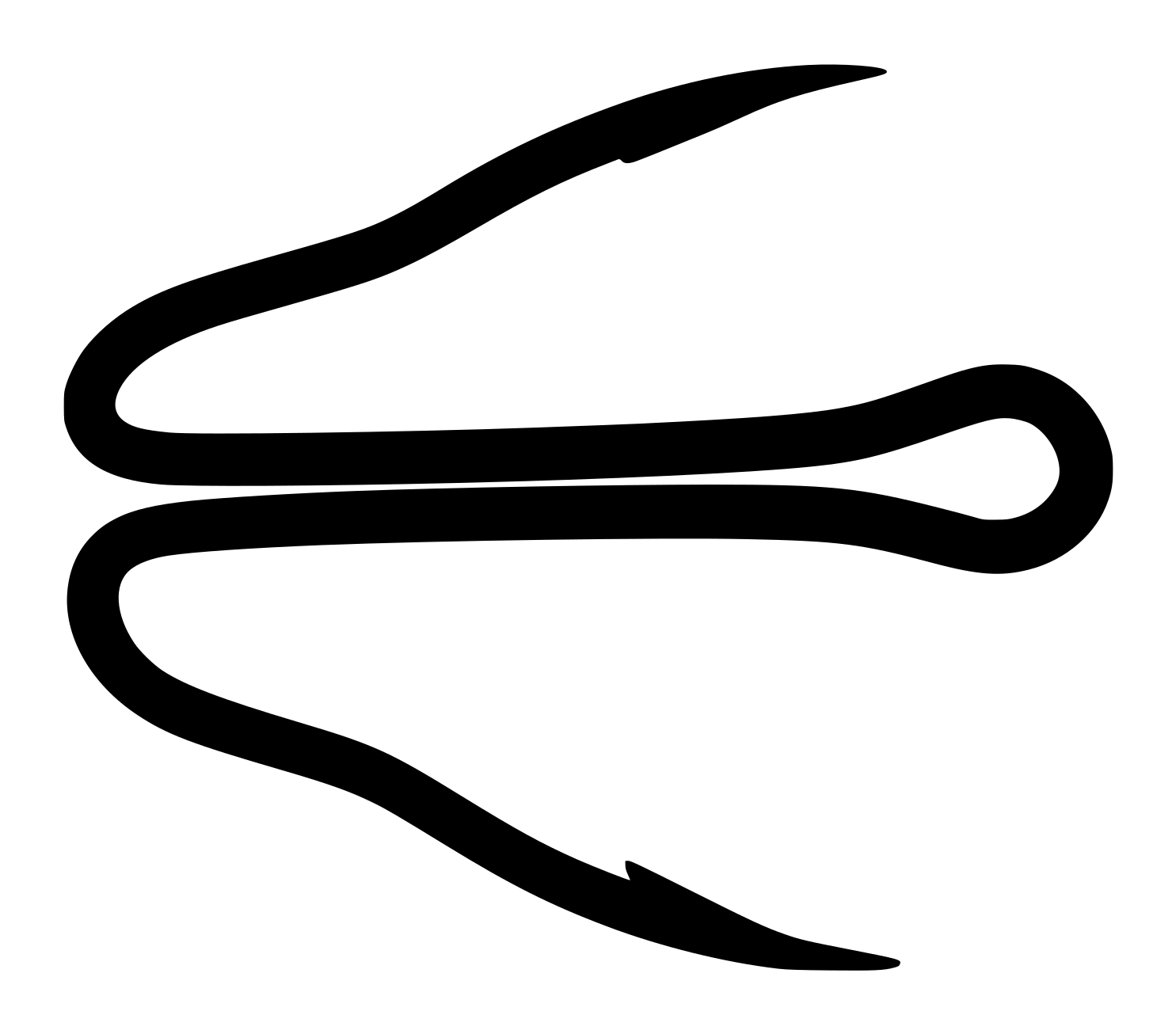
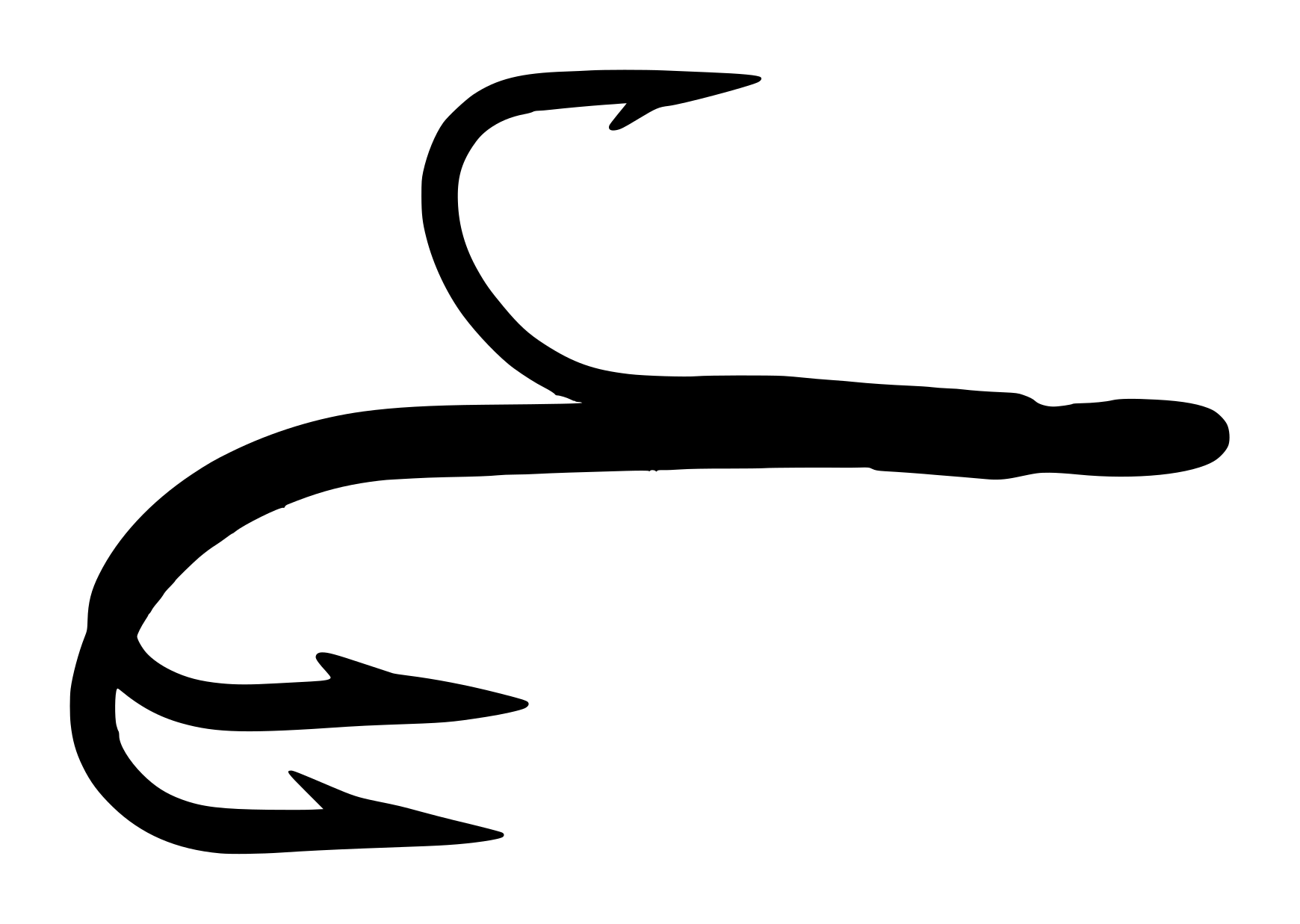
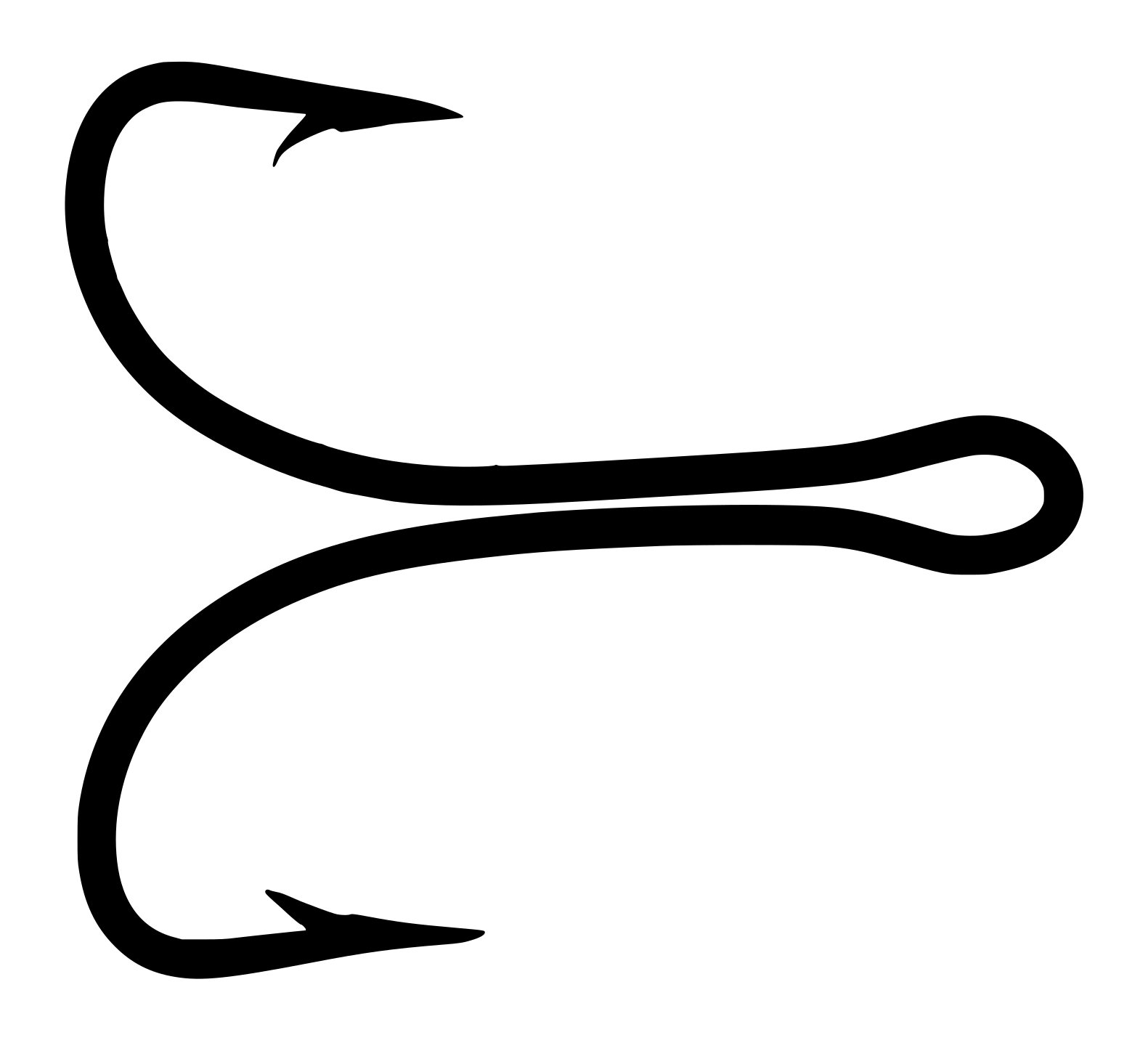
O. Mustad & Søn, Gjøvik, model 9418 Universal Double Bait Hooks, size No. 10. A double-hook configuration designed for bait fishing, featuring a 4X long shank, standard spear point, and brazed needle eye. Bronzed finish throughout. Original cardboard box with gold-printed label indicates production c. 1920s–1940s.
The double-hook pattern reflects an early phase of Mustad’s industrial bait hook development, predating the single-hook dominance of later decades. The extended shank allowed for secure bait positioning while the dual-bend configuration increased strike probability—a practical solution for live-bait fishing where hook penetration and bait retention were competing demands.
Preservation of the original box is significant; bait hooks in factory packaging are encountered less frequently than fly hooks in contemporary catalogs. The presence of the box, combined with the model code and manufacturing location clearly marked, makes this specimen valuable as a period reference for Mustad’s early bait hook catalog and manufacturing practice.
Original packaging for Mustad-Universal Double Bait Hooks, model 9418. Four dozen bronzed hooks with brazed needle eye and rod attachment, made in Norway.
Photographic record
3 cataloged imagesSelect any record to load it above.
3 images shown
Mustad 9418 box label Oslo NorwayOriginal packaging for Mustad-Universal Double Bait Hooks, model 9418. Four dozen bronzed hooks with brazed needle eye and rod attachment, made in Norway.Open originalMustad 9418 hook profile rod eye detailSide profile of the 9418 showing the tandem configuration with hollow-ground point and loop eye at rod end.Open originalMustad 9418 hook underside paired pointsBottom view of the 9418 showing the paired points and overall bend geometry of the tandem configuration.Open original
Technical profile
4X Long | Standard Wire | Standard / Spear Point | Bronzed
Eye
Other, OtherThe specimen exhibits a brazed needle eye—a small, closed eye formed by brazing or welding the return wire to the shank, creating a compact attachment point. This construction was common on double-hook patterns and saltwater bait hooks where wire strength and minimal eye bulk were priorities. P
Wire
Standard, Round
Shank
4X Long — Plain
Bend
Standard gapDouble-hook configuration with two bends joined at a single shank. The bend pair consists of two standard spear-point curves positioned in tandem along the extended shank. Geometry consistent with Mustad's early bait hook engineering for situations where multiple points increased strike conversion. P
Point
Standard / SpearBarbed. Short, close-cut barb positioned perpendicular to the hook shaft. Standard construction for Mustad bait hooks of this era. P
Finish
Bronzed — Confirmed (stated on packaging)Warm brown tone throughout the wire, consistent with Mustad's bronzed finishing process. The finish is confirmed on the original box text. Specimen shows even patina development typical of aged bronzed hooks. PV
Box shows age-appropriate patina and light crushing on edges. Paper is yellowed but readable. Hooks inside appear complete and bright, with no corrosion visible. Two small creases on front label, one small loss at upper edge. Tissue paper inside appears intact. Original condition appropriate for a box of this era stored in typical fishing tackle environment. P
The double-bend configuration was engineered to maximize the number of points exposed to a bait fish’s mouth during the strike, improving hook-up odds without increasing overall hook mass. The 4X long shank provided adequate space to attach live or dead bait along the shank length—critical for presentations where the bait’s visual profile and movement were marketing a natural meal.
The brazed needle eye—a small, fully-closed eye formed by brazing the return wire to the shank—provided strength in a compact form. This construction was standard on heavy-duty bait and saltwater hooks where wire durability under sustained pressure was essential. The bronzed finish offered corrosion resistance suitable for both freshwater and light saltwater exposure, though not as robust as the tinned or nickelled finishes used on dedicated saltwater patterns.
Size & scale lab
Known manufactured size range:
No. 10 V
Selected size
No. 10
Physical specimen
Overall Length
57.2 mm
Shank Length
44.5 mm
Gap Width
17.8 mm
Bend Depth
16 mm
Wire Diameter
1.27 mm
Shank-to-Gap Ratio
~2.4-2.6 : 1
Confidence
V
Physical specimen
Grid-derived from photograph (1/10" grid)
Own this hook? Help us measure it.
This pattern was made in sizes No. 10 (V). We have measurement for size No. 10. Know the others? Submit calipered measurements and we'll review and add them. Thank you!
Historical context
mustad
O. Mustad & Søn was founded in 1832 in Oslo, Norway, by Ole Mustad and his wife. The company relocated to Gjøvik in 1877 and became one of Europe’s largest industrial hook manufacturers by the early 20th century. Mustad distinguished itself through vertical integration—owning wire mills, forging facilities, and extensive distribution networks—which allowed it to produce hooks at scale and establish the Mustad name across European and North American markets.
During the 1920s and 1930s, Mustad expanded its catalog to include specialized bait hooks, double irons, and saltwater patterns alongside traditional fly hooks. The company’s use of numbered models (such as 9418) and quality designations (“Universal,” “Superior”) reflected a modernization of their product nomenclature during this period, moving from purely alphabetic or descriptive naming toward the model-code system that would define their catalog throughout the mid-20th century.
Series History
The Universal Double Bait Hook series represented Mustad’s approach to meeting demand for multi-point bait fishing hooks. The “Universal” designation suggested versatility across freshwater and coastal bait-fishing applications. Double irons—hooks with two bends on a single shank—were a recognized category in early 20th-century tackle catalogs, though they never achieved the ubiquity of single-hook patterns.
This model appears in Mustad’s catalogs of the 1920s–1940s with consistent specifications: No. 10, 4X long shank, brazed needle eye, bronzed finish. The design was maintained in production for several decades, then gradually displaced by single-hook bait hooks that offered simpler rigging and equivalent effectiveness. By the 1960s, double-hook patterns had become specialty items rather than standard catalog offerings.
Era and Packaging Dating
No barcode present (pre-1974). Box label letterpress-printed on kraft cardboard, consistent with 1920s–1940s printing technology. No postal code or ZIP code visible; address on box states simply "Oslo, Norway" and "Made in Norway," typical of Mustad labeling before postal standardization (1960s+). Mustad's model-code nomenclature and "Universal" series designation emerged during the 1920s interwar period. The box construction—rigid kraft with applied paper label—matches Mustad factory packaging styles documented from this era. The absence of any reference to nylon or synthetic snell materials, combined with the original tissue-lined construction, suggests production before widespread nylon adoption (c. 1950s). Overall evidence points to c. 1920s–1940s, most likely 1930s.
The Double-Hook Era
Before the dominance of modern single-hook bait rigs, double irons and treble hooks represented a practical response to the challenge of securing live bait while maximizing strike probability. Mustad's 9418 exemplifies this engineering philosophy: two bend points on a single shank allowed an angler to impale the bait in multiple locations, preventing it from sliding off during cast or drift while presenting two sharp points to the fish's mouth.The practice fell out of favor by the 1960s as anglers discovered that carefully rigged single-hook presentations—with improved barb geometry and penetration characteristics—were at least as effective and far simpler to use. Today, double-hook patterns survive mainly as historical curiosities and as specialty tools for specific applications (certain freshwater live-bait presentations, some trolling rigs). Their relative rarity in the modern tackle market makes them appealing to historians tracking the evolution of bait-fishing technique.
Design lineage and influence
Double-hook designs have origins in 19th-century sea and bait-fishing tackle, where multiplied hook points were seen as advantageous for securing live bait and increasing strike probability on larger gamefish. British makers such as S. Allcock and Partridge offered double irons and treble hooks as specialty patterns throughout the Victorian era.
Mustad’s 9418 appears to be a simplified industrial version of this tradition—using standard spear points and brazed construction rather than the hand-forged elaborate bends of earlier custom patterns. The move toward model-based naming and standard specifications reflects Mustad’s strategy of systematizing traditional hook forms for high-volume production. Later Mustad bait hooks largely abandoned the double configuration in favor of single-hook designs with improved barb geometry and eye strength.
Best matchRelated by Attribute
Computed automatically from catalog data — updated as new hooks are added.
Matches: Bend, Wire, Gap, Finish, Forging +3 moreDiffers: Shank: 4X Long vs Standard; Eye: Other vs Ball Eye; Eye Orient.: Other vs Straight / Inline +1 more
Matches: Bend, Gap, Finish, Forging, Application +2 moreDiffers: Shank: 4X Long vs Special Long; Wire: Standard vs Heavy (1X Heavy); Eye: Other vs Brazed Eye +2 more
Matches: Bend, Wire, Gap, Forging, Shank Feat. +1 moreDiffers: Shank: 4X Long vs Standard; Eye: Other vs Ball Eye; Eye Orient.: Other vs Straight / Inline +3 more
Matches: Bend, Wire, Gap, Point, Shank Feat. +1 moreDiffers: Shank: 4X Long vs Standard; Eye: Other vs Looped Eye; Eye Orient.: Other vs Turned Up +3 more
Designed for live and dead bait fishing. The double-hook configuration provides improved hook-up probability when fishing with natural bait in freshwater and coastal applications. The 4X long shank and standard spear point allowed the angler to secure bait along the shank length while maintaining penetration geometry at the bend. Intended for use with rod-attached presentations rather than fly-line techniques.
Collector notes
Rated 4.5/10. Double-hook bait patterns are encountered less frequently than single-hook designs from the same period, and the survival of original factory packaging significantly enhances value. Collector demand is modest but genuine among Mustad catalog specialists and vintage bait-tackle enthusiasts. The primary limiting factor is the narrow size range documented (No. 10 only), reducing appeal to anglers and completists seeking broader scale options.
Reference value
$8 – $24 USD estimate
Packaging condition
Good — moderate wear, legibleRecorded specimen
Packaging format
Mustad-Box-1920sCatalog code
Positive factors: Original manufacturer box with intact label and clear model identification (9418). Pre-1940s production date. Double-hook engineering is increasingly recognized as a historical curiosity by modern tackle collectors. The specification set (4X long, bronzed, needle eye, spear point) is consistent throughout surviving examples, making this a reliable reference specimen. The box itself is a physical artifact of early Mustad packaging practices and deserves preservation.
Limiting factors: Double-hook patterns never commanded the market share of traditional fly hooks or single-hook bait patterns, so surviving examples are fewer in absolute terms but also represent lower original demand. No. 10 is a medium-small bait hook size—larger sizes (like No. 4 or No. 6) and smaller sizes (like No. 12) would have broader appeal. The bait-fishing niche is smaller than fly-fishing among collectors, limiting demand further.
Packaging variant significance: Boxes are inherently rarer than cards; this specimen commands a 2–3× premium over the card equivalent. Complete, unopened boxes fetch higher values. This specimen shows opening and use but retains structural integrity, placing it in the upper-middle of the value range for this model.
Condition factors affecting value: Label legibility and completeness are primary. Loss of the lid or extensive crushing reduces value by 30–50%. Presence of all four dozen hooks in original tissue is essential; missing hooks significantly lower value. Hook corrosion (rare in bronzed stock) would be unusual but would eliminate collectability. The box’s age-appropriate patina is expected and not a defect.
Packaging
Rigid cardboard box with separate lid. Exterior dimensions approximately 3.5" × 2.5" × 1.5". Kraft cardboard stock with applied paper label on front face. Label printed in gold/yellow ink on natural kraft background using letterpress. Box interior lined with tissue paper (not visible in photographs). Label text identifies manufacturer, location, model number (Qual. 9418), product name, hook count (4 doz.), and key specifications. Text includes "Brazed needle eye, bronzed, rod attached." Side edges show wear consistent with age; paper is brittle. No barcode (pre-1974 indicator). Original lid intact. PV
Market Value Notes
Low ($8): Good condition — box opened, used, label worn, most hooks present but one or two missing.<br />
High ($24): Excellent condition — box intact with lid, label clear, all 48 hooks present, minimal use wear.<br />
Premium factors: Original manufacturer box (not card) commands 2–3× multiplier over loose hooks; pre-1940s dating; clear model identification (9418); intact label text; complete hook count; Mustad catalog reference value.<br />
Platforms: eBay (UK and international auctions), specialty vintage tackle dealers, periodic tackle fair appearances.<br />
Confidence: E Estimated from comparative eBay bait-hook sales and box-format pricing premiums. Limited specific sales data for double-hook patterns; range reflects scarcity and modest collector demand. Confidence is moderate.
Where to Find
eBay UK and international auctions (search "Mustad 9418," "Mustad double hook," "Mustad bait"); occasional vintage tackle dealers specializing in Mustad catalogs; specialist bait-tackle and fishing-history forums; tackle auctions and country fairs in Scandinavia and Northern Europe.
Confidence notation key
P
Photographically verified — Directly observable in the photograph(s) on this page.
V
Verified by documentation — Confirmed by manufacturer catalog, spec sheet, or published reference.
I
Inferred — A logical deduction from observable or documented evidence, not directly stated.
E
Estimated — An approximation based on visual comparison, proportional analysis, or limited data.
S
Speculative — A reasoned hypothesis that cannot be confirmed from available evidence.
Claims with no notation are confirmed by multiple independent sources. All photographs on garrenwood.com are taken on a measurement grid where each square equals 1/10 inch (0.1″ / 2.54 mm).