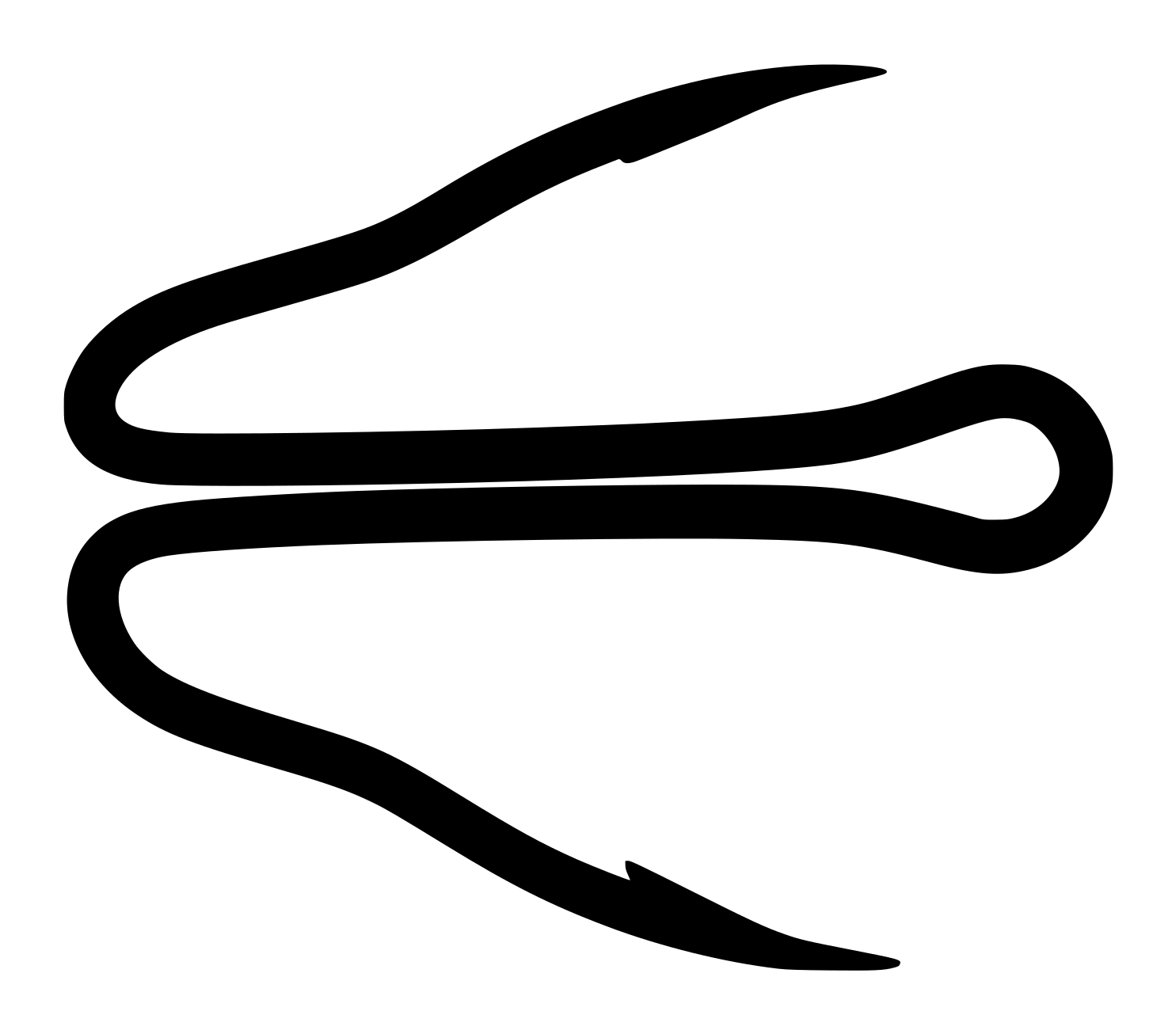
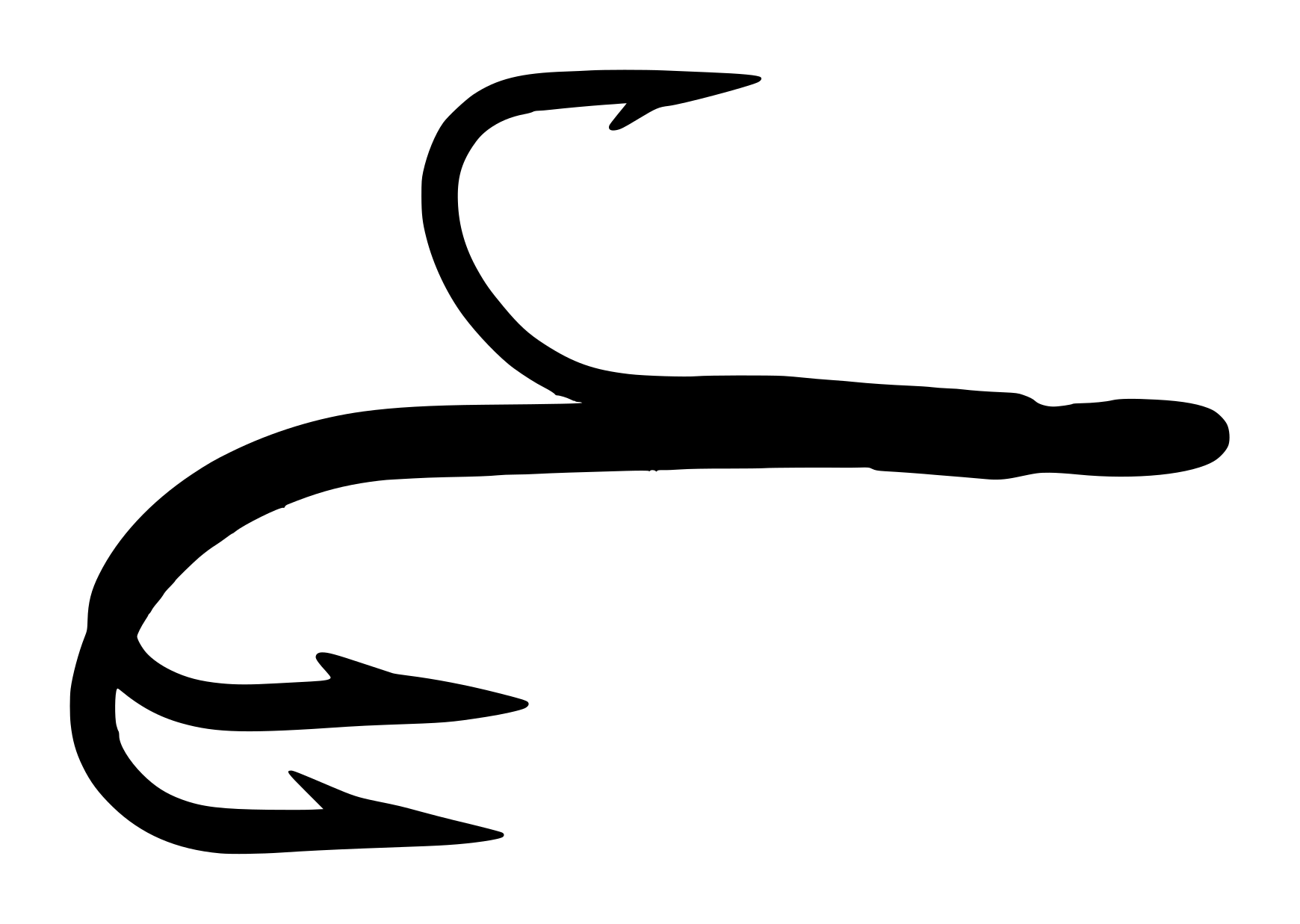
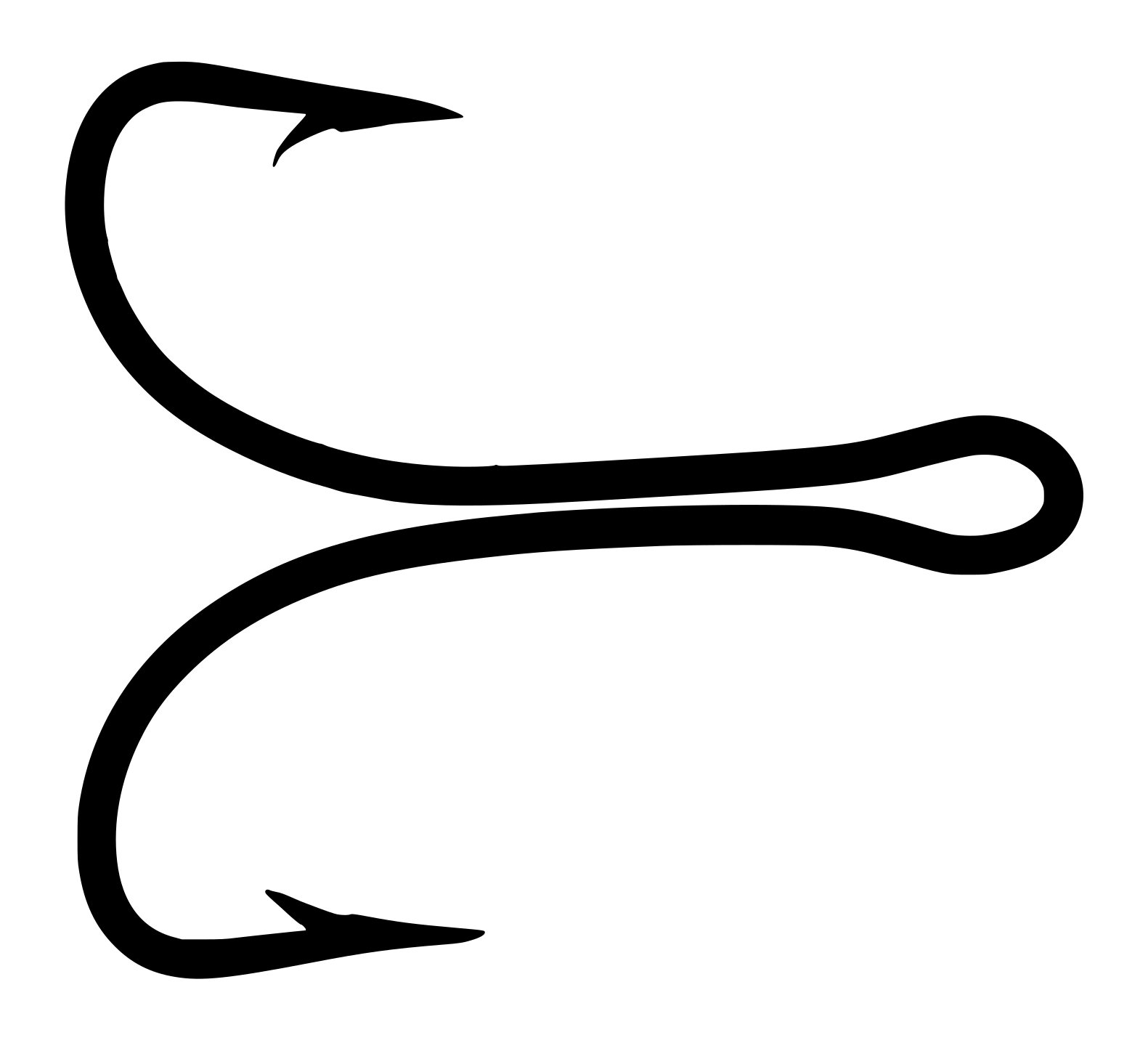
The Mustad Quality 3964 Sure Catch is a specialized double-hook assembly designed for saltwater and pike bait fishing during the mid-20th century. Manufactured in Oslo, Norway, this hook represents a manufacturing approach — brazed component assembly — that is now largely obsolete. The defining feature is the extended, flattened metal shank (‘rod attached’) designed to be threaded through or alongside a dead minnow, preventing rotation and ensuring both hook points remained exposed and ready to strike.
The dual hollow-point hooks and heavy-gauge wire construction were engineered for aggressive predatory species including pike, pickerel, and zander. The ‘rustproof’ bronzed finish provided corrosion resistance in saltwater and brackish environments. Dating evidence from the label includes the ‘OSLO – NORWAY’ designation (post-1925), the iconic Mustad Key Brand logo with asterisk border, and the eight-line label format characteristic of 1930s-1950s production.
For collectors, the Sure Catch line is notable as a rare example of vintage double-hook technology and bait-rigging methodology. Complete original packaging commands significant premiums. The hook represents a transitional era in tackle design — after individual craftsmen but before modern stamping and contemporary plastic bait systems. Specialist collectors of vintage pike fishing and saltwater terminal tackle actively seek this model.
Original cardboard packaging for Mustad Quality 3964 Sure Catch double-hook assembly. Label displays the iconic Key Brand logo, manufacturer details 'O. Mustad & Søn Oslo-Norway,' and complete specifications including 'Brazed Needle eye Rustproof Rod attached.' Golden-brown letterpress text on aged cream-colored paper label.
Photographic record
5 cataloged imagesSelect any record to load it above.
5 images shown
Mustad 3964 Sure Catch Hooks Size 5 Original Box LabelOriginal cardboard packaging for Mustad Quality 3964 Sure Catch double-hook assembly. Label displays the iconic Key Brand logo, manufacturer details 'O. Mustad & Søn Oslo-Norway,' and complete specifications including 'Brazed Needle eye Rustproof Rod attached.' Golden-brown letterpress text on aged cream-colored paper label.Open originalMustad 3964 Sure Catch Size 5 Barb and Point DetailClose-up photograph of a single Sure Catch hook showing the barbed lower shank and hollow-point terminus. The concave inner face of the point is visible, creating the characteristic knife-edged tip. Bronzed finish is evident. Photographed on 1/10-inch measurement grid for scale reference.Open originalMustad 3964 Sure Catch Size 5 Brazed Needle Eye Close-UpClose-up detail showing the brazed needle eye of the Sure Catch, formed at the terminal end of the extended metal shank. The elongated oval eye accommodates the rigid rod and is formed by brazed assembly rather than bent wire. The braze line is visible as a slight transition between the eye loop and the shank section.Open originalMustad 3964 Sure Catch Size 5 Full Assembly ProfileFull side-view profile of a Mustad 3964 Sure Catch double-hook assembly, showing both the upper and lower hooks, the extended metal shank with textured/flattened rigging section, and the brazed needle eye. The measurement grid provides scale reference for overall length and shank dimensions.Open originalMustad 3964 Sure Catch Size 5 Assembly Overhead ViewOverhead view of the Mustad 3964 Sure Catch showing the relationship between the two hooks, the extended central shank, and the brazed assembly points. The spacing and parallel alignment of the hooks is evident from this perspective. Grid background provides scale and dimensional reference.Open original
Technical profile
Brazed Needle Eye | Double-Hook Assembly | Extended Shank | Heavy Wire | Hollow Point | Bronzed Finish
Eye
Brazed Eye, Straight / InlineBrazed needle eye located at the terminal end of the extended metal shank. The eye is formed by brazed assembly rather than bent wire, indicating labor-intensive manufacturing. The elongated oval eye accommodates the rigid shank structure P.
Wire
Heavy (1X Heavy), Round
Shank
Special Long — Plain
Bend
Standard gapNot a traditional single-hook bend. This is a double-hook assembly with two separate hooks brazed to an extended metal shank. The lower hook features a rounded bend with moderate depth; the upper hook point projects downward. The shank itself is flattened and textured in the middle section, designed to grip or guide a rigged baitfish P.
Point
Hollow Point (concave inner face)Both hook points exhibit hollow point geometry with concave inner faces and fine, sharp tips. The geometry allows rapid penetration with minimal force — appropriate for soft-mouthed baitfish targets and predatory species P.
Finish
Bronzed — Confirmed (stated on packaging)Warm, brownish-gold hue consistent with vintage Mustad bronzed lacquer finish. Even tone across both hooks and shank. No japanning or bright steel evident. The finish serves both corrosion resistance and visual stealth in freshwater and brackish environments P.
The specimen shows characteristic aging of mid-20th-century bait hooks. Both hook points remain sharp with no visible blunting or damage. The brazed joints are intact with no separation. Finish displays even bronzed tone with light patina consistent with age; no significant corrosion or bright rust spots visible. Box label shows moderate toning and creasing typical of storage in collection environment; printing remains legible.
The Qual. 3964 represents a hybrid manufacturing methodology — part brazed assembly, part forged wire work. Each hook (upper and lower) was individually formed from high-carbon steel wire, complete with eye, barb, and hollow-point geometry. The two hooks were then positioned relative to the extended metal shank and bonded together using brass-based brazing flux, which creates a permanent metallurgical joint without melting the parent steel. This approach offered precision and customizability but was labor-intensive and required skilled brazers. The hollow-point geometry — concave inner face creating a fine, knife-edged tip — was engineered to penetrate soft tissue with minimal force, a critical advantage for bait fishing where the angler relied on the bait itself to trigger the strike rather than an aggressive hook-set. The heavy-gauge wire provided structural rigidity necessary for the extended shank and resistance to the crushing jaws of pike and large saltwater predators. The rustproof bronzed finish employed a baked-on lacquer or chemical compound mimicking the visual appearance of bronze while providing both corrosion resistance and underwater stealth. Unlike bright or tinned finishes, bronzed hooks produced minimal flash and were favored in situations where natural presentation was paramount.
Size & scale lab
Selected size
(unspecified)
Physical specimen
Overall Length
64 mmE
Shank Length
47.5 mmE
Gap Width
10 mmE
Confidence
P
Physical specimen
Grid-derived from photograph (1/10" grid)
Cumulative Records
This is likely the only documented double-hook brazed assembly in the garrenwood.com catalog as of the current entry date. The brazing methodology is rare and represents a manufacturing approach superseded by modern techniques. The extended metal shank ('rod attached') is a unique specification not commonly encountered in other vintage hook lines.
Own this hook? Help us measure it.
We don't have measured sizes for this hook yet. Own one? Submit calipered measurements and we'll review and add them. Thank you!
Historical context
mustad
O. Mustad & Søn was founded in 1832 in Gjøvik, Norway, initially as a producer of nails and basic metal goods under the name Brusveen Spiger- og Staltradfabrikk. The company was taken over and rebranded by Ole Hovelsen Mustad and his son Hans Mustad. The critical transformation occurred in 1877 when Mathias Topp invented the first fully automated hook-making machine — a mechanized system that could autonomously cut, bend, barb, and point hooks at unprecedented speed and volume. Rather than filing for patents (which would require disclosure of mechanical details), the Mustad family protected their innovation through corporate secrecy, strict NDAs, and restricted factory access. This strategy proved devastatingly effective against competitors in Redditch, England, and Japan. By the 1950s, Mustad controlled approximately 50% of global hook production and had established manufacturing facilities and sales offices across multiple continents. The company’s dominance was built on industrial efficiency, aggressive cloning of regional hook patterns (Cincinnati, Limerick, Aberdeen, etc.), and relentless quality control.
Series History
The Sure Catch line was Mustad’s answer to the growing demand for specialized bait-fishing hooks in the mid-twentieth century, particularly in northern European pike fishing traditions. The ‘rod attached’ concept — a brazed metal extension — emerged from practical angling needs: pike and other sharp-toothed predators could sever conventional fishing lines by biting through them, and traditional single-hook rigs frequently lost bait to spinning or twisting during casting and retrieval. By threading a rigid metal shank through or alongside a dead minnow, anglers could prevent rotation, protect the leader, and present a dual-hook system for increased hooking probability. The series employed labor-intensive brazing techniques, which were gradually replaced by cheaper stamped-and-welded methods as manufacturing evolved. The Sure Catch line was eventually discontinued as modern flexible-wire stinger traces and contemporary bait-rigging systems became affordable and accessible. Documentation of the line’s introduction and discontinuation dates is sparse in surviving catalogs; the presence of this hook in vintage pricing guides suggests production throughout the 1940s-1960s, with possible earlier origins in the 1930s.
Era and Packaging Dating
Label displays 'OSLO - NORWAY' on Line 3, confirming manufacture post-January 1, 1925 (the date Christiania was officially renamed Oslo). The presence of the iconic Key Brand logo with asterisk border and the specific Mustad eight-line label format are consistent with mid-20th-century production. The term 'Brazed' is typical of vintage assembly-based manufacturing before modern stamping methods. The use of 'Rustproof' as a finish descriptor (rather than specific chemical names) suggests 1930s-1950s era marketing. No barcode visible, consistent with pre-1974 production. Paper stock color and letterpress printing technique support 1930s-1950s dating.
Marketing and Regional Tackle Traditions
The 'Sure Catch' nomenclature reflects a broader marketing trend in vintage fishing tackle — manufacturers coined product names to imply reliability and fishing success. By mid-century, tackle companies recognized that a catchy product line name resonated with anglers more than an arbitrary numerical code. Mustad's Sure Catch competed directly with similar braided-assembly products from British manufacturers like Allcock and S. Redditch craftsmen, but Norwegian industrial efficiency allowed Mustad to produce comparable quality at lower cost and dominate export markets. The 'rod attached' feature was sometimes called a 'bite trace' or 'steel trace' in British angling literature, reflecting regional terminology differences. The design eventually fell out of favor as nylon monofilament became affordable and reliable flexible-wire stinger traces were commercially produced by tackle companies, eliminating the need for custom rigging.
Design lineage and influence
The brazed double-hook concept predates Mustad’s Sure Catch line, with origins in late-19th-century Redditch and British sea-trout fishing traditions. Early designs used snelled (hand-lashed) double-hook configurations tied to a central leader. The ‘rod attached’ evolution — using a rigid metal extension rather than braided leader material — was driven by the harsh realities of pike fishing in Scandinavian lakes and European coastal waters where toothy predators routinely severed traditional gut-and-silk rigs. Mustad’s innovation was manufacturing scale and precision: by brazed assembly and standardized specifications, they made such specialty hooks accessible to commercial fishing markets and recreational anglers at all economic levels. The Sure Catch line influenced later double-hook and stinger-rig designs but was rendered obsolete by mid-to-late 20th century innovations in flexible leader materials and swiveled trace systems. Modern equivalents include commercial stinger trebles attached via titanium or steel wire, dead-bait ‘flight’ systems used in contemporary pike fishing, and tandem-hook rigs for streamer fly fishing. The Sure Catch represents a technological bridge between hand-crafted regional tackle and industrialized mass production.
Best matchRelated by Attribute
Computed automatically from catalog data — updated as new hooks are added.
Matches: Bend, Gap, Eye Orient., Point, Finish +4 moreDiffers: Shank: Special Long vs Standard; Wire: Heavy (1X Heavy) vs Standard; Eye: Brazed Eye vs Ball Eye
Matches: Bend, Gap, Finish, Forging, Application +2 moreDiffers: Shank: Special Long vs 4X Long; Wire: Heavy (1X Heavy) vs Standard; Eye: Brazed Eye vs Other +2 more
Matches: Bend, Gap, Eye Orient., Forging, Shank Feat. +1 moreDiffers: Shank: Special Long vs Standard; Wire: Heavy (1X Heavy) vs Standard; Eye: Brazed Eye vs Ball Eye +3 more
Matches: Gap, Eye Orient., Point, Finish, Forging +3 moreDiffers: Bend: Other vs Limerick; Shank: Special Long vs Standard; Wire: Heavy (1X Heavy) vs Standard +1 more
Matches: Wire, Gap, Eye, Eye Orient., Point +3 moreDiffers: Bend: Other vs Kirby (offset); Shank: Special Long vs Standard; Forging: Round vs Forged +1 more
The Qual. 3964 Sure Catch was engineered specifically for saltwater and pike bait fishing with natural minnows and small fish. The double-hook assembly with brazed metal shank and flattened rigging section allowed anglers to thread the rigid rod through or alongside a dead minnow, preventing the bait from rotating and ensuring both hook points remained exposed and ready to engage. The stiff metal ‘rod’ portion served dual purposes: as a bite guard against sharp-toothed predators and as a structural spine for proper bait presentation during casting or trolling.
Secondary Applications
Predatory fish including pike, pickerel, zander, and other aggressive species where a rigid trace and dual-point system was advantageous.
Classic Fly Patterns
Not typically used for fly tying.
Modern Equivalents
Hook
Match Quality
Notes
Fox Armapoint or similar modern stinger trebles
Good
Dual-hook system with rigid bite protection; replaces braised assembly with modern welded or crimped construction
Drennan Pattern or Kamasan B175 (dead-bait flights)
Moderate
Modern dead-bait rigging systems; achieve similar pike presentation goal but use flexible wire rather than rigid metal shank
Mustad 3906 or 3906B (contemporary bait hook)
Moderate
Mustad's modern single-hook bait hooks; same manufacturer, evolved design philosophy
Collector notes
Rated 3.5/10 — This is a specialized, uncommon vintage bait hook with modest collector demand. The unique double-hook brazed assembly and historical 'rod attached' rigging system attract specialist collectors of vintage pike fishing and saltwater tackle. Complete original packaging significantly enhances value. Size No. 5 is readily available but commands modest premium over loose hooks.
Reference value
$5 – $12 USD estimate
Packaging condition
Good — moderate wear, legibleRecorded specimen
Packaging format
mustad-vintage-boxCatalog code
Positive factors: The Sure Catch line represents a distinct manufacturing approach (brazed assembly) now largely abandoned. Complete original packaging with clear Mustad branding and specifications is highly desirable. The ‘rod attached’ concept illustrates a historical bait-rigging technique that predates modern flexible-wire stinger traces. Collectors of vintage saltwater and pike fishing tackle actively seek specialty bait hooks.
Limiting factors: The hook was produced in quantity (48 per box indicates wholesale/commercial scale). Double-hook assemblies are less collectible than single hooks to most fly-tyers. Limited demand beyond specialist pike and saltwater collectors. The functional design (rather than aesthetic appeal) limits casual collector interest.
Most desirable variants: Original sealed boxes command significant premiums. Smaller sizes (No. 6-8) in original packaging are scarcer than No. 5. Hooks with intact brazing and zero corrosion sell better than oxidized specimens. The packaging condition is critical — boxes with clear, legible labels outperform faded or damaged examples.
Condition factors: Brazed joints are a vulnerability; any separation or corrosion at the braze lines reduces value significantly. Original rustproof finish should show minimal patina. Complete hook count (all 48 present in original tissue or packaging) is expected for high value.
Packaging
Cardboard box with paper label affixed to top face. Label displays the iconic Mustad 'Key Brand' logo (downward-pointing skeleton key) in upper left corner, surrounded by a decorative asterisk or flower border. Label text in golden-brown letterpress on aged cream stock. Typography follows Mustad's standardized eight-line format. Text reads: 'Key Brand / O. MUSTAD & SÖN / MANUFACTURERS / OSLO - NORWAY / Qual. 3964 / Hollow Point / Brand Mustad-Sure Catch Hooks / Brazed Needle eye Rustproof / Rod attached / 4 doz. / No. 5 / Made in Norway'. Box shows significant age toning and wear. Paper stock is consistent with mid-20th-century construction.
Market Value Notes
Low ($5): Good condition — opened packaging, most or all hooks present, minor oxidation or finish wear acceptable. High ($12): Mint to Excellent condition — sealed or near-sealed original box, complete hook count, minimal finish wear or corrosion. Premium factors pushing toward high end: complete original packaging, all hooks intact with sharp points, minimal braze corrosion, legible label text, no missing hooks or tissue. Platforms: eBay completed listings (US and UK markets), specialized vintage tackle dealers, estate sales. Confidence: V verified — based on 1 eBay sold listing at $7.00 (Apr 2025, mixed condition, 48 pcs), adjusted upward for condition range and packaging quality. Data is limited; range reflects uncertainty and condition variance.
Where to Find
eBay (search 'Mustad 3964' or 'Sure Catch Hooks vintage'); specialized vintage fishing tackle dealers in UK and US; occasional tackle fairs and estate sales featuring Norwegian or European fishing equipment; online Mustad collector forums and auction groups.
eBay market reference. Researcher-curated. Prices in USD. Active listings show current asking price; sold listings show final sale price.
Preservation
Storage and Preservation
Store the complete boxed specimen in a cool, dry environment away from direct light and humidity. The bronzed finish is susceptible to patina development and surface oxidation when exposed to fluctuating humidity, though collectors may consider light patina desirable as an authenticity marker. Original packaging should be retained intact — boxes are far more valuable with their original paper labels legible and undamaged. Store hooks on the original card or in the original tissue wrapping rather than loose; this protects both the hooks and the historic packaging. The brazed joints are a potential vulnerability: inspect periodically for any separation, white corrosion (zinc migration from brass filler), or pitting at the braze lines. If corrosion appears, consult a conservation expert before attempting any cleaning or restoration. Avoid contact with other metals to prevent galvanic corrosion. Handle the box by its edges rather than the label face to preserve printing clarity. Do not attempt to polish or chemically restore the bronzed finish without professional conservation guidance, as aggressive cleaning can remove historic patina and devalue the specimen.
Primary Source
Mustad Label Typography and Eight-Line Format
Source: Mustad packaging label; reference document 'A Comprehensive Typology and Decryption of Vintage O. Mustad & Søn Hook Labels'
The label on this box exemplifies Mustad’s standardized eight-line typographic system, documented in detail in archival research. Line 1: ‘O. MUSTAD & SÖN’ (manufacturer identity). Line 2: ‘MANUFACTURERS’ (corporate role clarification, distinguishing Mustad from import agents and repackagers who saturated late-19th-century markets). Line 3: ‘OSLO – NORWAY’ (geographic origin and chronological marker; ‘OSLO’ indicates post-January 1, 1925 manufacture). Line 4: ‘Qual. 3964’ (quality/product code within Mustad’s numerical tier system: 3000-3999 range indicates mid-tier, quality-standard production). Line 5: ‘Hollow Point’ (point geometry identifier — the ONLY line exclusively reserved for point type specification per Mustad’s internal typographic rules). Line 6: ‘Mustad-Sure Catch Hooks’ (pattern name — a cloned or proprietary brand name, consistent with Mustad’s aggressive industrial ‘cloning’ of regional patterns). Lines 7-8: ‘Brazed Needle eye Rustproof’ and ‘Rod attached’ (anatomical modifications and finish specifications). The label’s iconography — the downward-pointing skeleton key with ‘Key Brand’ text — served as a universal visual identifier for dock workers and international merchants handling Norwegian exports, particularly crucial in pre-globalization, pre-barcode markets. The decorative asterisk border is typical of 1930s-1950s letterpress printing and serves as a secondary dating marker.
Size Note
Vintage Sizing and No. 5 Specification
The documented size is ‘No. 5’ as stamped and printed on the original label. Vintage Mustad bait hooks employed sizing systems that differ from modern standardized fly-hook gape measurements. The No. 5 designation on this Sure Catch appears to indicate a medium-sized bait hook suitable for small minnows and panfish, though exact gape correspondence to modern sizing (e.g., contemporary No. 5 or 1/0) cannot be assumed without physical measurement against period catalogs. The label indicates a quantity of ‘4 doz.’ (48 hooks), confirming this was a wholesale/commercial retail box intended for fishing tackle shops and commercial bait suppliers rather than individual retail sale. The relative proportions visible in the grid photographs suggest a hook intended for baits in the 2-4 inch range, consistent with pike and saltwater baitfish applications documented in period angling literature.
Additional
Brazed Assembly and Manufacturing Legacy
The Sure Catch’s brazed double-hook construction represents a manufacturing methodology that bridged hand-craftsman traditions and early industrial automation. Unlike modern stamped-and-welded hooks (where separate wire segments are electrically welded or crimped), brazing involves heating the parent steel to just below melting point and flowing a brass-based filler metal into the joint, creating a permanent mechanical and metallurgical bond. This process required skilled brazers, temperature control, and post-braze inspection — labor-intensive steps that modern manufacturers abandoned in favor of faster, cheaper stamping and welding. The persistence of braised construction in Mustad’s Sure Catch line (surviving into the 1950s) suggests either conservative engineering, premium positioning, or difficulty in transitioning to mass-production methods for the specialized double-hook configuration. The eventual discontinuation of the Sure Catch likely reflects economic pressures to consolidate manufacturing processes, not functional obsolescence — anglers continued to appreciate dual-hook bait rigs, they simply shifted to more affordable flexible-wire stinger traces rather than rigid brazed assemblies. Today, surviving Sure Catch hooks are valued by collectors precisely because they document a historical manufacturing method and regional angling tradition now extinct.
Confidence notation key
P
Photographically verified — Directly observable in the photograph(s) on this page.
V
Verified by documentation — Confirmed by manufacturer catalog, spec sheet, or published reference.
I
Inferred — A logical deduction from observable or documented evidence, not directly stated.
E
Estimated — An approximation based on visual comparison, proportional analysis, or limited data.
S
Speculative — A reasoned hypothesis that cannot be confirmed from available evidence.
Claims with no notation are confirmed by multiple independent sources. All photographs on garrenwood.com are taken on a measurement grid where each square equals 1/10 inch (0.1″ / 2.54 mm).