
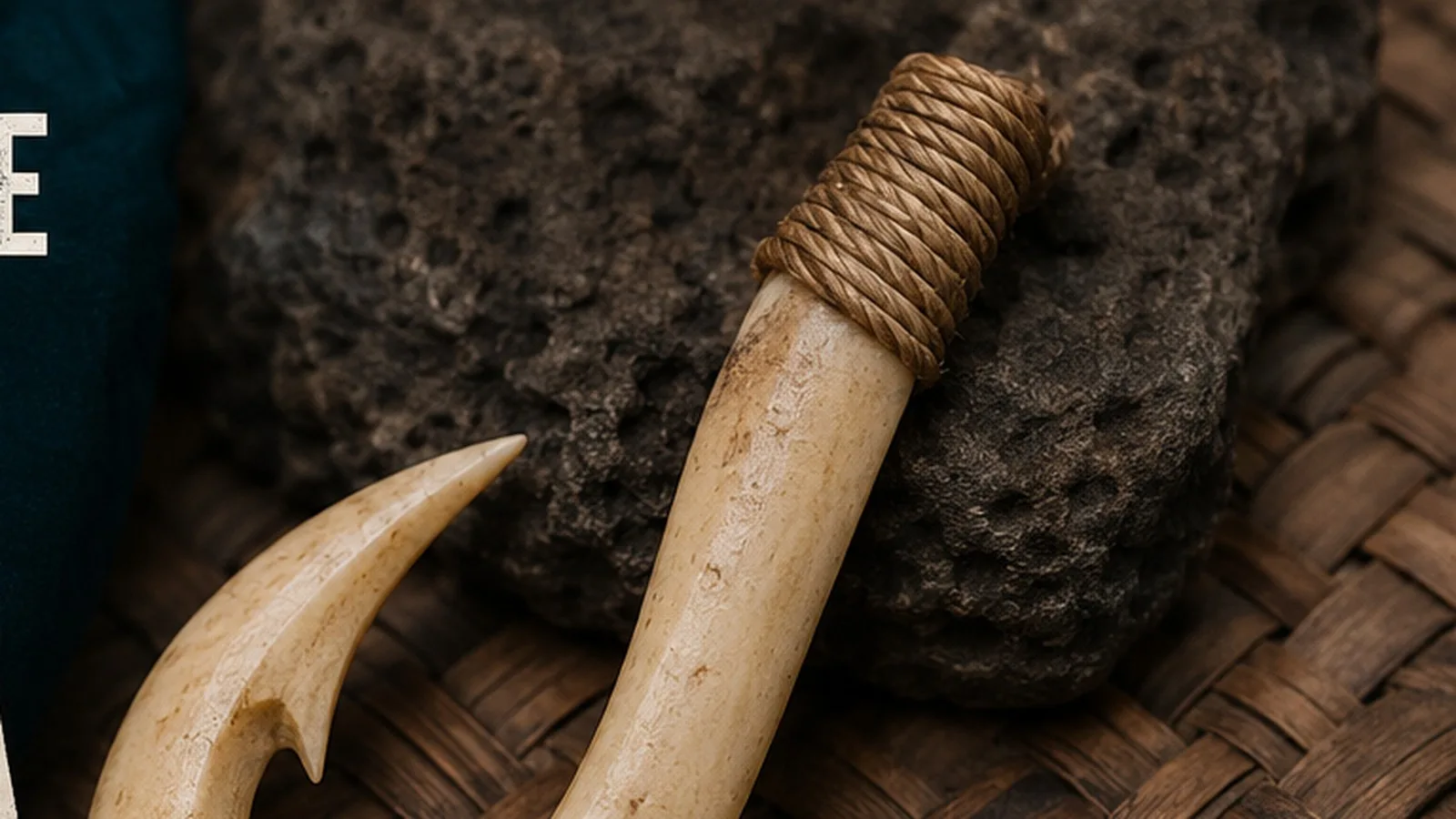
Spend enough time with 20th-century hook catalogs and it becomes easy to think of a fishing hook as a fixed recipe: steel wire, an eye, a shank, a bend, a point, perhaps a barb, and a size number stamped on a packet. The Australian Museum’s Pasifika fish-hook collection is a useful antidote to that way of thinking.
Its online collection introduces 98 fish hooks displayed in the museum’s Wansolmoana Pasifika Gallery. The hooks come from across the Pacific, some date to the 1800s, and the materials include bone, shell and wood. Even that short description is enough to make a hook collector reconsider what counts as “hook construction.”
A hook is a solution, not a standardized shape
For collectors of Mustad, Allcock, Partridge and other industrial makers, identification often begins with geometry. We compare the bend, eye, shank length, wire weight and finish, then look for a model number that ties those features to a catalog.
Many traditional Pacific hooks ask for a different reading. A hook may be composite rather than one-piece. Fiber lashings can be structural, not decorative. The line attachment may be built around a wrapped or pierced section rather than a familiar turned eye. A point and body can be made from different materials because each part has a different job.
That makes the object especially interesting from a hook-design standpoint. Instead of asking, “What bend is this?” the better first questions may be: What is carrying the load? What is resisting abrasion? How is the point attached? What keeps the hook oriented correctly? Which material was selected for each function?
Materials were part of the engineering
The Australian Museum’s main gallery emphasizes bone, shell and wood, while its linked regional pages show how broad that material vocabulary could be. The Cook Islands page, for example, describes fishing gear made with natural fibers, wood, bones and shells. In other words, the material choice was inseparable from the local environment and from the techniques used to build, rig and fish the tackle.
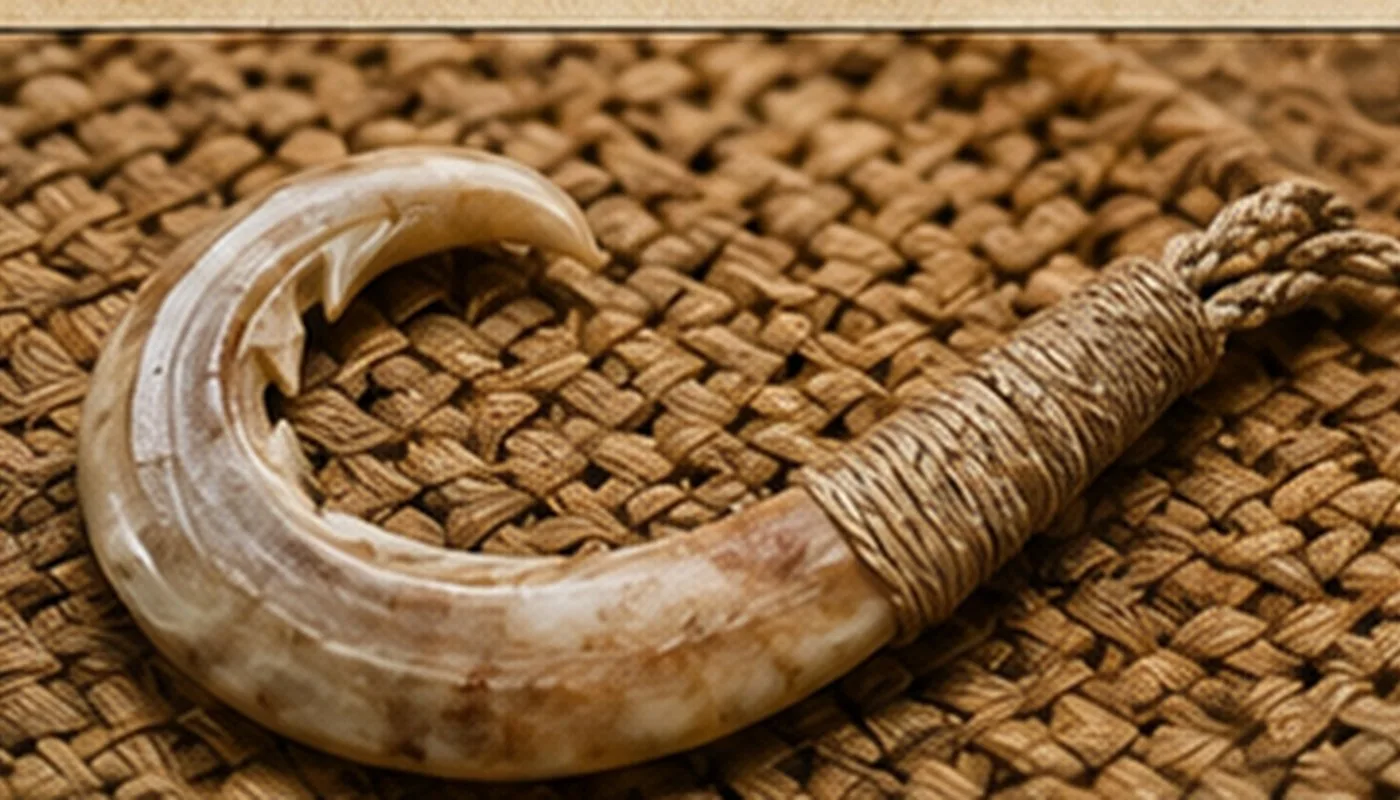
For a modern hook collector, this is worth lingering over. We tend to treat material as a specification—high-carbon steel, stainless steel, forged wire, bronzed finish. In a composite hook, material becomes architecture. A hard shell point, a carved body and a fiber binding can function as one system. The maker is not merely shaping a hook; the maker is assigning different mechanical jobs to different materials.
The fishing method matters as much as the hook
The regional pages are also a reminder that hooks make the most sense when they are studied alongside the fishing methods that used them. The Marshall Islands page describes Latippãn, a deep-water technique used in calm summer conditions for fish including marlin and tuna. It notes lines made from armwe tree bark reaching as much as 60 metres and hooks made from oyster shell.
That context changes how we look at the object. A hook is no longer an isolated artifact in a display case. It belongs to a system that includes line material, bait, target species, water depth, handling technique and the knowledge required to fish it successfully.
Tokelau provides another useful example. The museum describes traditional fishing practices there as closely tied to the atoll environment, lunar calendar and fish migration patterns. That is a much broader design brief than “catch fish.” The tackle exists inside a body of environmental knowledge.
There is no single ‘Pacific fish hook’
One of the easiest mistakes when looking at a collection like this is to collapse dozens of island cultures into one generalized tradition. The Australian Museum does the opposite: the main gallery branches into pages for Māori, Sāmoan, Tongan, Tuvaluan, Tokelauan, Cook Islands, Marshall Islands, Tahitian and other hooks, each presented within its own cultural and fishing context.
That matters to collectors. A familiar-looking curve is not enough to establish origin, use or meaning. Two hooks can share a silhouette while differing in material, attachment, fishing method and cultural significance. Provenance and documentation are therefore as important here as they are when distinguishing two nearly identical factory hook packets.
The Māori page makes that point especially clearly by placing fishing within Te Ao Māori and creation tradition. Tonga’s page describes fishing as integral to culture and livelihood. Tahiti’s page discusses a communal stone-fishing practice capable of involving entire villages and, at times, entire islands. These are not simply variations in tackle style; they are different relationships between people, fishing and place.
What fly tiers can take from these hooks
For fly tiers, the most interesting lesson is not to copy a historical Pacific hook and put a trout fly on it. That would miss the point. The more useful lesson is how much design can be accomplished through material, orientation, silhouette and attachment.
A classic salmon fly tier already thinks this way. A topping is selected not only for color but for curve. A married wing depends on material behavior as much as appearance. A gut eye changes the front of a fly structurally and visually. The same habit of looking at how a material behaves—where it bends, where it compresses, how it is lashed, how it catches light—is useful when studying these Pacific hooks.
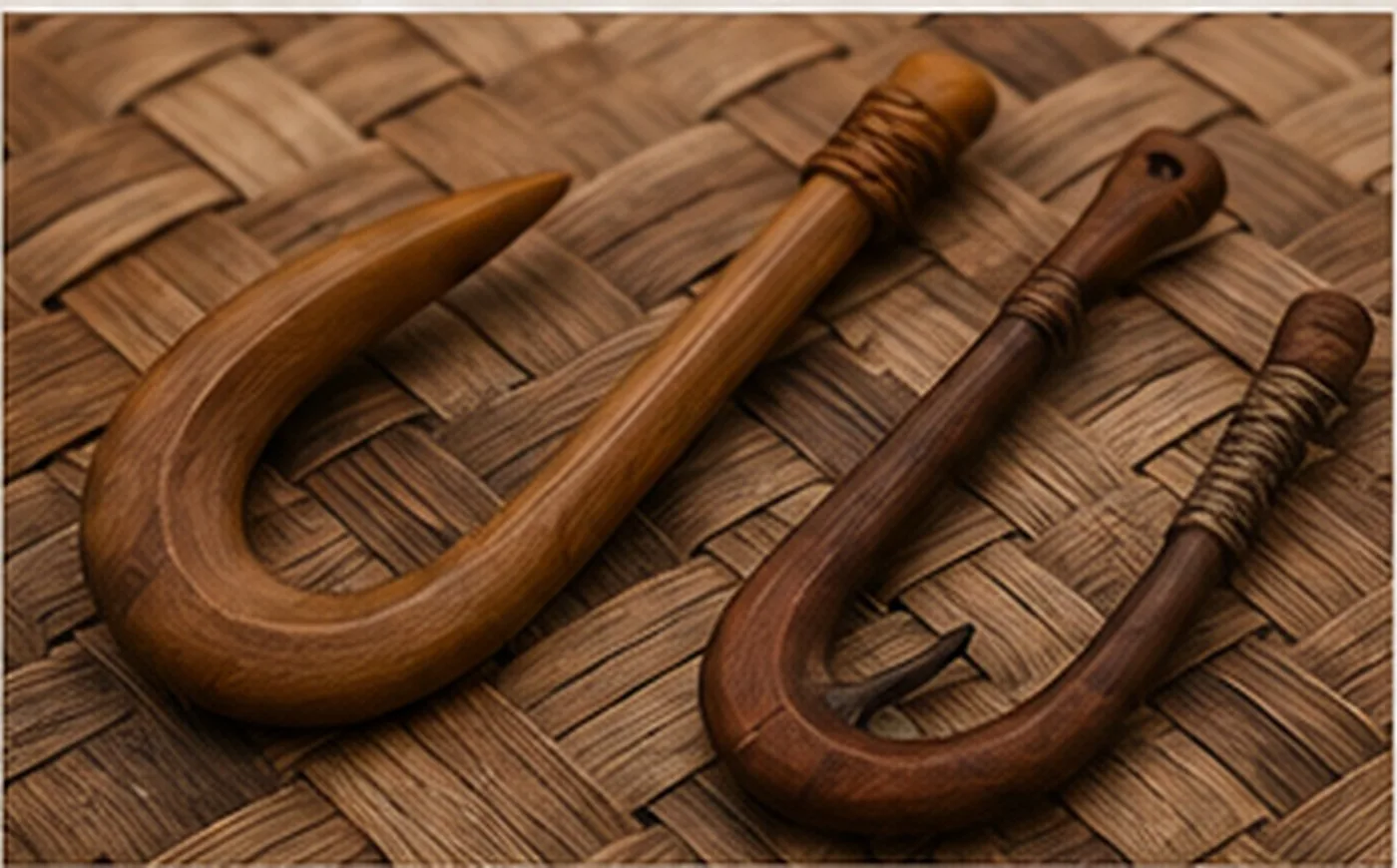
There is also a useful reminder here about imitation. Effective fishing tackle does not always need to resemble prey in a literal, anatomical sense. Shape, contrast, movement, orientation and the way an object presents in water can be just as important. Traditional hook and lure systems developed through practical observation over generations, and their forms deserve to be read as functional designs rather than as curiosities.
A different way to catalog hooks
The collection also suggests a richer vocabulary for hook research. For mass-produced steel hooks, fields such as bend family, eye type, wire gauge, shank length and finish work well. For composite or culturally specific hooks, a catalog should probably add fields such as body material, point material, lashing material, attachment method, number of components, bait or lure function, target fish, fishing method and documented place of use.
That is not just an academic exercise. Better description helps prevent modern categories from being forced onto objects that were designed under completely different assumptions. It also makes comparisons more meaningful. Instead of deciding that two hooks “look alike,” we can ask whether they solve the same mechanical problem in the same way.
Why this Australian Museum collection is worth exploring
For anyone interested in fishing-hook history, the Australian Museum page is valuable because it puts a large number of hooks into one browsable starting point and then lets the reader move outward into regional contexts. The photographs reward close looking: study the point, the lashings, the line attachment, the transitions between materials and the way the whole object is proportioned.
If your normal hook research starts with a maker’s catalog number, this collection is a refreshing change of pace. There may be no neat model code or standardized size chart. Instead, the evidence is in craftsmanship, materials, local knowledge and use.
Conclusion
The best historical fishing hooks are more than bent objects with sharp ends. They are compact records of engineering decisions. The Pasifika hooks presented by the Australian Museum make that especially visible: different environments, materials and fishing traditions produced different answers to the same basic challenge of connecting angler, line and fish.
For collectors and fly tiers, that is the real value of the collection. It expands the definition of hook design—and it is a strong reminder that before hooks became standardized industrial products, they were already highly developed tools shaped by place, material and accumulated fishing knowledge.
Source and further reading
Australian Museum, “Pasifika fish hooks”: https://australian.museum/learn/cultures/pasifika-collections/fish-hooks/
Image note: The images in this article are newly created editorial illustrations inspired by the general subject of traditional hook construction. They do not depict specific Australian Museum collection objects and should not be used as artifact-identification references.