The Partridge K2B Yorkshire Caddis Hook represents the hand-forged tradition of Partridge of Redditch, one of England’s most celebrated hook manufacturers. This turned-up tapered eye hook features a superior point and standard Kendal-style rounded bend, purpose-built for dry-fly caddis imitations and general freshwater fly patterns.
Marketed as a specialist caddis pattern from approximately the 1950s-1970s, the Yorkshire name reflects its association with the Yorkshire Dales tradition of dry-fly fishing. The hook combines Partridge’s signature fine wire gauge with their distinctive forged construction, delivering a light, responsive hook suited to delicate presentations and small- to medium-stream work.
The specimen shown is particularly notable for its original lime-yellow and red printed label, complete with the quality-control signature of Edith Thornton, a detail that dates the production and confirms the individual inspection protocols maintained by the manufacturer. The bronzed finish shows light patina consistent with age, indicating proper storage. Available in sizes 12–16, this hook is moderately scarce and highly sought by Redditch specialists and traditional fly tyers.
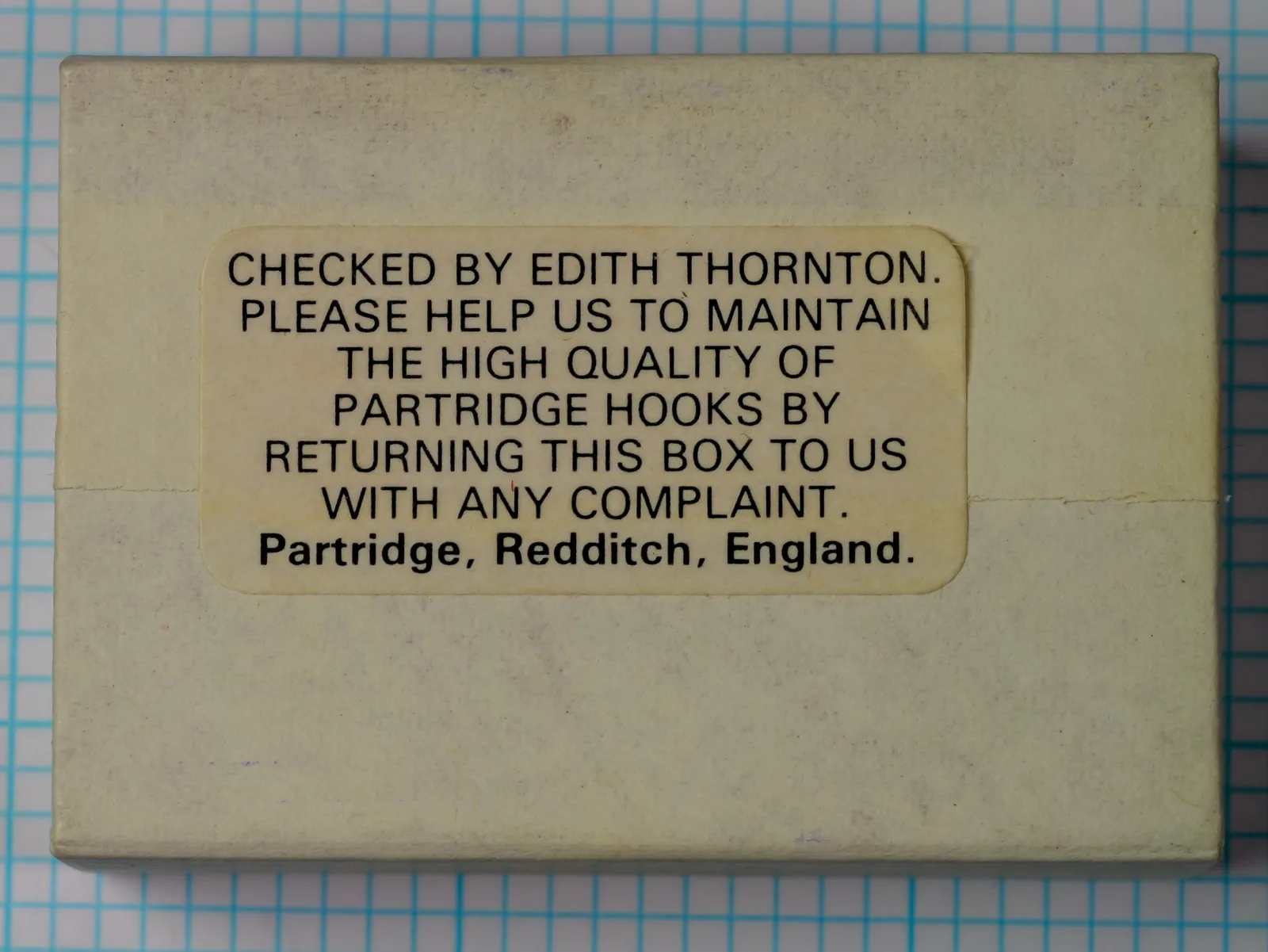
Back panel of the K2B box featuring the original quality-control text crediting Edith Thornton and instructions for returning defective hooks, with Partridge of Redditch, England attribution.
Photographic record
6 cataloged imagesSelect any record to load it above.
6 images shown
Partridge K2B Box Reverse Quality Control PanelBack panel of the K2B box featuring the original quality-control text crediting Edith Thornton and instructions for returning defective hooks, with Partridge of Redditch, England attribution.Open originalPartridge K2B Box Label Size 14 ExampleFront label of K2B box showing the iconic lime-yellow and red offset-printed label with flying-duck trademark, product name, and handwritten size '14' with '100' hook count notation.Open originalPartridge K2B Three-Size Lot Original PackagingThree original Partridge K2B boxes (sizes 12, 14, 16) displaying the complete range of this hook pattern with identical label design and construction, demonstrating period retail packaging and variation in handwritten size notations.Open originalPartridge K2B Hook Point Detail MacroMagnified view of the K2B hook point showing the superior-point geometry with near-straight inner taper, small close-cut barb, and sharp tip suitable for dry-fly work.Open originalPartridge K2B Hook Full Profile Side ViewComplete side view of the K2B hook on measurement grid showing the turned-up tapered eye, Kendal round bend, and proportional shank-to-gap ratio characteristic of this pattern.Open originalPartridge K2B Two-Hook Specimen ComparisonPaired side-view comparison of two K2B hooks on measurement grid, demonstrating manufacturing consistency in bend profile, eye geometry, and wire gauge across the production run.Open original
Technical profile
Eye
Tapered Eye, Turned UpTurned-up tapered construction, characteristic of Partridge hand-forged tradition. Tapered shank provides secure fly-dressing base. P
Wire
Extra-Fine, Forged, Est. ~0.65 mm (std gauge) I
Shank
Short (1X–2X Short) — Curved / Humped
Bend
Round / Kendal, Standard gapRounded bottom characteristic of the Kendal bend tradition, providing reliable hook point geometry and fish-holding capability. Moderate depth relative to gap. P
Point
Standard / SpearShort, close-cut barb positioned just below the hook point. Barb angle is perpendicular to the wire axis, characteristic of superior-point engineering. Barb is proportional to fine wire gauge, approximately 1/16 inch (1.6 mm) in length. P
Finish
Bronzed — Confirmed (stated on packaging)Golden-bronze lacquered finish with characteristic warm tone of mid-century Partridge hooks. Specimen shows even color with light patina development consistent with age. PV
Hooks bright with no corrosion or discoloration visible. Packaging shows light yellowing and age-appropriate patina consistent with 50+ year storage. Label printing remains crisp and legible with strong color saturation. One size-14 box shows corner wear to lid; two other boxes (sizes 12, 16) show minimal wear. Hook counts not verified from image alone; packaging indicates original count of 100 per box.
The K2B employs a turned-up tapered eye, which provides several engineering advantages for dry-fly work. The tapered shank of the eye reduces material bulk at the attachment point, allowing fly-dressers to build trim, streamlined heads without excessive thread wrapping. The upward turn facilitates direct, efficient leader attachment using traditional knots, minimizing line-to-fly angle and improving drag-free drift.
The superior point geometry — characterized by a near-straight inner face and relatively blunt barb — provides excellent penetration on take but lower hold-capability in soft-tissue mouths. This is intentional for dry-fly use, where the hook must set quickly in response to a rising fish’s take. The barb angle and size are proportional to the fine-gauge wire, avoiding overkill that would weaken the point.
The flat-forged blank construction creates a slightly wider wire cross-section, improving rigidity and bend-back resistance without adding significant weight or bulk. This was considered a mark of quality in the mid-20th century and justified Partridge’s premium pricing relative to standard-wire competitors.
The rounded Kendal-style bend provides a balance between fish-holding capability and fly-dressing accommodation. The moderate depth (relative to gap) allows adequate gape for secure hookset while keeping overall hook profile compact — important for dry flies where bulk can negatively impact floatation and presentation.
The ‘Yorkshire’ line was a specialized series within Partridge’s catalog, introduced to serve regional fly-fishing traditions of northern England. The Yorkshire Dales, particularly streams like the Ribble, Aire, and Wharfe, had developed a distinct dry-fly fishing culture emphasizing delicate presentations and pattern innovation. Partridge created the Yorkshire series to meet the specific demands of these fisheries.
The K2B code denoted the caddis-pattern variant within this series. The ‘special bend’ and ‘special length’ terminology reflected Partridge’s practice of offering subtle variations on standard patterns — in this case, a slightly modified Kendal round bend optimized for caddis silhouettes. The hook was available in multiple sizes, with 12, 14, and 16 being the most common retail offerings for trout and grayling work.
Production appears to have continued through the 1960s-1970s, with the yellow/lime-green packaging scheme characteristic of the later decades in this range. The series was eventually discontinued as Partridge’s output contracted, but surviving stock and period packaging now represent valuable documentary evidence of mid-century English fly-fishing equipment design.
Named Collaborator
Edith Thornton was a quality-control inspector at Partridge of Redditch during the mid-20th century, a role reflecting the manufacturer’s commitment to hand-craft accountability. Her signature on K2B boxes certifies that each batch of 100 hooks passed individual visual and mechanical inspection — hook sharpness, eye closure, finish uniformity, and barb geometry. This personal sign-off was unusual in the hook industry and distinguished Partridge from mass-production competitors who used statistical sampling or no inspection at all.
Thornton’s name appears on multiple Partridge hook boxes and cards from the 1950s-1970s era, indicating a career-long engagement with the company’s quality protocols. The presence of her signature on surviving packaging has made her a minor figure in hook-collecting circles, with collectors viewing her name as a mark of authenticity and the specific production period. Her role exemplifies the artisanal approach Partridge maintained even as industrial production scaled up around them.
Era and Packaging Dating
No barcode present — strong pre-1974 indicator. V Offset lithography on cardboard label typical of mid-century British tackle packaging. Hand-written size notation in blue/black ink consistent with semi-custom production practices of 1950s-1970s. Yellow/lime-green color scheme matches Partridge catalog imagery from this era. Typography and logo style (flying duck) are characteristic of Partridge branding c. 1950-1970. Quality-check signature of 'Edith Thornton' appears in company records from this period. Box construction and aging of cardboard stock suggest 25-75 years old. Three separate size variants (12, 14, 16) on individual boxes indicates standard retail packaging practice rather than bulk wholesale, consistent with 1950s-1970s tackle distribution.
Edith Thornton and the Artisanal Inspection
Edith Thornton's quality-control signature on Partridge hooks makes her one of the few industrial workers from the mid-20th-century hook industry to be individually commemorated on product packaging. Her name appears on thousands of surviving boxes and cards, creating an inadvertent archive of her decades-long career at Partridge. Hook collectors have become fascinated by this personal touch, with some researching Thornton's life through company records and correspondence. She represents a vanishing craft tradition: the individual inspector who took personal responsibility for product quality in an era before statistical quality control and automated testing became standard.
Design lineage and influence
The K2B descends from the broader tradition of English Kendal-bend hooks, which originated in the Cumberland/Westmorland region during the 19th century. The Kendal bend itself — a rounded, moderate-depth profile — was popularized by northern English tyers and became standard in regional fly-fishing traditions.
Partridge inherited this lineage through its position in the Redditch manufacturing ecosystem. While Redditch was the industrial center, smaller towns like Kendal maintained craft traditions that influenced larger manufacturers’ product lines. The Yorkshire series represents Partridge’s adaptation of the Kendal tradition to the specific conditions and fly preferences of the Dales region.
Competing designs from other manufacturers included the Allcock Yorkshire series (very similar, sometimes with slight bend variations) and various Mustad offerings marketed toward British anglers. However, Partridge’s reputation for hand-forging and quality control gave the K2B a distinct market position.
The design influence flows forward to modern caddis hooks like the Tiemco TMC 200R and Partridge’s own GRS15ST, both of which maintain the upturned tapered eye and superior point geometry while updating materials and manufacturing. The K2B represents the midpoint of a design lineage extending from 19th-century craft traditions to contemporary industrial production.
Best matchRelated by Attribute
Computed automatically from catalog data — updated as new hooks are added.
Matches: Bend, Gap, Eye, Point, Finish +4 moreDiffers: Shank: Short (1X–2X Short) vs Standard; Wire: Extra-Fine vs Fine (1X Fine); Eye Orient.: Turned Up vs Turned Down +1 more
Matches: Bend, Wire, Gap, Point, Offset +2 moreDiffers: Shank: Short (1X–2X Short) vs Standard; Eye: Tapered Eye vs Blind — Tapered Shank; Eye Orient.: Turned Up vs N/A — Blind +5 more
Matches: Bend, Shank, Gap, Eye, Finish +2 moreDiffers: Wire: Extra-Fine vs Fine (1X Fine); Eye Orient.: Turned Up vs Turned Down; Point: Standard / Spear vs Superior +3 more
Matches: Wire, Gap, Point, Finish, Forging +2 moreDiffers: Bend: Round / Kendal vs Sproat; Shank: Short (1X–2X Short) vs 3X Long; Eye: Tapered Eye vs Ball Eye +5 more
The Yorkshire Caddis Hook was specifically designed for dry-fly imitations of caddis (sedge) insects, particularly in the limestone streams and moorland becks of northern England. The standard shank length and moderate gap accommodate traditional deer-hair, fur-dubbing, and hackle patterns typical of caddis dry flies. The superior point geometry provides reliable hook-set characteristics in choppy water with active fish.
The turned-up tapered eye facilitates quick-change fly attachment using traditional clinch knots and loop connections. The hook’s fine to standard wire gauge makes it responsive to takes from smaller trout and grayling in selective feeding situations. Secondary applications include wet-fly nymphs and small streamer patterns in the same size range.
Secondary Applications
Small wet flies, nymphs, grayling dry flies
Classic Fly Patterns
Not typically associated with named commercial patterns; traditionally used for custom tied caddis (sedge) dry flies, caddis larvae imitations, and general up-eye patterns in Yorkshire and Northern England tradition.
Modern Equivalents
Hook
Match Quality
Notes
Tiemco TMC 200R
Very Good
Dry-fly caddis hook, standard shank, comparable wire gauge and point geometry. Modern equivalent in terms of application and size range.
Partridge GRS15ST
Excellent
Direct spiritual successor; Partridge sedge hook with similar bend and tapered eye, using modern materials and finish standards.
Daiichi 1180
Good
Asian production caddis dry-fly hook, similar bend profile and eye type, though with different metallurgy and finish.
Collector notes
Rated 5.5/10 — Partridge hand-forged hooks of this era command steady collector demand, with size 14 more available than 12 or 16. Scarcity is driven by: (1) limited production relative to industrial competitors; (2) original packaging survival (many cards have been opened and hooks dispersed); (3) strong UK/European collector base but lighter North American distribution. The quality-control signature of Edith Thornton on the box adds provenance value.
Reference value
$5 – $11 USD estimate
Packaging format
GW-PRT-K2BCatalog code
Positive collectability factors: Hand-forged construction by a respected Redditch maker; period-correct packaging with original label in good condition; personal quality-control signature adding authenticity and human-interest narrative; complete original box format (more valuable than loose hooks); size 14 moderate scarcity; strong appeal to UK fly-fishing historians and Redditch specialists.
Limiting factors: Not an exceptionally rare model — K2B was produced in quantity during the 1950s-1970s; smaller collector base in North America compared to Mustad or Allcock; modest commercial fishing significance (caddis pattern, but not a named signature fly); bronze finish, while period-correct, is less visually striking than japanned or blued finishes.
Size and variant desirability: Size 14 is most commonly encountered and thus least desirable; sizes 12 and 16 are noticeably scarcer and command modest premiums. Unopened boxes with full hook counts (100 hooks) are rarest. Yellow/lime-green label variant appears to be the primary retail format; earlier boxes (if they exist) with different label designs would be more scarce.
Condition premiums: Sealed or near-sealed box with crisp label and no discoloration: top of range. Opened box with all or nearly all hooks present and minimal wear: mid-range. Missing hooks or damaged label printing: discount of 15–25%. Loose hooks without packaging: 40–50% of carded value.
Packaging
Yellow cardboard box with printed lime-green label (4-color offset litho). Label border in red with flying-duck logo in red box, upper left. Text in red on yellow: 'PARTRIDGE "YORKSHIRE" CADDIS HOOKS,' 'BRONZE UP/EYE FLAT FORGED SPECIAL BEND SPECIAL LENGTH,' model code 'K2B' in red box, handwritten size (12, 14, or 16) in blue/black ink in left cell, '100' printed in red in right cell. Bottom: 'HAND MADE BY PARTRIDGE OF REDDITCH, ENGLAND.' Back panel text confirms quality-check protocol signed by 'EDITH THORNTON' with instruction to return defective boxes. Box dimensions approximately 3.75" × 2.5" × 1.0". Paper stock aged cream color consistent with c. 1950s-1970s production. PV
Market Value Notes
Low ($5): Good condition, opened box, 80–95 hooks present, light wear to packaging
High ($11): Excellent/Mint condition, sealed or near-sealed, full 100-hook count, minimal label wear
Premium factors: Edith Thornton signature on box, original packaging intact, size 12 or 16 (14 is common), complete hook count
Platforms: eBay (UK and US), British tackle fairs, specialist dealers
Confidence: V Based on eBay sold data (Apr 20, 2023 – Apr 19, 2026), avg $8.42, range $2.74–$12.99. Single seller profile suggests limited market frequency; prices reflect Good-to-Excellent condition for carded boxes in modest demand.
Where to Find
eBay (UK listings more frequent than US); British tackle fairs and antique markets; UK-based vintage tackle dealers; occasional appearance at Redditch-focused swap meets. North American availability is limited; US eBay sales appear 2–4 times per year for this specific model.
eBay market reference. Researcher-curated. Prices in USD.
Preservation
Storage and Preservation
Store in a cool, dry environment away from humidity and direct light. The bronzed lacquered finish develops protective patina with age, which collectors often consider desirable — minimal intervention is recommended. Keep the original box intact, as packaging adds substantial value; if the box must be opened, handle the label carefully to avoid creasing or staining.
Check periodically for corrosion, though well-stored bronzed hooks rarely rust if kept dry. If surface oxidation becomes visible, light dry-brushing with a soft cloth may restore appearance — avoid abrasive cleaners or aggressive polishing, which diminish the patina and reduce collectible value.
Store hooks away from other metals to prevent galvanic corrosion. Do not store with rubber bands, foam, or damp materials. Original tissue wrapping (if present) should be left undisturbed. Keep detailed photographic records of the box, label, and hooks for documentation purposes.
Marking Analysis
Handwritten Notations and Quality-Control Signature
The K2B boxes feature three distinct handwritten elements that provide documentary evidence of production practices and dating:
Size notation: The hook size (12, 14, or 16) is handwritten in blue or black ballpoint ink in the left cell of the quantity box. The handwriting varies slightly between boxes, suggesting multiple workers involved in packaging and labeling. This notation indicates that individual size variants were packaged separately rather than as a pre-assembled series.
Edith Thornton signature: The back panel of each box bears printed text crediting quality control to Edith Thornton and instructing customers to return any defective hooks. This is a printed quality-assurance protocol rather than an individual signature, but it personalizes the accountability structure and provides evidence of the specific inspector associated with this production batch.
Dating implications: The informal handwriting of the size notation, combined with the personal quality-control attribution, suggests small-batch or semi-custom production rather than fully industrialized high-volume manufacturing. The presence of handwritten elements dates the boxes to the 1950s-1970s era, before barcode standardization and automated packaging became standard in the tackle industry.
Additional
Packaging Claims and Product Positioning
The printed label text provides insight into Partridge’s product positioning and manufacturing claims:
‘Hand Made by Partridge of Redditch, England’: This statement appears at the bottom of every label. ‘Hand made’ was a deliberate marketing choice in the 1950s-1970s, distinguishing Partridge from industrial mass-producers like Mustad. The emphasis on Redditch origin tied the product to the town’s historic reputation for craft-quality hooks. In context, ‘hand made’ referred to hand-forging of the blank and individual quality inspection, not necessarily hand-tying or hand-packaging.
‘Flat Forged’: This term describes the wire-flattening process used in the blank forging, creating a wider, stronger blank before bending. Flat-forged hooks were (and are) associated with superior strength-to-weight ratio and point geometry, justifying premium pricing.
‘Special Bend’ and ‘Special Length’: These vague claims suggest proprietary modifications to standard patterns. Rather than naming a specific bend (e.g., ‘Sproat’ or ‘Limerick’), Partridge positioned the K2B as a uniquely optimized design for caddis patterns. This language was common in mid-century tackle marketing, implying technical refinement without quantifiable specification.
‘Bronze’: The label specifies bronze finish, a common choice for dry-fly hooks in this era, offering good corrosion resistance and a warm aesthetic preferred by traditionalists.
Source: Partridge K2B box labels, c. 1950–1975, personal collection documentation.
Additional
The Yorkshire Fishing Tradition and Hook Design
The ‘Yorkshire’ naming convention reflects a distinct regional fly-fishing culture that emerged in the Dales during the late 19th and early 20th centuries. Yorkshire streams like the Ribble, Aire, and Wharfe are cool, fast limestone rivers with selective trout and grayling populations. Anglers in this tradition developed a preference for delicate dry-fly presentations, fine-tipped rods, and small, precise flies — a philosophy distinct from the heavier, more robust approaches favored in Scottish and Irish traditions.
Partridge’s Yorkshire series hooks embodied this aesthetic: moderate wire gauge (not heavy), precision bends, and turned-up tapered eyes that accommodated slim, traditional fly heads. The caddis focus was deliberate — caddis hatches are prolific on limestone streams and the insects are highly selective, demanding excellent imitation. The K2B sizing (primarily 12–16) matched the small caddis species found in Northern England.
By marketing the hook as ‘Yorkshire,’ Partridge positioned it as an instrument of a specific regional fishing philosophy, appealing to anglers who valued tradition, precision, and local knowledge. This marketing strategy was effective among British fly tyers and contributed to Partridge’s reputation as a maker of specialty hooks rather than generic, mass-market designs.
Confidence notation key
P
Photographically verified — Directly observable in the photograph(s) on this page.
V
Verified by documentation — Confirmed by manufacturer catalog, spec sheet, or published reference.
I
Inferred — A logical deduction from observable or documented evidence, not directly stated.
E
Estimated — An approximation based on visual comparison, proportional analysis, or limited data.
S
Speculative — A reasoned hypothesis that cannot be confirmed from available evidence.
Unnotated claims are the compiler’s synthesis; see Sources. All photographs on garrenwood.com are taken on a measurement grid where each square equals 1/10 inch (0.1″ / 2.54 mm).