The Ray Bergman “Yellow Label” H.P. Sproat Hook is one of the most historically significant pieces of mid-twentieth century American fly fishing tackle that a collector can encounter. Bearing the name of Ray Bergman — legendary Fishing Editor of Outdoor Life magazine from 1934 to 1960 and author of the immortal Trout (1938) — these hooks represent the personal tackle philosophy of the man who introduced fly fishing to more American anglers than perhaps any writer before or since. Specified by Bergman himself and manufactured in England (almost certainly by Allcock & Co. of Redditch, the era’s premier hook maker), the Yellow Label series embodied everything Bergman valued in a wet fly hook: the smooth, penetrating arc of the Sproat bend, the superior point geometry of the Hollow Point, the reliable knot-seating of a ball eye, and the reassuring strength of 2x stout wire for large trout, bass, and heavy-water fishing. A complete box of 100 hooks in the original yellow-labeled cardboard packaging, as shown here from Bergman’s Nyack, New York distribution address, is a genuinely rare survivor — a commercial wholesale quantity that has somehow escaped the century of use it was intended for, arriving intact as both a functional artifact and a collectible of the first order for anyone who loves the history of American fly fishing.
Ray Bergman Yellow Label H.P. Sproat – Additional Info
1. Identification
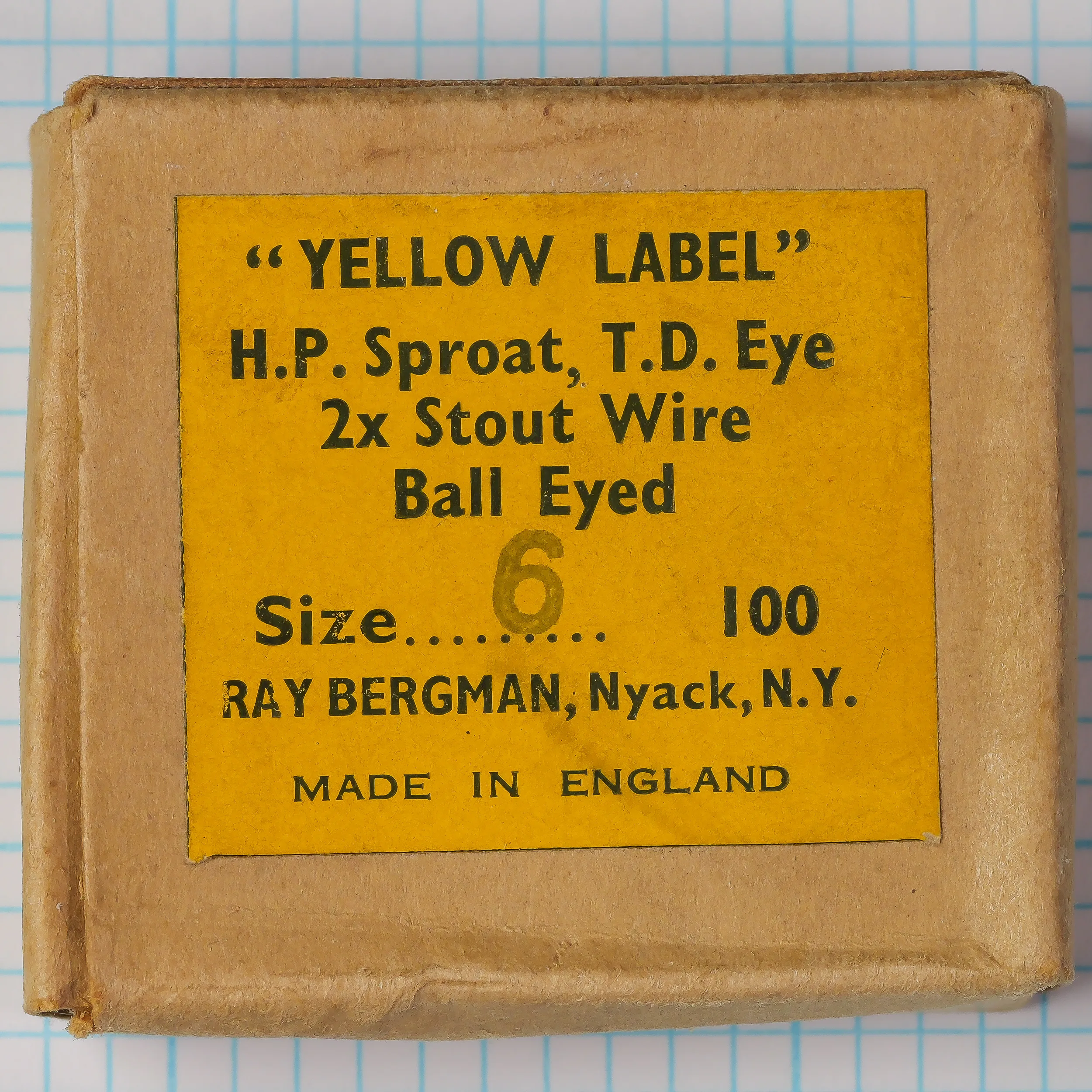
Brand: Ray Bergman — “Yellow Label” Series
Model/Code: H.P. Sproat — T.D. Eye — 2x Stout Wire — Ball Eyed
Size: 6 (standard American hook sizing)
Quantity: 100 hooks (full commercial gross box)
Distributor: Ray Bergman, Nyack, New York
Manufacture Origin: Martinez and Bird of Redditch England
Estimated Era: 1935–1955, based on the serif/mixed typography on the yellow label, the kraft cardboard box construction, and Ray Bergman’s documented active period as a tackle endorser and Outdoor Life angling editor. The hand-applied yellow label affixed to a plain cardboard box is consistent with American tackle distribution practice of the late Depression through early postwar period. Post-Korean War era packaging from importers of this class typically shifted to printed boxes rather than applied labels.
2. Technical Specifications
| Feature | Detail |
|---|---|
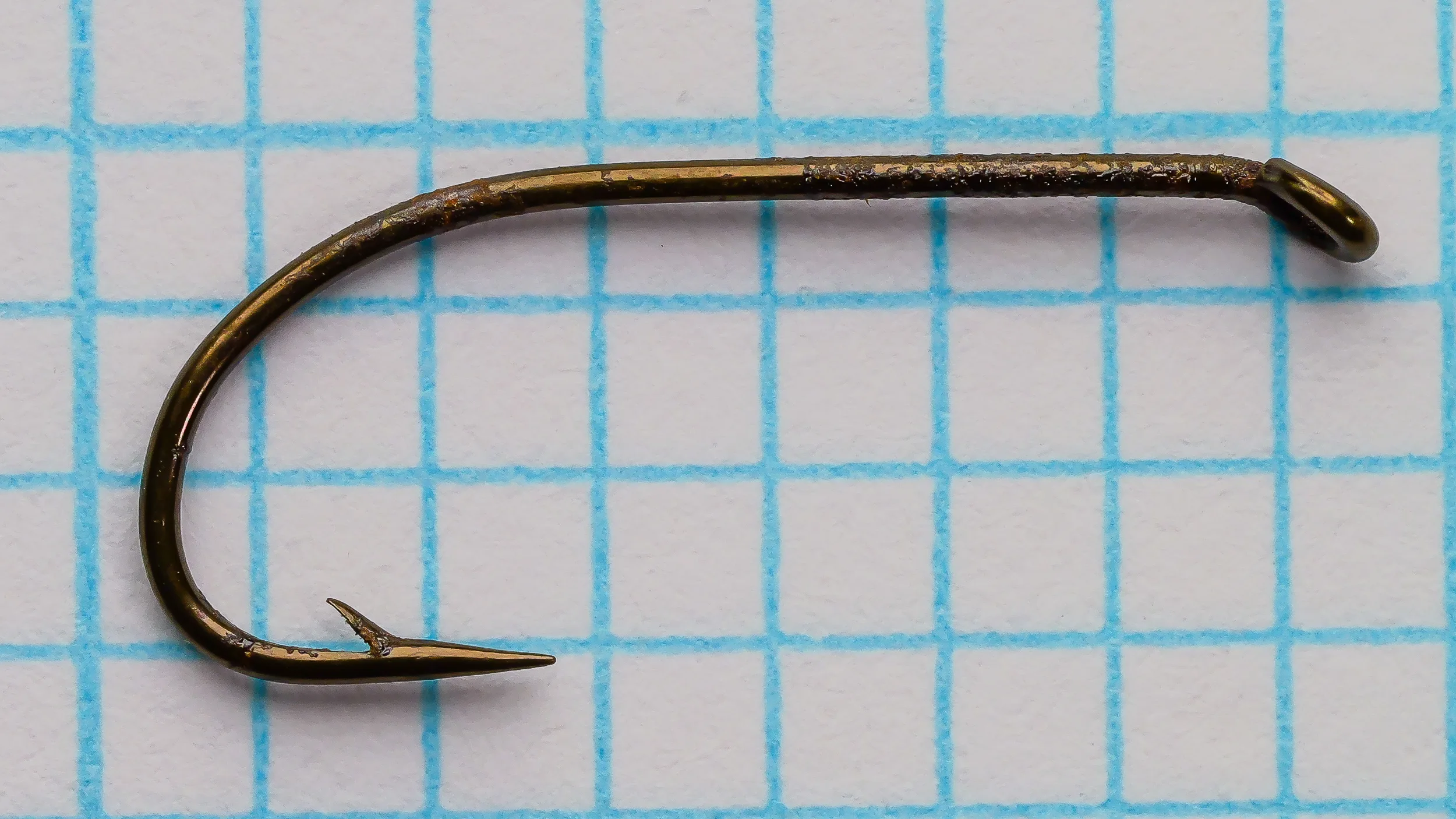
| Eye | Turned-Down (T.D.) Ball Eye |
| Wire | 2x Stout (2x Heavy gauge over standard for that size) |
| Shank | Standard length, straight, with subtle taper toward the bend |
| Bend | H.P. Sproat — Hollow Point Sproat: a smooth, continuous circular arc with a slightly hollowed/concave inner point geometry |
| Point Style | Hollow Point (H.P.) — concave inner face provides superior penetration with less resistance on the strike |
| Finish | Bronzed / Japanned — confirmed by the dark olive-bronze coloration in Image 2, with age-appropriate oxidation patina visible on the shank |
| Barb | Standard cut barb, well-defined, prominent |
| Forging | Visible flattening on the shank face, consistent with period Redditch forged-wire practice |
Decoding the Label Terminology:
- H.P. = Hollow Point — the inner face of the point is slightly concave, a hallmark of premium British hook-making that significantly improves hook-set on a strip strike
- Sproat = the bend style, named after Robert Sproat of Redditch, characterized by a smooth, elliptical arc rather than the angular facets of a Limerick or the perfect circle of a round bend
- T.D. Eye = Turned-Down Eye — the eye angles downward from the shank plane, standard for wet fly and nymph applications
- 2x Stout Wire = wire diameter two gauges heavier than standard for size 6, providing increased strength for bass, large trout, and steelhead applications
- Ball Eyed = the eye is formed with a smooth, fully closed ball/loop rather than a tapered or open eye — reduces leader abrasion and provides a clean knot seating surface
3. Historical Context
Ray Bergman (1891–1967) was one of the most influential American angling writers of the twentieth century. Serving as Fishing Editor of Outdoor Life magazine from 1934 until his retirement in 1960, Bergman reached millions of American anglers through his monthly columns and through his landmark books — most notably Trout (1938, Penn Publishing), which became one of the best-selling fly fishing books in American publishing history and has never gone out of print in various editions. He also authored Just Fishing (1932), With Fly, Plug and Bait (1947), and Fresh Water Bass (1942).
Bergman lived and fished from Nyack, New York, on the Hudson River, giving him access to the Catskill streams — the Beaverkill, Willowemoc, Esopus, and Neversink — that were the epicenter of American fly fishing culture during his most productive years. He was a deeply practical angler who fished widely across North America and wrote with unusual specificity about flies, tackle, and technique.
The “Yellow Label” Hook Line represents Bergman’s personal endorsement line — hooks he specified, tested, and sold under his name to readers and tackle shops. The fact that they were Made in England places them squarely within the dominant paradigm of American tackle distribution in the 1930s–1950s, when the finest hooks available to American tyers were those manufactured in Redditch, Worcestershire — the global center of hook-making. American tackle personalities and editors frequently contracted with Redditch houses (primarily Allcock & Co., the largest Redditch manufacturer of the era, but also Partridge and others) to produce hooks to their personal specifications, branded and boxed for the American market.
The choice of the Hollow Point Sproat in 2x Stout wire with a turned-down ball eye was highly deliberate. This specification was ideal for:
- Large wet fly trout patterns (Bergman’s specialty)
- Streamer and bucktail flies on northeastern rivers
- Bass fly fishing, for which 2x stout wire was essential
- General heavy-water applications where standard wire risked opening under load
Ray Bergman’s legacy is secure: Trout is still cited as essential reading, his Outdoor Life columns introduced fly fishing to a generation of American anglers, and his tackle endorsements — including the Yellow Label hooks — are now prized collectibles that bring his era vividly to life.
Fun Fact: In his landmark book Trout, Bergman was notably specific about hook preferences, writing at length about bend styles, wire weights, and eye types for different fly categories — making him one of the first American angling writers to treat hook selection as a serious technical discipline rather than an afterthought. His preference for the Sproat bend for wet flies was explicitly stated, and the Yellow Label series directly embodied his published recommendations. Owning a box of his Yellow Label hooks is, in a very real sense, owning a piece of his published tackle philosophy made tangible in metal.
4. Usage & Equivalents
Best Used For (per Bergman’s own documented preferences and this hook’s specifications):
- Classic American wet flies: Leadwing Coachman, Cahill, March Brown, Royal Coachman Wet, Hare’s Ear Wet
- Catskill-tradition soft-hackle and winged wet flies
- Early-season streamer and bucktail patterns (2x stout wire gives confidence on larger fish)
- Bass poppers and deer hair bugs (the robust 2x stout wire handles hair-spinning stress well)
- Traditional nymph patterns scaled for large fish
- Bergman’s own documented “fancy” wet fly patterns from Trout
Modern Equivalents:
| Modern Hook | Notes |
|---|---|
| Mustad 3906B | Sproat bend, bronzed, turned-down eye; closest mass-market equivalent |
| Daiichi 1550 | Standard wet fly, Sproat-adjacent bend, similar proportions |
| Tiemco TMC 3761 | Heavy wire wet fly, turned-down eye; the 2x stout equivalent |
| Partridge L2A “Sproat Wet Fly” | English-made Sproat; the most authentic modern heir to this tradition |
| Mustad 9671 | 2x long, 2x stout streamer hook; appropriate for Bergman’s streamer patterns |
5. Technical Description
Ray Bergman “Yellow Label” H.P. Sproat Hook, Size 6, Made in England, circa 1935–1955. Construction: 2x stout forged wire, bronzed/Japanned finish exhibiting characteristic olive-bronze coloration with age-appropriate oxidation patina consistent with mid-century Redditch chemical bronzing processes. Shank: straight, standard length, with light forging visible on shank face. Bend: Sproat pattern — smooth, continuous elliptical arc transitioning cleanly from shank to point plane, exhibiting none of the angular faceting of the Limerick pattern. Point: Hollow Point (H.P.) — inner face of point carries a subtle concave grind, increasing penetration efficiency relative to standard spear point geometry. Barb: single, standard cut, well-defined, angled at approximately 30° to point axis. Eye: turned-down (T.D.) ball eye, fully closed, smooth-polished, suitable for all standard knot types. Shank-to-Gap Ratio of 2.29 confirms a notably long shank relative to gap — characteristic of wet fly hooks designed for fully dressed winged patterns where body length is a primary aesthetic consideration. Overall condition: excellent for age, with the bronze finish retaining structural integrity beneath surface oxidation.
6. Collectability
Collectability Rating: 9.5 / 10
Reasoning: This is among the most collectible hook packages that can be found in American vintage tackle collecting, for multiple compounding reasons:
Ray Bergman’s name alone is a premium collectability driver. He is to mid-20th century American fly fishing what Theodore Gordon was to the Catskill tradition and what Lee Wulff was to the postwar era — a foundational figure whose name commands immediate recognition and respect among serious collectors and angling historians. His Trout remains one of the most sought-after angling books in first edition form, and any tackle bearing his personal endorsement carries reflected cultural weight.
A sealed or near-complete box of 100 hooks in the original Yellow Label packaging is an order of magnitude rarer than individual hooks. Commercial boxes of 100 were sold to tackle shops, not typically to individual anglers, and surviving complete boxes have almost always been opened and depleted over decades of use. A full, intact box is a genuine time capsule.
The combination of factors — English manufacture, personal Bergman specification, the iconic yellow label, the period cardboard box, the complete quantity, and the highly specific hook designation — creates a collectability profile that appeals simultaneously to: vintage hook collectors, Catskill fly fishing historians, Ray Bergman/Outdoor Life memorabilia collectors, and fly tying historians interested in mid-century American technique.
Availability: Genuinely rare. Individual Yellow Label hooks surface occasionally on eBay and at sporting antique shows. A complete box of 100 in this condition would be considered a significant find by any serious collector. Complete boxes in any size are uncommon; a complete, undisturbed size 6 box is exceptional.
The only reason this does not score 10/10 is that the hook collecting hobby, while devoted, is a narrower niche than broader fishing tackle collecting, and the total universe of potential buyers — while passionate — is smaller than for, say, vintage reel or rod collecting.