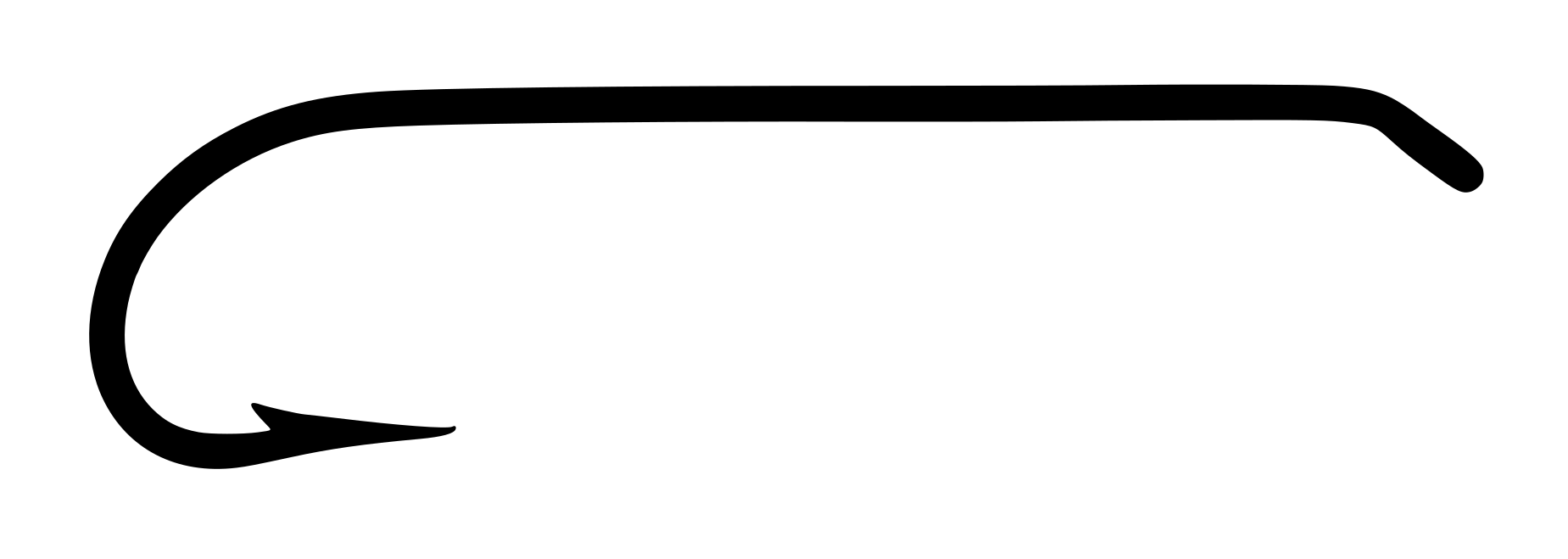
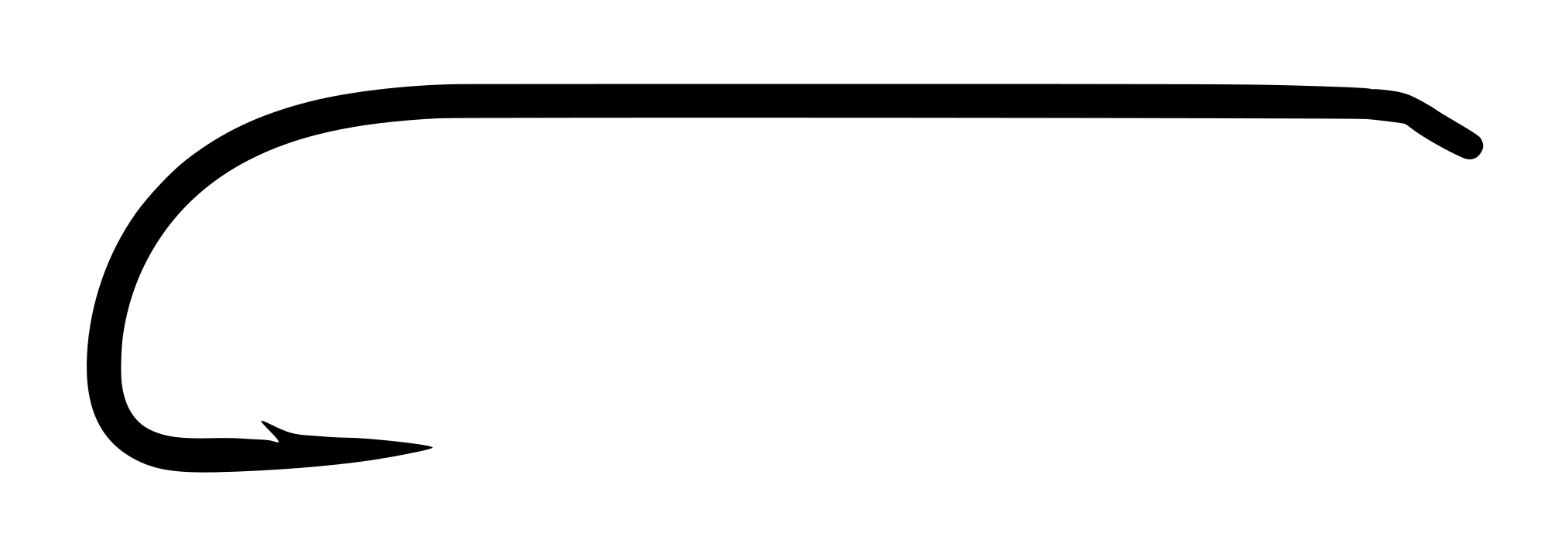
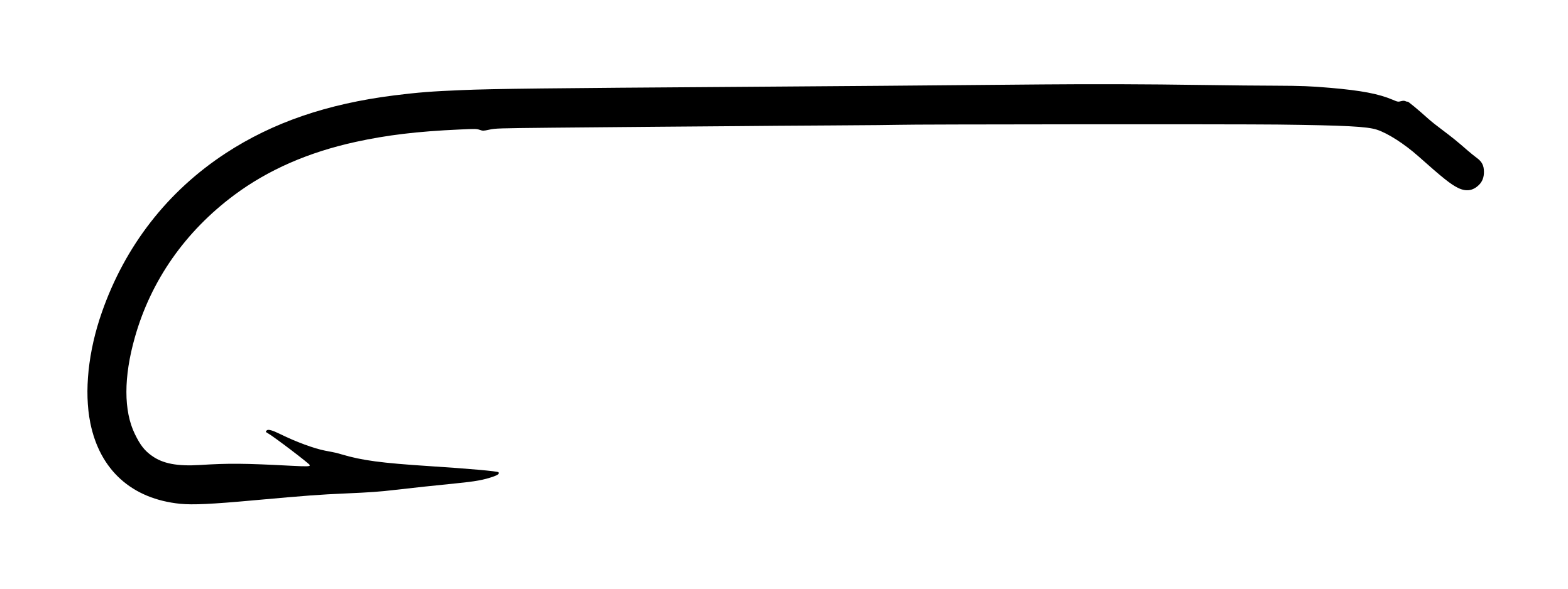
The Mustad 92616 ST Beak Hook in size 2/0 with tinned finish is a heavy-wire bait hook manufactured by O. Mustad & Sön and packaged in a pre-barcode 100-hook wholesale bulk box bearing the firm’s classic eagle-head trademark in letterpress red and black. Despite individual rarity being low by the standards of fly hooks and salmon patterns, this hook represents the parallel industrial bait-fishing tradition that existed throughout the twentieth century alongside—and ultimately absorbed—the Redditch craft tradition.
The beak hook is defined by a dramatically recurved inward-pointing geometry that was explicitly condemned by early 20th-century salmon-fly theorists (G.M. Kelson in 1895, Pryce-Tannatt in 1914) as self-defeating for fly work, yet proved entirely vindicated in live-bait applications where the running load of a strong fish rotates the hook to self-purchase in the corner of the mouth. This mechanical principle anticipated by decades the modern circle-hook design that now dominates conservation-oriented sport fishing.
The packaging, dated by its eagle-head illustration, Oslo-Norway address, letterpress typography, absence of barcode, and physical card patina to approximately 1950–1972, is itself a primary-source document. The large red ‘BEAK HOOKS’ legend, hand-stamped purple-ink size marking, and black-marker ‘TINNED’ annotation are all confirmed by legible photographs. The tinned finish—confirmed by packaging text and visually assessed in macro detail as dull silver-grey with characteristic greenish tin-oxide patina in recesses—offers corrosion resistance superior to bronze in marine and bait-acidic environments.
Rated 3.5/10 for collectability, the 92616 ST is valued at $8–18 in Good to Excellent condition. As essential context for understanding what Mustad was manufacturing when the craft fly-hook tradition was still alive, this hook illuminates what was at stake when the two traditions finally converged.
Wholesale box label for the Mustad 92616 ST Beak Hook showing the classic eagle-head trademark, red-and-black letterpress printing, quality grade designation, hand-stamped purple-ink size marking, and hand-annotated 'TINNED' finish designation. Pre-barcode era and Norwegian address confirm mid-twentieth-century manufacture.
Photographic record
3 cataloged imagesSelect any record to load it above.
3 images shown
Mustad 92616 ST Size 2/0 Tinned — Box LabelWholesale box label for the Mustad 92616 ST Beak Hook showing the classic eagle-head trademark, red-and-black letterpress printing, quality grade designation, hand-stamped purple-ink size marking, and hand-annotated 'TINNED' finish designation. Pre-barcode era and Norwegian address confirm mid-twentieth-century manufacture.Open originalMustad 92616 ST Size 2/0 — Hook ProfileFull-length profile of the Mustad 92616 ST size 2/0 showing the straight ring eye closure, extended shank, round bend curve, and inward-recurving beak point geometry. The dull silver-grey tinned finish and heavy wire gauge are visible. Photographed on 1/10-inch measurement grid for scale reference.Open originalMustad 92616 ST Size 2/0 — Beak Point DetailClose-up macro photograph of the inward-recurving beak point detail, showing the characteristic dramatic arc that sweeps back toward the shank and would re-enter the gape space if extended. The standard-cut barb is visible at proper placement well back from the tip. The greenish-grey oxide patina in the shadowed bend and barb-zone recesses is diagnostically characteristic of tinned finish oxidation over decades.Open original
Technical profile
Eye
Ball Eye, Turned DownRing eye with ball closure, oriented straight to shank axis (confirmed by 'ST' designation). Wire returns on itself forming a neat rounded eye termination. Functional design allows direct pull along shank axis, mechanically optimal for bait-fishing load distribution. (I, V)
Wire
Heavy (1X Heavy), Round, Est. ~0.85-0.95 mm E
Shank
2X Long
Bend
Beak / Reversed Point, Standard gap, Offset / kirbedModified continuous arc following the round/Captain Hamilton family tradition, maintaining approximately constant radius throughout the sweep without angular breaks. The critical defining feature is the inward-recurving beak point that breaks sharply from the expected in-line trajectory: rather than tracking straight, the point sweeps in a long graceful inward arc that would re-enter the gape space if extended. This recurved geometry is the signature characteristic of the beak hook family and constitutes a series first for inward-curved point geometry in Mustad's production line. P
Point
Beak / Reversed (incurving)Standard cut barb, prominent and well-positioned back from the tip. Characteristic of industrial production barbing standard for the era. P
Finish
Tinned — Confirmed (stated on packaging)Tin-plated steel, producing dull matte-to-semi-matte silver-grey surface with moderate reflectivity. Confirmed by hand-annotated 'TINNED' marking on packaging. Visually characterized in macro photographs by pale, slightly granular metallic surface tone and characteristic greenish-grey oxide patina in protected areas (visible in bend recesses and barb zone). This patina is diagnostically distinctive for tinned finish and indicates decades of storage without active oxidation or corrosion. Tinned finish offers corrosion resistance superior to bronze in marine and bait-acidic environments. (P, V)
The 92616 ST’s heavy wire (approximately 0.85-0.95 mm) and round (unforged) cross-section reflect the engineering priority of strength-under-load for bait applications. Forging was unnecessary: the relative heaviness of the wire itself provided adequate bend resistance without the additional manufacturing step. The straight ring eye allows direct pull along the shank axis, mechanically optimal for the rotational loading a bait hook encounters. The inward-recurving beak point operates on a principle of self-purchase: as the fish runs and pulls the line, the load rotates the hook through the fish’s mouth until the point catches on the corner of the jaw or throat tissue. This geometry requires the point to sweep inward far enough to re-enter the gape space—approximately what the photographs document—to achieve reliable penetration at a wide range of hook entry angles. The tinned finish was specified for marine and bait-acidic environments where bronze develops unwanted patina more rapidly.
First documented inward-recurving beak-point design in Mustad production line (92xxx series). Represents a significant series expansion toward bait-fishing specialization in Norwegian industrial manufacture. Tinned finish on bulk bait-hook packaging is less commonly documented in surviving garrenwood.com stock; this specimen provides a primary-source reference for mid-century Mustad tinning practice on industrial bait hooks.
Own this hook? Help us measure it.
We don't have measured sizes for this hook yet. Own one? Submit calipered measurements and we'll review and add them. Thank you!
The Mustad 92xxx eyed-hook series comprises the manufacturer’s industrial production line for bait and saltwater applications, distinguished from specialty fly-hook patterns by heavy-wire specifications and simplified eye constructions optimized for bulk manufacture. The 92616 Beak Hook is a contained standalone pattern within this series, not part of a broader design family, though the beak-point geometry itself reflects wider design evolution in bait-hook engineering. The pattern was marketed as ‘BEAK HOOKS’ with the eagle-head trademark creating a coherent visual identity. The ‘ST’ suffix designates straight ring eye orientation as distinct from turned-down (BLN) or turned-up variants. This wholesale 100-count box represents the bulk commercial packaging format standard for industrial production distribution in the mid-twentieth century, with hand-written annotations (size, finish variant) added during wholesale distribution to differentiate inventory variants in shared storage.
Era and Packaging Dating
Absence of barcode places manufacture before late 1980s barcoding standard. Absence of postal code, telephone number, fax, email, or web address eliminates post-1970 dating on commercial practice grounds. 'O. MUSTAD & SÖN' form with Norwegian umlaut consistent with pre-1970s international stationery practice; later export packaging increasingly omitted diacritics. Oslo commercial address (distinct from Gjøvik factory location) reflects pre-rationalization practice. Eagle-head line-art illustration consistent with letterpress quality of 1940s-1960s commercial engraving. Card stock shows deep cream-to-tan coloration, foxing, and moisture staining incompatible with post-1980 production. Handwritten '1·74' notation interpreted as wholesale price £1.74 per box (consistent with 1960s-70s British tackle pricing) or date code providing terminus ante quem of 1974. Combined evidence places production most probably 1950-1970 with commercial trading life extending into early 1970s.
When Fly Theorists Were Wrong
G.M. Kelson's 1895 salmon-fishing treatise 'The Salmon Fly' explicitly condemned the inward-recurving beak point as 'worst for salmon fly fishing,' while Pryce-Tannatt's 1914 analysis of angle-of-impact mechanics argued against the same geometry for fly applications. Yet the Mustad 92616 ST proved entirely vindicated for its actual purpose: in live-bait fishing, the running load of a strong fish rotates the hook to self-purchase in the corner of the mouth, achieving a mechanical principle that wouldn't be formally recognized until circle hooks dominated conservation-oriented sport fishing decades later. The beak hook was right all along—just not for the application the fly-theorists were studying.
Design lineage and influence
The beak-point geometry predates the Mustad 92616 in earlier British bait-hook traditions, but Mustad’s industrial production elevated it to international commercial standard. The inward-recurving point represents a design branch distinct from the Redditch Sproat and Limerick families, reflecting separate evolutionary pressures in Norwegian industrial engineering. Modern circle hooks (pioneered by Japanese manufacturers in the 1990s and formalized by conservation-fishing organizations) represent the functional descendant of the beak principle, though arrived at through independent mechanical analysis rather than direct lineage.
Best matchRelated by Attribute
Computed automatically from catalog data — updated as new hooks are added.
Matches: Bend, Wire, Gap, Eye, Point +3 moreDiffers: Shank: 2X Long vs Special Long; Eye Orient.: Turned Down vs Straight / Inline; Finish: Tinned vs Gold-Plated +3 more
Matches: Bend, Gap, Point, Offset, Application +1 moreDiffers: Shank: 2X Long vs Short (1X–2X Short); Wire: Heavy (1X Heavy) vs Extra-Heavy (2X+); Eye: Ball Eye vs Tapered Eye +3 more
Matches: Bend, Gap, Eye, Eye Orient., Finish +3 moreDiffers: Shank: 2X Long vs Extra-Extra Long; Wire: Heavy (1X Heavy) vs Extra-Heavy (2X+); Point: Beak / Reversed vs Hollow Point +3 more
Matches: Bend, Gap, Eye, Eye Orient., Point +2 moreDiffers: Shank: 2X Long vs Special Long; Wire: Heavy (1X Heavy) vs Extra-Heavy (2X+); Finish: Tinned vs Nickelled +4 more
The 92616 ST Beak Hook is a heavy-wire bait hook designed for live-fish and saltwater applications where casting stress, bait weight, and the sustained pressure of large sport fish demand wire strength above all other considerations. The dramatically recurved inward-pointing beak geometry—condemned by early 20th-century salmon fly theorists like G.M. Kelson and Pryce-Tannatt as self-defeating for fly work—proved entirely vindicated in bait fishing: the running load of the fish rotates the hook to self-purchase in the corner of the mouth, achieving a mechanical principle that would later be formalized as the modern circle hook design. This hook represents the parallel industrial bait-fishing tradition that existed alongside—and ultimately absorbed—the Redditch craft fly-hook tradition.
Secondary Applications
Saltwater bottom fishing, live-bait trolling for large predatory fish
Modern Equivalents
Hook
Match Quality
Notes
Mustad 92247 Beak
Good
Modern continuation of beak-point design; comparable size and wire gauge; tinned and bronzed finishes available.
Owner SSW Circle Hook
Moderate
Represents modern functional evolution of beak-point principle — inward geometry achieves similar self-hooking mechanical effect through different design approach.
Collector notes
Rated 3.5/10 — moderate collecting interest driven primarily by packaging condition and pre-barcode era documentation. Industrial production volumes and functional bait-hook category limit rarity. Complete original packaging in good-to-excellent condition commands modest premium. Collector demand is modest among mid-century industrial-fishing historians and Mustad specialists; not actively hunted by generalist hook collectors.
Reference value
$8 – $18 USD estimate
Packaging condition
Good — moderate wear, legibleRecorded specimen
Packaging format
GW-M-92616-01Catalog code
Positive factors: Pre-barcode wholesale packaging is a primary-source commercial document from the industrial fishing tradition. The beak-point geometry represents a series first for inward-recurved point design in Norwegian production. Hand-annotated size and finish designations add authenticity to the mid-century distribution chain. Tinned finish is less commonly encountered than bronzed in surviving stock. Complete 100-hook bulk box, if fully stocked or nearly so, documents industrial wholesale practice.
Limiting factors: Mustad’s industrial production volumes mean surviving stock remains relatively abundant, particularly in larger practical sizes. The 92616 ST is not a specialized fly-hook or rare salmon pattern that appeals to premium fly-tyer collectors. Bait-hook category commands lower valuations than fly-hook equivalents in general collecting practice. Size 2/0 is a practical working size that sees actual fishing use, reducing survival rates in perfect condition.
Desirable variants: Smallest available sizes (smaller than 2/0) are less commonly encountered. Sealed or near-sealed boxes command higher premiums than opened cards. Bronzed-finish variants may be slightly more desirable than tinned in some markets. Hand-annotated finishes add provenance value over blank boxes.
Condition factors: Complete hook count (all 100 present) is essential to premium valuation. Card integrity (no splitting, minimal foxing, legible printing) significantly affects value. Hooks themselves should show no corrosion or damage. Original tissue wrapping or envelope, if present, adds 20-30% premium.
Packaging
Pre-barcode wholesale slide-box, cardboard construction. Cream-colored stock with deep tan foxing and moisture staining consistent with mid-century storage. Face label features red letterpress 'MUSTAD BEAK HOOKS' headline, black-printed model number '92616 ST', 'Qual. 1' grade designation, manufacturer information 'O. MUSTAD & SÖN, Manufacturers - Establ. 1832, Oslo - Norway', quantity '100'. Eagle-head trademark illustration in black line art. Hand-stamped purple-ink size marking '2/0' (visible on front). Hand-annotated black-marker 'TINNED' at lower edge. Handwritten '1·74' at lid top (interpreted as wholesale price or date code). No barcode present.
Market Value Notes
Low ($8): Good condition — opened box, 90+ hooks present, card shows moderate wear and foxing, legible printing, minor hook surface oxidation acceptable.
High ($18): Excellent condition — sealed or near-sealed, complete 100-hook count, minimal card wear, sharp printing, hooks bright, original tissue wrapping if present.
Premium factors: Pre-barcode era dating, hand-annotated finish designation, complete hook count, sealed or near-sealed packaging, minimal card damage.
Platforms: eBay (UK and US), specialist tackle dealers, occasional online vintage fishing retailers.
Confidence: E estimated — limited comparable sold data; wholesale bulk boxes rarely appear on retail markets; estimate derived from comparable Mustad industrial-pattern boxes and bait-hook card pricing. Bulk box format commands lower per-hook value than retail carded formats.
Where to Find
eBay UK and US (search 'Mustad 92616' or 'Mustad Beak Hook' — bulk boxes appear infrequently). Specialist vintage tackle dealers and online retailers. Tackle fairs and auctions in UK and Scandinavia more likely to feature Mustad wholesale packaging. Estate sales and hobby-collection dispersals occasionally yield unopened stock.
Collector's Identification Tips
Identify by model number 92616 ST printed on packaging. Verify ‘BEAK HOOKS’ marketing headline in red letterpress. Confirm hand-stamped purple-ink size designation. Look for hand-annotated finish variant (‘TINNED’, ‘BRONZED’, etc.). Assess packaging for pre-barcode dating indicators: no EAN/UPC code, Oslo address form, Norwegian umlaut on ‘SÖN’, letterpress printing quality, cream-tan card stock with foxing, absence of postal code or phone number. Ring eye should be straight to shank axis per ST designation.
Preservation
Storage and Preservation
Store the 92616 ST in a cool, dry environment away from humidity and moisture exposure. The tinned finish is resistant to aggressive corrosion but will develop protective oxide patina (the greenish-grey discoloration visible in the photographs) with extended moisture exposure; collectors typically consider this patina desirable as evidence of authenticity and age. Keep the hooks on their original packaging card rather than loose — the cardboard provides physical protection and adds significant value. Store in a flat position to prevent warping or card damage. Avoid contact with other metals (copper, brass, steel) to prevent galvanic corrosion at interface points. If the box contains tissue wrapping or envelope, preserve it intact — original packing materials add meaningful premium. For hooks removed from the card, store in individual small envelopes or acid-free paper to prevent moisture accumulation. Inspect periodically for signs of serious corrosion (not the surface patina, but deep pitting); if corrosion appears, increase air circulation and reduce relative humidity in the storage area. Do not attempt to polish or clean the tinned finish — the original surface, including patina, is the authentic documented state and should be preserved as-is.
Marking Analysis
Hand Annotations and Maker's Marks
The 92616 ST box documents three distinct hand-annotation campaigns visible in the photographs: (1) Purple-ink hand-stamped size designation ‘2/0’ in the center-left of the label face, indicating the hook size. This is a standard Mustad practice for mid-century wholesale boxes, where the same box design was used for multiple sizes and the size was marked by hand to identify inventory. The purple color and stamp quality are consistent with 1950s-1970s commercial practice. (2) Black-marker hand-annotation ‘TINNED’ at the lower edge of the label, almost certainly written by the wholesale distributor during packaging or inventory management to differentiate this box’s finish variant from concurrent stock of the same pattern in bronze, japanned, or nickel finishes. This marker-written finish designation is typical of mid-century tackle distribution, where bulk boxes of identical patterns in different finishes were stored together and required manual differentiation. The black marker used for this annotation is consistent with period commercial marking practice. (3) Handwritten ‘1·74’ notation at the top edge of the box lid (visible in the main packaging photograph), interpreted either as a wholesale price of £1.74 per 100-hook box (consistent with 1960s-1970s British tackle pricing data) or as a date code (January 1974 in European date notation: 1.74). If the latter interpretation is correct, this notation provides a terminus ante quem of 1974 for when the box was in active commercial circulation, consistent with manufacture in the prior decade.
All three annotations are original period markings, not later collector additions, as evidenced by the fading, ink saturation, and integration with the box’s patina. These handwritten elements significantly add to the specimen’s value as a primary-source document of mid-century wholesale fishing-tackle distribution practices.
Primary Source
Packaging Text and Historical Documentation
Source: Mustad 92616 ST box label, c. 1950-1972
‘O. MUSTAD & SÖN’ — The form of the manufacturer’s name with the Norwegian umlaut on ‘Ö’ and the ampersand ‘&’ followed by ‘SÖN’ (son/sons) is consistent with Norwegian corporate nomenclature and international stationery practice of the pre-1970s era. Later Mustad export packaging increasingly anglicized this to ‘MUSTAD SON’ without diacritics, making the formal Norwegian spelling a reliable dating indicator for mid-twentieth-century production. The presence of the umlaut confirms this is genuine-period packaging, not a later reprint.
‘Manufacturers – Establ. 1832’ — This founding date is accurate to Mustad’s 1832 establishment in Oslo. The inclusion of the founding date on commercial packaging is typical of the 1950s-1970s period when manufacturers emphasized heritage and tradition; earlier and later packaging practices typically omitted this detail.
‘Oslo – Norway’ — The specification of Oslo (rather than Gjøvik, where the actual factories were located) as the commercial address reflects Mustad’s pre-rationalization practice of maintaining Oslo as its international trading face and business headquarters. This address format is another reliable dating indicator for mid-century packaging; later Mustad boxes increasingly specified Gjøvik or simply ‘Norway.’
‘BEAK HOOKS’ — The marketing name directly references the inward-recurving point geometry, reinforced by the eagle-head trademark illustration. This nomenclature is consistent with Mustad’s product marketing of the era; modern packaging for the same pattern uses different naming conventions.
‘Qual. 1’ — Mustad’s standard quality grade, the baseline production tier as opposed to special, competition, or premium grades. This designation indicates industrial-production consistency rather than artisan inspection. The presence of a quality grade on the label is typical of wholesale bulk packaging; retail cards typically omit this technical designation.
‘100’ — The quantity per box confirms this as industrial-scale wholesale packaging, not retail distribution. A 100-count box represents the standard bulk format for mid-century tackle distribution to wholesale buyers, retailers, and commercial fishing operations.
Additional
The Beak Point in Fishing Theory and Practice
The inward-recurving beak-point geometry on the 92616 ST occupies a fascinating position in fishing-hook history: it was theoretically dismissed by the most authoritative 19th- and 20th-century fly-fishing writers, yet proved entirely vindicated in practice for the application it actually served.
G.M. Kelson’s foundational 1895 treatise The Salmon Fly explicitly condemned inward-pointing hook geometries as ‘worst for salmon fly fishing,’ arguing from the mechanics of fly presentation that a point angled back toward the shank would fail to penetrate cleanly when the fish took the fly. Pryce-Tannatt’s 1914 analysis of angle-of-impact mechanics reinforced this critique with more rigorous biomechanical reasoning. Both theorists were studying fly-fishing applications where the hook is embedded in a fly’s wing and hackle, delivered to a fish’s mouth at specific angles dictated by fly design and presentation technique. In that context, their analysis was sound.
But the Mustad 92616 ST was never intended for fly fishing. It was engineered for live-bait or cut-bait applications where the hook operates under entirely different loading conditions. In live-bait fishing, the fish’s running load and head movement cause rotation and torque on the hook that the straight shank cannot resist. As the fish pulls and thrashes, the hook rotates through the tissues of the mouth until the point—sweeping inward as it does—catches on the corner of the jaw, throat tissues, or gill structures. The inward geometry that Kelson and Pryce-Tannatt dismissed as a liability becomes an asset: it increases the probability of secure purchase across a wider range of strike angles and fish head positions.
This principle was eventually formalized a century later in the development of modern circle hooks in the 1990s, which were engineered by Japanese manufacturers and adopted by conservation-fishing organizations specifically because they achieve high hook-up rates and cause fewer injuries to released fish. The circle hook represents the explicit recognition of what the beak-point design had demonstrated decades earlier: that an inward-angled point can provide superior self-hooking mechanics under conditions of uncontrolled, dynamic loading.
The 92616 ST thus documents a quiet vindication: industrial bait-hook engineering had solved a problem through empirical practice that fly-fishing theory had declared unsolvable. It is a useful reminder that theoretical correctness and practical efficacy do not always align, and that working fishermen—applying hooks in unglamorous live-bait applications—were solving problems that the literary fly-fishing tradition was still debating.
Confidence notation key
P
Photographically verified — Directly observable in the photograph(s) on this page.
V
Verified by documentation — Confirmed by manufacturer catalog, spec sheet, or published reference.
I
Inferred — A logical deduction from observable or documented evidence, not directly stated.
E
Estimated — An approximation based on visual comparison, proportional analysis, or limited data.
S
Speculative — A reasoned hypothesis that cannot be confirmed from available evidence.
Unnotated claims are the compiler’s synthesis; see Sources. All photographs on garrenwood.com are taken on a measurement grid where each square equals 1/10 inch (0.1″ / 2.54 mm).