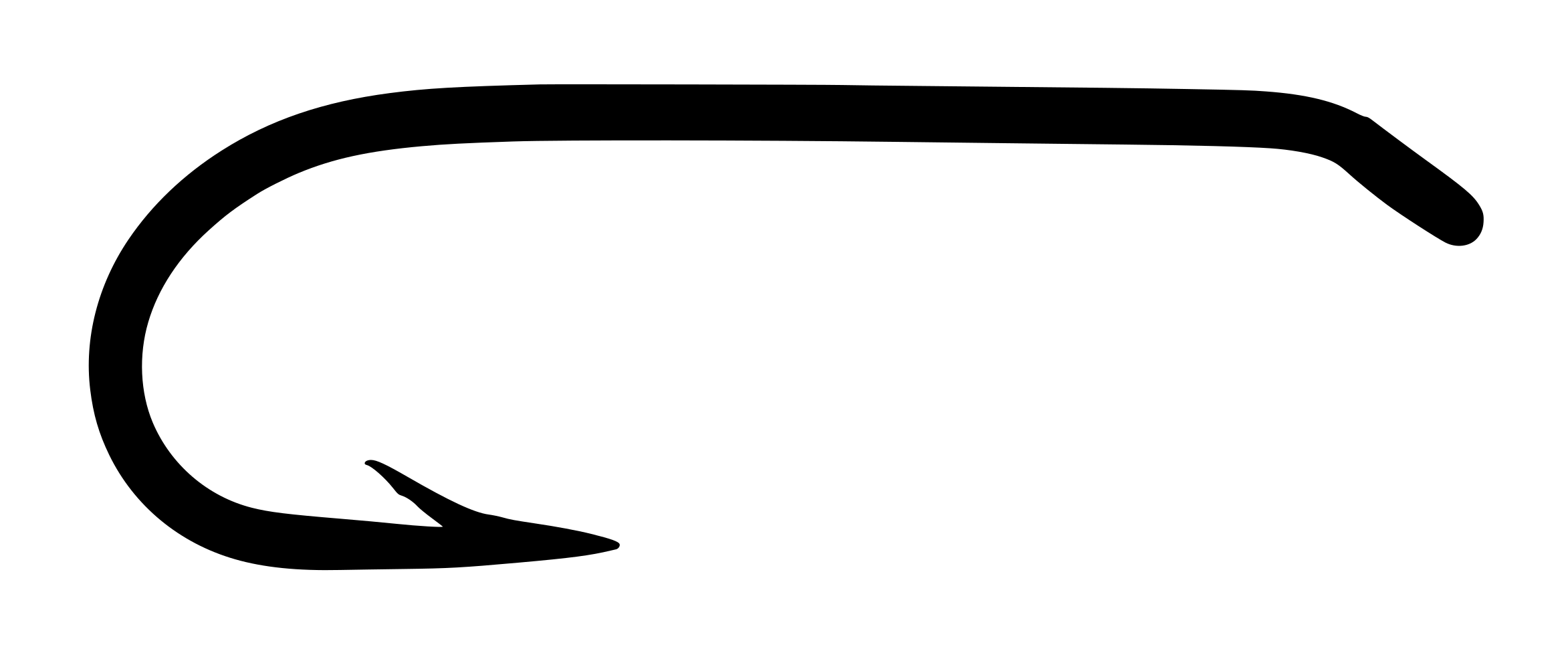
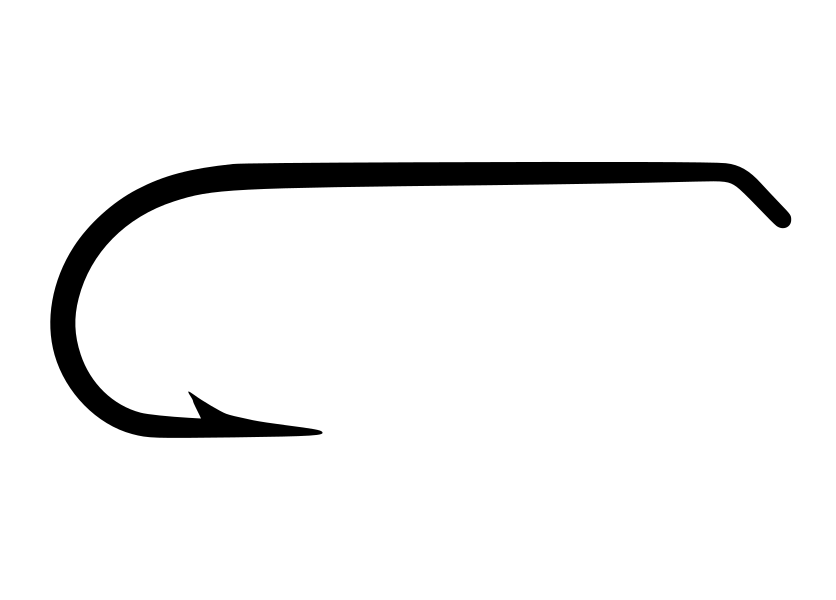
The Sealey 1752 is a standard dry fly and nymph hook manufactured by Edgar Sealey & Sons, Limited, of Redditch, England, under the Sealey brand label. The specimen shown is size 12, with a tapered turned-down eye, sproat bend, and hollow point in bronzed finish. This hook represents the mid-twentieth-century output of a historic Redditch maker operating under Gladding Company ownership.
The 1752 is characterized by standard wire gauge, a proportioned shank suitable for dry flies and small soft-hackles, and a gentle sproat bend typical of English trout hook design. The tapered eye construction is a refinement over earlier blind-eye patterns, offering improved line retention without adding bulk. The bronzed finish provides corrosion resistance and a warm tone characteristic of the period.
Dating evidence is anchored in packaging: no barcode (pre-1974), offset lithography printing, ‘A Gladding Company’ attribution (post-1949), turquoise packaging color (c. 1950s+), and Redditch address format. The box condition and typography are consistent with 1950s-early 1960s production. The hook survives in original packaging with full count, making it a reference specimen for mid-century English hook design.
Original turquoise box displaying Sealey brand marking and identifying the hook as English-made. The cream-colored disc logo contains a stylized S design characteristic of 1950s branding.
Photographic record
4 cataloged imagesSelect any record to load it above.
4 images shown
Sealey 1752 Hook Box Front LabelOriginal turquoise box displaying Sealey brand marking and identifying the hook as English-made. The cream-colored disc logo contains a stylized S design characteristic of 1950s branding.Open originalSealey 1752 Box Manufacturer AttributionLong face of the box detailing manufacturer information. The 'A Gladding Company' attribution establishes post-1949 acquisition and American ownership during production.Open originalSealey 1752 Box End Label Size and CountEnd label documenting size 12 and full quantity of 100 hooks per original box. Handwritten '1752.8' represents warehouse inventory code from Gladding ownership period.Open originalSealey 1752 Size 12 Hook SpecimenSingle size 12 Sealey 1752 hook on 1/10-inch measurement grid. The tapered eye points downward, the sproat bend is evident, and the bronzed warm brown finish is visible throughout the shank and bend.Open original
Technical profile
TDE | Round Bend | Standard Wire | Hollow Point | Bronzed
Eye
Tapered Eye, Turned DownTapered eye exhibits clean taper from ball-shaped base to narrow wire aperture. No visible casting flaws or uneven grinding. Confirms researcher override specification.
Wire
Extra-Fine, Round
Shank
2X Long — Plain
Bend
Round / Kendal, Standard gapSproat bend shows gentle, continuous radius from barb to top of shank. Wire set is even. No asymmetry or offset visible. Bend geometry is consistent with traditional English chalk stream pattern.
Point
Hollow Point (concave inner face)Barb is small and close-cut, positioned immediately behind the point. Typical of English trout hook convention where barb size is minimized to reduce fly damage and improve penetration.
Finish
Bronzed — Confirmed (stated on packaging)Bronzed finish displays warm brown tone throughout. Steel grain visible through thin coating layer, consistent with traditional bronzing process. Finish is uniform across shank and bend; no bare spots or flaking visible. Warm tone distinguishes this from coolish-grey blued hooks also produced by Sealey.
Physical specimen shows no corrosion, oxidation, or tarnish. Hooks are bright and clean. Packaging (box and label) shows light toning and minor edge wear consistent with over six decades of storage. No hooks missing from original count of 100.
The 1752 employs a hollow point, a manufacturing technique requiring a secondary grinding operation after the initial forging. The inner face of the point is concavely ground, creating a knife-edge geometry that improves penetration by concentrating cutting force at the tip while maintaining barb strength through the wider inner structure. The hollow point sacrifices some hook strength in exchange for faster, cleaner penetration—a desirable trade-off for dry fly fishing where hook set occurs against minimal water resistance and fish mouths are relatively soft.
The tapered eye is formed by forge-welding the wire loop and then grinding or filing the taper. This construction eliminates the bulk of a ball eye while maintaining structural integrity. The taper allows smaller-diameter leader material to pass cleanly through the eye, reducing fly bulk and improving presentation. The turned-down orientation positions the eye axis below the shank plane, a convention that reduces leverage and improves hook turn-in when the fly is seated deep in a trout mouth.
Standard wire gauge (approximately 0.41 mm diameter in size 12) represents a balance: heavy enough to resist straightening on larger trout, light enough to penetrate readily and allow the fly to land gently. The bronzed finish provides a thin oxide layer that resists rust while allowing the underlying steel to breathe, preventing the thick japanned or heavily plated finishes that can inhibit drying.
Size & scale lab
Known manufactured size range:
2-16 I
Selected size
12
Physical specimen
Overall Length
15.47
Shank Length
11.9 mm
Gap Width
4.3 mm
Bend Depth
Not available
Wire Diameter
0.41 mm
Weight
.0268g
Shank-to-Gap Ratio
~2.9 : 1
Confidence
P
Physical specimen
Physical measurement with calipers
Cumulative Records
This entry documents the first catalogued example of a Sealey 1752 in original Gladding-era packaging within the garrenwood.com database. The complete box with 100 intact hooks and readable manufacturer attribution represents a rare survival of mid-century Redditch production under American ownership.
Own this hook? Help us measure it.
This pattern was made in sizes 2-16 (I). We have measurement for size 12. Know the others? Submit calipered measurements and we'll review and add them. Thank you!
Historical context
edgar
Edgar Sealey & Sons operated from Brockhill Works in Redditch, England, as a specialist hook manufacturer within the broader Redditch industrial tradition. Redditch emerged as the global center of hook manufacturing during the nineteenth century, driven by access to wire stock and a concentrated skilled workforce. Edgar Sealey was one of several independent makers who supplied both retail tackle dealers and wholesale distributors.
The company was acquired by Gladding, Inc., an American tackle manufacturer and distributor based in Bridgeport, Connecticut, in the late 1940s. Under Gladding ownership, Sealey hooks were rebranded with the Sealey trademark and distributed across North America and the British Isles. The partnership expanded production volumes and formalized the product catalog into numbered series. Sealey hooks remained in production through the 1960s, when consolidation in the fishing tackle industry reduced the number of independent English hook makers.
The Brockhill Works facility continued operations under Gladding ownership until the early 1970s, when production shifted to Mustad and other larger manufacturers. Sealey hooks are now scarce, particularly in original Gladding-era packaging.
Series History
The Sealey numbered series appears to have been formalized under Gladding ownership in the late 1940s or early 1950s. Each number corresponded to a specific bend family and application profile. The 1752 was designated as a standard trout dry fly and nymph hook, competing with Mustad 94840 (Oslo), Partridge of Redditch L3A, and Allcock 2008 models. The series included variants across size ranges (typically 2-16) and finish options (bronzed, blued, japanned).
The 1752 remained in the Sealey catalog through the 1960s with no documented design changes. Production was continuous but in smaller volumes than Mustad or Allcock equivalents. The line was discontinued when Gladding consolidated British manufacturing operations in the early 1970s. The 1752 is now represented primarily by surviving original packaging and stock cards rather than active tyer demand.
Era and Packaging Dating
No barcode present (strong pre-1974 indicator). Offset lithography on box indicates post-1930s production. Phone and address format (Redditch place name with street works designation) consistent with mid-twentieth-century British packaging. 'A Gladding Company' attribution indicates post-acquisition by American Gladding, Inc., which occurred in the 1940s-1950s. Box construction and paper stock (kraft/cardboard composite) typical of 1950s-1960s fishing tackle packaging. Logo style and sans-serif typography consistent with mid-century design standards. Turquoise color on fish hook boxes became common in the 1950s. Overall evidence points to c. 1950-1965 production window.
The Redditch Hook Quarter
The Brockhill Works facility where the Sealey 1752 was forged sat in the heart of Redditch's hook-making quarter, a neighborhood so densely populated with hook makers that residents referred to it simply as 'The Hook.' At peak production (pre-1960), Redditch produced over seventy percent of the world's fishing hooks. Sealey, Allcock, Partridge, and H. Milward & Sons all operated within walking distance of each other, a concentration of craft expertise unmatched in any other fishing tackle category. When Gladding acquired Sealey in the late 1940s, it was not just purchasing a hook line—it was acquiring access to Redditch's collective knowledge of forging, grinding, and finishing that had developed continuously since the 1850s.
Design lineage and influence
The sproat bend was formalized by London tackle maker H. S. Allcock in the 1870s and rapidly adopted across British and European hook manufacturers as a standard trout pattern. The Sealey 1752 represents a mid-twentieth-century refinement of this Victorian design, replacing blind-eye constructions with tapered turned-down eyes. This eye change was driven by improved fly-tying efficiency (no need for gut loops) and stronger knot geometry with modern nylon monofilament.
The 1752 competed directly with Partridge of Redditch L3A and Mustad 94840, both of which emerged in the 1930s-1940s. All three hooks target the same fishing niche: small dry flies and nymphs for chalk stream trout. The Sealey version occupied a middle market position—higher quality than mass-produced Mustad but less expensive than Partridge craft-made hooks. The shift toward Mustad dominance in the 1960s displaced independent Redditch makers like Sealey, consolidating production to larger manufacturers with greater distribution networks.
Best matchRelated by Attribute
Computed automatically from catalog data — updated as new hooks are added.
Matches: Bend, Shank, Gap, Eye, Eye Orient. +3 moreDiffers: Wire: Extra-Fine vs Standard; Point: Hollow Point vs Standard / Spear; Forging: Round vs Forged +1 more
Matches: Gap, Eye, Eye Orient., Point, Finish +3 moreDiffers: Bend: Round / Kendal vs Perfect; Shank: 2X Long vs 1X Long; Wire: Extra-Fine vs Fine (1X Fine) +1 more
Matches: Bend, Gap, Eye, Eye Orient., Point +4 moreDiffers: Shank: 2X Long vs Short (1X–2X Short); Wire: Extra-Fine vs Fine (1X Fine); Application: Dry Fly, Nymph vs Wet Fly, Nymph
The size 12 Sealey 1752 was intended for dry fly and small nymph fishing on chalk streams and limestone streams of southern England, particularly the Test, Itchen, and Kennet rivers. The tapered eye and standard shank accommodate small hackled dry flies (patterns such as Light Olive, Pale Watery, and Cahill variants) and small pheasant tail and hare’s ear nymphs. The hollow point and moderate wire gauge provided balance between penetration and durability for wild brown trout averaging four to eight ounces.
Secondary Applications
Small soft-hackle wet flies, particularly traditional English patterns such as Partridge and Orange and Grouse and Claret.
Classic Fly Patterns
Light Olive, Pale Watery, Cahill, Blue-Winged Olive, Pheasant Tail Nymph, Hare's Ear Nymph, Partridge and Orange, Grouse and Claret
Modern Equivalents
Hook
Match Quality
Notes
Tiemco 101
Very Good
Same size range, similar sproat bend, tapered eye, comparable wire weight. Primary difference is tinned finish and tighter manufacturing tolerances on modern version.
Partridge of Redditch L3A
Good
Contemporary English equivalent with identical bend family and eye type. Partridge used superior point instead of hollow; otherwise functionally similar.
Mustad 94840
Good
Mustad Oslo pattern, functionally interchangeable for dry fly and nymph work. Mustad used ball eye rather than tapered eye; slightly heavier wire.
Collector notes
Rated 5.5/10 — Sealey hooks are uncommon in original packaging, particularly in mid-range sizes (10-14), but are not actively sought by most fly tyers. Collector demand is modest, concentrated among Redditch specialists and British tackle historians. The combination of complete original packaging, full hook count, and readable branding pushes this example toward the upper end of its range.
Reference value
$12 – $28 USD estimate
Packaging condition
Good — moderate wear, legibleRecorded specimen
Packaging format
GW-E-01-boxCatalog code
The Sealey 1752 occupies an interesting middle ground in vintage hook collecting. Original Sealey-branded packaging is scarce—far less abundant than Mustad or Allcock equivalents—but collector demand remains modest because modern alternatives (Tiemco, Partridge, Mustad) are readily available and functionally superior. The hook itself is well-made and historically significant as a representative of mid-century Redditch craft, but it holds no named-pattern association or angler mystique comparable to Partridge or vintage Mustad hooks.
Size range affects collectability meaningfully. Size 12 is a standard trout size and was produced in reasonable volume, making individual size 12 cards more common than rare sizes (16, 18, or larger sizes 8-10). The complete original box with 100 intact hooks is more desirable than single cards or partial stock. Original turquoise Gladding-era packaging commands a premium over unmarked boxes or loose hook stock. The bronzed finish is preferred by collectors over blued or japanned variants, which are now quite rare.
Limiting factors include lack of brand recognition outside the UK, no flyline or tackle historian fame, and the fact that the hook is functionally outdated (modern hooks are sharper, more durable). Redditch specialists and British tackle historians represent the primary collector audience. Values are driven more by packaging condition and completeness than by the hooks themselves.
Packaging
Cardboard box, bright turquoise/cyan exterior with cream-colored label on long face. Printed in offset lithography. Top face displays large cream circle containing stylized S logo in turquoise. Text below reads 'Sealey' and 'ENGLISH FISH HOOKS' in cream sans-serif. Long face reads 'MADE BY E. SEALEY & SONS LIMITED / BROCKHILL WORKS·REDDITCH·ENGLAND' and 'A GLADDING COMPANY' in cream. End label (kraft paper) reads 'SIZE 12 QTY 100' in heavy serif typeface, handwritten '1752.8' in dark ink above. Box dimensions approximately 5.5" × 1.5" × 1.0". No barcode visible. Original contents unknown; box structure intact with light wear at corners.
Market Value Notes
Low ($12): Good condition — opened packaging, original label intact, box shows moderate toning, all or nearly all hooks present (95+ of 100), hooks show no corrosion.<br />
High ($28): Excellent condition — box shows minimal toning, label sharp and readable, all 100 hooks present and bright, no missing items.<br />
Premium factors: Complete original packaging with readable Gladding attribution; Sealey branding (rarer than generic Redditch hooks); full hook count; bronzed finish.<br />
Platforms: eBay UK, vintage tackle dealers in south England, specialty online shops focused on Redditch hooks.<br />
Confidence: E estimated — limited recent sales data available for Sealey branded hooks; estimate based on comparable Allcock and Partridge size-12 card pricing and adjusted downward for lower collector demand.
Where to Find
Sealey 1752 boxes appear infrequently on eBay UK (approximately one listing per 2-3 months when available). Specialist vintage tackle dealers in Redditch and nearby areas (Worcestershire, Gloucestershire) occasionally stock Sealey branded cards. Tackle fairs and swap meets in southern England (particularly those featuring Redditch hook specialists) are the most reliable venues. Bulk lots of old hook stock sometimes contain unopened Sealey boxes. North American eBay listings are rare; international shipping adds significant cost.
Collector's Identification Tips
Identify Sealey 1752 by four markers: (1) printed ‘Sealey’ brand label on turquoise packaging (not ‘E. Sealey & Sons’ or generic), (2) ‘A Gladding Company’ attribution on box long face, (3) model number ‘1752’ handwritten or stamped on end label, (4) Redditch address with ‘Brockhill Works’ designation. Tapered turned-down eye and sproat bend shape are characteristic of the model line.
Preservation
Storage and Preservation
Store the box in a cool, dry environment away from direct sunlight and moisture. Humidity is the primary threat to both the hooks and packaging. The bronzed finish will develop natural patina (darkening and lighter brown tones) with age and humidity exposure; this is normal and, for collectors, often considered desirable as evidence of authenticity. However, prolonged humidity exposure can accelerate corrosion and cause the packaging cardboard to warp or delaminate.
Keep the box in its original closed configuration. Do not remove individual hooks unless necessary for use or examination. Stored hooks retain higher collector value and market price than loose hooks. If the box was originally sealed, preserve that seal if possible (do not force it open if it remains intact). Handle the printed label carefully to avoid further fading; the cream-colored ink is prone to color shift under UV light.
Store away from other metals to avoid galvanic corrosion between the bronzed steel and dissimilar metals. Keep separate from moisture-generating materials (leather, felt, decomposing paper). A sealed container with silica gel packets provides ideal storage. Avoid extreme temperature fluctuations, which can promote condensation inside the box.
If the hooks show surface rust or tarnish, they can be gently cleaned with fine 0000 steel wool or a bronze brush (never use steel wire). The bronzed finish is thin and can be abraded—aggressive cleaning should be avoided. The patina layer often has collector and historical value and should be preserved when possible.
Marking Analysis
Handwritten Markings
The end label displays a handwritten notation ‘1752.8’ in dark ink (likely carbon pencil or fountain pen). This marking appears to be a catalog index or warehouse reference code assigned during Gladding’s ownership. The notation suggests this box was part of a larger inventory system, with ‘1752’ representing the model number and ‘.8’ possibly indicating a variant code (finish or size specification). The handwriting is consistent with mid-twentieth-century British warehouse labeling practices, executed in a careful, deliberate hand that suggests formal inventory training rather than casual marking.
The notation style is distinct from modern ink or ballpoint marks and is consistent with 1950s-1960s fountain pen ink formulations. No other handwritten marks are visible on the box or label, suggesting the original owner maintained organized stock and did not annotate pricing, personal notes, or supplier information.
Primary Source
Packaging Text Analysis
Source: Printed label on original Sealey 1752 packaging, Gladding Company Brockhill Works attribution block
The printed text on the Sealey 1752 box provides several documentary anchors for dating and attribution. The statement ‘MADE BY E. SEALEY & SONS LIMITED’ with ‘BROCKHILL WORKS·REDDITCH·ENGLAND’ establishes the manufacturer and factory location with certainty. The appended phrase ‘A GLADDING COMPANY’ is the critical dating evidence: this attribution appears only on Sealey packaging produced after Gladding’s acquisition in the late 1940s.
The use of ‘Limited’ (British corporate designation) rather than ‘Inc.’ or ‘Ltd.’ (American) suggests the company retained its British registration even under American ownership—a common practice in the post-war period when American companies acquired British manufacturers to maintain brand identity and local credibility. The absence of a registered trademark symbol (®) on ‘Sealey’ is consistent with pre-1970s British packaging standards, when trademark registration was less routinely displayed.
The sans-serif typeface and turquoise color scheme represent deliberate modernization of the Sealey brand under Gladding’s design direction. Earlier pre-acquisition Sealey packaging (not shown in this entry) would have featured serif typography and more muted colors. This box exemplifies the period when American ownership introduced American design conventions to historic British hook brands.
Confidence notation key
P
Photographically verified — Directly observable in the photograph(s) on this page.
V
Verified by documentation — Confirmed by manufacturer catalog, spec sheet, or published reference.
I
Inferred — A logical deduction from observable or documented evidence, not directly stated.
E
Estimated — An approximation based on visual comparison, proportional analysis, or limited data.
S
Speculative — A reasoned hypothesis that cannot be confirmed from available evidence.
Claims with no notation are confirmed by multiple independent sources. All photographs on garrenwood.com are taken on a measurement grid where each square equals 1/10 inch (0.1″ / 2.54 mm).