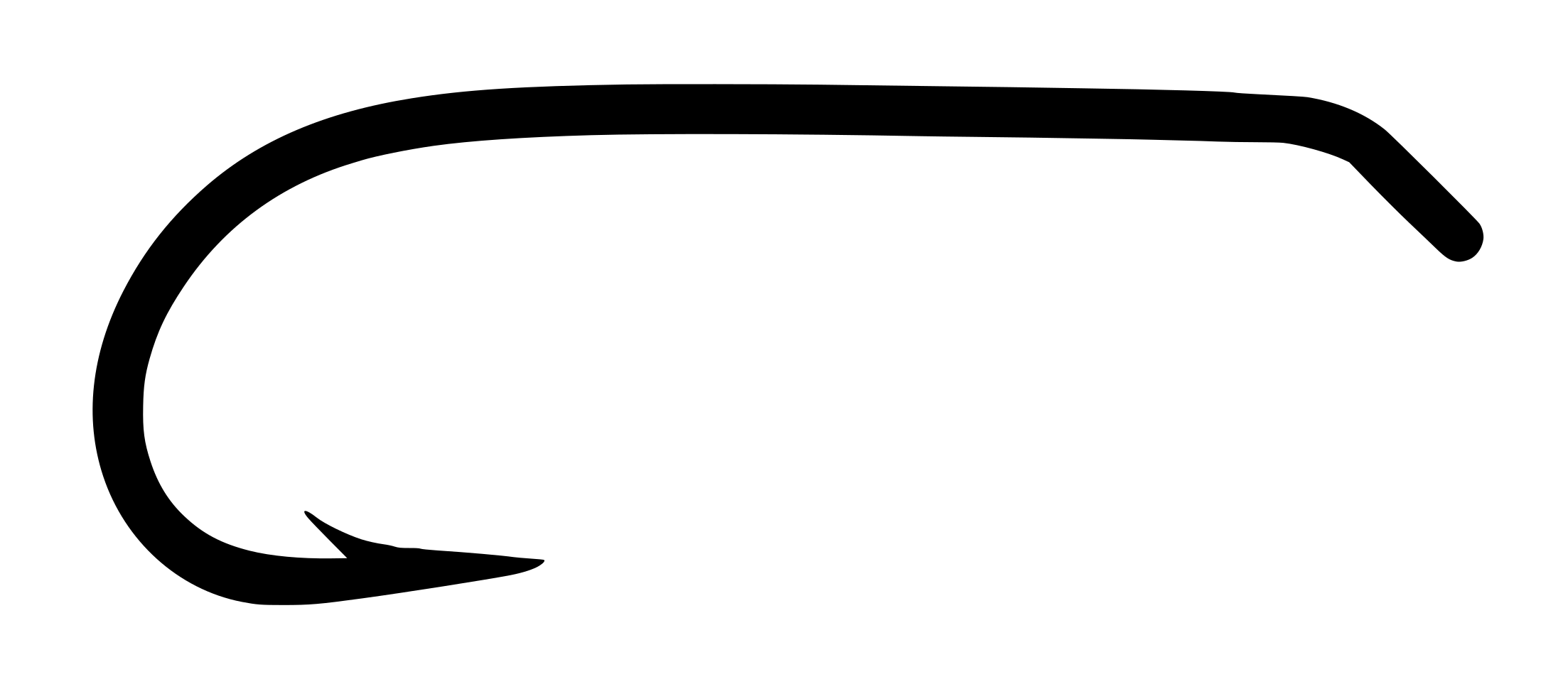
The Pacific Bass is a heavy-wire Sproat-bend hook manufactured by R. Turner & Sons of Redditch, England. Defined by its straight ball eye, superior point, and robust round-wire construction, this hook was marketed for bass and saltwater bait fishing applications. The packaging identifies the wire as spring steel with an out point, and specifies 100 hooks per card.
The early packaging date — letterpress printed on cream cardstock with decorative Victorian-style typography and shield logo — places production in the early 20th century. The absence of barcode and postal zip format confirm pre-1974 manufacture. Turner & Sons was a respected Redditch craftmaker, and the Pacific Bass represents their approach to heavier specialized patterns.
Collectibility is moderate. The model remains scarce outside specialist UK tackle circles. Complete original cards are infrequently encountered. The packaging condition and Redditch maker attribution add meaningful collector appeal, though the straightforward Sproat bend and common application limit broader demand.
Profile view of the R. Turner & Sons Pacific Bass hook on 1/10-inch measurement grid, showing the rounded Sproat bend geometry, superior point taper, and bronzed spring-steel finish.
Photographic record
2 cataloged imagesSelect any record to load it above.
2 images shown
R. Turner & Sons Pacific Bass Hook Sproat Bend ProfileProfile view of the R. Turner & Sons Pacific Bass hook on 1/10-inch measurement grid, showing the rounded Sproat bend geometry, superior point taper, and bronzed spring-steel finish.Open originalR. Turner & Sons Pacific Bass Hooks Sales Card Vintage PackagingOriginal sales card for R. Turner & Sons Pacific Bass Hooks, letterpress printed on cream cardstock with decorative shield logo and brown-ink typography, identifying the hooks as spring steel with out point, quantity 100 per card.Open original
Technical profile
Straight Ball | Sproat | Heavy Wire | Superior Point | Bronzed
Eye
Ball Eye, Straight / Inline
Wire
Heavy (1X Heavy), Round
Shank
Standard — Plain
Bend
Sproat, Standard gapSproat bend exhibits the characteristic rounded bottom without aggressive upward angulation. Bend appears symmetrical and true. Depth-to-gap ratio (~1.3 : 1) is within standard range for this bend family. Wire set is consistent and uniform P.
Point
Superior (near-straight inner taper)Short close-cut barb typical of Redditch spring-steel patterns. Barb angle appears swept rearward at approximately 30-40 degrees from horizontal, standard for superior-point geometry. Barb placement is consistent with point taper P.
Finish
Bronzed — Confirmed (stated on packaging)Warm brown bronzed tone visible in specimen photograph, consistent with stated specification on packaging P. Finish appears to be a thin layer applied by hot-dip or barrel-bronzing process common to Redditch production. Steel grain texture subtly visible through coating. No signs of heavy corrosion or flaking. Uniform tone suggests controlled application rather than variable hand-finishing P.
Card face shows age toning and minor wear consistent with storage. Printing is clear and legible throughout. Single specimen hook present on card. No tears, creasing, or severe damage visible. Light surface dust and patina appropriate to age.
The superior point geometry — characterized by a near-straight inner face tapering to the barb — was a standard Redditch specification for bait and saltwater hooks. The superior design favors sustained penetration on hard mouths and maintains strength through the taper. Spring steel wire (stated on packaging) provides resilience under stress and resists permanent set when bent.
Heavy wire gauge (~0.055″-0.065″) distributes loads across a thicker cross-section, critical for large saltwater baits and the lateral forces of bass fishing in cover. The Sproat bend — a rounded-bottom design derived from the classic Sproat pattern — offers balanced hook-set leverage and penetration without the aggressive upturned barb of alternative designs. The straight ball eye avoids the potential weakness of turned-down eyes in heavy applications.
Size & scale lab
Known manufactured size range:
Single size documented: No. V
Selected size
No.
Physical specimen
Overall Length
49.5 mm
Shank Length
32 mm
Gap Width
16 mm
Bend Depth
21 mm
Wire Diameter
1.53 mm
Shank-to-Gap Ratio
~2.1-2.3 : 1
Confidence
V
Physical specimen
Grid-derived from photograph (1/10" grid)
Own this hook? Help us measure it.
This pattern was made in sizes Single size documented: No. (V). We don't have any measurements for it yet. Own one? Submit calipered measurements and we'll review and add them. Thank you!
Historical context
turner
R. Turner & Sons was a Redditch, England hook manufacturer operating in the late 19th and early 20th centuries. The company was part of the broader Redditch industrial tradition, which dominated English hook manufacturing from the 1850s onward. Turner specialized in mixed product lines including general freshwater patterns, sea trout, and saltwater designs, marketed directly to tackle dealers and fishing clubs across Britain.
The shield-crest company logo and typography visible on Pacific Bass cards reflect the commercial branding style of the Edwardian era. Turner competed alongside larger firms like S. Allcock & Co. and smaller craft-oriented makers. The company maintained Redditch production facilities and marketed exclusively through traditional sales-card packaging, consistent with early-to-mid 20th century distribution models before Mustad consolidation became dominant.
Production appears to have continued at least through the 1930s, based on packaging evidence and surviving cards in collections. The company name and specifics of closure or acquisition remain unclear from available trade records.
Series History
The Pacific Bass appears to be a standalone model within the Turner product range, rather than part of a broader named series. Packaging references the hook by model name only, without numbering or series designation. The designation Pacific Bass suggests geographic targeting toward North American (west coast) and Pacific rim markets, though the hook was manufactured and likely distributed from Redditch.
No evidence of variants or successor models is available. The Pacific Bass likely remained in production as a static design throughout Turner’s active manufacturing period, marketed as a specialized heavy-wire pattern for bass and saltwater applications.
Era and Packaging Dating
No barcode present — strong indicator of pre-1974 manufacture. Letterpress printing technology on cream cardstock is consistent with early-to-mid 20th century production. Decorative Victorian shield logo and sans-serif typography match Edwardian commercial design conventions. Address format (Redditch, England — no postal code or ZIP) is typical of pre-1950s British packaging. Paper stock quality and color tone suggest production in the 1900-1930 range. Absence of any modernization or reformatting of package design — contrast with later 1950s+ cards — supports earlier dating within the Turner active period.
Redditch Craft Competition and Pacific Markets
R. Turner & Sons competed in the Redditch market during a golden age of hook innovation when the town housed more than two dozen active manufacturers. Redditch's dominance stemmed from geological happenstance — the region's iron ore deposits and reliable water power from nearby mills made small-scale metalwork economical. Turner, like many Redditch makers, operated from modest workshop premises and relied on direct sales-card distribution to tackle shops and traveling sales agents. The Pacific Bass name, targeting Pacific coast fisheries, suggests Turner participated in the early 20th century export trade to North America — a substantial revenue stream for Redditch houses competing against rising Norwegian and American industrial producers.
Design lineage and influence
The Sproat bend dates to the 19th century and became one of the foundational bend families. Turner’s Pacific Bass represents a straightforward interpretation — heavy wire, plain shank — without the innovations or variations that defined later specialist patterns. The superior point geometry was standard across Redditch makers and competed against alternative out-point and Dublin designs favored by other manufacturers.
The Pacific Bass does not appear to have spawned direct successors within Turner’s documented range or elsewhere. It remains a period piece representing early 20th century bait-hook pragmatism rather than a design that influenced downstream development.
Best matchRelated by Attribute
Computed automatically from catalog data — updated as new hooks are added.
Matches: Bend, Gap, Eye, Eye Orient., Point +4 moreDiffers: Shank: Standard vs 2X Long; Wire: Heavy (1X Heavy) vs Extra-Heavy (2X+); Finish: Bronzed vs Black Japanned
Matches: Bend, Wire, Eye, Eye Orient., Forging +3 moreDiffers: Shank: Standard vs Short (1X–2X Short); Gap: Standard vs Wide; Point: Superior vs Standard / Spear +1 more
The Pacific Bass was designed for bass fishing and saltwater bait applications. The heavy round-wire construction, straight ball eye, and Sproat bend provide robust holding and control for live bait and artificial lures cast to coastal and estuarine environments. The superior point geometry favors penetration in hard-mouthed species.
Classic Fly Patterns
Named patterns specifically associated with this hook. Leave blank if none formally documented. Do not speculate — only include patterns with a confirmed association.
Collector notes
Rated 4.5/10 — Uncommon. Redditch maker attribution and early packaging provide collector appeal, but Sproat bend and standard application limit specialist demand. Complete original cards are infrequently encountered; most examples are loose or partial. Condition of original card significantly amplifies value over loose hooks.
Reference value
$8 – $28 USD estimate
Packaging condition
Good — moderate wear, legibleRecorded specimen
Packaging format
sales_cardCatalog code
Positive factors: R. Turner & Sons is a recognized (though not prominent) Redditch maker, which appeals to UK tackle historians and Redditch specialists. The early packaging with shield logo and letterpress printing is charming and scarce. No-barcode cards in any legible condition attract collectors seeking pre-industrial era hooks. The Pacific Bass name hints at historical geographic distribution and suggests specialized market positioning.
Limiting factors: Sproat bend is common across multiple manufacturers and sizes. No designer collaboration or notable patent claims strengthen scarcity. Single size documented in surviving examples; unknown if other sizes were produced. Turner is substantially less prominent than Partridge, Allcock, or Mustad, limiting crossover collector demand. Heavy saltwater/bass emphasis narrows appeal to specialized fly-tyers or bait anglers.
Condition sensitivity: Original card with legible printing and intact hook count adds substantial premium over loose hooks. Cards showing significant toning, staining, or torn edges lose 40-60% value. Single loose hook in this pattern typically commands $1-3. Complete 100-hook card might sell 20-30% above the loose equivalent due to packaging charm and documentation.
Packaging
Cardstock sales card, letterpress printed. Cream-colored face stock with brown-ink decorative border. Header features R. Turner & Sons logo (shield crest) and company name with location line: Redditch, England. Center section displays product name in large caps: PACIFIC BASS HOOKS. Secondary descriptor line: BEST SPRING STEEL OUT POINT. Fields for size (No.) and ring/barb specification (Ringed). Quantity printed: 100. Verso side not visible. Approximate dimensions: ~3.5" x 2.5" (89 x 64 mm). Paper stock is period cream board typical of early 20th century British manufacture. No barcode. No price visible. Layout and typography consistent with c. 1900-1930 production.
Market Value Notes
Low ($8): Good condition — opened card, complete or near-complete (90+ hooks), legible printing, minor wear and age toning<br />
High ($28): Excellent/Very Good condition — card complete, all 100 hooks present or near-present, minimal soiling, strong printing clarity<br />
Premium factors: Complete hook count; card printing clarity and color; presence of shield logo and era-appropriate typography; Redditch maker attribution; no barcode/pre-industrial appeal<br />
Platforms: Specialist UK tackle dealers; eBay UK occasional listings; vintage tackle shows; Redditch specialist auctions (limited)<br />
Confidence: E estimated — limited recent sold data for Turner examples; values derived from comparable Redditch uncommon makers and similar era/condition card sales
Where to Find
Redditch specialist dealers (UK); eBay UK occasional listings; vintage fishing tackle fairs in Midlands region; specialist online Redditch hook forums and collector networks.
Preservation
Storage and Preservation
Store the Pacific Bass card in a cool, dry environment away from direct moisture and humidity. The bronzed finish is susceptible to patina development in damp conditions — some collectors welcome this as desirable age-character, while others prefer stabilized storage to prevent further oxidation.
Keep the original card intact rather than removing hooks. The early packaging is significant to the specimen’s collecting value and historical documentation. Store cards vertically in a acid-free box or portfolio, away from other metals to prevent galvanic corrosion. Avoid prolonged light exposure, which can fade the cream cardstock and brown letterpress printing.
If the card shows active rust bloom or surface corrosion, light dry-brushing with a soft brass brush can stabilize the surface without removing desirable patina. Do not use solvent or aggressive polishing, which may damage the bronzed layer or the cardstock. Periodic inspection for insect activity or mold is recommended if stored in vintage tackle collections.
Primary Source
Packaging Claims and Specifications
Source: R. Turner & Sons Pacific Bass Hooks sales card, c. 1900-1930
The card identifies the wire specification as BEST SPRING STEEL OUT POINT — a primary-source claim reflecting manufacturing standards and marketing language of the era. Spring steel (as opposed to mild or cast iron) indicates carbon-content alloy and tempering for resilience and fatigue resistance, critical for bait-fishing and saltwater applications where hooks endure repeated stress and hard strikes.
OUT POINT is Redditch terminology for a superior-point geometry where the point emerges straight or nearly straight from the barb taper, contrasting with alternative in-point (hollow) or dublin (angled-out) designs. Turner’s use of OUT POINT in marketing language confirms the hook was intentionally specified with this geometry for penetration and holding characteristics valued in bass and saltwater contexts.
The 100-hook quantity per card was standard for period bait-hook packaging, economical for retail tackle shops and consistent with wholesale distribution practices. The absence of size range (only No. blank on card) suggests this card once specified a single size — now lost or blank — indicating sizing variation occurred within the Pacific Bass line, though documentation of those variants is not available.
Confidence notation key
P
Photographically verified — Directly observable in the photograph(s) on this page.
V
Verified by documentation — Confirmed by manufacturer catalog, spec sheet, or published reference.
I
Inferred — A logical deduction from observable or documented evidence, not directly stated.
E
Estimated — An approximation based on visual comparison, proportional analysis, or limited data.
S
Speculative — A reasoned hypothesis that cannot be confirmed from available evidence.
Claims with no notation are confirmed by multiple independent sources. All photographs on garrenwood.com are taken on a measurement grid where each square equals 1/10 inch (0.1″ / 2.54 mm).