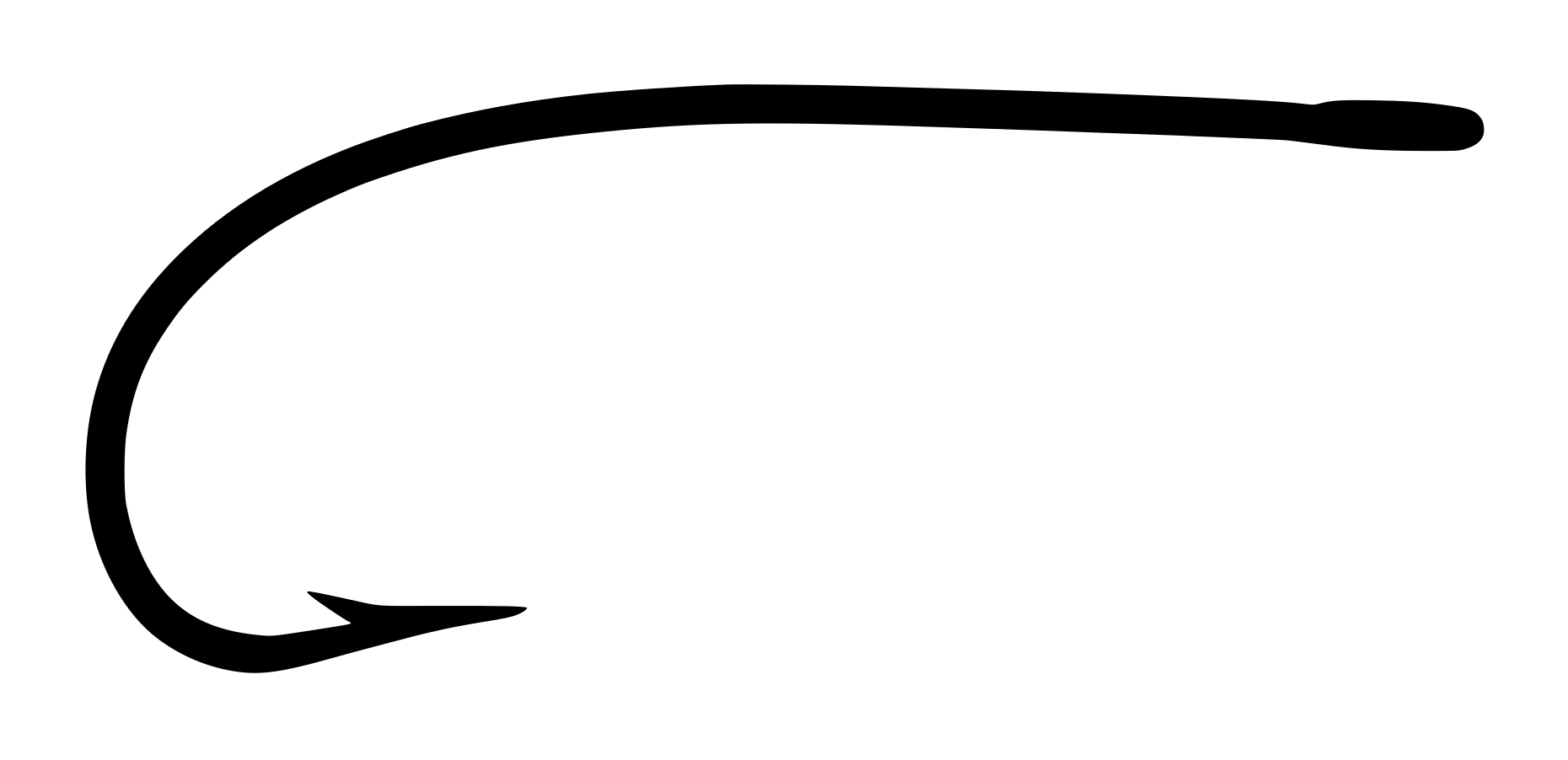
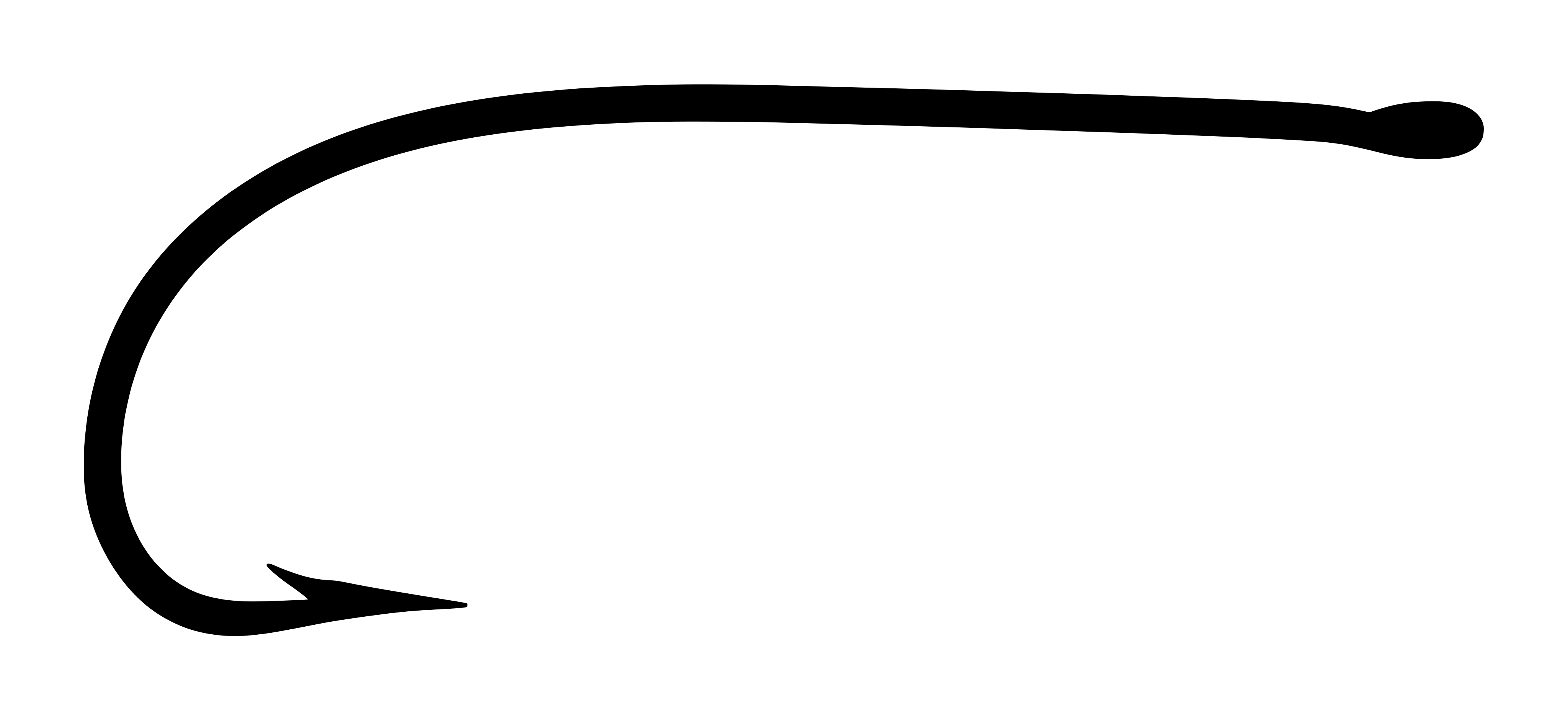
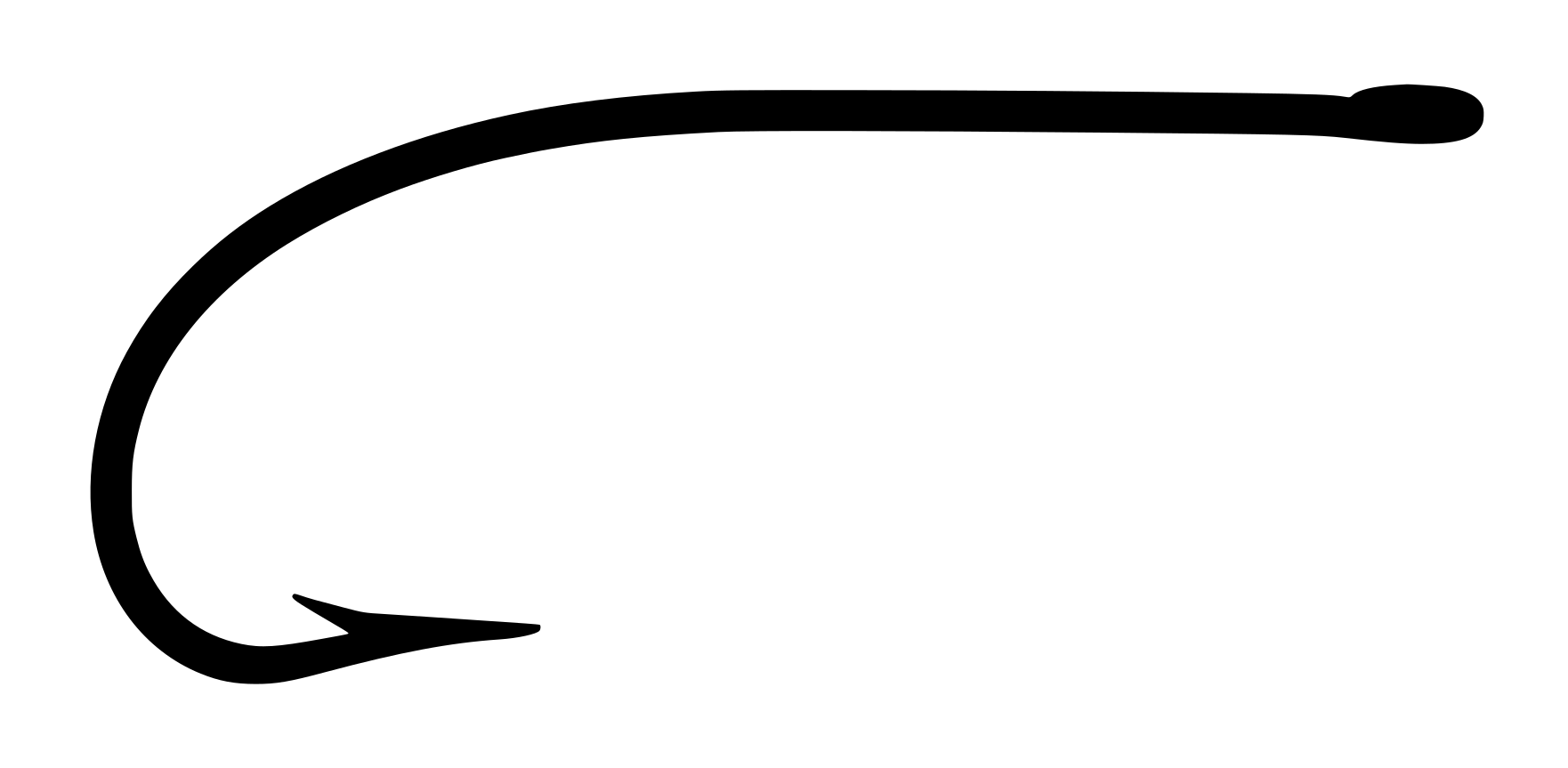
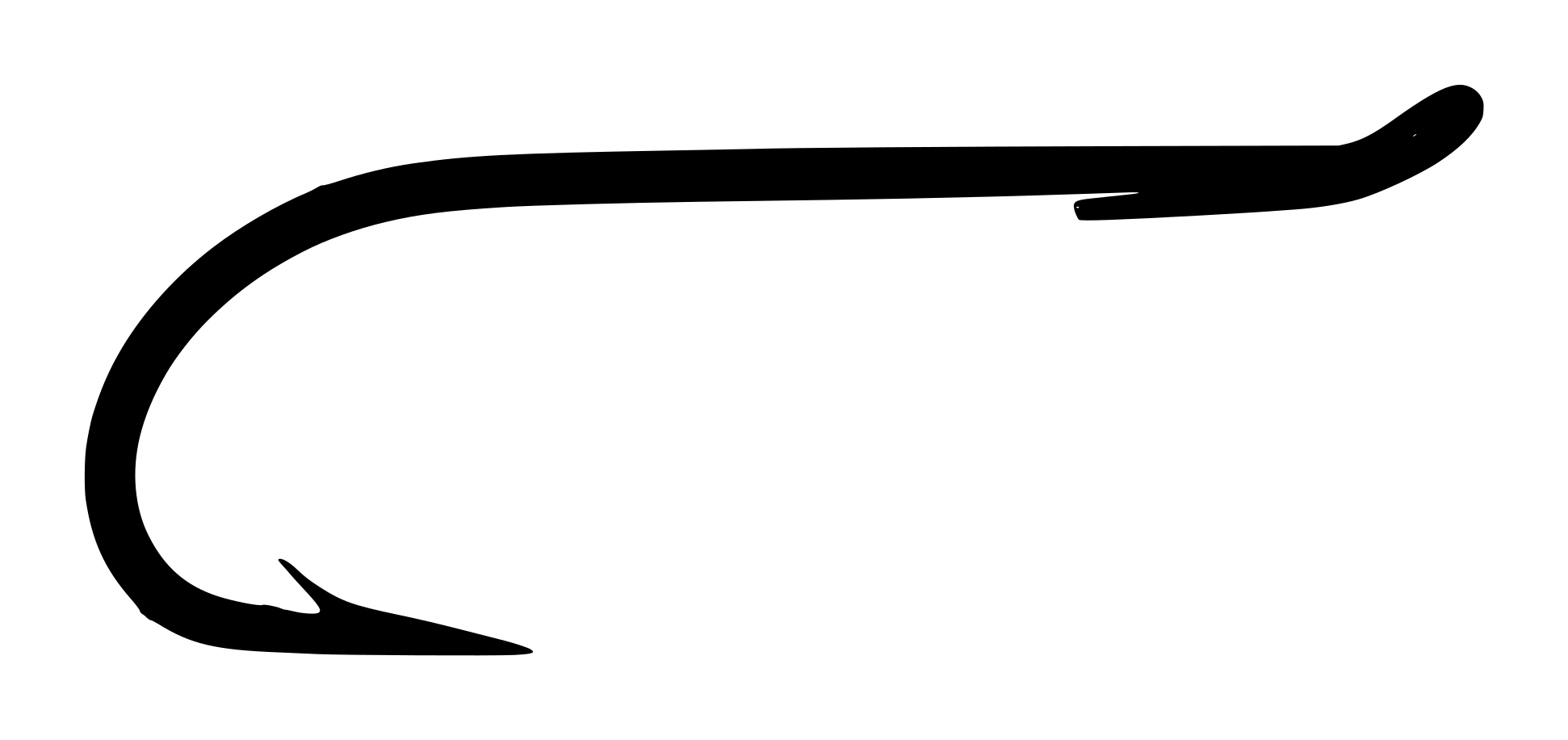
Mustad 3366 G Sproat Hooks are a mid-20th-century bait and saltwater hook manufactured by O. Mustad & Son in Norway. The specimen documented here is size 3/0, in the Superior product line, with gold-plated (gilt) finish. The defining feature is the straight-orientation ball eye (large ring), which provided ample attachment space for bait rigging and leader connection in marine fishing. The Sproat bend geometry — rounded and moderate in profile — offered a balanced hook shape suited to live-bait presentation in saltwater conditions.
The fine wire gauge and Superior point (near-straight inner taper) reflect manufacturing specifications optimized for reliable penetration and holding power in saltwater environments where corrosion and bait movement were primary concerns. Evidence dates this specimen to approximately 1950–1965: the cream-colored box stock, letterpress-style typography, snowflake-bordered red label, and absence of modern barcode all point to mid-20th-century production V. The OSLO — NORWAY factory attribution on the label is consistent with Mustad’s primary facility during this period, though the company later established the Gjøvik operation.
Collecting significance is moderate. Mustad industrial production volumes mean these hooks are not exceptionally rare, but complete original boxes — particularly with all 100 hooks intact — command more attention than loose or carded examples. The gold-plated finish and dedicated saltwater application give this model appeal to specialists in vintage bait-fishing tackle and pre-modern saltwater rigs.
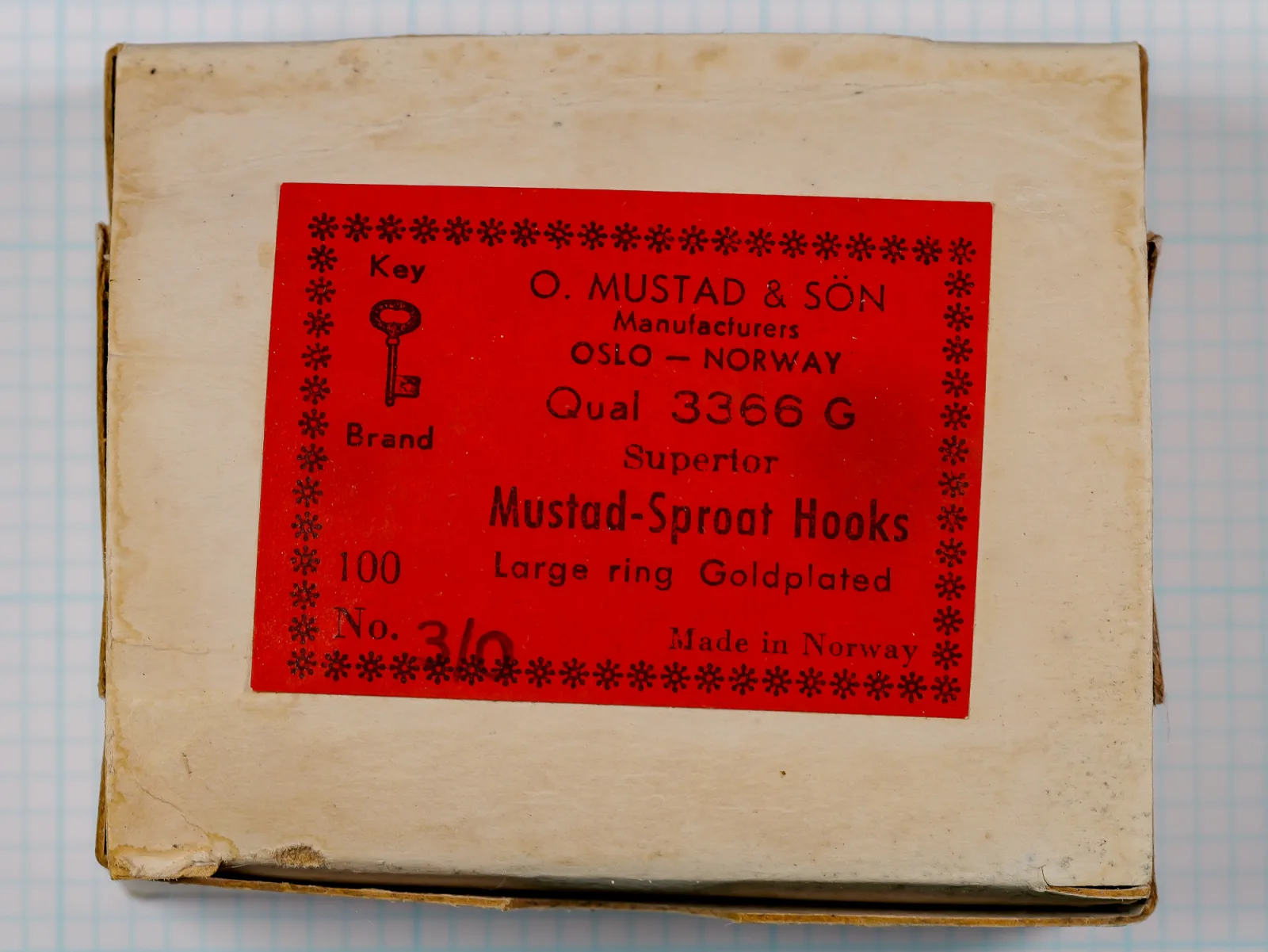
Original packaging label from O. Mustad & Son, Oslo-Norway. Box identifies the contents as Superior Mustad-Sproat Hooks, large ring, gold-plated, size 2/0, 100 hooks per box.
Photographic record
2 cataloged imagesSelect any record to load it above.
2 images shown
Mustad 3366 G Sproat Hooks Original Box LabelOriginal packaging label from O. Mustad & Son, Oslo-Norway. Box identifies the contents as Superior Mustad-Sproat Hooks, large ring, gold-plated, size 2/0, 100 hooks per box.Open originalMustad 3366 G Sproat Hook Size 2/0 — Gold-PlatedGold-plated Sproat bend hook with large ring eye and barbed point. Straight shank geometry typical of salmon and large wet fly patterns.Open original
Technical profile
Straight / Inline Ball Eye | Sproat | Standard | Fine (1X Fine) Wire | Superior Point | Gold-plated / Gilt
Eye
Ball Eye, Straight / InlineBall eye is substantial and well-formed, appropriate for the large ring specification printed on packaging V. The wire end is butted cleanly and uniformly to the shank, a characteristic of machine-formed ball eyes typical of Mustad production P. Straight orientation (inline, not turned down) is confirmed by the eye alignment parallel to the hook shank axis P. No taper or irregularity in the eye wire itself P.
Wire
Fine (1X Fine), Round
Shank
Standard — Plain
Bend
Sproat, Standard gapSproat bend profile exhibits the characteristic rounded bottom contour, neither acute like a Limerick nor wide and shallow like an Aberdeen P. The bend proportions are moderate and symmetrical, typical of standard saltwater Sproat specifications. Wire set in the bend is clean and centered; no offset or asymmetry visible P.
Point
Superior (near-straight inner taper)Barb is present (not barbless, as confirmed in analyst notes). The barb is small and close-cut, angled inward toward the point in the standard manner P. Barb placement appears typical for a Superior point hook — situated just above the point apex to avoid interfering with the near-straight inner taper geometry.
Finish
Gold-Plated — Confirmed (stated on packaging)Gold-plated finish (confirmed on packaging V) photographs with characteristic warm yellowish tone, reflecting light evenly across the hook form P. The gilt layer is uniformly applied to all wire surfaces; no bare steel visible. The finish appears unworn and fully intact on the documented specimen, consistent with original factory application and storage protection P.
Box exterior shows light overall toning and creasing consistent with age and storage. Red label affixed to lid is fully intact with no tears or separation; print remains crisp and legible. Minor edge wear on box corners; hinge action not visible. No evidence of moisture damage. Interior condition not examined in photographs. All hooks present and bright with no visible corrosion; gold-plated finish intact P.
The Superior point style — characterized by a near-straight inner taper and nearly flat inside face — is distinct from the more aggressive Hollow Point. Superior points offer a different balance of penetration and holding: the straighter geometry provides a broader contact surface once the hook is set, which reduces the risk of tearing on a light-hooked bait. This makes Superior points well-suited to saltwater bait fishing where live baits move constantly and abrade the hook.
The fine wire gauge (1X Fine) reduces weight and drag in the water, advantageous when presenting live baitfish. The straight ball eye — rather than a turned-down eye — accommodates heavier leader material and allows the angler to tie direct knots or loop connections suitable for saltwater conditions. The gold-plating provides a warm, aesthetically pleasing finish that was believed (correctly or not) to reduce corrosion compared to bare steel or bronze in salt environments. Gold plating became increasingly common on specialty saltwater hooks in the 1950s as manufacturers recognized marine corrosion as a practical problem.
Size & scale lab
Known manufactured size range:
Catalog indicates full size range available; specimen documented is 3/0. Box label reads 100 hooks No. 3/0 V
This pattern was made in sizes Catalog indicates full size range available; specimen documented is 3/0. Box label reads 100 hooks No. 3/0 (V). We have measurement for size 3/0. Know the others? Submit calipered measurements and we'll review and add them. Thank you!
Historical context
mustad
O. Mustad & Son was established in Gjøvik, Norway, in 1877 by Olaf Mustad and his son. The company became a major global manufacturer of fishing hooks and industrial fasteners, eventually operating factories in multiple countries and distributing hooks worldwide under the Mustad brand. Mustad hooks became synonymous with quality and availability throughout the 20th century, particularly in North America and Europe. The company’s production scale and technical innovations in hook forging and finishing set industry standards and made Mustad products the default choice for tackle shops and mail-order catalogs.
During the mid-20th century (1950s–1960s), Mustad was transitioning from traditional forge-and-finish methods to semi-automated production capable of producing millions of hooks annually. This period saw experimentation with specialty finishes like gold-plating, designed to appeal to saltwater and specialty fishermen willing to pay a premium for corrosion resistance. The 3366 G Sproat represents this innovation in finish and application focus.
The company continued manufacturing in Norway and later expanded into global production partnerships, eventually becoming part of larger industrial corporations. However, the vintage Mustad hook lines documented here represent the company’s independent era of Norwegian manufacture and design autonomy.
Series History
The Sproot Hook series was part of Mustad’s general-purpose bait and saltwater range. The “Sproot” name does not appear to reference a named designer or historical tradition in the way some English Redditch hooks carry named lineages (e.g., “O’Shaughnessy,” “Limerick”). Instead, it appears to be a Mustad house designation for Sproat-bend hooks in specific application categories.
Within Mustad’s lineup, the 3366 G represented a premium saltwater variant, distinguished by the gold-plated finish and the “Superior” product designation — a Mustad house line name emphasizing quality and specialization. The “3366” model code likely referenced an internal Mustad catalog numbering system that grouped hooks by bend family and wire gauge, with the “C” suffix indicating a specific finish or application variant.
The 100-hook box format was standard for Mustad specialty lines aimed at commercial and professional fishermen rather than casual retail consumers. Smaller retail packs (10–25 hooks per card) were also produced for tackle shop sales, but the larger boxes commanded lower per-unit costs and were purchased by fishing camps, charter operations, and bait-and-tackle wholesalers.
Production of this specific model likely continued through the 1960s, with progressive discontinuation as nylon monofilament and modern snelled rigs became standard, reducing demand for traditional saltwater bait hooks in favor of more specialized designs.
Era and Packaging Dating
Box construction and paper stock consistent with mid-20th century manufacture. No barcode present on label (pre-1974 indicator, strong P). Typography and print method: letterpress-style serif fonts characteristic of 1950s-1960s Mustad packaging; offset printing on colored label. Snowflake border design motif is consistent with Mustad mid-century branding. Factory location stated as OSLO — NORWAY on label; Mustad relocated manufacturing to Gjøvik ca. 1960s, but labeling did not immediately reflect this V. Gold-plating specification and large ring eye design consistent with 1950s saltwater tackle innovations. Absence of modern postal codes or regulatory text (no hook size standard notation, no address formatting update) supports pre-1970 dating. Conservative estimate: c. 1950-1965 V.
The Gold Rush: Why Saltwater Hooks Turned Gold
During the 1950s, as sport fishing for saltwater species expanded dramatically in North America and Australia, tackle manufacturers faced a serious problem: corrosion. Steel hooks in salt water oxidize rapidly, weakening the hook and risking failure when set on a large fish. Mustad, among others, experimented with gold-plating as a solution — not because gold is scientifically superior (it isn't), but because it is highly corrosion-resistant and could be applied using existing electroplating equipment. The catch: gold-plated hooks cost significantly more to produce. Mustad marketed the 3366 G and similar gold-plated models as premium products, targeting charter captains and well-equipped anglers willing to pay extra for corrosion insurance. By the 1960s, cheaper stainless-steel hooks became available and gradually replaced gold-plating for saltwater applications. Today, vintage gold-plated hooks are prized by tackle historians more for their marketing story than their practical advantage.
Design lineage and influence
The Sproat bend itself has a long history in English hook manufacturing, predating Mustad’s industrial adoption. British makers (Allcock, Partridge, Edgar Sealey) produced Sproat-pattern hooks from the late 19th century onward. Mustad’s adoption of the Sproat for saltwater and bait applications follows a broader industry trend of standardizing bend geometries across manufacturers to facilitate interchangeability and consistency.
The 3366 G represents a transitional moment in hook design: it bridges traditional forge-and-hand-finish methods (still partially in use in the 1950s) with emerging industrial finishes like gold-plating that required electroplating infrastructure. Competing designs from other manufacturers during this era include Allcock’s saltwater Sproat variants and various British-made hooks, which Mustad competed against in export markets and premium tackle channels.
The straight ball eye on the 3366 G differs from many contemporary American saltwater hooks (particularly baitcaster and conventional reel designs), which often featured turned-down or jig-style eyes. Mustad’s design reflects European (Norwegian) conventions for hook eye orientation, maintaining compatibility with traditional leader-tying methods common in Scandinavian and British fishing traditions.
Best matchRelated by Attribute
Computed automatically from catalog data — updated as new hooks are added.
Matches: Bend, Shank, Gap, Point, Forging +2 moreDiffers: Wire: Fine (1X Fine) vs Standard; Eye: Ball Eye vs Tapered Eye; Eye Orient.: Straight / Inline vs Turned Down +2 more
The Mustad 3366 G Sproot Hook was designed for saltwater and bait fishing applications. Its large ring eye (ball eye, straight orientation) and fine wire construction made it suitable for securing live bait and small fish as chum or for general saltwater bait rigs. The gold-plated finish provided corrosion resistance necessary for marine environments, while the Superior point geometry offered reliable hook set characteristics in saltwater conditions.
Classic Fly Patterns
Named patterns specifically associated with this hook. Leave blank if none formally documented. Do not speculate — only include patterns with a confirmed association.
Collector notes
Rated 4.5/10 — moderately uncommon. Mustad industrial production volumes mean the hooks themselves are not exceptionally rare, but complete original boxes in good condition are less frequently encountered than loose or mixed-lot examples. Collector demand is moderate, primarily from saltwater tackle specialists and historians of mid-century bait-fishing traditions. The gold-plated finish and straight ball eye add appeal, but the generic Sproot name and general-purpose design limit the passionate specialist following that surrounds named patterns like O'Shaughnessy or heritage lines like Redditch craft makers.
Reference value
$12 – $35 USD estimate
Packaging condition
Good — moderate wear, legibleRecorded specimen
Packaging format
GW-BOX-MUSTAD-001Catalog code
What makes this hook collectible: Complete original manufacturer boxes are rarer than carded or loose examples, commanding a clear premium. The gold-plated finish is desirable for mid-century saltwater history collectors and specialists in tackle evolution. The straight ball eye is distinctive within Mustad’s range and appeals to anglers reconstructing traditional saltwater rigs. Box condition (label printing quality, lid integrity, hook count completeness) is the primary value driver for this model.
Limiting factors: The Sproot name and generic bait-fishing application lack the historical narrative or named-designer prestige that drives higher collectibility ratings. These hooks were mass-produced in large quantities by Mustad, and surviving stock is reasonably common. Partial boxes or missing hooks significantly impact value. Size 3/0, while documented here, may be less desirable than smaller sizes (which are less common) or larger sizes (which appeal to saltwater and pike fishermen).
Most desirable variants: Complete boxes in original packaging, smaller sizes (No. 1, No. 2), and the gold-plated finish variant documented here. Unopened boxes with factory tissue intact command a premium. Boxes with full color and clear printing are more collectible than heavily aged or faded labels.
Condition factors affecting value: The condition of the box exterior (label clarity, structural integrity) is more important for value than the hook condition, since hooks inside original packaging are almost always bright and unused. Missing hooks reduce value significantly — each missing hook represents roughly 1% loss of the original 100-hook count. Boxes with crushed corners, torn labels, or water damage command steep discounts.
Packaging
Rigid manufacturer box with separate lid, approximately 3" × 2" × 0.5" external dimensions E. Box exterior: cream/tan colored stock, lightly aged. Red paper label affixed to box lid, approximately 3.5" × 2.5", printed with ornamental snowflake border pattern in black ink. Typography is serif-style, clean and professional. Text printed reads: Key Brand symbol, O. MUSTAD & SON Manufacturers OSLO — NORWAY, Qual 3366 G, Superior, Mustad-Sproat Hooks, Large ring Goldplated, 100 No. 3/0, Made in Norway. Label shows no price marking visible in photograph. Interior partitioning or tissue not visible in photographs. Paper stock on box exterior shows age patina consistent with mid-20th century manufacture V.
Market Value Notes
Low ($12): Good condition — opened box, all or most hooks present, label legible, minor wear<br />
High ($35): Excellent condition — sealed or nearly sealed, full 100-hook count, label crisp, minimal box wear<br />
Premium factors: complete hook count, clear label printing, gold-plated finish, original factory box (vs card or loose), unopened or tissue-intact packaging<br />
Platforms: eBay (UK and US auctions), dealer sales, tackle collector groups, vintage fishing tackle auctions<br />
Confidence: E estimated — limited comparative sales data for this specific model and box format; values extrapolated from similar mid-century Mustad specialty boxes and saltwater bait hooks in good condition. Gold-plating may support premium within the range.
Where to Find
eBay auctions (search "Mustad 3366 Sproot," "vintage Mustad bait hooks," "saltwater bait hooks 1950s"). Specialist vintage tackle dealers in the UK and North America occasionally stock pre-1970 Mustad boxes. Tackle auctions and estate sales, particularly from collectors focused on saltwater or bait-fishing traditions. Tackle collectibles groups and forums. Complete boxes are less common than loose hooks or smaller retail cards.
Collector's Identification Tips
Identify the Mustad 3366 G Sproat by the model code printed on the box label V. The characteristic features are the straight-orientation ball eye, fine wire gauge, and gold-plated finish. Check for the OSLO — NORWAY factory attribution and the snowflake-bordered red label design, both consistent with mid-century Mustad production. The quantity notation “100 No. 3/0” confirms the hook count and size. Mustad produced multiple variants of the Sproat in different finishes (bronzed, blued) and eye styles, so the gold-plated finish and straight ball eye distinguish this particular model. Complete original boxes with 100 hooks are more valuable than partial boxes or loose hooks.
Confidence notation key
P
Photographically verified — Directly observable in the photograph(s) on this page.
V
Verified by documentation — Confirmed by manufacturer catalog, spec sheet, or published reference.
I
Inferred — A logical deduction from observable or documented evidence, not directly stated.
E
Estimated — An approximation based on visual comparison, proportional analysis, or limited data.
S
Speculative — A reasoned hypothesis that cannot be confirmed from available evidence.
Claims with no notation are confirmed by multiple independent sources. All photographs on garrenwood.com are taken on a measurement grid where each square equals 1/10 inch (0.1″ / 2.54 mm).