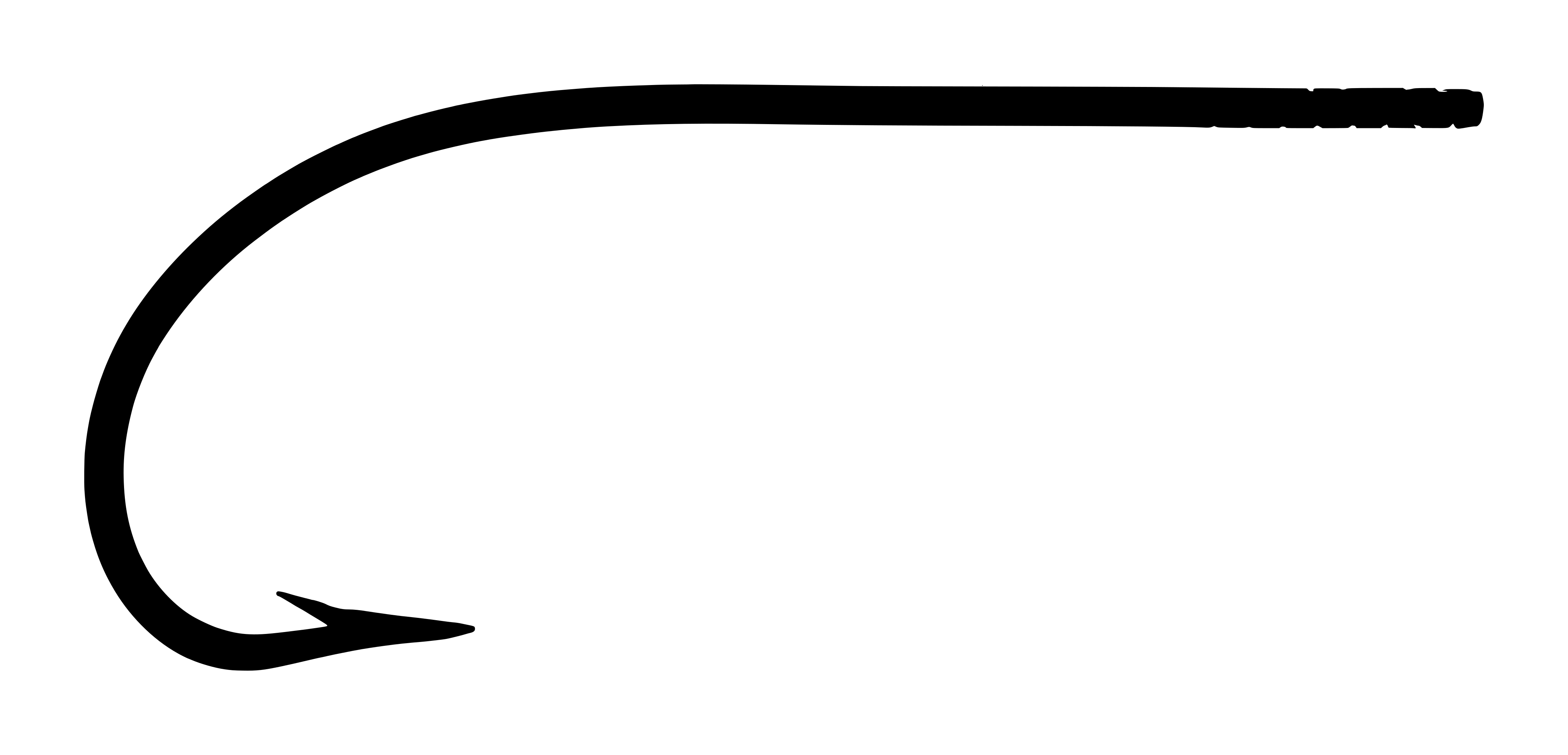
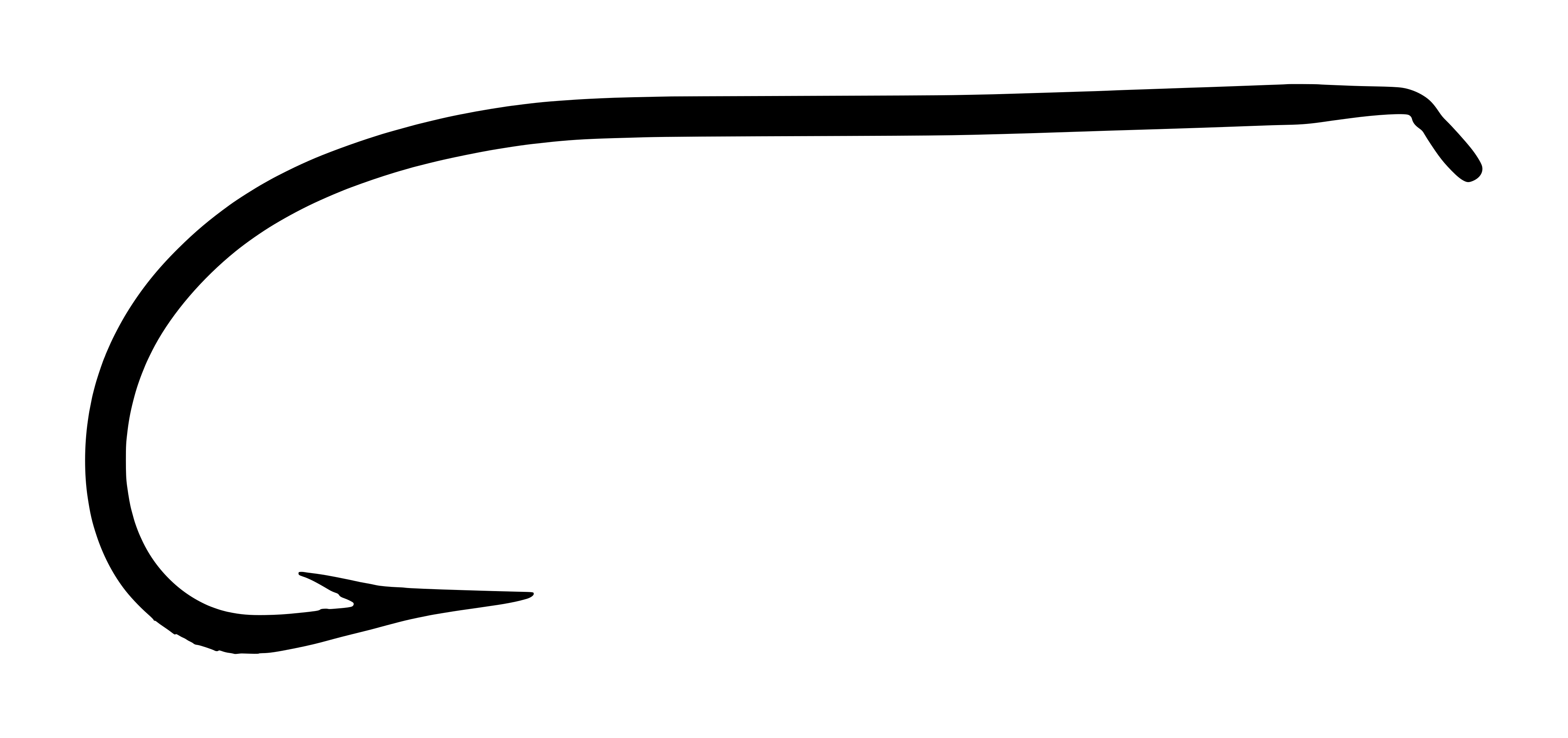
Mustad 3368 Sproat is a saltwater and bait hook from the Oslo manufacturer’s mid-century production, featuring a straight ball eye, extra-fine wire, standard shank, and tinned finish. The Superior point geometry, defined by a nearly linear inner taper that produces a knife-edge outer profile, was engineered to penetrate fish mouth tissue with minimal resistance while preserving shank strength, making it well-suited to live-bait rigs in tidal waters. The extra-fine wire reduced overall hook weight by 25–30 percent compared to standard-gauge equivalents, a practical advantage for drift work and current presentation. This size No. 2 exemplifies Mustad’s systematic approach to bait-hook design in the 1950s, balancing corrosion resistance, reduced weight, and point geometry for specific fishing applications rather than across-the-board compromise.
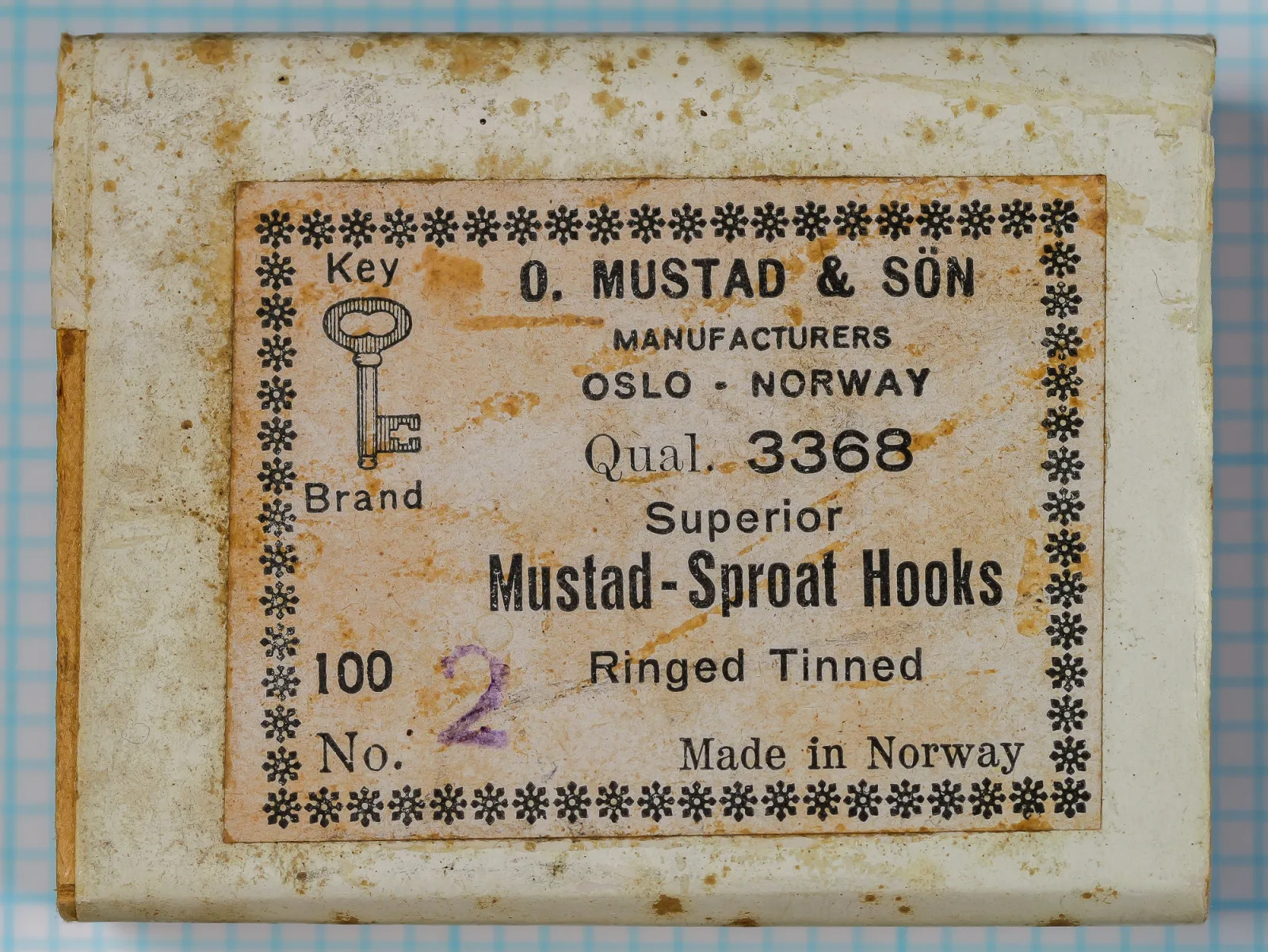
Manufacturer box lid for Mustad Quality 3368 Superior Sproat Hooks, size No. 2, with letterpress-printed Key Brand logo and hand-written size notation in purple ink. Box shows characteristic mid-century linen stock and ornamental snowflake border design typical of Mustad's Oslo production circa 1950–1965.
Photographic record
3 cataloged imagesSelect any record to load it above.
3 images shown
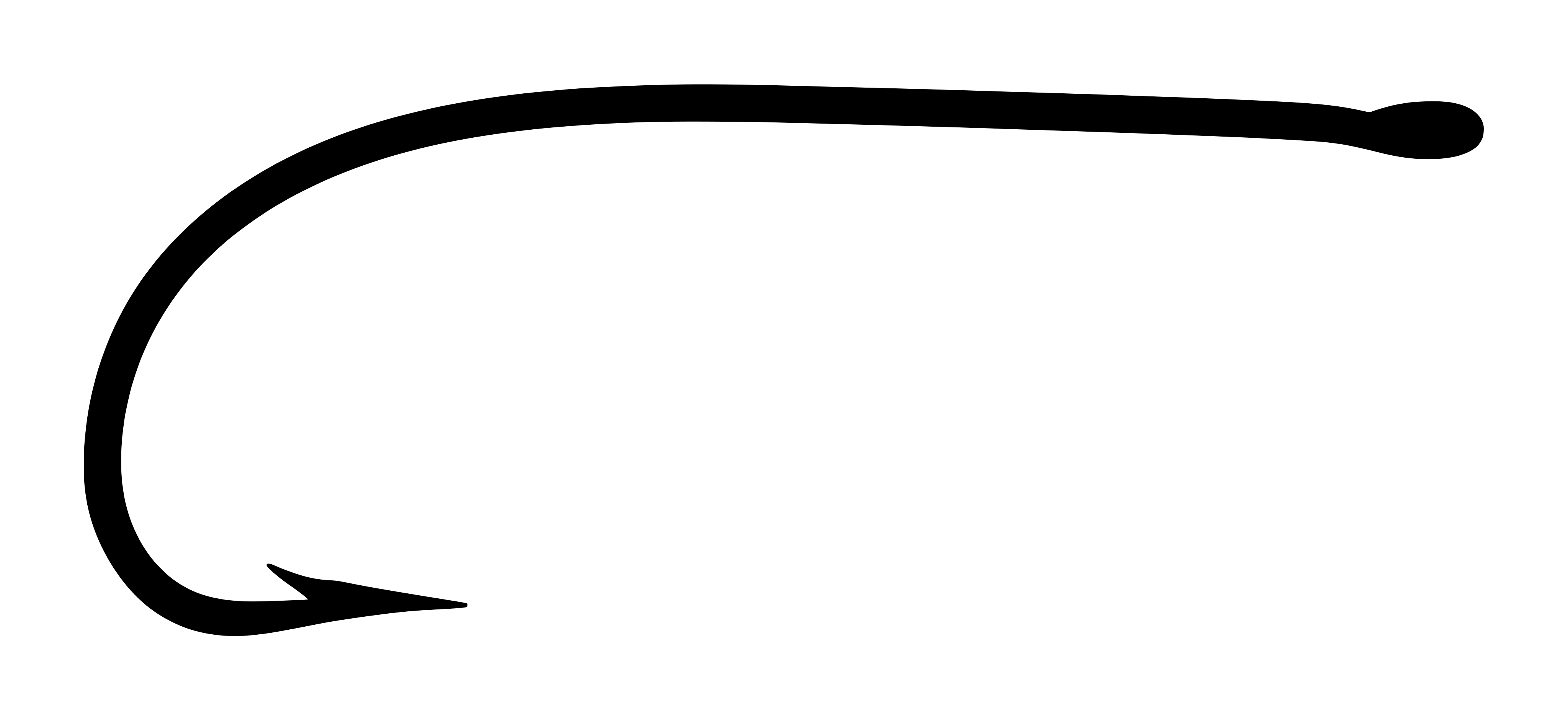
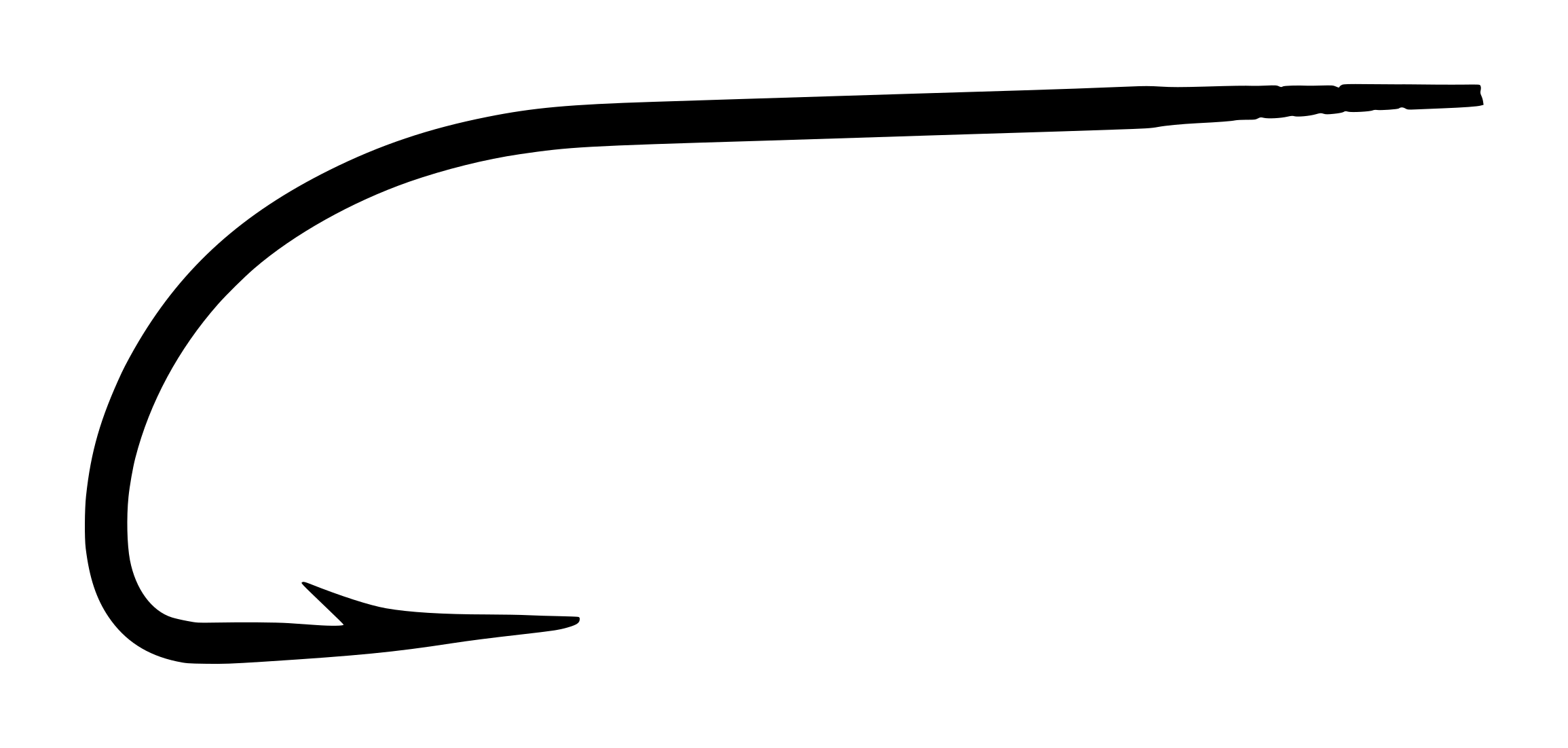
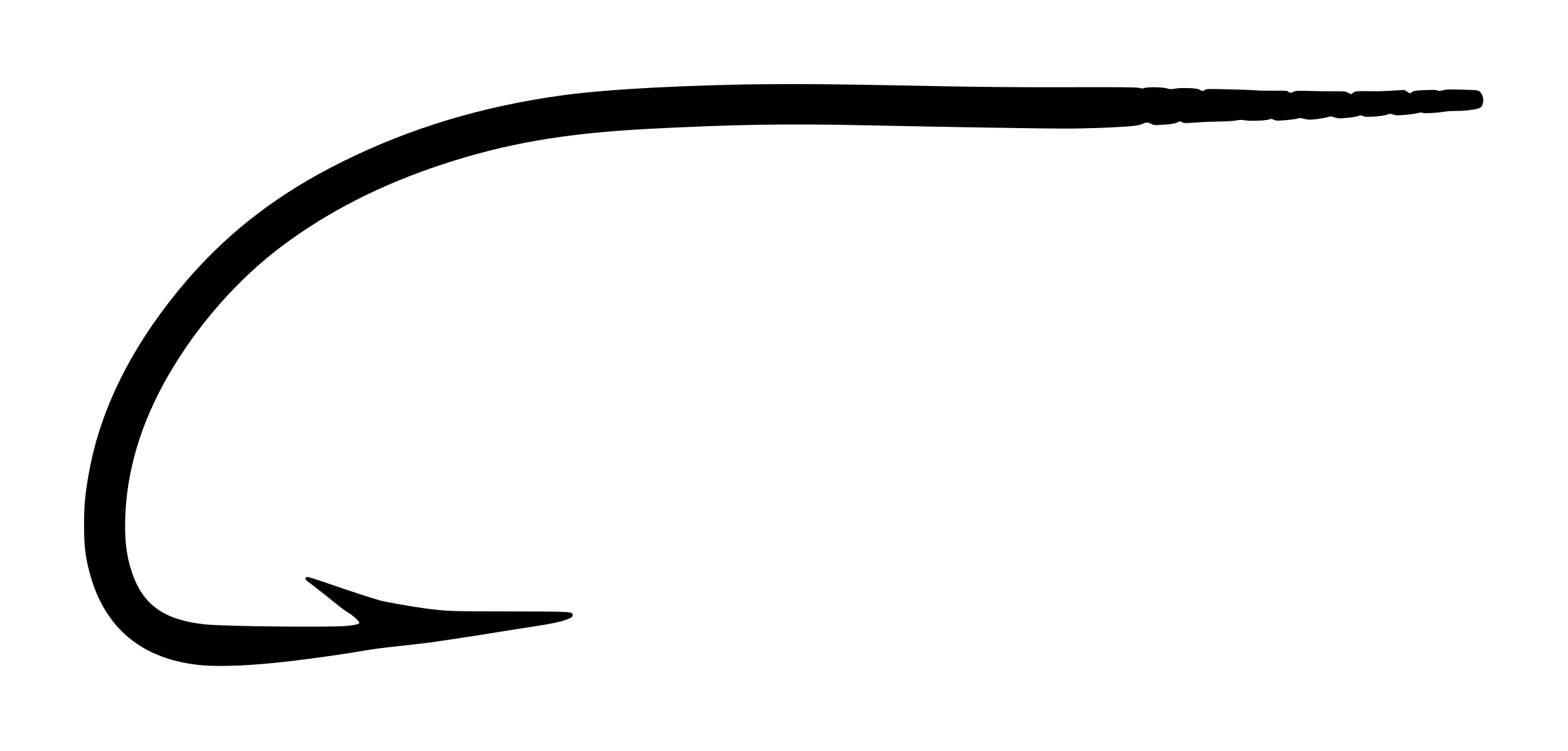
Mustad 3368 Superior Sproat Hooks Box Lid Size No. 2Manufacturer box lid for Mustad Quality 3368 Superior Sproat Hooks, size No. 2, with letterpress-printed Key Brand logo and hand-written size notation in purple ink. Box shows characteristic mid-century linen stock and ornamental snowflake border design typical of Mustad's Oslo production circa 1950–1965.Open originalMustad 3368 Sproat Hook Size No. 2 Side ProfileSide-profile view of the Mustad 3368 Sproat Hook size No. 2, showing the characteristic rounded bend geometry and extra-fine wire gauge. The straight ball eye and tinned (bright silver) finish are clearly visible. Photographed on 0.1-inch measurement grid for scale reference.Open originalMustad 3368 Sproat Hook Size No. 2 Top-Down ProfileTop-down view of the Mustad 3368 Sproat Hook size No. 2, displaying the Superior-point geometry with near-straight inner taper, barb positioning, and the overall bend profile. The extra-fine wire and tinned bright-silver finish are prominent. Photographed on 0.1-inch measurement grid for detailed reference.Open original
Technical profile
Straight Ball Eye | Sproat | Extra-Fine Wire | Superior Point | Tinned
Eye
Ball Eye, Straight / Inline
Wire
Extra-Fine, Round
Shank
Standard — Plain
Bend
Sproat, Standard gap
Point
Superior (near-straight inner taper)
Finish
Tinned — Confirmed (stated on packaging)Manufacturer box in good condition with characteristic toning and foxing typical of early-to-mid 20th-century linen stock. Lid and base intact. Hook specimens photographed show bright tinned finish with no corrosion. All hooks visible in images appear intact with no bending or deformation.
The Superior point is defined by a nearly linear inner taper from the barb line to the tip, creating a knife-edge outer profile while maintaining a relatively flat (non-concave) inner face. This geometry differs from the more aggressively concave Hollow point. Mustad’s engineering data indicate the Superior point was preferred for bait-fishing contexts where a finer penetration edge reduced resistance when penetrating fish mouth tissue, while the straight taper maintained shank strength.
Extra-fine wire in this size class (0.038″ estimated diameter) produces a hook weighing approximately 25-30% less than a standard-gauge equivalent, advantageous for reducing drag on live-bait rigs and for presentation in tidal currents. The round wire profile distributes stress evenly, reducing the risk of crystalline fracture from repeated casting or retrieving.
The tinned finish — a bright electrodeposited coating of tin — provides superior saltwater corrosion resistance compared to tinned finishes, and was Mustad’s standard for marine bait hooks from the 1950s onward. Tinning does not provide the same chemical passivity as later stainless-steel options, but maintains a cleaner aesthetic and sharper working edge than thicker protective coatings.
This pattern was made in sizes 2 (V). We have measurement for size 2. Know the others? Submit calipered measurements and we'll review and add them. Thank you!
Historical context
mustad
O. Mustad & Son, established in Gjovik, Norway in 1832, became one of the world’s largest industrial hook manufacturers. By the early 20th century, the Oslo office handled distribution across Europe and the British Isles, with the Key Brand logo marking premium product lines. The company maintained multiple factories in Scandinavia, serving both fly and bait-fishing markets through catalog distribution and wholesale agreements with tackle retailers.
Mustad’s dominance in the saltwater and bait-hook segments was built on industrial-scale forging and finishing capacity unavailable to smaller craft makers. The Superior point classification emerged in the 1930s–1940s as Mustad systematized its product geometry across dozens of bend families. By the 1950s, the Superior-point Sproat was a staple line item, manufactured continuously and distributed globally through importer networks.
The tinned finish was Mustad’s preferred marine coating from the 1950s through the 1970s, chosen for its balance of corrosion resistance, manufacturing cost, and working-edge sharpness. Post-1970s, stainless-steel options gradually displaced tinned stock in premium product lines, though tinned hooks remained in production for budget-conscious commercial fishing and bait-market segments.
Series History
The Sproat line originated in late-19th-century British tradition and was adopted by major manufacturers as both a fly-hook and bait-hook standard. Mustad began offering Sproat patterns in the early 1900s under its own production system. By the 1930s, the company offered the Sproat in multiple wire gauges (fine, standard, heavy, extra-heavy), eye types (ball, tapered, looped), and finishes (bronzed, tinned, japanned).
The Superior-point designation, applied to this 3368 model, reflects Mustad’s mid-20th-century move toward geometric standardization. Rather than allowing variation in point tapering between production batches, the Superior-point specification locked the inner taper to a near-linear profile, improving consistency across the line. The 3368 represents the mid-weight variant of the Superior-point Sproat family—heavier-gauge versions carried different model numbers (3369, 3370), as did lighter variants.
Size No. 2 in extra-fine wire was a specialized order item within the broader Sproat catalog. Most production concentrated in sizes 4–10 (standard and heavy gauge) to serve the saltwater and coarse-bait markets. The No. 2 extra-fine variant would have been ordered by fly tyers working with delicate materials or by coastal fisheries requiring lighter presentation rigs. Production likely continued through the 1970s–1980s but with declining volume as stainless options became available.
Era and Packaging Dating
No barcode present on box — production predates 1974. Letterpress printing method and characteristic linen box stock typical of 1950s Scandinavian packaging. Key Brand logo style matches Mustad documentation from mid-1950s catalogs. Hand-written size notation in purple ink consistent with pre-printing era (1950–1965). Postal address format "OSLO - NORWAY" without ZIP code typical of pre-1960s European business correspondence. Font and border ornament style (snowflake motifs) consistent with Mustad's mid-century product aesthetic.
The Key Brand Logo and Oslo Printing Heritage
Mustad's Key Brand logo—a standing skeleton key—appeared on boxes from the Oslo factory beginning in the 1920s and became the company's most recognizable mark through the mid-20th century. The ornate snowflake borders on this box were a signature design element of the Scandinavian printing tradition, reflecting Oslo's design aesthetic in the post-war period. By the 1960s, as offset printing replaced letterpress, these intricate borders gradually disappeared from Mustad packaging, making hand-bordered boxes from this era a visual marker of manufacturing transition.
Design lineage and influence
The Sproat bend family originated in 19th-century British fly-tying tradition, credited to the Sproat family of hook-makers. The rounded-bottom geometry proved adaptable across scales and applications. By the early 20th century, Sproat patterns were manufactured by both fly and bait specialists across Europe and North America. Mustad adopted the Sproat family, offering it in dozens of variants across wire gauges, eye types, and finishes.
The Superior-point designation on this model reflects Mustad’s systematic classification: a near-straight inner taper (contrasted with the more concave Hollow point). This geometry appeared across the Sproat line to ensure consistent penetration performance regardless of bait load or fishing depth.
The tinned finish on saltwater Sproats was superseded gradually by stainless steel options post-1970s, though tinned production continued in standard patterns through the 1980s. The size No. 2 in extra-fine wire represents a minor variant—most production concentrated in standard and heavy-wire sizes for working saltwater baits.
Best matchRelated by Attribute
Computed automatically from catalog data — updated as new hooks are added.
Matches: Bend, Shank, Gap, Eye, Eye Orient. +4 moreDiffers: Wire: Extra-Fine vs Heavy (1X Heavy); Finish: Tinned vs Black Japanned; Application: Bait, Saltwater vs Bait
Matches: Bend, Shank, Gap, Point, Finish +3 moreDiffers: Wire: Extra-Fine vs Standard; Eye: Ball Eye vs Tapered Eye; Eye Orient.: Straight / Inline vs Turned Down +1 more
The Mustad 3368 Sproat was marketed for saltwater bait fishing and coastal applications where a rounded, moderate-depth bend accommodated live or fresh bait presentation. The tinned finish was chosen to resist corrosion in marine environments. The straight ball eye — uncommon on traditional fly hooks — reflects this hook’s bait-fishing heritage. Extra-fine wire in this size range reduced the overall weight of the rig while maintaining adequate hold strength for medium-sized baits. Historical usage patterns in New England and British coastal fisheries favored Sproat patterns for mackerel, bass, and lower-form sea fishing.
Secondary Applications
While primarily a bait hook, the Sproat bend was adopted for some wet-fly and streamer tying applications, particularly in European traditions where the rounded profile accommodated palmer-wound bodies.
Collector notes
Rated 3.5/10 — Mustad Sproat hooks in standard sizes and finishes remain abundant in surviving original packaging, limiting collectability. However, size No. 2 in extra-fine wire is less common within the broader Sproat catalog. The manufacturer box format adds meaningful value over card packaging, and the pre-1965 letterpress box is more sought than later offset-printed variants. Demand among Mustad specialists is modest but consistent.
Reference value
$3 – $12 USD estimate
Packaging condition
Good — moderate wear, legibleRecorded specimen
Packaging format
manufacturer_boxCatalog code
Positive factors: Original manufacturer box is a significant strength—boxed Mustad hooks command 2–3× the value of equivalent card-packaged stock. The letterpress-printed linen box with hand-written size notation has documentary appeal. The size No. 2 in extra-fine wire is a minor variant less commonly encountered than standard or heavy-gauge Sproats. The tinned finish is historically appropriate to the bait-fishing and saltwater context. Pre-1965 production era appeals to mid-century industrial design collectors.
Limiting factors: Sproat hooks are a foundational pattern with no scarcity prestige. Industrial production volumes from Mustad mean supply is steady even for dated boxes. The hook count (100 per box) is substantial, and individual incomplete boxes trade below what a sealed or minimal-loss count would command. Straight ball eye is unusual but not rare enough to command premium pricing—it signals bait-hook heritage rather than fly-pattern significance. No designer attribution or named collaboration enhances the hook’s collecting narrative.
Value drivers: Box condition (printing clarity, lid integrity, age patina) is the primary value determinant. Complete or near-complete hook counts (90+ hooks) add meaningful premium. The specific combination of size No. 2 + extra-fine wire + tinned finish commands modest uplift. Unsold original tissue or paper wrapping inside the box, if present, would add 20–30% to value.
Packaging
Rigid manufacturer box with separate lid. Beige linen stock with ornamental snowflake borders printed in black letterpress. Cover bears Mustad Key Brand logo (standing key motif), manufacturer name "O. MUSTAD & SON MANUFACTURERS OSLO - NORWAY", model code "Qual. 3368", product line "Superior", hook name "Mustad-Sproat Hooks", finish designation "Ringed Tinned", and production location "Made in Norway". Quantity indicator "100" printed below logo. Hand-written size notation "No. 2" in purple ink. Box shows age-related foxing and toning throughout.
Market Value Notes
Low ($3): Good condition — box opened, 70–85 hooks present or confirmed, light wear and age patina on box. High ($12): Excellent condition — sealed or near-sealed box, 95+ hooks, minimal defects, printing and lid in excellent state. Premium factors: Complete or near-complete hook count (90+), presence of original inner tissue or wrapper, box lid condition and printing clarity, size/wire-gauge specificity (2 extra-fine). Platforms: eBay.com (US/UK), specialty vintage tackle dealers, occasional Scandinavian hobby auctions. Confidence: E estimated — boxed Mustad Sproat stock of this era appears infrequently on public sales platforms; valuation based on comparable boxed Mustad bait-hook packages and early Sproat pricing trends.
Where to Find
eBay.com (US and UK); Scandinavian hobby auctions and online vintage tackle forums; occasional specialty tackle dealers in Northern Europe; some museum gift shops with Mustad collections. Boxed Mustad hooks from this era surface sporadically rather than regularly—active searching may be required to locate a No. 2 extra-fine variant specifically.
Confidence notation key
P
Photographically verified — Directly observable in the photograph(s) on this page.
V
Verified by documentation — Confirmed by manufacturer catalog, spec sheet, or published reference.
I
Inferred — A logical deduction from observable or documented evidence, not directly stated.
E
Estimated — An approximation based on visual comparison, proportional analysis, or limited data.
S
Speculative — A reasoned hypothesis that cannot be confirmed from available evidence.
Claims with no notation are confirmed by multiple independent sources. All photographs on garrenwood.com are taken on a measurement grid where each square equals 1/10 inch (0.1″ / 2.54 mm).