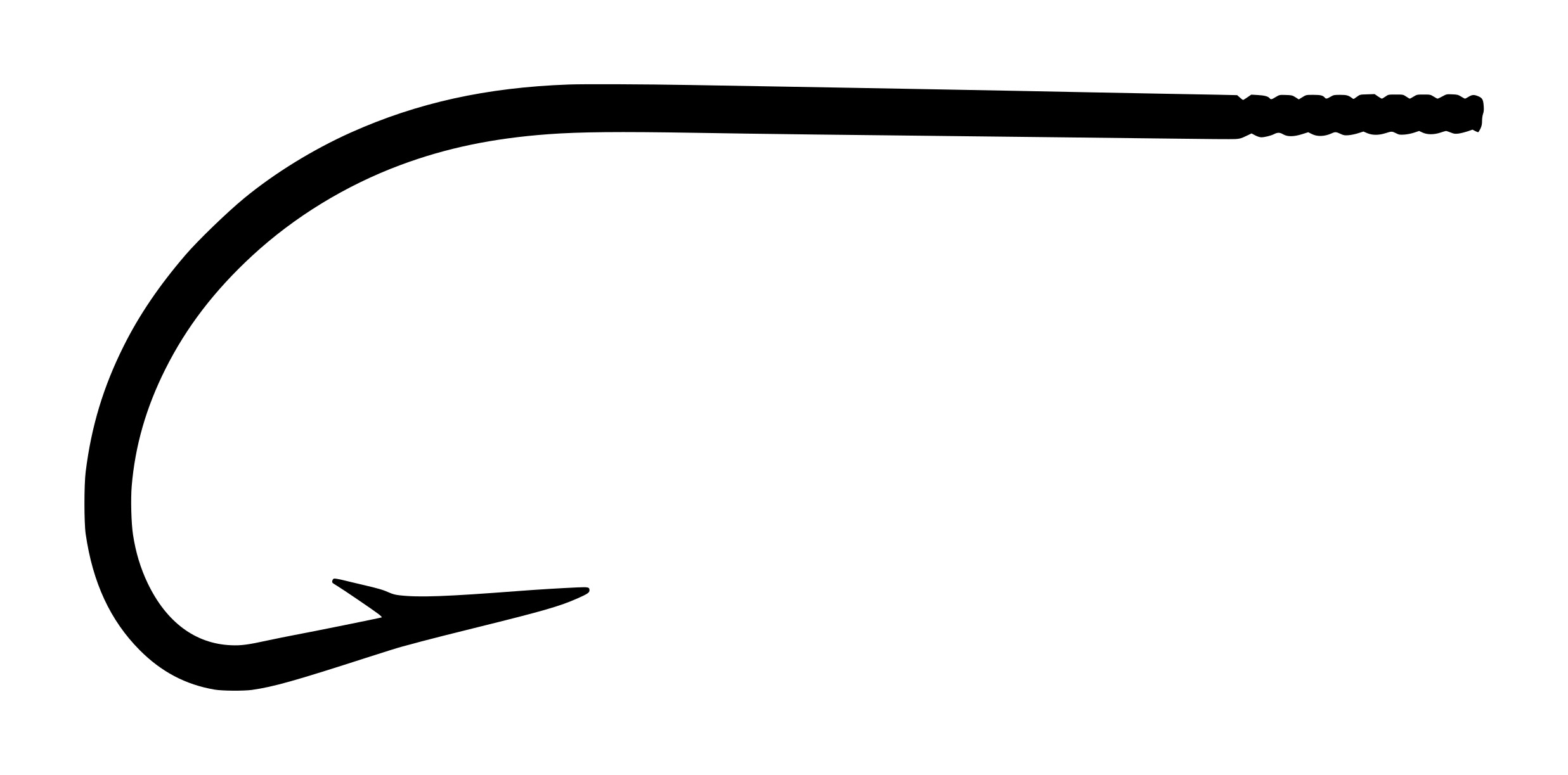
- Overall Length
- 36.4 mm
- Shank Length
- 27.4 mm
- Gap Width
- 11.7 mm
- Bend Depth
- 12.7 mm
- Wire Diameter
- 1.09 mm
- Weight
- .351g
- Confidence
- P Physical specimen
Physical measurement with calipers
The Mustad Quality 241 represents classic Norwegian industrial hook manufacturing from the early-to-mid 20th century P. This heavy-wire flatted-eye salmon hook features a forged Limerick bend and superior point, designed for demanding saltwater and large freshwater applications P. The elegant gold letterpress packaging with decorative border demonstrates Mustad’s premium ‘Quality’ branding from the pre-war era P.
With 100 hooks per package, this was clearly intended for commercial fishing operations or serious anglers who demanded reliable performance in quantity V. The blind flatted eye construction reflects traditional European salmon fishing practices, where spade-end hooks were preferred for their strength and low profile I. Today, surviving examples in original packaging represent an important chapter in fishing tackle industrialization.
3 cataloged imagesSelect any record to load it above.
3 images shown
The forged construction compresses the steel to increase strength while maintaining relatively light weight for the hook’s size P. The superior point features a near-straight inner taper that provides excellent penetration while maintaining strength at the tip P. The Limerick bend distributes stress evenly along the curve, making it ideal for the powerful runs characteristic of salmon fishing I. The blind flatted eye eliminates the potential weak point of a closed eye while allowing for traditional snell knot attachment methods preferred by European salmon anglers I.
Physical measurement with calipers
We have measurement for size 2/0. Know any others? Submit calipered measurements and we'll review and add them. Thank you!
O. Mustad & Son was founded in 1832 by Ole Mustad in Gjovik, Norway, growing from a small nail-making operation into the world’s largest fishhook manufacturer by the early 20th century. The company’s success was built on industrial-scale production methods, high-quality steel, and innovative tempering processes that produced consistently reliable hooks. Under the leadership of Hans Mustad, Ole’s son, the company expanded internationally and established the global standard for hook quality and numbering systems.
The ‘Quality’ sub-brand represented Mustad’s premium line, marketed to serious anglers and commercial fishermen who demanded the highest performance standards. This branding was used extensively from the 1920s through the 1950s, before being absorbed into Mustad’s general product line as manufacturing quality became more standardized across all products.
The Mustad 241 was part of the company’s extensive salmon and sea trout hook series, designed specifically for European angling traditions where flatted-eye hooks were preferred over ringed eyes for their strength and streamlined profile. This model was likely introduced in the 1920s as part of Mustad’s expansion into specialized sporting hooks, complementing their industrial fishing hook production.
The 241 remained in production through at least the 1950s, with packaging and finish variations marking different production periods. It represents the transition period when Mustad was standardizing their global sizing system while maintaining regional preferences for eye construction and bend styles.
Gold letterpress printing on white card stock, decorative border pattern, and 'Oslo-Norvege' address format are consistent with early-to-mid 20th century Mustad packaging before modern offset printing and barcode systems were adopted.
The term 'Irlandais' (Irish) on Mustad packaging doesn't refer to country of origin but to the Limerick bend style, which was perfected by Irish hook makers in the 18th century. Mustad adopted this terminology across their European markets to indicate the traditional bend geometry favored for salmon fishing.
Designed primarily for salmon and sea trout fishing using natural baits such as prawns, worms, and small fish I. The blind flatted eye allows for snell knot attachment, providing maximum strength for fighting large fish I. The long shank provides excellent leverage for hook setting and prevents fish from swallowing the hook deeply, making it ideal for catch-and-release practices common in salmon fishing I.
Large saltwater baitfish, pike fishing with dead baits, commercial longlining for cod and similar species
Not typically used for fly tying
| Hook | Match Quality | Notes |
|---|---|---|
| Mustad 92671 | Moderate | Modern equivalent with ringed eye rather than flatted eye |
Moderate collectability driven by attractive vintage packaging and historical significance as early industrial salmon hook.
The Mustad Quality 241 appeals to collectors primarily for its elegant pre-war packaging and representation of early 20th century Norwegian hook manufacturing excellence. The gold letterpress printing and decorative border work demonstrate the premium positioning of the ‘Quality’ brand during Mustad’s expansion period. The blind flatted eye construction also interests collectors focused on traditional European salmon fishing tackle.
Collecting interest is somewhat limited by the hook’s industrial rather than artisanal origins, and the relatively large quantities originally produced. However, surviving examples in original packaging are becoming increasingly scarce, particularly in the excellent condition shown here. The 100-hook quantity per package also makes complete examples more valuable than individual hooks.
White card stock package with gold letterpress printing featuring decorative star border pattern. Header reads 'O. MUSTAD & SON' with 'FABRIKANT' and 'OSLO-NORVEGE' address. Model designation 'Qual 241' with 'Première Qualité' and 'Hameçons Irlandais-Mustad' branding. Package quantity '100' with size '2/0' and 'Blancs à poils' specification.
Pricing reflects premium for complete original packaging in excellent condition. Individual hooks would command significantly less.
Vintage tackle dealers, Norwegian fishing heritage collectors, estate sales in salmon fishing regions
Store this vintage Mustad package in a cool, dry environment with stable humidity to prevent further deterioration of the card stock and preserve the gold letterpress printing. The blued finish on the hooks is relatively stable but should be protected from moisture to prevent rust formation. Keep the package flat to prevent warping of the card stock, and handle minimally to preserve the edges and corners.
The gold letterpress printing is particularly susceptible to handling damage – oils from skin contact can cause discoloration over time. Consider using cotton gloves when examining the package. If displaying, use UV-protective framing materials to prevent fading of the gold ink. The package’s value lies significantly in its completeness, so avoid removing hooks unnecessarily.
Source: Package letterpress text, Mustad Quality 241, c. 1920-1950
The package text ‘Hameçons Irlandais-Mustad’ directly translates to ‘Irish-Mustad Hooks,’ referencing the Limerick bend style’s Irish origins rather than indicating Irish manufacture. ‘Première Qualité’ (First Quality) emphasizes the premium positioning of this product line. The specification ‘Blancs à poils’ likely refers to the hooks being ‘blank’ (without additional treatments) and suitable for hair-wing flies or natural bait presentations.
The address format ‘Oslo-Norvege’ reflects the period when Oslo was gaining international recognition as Norway’s capital, with the French spelling ‘Norvege’ indicating this package was intended for French-speaking markets or international distribution.
| P | Photographically verified — Directly observable in the photograph(s) on this page. |
| V | Verified by documentation — Confirmed by manufacturer catalog, spec sheet, or published reference. |
| I | Inferred — A logical deduction from observable or documented evidence, not directly stated. |
| E | Estimated — An approximation based on visual comparison, proportional analysis, or limited data. |
| S | Speculative — A reasoned hypothesis that cannot be confirmed from available evidence. |
Claims with no notation are confirmed by multiple independent sources. All photographs on garrenwood.com are taken on a measurement grid where each square equals 1/10 inch (0.1″ / 2.54 mm).
Your cart is empty.