H. Milward & Sons
Redditch, England · Est. 1730 · Iron Arm · Hexacane · Red Loop · ENTACO
H. Milward & Sons stands as one of the oldest and most consequential names in the history of British hook manufacturing. The Milward family’s involvement in the needle trade dates to 1676, when James Milward operated as an independent needle maker on Fish Hill in Redditch. The formal corporate entity was established in 1730 when Symon Milward — whose very surname translates to “keeper of the mill” — repurposed a 12th-century corn mill on the River Arrow in Studley to power the friction-heavy processes of needle scouring and grinding. He registered the firm in the name of his infant son, creating the enduring corporate name Henry Milward & Sons.
For the next century the firm remained under unbroken family stewardship, transitioning from Studley to a dedicated Redditch factory near the Fountain Inn around 1800 under Henry Milward II. Steam power arrived in 1854, liberating the firm from its dependence on the River Arrow. That same year Henry Milward III’s son John Frederic departed for Brooklyn, New York, where he spent eight years building a transatlantic export network. Returning in 1862, he invested that capital in the colossal, steam-powered Washford Mills on Ipsley Street — a three-story brick landmark that dominated the Redditch skyline and at peak production employed between 700 and 800 workers producing nine million needles and two million fish hooks every single week.
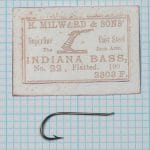
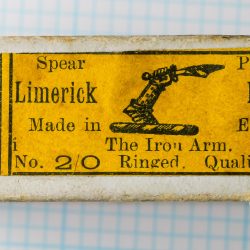
The pivot into fishing tackle was catalyzed by Colonel Henry Milward, a committed fly angler who recognized that the skills of tempering and pointing needles were directly transferable to hooks. By the late Victorian era Milward was producing hooks for markets across five continents, winning thirty first-class awards at international exhibitions between 1853 and 1922. Their most famous trademark, the “Iron Arm” — a muscular armored arm embossed on hook packets, rod fittings, and leather tackle wallets — became one of the most recognized marks in the global tackle trade. Patent No. 2947, registered in December 1853, mechanized the core processes of wire drawing, barb cutting, and hook bending, underpinning the enormous output of the Washford Mills.
The 20th century brought defensive consolidation. Milward absorbed W. Bartleet & Sons in 1903 and John James & Sons in 1912, combining the district’s most significant proprietary designs and patents under one roof. By 1930, severe depression-era pressures drove a merger with W. Hall & Co. to form Amalgamated Needles and Fish Hooks Limited, with manufacturing operations consolidated under ENTACO (The English Needle and Fishing Tackle Co. Ltd) in 1932. ENTACO was renamed Needle Industries in 1946. After the death of Colonel Henry Milward in 1965, the fishing tackle division quietly concluded. Needle Industries was acquired by Coats Patons Ltd in 1973. In 2016, Groves Ltd of Thame purchased the Milward sewing and haberdashery brand from Coats, continuing modern craft production under the historic name. No fishing hooks are manufactured under the Milward name today.