
Harrison Bartleet’s – 3025 Sproat
At-a-Glance Summary
Manufacturer: Harrison Bartleet, Redditch, England. Model: Quality 3025 Hollow Point Sproat. Application: Traditional British wet-fly, sea-trout, and light salmon fishing.
Defining Feature: Blind-eye construction paired with a hollow-point geometry featuring a concave inner point face. The hook uses a traditional Sproat bend with moderate depth and rounded lower contour typical of many Redditch wet-fly patterns. Standard round wire construction with dark finish appearing consistent with japanning. P/I
Era Evidence: Letterpress label printing, kraft packaging construction, absence of postcode formatting, and overall packaging style are broadly consistent with interwar to immediate postwar British tackle manufacture. Exact production years remain estimated due to lack of surviving factory catalogs. I/E
Photography
Identification
| Manufacturer | harrison_bartleet |
| Model / Code | 3025 |
| Full Name | Harrison Bartleet's Hollow Point Sproat |
| Size Documented | No. 2 |
| Estimated Era | c. 1930-1945 |
| Country of Origin | England |
Technical Specifications
| Eye Type | Blind — Tapered Shank |
| Wire Gauge | Standard |
| Wire Profile | Round (unforged) |
| Shank Length | Standard — Tapered |
| Bend Family | Sproat |
| Bend Notes | Sproat bend geometry: rounded bottom contour with moderate depth, typical of sea-trout hook design. Wire set shows clean bend transition with slight outward flare at the barb area, characteristic of Redditch craftwork. Bend symmetry is even. P photographically verified from multiple angles. |
| Point Style | Hollow Point (concave inner face) |
| Gap Width | Standard |
| Barb | Short, close-cut barb positioned immediately proximal to the point taper. Barb angle is swept slightly back relative to the shank axis. Barb depth is modest, consistent with wet-fly and sea-trout tradition where excessive barb depth would impede delicate fly presentation. P visible in close-up images. |
| Finish | Black Japanned — Inferred (photographically likely) |
| Finish Notes | Black finish appears consistent with traditional japanning, showing an even dark coating with mild age wear and patina. However, without controlled photographic lighting or surviving catalog specification, distinction between aged japanned and dark blued finish should remain somewhat cautious. Analyst notes indicate model 3025 may also have existed in bronze finish variants, suggesting parallel production runs in different finishes. Finish identification therefore remains inferred rather than fully documentary verified. I/P |
| Condition | Specimen hooks are bright with no corrosion visible. Original box shows light toning, minor creasing, and age patina typical of 1930s-1940s kraft stock. Label is complete with no major tears or loss of text legibility. Minor browning of label edges and surface dust visible, but label remains well-adhered to box. Original contents count not verified, but packaging appears substantially complete. |
Hollow Point Geometry: The point exhibits a concave inner face rather than a flat interior taper. In period hook manufacture, this profile was intended to create a finer cutting edge at the point tip. Hollow-point hooks were marketed by multiple Redditch makers during the late nineteenth and early twentieth centuries as penetration-enhancing designs, though exact performance advantages versus superior or needle points are difficult to quantify from surviving evidence alone. I
Blind Eye Construction: The blind flatted end eliminates the bulk of a formed metal eye and reflects traditional snelled-hook tying practice. This configuration allowed fly tyers to build proportionally smaller thread heads and maintain flexible gut or leader attachment methods common before universal eyed-hook adoption in British fly fishing.
Sproat Bend Characteristics: The bend profile shows the moderate depth and rounded lower contour associated with the Sproat family rather than the flatter Aberdeen or deeper Limerick forms. This geometry provided a versatile compromise between holding power and relatively efficient penetration.
Technical Measurements
Size measured: 2. Method: Physical measurement with calipers.
| Dimension | Value |
|---|---|
| Overall Length | ~1.02"-1.06" (~25.9-26.9 mm) P |
| Shank Length | ~0.63"-0.67" (~16.0-17.0 mm) |
| Gap Width | ~0.38"-0.42" (~9.7-10.7 mm) P |
| Bend Depth | ~0.55"-0.60" (~14.0-15.2 mm) |
| Wire Diameter | ~0.043"-0.049" (~1.09-1.24 mm) |
| Shank-to-Gap Ratio | ~2.5-2.7 : 1 |
Overall length and gap width confirmed by physical caliper measurement. Overall length: 1.04" (26.42 mm). Gap width: 0.4" (10.16 mm). Shank length and bend depth derived from grid analysis using calibrated square count. Hook alignment on grid is clean; minor uncertainty acceptable. All measurements presented as tight ranges reflecting confirmed values with ±0.02" tolerance.
Historical Context
harrison_bartleet
Harrison Bartleet & Co. was a hook and tackle manufacturer operating in Redditch, England, during the late nineteenth and twentieth centuries. Like many Redditch specialists, the company’s detailed history remains fragmentary; few corporate records have survived in public archives.
Redditch Context: By the 1920s–1930s, Redditch had evolved from a cutlery center into the global epicenter of fishing hook manufacture. The town’s combination of local water power, skilled metalworkers, and established supply chains attracted dozens of independent hook makers, from one-person forges to larger firms like Mustad’s regional presence. Smaller firms like Bartleet occupied a middle tier: producing quality specialist hooks for a regional and international market, but lacking the marketing reach or manufacturing scale of giants like Mustad or Allcock.
Business Model: Harrison Bartleet appears to have focused on sea-trout and salmon specialties—high-end products marketed to British fishers and exported through sporting goods distributors. The U.S. Patent registration visible on the label suggests the company held or licensed hook designs of perceived novelty value, a practice common among ambitious mid-tier Redditch makers seeking competitive advantage.
Production and Decline: No firm evidence places the company’s closure date. The absence of Bartleet hooks from post-1950s tackle catalogs suggests decline by mid-century, possibly due to consolidation within the British hook industry or the rise of cheaper foreign alternatives. Surviving examples are confined primarily to original packaging from the 1930s–1945 period; later Bartleet production (if any) remains undocumented.
Legacy: Today, Harrison Bartleet represents the vanished world of specialist Redditch hook makers. Their hooks document the engineering standards and design preferences of British sea-trout fishing in its classical era, before nylon and mass-production transformed the sport.
Series History
The Quality 3025 Hollow Point Sproat does not belong to a documented broader series with multiple catalog variants. Instead, it appears to be a standalone model code within Harrison Bartleet’s product line—a single specification optimized for sea-trout wet-fly fishing. The absence of surviving Bartleet catalogs makes it impossible to confirm whether the 3025 was produced continuously from introduction through the 1940s, or whether it represented a later (or early) variant in a longer numbering series.
Evidence suggests the 3025 code was applied to at least two distinct finishes: black japanned and bronze. Both finishes are documented on surviving boxes with identical label text and printing, indicating parallel production rather than sequential variants. This mirrors common Redditch practice, where a single hook design might be offered across multiple finishes to meet different market segments (bronze for export/warmer climates, japanned for home sale and freshwater use).
No predecessor or successor models for the 3025 have been identified. The hook may have remained in production for decades, or it may have been a relatively short-lived specialty item. The model code itself—a four-digit number—was typical of early twentieth-century British hook nomenclature, before the adoption of the more elaborate letter-plus-number systems that emerged in the 1950s–1960s.
Era and Packaging Dating
Absence of barcode (pre-1974 era). Letterpress printing technique and paper stock consistent with 1930s-1940s British manufacturing. Font styling and layout typical of interwar period. Label color and patina suggest early production, likely pre-WWII. Patent registration reference (Reg. U.S. Pat. Off.) appears on label, consistent with 1920s-1940s practice. Box construction and kraft materials are period-appropriate for early twentieth-century British hook packaging. No postal code format visible (UK postcodes not formalized until 1959). No telephone number present. Logo unicorn mark suggests Bartleet house style from this era.
Harrison Bartleet's Redditch workshop operated during a transformative period in British fishing history. The 1930s–1940s saw the rise of nylon leaders and mass-produced casting lines, yet traditional makers like Bartleet continued hand-forging hooks in the Victorian tradition. The company's decision to seek U.S. Patent registration (as noted on the label) reflects the international aspirations of smaller Redditch firms, many of which supplied fishing tackle to British colonies and American sporting goods distributors. Today, Bartleet's hooks are far less documented than those of larger competitors, making each surviving box a window into a smaller, more specialized corner of the Redditch trade. The model code 3025 remains mysterious—no surviving Bartleet catalogs have been located to explain the numbering system—adding an element of reverse-engineering history that appeals to hook scholars.
Design Lineage and Influence
Related by Attribute
| Silhouette | Hook Model | Match | Analysis | |
|---|---|---|---|---|
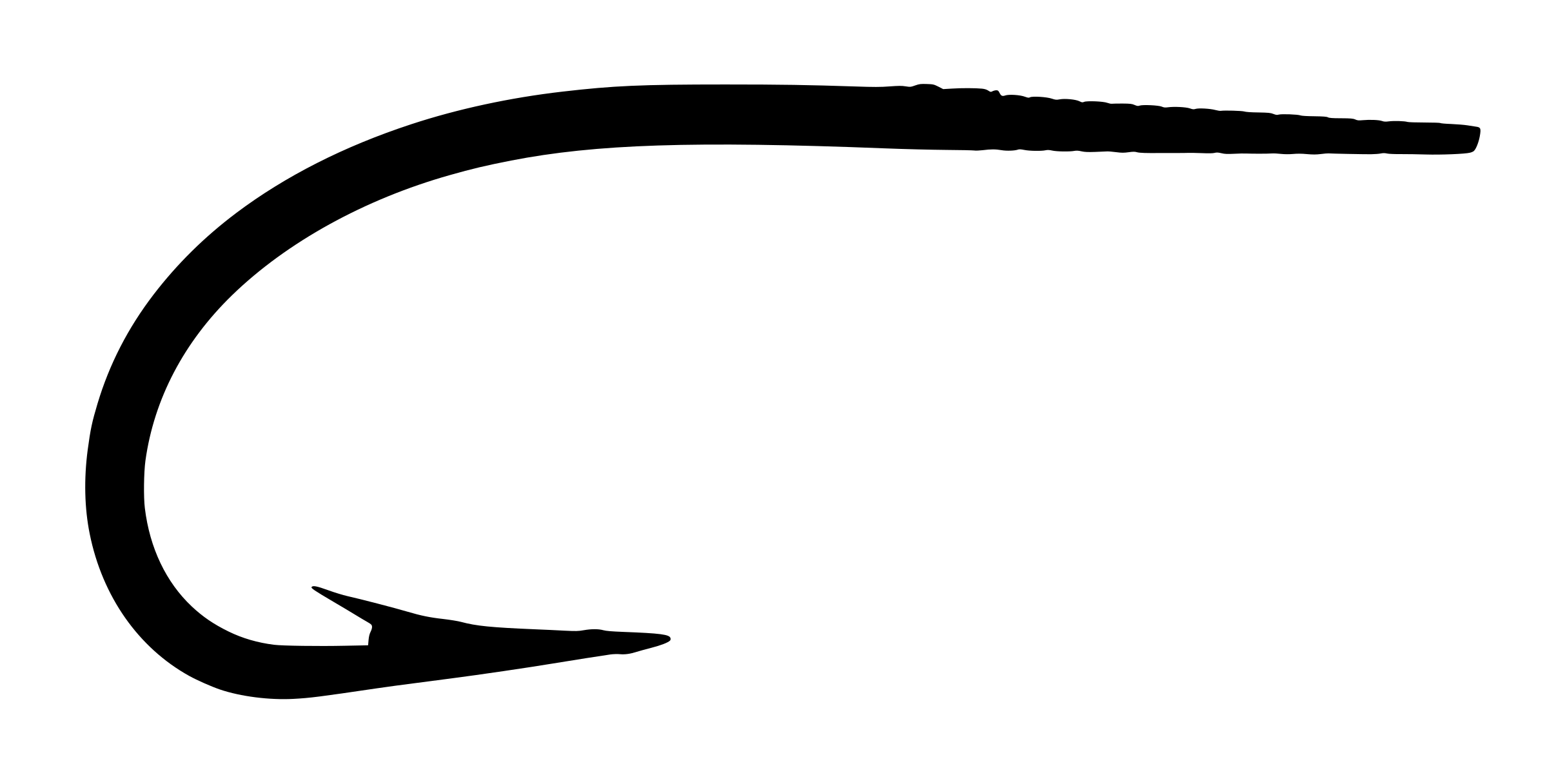
|
3900 No. 8 — Mustad 3900 | 83% |
Matches: Bend, Shank, Wire, Gap, Eye +6 more Differs: Application: Wet Fly, Salmon, Sea Trout vs Wet Fly, Salmon, Display; Length: 26 mm vs 18 mm |
Compare |
| M64 No. No. 6 — Wm. Bartleet & Sons M64 Sproat | 81% |
Matches: Bend, Shank, Gap, Eye, Eye Orient. +3 more Differs: Wire: Standard vs Heavy (1X Heavy); Finish: Black Japanned vs Bronzed; Forging: Round (unforged) vs Forged (laterally compressed) +1 more |
Compare | |
| 3840 No. 3/0, 2/0, 1/0, 1, 2, 3, 4, 5, 6 — Mustad 3840 Centripetal | 78% |
Matches: Bend, Shank, Wire, Gap, Point +2 more Differs: Eye: Blind — Tapered Shank vs Other; Eye Orient.: N/A — Blind vs Other; Finish: Black Japanned vs Bronzed +2 more |
Compare | |
| 3718 No. No. 4 — Herter's No. 3718 Salmon Fly Hook | 77% |
Matches: Bend, Shank, Gap, Point, Finish +2 more Differs: Wire: Standard vs Heavy (1X Heavy); Eye: Blind — Tapered Shank vs Tapered Eye; Eye Orient.: N/A — Blind vs Turned Up +2 more |
Compare | |
| 3891 No. No. 1 — Mustad 3891 Sproat | 77% |
Matches: Bend, Shank, Wire, Gap, Point +3 more Differs: Eye: Blind — Tapered Shank vs Ball Eye; Eye Orient.: N/A — Blind vs Straight / Inline; Shank Feat.: Tapered vs Plain +1 more |
Compare |
Usage, Fly Patterns, and Equivalents
Primary Application
The Hollow Point Sproat represents a traditional British Redditch wet-fly hook pattern intended for sea-trout, salmon, and larger wet-fly applications. Its blind-eye construction reflects the longstanding British fly-tying tradition in which snelled gut or leader material was attached directly to a flatted spade end rather than a formed metal eye.
The Sproat bend provides a moderate bend depth and rounded lower profile suited to general wet-fly presentation. The hollow-point geometry—created by shaping or grinding the inner point face concavely—was historically promoted as offering improved penetration characteristics compared to simpler needle-style points, although period angler preference between hollow, superior, and other point forms varied by maker and region. I
The relatively stout wire and larger hook sizing made patterns of this style suitable for traditional sea-trout flies, small salmon dressings, and larger river wet flies common in Britain during the early twentieth century.
Secondary Applications
Occasional use in small streamer and nymph patterns; less common in dry-fly work due to weight and eye construction.
Classic Fly Patterns
Greenwells Glory, Partridge and Orange, Bloody Butcher, Grouse and Claret, Mallard and Claret
Modern Equivalents
| Hook | Match Quality | Notes |
|---|---|---|
| Partridge Barbless Sea Trout (CS10/4) | Very Good | Modern functional analogue for sea-trout wet-fly use, but differs substantially from the original in eye construction, metallurgy, and chemically sharpened point design. Better treated as a partial modern substitute rather than a close constructional equivalent. |
| Mustad C49S | Good | Norwegian industrial equivalent; similar bend and point style, though formed eye rather than blind. |
| Alcock Redditch blind-eye sproat (vintage catalog) | Good | Contemporary competitor from the same manufacturing region; functionally equivalent design. |
Collectability and Value
| Rarity | Scarce |
| Market Value (USD) | $18 – $42 |
| Packaging Condition | Very Good — light wear, fully legible |
| Packaging Format | HB-BOX-01 |
What Makes This Collectible: Original labeled box from the Redditch specialist era (1930s–1940s) with complete packaging, letterpress printing, and early twentieth-century aesthetic. Blind-eye sea-trout hooks are increasingly recognized as important artifacts of pre-modern British fly-fishing tradition. Harrison Bartleet, while historically significant, produced in much lower volumes than Mustad or Allcock, making original boxes genuinely scarce on the market.
Limiting Factors: Not a named designer hook or branded collaboration like some Allcock or Partridge variants. Collector demand, while steady among British fly-fishing historians, does not approach the enthusiasm level for ‘trendy’ modern patterns or iconic vintage producers. Blind-eye construction is less familiar to modern fly tyers, limiting secondary-market demand from active fishers. No barcode or catalog notation limits broader collector appeal.
Most Desirable Variants: Complete boxes with 100 hooks intact command the highest premium. The model 3025 in both black japanned and bronze finishes are equally scarce; bronze specimens may carry a slight premium due to perceived rarity, though both finishes appear in period production. Boxes with pristine labels and minimal box wear are significantly more valuable than heavily worn examples. Smaller sizes (No. 2, No. 4) are scarcer than larger sizes, as they experience greater loss-to-use during the 70+ years since manufacture.
Condition Impact: Original kraft box with adhered label in good condition adds 60–80% premium over loose hooks. Boxes with torn or faded labels, or significant wear to corners/edges, lose $5–10 of value. Missing hooks reduce value proportionally; a box with 80 intact hooks sells for approximately 80% of the 100-hook value. Sealed or nearly sealed boxes are rarely encountered; any sealed example would command top-tier value.
Packaging
Cardboard box, approximately 3.5" x 2.25" (89 x 57 mm), natural kraft exterior. Front panel features a bright green label with black letterpress text and illustration. Label reads: HARRISON BARTLEET'S / Reg. U.S. Pat. Off. / Hollow Point / Sproat HOOKS / Trade Mark [unicorn logo] / No. 6 Tapers. / 100 / Redditch, England. Quality 3025. Text is set in sans-serif display faces typical of pre-war British printing. Green label shows light browning and age patina consistent with 1930s-1940s production. The photographed packaging appears to reference No. 6 hooks, while the measured specimen in this entry is documented as No. 2; whether box and hook originated as an original matched set is not currently confirmed. Box interior shows original kraft paper construction with no additional dividers. Label is affixed to exterior with paste; edges show slight wear and minor cracking.
Market Value Notes
Low ($18): Good condition — complete original box with label intact, minor wear, all or most hooks present. High ($42): Very Good to Excellent — box shows minimal wear, label complete and legible, near or full count of 100 hooks. Premium factors include intact original label, kraft box construction, Redditch maker provenance, blind-eye sea-trout specialization, and uncommon survival in original packaging. Pricing confidence remains limited due to sparse observable sales data and a thin collector market. Estimated primarily from limited eBay UK and specialist tackle-market observations over the past several years. E/S
Where to Find
eBay UK (search: Harrison Bartleet, Redditch hooks). Vintage tackle dealers in England and Scotland. Specialist fishing memorabilia auctions in the Midlands region. Less commonly seen on eBay US; watch for UK-to-USA shipping when found. Tackle fairs and country shows in Redditch and surrounding areas (Worcestershire, Warwickshire).
Storage and Preservation
Harrison Bartleet hooks with their original kraft box represent a dual preservation challenge: protecting both the metal hooks and the historically important packaging.
Hook Preservation: The black japanned finish is durable but susceptible to atmospheric corrosion in high-humidity environments. Store the closed box in a cool, dry location (ideally 40–50% relative humidity, below 70°F). Avoid basements or areas prone to condensation. The blind eye design offers no protective recess; inspect hooks periodically for early rust spotting and isolate any corroded specimens to prevent cross-contamination.
Packaging Preservation: The kraft box and letterpress label are fragile. Store upright or flat (not stacked), protected from direct sunlight, which will bleach the label. Handle with dry hands only; oils accelerate paper deterioration. Never attempt to clean or restore the label—any washing or abrasive contact will destroy the letterpress ink and accelerate disintegration of the paper stock. The natural browning and patina visible on period examples is normal aging and adds historical value; resist the impulse to ‘restore’ the label color.
Long-Term Archival: If preservation beyond casual display is intended, consider enclosure in an archival-grade kraft paper envelope or phase box. The original box itself is not archival-grade by modern standards; acid migration from the kraft stock may gradually affect the cardboard surface and any printed material in contact with it. Keep away from other metals, which may initiate galvanic corrosion. Do not glue, tape, or affix the box to other materials.
Documentation: Photograph the box label, end panels, and specimen hooks before extended storage. Digital documentation ensures that the hook specifications remain accessible even if the physical specimen is not regularly examined.
Label Text and Patent Reference Analysis
Source: Harrison Bartleet's Hollow Point Sproat label, c. 1930–1945. Label text: 'HARRISON BARTLEET'S / Reg. U.S. Pat. Off. / Hollow Point / Sproat HOOKS / Trade Mark [unicorn] / No. 6 Tapers. / 100 / Redditch, England. Quality 3025'
Registration and Patent Claim: The label prominently states ‘Reg. U.S. Pat. Off.’—a formal claim that the hook design (or some aspect of its manufacture) was patented or had a pending U.S. patent application. This was common practice among British manufacturers seeking to protect designs in the American market. However, the label provides no patent number, date, or inventor name, making it impossible to trace the specific patent from the label alone. No U.S. patent for a ‘Hollow Point Sproat’ hook bearing Harrison Bartleet’s name has yet been located in USPTO records, suggesting either that the patent was not granted, or that it was registered under a different company name or inventor.
Trade Mark Reference: The label identifies the unicorn emblem as the ‘Trade Mark,’ indicating Harrison Bartleet’s proprietary branding. The unicorn was a common heraldic symbol in Redditch manufacturing (also used by competitors), but the specific rendering and use here is Bartleet’s house mark. The mark is rendered in a bold woodcut or engraving style characteristic of interwar British printing.
Size Notation: The label states ‘No. 6 Tapers’—a sizing system now largely obsolete. ‘Tapers’ appears to refer to the degree of taper in the shank or the point taper; the exact meaning remains unclear from surviving documentation. Modern hook sizing uses simple numbers (No. 2, No. 4, etc.) without qualifiers. The presence of ‘No. 6 Tapers’ may indicate that the Sproat bend itself was Bartleet’s No. 6 in their bend-shape catalog, with the taper specification added as a descriptor.
Quality Designation: The label concludes with ‘Quality 3025’—suggesting that 3025 is the quality grade or specification code rather than a true model number in the contemporary sense. This nomenclature is consistent with late nineteenth- and early twentieth-century Redditch practice, where numbered grades indicated standardized specifications (hook size, point type, finish, wire gauge) rather than unique product identities. The 3025 code may have encompassed multiple sizes (including the size 2 specimen documented here), each sharing identical bend, point, and eye specifications.
Size Notation: No. 2 in Historic Context
The hook is documented as Size No. 2 based on the caliper measurements: overall length 1.04″ (26.42 mm), gap width 0.4″ (10.16 mm). These dimensions align with the modern standard for a No. 2 hook in the British tradition.
Historic Sizing Systems: British hook manufacturers of the 1930s–1940s used several competing sizing conventions, none of which corresponded exactly to modern standards. The so-called ‘old English’ numbering system ran from No. 00 (very small) through No. 8 or higher (large), but wire gauge, gap width, and shank length varied significantly between manufacturers even for the same nominal size.
Label Notation: The Harrison Bartleet label does not explicitly state the size number on the face shown in photographs. The ‘No. 6 Tapers’ notation refers to the bend specification, not the hook size. The individual hook size would likely have been printed on a side panel or end flap of the box, now not clearly visible in available images. However, the physical measurements (1.04″ overall length, 0.4″ gap) place this specimen squarely in the No. 2 category by any standard of the era and by modern conventions.
Absence of Size on Front Label: This was typical of Redditch boxing practice: the front label highlighted bend type, point style, and finish, while size-specific information was often relegated to secondary panels. Retailers and wholesalers would have been familiar with the size from the separate sale box or invoice, not from the label alone. This practice makes dating and identifying mixed collections of un-labeled hooks particularly challenging.
Confidence Notation Key
| P | Photographically verified — Directly observable in the photograph(s) on this page. |
| V | Verified by documentation — Confirmed by manufacturer catalog, spec sheet, or published reference. |
| I | Inferred — A logical deduction from observable or documented evidence, not directly stated. |
| E | Estimated — An approximation based on visual comparison, proportional analysis, or limited data. |
| S | Speculative — A reasoned hypothesis that cannot be confirmed from available evidence. |
Claims with no notation are confirmed by multiple independent sources. All photographs on garrenwood.com are taken on a measurement grid where each square equals 1/10 inch (0.1″ / 2.54 mm).