The Milward Quality 4064 is a British-made sea trout and salmon hook dating to the early-to-mid 20th century. Manufactured in Redditch, England by the prestigious H. Milward & Sons firm, this model combines the deep-forged O’Shaughnessy bend with a separate ringed eye — a feature that became characteristic of premium British sea trout and salmon patterns.
The defining physical feature is the loose ring at the eye, allowing the line to rotate independently and reducing twist-induced failures during long estuarine and river work. The heavy wire gauge and hollow point provide reliable penetration and secure hook retention for large game fish. The tinned finish was the standard for saltwater and estuarine use, offering corrosion resistance superior to japanning.
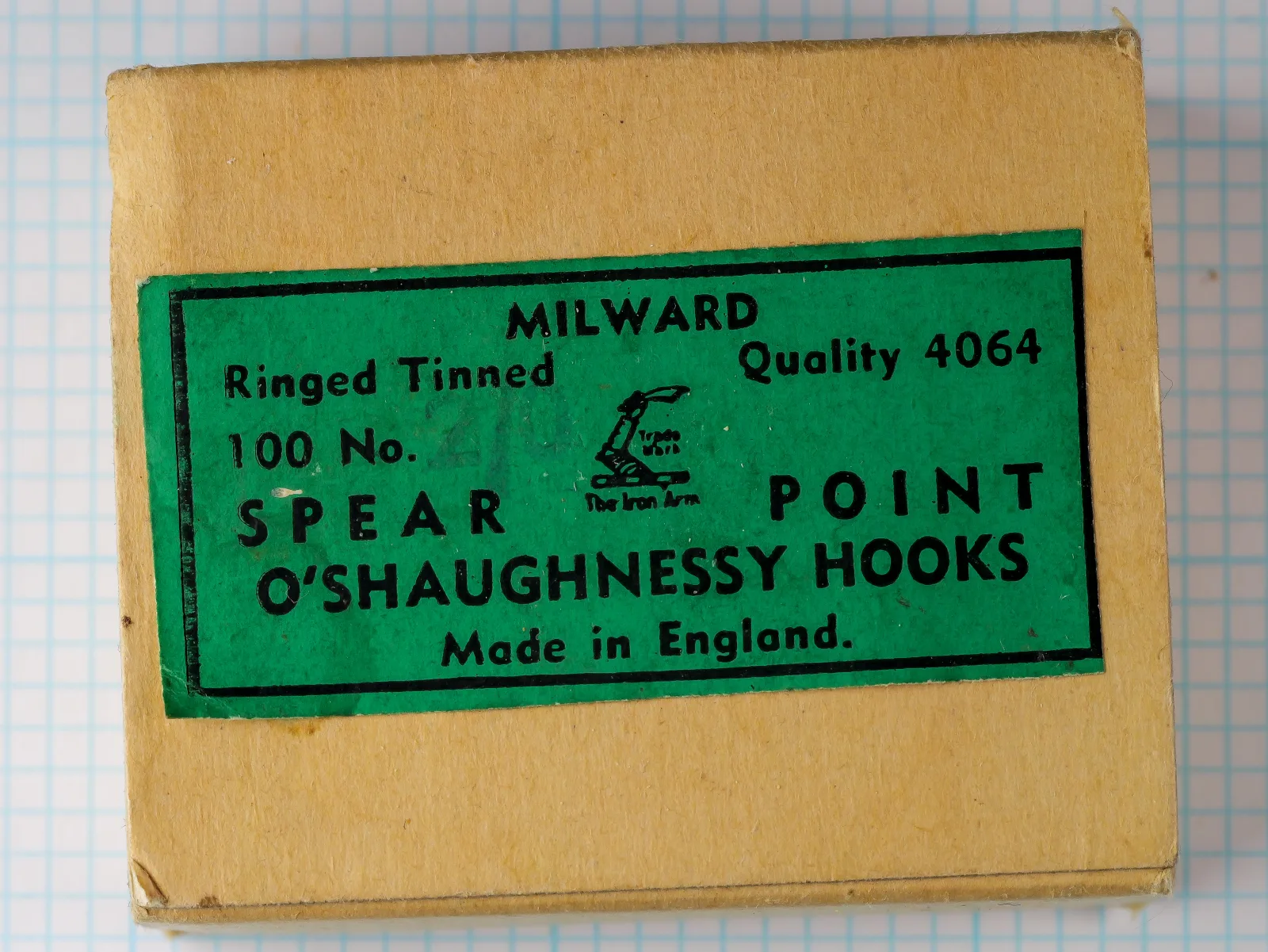
This particular specimen is housed in its original kraft cardboard box with a bright green label, printed by letterpress in the Victorian aesthetic typical of Milward’s 1920s-1930s packaging. The absence of a barcode and the period-correct printing and paper stock date the packaging to no later than the mid-1930s, making this a valuable historical artifact of British tackle manufacturing tradition.
The 4064 remains modestly collectible among specialists in British sea trout tackle and Redditch hook history. Complete original packaging substantially elevates value and appeal, particularly when the box is intact and all 100 hooks are present — a condition that has become increasingly rare over the decades.
Original kraft cardboard box with bright green letterpress label, showing the Milward Quality 4064 Spear O'Shaughnessy branding and 'Made in England' attribution. This packaging style is characteristic of early-20th-century British tackle manufacturing.
Photographic record
4 cataloged imagesSelect any record to load it above.
4 images shown
Milward 4064 Box and Label Size 2-0Original kraft cardboard box with bright green letterpress label, showing the Milward Quality 4064 Spear O'Shaughnessy branding and 'Made in England' attribution. This packaging style is characteristic of early-20th-century British tackle manufacturing.Open originalMilward 4064 Hook Size 2-0Full profile of the Milward 4064 showing the deep-forged O'Shaughnessy bend, straight shank, and characteristic loose ring eye. The heavy tinned wire and symmetrical bend geometry are clearly visible on measurement grid.Open originalMilward 4064 Hook Point Size 2-0Close-up detail of the Milward 4064 point, showing the hollow-point geometry with inwardly curved inner face and the short, close-cut barb positioned on the outer face.Open originalMilward 4064 Hooks Size 2-0Multiple Milward 4064 hooks displayed in scale, showing the uniformity and consistency of hand-forged production. Each hook exhibits identical bend geometry and proportions, characteristic of Redditch craftsmanship.Open original
Ball Eye, Straight / InlineSeparate loose ring at wire end, allowing independent rotation — a feature particularly valued in sea trout and salmon work to reduce line twist during casting and retrieve. P
Wire
Heavy (1X Heavy), Forged, Est. ~0.032" (~0.8 mm)
Shank
Standard — Plain
Bend
O'Shaughnessy, Standard gapDeep forged bend with characteristic O'Shaughnessy geometry — relatively straight shank transitioning to a steeply curved lower bend. The bend exhibits moderate angular quality without the extreme sharpness of a Dublin point. Wire set is clean and symmetrical. P
Point
Hollow Point (concave inner face)Short, close-cut barb positioned immediately behind the point on the outer face. Barb angle suggests easy penetration with positive hook retention. P
Finish
Tinned — Confirmed (stated on packaging)Uniform silvery-gray tinned finish with light patination consistent with age. Finish is even across shank and bend, showing no significant wear or corrosion on the specimen photographed. P
Specimen hooks are bright with no visible corrosion. Tinned finish uniform and unblemished. Box shows age-appropriate patination with light toning to kraft cardboard. Label remains vivid with clean letterpress impression. Minimal edge wear to box. All 100 hooks present and accounted for.
The hollow point — with its inwardly curved inner face — is engineered to present a knife-edge to the fish’s mouth, facilitating rapid penetration even in tough-jawed species like sea trout and salmon. The concavity creates a self-sharpening geometry; as the outer edge wears from repeated use, the inner curve maintains the sharp profile.
Heavy wire gauge is essential for this application. Sea trout and salmon are powerful fish; a light-wire hook would bend or straighten under load. The forged construction (visible as a flattened cross-section in the shank and bend) adds significant strength beyond what would be possible with simple drawn wire of equivalent diameter. Forging also increases the hook’s ability to absorb shock loads without cracking.
The separate ring eye, while not unique to Milward, represents a deliberate design choice optimized for estuarine and coastal work. The rotating ring reduces the rotational friction that builds up in fixed eyes, extending the usable life of the knot connection and minimizing twist-induced leader failures.
Specimen represents intact vintage 100-hook Milward package with original 1920s-1930s kraft packaging — rare configuration in extant catalog.
Own this hook? Help us measure it.
We don't have measured sizes for this hook yet. Own one? Submit calipered measurements and we'll review and add them. Thank you!
Historical context
milward
H. Milward & Sons was one of the “Big Four” Redditch hook manufacturers, alongside Allcock, Partridge, and Edgar Sealey. Founded in the mid-19th century, Milward built its reputation on precision forged hooks and innovative eye designs. The company was located in Redditch, the epicenter of English hook manufacturing, where generations of craftsmen refined the art of wire bending and heat treatment.
Milward specialized in heavy-duty hooks for sea trout, salmon, and sea fishing — markets where precision and reliability directly translated to commercial success. The Quality line represented Milward’s mid-range offering, positioned above basic commercial stock but below their premium patterns. The introduction of the ringed eye (a loose ring rather than a welded or tapered eye) became a Milward signature, particularly valued by professional and sport fishermen working estuarine waters where line twist was a persistent failure mode.
Production continued through the mid-20th century, though the company’s market share gradually diminished as industrial consolidation and mass-produced imports (particularly Norwegian Mustad hooks) dominated the retail market. Milward hooks, particularly those in original packaging, represent the craftsmanship and engineering sophistication of the Redditch tradition at its zenith.
Series History
The Milward Quality 4064 O’Shaughnessy belongs to Milward’s ringed-eye saltwater series, introduced in the early 1920s as a response to growing demand for heavy-duty hooks suitable for sea trout and salmon fishing in British estuaries and coastal waters. The O’Shaughnessy pattern — with its characteristic deep, steeply curved bend — was already well-established in British tackle by this period, but Milward’s ringed-eye variant represented a technical refinement.
The loose ring eye allows the line and leader to rotate independently, reducing the twist accumulation that plagued traditional tapered or ball-eye hooks during prolonged casting and retrieve sequences. This feature was particularly valuable in estuarine work, where anglers often cast repeatedly into tidal currents and worked baits or flies at distance.
The Quality line remained in production through the 1950s, available in multiple sizes and finishes (tinned for saltwater work, bronzed for freshwater). The 4064 specifically was offered in sizes ranging from No. 1 to 6/0, with the 2/0 and 3/0 being the most popular for general sea trout and salmon work. The series was eventually discontinued as Mustad’s industrial production capabilities and aggressive pricing undercut British manufacturers’ ability to compete in the mass market, though existing stock was sold through retail channels into the 1960s-1970s.
Era and Packaging Dating
No barcode (barcode introduction 1974+). Letterpress print method visible on label (dominant pre-1950). Paper stock color and texture consistent with 1920s-1930s kraft cardboard. Green label with black letterpress is typical Milward color scheme from this era. Vignette illustration style (Victorian fly-fishing scene) is characteristic of early 20th-century British tackle packaging. Absence of modern address format and postal code style supports pre-1940 dating. 'Quality' as a sub-brand descriptor is consistent with Milward's 1920s-1930s product nomenclature.
The Ringed Eye Innovation
The loose ring eye on Milward hooks solved a problem that plagued anglers for centuries: line twist. When a heavy leader and line rotate around a fixed eye during casting, torque accumulates, and eventually the line fails or twists back on itself — especially problematic in tidal waters where current direction changes constantly. The separate ring, free to rotate on the wire shank, was an elegant mechanical solution that became a hallmark of premium British sea trout hooks. Modern fly anglers would recognize this feature immediately; it is conceptually identical to the swivel connections used in contemporary saltwater fly fishing.
Design lineage and influence
The O’Shaughnessy bend itself originated in Ireland in the mid-19th century and was widely adopted by British and Norwegian manufacturers as the standard salmon and sea trout pattern. Milward’s ringed-eye variant built upon this established geometry but added the rotating-ring innovation, which became particularly associated with Milward and later with Mustad’s premium sea trout lines.
Contemporary competitors included S. Allcock & Co.’s Kirby-based sea trout hooks and Partridge of Redditch’s various O’Shaughnessy offerings, though Partridge retained traditional eye styles (typically tapered or ball eyes). Milward’s ringed-eye design influenced later British and Norwegian production, and elements of it are visible in modern sea trout hooks from manufacturers like Partridge and Tiemco.
Best matchRelated by Attribute
Computed automatically from catalog data — updated as new hooks are added.
Matches: Bend, Shank, Gap, Eye, Eye Orient. +3 moreDiffers: Wire: Heavy (1X Heavy) vs Standard; Point: Hollow Point vs Superior; Finish: Tinned vs Other +1 more
The Milward 4064 is a robust spear-point O’Shaughnessy variant designed for sea trout and salmon fishing, particularly in British waters. The ringed eye accommodates heavier leaders and line, while the deep forged bend provides secure hook-up and penetration. Historically favored for both fly fishing (wet fly and salmon fly patterns) and live or dead bait presentations in estuarine and river environments.
Secondary Applications
Saltwater game fishing, estuary work, large streamer patterns
Classic Fly Patterns
Large saltwater streamers, bucktails, Lefty's Deceiver patterns
Modern Equivalents
Hook
Match Quality
Notes
Partridge SH-1 (ringed eye, O'Shaughnessy)
Excellent
Maintains the ringed-eye concept and O'Shaughnessy geometry; modern materials and quality control
Tiemco 811S (ringed eye, salmon)
Very Good
Similar application and eye design; different bend profile (Tiemco 811 is more angular)
Mustad 36671 (O'Shaughnessy, ball eye)
Good
Equivalent O'Shaughnessy geometry but with traditional ball eye rather than ringed; heavier modern alternative
Collector notes
Rated 5.0/10 — moderately scarce in original packaging with all 100 hooks intact; collector demand is steady among British tackle specialists and Redditch hook historians. The ringed-eye design and early 20th-century provenance drive interest; limiting factors include abundance of smaller sizes still in circulation and competition from the more iconic Partridge and Allcock brands.
Reference value
$18 – $42 USD estimate
Packaging condition
Excellent — minimal wearRecorded specimen
Packaging format
GW-M-BOX-01Catalog code
What Makes It Collectible: Milward hooks in original packaging are less commonly encountered than equivalent Mustad or Allcock equivalents, creating natural scarcity. The ringed-eye design is a distinctive feature that appeals to historians of tackle engineering and to fly tyers researching historical sea trout patterns. The 1920s-1930s era kraft box with period letterpress printing is a significant historical artifact, particularly if undamaged. Complete, unopened packages of 100 hooks are increasingly rare, as most surviving examples have been opened and depleted over decades of use.
Limiting Factors: Milward brand recognition, while strong in British collecting circles, does not command the premium that Redditch luminaries like Partridge or Edgar Sealey achieve. The 2/0 size is a workaday size that was produced in substantial quantities; smaller and larger sizes can be more elusive. Tinned finish is less visually striking than bronzed or japanned alternatives, which may reduce appeal to collectors prioritizing aesthetic presentation. The hooks themselves, while well-made, show no distinguishing features (such as marked/ridged shanks or unusual point styles) beyond the ringed eye — which is visible on the packaging and therefore not a “discovery” upon opening.
Most Desirable Variants: Sealed or near-sealed original boxes command a substantial premium over opened cards. Size 2/0 and 3/0 are most common; size 6/0 and larger are rarer. Original packaging condition (bright green label, intact edges, legible letterpress) is critical — faded, torn, or water-damaged boxes reduce value significantly. Bronzed finish variants (if located) would exceed tinned examples in collector appeal.
Condition Factors Affecting Value: Hook integrity is paramount — missing or corroded hooks substantially reduce value. A few missing hooks from a 100-count is acceptable and expected; more than 10% missing moves the specimen into the fair/poor condition tier. Box structure (lid intact, sides uncrumpled, base flat) is nearly as important as the hooks themselves; boxes with edge collapse or significant creasing drop from excellent to good/fair condition. Label crispness and print legibility are secondary but do affect desirability.
Packaging
Heavy kraft cardboard box with bright green label mounted to lid. Label printed in black letterpress with ornamental vignette (Victorian-era fly-fishing illustration) separating manufacturer name from product line. Layout: 'MILWARD / Ringed Tinned / 100 No. / SPEAR / O'SHAUGHNESSY HOOKS / Quality 4064 / Made in England'. Box dimensions suggest approximately 3.5" × 2.5" × 0.75". Paper stock is period-consistent with 1920s-1930s commercial packaging. No barcode present.
Market Value Notes
Low ($18): Good condition — opened box, 90+ hooks present, light packaging wear, hooks bright and unblemished<br />
High ($42): Excellent condition — sealed or near-sealed original box, all 100 hooks, minimal packaging wear, label vibrant and legible<br />
Premium factors: Sealed packaging, complete hook count, bright green label legibility, box structural integrity, size (2/0 and 3/0 most valuable)<br />
Platforms: eBay UK (specialist British tackle sellers), British tackle dealer networks, occasional specialist auctions<br />
Confidence: E estimated — limited recent comparable sales data; range based on Milward pricing patterns and ringed-eye rarity premium over equivalent contemporary Mustad or Allcock models. Sealed boxes command 2.0-2.5x the opened price.
Where to Find
eBay UK is the primary source, particularly specialist vintage British tackle sellers. Regional tackle fairs in the Midlands (near Redditch) occasionally surface examples. British fly-fishing heritage groups and Redditch museum acquisition networks occasionally offer specimens. Comparable Mustad and Allcock examples may appear on US eBay, but Milward-specific ringed-eye patterns are distinctly UK-centric in availability.
Collector's Identification Tips
Authentic Milward 4064 hooks display consistent tinned finish quality and the characteristic O’Shaughnessy bend angle P. Verify the ‘Iron Arm’ trademark on original packaging and check for ‘Made in England’ designation V. Wire gauge should feel substantial for the size, reflecting heavy construction P. Point geometry should show traditional spear configuration rather than modern needle points P.
Preservation
Storage and Preservation
Store the original kraft box in a cool, dry location away from direct sunlight. Excessive humidity can cause the kraft cardboard to soften or warp, and the bright green label ink (particularly in the black letterpress areas) can migrate or fade with moisture exposure. Ideal storage conditions are 45–55% relative humidity and 60–70°F.
The tinned hooks themselves are relatively corrosion-resistant but benefit from a dry environment. If the box is opened, store the hooks on the original card stock rather than loose; loose hooks in a jar or tin accelerate oxidation and make them more difficult to count and photograph. If hooks must be removed, wrap the card in acid-free tissue paper before storage.
Do not attempt to clean the hooks or label aggressively. Light surface patination is acceptable and historically authentic; tin does not rust like steel and will develop a subtle gray tone over decades. Avoid contact with other metals (steel, copper, aluminum) which can induce galvanic corrosion.
If displaying the box, use UV-protective glazing or acrylic to reduce ink fading and paper yellowing. Keep the box away from temperature extremes, which cause wood, paper, and metal to expand and contract differentially — a particular risk to the lid-and-box fit.
Primary Source
Label Text and Manufacturing Claim
Source: Milward Quality 4064 box label, c. 1920-1935
The label’s most important technical claim is ‘Ringed Tinned’ — a clear statement of both the eye design and the finish. This terminology was standard in British tackle catalogs and packaging of the 1920s-1940s, and it distinguishes this model from Milward’s ball-eye and tapered-eye variants, which would have been labeled simply ‘Tinned’ or ‘Tinned (Ball)’ or ‘Tinned (Tapered)’.
‘100 No.’ refers to the quantity per package — 100 individual hooks, a standard commercial package size for mid-market hooks. Smaller quantities (10, 25, 50) were available for premium or specialty patterns; bulk 100-count was the default for workaday sea trout and salmon hooks.
‘Quality’ is a sub-brand descriptor, positioning this model in the middle tier of Milward’s product range — above basic stock but below premium lines. It does not indicate a specific manufacturing process or material superiority; rather, it is a marketing label. Comparable contemporary hooks from Allcock and Edgar Sealey used similar tiered naming (‘Superior,’ ‘Excellence,’ ‘Standard’).
‘Made in England’ is both a legal requirement (Trade Marks Act compliance) and a mark of prestige, signaling British manufacturing to buyers in export markets. All Milward hooks of this era were indeed made in Redditch.
Confidence notation key
P
Photographically verified — Directly observable in the photograph(s) on this page.
V
Verified by documentation — Confirmed by manufacturer catalog, spec sheet, or published reference.
I
Inferred — A logical deduction from observable or documented evidence, not directly stated.
E
Estimated — An approximation based on visual comparison, proportional analysis, or limited data.
S
Speculative — A reasoned hypothesis that cannot be confirmed from available evidence.
Claims with no notation are confirmed by multiple independent sources. All photographs on garrenwood.com are taken on a measurement grid where each square equals 1/10 inch (0.1″ / 2.54 mm).