
Everything in this reference was made in the last two hundred and fifty years, and nearly all of it in the last hundred and fifty. That is a rounding error in the history of the hook. People were catching fish on hooks before they had pottery, before they had farming, and long before they had metal, and the hooks they made are recognisably the same tool as a Mustad 3906. This article follows the hook from the oldest known examples to the first steel ones, and points out along the way how much of the modern vocabulary, bend, barb, gape, eye, was already settled before anyone had heard of Redditch.
The oldest hooks: shell, 23,000 years ago
The oldest fish hooks yet found come from Sakitari Cave on Okinawa, in the Ryukyu Islands, excavated by a team from the Okinawa Prefectural Museum and reported in 2016. They are made from the shell of Trochus sea snails, ground into a crescent about 14 mm across, and charcoal from the same layer dates them to between roughly 22,400 and 22,800 years ago. They are one-piece hooks with a point that curves back toward the shank, and one of them is unfinished, which is the archaeological equivalent of finding the workshop.
They are not alone. Jerimalai cave in East Timor produced a shell hook of similar form and about the same age, somewhere between 16,000 and 23,000 years old, alongside fish bones that show its makers were catching tuna in open water. The two sites together push the hook back into the last Ice Age and into island Southeast Asia and Japan, which is not where the textbooks of a generation ago expected it. Neither is a crude object. Both are ground to shape, both have a defined point and shank, and the Sakitari hooks show the gape-to-shank proportions of a modern short-shank hook.
Gorges and the question of what counts as a hook
Older still, and found across Europe, are gorges: short, straight or slightly curved slivers of bone or antler, pointed at both ends, with a groove or notch in the middle for the line. A gorge is swallowed with the bait and turns sideways in the fish’s throat. It is not a hook in the modern sense, and whether a given double-pointed bone sliver is a gorge, a point for a composite hook, or an awl is an argument archaeologists have been having for a century. But it is the same idea, a piece of hard material that catches inside the fish and is held by a line, and the gorge survived alongside the hook well into historical times; Duhamel du Monceau illustrates one in 1769.
Bone and antler: the Mesolithic hook
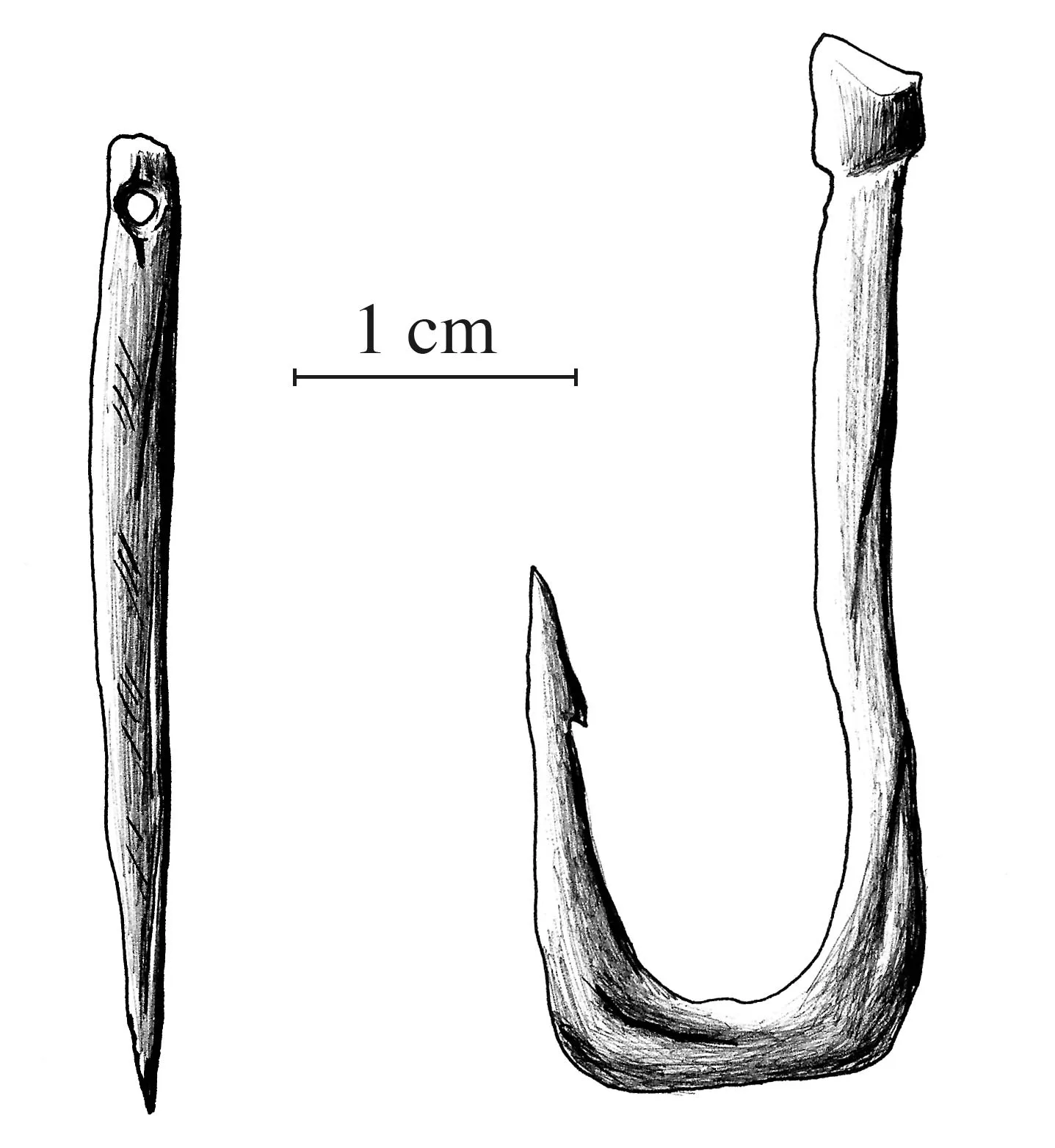
After the Ice Age, in the Mesolithic of northern Europe from about 9000 BC, bone and antler hooks become common. They are carved, not ground: a piece of long bone or antler tine is cut to a rough U or J, then scraped and polished to a hook with a shank, a bend and a point, sometimes with a barb and sometimes with a notch or a knob at the top of the shank to hold the line. The finest examples, from the Danish and Baltic bog sites and from Poland and Russia, are as elegant as anything made since.

What strikes a modern collector about these is how familiar the shapes are. The Radusz hook above has a long shank, an open round bend and a point that turns slightly in, which is the profile of a Carlisle or a Kendal round bend. Others have short shanks and tight bends. The variation is not random; it tracks the fish being caught, exactly as it does in a modern catalogue. Composite hooks, with a separate bone or thorn point lashed to a wooden or bone shank, appear in the same period and persist in the Pacific and the American north-west into the twentieth century, as the site’s article on Pasifika hooks describes.
Copper and bronze
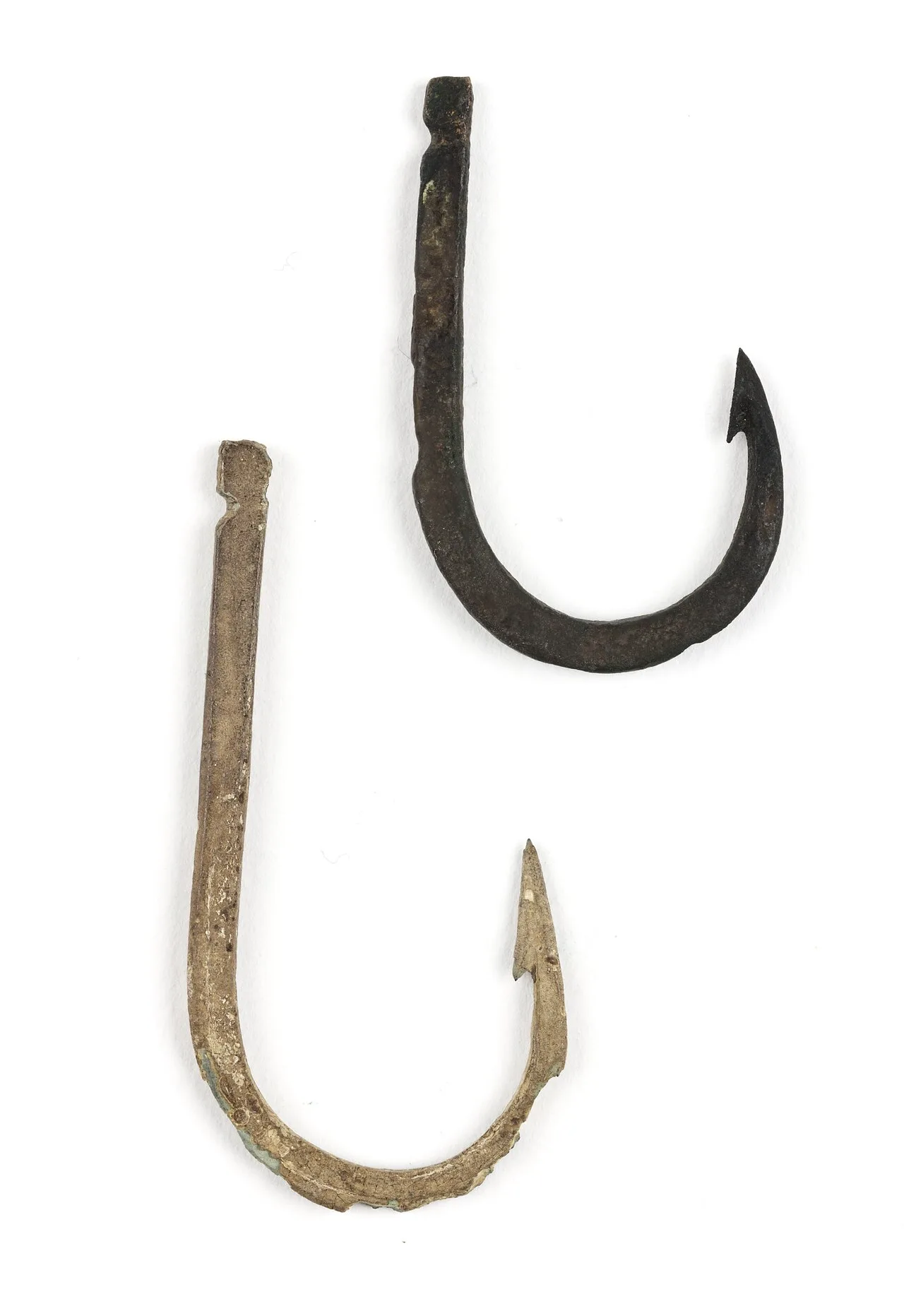
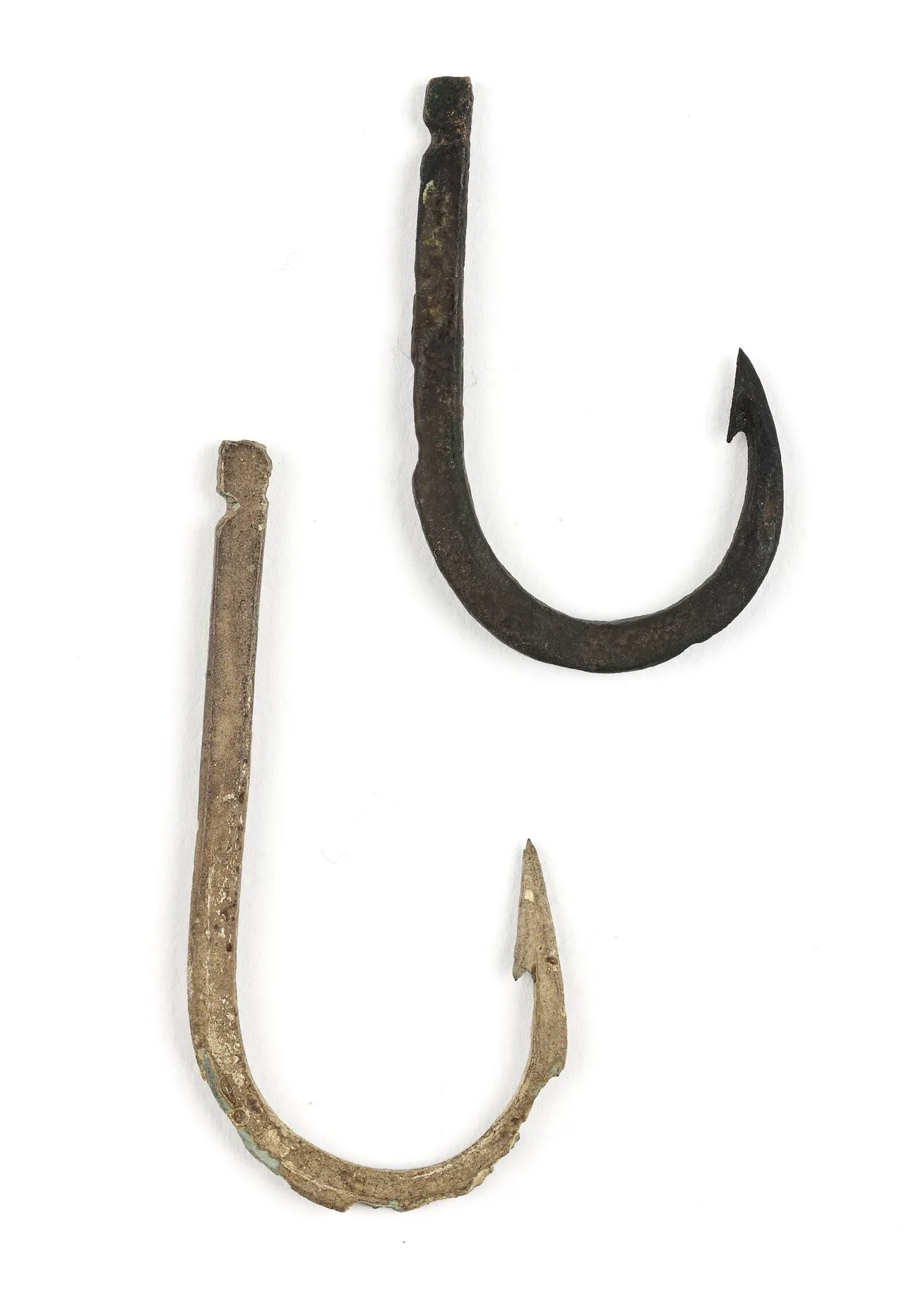
Metal hooks arrive with metallurgy, first in copper and then, from the third millennium BC, in bronze. Bronze hooks have been found in Egypt, Mesopotamia, Minoan Crete, the Iberian and Gallic Bronze Age, and in enormous numbers in China, where cast bronze hooks were made into the historical period. A cast hook is different in kind from a carved one: it comes out of a mould with its shape fixed, it can be made in quantity, and it can be barbed and eyed as part of the casting. The Chinese examples in the Hallwyl Museum, shown below, have a flattened spade end for the line and a barb cut into the point, which is the anatomy of a nineteenth-century blind-eye salmon hook.
Iron
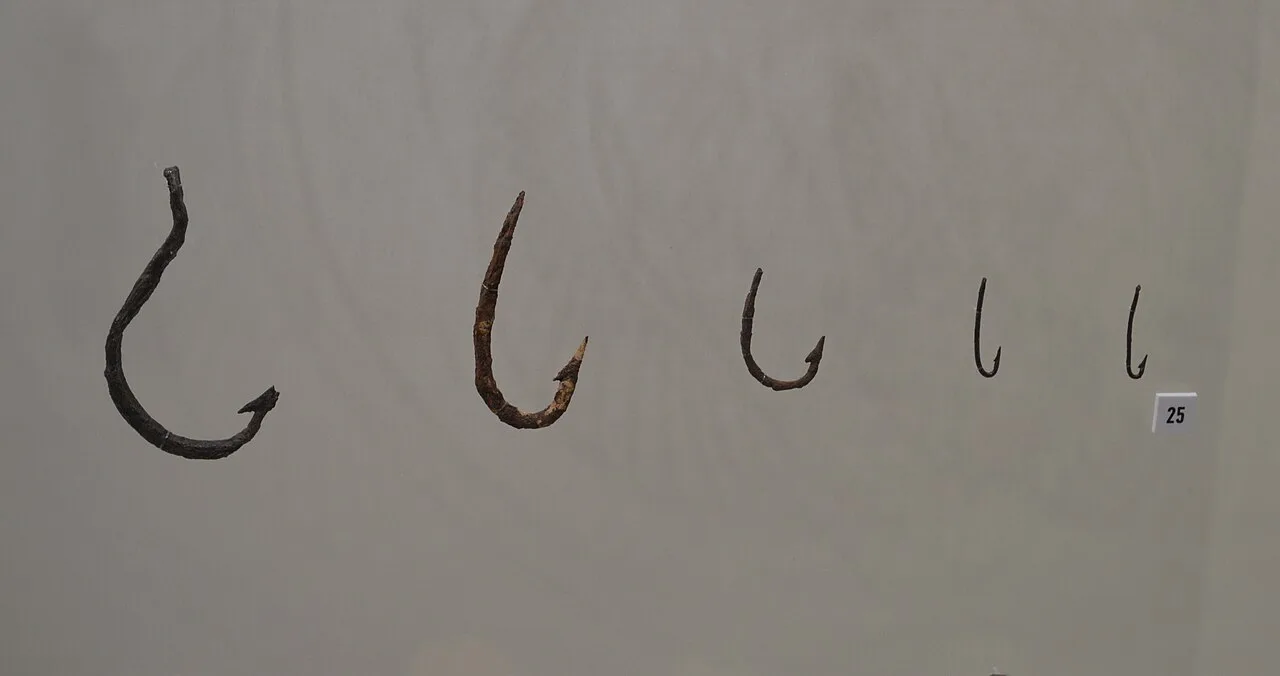
Iron hooks are forged, not cast, and forging is the technique that leads directly to the modern hook. A smith draws a rod of iron down to a wire, points it, cuts a barb with a chisel, bends it over the horn of the anvil or a former, and flattens or loops the end for the line. Roman iron hooks from across the Empire, Viking-age hooks from Scandinavia and medieval hooks from Russian and English towns are all made this way, and they are remarkably standardised. The forged hooks from the Nizhny Novgorod kremlin below, of the thirteenth to fifteenth centuries, run through a size series like a page from a catalogue.
Steel and the needle makers
The last step is from iron to hardened and tempered steel, which holds a fine point and springs back instead of bending. That is a matter of heat treatment rather than shape, and it is the contribution of the seventeenth-century London needle and hook makers, above all Charles Kirby, whose name still sits on a bend. From there the story is the one the rest of this site tells: Redditch, Kendal, Limerick, Gjøvik, and the machine.
What the archaeology tells the collector
Three things. First, the hook’s shape was solved a very long time ago; the bends in a modern catalogue are refinements of forms that were already in use in bone. Second, the vocabulary this site uses to describe an Allcock or a Mustad, shank, bend, gape, barb, spade, loop, is equally useful for a Mesolithic hook, which is one reason museum catalogues and hook catalogues read so alike. And third, a hook is an ordinary object that people have always made carefully. The Sakitari shell hooks are twenty-three thousand years old and somebody took the trouble to make them symmetrical. The bench has not changed as much as the material.
Source and further reading
Masaki Fujita et al., “Advanced maritime adaptation in the western Pacific coastal region extends back to 35,000–30,000 years before present”, PNAS 113 (2016), for the Sakitari Cave hooks. Sue O’Connor, Rintaro Ono and Chris Clarkson, “Pelagic fishing at 42,000 years before the present and the maritime skills of modern humans”, Science 334 (2011), for Jerimalai. Duhamel du Monceau, Traité général des pesches (1769), for the gorge. The Australian Museum’s Pasifika fish hook pages, discussed in an earlier post on this site.
Image note: The photographs and drawing are public domain or CC0 reproductions from Wikimedia Commons and are credited in their captions. None depicts the Sakitari or Jerimalai finds, which are held by the excavating institutions.

