

Every collector knows the Kirby bend. Very few could say who Kirby was, and the honest answer is that we know less than we would like. Charles Kirby was a London hook maker of the middle of the seventeenth century, working in the years of the Commonwealth, the Restoration, the plague and the Great Fire, and he is the first hook maker in the English-speaking world whose name survives attached to his product. That survival is owed to a book, and to a handful of lines in it. This article sets out what the sources actually say about Kirby and his trade, and separates it from the folklore that has grown up around him.
The world before Kirby
English anglers before the mid-seventeenth century made their own hooks or had them made by a local smith or needle maker. The Treatyse of Fysshynge wyth an Angle of 1496 tells the reader how: take a needle, soften it in the fire, bend it, raise the barb with a file, harden and temper it, and whip on the line. That is a recipe, not a trade. John Dennys’s Secrets of Angling (1613) speaks of “hooks of hardest steel” without saying where to buy them, and Thomas Barker, whose Art of Angling appeared in 1651, was still describing hooks as something the reader might need to make.
What Walton says
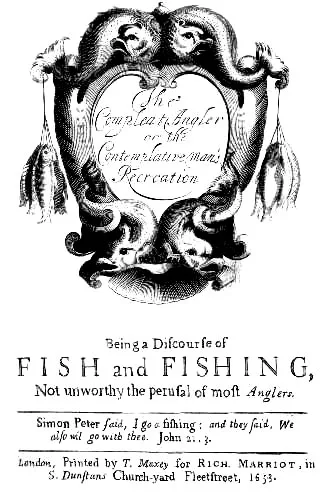
Izaak Walton published The Compleat Angler in 1653 and kept revising it until the fifth edition of 1676, and it is in the later editions that hook makers appear by name. Walton recommends that the angler buy hooks rather than make them, and directs him to Charles Kirby in Harp Alley, Shoe Lane, describing him as the most exact and best hook maker the nation affords. That is the whole of the primary evidence for Kirby’s reputation, and it has been enough to carry his name for three and a half centuries.
Shoe Lane runs north from Fleet Street, and Harp Alley was one of the courts off it, in the district of small metal trades, cutlers, needle makers and instrument makers, that clustered around the City’s western edge. Kirby was one of a number of hook makers there. Barker also speaks of Kirby, which suggests the reputation was already established when Walton wrote, and by the end of the century the London trade directories list several hook makers in the same streets. Kirby was the best-known because Walton said so, and because his hooks, by every later account, were properly hardened and tempered when many others were not.
Tempering: the real invention
The tradition, repeated in every nineteenth-century angling book, is that Kirby’s contribution was not a shape but a process. A steel hook has to be hardened by heating and quenching, which makes it brittle, and then tempered by reheating to a lower temperature, which restores toughness at the cost of some hardness. Get the temper wrong in one direction and the hook snaps; in the other and it opens on a fish. Kirby is credited with getting it consistently right, at a time when the needle makers who supplied most hooks were tempering for a needle’s job, not a hook’s.
Whether Kirby invented anything or simply did the job well is not recoverable. What is clear is that from his time onward English hooks had a reputation for temper that Irish and Continental hooks did not, and that the name “Kirby” came to stand for a reliably tempered hook of a particular round-bend, offset-point shape long before it was a formal pattern name. By 1808 the angling writer Salter gives a cut of the Kirby as a recognised pattern, and it appears in Redditch and Kendal lists throughout the nineteenth century.

The Great Fire and the Redditch legend
The best-known story about Kirby is that after the plague of 1665 and the Great Fire of 1666, which destroyed the Shoe Lane district, the London hook makers dispersed, and that some of them settled in Redditch, founding the trade there. It is a satisfying story and it may even be partly true, but there is no document behind it. Needle making was already established in the Redditch area before 1666, hooks were being made there by the late eighteenth century, and the connection between the two trades is enough to explain Redditch’s rise without a refugee from Harp Alley. The Kirby name did survive in Redditch, as a pattern and possibly as a family, but that is not the same thing.
What the Fire certainly did was end the London hook trade’s dominance. The small metal trades never fully returned to the burned district, the eighteenth-century tackle shops of London bought their hooks in, and by the time Duhamel du Monceau was engraving hook plates in Paris in the 1760s the English hook was a provincial product.
Kirby the pattern
The Kirby bend as the nineteenth century understood it is a round bend with the point set off to one side of the shank, “kirbed”, and it became the general-purpose bait hook of the British Isles and, through export, of much of the world. Whether the man made hooks of exactly that shape is unknown; no hook that can be attributed to him survives, and the earliest illustrations are a century and a half after his death. The safest statement is that “Kirby” was first a maker’s name, then a byword for quality, and finally a shape, and that the three meanings overlapped for so long that the angling writers of 1867 were not sure which they were using. Eric Taverner, writing in 1942, made exactly that point about Kirby, Limerick, Carlisle and Kinsey together.
Why he matters to a collector
Kirby is the start of the hook as a branded product. Before him, a hook was a thing you made or had made; after him, it was a thing you bought from a named maker whose reputation guaranteed it. Every packet in the reference, from Allcock’s “Standard Works” to Mustad’s “Key Brand”, descends from that idea. Walton’s sentence about Harp Alley is the first hook advertisement in the English language, and it is still working.
Source and further reading
Izaak Walton, The Compleat Angler, fifth edition (1676). Thomas Barker, The Art of Angling (1651; enlarged as Barker’s Delight, 1657). Eric Taverner, Fly Tying for Salmon (1942). Ron Reinhold, “Antique Hook Manufacturers”, on the restored Ronn Lucas Sr. site, for the Kirby, Kendal and Limerick chronology.
Image note: The portrait and title page are public domain reproductions from Wikimedia Commons and are credited in their captions.

